



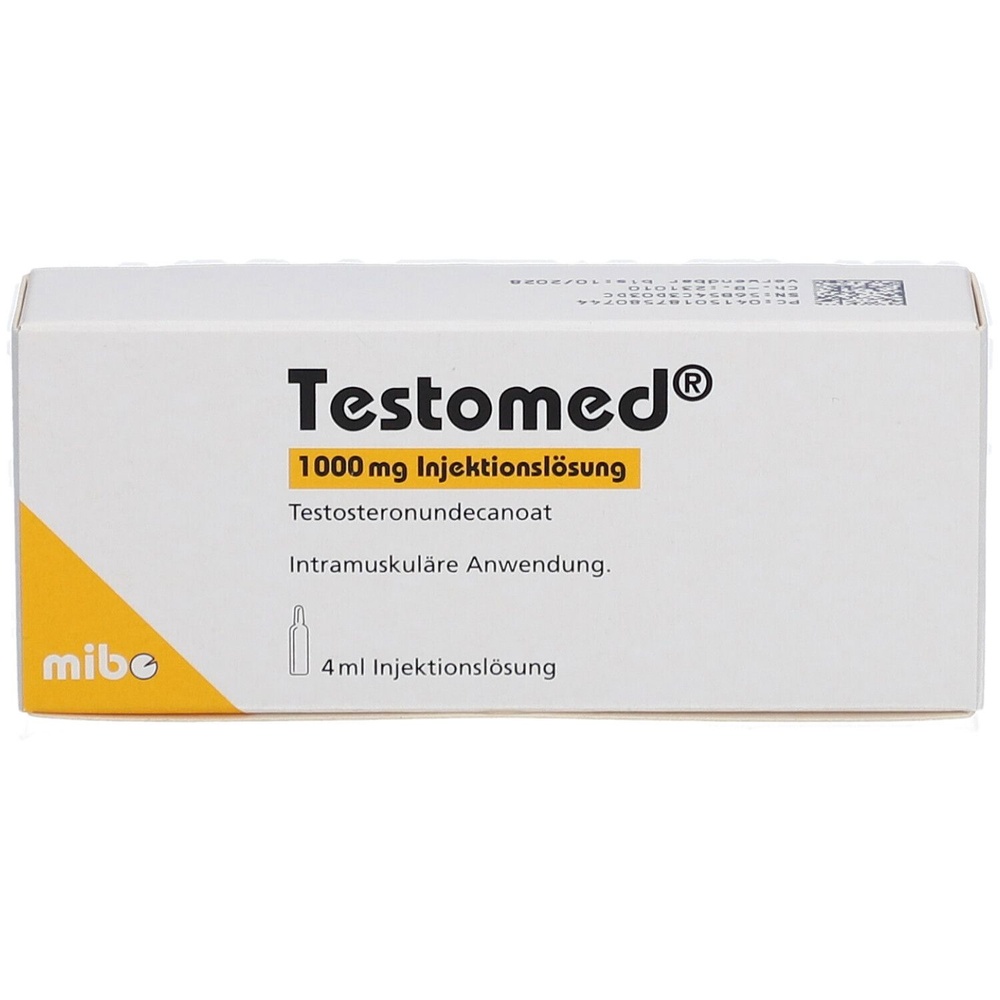
TESTOMED 1000 mg Roztwór Do Wstrzykiwań

Ocena recepty online
Lekarz przeanalizuje Twój przypadek i zdecyduje, czy wystawienie recepty jest medycznie uzasadnione.

Porozmawiaj z lekarzem o tym leku
Omów swoje objawy i opcje leczenia podczas szybkiej konsultacji online.



Jak stosować TESTOMED
Treść ulotki
TESTOMED 1000 mg injectable solution
testosterone undecanoate
Read this leaflet carefully before using this medicine as it contains important
information for you.
- Keep this leaflet. You may need to read it again.
- If you have any questions, ask your doctor, pharmacist or nurse.
- This medicine has been prescribed for you only. Do not pass it on to others, even if they have the same symptoms as you, as it may be harmful.
- If you get any side effects, even those not listed in this leaflet, tell your doctor, pharmacist or nurse. See section 4.
Contents of this leaflet
- 1. What TESTOMED is and what it is used for
- 2. What you need to know before using TESTOMED
- 3. How to use TESTOMED
- 4. Possible side effects
- 5. How to store TESTOMED
- 6. Contents of the pack and other information
1. What is TESTOMED and what is it used for
TESTOMED contains the male hormone testosterone as the active ingredient. TESTOMED is
injected into the muscle. It remains accumulated in the muscle and is released gradually over a
prolonged period of time.
TESTOMED is used for testosterone replacement therapy in adult men for the
treatment of various health problems due to testosterone deficiency (male hypogonadism).
This deficiency must be confirmed by two distinct measurements of testosterone concentrations
in the blood. Some clinical symptoms must also be present, such as:
- sexual dysfunction (impotence)
- infertility
- reduced sexual desire
- fatigue
- depressed mood
- loss of bone mass due to low hormone levels.
2. What you need to know before using TESTOMED
Do not use TESTOMED
- if you are allergic to testosterone undecanoate or any of the other ingredients of this medicine (listed in section 6).
- if you have or suspect you have cancer of the prostate or the breast, whose growth is stimulated by male sex hormones (androgens)
- if you have or have had a liver tumor
TESTOMED is not intended for use in women.
Warnings and precautions
Talk to your doctor before using TESTOMED if you suffer from or have ever suffered from the following conditions:
- epilepsy
- heart, kidney or liver disease
- migraine
- temporary interruptions of breathing during sleep (sleep apnea), as they may worsen
- cancer, because it may be necessary to regularly check the level of calcium in the blood
- high blood pressure or if you are being treated for high blood pressure, as testosterone can cause an increase in blood pressure
- alterations in blood coagulation: or bleeding disorders (i.e. hemophilia) or thrombophilia (a blood clotting disorder that increases the risk of blood clots in the veins) or factors that increase the risk of blood clots in a vein: previous blood clots in a vein; smoking; obesity; cancer; immobility; if one of your close relatives has had a blood clot in the leg, lung or other organ at a young age (e.g. under 50 years of age); or if you are elderly.
How to recognize a blood clot: painful swelling of a leg or sudden change in skin color, for example becoming pale, red or blue; sudden shortness of breath; unexplained sudden cough, which may cause blood to be coughed up; sudden chest pain, severe dizziness or lightheadedness; severe stomach pain; sudden loss of vision. Seek immediate medical attention if any of these symptoms occur.
If you suffer from severe heart, liver or kidney disease, treatment with TESTOMED may cause serious complications in the form of fluid accumulation in the body, sometimes accompanied by an accumulation of blood (congestive heart failure).
Before and during treatment, your doctor must perform the following blood tests: testosterone levels in the blood, complete blood count.
If your liver is no longer functioning properly
Formal studies have not been conducted in patients with impaired liver function. You will not be prescribed TESTOMED if you have ever suffered from a liver tumor (see section “Do not use TESTOMED”).
Medical examinations/periodic checks
Male sex hormones can promote the growth of prostate cancer and enlargement of the prostate gland (benign prostatic hyperplasia). Before injecting TESTOMED, your doctor will examine you to make sure you do not have prostate cancer.
Your doctor will perform regular checks of the prostate and breasts, especially if you are elderly. They will also perform regular blood tests.
The onset of benign (non-cancerous) and malignant (cancerous) liver tumors has been observed following the use of hormonal substances such as androgenic compounds.
Children and adolescents
This medicine is not intended for children and adolescents. No data are available in male adolescents under 18 years of age.
Elderly patients (65 years and over)
If you are over 65 years of age, your doctor will generally not change the dosage (increase in dose) (see section “Medical examinations/periodic checks”).
Effects if used improperly for doping
The use of TESTOMED may lead to positive doping control tests. Androgens, such as those contained in TESTOMED, are not suitable for improving muscle development in healthy individuals or for increasing physical capacity. The health consequences of using TESTOMED as a doping agent cannot be predicted; serious health risks cannot be ruled out.
Drug abuse and dependence
Always take the medicine exactly as your doctor or pharmacist has told you.
Abuse of testosterone, especially if you take too much of this medicine on your own or with other anabolic androgenic steroids, can cause serious health problems with the heart and blood vessels (which can lead to death), mental health and/or the liver.
Individuals who have abused testosterone may become dependent and withdrawal symptoms may occur when the dosage is changed significantly or stopped abruptly. Do not abuse this medicine on your own or with other anabolic androgenic steroids because it involves serious health risks (see also section 4. "Possible side effects".)
Other medicines and TESTOMED
Tell your doctor or pharmacist if you are taking/using, have recently taken/used or might take/use any other medicines.
Your doctor may need to adjust the dose if you are taking/using one or more of the following medicines:
- the hormone ACTH (adrenocorticotropic hormone - a specific pituitary hormone) or corticosteroids (adrenal cortex hormones used to treat various conditions such as rheumatism, arthritis, allergic conditions and asthma): TESTOMED may increase the risk of fluid accumulation in the tissues, especially if you suffer from heart or liver disease
- tablets to thin the blood (oral coumarin-derived anticoagulants) as this may increase the risk of bleeding. The doctor will check the dosage.
- Medicines used to treat diabetes. It may be necessary to adjust the dose of your medicine to lower blood sugar. Like other androgens, testosterone can increase the effect of insulin
Please make sure to inform your doctor if you have a blood clotting disorder, because it is important that the doctor knows this before deciding to inject TESTOMED.
TESTOMED can also affect the results of certain laboratory tests (e.g. those for thyroid function). Inform your doctor or laboratory personnel that you are using TESTOMED.
Pregnancy, breastfeeding and fertility
Pregnancy and breastfeeding
TESTOMED is not intended for use in women and therefore should not be used during pregnancy or while breastfeeding.
Fertility
Treatment with high doses of testosterone preparations usually can block or reversibly reduce sperm production (see also section “Possible undesirable effects”).
Driving and using machines
TESTOMED does not alter or negligibly alters the ability to drive vehicles and use machinery.
TESTOMED contains benzyl benzoate
This medicine contains 2000 mg of benzyl benzoate in each vial (4 mL), corresponding to 500 mg of benzyl benzoate/mL.
3. How to use TESTOMED
The doctor will inject TESTOMED very slowly into a muscle. The injections will be given every
10-14 weeks. This frequency allows maintaining sufficient testosterone levels without
leading to an accumulation of testosterone in the blood.
TESTOMED must be strictly administered by intramuscular injection. Particular
attention will be paid to avoiding injecting the medicine into a blood vessel (see the paragraph
“The following information is intended exclusively for healthcare professionals” under the paragraph
“Administration” at the end of this leaflet).
The solution for intramuscular injection must be visually inspected before use. Only clear solutions free of particles must
be used.
Start of treatment
Before starting treatment and in its early stages, the doctor will measure your testosterone levels in
the blood. The doctor may give you the second injection after only 6 weeks in order to quickly reach
the necessary testosterone level. This will depend on the signs of illness (symptoms) and on
how high your testosterone levels are.
Maintaining your testosterone levels during treatment
The interval between injections must always remain between 10 and 14 weeks, as
recommended.
Your doctor will regularly measure your testosterone levels at the end of an interval between
one injection and the next to ensure they are correct. If the values are too low, the doctor may
give injections more frequently. If the values are high, the doctor may give injections less
frequently. Do not miss your injection appointments. Otherwise it will not be possible to maintain
optimal testosterone levels.
If you think that the effect of TESTOMED is too strong or too weak, talk to your doctor or
pharmacist.
If you use more TESTOMED than you should
Symptoms of having too much TESTOMED include:
- irritability
- nervousness
- weight gain
- prolonged or frequent erections.
Tell your doctor if you experience any of these symptoms. The doctor will inject TESTOMED less
often or stop the treatment.
4. Possible side effects
Like all medicines, this medicine can cause side effects, although not everyone will experience them.
The most common side effects are acne and pain at the injection site.
Common (may affect up to 1 in 10 people):
Abnormally high levels of red blood cells; weight gain; hot flushes; acne; enlarged prostate (benign prostatic hyperplasia) and associated disorders, increased value of a specific blood test for the prostate (PSA); various reactions at the injection site
(e.g. pain, bruising or irritation).
Uncommon (may affect up to 1 in 100 people):
Allergic reactions; increased red blood cells and increased hemoglobin (Hb) in the blood, increased
appetite, changes in some blood tests (e.g. increased sugars and fats in the
blood); depression, emotional disorders, insomnia, restlessness, aggression and irritability; headache,
migraine and tremor; disturbances of the cardiovascular system, high blood pressure, dizziness;
bronchitis, inflamed sinuses (sinusitis), cough, shortness of breath, snoring, hoarseness; diarrhea,
nausea; changes in liver function blood tests; hair loss, various skin reactions (e.g. itching, redness or dry skin); joint pain, pain in the extremities, muscle problems (e.g. muscle spasms, muscle pain or stiffness); increased creatine phosphokinase in the
blood (an enzyme that provides energy, e.g. for muscle contraction); urinary tract disorders (e.g. decreased urine flow, urinary retention, need to urinate at night);
disorders affecting the prostate (e.g. prostatic dysplasia [a precursor to prostate cancer],
hardening and inflammation of the prostate), changes in sexual desire, testicular pain,
pain, hardening or enlargement of the breasts, increased levels of male or female sex hormones in the blood; fatigue, general feeling of weakness, excessive sweating
and night sweats.
Rare (may affect up to 1 in 1000 people):
TESTOMED, which is an oily liquid, can reach the lungs (oily microembolism of the
lungs) leading in rare cases to signs and symptoms such as cough, shortness of breath, general malaise,
excessive sweating, chest pain, dizziness, tingling or fainting. These reactions can
occur during or immediately after the injection and are reversible.
Cases of suspected hypersensitivity reactions (anaphylactic reactions) have been reported after injection of testosterone undecanoate.
In addition to the side effects listed above, the following side effects have been reported following treatment with preparations containing
testosterone: nervousness, hostility, brief interruptions
of breathing during sleep, various skin reactions including dandruff and oily skin, increased hair growth,
more frequent erections and very rare cases of yellowing of the skin and eyes (jaundice).
Generally, treatment with testosterone-based preparations at high doses stops or reduces
sperm production. This change returns to normal after discontinuation of treatment.
Testosterone replacement therapy for reduced testicular function (hypogonadism) may cause
rarely persistent and painful erections (priapism). The administration of testosterone at high doses
or for prolonged periods may occasionally lead to more frequent manifestations of fluid retention
and edema (swelling due to fluid retention).
Through periodic blood tests, an increased risk of red blood cell count, hematocrit (percentage of red blood cells in the blood) and hemoglobin (the component of
red blood cells that carries oxygen) has been observed, common to testosterone-containing products in general.
Reporting of side effects
If you experience any side effects, including those not listed in this leaflet, please inform
your doctor, pharmacist or nurse. You can also report side effects directly
through the national reporting system at
https://www.aifa.gov.it/content/segnalazioni-reazioni-avverse
By reporting side effects you can help provide more information on the safety of
this medicine.
5. How to store TESTOMED
Keep this medicine out of the sight and reach of children.
Do not use this medicine after the expiry date which is stated on the package and the vial after Exp.
The expiry date refers to the last day of that month.
This medicine does not require any particular storage conditions.
Under low-temperature storage conditions, the properties of this oil-based solution
may temporarily change (e.g. increased viscosity, turbidity). If stored at low
temperature, the product must be brought to room or body temperature before use.
The contents of the vial must be administered immediately after opening the vial. This
medicine is for single use only. Any unused solution must be discarded.
Do not dispose of any medicine in wastewater. Ask your pharmacist how to dispose of medicines that
you no longer use. This will help protect the environment.
6. Package contents and other information
What TESTOMED contains
- The active ingredient is: testosterone undecanoate. 1 mL of injectable solution contains 250 mg of testosterone undecanoate, corresponding to 157.9 mg of testosterone. 1 vial of 4 mL of injectable solution contains 1000 mg of testosterone undecanoate, corresponding to 631.5 mg of testosterone.
- The other ingredients are: benzyl benzoate and refined castor oil
Description of the appearance of TESTOMED and contents of the pack
TESTOMED is a clear, oily solution, from colorless to slightly yellowish.
Contents of the pack:
One amber glass vial with 4 mL of injectable solution.
Marketing authorisation holder and manufacturer
mibe pharma Italia S.r.l.
via Leonardo da Vinci 20/B
39100 Bolzano
<------------------------------------------------------------------------------------------------------------------------>
The following information is intended exclusively for healthcare professionals:
Administration
Take particular care to avoid intravascular injection.
Like all oily solutions, TESTOMED must be injected strictly
intramuscularly and very slowly (over more than 2 minutes). It must not be injected in any case into the
upper arm or thigh. The preferred site for intramuscular injection is the middle gluteal muscle in the upper outer quadrant of the gluteal region.
The formation of oily microemboli can, in rare cases, lead to signs and
symptoms such as cough, dyspnea, malaise, hyperhidrosis, chest pain, dizziness, paresthesia or syncope.
These reactions can occur during or immediately after the injection and are reversible. Treatment is usually supportive, e.g. administration of supplemental oxygen.
Cases of suspected hypersensitivity reaction (anaphylactic reaction) have been reported after injection
of testosterone undecanoate.
Warnings
Patients taking testosterone therapy must be subjected to careful and regular monitoring of the prostate gland and breasts, according to recommended methods (digital rectal examination and serum PSA determination) at least once a year and twice a year in
elderly patients and patients at risk (those with clinical or family risk factors).
In patients undergoing long-term androgen therapy, in addition to laboratory tests relating to
testosterone concentration, the following laboratory parameters must also be monitored
at regular intervals: hemoglobin, hematocrit, liver function parameters and lipid profile.
In patients with severe heart, liver or kidney failure or with ischemic heart disease, treatment with testosterone may induce serious complications, characterized by edema with or without
congestive heart failure. In such cases, treatment should be discontinued immediately.

Nie jesteś pewien, czy ten lek jest odpowiedni dla ciebie?
Omów swoje objawy i leczenie z lekarzem online.

Zacząłeś przyjmować lek i masz pytania?
Omów swoje objawy i leczenie z lekarzem online.
- Kraj rejestracji
- Postać farmaceutycznaInjectable solution, 1000 MG
- Kod ATCG03BA03
- Substancja czynna
- Wymaga receptyTak
- Producent
- Te treści mają charakter wyłącznie informacyjny i nie zastępują konsultacji lekarskiej.
- Zamienniki TESTOMEDPostać farmaceutyczna: Injectable solution, 1000 MG/4 MLSubstancja czynna: testosteroneProducent: GRUNENTHAL ITALIA S.R.L.Wymaga receptyPostać farmaceutyczna: Injectable solution, 250 MG/MLSubstancja czynna: testosteroneProducent: ASPEN PHARMA TRADING LIMITEDWymaga receptyPostać farmaceutyczna: Transdermal gel, 20 MG/GSubstancja czynna: testosteroneProducent: THE SIMPLE PHARMA COMPANY LIMITEDWymaga recepty
Odpowiedniki TESTOMED w innych krajach
Leki z tą samą substancją czynną dostępne w innych krajach.
Odpowiednik TESTOMED w Hiszpania
Odpowiednik TESTOMED w Polska
Odpowiednik TESTOMED w Ukraina
Lekarze online w sprawie TESTOMED
Omów stosowanie TESTOMED, bezpieczeństwo i ocenę zasadności recepty zgodnie z obowiązującymi przepisami.


Uzyskaj receptę na TESTOMED online
Wypełnij 2-minutowy formularz
Opisz swoje objawy, historię choroby i lek, o który prosisz.
Wybierz lekarza lub pozwól nam przydzielić
Wybierz specjalistę lub dopasujemy Cię do najbliższego dostępnego lekarza.
Lekarz analizuje Twój przypadek
Zazwyczaj w ciągu 30 minut. Może zadawać dodatkowe pytania przez czat.
Odbierz w dowolnej aptece
Recepta elektroniczna wysłana na Twój e-mail — ważna w całej Polsce.
Często zadawane pytania
TESTOMED wymaga recepty w Włochy. Możesz skonsultować się z lekarzem online, aby sprawdzić, czy ten lek może być odpowiedni w Twojej sytuacji.
Substancją czynną w TESTOMED jest testosterone. Informacja ta pomaga rozpoznać leki o tym samym składzie, ale pod różnymi nazwami handlowymi.
TESTOMED jest produkowany przez MIBE PHARMA ITALIA S.R.L.. Nazwy handlowe i opakowania mogą się różnić w zależności od dystrybutora.
Lekarze, tacy jak Lekarze rodzinni, Psychiatrzy, Dermatolodzy, Kardiolodzy, Endokrynolodzy, Gastroenterolodzy, Pulmonolodzy, Nefrolodzy, Reumatolodzy, Hematolodzy, Zakaźnicy, Alergolodzy, Geriatrzy, Pediatrzy, Onkolodzy, mogą ocenić, czy stosowanie TESTOMED jest odpowiednie w Twoim przypadku, w zależności od sytuacji klinicznej i lokalnych przepisów. Możesz umówić konsultację online, aby omówić objawy i możliwe dalsze kroki.
Polska posiada dobrze rozwiniętą infrastrukturę ochrony zdrowia w dużych miastach, takich jak Warszawa, Kraków, Wrocław i Gdańsk. Apteki są łatwo dostępne i działają zgodnie z obowiązującymi przepisami, zapewniając dostęp do leków na receptę.
Możesz kupić TESTOMED w Warszawie, Krakowie, Wrocławiu lub Gdańsku w każdej aptece, posiadając ważną receptę.
Aby uzyskać receptę, możesz skorzystać z Oladoctor:
Inne leki zawierające tę samą substancję czynną (testosterone) to m.in. NEBID, SUSTANON, TESTAVAN. Mogą one różnić się nazwą handlową lub postacią, ale zawierają ten sam składnik terapeutyczny. Przed zmianą lub rozpoczęciem nowego leku skonsultuj się z lekarzem.
