



SEVENDOC 1 mg/5 mg Krople Do Oczu, Roztwór

Ocena recepty online
Lekarz przeanalizuje Twój przypadek i zdecyduje, czy wystawienie recepty jest medycznie uzasadnione.

Porozmawiaj z lekarzem o tym leku
Omów swoje objawy i opcje leczenia podczas szybkiej konsultacji online.



Jak stosować SEVENDOK
Treść ulotki
SEVENDOC 1 mg/ml + 5 mg/ml
eye drops, solution
desametasone / levofloxacin
Read this leaflet carefully before you start using this medicine, as it contains important
information for you.
- Keep this leaflet. You may need to read it again.
- If you have any questions, ask your doctor or pharmacist.
- This medicine has been prescribed for you only. Do not pass it on to others, even if their symptoms are the same as yours, as it could be harmful.
- If you get any side effects, even those not listed in this leaflet, tell your doctor or pharmacist. See section 4.
Contents of this leaflet
- 1. What SEVENDOC is and what it is used for
- 2. What you need to know before you use SEVENDOC
- 3. How to use SEVENDOC
- 4. Possible side effects
- 5. How to store SEVENDOC
- 6. Contents of the pack and other information
1. What SEVENDOC is and what it is used for
What type of medicine it is and how it works
SEVENDOC is an eye drop, solution containing levofloxacin and dexamethasone.
Levofloxacin is an antibiotic belonging to the class of fluoroquinolones (also called, for
brevity, quinolones). This antibiotic works by killing certain types of bacteria that can cause
infections.
Dexamethasone is a corticosteroid that exerts an anti-inflammatory action (stops symptoms such as
pain, heat, swelling and redness).
What this medicine is used for
SEVENDOC is used to prevent and treat inflammation and to prevent possible infections
of the eye after cataract surgery.
2. What you need to know before using SEVENDOC
Do not use SEVENDOC:
- if you are allergic to levofloxacin (or other quinolones) or to desamethasone (or other corticosteroids) or to any of the other ingredients of this medicine (listed in section 6).
- if you have an eye infection that you are not treating with medicines, including viral infections (e.g. herpes simplex, keratitis or varicella), infections caused by fungi and tuberculosis of the eye. Your eye may have an infection if it has a sticky discharge or if it is red and has not been examined by a doctor.
Warnings and precautions
Talk to your doctor before using SEVENDOC:
- If you are using other antibiotics, including oral antibiotics. As with other anti-infectives, prolonged use can induce antibiotic resistance and lead to excessive growth of pathogenic microorganisms.
- If you suffer from high eye pressure, or have suffered from it in the past after using a steroid medicine for the eyes. If you use SEVENDOC, this problem may recur. If you suffer from high eye pressure, inform your doctor
- If you have glaucoma
- If you have vision disorders or blurred vision
- If you are using NSAIDs (Non-Steroidal Anti-Inflammatory Drugs) read the paragraph “Other medicines and SEVENDOC.”
- If you have disorders that cause thinning of the tissues of the eye, as prolonged treatment with steroids can cause further thinning and eventual perforation.
- If you have diabetes.
Important information if you wear contact lenses
After cataract surgery you should not wear contact lenses for the entire duration of the
therapy with SEVENDOC.
Children and adolescents
SEVENDOC is not recommended in children and adolescents under 18 years of age due to
lack of safety and efficacy data in this age group.
Other medicines andSEVENDOC
Tell your doctor or pharmacist
- if you are taking, have recently taken or might take any other medicines, including those available without a prescription.
- if you were already using any other type of eye drops or eye ointment before using SEVENDOC (see section 3 - How to use SEVENDOC)
- if you are using NSAIDs for the eyes (used to counteract pain and inflammation), such as ketorolac, diclofenac, bromfenac and nepafenac. The simultaneous use of NSAIDs and steroids for the eyes can increase the risk of eye healing problems.
- if you are taking ritonavir or cobicistat (used in the treatment of HIV), as they may increase the level of desamethasone in the blood
- if you are taking probenecid (to treat gout), cimetidine (to treat stomach ulcers) and cyclosporine (to prevent transplant rejection), as they may alter the absorption and metabolism of levofloxacin.
Pregnancy and breastfeeding
If you are pregnant, suspect you are pregnant or are planning a pregnancy, or if you are breastfeeding
with breast milk, ask your doctor or pharmacist for advice before using this medicine.
SEVENDOC should not be used during pregnancy or breastfeeding.
Driving and operating machinery
After using this medicine you may experience temporary blurred vision, if this
happens do not drive or operate machinery until the problem disappears.
SEVENDOC contains phosphate buffer
This medicine contains 4.01 mg of phosphates per ml, corresponding to 0.12 mg per drop. If you have a
severe damage to the outermost transparent layer of the eye (the cornea), phosphates may cause, in rare
cases, opaque spots on the cornea due to calcium accumulation during treatment.
Tell your doctor who may advise you on a phosphate-free treatment.
SEVENDOC contains benzalkonium chloride
This medicine contains 0.05 mg of benzalkonium chloride per ml, corresponding to 0.0015 mg per
drop.
Benzalkonium chloride can also cause eye irritation, especially if you have dry eyes or
corneal disorders (the most superficial transparent layer of the eye). If you experience an
abnormal sensation in the eye, burning or pain after using this medicine, talk to your doctor.
3. How to use SEVENDOC
Use this medicine following the instructions of your doctor or pharmacist exactly. If you have
any doubts, consult your doctor or pharmacist.
The recommended dose is 1 drop in the affected eye every 6 hours. The maximum dose is 4 drops
per day. The treatment cycle with SEVENDOC is usually 7 days, followed, if your doctor deems it
necessary, by another 7 days of treatment with a steroid eye drop.
Your doctor will indicate the duration of treatment.
If you are using other eye drops or ophthalmic ointments, you must wait at least 15 minutes between
each application. Ophthalmic ointments should be applied last.
Instructions for use:
If possible, ask another person to apply the drops for you. Ask this person to read the
instructions with you before application.
- 1) Wash your hands carefully (figure 1).
- 2) Open the bottle. Remove the safety ring that detaches from the cap upon first opening of thebottle.The dropper tip must not come into contact with the eye, the area around the eye, or your fingers.
- 3) Unscrew the cap of the bottle. Hold the bottle upside down, gripping it between your thumb and other fingers.
- 4) Lower the lower eyelid with a finger to form a “pocket” between the eyelid and the eye. The drop should be instilled in this area (figure 2).
- 5) Tilt your head back and bring the tip of the bottle close to the eye, then gently press the central part of the bottle until a drop falls into the eye (figure 3). Keep in mind that a few seconds may pass between pressing the bottle and the drop coming out. Do not press too hard.
- 6) After applying SEVENDOC, press with a finger on the inner corner of the eye near the nose. This will prevent the medicine from spreading throughout the body (figure 4).
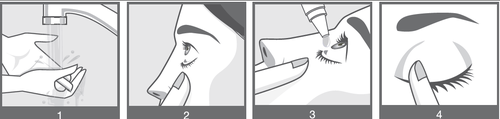
If a drop does not end up in the eye, try again. Screw the cap of the bottle back on tightly immediately after use.
If you use more SEVENDOC than you should
If you have applied an excessive amount of medicine, rinse the eye with lukewarm water.
If you forget to use SEVENDOC
If you forget to use this medicine, do not worry and apply it as soon as possible. Do not
apply a double dose to make up for the missed dose.
If you stop using SEVENDOC
If you stop treatment with this medicine prematurely, inform your doctor. If you have
any doubts about the use of this medicine, consult your doctor or pharmacist.
4. Possible side effects
Like all medicines, this medicine can cause side effects, although not everybody gets them.
These are mostly non-serious side effects that affect only the eye.
- In very rare cases, this medicine can cause serious allergic reactions (anaphylactic reactions), accompanied by swelling and a feeling of tightness in the throat and difficulty breathing.
- Stop using SEVENDOC and contact your doctor immediately if any of these symptoms occur.
- Taking fluoroquinolones orally or intravenously can cause swelling and rupture of tendons, particularly in elderly subjects and those treated simultaneously with corticosteroids. Stop using SEVENDOC if you experience tendon pain or swelling (tendonitis).
One or more of the following effects affecting one or both eyes may also occur:
Very common(may affect more than 1 in 10 people):
- increased eye pressure.
Common(may affect up to 1 in 10 people):
- discomfort, stinging or irritating pain, burning, itching in the eye,
- blurred or decreased vision,
- presence of mucus in the eye. Uncommon(may affect up to 1 in 100 people):
- delayed healing of corneal wounds
- eye infections
- abnormal sensation in the eye
- increased tearing
- dry and tired eye
- eye pain
- brighter vision
- swelling or redness (bloodshot eyes) of the outer coating of the eye (conjunctiva)
- swelling or redness of the eyelid
- sensitivity to light
- sticky eyelids. Very rare(may affect up to 1 in 10,000 people):
- pupil dilation
- drooping eyelids
- calcium deposit on the surface of the eye (corneal calcification)
- tearing and a gritty feeling in the eye (crystalline keratopathy)
- change in the thickness of the superficial layer of the eye
- ulcer on the surface of the eye
- small holes on the surface of the eye (corneal perforation)
- swelling of the surface of the eye (corneal edema)
- inflammation of the eye causing pain and redness (uveitis).
Effects affecting other areas of the body may also occur:
Uncommon(may affect up to 1 in 100 people):
- headache
- altered taste
- itching
- stuffy or runny nose.
Rare(may affect up to 1 in 1,000 people):
- allergic reactions such as skin rash. Very rare(may affect up to 1 in 10,000 people):
- swelling of the face.
Not known
- decreased function of the adrenal gland, which may manifest as low blood sugar, dehydration, weight loss and confusion.
- Hormonal problems: increased hair growth on the body (especially in women), weakness and muscle atrophy, purple stretch marks on the skin of the body, increased blood pressure, irregular or absent periods, changes in protein and calcium levels in the body, delayed growth in children and adolescents, and swelling and weight gain of the body and face (called “Cushing’s syndrome”)
Reporting of side effects
If you get any side effects, talk to your doctor or pharmacist. This includes any possible side effects not listed in this leaflet. You can also report side effects directly through the national reporting system at: www.aifa.gov.it/content/segnalazioni-reazioni-avverse .
By reporting side effects you can help provide more information on the safety of this medicine.
5. How to store SEVENDOC
Keep this medicine out of the sight and reach of children.
Do not use this medicine after the expiry date which is stated on the label of the bottle and on the
pack after “Exp.”. The expiry date refers to the last day of that month.
Do not use this medicine if, before opening a new bottle, you notice that the plastic film that
surrounds the cap and neck of the bottle is damaged or absent.
Keep the bottle tightly closed. To avoid infections, 28 days after first opening, you must
discard the bottle and use a new one.
This medicine does not require particular precautions for storage.
Do not dispose of any medicine in wastewater or household waste. Ask your pharmacist how to
dispose of medicines you no longer use. This will help protect the environment.
6. Contents of the pack and other information
What SEVENDOC contains
- The active ingredients are levofloxacin, as hemihydrate, and dexamethasone, as sodium phosphate. Each millilitre of solution contains 5 mg of levofloxacin and 1 mg of dexamethasone.
- The other ingredients are: disodium hydrogen phosphate monohydrate, disodium phosphate dodecahydrate, sodium citrate, benzalkonium chloride, sodium hydroxide-hydrochloric acid (for pH adjustment), water for injections.
Description of the appearance of SEVENDOC and contents of the pack
SEVENDOC is a clear solution, with a light yellowish-green colour, practically free of
particles, even if the drop dispensed appears transparent and colourless. It is supplied in a pack
containing a 5 ml plastic bottle with a white dropper. The plastic bottle is closed with a
screw cap.
Marketing Authorisation Holder and Manufacturer:
Marketing Authorisation Holder
DOC Generici S.r.l.
Via Turati 40
20121 Milano
Italy
Manufacturer
Tubilux Pharma S.p.A.
Via Costarica, 20/22,
00040 Pomezia (Roma)
Italy
This medicinal product is authorised in the Member States of the European Economic Area under the
following denominations:
| Germany, Italy. | SEVENDOC 1 mg/ml + 5 mg/ml |

Nie jesteś pewien, czy ten lek jest odpowiedni dla ciebie?
Omów swoje objawy i leczenie z lekarzem online.

Zacząłeś przyjmować lek i masz pytania?
Omów swoje objawy i leczenie z lekarzem online.
- Kraj rejestracji
- Postać farmaceutycznaEye drops, solution, 1 MG/ML + 5 MG/ML
- Kod ATCS01CA01
- Substancja czynna
- Wymaga receptyTak
- Producent
- Te treści mają charakter wyłącznie informacyjny i nie zastępują konsultacji lekarskiej.
- Zamienniki SEVENDOKPostać farmaceutyczna: Eye drops, suspension, 0.2% + 0.5%Substancja czynna: dexamethasone and antiinfectivesProducent: BAUSCH & LOMB-IOM S.P.A.Bez receptyPostać farmaceutyczna: Eye drops, suspension, 3 mg/ml + 1 mg/mlSubstancja czynna: dexamethasone and antiinfectivesProducent: BRUSCHETTINI S.R.L.Bez receptyPostać farmaceutyczna: Eye drops, solution, <3 mg/ml + 1 mg/mlSubstancja czynna: dexamethasone and antiinfectivesProducent: FIDIA FARMACEUTICI S.P.A.Wymaga recepty
Odpowiedniki SEVENDOK w innych krajach
Leki z tą samą substancją czynną dostępne w innych krajach.
Odpowiednik SEVENDOK w Polska
Odpowiednik SEVENDOK w Ukraina
Odpowiednik SEVENDOK w Hiszpania
Lekarze online w sprawie SEVENDOK
Omów stosowanie SEVENDOK, bezpieczeństwo i ocenę zasadności recepty zgodnie z obowiązującymi przepisami.









Uzyskaj receptę na SEVENDOK online
Wypełnij 2-minutowy formularz
Opisz swoje objawy, historię choroby i lek, o który prosisz.
Wybierz lekarza lub pozwól nam przydzielić
Wybierz specjalistę lub dopasujemy Cię do najbliższego dostępnego lekarza.
Lekarz analizuje Twój przypadek
Zazwyczaj w ciągu 30 minut. Może zadawać dodatkowe pytania przez czat.
Odbierz w dowolnej aptece
Recepta elektroniczna wysłana na Twój e-mail — ważna w całej Polsce.
Często zadawane pytania
SEVENDOK wymaga recepty w Włochy. Możesz skonsultować się z lekarzem online, aby sprawdzić, czy ten lek może być odpowiedni w Twojej sytuacji.
Substancją czynną w SEVENDOK jest dexamethasone and antiinfectives. Informacja ta pomaga rozpoznać leki o tym samym składzie, ale pod różnymi nazwami handlowymi.
SEVENDOK jest produkowany przez DOC GENERICI SRL. Nazwy handlowe i opakowania mogą się różnić w zależności od dystrybutora.
Lekarze, tacy jak Lekarze rodzinni, Psychiatrzy, Dermatolodzy, Kardiolodzy, Endokrynolodzy, Gastroenterolodzy, Pulmonolodzy, Nefrolodzy, Reumatolodzy, Hematolodzy, Zakaźnicy, Alergolodzy, Geriatrzy, Pediatrzy, Onkolodzy, mogą ocenić, czy stosowanie SEVENDOK jest odpowiednie w Twoim przypadku, w zależności od sytuacji klinicznej i lokalnych przepisów. Możesz umówić konsultację online, aby omówić objawy i możliwe dalsze kroki.
Polska posiada dobrze rozwiniętą infrastrukturę ochrony zdrowia w dużych miastach, takich jak Warszawa, Kraków, Wrocław i Gdańsk. Apteki są łatwo dostępne i działają zgodnie z obowiązującymi przepisami, zapewniając dostęp do leków na receptę.
Możesz kupić SEVENDOK w Warszawie, Krakowie, Wrocławiu lub Gdańsku w każdej aptece, posiadając ważną receptę.
Aby uzyskać receptę, możesz skorzystać z Oladoctor:
Inne leki zawierające tę samą substancję czynną (dexamethasone and antiinfectives) to m.in. KLORADEX, KOMBISTILL, KOMBITIMOR. Mogą one różnić się nazwą handlową lub postacią, ale zawierają ten sam składnik terapeutyczny. Przed zmianą lub rozpoczęciem nowego leku skonsultuj się z lekarzem.
