



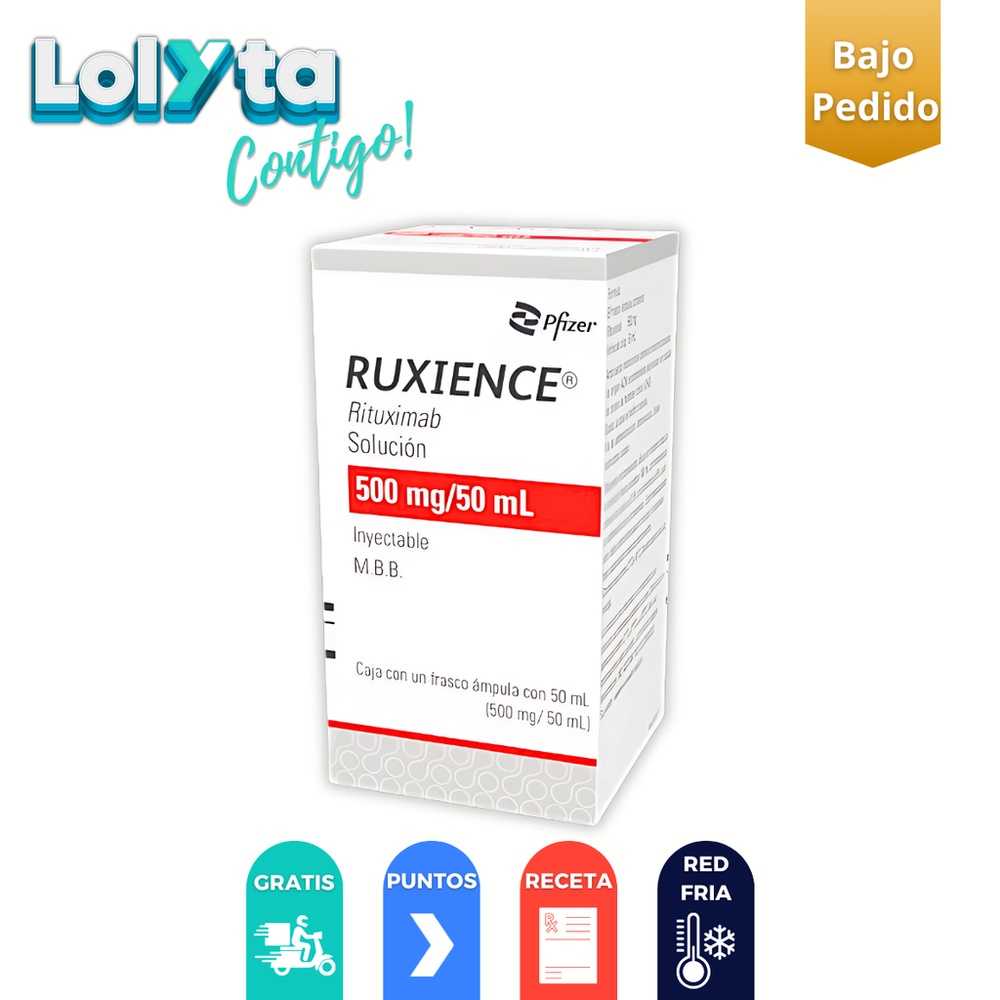
RUXIENCE 100 mg Koncentrat Do Sporządzania Roztworu Do Infuzji

Ocena recepty online
Lekarz przeanalizuje Twój przypadek i zdecyduje, czy wystawienie recepty jest medycznie uzasadnione.

Porozmawiaj z lekarzem o tym leku
Omów swoje objawy i opcje leczenia podczas szybkiej konsultacji online.



Jak stosować RUXIENKE
Treść ulotki
- Ruxience 100 mg concentrate for solution for infusion, 500 mg concentrate for solution for infusion
- Ruxience is used to fight infections and it is necessary to wait for the infection to
- B. PACKAGE LEAFLET
Ruxience 100 mg concentrate for solution for infusion, 500 mg concentrate for solution for infusion
rituximab

Medicinal product subject to additional monitoring. This will allow the rapid identification of
new safety information. You can contribute by reporting any adverse effects
experienced during the use of this medicine. See the end of section 4 for
information on how to report adverse effects.
Read this leaflet carefully before you start using this medicine as it contains
important information for you.
- Keep this leaflet. You may need to read it again.
- If you have any questions, ask your doctor, pharmacist or nurse.
- If you get any side effects, see your doctor, pharmacist or nurse. See section 4.
Contents of this leaflet:
- 1. What Ruxience is and what it is used for
- 2. What you need to know before you use Ruxience
- 3. How Ruxience is administered
- 4. Possible side effects
- 5. How to store Ruxience
- 6. Contents of the pack and other information.
1. What is Ruxience and what is it used for
What is Ruxience
Ruxience contains the active ingredient “rituximab”, a type of protein called a “monoclonal antibody” that binds to the surface of certain white blood cells, namely B lymphocytes. When rituximab binds to the surface of these cells, it causes their death.
What is Ruxience used for
Ruxience can be used for the treatment of many and diverse conditions in adults and children. Your doctor may prescribe Ruxience for the treatment of:
a)Non-Hodgkin’s Lymphoma
Non-Hodgkin’s lymphoma is a disease of the lymphatic tissue (part of the immune system) that involves B lymphocytes, a particular type of white blood cell.
In adults, Ruxience can be given as monotherapy (alone) or with other medicines called collectively “chemotherapy”.
In adult patients where treatment proves effective, Ruxience can be used as maintenance therapy for 2 years after completion of initial treatment.
In children and adolescents, Ruxience is given in combination with “chemotherapy”.
b)Chronic Lymphocytic Leukemia
Chronic lymphocytic leukemia (CLL) is the most common form of leukemia in adults. CLL involves a particular lymphocyte, the B cell, which originates in the bone marrow and matures in the lymph nodes. Patients with CLL have too many abnormal lymphocytes, which accumulate mainly in the bone marrow and blood.
The proliferation of these abnormal B lymphocytes is the cause of the symptoms you may have. Ruxience in association with chemotherapy destroys these cells which are gradually removed from the body by biological processes.
c)Rheumatoid Arthritis
Ruxience is used for the treatment of rheumatoid arthritis. Rheumatoid arthritis is a disease that affects the joints. B lymphocytes are responsible for some of the symptoms you have. Ruxience is used to treat rheumatoid arthritis in people who have already tried other medicines, which have stopped working, have not worked well enough, or have caused undesirable effects. Ruxience is generally taken with another medicine called methotrexate.
Ruxience slows down the damage to the joints caused by rheumatoid arthritis and increases the ability to perform normal daily activities.
The best response to Ruxience has been observed in those who have a blood test positive for rheumatoid factor (RF) and/or Anti-Cyclic Citrullinated Peptide (anti-CCP). Both tests are commonly positive in rheumatoid arthritis and help in confirming the diagnosis.
d)Granulomatosis with Polyangiitis and Microscopic Polyangiitis
Ruxience is used for the treatment of adults and children aged 2 years and older with granulomatosis with polyangiitis (formerly called Wegener's disease) or microscopic polyangiitis, in combination with glucocorticoids.
Granulomatosis with polyangiitis and microscopic polyangiitis are two forms of inflammation of the blood vessels that primarily affect the lungs and kidneys, but can also affect other organs. B lymphocytes are involved in the cause of these conditions.
e)Pemphigus Vulgaris
Ruxience is used for the treatment of patients with moderate to severe pemphigus vulgaris. Pemphigus vulgaris is an autoimmune disease that causes the formation of painful blisters on the skin and mucous membranes (lining tissues) of the mouth, nose, throat and genitals.
2. What you need to know before you use Ruxience
Do not take Ruxience:
- if you are allergic to rituximab, to other proteins similar to rituximab or to any of the other ingredients of this medicine (listed in section 6);
- if you currently have a serious active infection;
- if your immune system is weak;
- if you suffer from severe heart failure or severe uncontrolled heart disease and have rheumatoid arthritis, granulomatosis with polyangiitis, microscopic polyangiitis or pemphigus vulgaris.
Do not take Ruxience if any of the above conditions apply to you. If you have any doubts, ask your
doctor, pharmacist or nurse before you are given Ruxience.
Warnings and precautions
It is important that you and your doctor record the trade name and batch number of the medicine.
Talk to your doctor, pharmacist or nurse before you are given Ruxience if:
- you have had a hepatitis infection in the past or may have it now, as in a small number of cases Ruxience may cause reactivation of hepatitis B, which in very rare cases can be fatal. Patients with a previous hepatitis B infection will be carefully monitored by the doctor to detect any signs of this infection
- you have had heart problems in the past (such as angina, palpitations or heart failure) or have had breathing problems.
If any of the above conditions apply to you (or if you have any doubts), talk to your doctor, the
pharmacist or nurse before you are given Ruxience. Your doctor may need to pay particular attention to you
during treatment with Ruxience.
Talk to your doctor also if you think you may need any vaccinations in the near future,
including vaccinations needed to travel to other countries. Some vaccines should not be
given at the same time as Ruxience or in the months following taking Ruxience. Your
doctor will assess whether you can have any vaccines before taking Ruxience.
If you have rheumatoid arthritis, granulomatosis with polyangiitis, microscopic polyangiitis or
pemphigus vulgaris talk to your doctor
- if you think you have an infection, even a mild one like a cold. The cells that are affected by
Ruxience is used to fight infections and it is necessary to wait for the infection to
heal before taking Ruxience. Also, inform your doctor if you have had numerous
infections in the past or if you suffer from severe infections;
Children and adolescents
Non-Hodgkin lymphoma
Ruxience can be used for the treatment of children and adolescents aged 6
months or older with non-Hodgkin lymphoma, specifically diffuse large B-cell lymphoma (DLBCL)
CD20 positive, Burkitt lymphoma (BL)/Burkitt leukemia (mature B-cell acute leukemia; BAL)
or Burkitt-like lymphoma (BLL).
Talk to your doctor, pharmacist or nurse before administering this medicine if
you or your child are under 18 years of age.
Granulomatosis with polyangiitis or microscopic polyangiitis
Ruxience can be used for the treatment of children and adolescents, aged 2
years or older, with granulomatosis with polyangiitis (previously called Wegener's disease) or
microscopic polyangiitis. Currently, there is not much information available regarding the use of
rituximab in children and adolescents with other diseases.
Talk to your doctor, pharmacist or nurse before administering this medicine if
you or your child are under 18 years of age.
Other medicines and Ruxience
Tell your doctor, pharmacist or nurse if you are taking, have recently taken or might
take any other medicines, including those available without a prescription and herbal medicines, as Ruxience may affect the way some medicines work and vice versa.
In particular, tell your doctor:
- if you are taking medicines for the treatment of high blood pressure. You may be asked to stop taking these medicines 12 hours before taking Ruxience, as some people experience a drop in blood pressure during the administration of Ruxience;
- if you have taken medicines in the past that affect the immune system - such as chemotherapy or immunosuppressant drugs.
If any of the above conditions apply to you (or if you have any doubts), talk to your doctor, the
pharmacist or nurse before you are given Ruxience.
Pregnancy and breastfeeding
You must tell your doctor or nurse if you are pregnant, suspect you are pregnant or are planning
a pregnancy, as Ruxience can cross the placenta and have effects on the baby.
If there is a possibility that you may become pregnant, during treatment with Ruxience and for 12 months
after the administration of the last treatment with Ruxience, you and your partner should
use an effective method of contraception.
Ruxience passes into breast milk in very small amounts. As the long-term effects on
breastfed infants are unknown, as a precaution, breastfeeding is not
recommended during treatment with Ruxience and for 6 months after treatment.
Driving and using machines
It is not known whether rituximab affects the ability to drive and use tools or machinery.
Ruxience contains sodium
This medicine contains less than 1 mmol (23 mg) of sodium per dose, i.e. essentially “sodium-free”.
3. How Ruxience is administered
Administration
Ruxience will be administered to you by a doctor or a nurse experienced in the use of this treatment.
They will carefully monitor you during the administration of the medicine in order to detect
the possible occurrence of undesirable effects.
The administration of Ruxience will always be done by intravenous drip infusion
(intravenous infusion).
Medicines administered before each infusion ofRuxience
Before the infusion of Ruxience, other medicines (premedication) will be administered to you to
prevent or reduce the occurrence of possible undesirable effects.
Quantity and frequency with which you will receive the therapy
a)If you are being treated for Non-Hodgkin's Lymphoma
- If you are administered onlyRuxience Ruxience will be administered once a week for 4 weeks. Repeated treatment cycles with Ruxience are possible.
- If you are administeredRuxience in association with chemotherapyYou will receive Ruxience on the same day you receive chemotherapy; their administration generally occurs every 3 weeks for a maximum of 8 times.
- If you respond well to treatment, Ruxience may be administered to you as maintenance therapy every 2 or 3 months for two years. Based on your response to the medicine, the doctor may modify this administration schedule.
- If you are under 18 years of age, you will be administered Ruxience with chemotherapy. You will receive Ruxience up to 6 times over a period of 3.5-5.5 months.
b)If you are being treated for Chronic Lymphocytic Leukemia
If you are being treated with Ruxience in association with chemotherapy, you will receive Ruxience infusions on
day 0 of cycle 1, then on day 1 of each cycle for a total of 6 cycles. Each cycle lasts 28
days. Chemotherapy should be administered after the Ruxience infusion. The doctor will decide
whether you should receive concomitant supportive therapy.
c)If you are being treated for Rheumatoid Arthritis
Each treatment cycle includes two distinct infusions, administered at an interval of 2
weeks from each other. Repeated treatment cycles with Ruxience are possible. Based on the signs and
symptoms of the disease, the doctor will determine when to administer you further cycles. This could
occur several months later.
d)If you are being treated for Granulomatosis with Polyangiitis or Microscopic Polyangiitis
Treatment with Ruxience includes four distinct infusions given at weekly intervals.
Corticosteroids will be administered by injection before the start of treatment with Ruxience. Oral
administration of corticosteroids may be started at any time by the doctor
to treat your condition.
If your age is 18 years or older and you respond well to treatment, Ruxience may be
administered to you as maintenance therapy. This will consist of two distinct infusions,
administered at an interval of 2 weeks from each other, followed by an infusion every 6 months for
at least 2 years. Based on your response to the medicine, the doctor may decide to extend the
treatment with Ruxience (up to a maximum duration of 5 years).
e)If you are being treated for Pemphigus Vulgaris
Each treatment cycle includes two distinct infusions, administered at an interval of 2
weeks from each other. If you respond well to treatment, Ruxience may be administered to you
as maintenance therapy at 1 year and 18 months from the initial treatment and, subsequently, if
necessary, every 6 months. Based on your response to the medicine, the doctor may modify this
administration schedule.
If you have any further questions regarding the use of this medicine, ask your doctor, pharmacist or
nurse.
4. Possible side effects
Like all medicines, this medicine can cause side effects, although not everyone will experience them.
Most side effects are mild or moderate, but in some cases they can be serious
and require treatment. Rarely, some of these reactions have been fatal.
Infusion reactions
During or within the first 24 hours of the infusion, you may develop fever, chills, and tremor. Less
frequently, some patients may experience pain at the infusion site, blister formation,
itching, nausea, fatigue, headache, difficulty breathing, increased blood
pressure, wheezing, sore throat, swelling of the tongue or throat, irritation or runny nose,
vomiting, a feeling of warmth or palpitations, heart attack, or a decrease in the number of platelets. If you
have heart disease or angina, these reactions may worsen. If you or
your child experiences any of these symptoms, immediately inform the person who is
giving you the infusion, as it may be necessary to slow down the infusion rate or
stop it. Additional treatment may be necessary, for example with an antihistamine or
paracetamol. When these symptoms resolve or improve, the infusion can be resumed. It is
less likely that these reactions will occur after the second infusion. The doctor may
decide to discontinue treatment with Ruxience if these reactions are severe.
Infections
Immediately inform your doctor if you or your child shows signs of an infection,
including:
- fever, cough, sore throat, burning when urinating, feeling weak or generally unwell
- memory loss, thinking problems, difficulty walking, or vision loss - these may be due to a very rare, life-threatening infection (Progressive Multifocal Leukoencephalopathy or PML).
- fever, headache, and stiff neck, lack of coordination (ataxia), altered personality, hallucinations, altered state of consciousness, seizures, or coma - these may be due to a serious brain infection (enteroviral meningoencephalitis), which can be fatal.
You may be more likely to develop infections during treatment with Ruxience.
These are often colds, but cases of pneumonia, urinary tract infections, and
serious viral infections have occurred. These conditions are listed below in the section “Other side
effects”.
If you are being treated for rheumatoid arthritis, granulomatosis with polyangiitis, microscopic polyangiitis, or pemphigus vulgaris, you will also find this information in the Patient Alert Card that your doctor will give you. It is important that you carry this alert card with you and
show it to family members or anyone who cares for you.
Skin reactions
Very rarely, serious skin reactions can occur, with blister formation, which
can be life-threatening. Redness, often associated with blisters, may appear on the
skin or mucous membranes, such as inside the mouth, in the genital area, or on the eyelids, and
may be accompanied by fever. Immediately inform your doctor if any of
these symptoms occur.
Other side effects
a)If you or your child is being treated for non-Hodgkin's lymphoma or chronic lymphocytic
leukemia
Very common side effects (may affect more than 1 in 10 people):
- bacterial or viral infections, bronchitis
- low number of white blood cells, with or without fever, or platelets (blood cells)
- nausea
- areas of hair loss on the scalp, chills, headache
- weakening of the immune system - due to a decrease in the amount of certain antibodies called “immunoglobulins” (IgG) in the blood that help the body fight off infections.
Common side effects (may affect up to 1 in 10 people):
- blood infections (sepsis), pneumonia, herpes zoster, cold, bronchial infection, fungal infections, infections of unknown origin, sinusitis, hepatitis B
- low number of red blood cells (anemia), low number of all blood cells
- allergic reactions (hypersensitivity)
- high blood sugar levels, weight loss, swelling of the face and body, high levels of the enzyme “LDH” in the blood, low levels of calcium in the blood
- abnormal sensations on the skin - such as numbness, tingling, prickling, burning, skin tightness, decreased sense of touch
- feeling restless, difficulty falling asleep
- marked redness on the face and other skin areas as a result of blood vessel dilation
- dizziness or anxiety
- increased tearing, problems with the tear duct, eye inflammation (conjunctivitis)
- ringing in the ears, ear pain
- heart problems - such as heart attack, irregular or accelerated heart rate
- high or low blood pressure (decreased blood pressure, especially when standing up)
- constriction of the muscles of the airways causing wheezing (bronchospasm), inflammation, irritation in the lungs, throat, or sinuses, shortness of breath, runny nose
- vomiting, diarrhea, stomach pain, irritation or ulceration of the throat and mouth, difficulty swallowing, constipation, indigestion
- eating disorders, insufficient food intake with resulting weight loss
- hives, increased sweating, night sweats
- muscle problems - such as muscle stiffness, joint or muscle pain, back and neck pain
- tumor pain
- general feeling of unwellness, restlessness, or fatigue, tremors, flu-like symptoms
- multi-organ failure.
Uncommon side effects (may affect up to 1 in 100 people):
- problems with blood clotting, decreased production of red blood cells and increased destruction of red blood cells (hemolytic and aplastic anemia), swelling or enlargement of the lymph nodes
- low mood and loss of interest or pleasure in activities, nervousness
- taste-related problems - such as altered sense of taste
- heart problems - such as decreased heart rate or chest pain (angina)
- asthma, insufficient oxygen reaching the body's organs
- stomach bloating.
Very rare side effects (may affect up to 1 in 10,000 people):
- a temporary increase in the amount of certain types of antibodies (called immunoglobulins - IgM) in the blood, chemical change in the blood due to the breakdown of dying tumor cells
- nerve damage in arms and legs, facial paralysis
- heart failure
- inflammation of blood vessels, including those causing skin symptoms
- respiratory failure
- damage to the intestinal wall (perforation)
- serious skin problems, with blister formation, potentially life-threatening. Redness, often associated with blisters, may appear on the skin or mucous membranes, such as inside the mouth, in the genital area, or on the eyelids, and may be accompanied by fever
- kidney failure
- severe vision loss
Not known (frequency cannot be estimated based on available data):
- delayed decrease in white blood cells
- decrease in the number of platelets immediately after the infusion - a reversible condition, but potentially fatal in rare cases
- hearing loss, loss of other senses
- infection/inflammation of the brain and meninges (enteroviral meningoencephalitis)
Children and adolescents with non-Hodgkin's lymphoma
In general, the side effects recorded in children and adolescents with non-Hodgkin's lymphoma
have been similar to those observed in adults with non-Hodgkin's lymphoma or chronic lymphocytic
leukemia. The most common side effects observed have been fever associated with low levels of a type
of white blood cells (neutrophils), inflammation or sores on the lining of the mouth, and allergic
reactions (hypersensitivity).
b)If you are being treated for rheumatoid arthritis
Very common side effects (may affect more than 1 in 10 people):
- infections such as pneumonia (bacterial)
- pain when urinating (urinary tract infections)
- allergic reactions that likely occur during the infusion but may occur up to 24 hours after the infusion
- changes in blood pressure, nausea, skin rashes, fever, itchy skin, stuffy or runny nose, sneezing, tremor, rapid heartbeat, and fatigue
- headache
- changes in laboratory tests required by the doctor. These include a decrease in the amount of certain specific proteins in the blood (immunoglobulins) that help protect against infections.
Common side effects (may affect up to 1 in 10 people):
- infections such as bronchial inflammation (bronchitis)
- a feeling of pain and fullness behind the nose, cheeks, and eyes (sinusitis), stomach pain, vomiting, and diarrhea, problems with breathing
- fungal foot infection (athlete's foot)
- high cholesterol levels in the blood
- abnormal sensations on the skin, such as numbness, tingling, prickling, or burning, sciatica, migraine, dizziness
- hair loss
- anxiety, depression
- indigestion, diarrhea, acid reflux, irritation and/or ulceration of the throat and mouth
- stomach, back, muscle, and/or joint pain.
Uncommon side effects (may affect up to 1 in 100 people):
- excess fluid retention in the face and body
- inflammation, irritation, and/or tension in the lungs, throat, cough
- skin reactions, including hives, itching, rashes
- allergic reactions including wheezing or shortness of breath, swelling of the face and tongue, collapse.
Very rare side effects (may affect up to 1 in 10,000 people):
- a complex of symptoms that occur within weeks of the rituximab infusion including allergic-type reactions such as skin rashes, itching, joint pain, swollen lymph nodes, and fever
- serious skin reactions with blister formation that can be life-threatening. Redness, often associated with blisters, may appear on the skin or mucous membranes, such as inside the mouth, in the genital area, or on the eyelids, and may be accompanied by fever
Not known (frequency cannot be estimated based on available data):
- serious viral infections
- infection/inflammation of the brain and meninges (enteroviral meningoencephalitis)
Other side effects rarely reported due to rituximab treatment include a
decrease in the number of white blood cells in the blood (neutrophils) that fight
infections. Some infections may be serious (please see the information
relating to Infectionswithin this section).
c)If you or your child is being treated for granulomatosis with polyangiitis or microscopic
polyangiitis
Very common side effects (may affect more than 1 in 10 people):
- infections such as lung infections, urinary tract infections (pain when urinating), colds, and herpes infections
- allergic reactions that likely occur during the infusion but may occur up to 24 hours after the infusion
- diarrhea
- cough or shortness of breath
- nosebleeds
- increased blood pressure
- joint or back pain
- muscle contractions or agitation
- feeling dizzy
- tremors (often in the hands)
- sleep disturbances (insomnia)
- swelling of the hands and ankles
Common side effects (may affect up to 1 in 10 people):
- indigestion
- constipation
- skin rashes, including acne or spots
- flushing or redness of the skin
- fever
- stuffy or runny nose
- muscle stiffness or muscle pain
- pain in the muscles or hands or feet
- low number of red blood cells (anemia)
- low number of platelets in the blood
- increased amount of potassium in the blood
- changes in heart rate or a faster heart rate than normal.
Very rare side effects (may affect up to 1 in 10,000 people):
- serious skin reactions with blister formation that can be life-threatening. Redness, often associated with blisters, may appear on the skin or mucous membranes, such as inside the mouth, in the genital area, or on the eyelids, and may be accompanied by fever
- recurrence of a previous hepatitis B infection.
Not known (frequency cannot be estimated based on available data):
- serious viral infections
- infection/inflammation of the brain and meninges (enteroviral meningoencephalitis)
Children and adolescents with granulomatosis with polyangiitis or microscopic polyangiitis
In general, undesirable effects in children and adolescents with granulomatosis with
polyangiitis or microscopic polyangiitis have been found to be similar in type to those observed in adults
with granulomatosis with polyangiitis or microscopic polyangiitis. The undesirable effects observed with
greater frequency were infections, allergic reactions and nausea.
d)If you are being treated for pemphigus vulgaris
Very common undesirable effects (may affect more than 1 in 10 people):
- allergic reactions that are likely to occur during the infusion but may occur up to 24 hours after the infusion
- headache
- infections, such as chest infections
- persistent depression
- hair loss.
Common undesirable effects (may affect up to 1 in 10 people):
- infections, such as colds, herpes infections, eye infections, oral thrush and urinary tract infections (pain during urination)
- mood disorders, such as irritability and depression
- skin conditions, such as itching, hives and benign cysts
- fatigue or dizziness
- fever
- joint or back pain
- abdominal pain
- muscle pain
- fast heartbeat compared to normal.
Not known (frequency cannot be estimated based on available data):
- severe viral infections
- infections/inflammation of the brain and meninges (enteroviral meningoencephalitis)
Ruxience can also cause changes in laboratory tests requested by your doctor.
If you are taking Ruxience in combination with other medicines, some of the undesirable effects that
occur may be due to the other drugs.
Reporting of undesirable effects
If you experience any undesirable effects, including those not listed in this leaflet, tell your doctor, pharmacist or nurse. You can also report undesirable effects
directly through the national reporting system as detailed in Annex V.
By reporting undesirable effects, you can help provide more information on the safety of
this medicine.
5. How to store Ruxience
Keep this medicine out of sight and reach of children.
Do not use this medicine after the expiry date which is stated on the pack after “Scad”. The expiry
date refers to the last day of that month.
Store in a refrigerator (2°C – 8°C). Keep the container in the outer packaging to protect it
from light.
Do not dispose of any medicine in waste water or household waste. Ask your pharmacist how
to dispose of medicines you no longer use. This will help protect the environment.
6. Package Contents and Other Information
What Ruxience contains
- The active substance of Ruxience is rituximab. The 10 mL vial contains 100 mg of rituximab (10 mg/mL). The 50 mL vial contains 500 mg of rituximab (10 mg/mL).
- The other ingredients are L-histidine, L-histidine hydrochloride monohydrate, disodium edetate, polysorbate 80, sucrose, water for injections.
Description of Ruxience and package contents
Ruxience is a solution from clear to slightly opalescent, from colorless to light brown-yellow
clear, provided as a concentrate for infusion solution [sterile concentrate].
Vial 10 mL – Pack of 1 vial
Vial 50 mL – Pack of 1 vial
Marketing Authorisation Holder
Pfizer Europe MA EEIG
Boulevard de la Plaine 17
1050 Brussels
Belgium
Manufacturer
Pfizer Manufacturing Belgium NV
Rijksweg 12
2870 Puurs-Sint-Amands
Belgium
For further information on this medicinal product, contact the local representative of the marketing
authorisation holder:
België/Belgique/Belgien
Luxembourg/Luxemburg
Pfizer NV/SA
Tél/Tel: +32 (0)2 554 62 11
Kύπρος
Pfizer Eλλάς A.E. (Cyprus Branch)
Τηλ: +357 22817690
Česká republika
Pfizer, spol. s r.o.
Tel: +420 283 004 111
Magyarország
Pfizer Kft.
Tel.: + 36 1 488 37 00
Danmark
Pfizer ApS
Tlf: +45 44 20 11 00
Malta
Vivian Corporation Ltd.
Tel: +356 21344610
Deutschland
PFIZER PHARMA GmbH
Tel: +49 (0)30 550055-51000
Nederland
Pfizer bv
Tel: +31 (0)800 63 34 636
България
Пфайзер Люксембург САРЛ,
Клон България
Teл.: +359 2 970 4333
Norge
Pfizer AS
Tlf: +47 67 52 61 00
Eesti
Pfizer Luxembourg SARL Eesti filiaal
Tel: +372 666 7500
Österreich
Pfizer Corporation Austria Ges.m.b.H.
Tel: +43 (0)1 521 15-0
Ελλάδα
Pfizer Eλλάς A.E.
Τηλ: +30 210 6785800
Polska
Pfizer Polska Sp. z o.o.
Tel.: +48 22 335 61 00
España
Pfizer, S.L.
Tel: +34 91 490 99 00
Portugal
Laboratórios Pfizer, Lda.
Tel: +351 21 423 5500
France
Pfizer
Tél: +33 (0)1 58 07 34 40
România
Pfizer Romania S.R.L.
Tel: +40 (0) 21 207 28 00
Hrvatska
Pfizer Croatia d.o.o.
Tel: +385 1 3908 777
Slovenija
Pfizer Luxembourg SARL
Pfizer, podružnica za svetovanje s področja
farmacevtske dejavnosti, Ljubljana
Tel: +386 (0)1 52 11 400
Slovenská republika
Pfizer Luxembourg SARL, organizačná zložka
Tel: + 421 2 3355 5500
Ireland
Pfizer Healthcare Ireland
Tel: +1800 633 363 (toll free)
Tel: +44 (0)1304 616161
Suomi/Finland
Pfizer Oy
Puh/Tel: +358 (0)9 430 040
Ísland
Icepharma hf.
Sími: +354 540 8000
Sverige
Pfizer AB
Tel: +46 (0)8 550 520 00
Italia
Pfizer S.r.l.
Tel: +39 06 33 18 21
United Kingdom (Northern Ireland)
Pfizer Limited
Tel: +44 (0)1304 616161
Latvija
Pfizer Luxembourg SARL filiāle Latvijā
Tel: +371 670 35 775
Lietuva
Pfizer Luxembourg SARL filialas Lietuvoje
Tel: +370 5 251 4000
Other sources of information
More detailed information on this medicinal product is available on the website of the European
Medicines Agency: http://www.ema.europa.eu.
This leaflet is available in all languages of the European Union/European Economic Area on the
website of the European Medicines Agency.

Nie jesteś pewien, czy ten lek jest odpowiedni dla ciebie?
Omów swoje objawy i leczenie z lekarzem online.

Zacząłeś przyjmować lek i masz pytania?
Omów swoje objawy i leczenie z lekarzem online.
- Kraj rejestracji
- Postać farmaceutycznaConcentrate for infusion solution, 100 MG
- Kod ATCL01FA01
- Substancja czynna
- Wymaga receptyTak
- Producent
- Te treści mają charakter wyłącznie informacyjny i nie zastępują konsultacji lekarskiej.
- Zamienniki RUXIENKEPostać farmaceutyczna: Injectable solution, 100 MGSubstancja czynna: rituximabProducent: ROCHE REGISTRATION GMBHWymaga receptyPostać farmaceutyczna: Concentrate for infusion solution, 100 MGSubstancja czynna: rituximabProducent: SANDOZ GMBHWymaga receptyPostać farmaceutyczna: Concentrate for infusion solution, 100 MGSubstancja czynna: rituximabProducent: SANDOZ GMBHWymaga recepty
Odpowiedniki RUXIENKE w innych krajach
Leki z tą samą substancją czynną dostępne w innych krajach.
Odpowiednik RUXIENKE w Hiszpania
Odpowiednik RUXIENKE w Ukraina
Uzyskaj receptę na RUXIENKE online
Wypełnij 2-minutowy formularz
Opisz swoje objawy, historię choroby i lek, o który prosisz.
Wybierz lekarza lub pozwól nam przydzielić
Wybierz specjalistę lub dopasujemy Cię do najbliższego dostępnego lekarza.
Lekarz analizuje Twój przypadek
Zazwyczaj w ciągu 30 minut. Może zadawać dodatkowe pytania przez czat.
Odbierz w dowolnej aptece
Recepta elektroniczna wysłana na Twój e-mail — ważna w całej Polsce.
Często zadawane pytania
RUXIENKE wymaga recepty w Włochy. Możesz skonsultować się z lekarzem online, aby sprawdzić, czy ten lek może być odpowiedni w Twojej sytuacji.
Substancją czynną w RUXIENKE jest rituximab. Informacja ta pomaga rozpoznać leki o tym samym składzie, ale pod różnymi nazwami handlowymi.
RUXIENKE jest produkowany przez PFIZER EUROPE MA EEIG. Nazwy handlowe i opakowania mogą się różnić w zależności od dystrybutora.
Lekarze, tacy jak Lekarze rodzinni, Psychiatrzy, Dermatolodzy, Kardiolodzy, Endokrynolodzy, Gastroenterolodzy, Pulmonolodzy, Nefrolodzy, Reumatolodzy, Hematolodzy, Zakaźnicy, Alergolodzy, Geriatrzy, Pediatrzy, Onkolodzy, mogą ocenić, czy stosowanie RUXIENKE jest odpowiednie w Twoim przypadku, w zależności od sytuacji klinicznej i lokalnych przepisów. Możesz umówić konsultację online, aby omówić objawy i możliwe dalsze kroki.
Polska posiada dobrze rozwiniętą infrastrukturę ochrony zdrowia w dużych miastach, takich jak Warszawa, Kraków, Wrocław i Gdańsk. Apteki są łatwo dostępne i działają zgodnie z obowiązującymi przepisami, zapewniając dostęp do leków na receptę.
Możesz kupić RUXIENKE w Warszawie, Krakowie, Wrocławiu lub Gdańsku w każdej aptece, posiadając ważną receptę.
Aby uzyskać receptę, możesz skorzystać z Oladoctor:
Inne leki zawierające tę samą substancję czynną (rituximab) to m.in. MABTERA, RIXATON, RIXIMYO. Mogą one różnić się nazwą handlową lub postacią, ale zawierają ten sam składnik terapeutyczny. Przed zmianą lub rozpoczęciem nowego leku skonsultuj się z lekarzem.
