



MABTERA 1400 mg /11.7 Ml Solution

Ocena recepty online
Lekarz przeanalizuje Twój przypadek i zdecyduje, czy wystawienie recepty jest medycznie uzasadnione.

Porozmawiaj z lekarzem o tym leku
Omów swoje objawy i opcje leczenia podczas szybkiej konsultacji online.



Jak stosować MABTERA
Treść ulotki
- INSTRUCTIONS for medical use of the medicinal product TERBINORM (TERBINORM)
- Composition
- Pharmaceutical form
- Main physical and chemical properties
- Pharmacotherapeutic group
- Pharmacological properties
- Clinical characteristics
- Special instructions
- Method of application and dosage
- Overdose
- Side reactions
- Reporting suspected side reactions
- Shelf life
- Storage conditions
- Packaging
- Release category
- Manufacturer
- Location of the manufacturer and address of the place of its activity
- Applicant
INSTRUCTIONS for medical use of the medicinal product TERBINORM (TERBINORM)
Composition
active substance: terbinafine; 1 ml of the preparation contains 10.08 mg of terbinafine hydrochloride; excipients: propylene glycol, macrogol 300, ethanol 96%, purified water.
Pharmaceutical form
Spray for external use, solution.
Main physical and chemical properties
Transparent or slightly opalescent solution, colorless or with a yellowish tint.
Pharmacotherapeutic group
Antifungal agents for topical use. ATC code D01A E15.
Pharmacological properties
Pharmacodynamics
Terbinafine is an allylamine with a broad spectrum of antifungal activity against skin infections caused by dermatophytes such as Trichophyton (e.g., T. rubrum, T. mentagrophytes, T. verrucosum, T. violaceum), Microsporum canis, and Epidermophyton floccosum. At low concentrations, it has a fungicidal effect on dermatophytes and mold fungi. The activity against yeast fungi is either fungicidal (e.g., Pityrosporum orbiculare or Malassezia furfur) or fungistatic, depending on the species.
Terbinafine specifically inhibits the early stage of sterol biosynthesis in the fungal cell membrane. This leads to a deficiency of ergosterol and an intracellular accumulation of squalene, resulting in the death of the fungal cell. The effect of terbinafine is exerted by inhibiting the enzyme squalene epoxidase in the fungal cell membrane. This enzyme does not belong to the cytochrome P450 system. Terbinafine does not affect the metabolism of hormones or other medicinal products.
Pharmacokinetics
After external application, less than 5% of the applied dose is absorbed, so the systemic exposure to terbinafine is very low.
Clinical characteristics
Indications
Treatment of interdigital epidermophytosis of the feet ("athlete's foot") and inguinal dermatophytosis ("jockey's itch"), caused by dermatophytes such as Trichophyton (e.g., T. rubrum, T. mentagrophytes, T. verrucosum, T. violaceum) and Epidermophyton floccosum.
Contraindications
Increased sensitivity to the active substance or to other components of the preparation.
Interaction with other medicinal products and other types of interactions
Although there is no information about the occurrence of any medicinal interactions, as a precautionary measure, it is not recommended to apply other medicinal products to areas treated with the preparation.
Special instructions
The preparation should be used with caution in patients with skin lesions, as ethanol, which is part of its composition, can cause irritation.
The preparation is intended for external use only. The spray should not be applied to the face.
The preparation may cause eye irritation. In case of accidental contact with the eyes, they should be rinsed immediately with running water.
Do not inhale. In case of accidental inhalation of the preparation, consult a doctor if any side symptoms worsen or persist.
The spray contains 46.56 mg of alcohol (ethanol) per daily dose, which is equivalent to 250 mg/g of 96% ethanol. May cause a burning sensation on damaged skin.
The preparation also contains propylene glycol, which can cause skin irritation.
Use during pregnancy or breastfeeding
Pregnancy
Animal studies have not revealed any teratogenic or embryotoxic effects of terbinafine. To date, there have been no reports of birth defects in humans. Clinical experience with the use of the preparation in pregnant women is limited. Studies of fetal toxicity in animals indicate no adverse effects.
The preparation should not be used during pregnancy, except in cases of urgent need.
Breastfeeding period
Terbinafine penetrates into breast milk, so the preparation should not be used during breastfeeding.
Avoid contact between infants and any area of skin where the preparation has been applied.
Fertility
Animal studies have not shown any effect of terbinafine on fertility.
Ability to affect reaction speed when driving vehicles or operating other mechanisms
Does not affect.
Method of application and dosage
Method of application
The preparation is intended for external use only.
Before its application, the affected areas of the skin should be thoroughly cleaned and dried. The spray should be sprayed at a distance of 1-15 cm onto the affected areas in an amount sufficient to thoroughly moisten them, and also applied to adjacent areas of both affected and intact skin.
Dosage
Adults and children over 16 years old
The preparation should be applied once a day for a week.
Relief of disease symptoms is usually expected within a few days. Non-systematic application or premature termination of treatment can lead to the occurrence of relapses of the disease.
If there are no signs of improvement after a week of treatment, consult a doctor.
Special categories of patients
Elderly patients
No dose adjustment is required for elderly patients.
Children.
Do not use the preparation in children under 16 years old. Experience with the use of terbinafine 1% spray in children is limited, so it is not recommended to use the preparation in children.
Overdose
Low systemic absorption of terbinafine during local application makes the likelihood of overdose extremely low.
In case of accidental ingestion, the contents of one vial of the medicinal product (containing 200 mg of terbinafine) can be compared to the use of one tablet of terbinafine 250 mg (single dose for adults for oral use).
In case of accidental ingestion, consider the content of ethyl alcohol in the medicinal product (4032.8 mg/vial).
In case of accidental ingestion of more than one vial, manifestations of such side reactions as headache, nausea, epigastric pain, dizziness are possible.
Treatment of overdose consists in removing the active substance, primarily by using activated charcoal, and conducting symptomatic therapy if necessary.
Side reactions
Local symptoms such as itching, peeling, or burning of the skin, pain, and irritation at the site of application, pigmentation disorders, erythema, crust formation, and others may be observed at the site of application. These minor symptoms should be distinguished from hypersensitivity reactions, including rash, widespread itching, bullous eruptions, and urticaria, which are reported in individual cases and require discontinuation of treatment. In case of accidental contact with the eyes, the preparation may cause eye irritation. In rare cases, exacerbation of hidden fungal infection is possible.
Side reactions listed below are classified by organs and systems and by frequency of occurrence (very often: ≥1/10; often: ≥1/100 to <1/10; uncommon: ≥1/1000 to <1/100; rare: ≥1/10000 to <1/1000; very rare: <1/10000), frequency unknown (frequency cannot be calculated from available data).
Immune system disorders
Frequency unknown - hypersensitivity reactions.
Eye disorders
Rare - eye irritation.
Skin and subcutaneous tissue disorders
Often - peeling of the skin, itching; uncommon - skin damage, crust formation, skin lesions, pigmentation disorders, erythema, burning sensation; rare - dryness of the skin, contact dermatitis, eczema; frequency unknown - rash.
General disorders and administration site reactions
Uncommon - pain, pain at the site of application, irritation at the site of application; rare - exacerbation of symptoms.
Reporting suspected side reactions
Reporting side reactions after registration of the medicinal product is important. This allows monitoring the benefit/risk ratio of using this medicinal product. Medical and pharmaceutical workers, as well as patients or their authorized representatives, should report all cases of suspected side reactions and lack of efficacy of the medicinal product through the Automated Information System for Pharmacovigilance at: https://aisf.dec.gov.ua.
Shelf life
3 years. Do not use after the expiration date.
Storage conditions
Store at a temperature not exceeding 25°C in a place inaccessible to children.
Packaging
20 ml of the preparation in a polymer vial with a sprayer and a cap. One vial in a cardboard box.
Release category
Without prescription.
Manufacturer
C.O. Rompharm Company S.R.L./ S.C. Rompharm Company S.R.L.
Location of the manufacturer and address of the place of its activity
Otopeni, Eroilor Street No. 1A, 075100, Ilfov County, Romania.
Applicant
WORLD MEDICINE, LLC, Ukraine.

Nie jesteś pewien, czy ten lek jest odpowiedni dla ciebie?
Omów swoje objawy i leczenie z lekarzem online.

Zacząłeś przyjmować lek i masz pytania?
Omów swoje objawy i leczenie z lekarzem online.
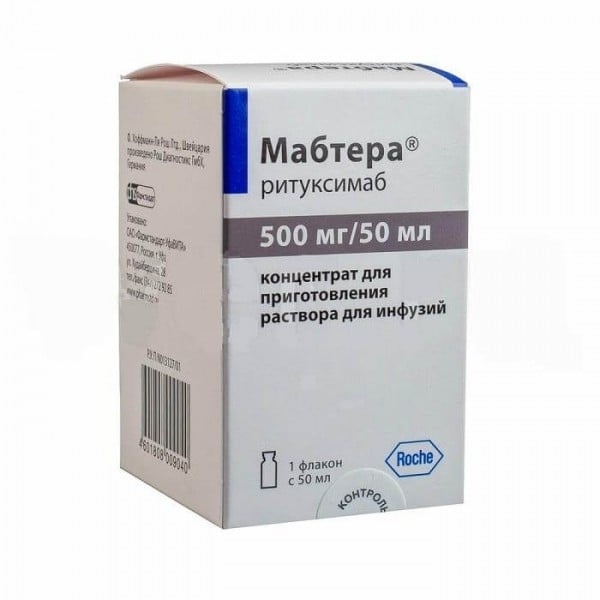
- Kraj rejestracji
- Postać farmaceutycznasolution, 1400 mg/11.7 ml
- Kod ATCL01FA01
- Substancja czynna
- Wymaga receptyTak
- Producent
- Te treści mają charakter wyłącznie informacyjny i nie zastępują konsultacji lekarskiej.
- Zamienniki MABTERAPostać farmaceutyczna: concentrate, 1000 mg/40 mlSubstancja czynna: obinutuzumabProducent: Ф. Хоффманн-Ля Рош ЛтдWymaga receptyPostać farmaceutyczna: concentrate, 100mg/4ml; 400mg/16mlSubstancja czynna: bevacizumabProducent: Рош Діагностикс ГмбХWymaga receptyPostać farmaceutyczna: powder, 50 mg; 1 vialSubstancja czynna: brentuximab vedotinProducent: БСП Фармасьютікалз С.П.А.Wymaga recepty
Odpowiedniki MABTERA w innych krajach
Leki z tą samą substancją czynną dostępne w innych krajach.
Odpowiednik MABTERA w Włochy
Odpowiednik MABTERA w Hiszpania
Uzyskaj receptę na MABTERA online
Wypełnij 2-minutowy formularz
Opisz swoje objawy, historię choroby i lek, o który prosisz.
Wybierz lekarza lub pozwól nam przydzielić
Wybierz specjalistę lub dopasujemy Cię do najbliższego dostępnego lekarza.
Lekarz analizuje Twój przypadek
Zazwyczaj w ciągu 30 minut. Może zadawać dodatkowe pytania przez czat.
Odbierz w dowolnej aptece
Recepta elektroniczna wysłana na Twój e-mail — ważna w całej Polsce.
Często zadawane pytania
MABTERA wymaga recepty w Ukraina. Możesz skonsultować się z lekarzem online, aby sprawdzić, czy ten lek może być odpowiedni w Twojej sytuacji.
Substancją czynną w MABTERA jest rituximab. Informacja ta pomaga rozpoznać leki o tym samym składzie, ale pod różnymi nazwami handlowymi.
MABTERA jest produkowany przez F. Hoffmann-La Ros Ltd. Nazwy handlowe i opakowania mogą się różnić w zależności od dystrybutora.
Lekarze, tacy jak Lekarze rodzinni, Psychiatrzy, Dermatolodzy, Kardiolodzy, Endokrynolodzy, Gastroenterolodzy, Pulmonolodzy, Nefrolodzy, Reumatolodzy, Hematolodzy, Zakaźnicy, Alergolodzy, Geriatrzy, Pediatrzy, Onkolodzy, mogą ocenić, czy stosowanie MABTERA jest odpowiednie w Twoim przypadku, w zależności od sytuacji klinicznej i lokalnych przepisów. Możesz umówić konsultację online, aby omówić objawy i możliwe dalsze kroki.
Polska posiada dobrze rozwiniętą infrastrukturę ochrony zdrowia w dużych miastach, takich jak Warszawa, Kraków, Wrocław i Gdańsk. Apteki są łatwo dostępne i działają zgodnie z obowiązującymi przepisami, zapewniając dostęp do leków na receptę.
Możesz kupić MABTERA w Warszawie, Krakowie, Wrocławiu lub Gdańsku w każdej aptece, posiadając ważną receptę.
Aby uzyskać receptę, możesz skorzystać z Oladoctor:
Inne leki zawierające tę samą substancję czynną (rituximab) to m.in. ГАЗІВА, АВАСТИН, АДЦЕТРИС. Mogą one różnić się nazwą handlową lub postacią, ale zawierają ten sam składnik terapeutyczny. Przed zmianą lub rozpoczęciem nowego leku skonsultuj się z lekarzem.
