



NUMETA 500 ML Emulsja do infuzji dożylnej

Ocena recepty online
Lekarz przeanalizuje Twój przypadek i zdecyduje, czy wystawienie recepty jest medycznie uzasadnione.

Porozmawiaj z lekarzem o tym leku
Omów swoje objawy i opcje leczenia podczas szybkiej konsultacji online.



Jak stosować NUMETA
Treść ulotki
- NUMETA G13E, emulsion for infusion
- Numeta G13E has been designed to meet the nutritional needs of premature infants
- Numeta G13E may not be suitable for some premature infants, as their
- Numeta G13E is presented in the form of a three-compartment bag. Each bag contains
- NUMETA G16E, emulsion for infusion
- Numeta G16E to meet the individual needs of the child if they present the following
- NUMETA G19E, emulsion for infusion
- Numeta G19E has been designed to meet the nutritional needs of children with age
- Numeta G19E is presented as a three-compartment bag. Each bag contains
NUMETA G13E, emulsion for infusion
Read this leaflet carefully before using this medicine because
it contains important information for you.
- Keep this leaflet. You may need to read it again.
- If you have any questions, ask your pediatrician, pharmacist, or nurse.
- If your child experiences any side effects, inform your pediatrician or nurse. This may include any side effect not listed in this leaflet. See section 4.
Contents of this leaflet:
- 1. What Numeta G13E is and what it is used for
- 2. What you need to know before Numeta G13E is given to your child
- 3. How Numeta G13E is administered
- 4. Possible side effects
- 5. How to store Numeta G13E
- 6. Contents of the pack and other information
1. What is Numeta G13E and what is it used for
Numeta G13E is an emulsion for nutrition specially designed for premature infants.
It is administered through a tube inserted into your child's vein,
when they are unable to take all the necessary nourishment orally.
Numeta is presented in a three-compartment bag in which each separate compartment
contains:
a 50% glucose solution
a 5.9% pediatric amino acid solution, with electrolytes
a 12.5% lipid (fat) emulsion
Two or three of these solutions are mixed in the bag before being administered
to your child, based on their needs.
Numeta G13E must be used exclusively under medical supervision.
2. Cosa deve sapere prima che al suo bambino sia somministrato Numeta G13E
Al suo bambino non deve essere dato Numeta G13E nei seguenti casi:
Con le soluzioni di glucosio e amminoacidi/elettroliti miscelate nella sacca ("2 in 1"):
- Se il suo bambino è allergico alle uova, alla soia, alle arachidi o a qualsiasi altro componente di questo medicinale o componente del contenitore (elencati nel paragrafo 6)
- Se l'utilizzo di componenti delle proteine crea problemi all'organismo del suo bambino.
- Se il suo bambino presenta nel sangue alte concentrazioni di uno qualsiasi degli elettroliti inclusi in Numeta G13E
- Numeta G13E (o altre soluzioni contenenti calcio) non deve essere somministrato contemporaneamente al ceftriaxone (un antibiotico), anche in caso di utilizzo di linee di infusione separate. C’è il rischio fatale di formazioni di particelle nel flusso sanguigno del neonato
- Se il suo bambino soffre di iperglicemia (livelli di zuccheri nel sangue particolarmente alti)
Con le soluzioni di glucosio, amminoacidi/elettroliti e lipidi miscelate nella sacca ("3
in 1"):
Tutte le situazioni menzionate in “2 in 1” più la seguente:
- Se il suo bambino ha livelli di grassi nel sangue particolarmente elevati.
In tutti i casi, il medico deciderà se il suo bambino dovrà ricevere questo medicinale sulla
base di fattori quali età, peso e condizione clinica. Il medico terrà conto anche dei risultati
degli esami eseguiti.
Avvertenze e precauzioni
Parli con il pediatra o con l’infermiere prima che diano Numeta G13E.
Quando impiegata in neonati e bambini di età inferiore a 2 anni, la soluzione (nelle sacche
e nei set per la somministrazione) deve essere protetta dall’esposizione alla luce fino al
completamento della somministrazione. L’esposizione di Numeta G13E alla luce
ambientale, specialmente dopo aggiunta di oligoelementi e/o vitamine, genera perossidi e
altri prodotti di degradazione che possono essere ridotti con la protezione dall’esposizione
alla luce.
Reazioni Allergiche
L'infusione deve essere interrotta immediatamente in caso di sviluppo di segni o sintomi di
reazione allergica (ad esempio febbre, sudorazione, brividi, mal di testa, eruzioni cutanee
o difficoltà respiratoria). Questo medicinale contiene olio di semi di soia che, raramente,
può causare gravi reazioni di ipersensibilità. È stato osservato raramente che alcuni soggetti
allergici alle proteine delle arachidi sono allergici anche alle proteine dei semi di soia.
Numeta G13E contiene glucosio prodotto dall'amido di mais. Pertanto, Numeta G13E deve
essere utilizzato con cautela nei pazienti con allergia nota al mais o ai prodotti derivati dal
mais.
Rischio di formazione di particelle con ceftriaxone (antibiotico):
Un determinato antibiotico chiamato ceftriaxone non deve essere miscelato o
somministrato contemporaneamente a soluzioni contenenti calcio (incluso Numeta G13E)
somministrate con una una flebo in vena.
Il medico lo sa e non li somministrerà insieme, neanche attraverso diverse linee di infusione
o diversi siti di infusione.
Formazione di piccole particelle nei vasi sanguigni dei polmoni:
Anche la difficoltà respiratoria può essere un segno che si sono formate piccole particelle,
che bloccano i vasi sanguigni nei polmoni (precipitati vascolari polmonari). Se il suo
bambino accusa difficoltà respiratorie, si rivolga al pediatra o infermiere. Essi decideranno
quali azioni intraprendere.
Infezioni e Sepsi
Il medico controllerà accuratamente il suo bambino per qualsiasi segnale di infezione.
Il rischio di infezione può essere ridotto usando una “tecnica asettica” (tecnica priva di germi)
durante il posizionamento e la manutenzione del catetere, come anche nella preparazione della
formula nutrizionale.
A volte, i bambini possono sviluppare infezione e sepsi (presenza di batteri nel sangue)
quando viene inserito un tubo in vena (catetere endovenoso). Alcuni medicinali e alcune
malattie possono aumentare il rischio di sviluppare un'infezione o la sepsi. I pazienti che
necessitano di nutrizione parenterale (somministrazione di nutrimento attraverso un tubo
inserito in vena) possono essere maggiormente soggetti allo sviluppo di un'infezione a
causa delle loro condizioni mediche.
Sindrome da sovraccarico di grassi
La sindrome da sovraccarico di grassi è stata riportata con medicinali simili. Una ridotta o
limitata capacità di rimuovere i lipidi presenti in Numeta G13E o un sovradosaggio
possono provocare una "sindrome da sovraccarico di grassi". (Vedere il paragrafo 3 ed il
paragrafo 4).
Alterazioni nei parametri chimici del sangue
Il medico controllerà e verificherà i fluidi, la composizione chimica del sangue ed altri
parametri del sangue del suo bambino durante il trattamento con Numeta G13E. A volte,
la rialimentazione di pazienti gravemente malnutriti può determinare alcune alterazioni dei
livelli chimici del sangue che necessitano di essere corrette. Inoltre, si possono verificare
gonfiore e presenza di quantità eccessive di fluidi nei tessuti. Si raccomanda di iniziare la
nutrizione parenterale lentamente e con la massima attenzione.
Monitoraggio e aggiustamenti:
Il medico manterrà il suo bambino sotto stretto controllo e aggiusterà il dosaggio di
Numeta G13E per rispondere alle esigenze individuali del bambino, specialmente se
presenta le seguenti condizioni:
- condizioni post-traumatiche gravi
- diabete mellito grave
- shock
- attacco cardiaco
- infezione grave
- alcuni tipi di coma
Utilizzare con cautela:
Numeta G13E deve essere utilizzato con cautela se il suo bambino ha:
- edema polmonare (fluido nei polmoni) o insufficienza cardiaca;
- gravi problemi epatici;
- problemi nell'utilizzo corretto degli elementi nutritivi;
- iperglicemia;
- problemi renali;
- gravi disturbi metabolici (incapacità dell'organismo di scomporre le sostanze in modo normale);
- patologie della coagulazione del sangue. Lo stato dei fluidi del suo bambino, i valori di funzionalità epatica e/o i valori del sangue verranno attentamente controllati. Vi sono informazioni limitate sulla somministrazione di questo medicinale nei neonati pretermine (prematuri) di meno di 28 settimane di età gestazionale.
Altri medicinali e NumetaG13E
Informi il medico se il suo bambino sta assumendo o utilizzando, o ha recentemente assunto
o potrebbe assumere qualsiasi altro medicinale.
- Numeta G13E non deve non deve essere somministrato contemporaneamentea:ceftriaxone(un antibiotico) neanche attraverso linee d’infusione separate a causa del rischio di formazione di particelle.
- sanguetramite lo stesso set d'infusione a causa del rischio di pseudoagglutinazione (formazione di grumi di globuli rossi).
- Ampicillina, fosfenitoina o furosemideattraverso la stessa linea d’infusione a causa del rischio di formazione di particelle.
Cumarina e warfarin (Anticoagulanti):
Il medico visiterà con cura il suo bambino se sta assumendo cumarina o warfarin. Questi
farmaci sono anticoagulanti che impediscono la coagulazione del sangue. L’olio di oliva e
l’olio di soia hanno un contenuto naturale di vitamina K1. La vitamina K1 può interferire
con i medicinali quali la cumarina e la warfarin.
Analisi di laboratorio
I lipidi contenuti in questa emulsione possono interferire con i risultati di determinati test
di laboratorio. I test di laboratorio possono essere eseguiti dopo un periodo di 5-6 ore
dall'uso dei lipidi quando non vengono somministrati lipidi aggiuntivi
Interazioni di Numeta G13E con medicinali che possono alterare i livelli/metabolismo
del potassio
Numeta G13E contiene potassio. Alte concentrazioni di potassio nel sangue possono
causare un ritmo cardiaco anormale. Prestare particolare attenzione in pazienti che
assumono diuretici (medicinali che riducono la ritenzione dei fluidi), ACE-inibitori
(medicinali per la pressione alta) o antagonisti del recettore dell’angiotensina II (medicinali
per la pressione alta) o immunosoppressori (medicinali che possono abbassare le normali
difese immunitarie del corpo). Queste tipologie di medicinali possonoaumentare i livelli di
potassio.
3. How Numeta G13E is administered
Numeta G13E should always be given to your baby exactly as
indicated by the doctor. If you are unsure, check with your doctor.
Age groups
Numeta G13E has been designed to meet the nutritional needs of premature infants
premature.

Nie jesteś pewien, czy ten lek jest odpowiedni dla ciebie?
Omów swoje objawy i leczenie z lekarzem online.
Numeta G13E may not be suitable for some premature infants, as their
clinical condition may require customized formulations to meet their
specific nutritional needs. The doctor will decide if this medicine is suitable for
your baby.
Administration
This medicine is an emulsion for infusion. It is given through a plastic tube into
a vein in your baby's arm or into a large vein in the chest.
The pediatrician may decide not to administer lipids to the baby. The bag of Numeta
G13E is designed in such a way as to allow the breaking of only the separation membrane that
separates the amino acid/electrolyte compartment and the glucose compartment. In
this case, the separation membrane between the amino acid compartment and the
lipid compartment remains intact. The contents of the bag can then be infused
without lipids.
When used in newborns and children under 2 years of age, the solution (in bags
and administration sets) must be protected from light exposure until
completion of administration (see paragraph 2).
Dosage and duration of treatment
The doctor will decide the dose and for how long it will be administered. The dosage depends
on your baby's nutritional needs. The dosage will be based on your baby's weight,
clinical condition and the body's ability to break down and utilize the constituents of
Numeta G13E. Additional nutrients or proteins may also be given orally/enterally.
If your baby is given too much Numeta G13E
Symptoms
Overdoses of this medicine, or administration that is too fast, can
cause the following:
- nausea (feeling sick)
- vomiting
- chills
- electrolyte imbalances (abnormal amounts of electrolytes in the blood)
- signs of hypervolemia (increased blood volume in circulation, excess fluid in the blood vessels)
- acidosis (increased acidity of the blood) In such situations, stop the infusion immediately. The doctor will decide if further measures are necessary. An overdose of the fats contained in Numeta G13E can cause a "fat overload syndrome", which is usually reversible after stopping the infusion. In newborns and young children (infants), fat overload syndrome has been associated with respiratory disorders leading to a reduction in oxygen in the body
(difficulty breathing) and conditions leading to increased acidity of the blood
(acidosis).
To prevent such events, the doctor will regularly monitor your baby's condition and check their blood levels during treatment.
4. Possible side effects
Like all medicines, this medicine can cause side effects, although not all
children will experience them.
If you notice any changes in your child's health status, during or after treatment,
promptly inform the doctor or nurse.
The tests that the doctor will perform while your child is taking the medicine reduce the
risks of side effects.
In case of the appearance of signs of an allergic reaction, the infusion must be stopped and
the doctor must be contacted immediately. This may be serious and the signs may
include:
- sweating
- chills
- headache
- skin rashes
- difficulty breathing Other side effects that have been observed are: Common(may affect up to 1 in 10 people):
- A low level of phosphates in the blood (hypophosphatemia)
- A high level of sugars in the blood (hyperglycemia)
- A high level of calcium in the blood (hypercalcemia)
- A high level of triglycerides in the blood (hypertriglyceridemia)
- An electrolyte imbalance (hyponatremia) Uncommon (may affect up to 1 in 100 people):
- A high level of lipids in the blood (hyperlipidemia).
- A condition in which bile cannot flow from the liver to the duodenum (cholestasis). The duodenum is part of the intestine.
Not known: frequency cannot be estimated based on available data(These
adverse reactions have only been reported for Numeta G13E and G16E when
administered via peripheral route with insufficient dilution). :
- Skin necrosis
- Soft tissue injury
- Extravasation
The following side effects have been reported with other medicines for parenteral
nutrition:
The reduced or limited ability to remove the lipids contained in Numeta may result in
a “fat overload syndrome”. The following signs and symptoms of this syndrome
are usually reversible after discontinuation of the lipid emulsion infusion:
o sudden and unexpected worsening of the patient's medical condition
o high levels of fats in the blood (hyperlipidemia)
o fever
o fat infiltration into the liver (hepatomegaly)
o deterioration of liver function
o reduction of red blood cells which can make the skin pale and cause a feeling of
weakness or shortness of breath (anemia)
o low white blood cell count, which may increase the risk of infection
(leukopenia)
o low platelet count, which may increase the risk of bruising and/or
bleeding (thrombocytopenia)
o coagulation disorders that compromise the blood's ability to
coagulate
o Respiratory disorders involving a reduction of oxygen in the body
(difficulty breathing)
o Conditions leading to an increase in blood acidity (acidosis)
o coma, requiring hospitalization
- Formation of particles that can cause blockage of blood vessels in the lungs (pulmonary vascular precipitates) or difficulty breathing.
Reporting of side effects
If your child experiences any side effect, including those not listed
in this leaflet, please inform your doctor or nurse.
You can also report side effects directly (see details below).
By reporting side effects you can help provide more information on the
safety of this medicine.
Side effects can also be reported directly through the national reporting system at https://www.aifa.gov.it/content/segnalazioni-
reazioni-avverse.
5. How to store Numeta G13E
Keep this medicine out of the sight and reach of children when not being
administered.
When used in newborns and children under 2 years of age, the solution (in bags
and administration sets) must be protected from light exposure until the
completion of administration (see section 2).
Do not use this medicine after the expiry date stated on the bag and on the
outer packaging (MM/YYYY). The expiry date refers to the last day of the
month.
Do not freeze.
Store in the outer packaging.
Do not dispose of any medicine in wastewater or household waste. Ask your
pharmacist how to dispose of medicines you no longer use. This will help protect
the environment.
6. Package Contents and Other Information
Description of the appearance of Numeta G13 and package contents
Numeta G13E is presented in the form of a three-compartment bag. Each bag contains
a sterile combination of a glucose solution, a pediatric amino acid solution, with electrolytes, and a lipid emulsion, as described below.
| Container size | 50% Glucose solution | 5.9% Amino acid solution with electrolytes | 12.5% Lipid emulsion |
| 300 mL | 80 mL | 160 mL | 60 mL |
Appearance before reconstitution:
The solutions in the amino acid and glucose compartments are clear, colorless or slightly yellow
The lipid emulsion compartment contains a uniform liquid of milky white color
Appearance after reconstitution:
- The infusion solution “2 in 1” (amino acids/electrolytes and glucose) for infusion is clear, colorless or slightly yellow. The infusion emulsion “3 in 1” is uniform in milky white color
The three-compartment bag is a multi-layer plastic bag.
To prevent contact with air, the bag of Numeta G13E is packaged in an outer barrier pouch for oxygen, which also contains an oxygen absorber and an oxygen indicator.
Pack sizes:
300 ml bag: 10 units per cardboard box
1 bag of 300 ml
Not all pack sizes may be marketed.
Marketing Authorisation Holder
Baxter S.p.A.
Via Del Serafico 89
00142 Rome
Italy
Manufacturer responsible for batch release:
Baxter SA
Boulevard René Branquart 80
7860 Lessines
(Belgium)
This medicinal product is authorised in the Member States of the European Economic Area with the following denominations:
| Austria Germany | Numeta G 13 % E Emulsion zur Infusion |
| Belgium Luxembourg | NUMETZAH G13%E, émulsion pour perfusion |
| France | NUMETAH G13%E PREMATURES, emulsion pour perfusion |
| Denmark Norway Sweden | Numeta G13E |
| Czech Republic | Numeta G 13 % E |
| Greece | NUMETA Preterm G 13 E |
| Netherlands | Numeta G13%E emulsie voor infusie |
| Ireland Malta United Kingdom | Numeta G13%E Preterm, Emulsion for Infusion |
| Italy | Numeta G13E emulsione per infusione |
| Finland | Numeta G13E infuusioneste, emulsio |
| Poland | Numeta G 13 % E Preterm |
| Portugal | Numeta G13%E |
| Spain | Numeta G13%E, emulsión para perfusión |
The following information is intended exclusively for medical professionals or
healthcare operators*
*Please note that in some cases this medicine may be administered at home
by parents or other caregivers. In these cases, parents or caregivers
must read this information.
Do not add anything to the bag before verifying its compatibility. Particles may
form or the lipid emulsion may break. This would lead to blockage of the
blood vessels.
Numeta G13E must be at room temperature before use.
Before using Numeta G13E, prepare the bag as shown below.
Check that the bag is not damaged. Use the bag only if it is not damaged.
The appearance of an intact bag is as follows:
- The non-permanent separating membranes are intact. This indicates the absence of mixing of the contents of the three compartments.
- The amino acid and glucose solutions are clear, colorless or slightly yellow, without visible particles.
- The lipid emulsion is a uniform milky white liquid.
Before opening the outer packaging, check the color of the oxygen indicator.
Compare it to the reference color printed next to the OK symbol
in the printed area of the indicator label.
Do not use the bag if the color of the oxygen indicator does not match the
reference color printed next to the OK symbol.
Figures 1 and 2 illustrate how to remove the outer protective packaging. Dispose of
the outer packaging, the oxygen indicator and the oxygen absorber
















Figure 1 Figure 2
Preparation of the mixed emulsion:
ensure that the medicine is at room temperature when breaking the
non-permanent separating membranes.
Place the bag on a flat, clean surface.
Activation of the 3-compartment bag (mixing the 3 solutions by
breaking the 2 non-permanent membranes)
Step 1: Start by rolling the bag from the side of the D-port
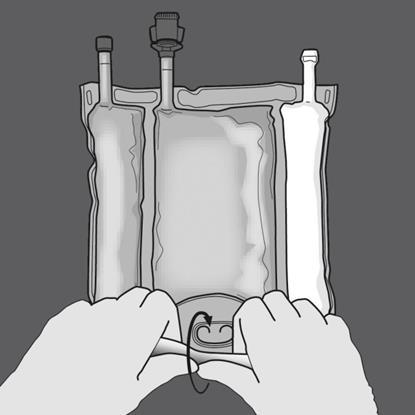
Step 2: Press until the separating membranes are open.

Step 3: Change direction by rolling the bag towards the D-port. Continue until
the membrane is completely open.
Proceed in the same way to complete the opening of the second membrane.
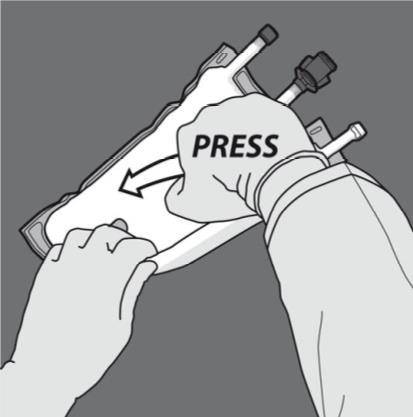
Step 4: Invert the bag at least three times to mix the contents completely.
The appearance of the mixed solution should be similar to a milky white
emulsion
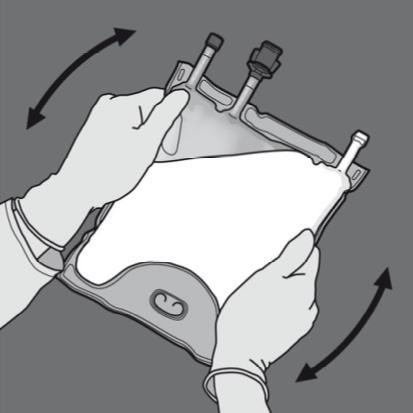
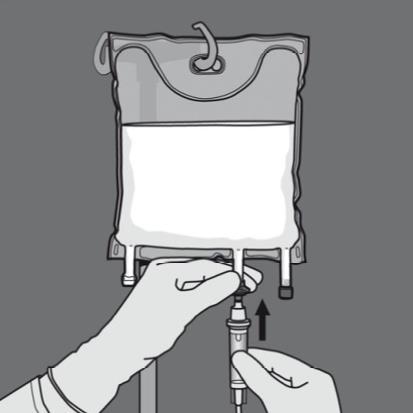
Step 5: Remove the protective cap from the administration port and insert the
intravenous infusion set
Activation of the 2-compartment bag (mixing the 2 solutions by
breaking the non-permanent membrane between the amino acid compartment and the
glucose compartment)
Step 1:
To mix only 2 solutions, roll the bag from the upper corner (end with
the port) of the membrane separating the solutions.
Press to open the membrane separating the glucose and
amino acid compartments.








Step 2: Position the bag so that the compartment containing the lipid emulsion
is closest to the operator.
Roll the bag protecting the lipid emulsion compartment with the palms of your
hands
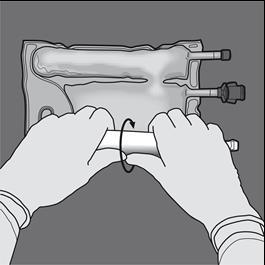
Step 3: With one hand, press by rolling the bag towards the injection points.
















Step 4:
Change direction by rolling the bag towards the upper side (end with
the port).
Press with the other hand, continuing until the membrane separating the
amino acid and glucose solutions is completely open.
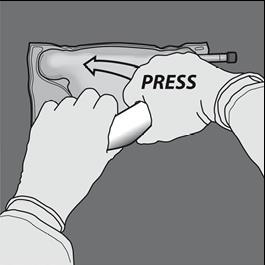
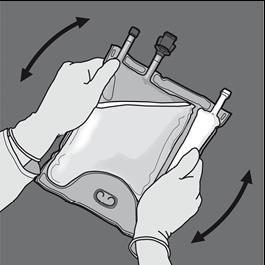
Step 5: Invert the bag at least three times to mix the contents completely.
The appearance of the mixed solution should be clear, colorless or slightly yellow.
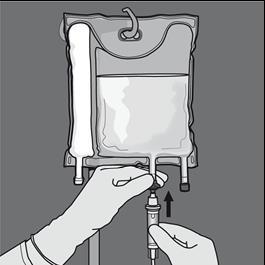
Step 6: Remove the protective cap from the administration port and insert the
intravenous infusion set.
The flow rate must be increased gradually during the first hour. The
flow rate must be adjusted according to the following factors:
dose to be administered
daily intake volumes
duration of infusion
Mode of administration
When used in neonates and children under 2 years of age, the solution (in bags
and infusion sets) must be protected from exposure to light until
completion of administration.
The use of a 1.2 micron filter is recommended for the administration of Numeta
G13E.
Due to its high osmolarity, undiluted Numeta G13E can only be administered
through a central vein. However, sufficient dilution of Numeta G13E with
water for injectable preparations reduces the osmolarity and allows peripheral infusion.
The following formula indicates the effect of dilution on the osmolarity of the bags.

The table below shows examples of osmolarity for mixtures of 2CB activated and 3CB
activated after adding water for injectable preparations:
| a Amino acids and glucose (2CB activated) | Amino acids, glucose and lipids (3CB activated) | |
| Initial volume in the bag (mL) | i 240 | 300 |
| Initial osmolarity (approx. mOsm/L) | l a 1400 | 1150 |
| Volume of water added (mL) | t 240 | 300 |
| I Final volume after addition (mL) | 480 | 600 |
| a Osmolarity after addition (approx. mOsm/L) | 700 | 575 |
Additives:
Exposure to light of intravenous parenteral nutrition solutions, especially
after addition of trace elements and/or vitamins, can have adverse effects on clinical outcome in
neonates due to the generation of peroxides and other degradation products. When
used in neonates and children under 2 years of age, Numeta G13E must be protected
from ambient light until the completion of administration.
Compatible additives can be added through the injection site into the reconstituted mixture
(after opening of the non-permanent membranes and after mixing the
contents of the two or three compartments).
Vitamins can also be added to the glucose compartment before
the mixture is reconstituted (before opening the non-permanent separation membranes and before mixing the solutions and the emulsion).
Any additions of trace element solutions (identified as TE1 and TE4), vitamins (
identified as lyophilized V1 and emulsion V2), and electrolytes commercially available in
defined quantities are shown in tables 1-4.
- 1.Compatibility with TE4, V1 and V2
Table 1: Compatibility of the 3-in-1 bag (3CB activated) with and without dilution with water
| i For 300 mL (3 in 1 mixture with lipids) | ||||||
| l Undiluted mixture | Diluted mixture | |||||
| Additives | Level included | a Maximum additional addition | Maximum total level | Level included | Additional maximum addition | Maximum total level |
| Sodium (mmol) | 6.6 | t 5.0 | 11.6 | 6.6 | 5.0 | 11.6 |
| Potassium (mmol) | I 6.2 | 4.2 | 10.4 | 6.2 | 4.2 | 10.4 |
| Magnesium (mmol) | 0.47 | 0.83 | 1.3 | 0.47 | 0.83 | 1.3 |
| Calcium (mmol) | 3.8 | 3.5 | 7.3 | 3.8 | 3.5 | 7.3 |
| Phosphate* (mmol) | a 3.8 | 2.5 | 6.3 | 3.8 | 2.5 | 6.3 |
| Trace elements and vitamins | i | 15 mL TE4 + 1.5 vial V1 + 25 mL V2 | 15 mL TE4 + 1.5 vial V1 + 25 mL V2 | 15 mL TE4 + 1.5 vial V1 + 25 mL V2 | 15 mL TE4 + 1.5 vial V1 + 25 mL V2 | |
| Water for injections | z | 300 mL | 300 mL | |||
Table 2: Compatibility of the 2-in-1 bag (2CB activated) with and without dilution with water
| For 240 mL (2 in 1 mixture without lipids) | ||||||
| Undiluted mixture | a Diluted mixture | |||||
| Additives | Level included | Additional maximum addition | Maximum total level | Level included | m Additional maximum addition | Maximum total level |
| Sodium (mmol) | 6.4 | 17.6 | 24 | 6.4 | 0.0 | 6.4 |
| Potassium (mmol) | 6.2 | 17.8 | 24 | r 6.2 | 0.0 | 6.2 |
| Magnesium (mmol) | 0.47 | 2.13 | 2.6 | 0.47 | 0.0 | 0.47 |
| Calcium (mmol) | 3.8 | 3.5 | 7.3 | a 3.8 | 0.0 | 3.8 |
| Phosphate* (mmol) | 3.2 | 4.0 | 7.2 | 3.2 | 0.0 | 3.2 |
| Trace elements and vitamins | 2.5 mL TE4 + ¼ vial V1 | 2.5 mL TE4 + ¼ vial V1 | F | 2.5 mL TE4 + ¼ vial V1 | 2.5 mL TE4 + ¼ vial V1 | |
| Water for injections | l | 240 mL | 240 mL | |||
- 2.Compatibility with TE1, V1 and V2Table 3: Compatibility of the 3-in-1 bag (3CB activated) with and without dilution with water
| For 300 mL (3 in 1 mixture with lipids) | ||||||
| Undiluted mixture | Diluted mixture | |||||
| Additives | Level included | Additional maximum addition | a Maximum total level | Level included | Additional maximum addition | Maximum total level |
| Sodium (mmol) | 6.6 | n 5.0 | 11.6 | 6.6 | 0.0 | 6.6 |
| Potassium (mmol) | 6.2 | 4.2 | 10.4 | 6.2 | 0.0 | 6.2 |
| Magnesium (mmol) | 0.47 | a 0.83 | 1.3 | 0.47 | 0.0 | 0.47 |
| Calcium (mmol) | 3.8 | i 1.9 | 5.7 | 3.8 | 0.0 | 3.8 |
| Phosphate* (mmol) | 3.8 | 2.5 | 6.3 | 3.8 | 0.0 | 3.8 |
| Trace elements and vitamins | l a 2.5 mL TE1 + ¼ vial V1 + 2.5 mL V2 | 2.5 mL TE1 + ¼ vial V1 + 2.5 mL V2 | 2.5 mL TE1 + ¼ vial V1 + 2.5 mL V2 | 2.5 mL TE1 + ¼ vial V1 + 2.5 mL V2 | ||
| Water for injections | t | 300 mL | 300 mL | |||
Table 4: Compatibility of the 2-in-1 bag (2CB activated) with and without dilution with water
| For 240 mL (2 in 1 mixture without lipids) | ||||||
| i Undiluted mixture | Miscela diluita | |||||
| Additives | z Level included | Additional maximum addition | Maximum total level | Level included | Additional maximum addition | Maximum total level |
| n Sodium (mmol) | 6.4 | 17.6 | 24 | 6.4 | 0.0 | 6.4 |
| Potassium (mmol) | 6.2 | 17.8 | 24 | 6.2 | 0.0 | 6.2 |
| e Magnesium (mmol) | 0.47 | 2.13 | 2.6 | 0.47 | 0.0 | 0.47 |
| Calcium (mmol) | 3.8 | 3.5 | 7.3 | 3.8 | 0.0 | 3.8 |
| g Phosphate* (mmol) | 3.2 | 4.0 | 7.2 | 3.2 | 0.0 | 3.2 |
| Trace elements and vitamins | 2.5 mL TE1 + ¼ vial V1 | 2.5 mL TE1 + ¼ vial V1 | 2.5 mL TE1 + ¼ vial V1 | 2.5 mL TE1 + ¼ vial V1 | ||
| A Water for injections | 240 mL | 240 mL | ||||
The composition of vitamin and trace element preparations is illustrated in tables 5 and 6.
Table 5: Composition of the commercial trace element preparation used:
| Composition per vial | TE1 (10 mL) | TE4 (10 mL) |
| Zinc | 38.2 µmol or 2.5 mg | 15.3 µmol or 1 mg |
| Selenium | 0.253 µmol or 0.02 mg | 0.253 µmol or 0.02 mg |
| Copper | 3.15 µmol or 0.2 mg | 3.15 µmol or 0.2 mg |
| Iodine | 0.0788 µmol or 0.01 mg | 0.079 µmol or 0.01 mg |
| Fluorine | 30 µmol or 0.57 mg | |
| Manganese | 0.182 µmol or 0.01 mg | 0.091 µmol or 0.005 mg |
Table 6: Composition of the commercial vitamin preparation used:
To perform an addition:
- Operate under aseptic conditions
- Prepare the injection site of the bag
- Puncture the injection site and inject the additions using an injection needle or a reconstitution device
- Mix the contents of the bag and the additions
| Composition per vial | V1 | a V2 |
| Vitamin B1 | 2.5 mg | n |
| Vitamin B2 | 3.6 mg | |
| Nicotinamide | a 40 mg | |
| Vitamin B6 | 4.0 mg | |
| Pantothenic Acid | i 15.0 mg | |
| Biotin | l 60 µg | |
| Folic Acid | a 400 µg | |
| Vitamin B12 | 5.0 µg | |
| Vitamin C | t 100 mg | |
| Vitamin A | I | 2300 IU |
| Vitamin D | 400 IU | |
| Vitamin E | 7 IU | |
| Vitamin K | a | 200 µg |
Preparation of the infusion:
- Operate under aseptic conditions
- Suspend the bag
- Remove the plastic protection from the administration port
- Firmly insert the spike of the infusion set into the administration port
Administration of the infusion:
- For single use only
- Administer the medicine only after opening the non-permanent separation membranes between the two or three compartments and mixing the contents of the two or three compartments
- Ensure that the final emulsion for infusion of the 3 activated compartments does not show any evidence of phase separation or that the final infusion solution of the 2 activated compartments does not show any presence of particles
- After breaking the non-permanent membranes, the contents must be used immediately. Numeta G13E must not be stored for a subsequent infusion
- Do not connect any partially used bags
- Do not connect the bags in series to avoid the possibility of gas embolism due to possible residual gas contained in the main bag
- The use of a 1.2 micron filter is recommended for the administration of Numeta G13E
- When used in neonates and children under 2 years of age, protect from exposure to light until the completion of administration. Exposure of Numeta G13E to ambient light, especially after addition of trace elements and/or vitamins, generates peroxides and other degradation products that can be reduced by protection from exposure to light. Any unused product, waste materials and all disposable devices required must be disposed of properly and not reused
Period of validity after reconstitution
Use the medicine immediately after opening the non-permanent membranes
between the two or three compartments. Stability studies of the mixtures have been conducted for 7
days at a temperature between 2°C and 8°C, followed by 48 hours at 30°C.
Period of validity after integration (electrolytes, trace elements, vitamins, water):
For specific mixtures, the physical stability of the Numeta formulation has been demonstrated
at a temperature between 2 °C and 8 °C for 7 days, followed by 48 hours at 30°C. The
information on these additions is specified in section 6.6 of the SmPC (Summary
of Product Characteristics).
From a microbiological point of view, the medicine must be used immediately.
Otherwise, the times and conditions of storage after mixing and before
use are the responsibility of the user and must not exceed 24 hours, at a temperature
between 2°C and 8°C, unless the reconstitution / dilution / integration has
occurred under controlled and validated aseptic conditions.
Do not use Numeta G13E if the bag is damaged. This is what a damaged bag looks like:
- the non-permanent separation membranes are broken
- one of the compartments contains a mixture of the solutions
- the amino acid and glucose solutions are not clear, colorless or slightly yellow and/or contain visible particles
- the lipid emulsion is not a uniform milky white liquid.
Medicines should not be disposed of via drains and household waste. Ask
your pharmacist how to dispose of medicines you no longer use. This will help protect
the environment.
What Numeta G13E contains:
The active ingredients are:
| o Composition | ||
| Active ingredient | 2CB activated (240 ml) | c 3CB activated (300 ml) |
| Amino Acid Compartment | a | |
| Alanine | 0.75 g | 0.75 g |
| Arginine | m 0.78 g | 0.78 g |
| Aspartic acid | 0.56 g | 0.56 g |
| Cysteine | r 0.18 g | 0.18 g |
| Glutamic acid | a 0.93 g | 0.93 g |
| Glycine | F 0.37 g | 0.37 g |
| Histidine | 0.35 g | 0.35 g |
| Isoleucine | 0.62 g | 0.62 g |
| l Leucine | 0.93 g | 0.93 g |
| e Lysine monohydrate (as lysine) | 1.15 g (1.03 g) | 1.15 g (1.03 g) |
| d Methionine | 0.22 g | 0.22 g |
| a Ornithine hydrochloride (as ornithine) | 0.30 g (0.23 g) | 0.30 g (0.23 g) |
| Phenylalanine | 0.39 g | 0.39 g |
| n Proline | 0.28 g | 0.28 g |
| a Serine | 0.37 g | 0.37 g |
| i Taurine | 0.06 g | 0.06 g |
| l Threonine | 0.35 g | 0.35 g |
| Tryptophan | 0.19 g | 0.19 g |
| a Tyrosine | 0.07 g | 0.07 g |
| t Valine | 0.71 g | 0.71 g |
| I Potassium acetate | 0.61 g | 0.61 g |
| Calcium chloride dihydrate | 0.55 g | 0.55 g |
| a Magnesium acetate tetrahydrate | 0.10 g | 0.10 g |
| i Sodium glycerophosphate hydrate | 0.98 g | 0.98 g |
| z Glucose Compartment | ||
| n Glucose monohydrate (as anhydrous glucose) | 44.00 g (40.00 g) | 44.00 g (40.00 g) |
| Lipid Compartment | ||
| e Purified olive oil (approximately 80%) + purified soybean oil (approximately 20%) | 7.5 g | |
The reconstituted solution/emulsion provides the following:
| c Composition | ||||
| 2CB activated | 3CB activated | |||
| Per unit of volume (ml) Nitrogen (g) Amino acids (g) Glucose (g) Lipids (g) Energy Total calories (kcal) Non-protein calories (kcal) Calories from glucose (kcal) Calorie from lipids (kcal)a Non-protein calories/nitrogen (kcal/g N) Lipid calories/ non-protein calories (%) Lipid calories /total calories (%) Electrolytes Sodium (mmol) Potassium (mmol) Magnesium (mmol) i Calcium (mmol) l Phosphate (mmol)b a Acetate (mmol) t Malate (mmol) Chloride (mmol) | 240 1.4 9.4 40.0 0 198 160 160 0 113 ND a ND n 6.4 6.2 a 0.47 3.8 3.2 7.2 3.2 9.3 | 100 0.59 3.9 16.7 0 82 67 l 67 e 0 d 113 ND ND 2.7 2.6 0.20 1.6 1.3 3.0 1.3 3.9 | m 300 1.4 9.4 r 40.0 7.5 F 273 235 160 75 165 32 28 6.6 6.2 0.47 3.8 3.8 7.2 3.2 9.3 | a 100 0.47 3.1 13.3 2.5 91 78 53 25 165 32 28 2.2 2.1 0.16 1.3 1.3 2.4 1.1 3.1 |
| I pH (approx.) Osmolarity approx. (mOsm/L) | 5.5 1400 | 5.5 1400 | 5.5 1150 | 5.5 1150 |
The excipients are:

Zacząłeś przyjmować lek i masz pytania?
Omów swoje objawy i leczenie z lekarzem online.
NUMETA G16E, emulsion for infusion
Read this leaflet carefully before using this medicine because
it contains important information for you.
- Keep this leaflet. You may need to read it again.
- If you have any questions, ask your pediatrician, pharmacist, or nurse.
- If your child experiences any side effects, inform your pediatrician or nurse. This could include any side effect not listed in this leaflet. See section 4. Contents of this leaflet:
- 1. What Numeta G16E is and what it is used for
- 2. What you need to know before Numeta G16E is given to your child
- 3. How Numeta G16E is given
- 4. Possible side effects
- 5. How to store Numeta G16E
- 6. Contents of the pack and other information
1. What is Numeta G16E and what is it used for
Numeta G16E is an emulsion for nutrition specifically designed for term newborns
and children up to 2 years of age. It is administered through a tube that is placed in the vein
of your child, when your child is unable to take their nourishment by
mouth.
Numeta is available in a 3-compartment bag in which each separate compartment
contains:
a 50% glucose solution
a 5.9% pediatric amino acid solution, with electrolytes
a 12.5% lipid (fat) emulsion
Depending on your child's needs, 2 or 3 of these solutions are mixed together
in the bag before it is given to your child.
Numeta must be used exclusively under medical supervision.
2. What you need to know before Numeta G16E is given to your child
Numeta G16E should not be given to your child in the following cases:
With 2 solutions mixed in the bag (2 in 1):
- If your child is allergic to egg proteins, soy, peanuts or any of the components of the glucose or amino acid compartments (listed in paragraph 6).
- If your child's body has problems forming "building blocks" of proteins.
- If your child has high concentrations of any of the electrolytes included in Numeta G16E in their blood.
- If your child is a newborn (≤28 days of age) Numeta G16E (or other solutions containing calcium) should not be administered at the same time as ceftriaxone (an antibiotic), even if separate infusion lines are used. There is a fatal risk of particle formation in the newborn's bloodstream.
- If your child suffers from hyperglycemia (particularly high blood sugar levels).
With 3 solutions mixed in the bag (3 in 1):
- All the situations mentioned in “2 in 1” plus the following:
- If your child has particularly high levels of fats in the blood. In all cases, your doctor will decide whether your child should receive this medicine based on factors such as age, weight and clinical condition. Your doctor will also take into account the results of the tests performed. Warnings and precautionsTalk to your pediatrician or nurse before they give Numeta G16E. When used in newborns and children under 2 years of age, the solution (in bags and administration sets) must be protected from exposure to light until the administration is complete. Exposure of Numeta G16E to ambient light, especially after addition of trace elements and/or vitamins, generates peroxides and other degradation products that can be reduced by protecting from light exposure. Allergic Reactions:The infusion must be stopped immediately if signs or symptoms of an allergic reaction develop (e.g. fever, sweating, chills, headache, skin rash or difficulty breathing). This medicine contains soybean oil which, rarely, can cause serious hypersensitivity reactions. It has been rarely observed that some subjects allergic to peanut proteins are also allergic to soybean proteins. Numeta G16E contains glucose produced from corn starch. Therefore, Numeta G16E should be used with caution in patients with a known allergy to corn or corn-derived products. Risk of particle formation with ceftriaxone (antibiotic):An antibiotic called ceftriaxone should not be mixed or administered at the same time as any solution containing calcium (including Numeta G16E) administered to you with an intravenous drip. The doctor knows this and will not give them to you together, even through different infusion lines or different infusion sites.
However, the doctor may give calcium and ceftriaxone sequentially, one after the other if
infusion lines in different infusion sites are used or if the infusion lines are
replaced or have been thoroughly washed with physiological saline between
infusions to avoid precipitation.
Formation of small particles in the blood vessels of the lungs:
Difficulty breathing could also be a sign of small particles forming that block the blood
vessels in the lungs (pulmonary vascular precipitates). If
your child experiences any difficulty breathing, inform the pediatrician or
nurse. They will decide what actions to take.
Infections and Sepsis:
Your doctor will carefully check your child for any signs of infection.
The risk of infection can be reduced by using an “aseptic technique” (germ-free technique) during the placement and maintenance of the catheter as well as in the
preparation of the nutritional formula.
Sometimes, children may develop an infection and sepsis (presence of bacteria in the blood)
when a tube is inserted into a vein (central venous catheter). Some medicines and some
diseases can increase the risk of developing an infection or sepsis. Patients who
require parenteral nutrition (administration of nutrients through a tube
inserted into a vein) may be more susceptible to developing an infection
due to their medical conditions.
Fat Overload Syndrome:
Fat overload syndrome has been reported with similar products. Reduced or
limited ability to remove lipids present in Numeta G16E or an overdose
can lead to a "fat overload syndrome". (See paragraph 3 and paragraph 4 -).
Changes in blood chemical parameters:
Your doctor will monitor and evaluate your child's fluids, blood chemistry and other
blood parameters, as refeeding severely malnourished patients can sometimes cause changes in blood chemical levels.
In addition, swelling and excessive fluid in the tissues may occur.
It is recommended to start parenteral nutrition slowly and with maximum care.
High magnesium levels in the blood:
The amount of magnesium contained in Numeta G16E may cause an increase in
magnesium levels in the blood. Signs of this problem may include weakness, slow reflexes,
nausea, vomiting, low blood calcium levels, difficulty breathing, low blood pressure and irregular heartbeat. Because these signs may be difficult to detect, the doctor may check the child's blood values, especially if the
child has risk factors for high blood magnesium levels, including
reduced kidney function. If blood magnesium levels are high, the infusion
will be stopped or reduced.
Monitoring and Adjustments:
Your doctor will keep your child under close supervision and adjust the dosage of
Numeta G16E to meet the individual needs of the child if they present the following
conditions:
- severe post-traumatic conditions
- severe diabetes mellitus
- shock
- infarction
- severe infection
- some types of coma
Use with caution:
Numeta must be used with caution if your child has:
- Pulmonary edema (fluid in the lungs) or heart failure.
- Severe liver problems.
- Problems with nutrient utilization.
- High blood sugar concentrations.
- Kidney problems.
- Severe metabolic disorders (when the body cannot break down substances normally).
- Coagulation disorders. Your child's fluid status, liver function values and/or blood values will be carefully monitored.
Other medicines and Numeta G16E
Tell your doctor if your child is taking or using, or has recently
taken or may use any other medicine.
Numeta must not be given at the same time with:
- ceftriaxone(an antibiotic) even through separate infusion lines due to the risk of precipitate (particles) formation.
- bloodthrough the same infusion set due to the risk of pseudoagglutination (formation of red blood cell clumps).
- Ampicillin, fosphenytoin or furosemidethrough the same infusion line due to the risk of particle formation.
Coumarin and warfarin (Anticoagulants):
Your doctor will carefully monitor your child if they are taking coumarin or
warfarin. Olive oil and soybean oil have a natural content of vitamin
K1. Vitamin K1 can interfere with medicines such as coumarin and warfarin. These
drugs are anticoagulants that prevent blood clotting.
Laboratory tests:
The lipids contained in this emulsion may interfere with the results of certain laboratory
tests. Laboratory tests can be performed after a period of 5-6 hours
from the use of lipids when no additional lipids are administered.
Interactions of Numeta G16E on drugs that can alter potassium levels/metabolism:
Numeta contains potassium. High concentrations of potassium in the blood can cause an abnormal
heart rhythm. Take particular care in patients taking diuretics (drugs that
reduce fluid retention), ACE inhibitors (drugs for high blood pressure) or angiotensin II receptor antagonists (drugs for high blood pressure) or immunosuppressants (drugs that
can lower the body's normal defenses). These types of drugs can
increase potassium levels.
3. How Numeta G16E is administered
Your child should always be given Numeta G16E exactly as
indicated by the doctor. Check with your doctor if you are not sure.
Age groups
Numeta G16E has been designed to meet the nutritional needs of term infants
and children up to 2 years of age.
Your doctor will decide if this medicine is suitable for your child.
Administration
This medicine is an emulsion for infusion. It is administered via a plastic tube into a vein in the arm or into a large vein in the chest of your child.
Your pediatrician may decide not to administer lipids to your child. The bag of
Numeta G16E is designed in such a way as to allow breaking only the separation membrane
between the amino acid/electrolyte compartment and the glucose compartment if necessary. The
separation membrane between the amino acid compartment and the lipid compartment remains
intact in this case. The contents of the bag can thus be infused without lipids.
When used in infants and children under 2 years of age, the solution (in bags
and administration sets) must be protected from exposure to light until
completion of administration (see paragraph 2).
Dosage and duration of treatment
Your pediatrician will decide the dosage and duration of treatment. The dosage depends on the
nutritional needs of your child. The dosage will be based on your child's weight, on
their clinical condition and on the body's ability to metabolize and utilize the
constituents of Numeta G16E. Additional nutrients or proteins may also be given orally/enterally.
If your child is given too much Numeta G16E
Symptoms
Overdosage of this medicine or administration that is too fast can result
in:
- nausea (feeling sick)
- vomiting
- shivering
- electrolyte imbalances (abnormal amounts of electrolytes in the blood)
- signs of hypervolemia (increased blood volume in circulation)
- acidosis (increased acidity of the blood)
In such situations, stop the infusion immediately. Your child's doctor
will decide if further measures are necessary.
An overdose of the fats contained in Numeta G16E can cause a "fat overload
syndrome", which is usually reversible after stopping the infusion. In
newborns and young children (infants), fat overload syndrome has been
associated with respiratory disorders leading to a reduction in oxygen in the body
(difficulty breathing) and conditions leading to increased acidity of the blood
(acidosis).
To prevent such events, the doctor will regularly monitor your child's condition and check their blood levels during treatment.
4. Possible side effects
Like all medicines, this medicine can cause side effects, although not all
children will experience them.
If you notice any changes in your child's health status, during or after treatment,
promptly inform your doctor or nurse.
The tests that the doctor will perform while your child is taking the medicine reduce the
risk of side effects.
In the event of signs of an allergic reaction, the infusion must be stopped and
the doctor must be contacted immediately. This may be serious and the signs may
include:
- sweating
- chills
- headache
- skin rash
- difficulty breathing Other side effects that have been observed are:
Common(may affect up to 1 in 10 people):
- A low level of phosphates in the blood (hypophosphatemia)
- A high level of sugars in the blood (hyperglycemia)
- A high level of calcium in the blood (hypercalcemia)
- A high level of triglycerides in the blood (hypertriglyceridemia)
- An electrolyte imbalance (hyponatremia)
Uncommon (may affect up to 1 in 100 people):
- A high level of lipids in the blood (hyperlipidemia).
- A condition in which bile cannot flow from the liver to the duodenum. The duodenum is part of the intestine.
Not known: frequency cannot be estimated based on available data(These
adverse reactions have only been reported for Numeta G13E and G16E when
administered via peripheral route with insufficient dilution). :
- Skin necrosis
- Soft tissue injury
- Extravasation
The following side effects have been reported with other parenteral nutrition products:
The reduced or limited ability to remove the lipids contained in Numeta may result in
a “fat overload syndrome”. The following signs and symptoms of this syndrome
are usually reversible after discontinuation of the lipid emulsion infusion:
o sudden and unexpected worsening of the patient's medical condition
o high levels of fat in the blood (hyperlipidemia)
o fever
o fat infiltration into the liver (hepatomegaly)
o deterioration of liver function
o reduction of red blood cells which can make the skin pale and cause weakness or shortness of breath (anemia)
o low white blood cell count, which may increase the risk of infection
(leukopenia)
o low platelet count, which may increase the risk of bruising and/or
bleeding (thrombocytopenia)
o coagulation disorders that compromise the blood's ability to
coagulate
o Respiratory disorders involving a reduction of oxygen in the body
(difficulty breathing)
o Conditions leading to an increase in blood acidity (acidosis)
o coma, requiring hospitalization
Formation of small particles that can lead to blockage of blood vessels in the
lungs (pulmonary vascular precipitates), or difficulty breathing.
Reporting of side effects
If your child experiences any of the side effects, inform your doctor or
nurse. This includes any possible side effect not listed in this
leaflet.
You can also report side effects directly (see details below).
By reporting side effects you can help provide more information on the
safety of this medicine. Side effects can also be reported
directly through the national reporting system at
https://www.aifa.gov.it/content/segnalazioni-reazioni-avverse.
5. How to store Numeta G16E
Keep this medicine out of the sight and reach of children when not being
administered.
When used in newborns and children under 2 years of age, the solution (in bags
and administration sets) must be protected from light exposure until the
completion of administration (see section 2).
Do not use this medicine after the expiry date stated on the bag and on the
outer packaging (MM/YYYY). The expiry date refers to the last day of the
month.
Do not freeze.
Store in the outer packaging.
Medicines should not be disposed of via wastewater or household waste. Ask your
pharmacist how to dispose of medicines you no longer use. This will help protect
the environment.
6. Package contents and other information
Description of the appearance of Numeta G16E and contents of the pack
Numeta is presented as a three-compartment bag. Each bag contains a
sterile combination of a glucose solution, a pediatric amino acid solution,
with electrolytes, and a lipid emulsion, as described below.
| Container size | a 50% glucose solution i | 5.9% amino acid solution with electrolytes | 12.5% lipid emulsion |
| 500 mL | z 155 mL | 221 mL | 124 mL |
Appearance before reconstitution:
- The solutions in the amino acid and glucose compartments are clear, colorless or slightly yellow
- The lipid emulsion compartment contains a uniform milky white liquid
Appearance after reconstitution:
- The “2 in 1” infusion solution is clear, colorless or slightly yellow
- The “3 in 1” infusion emulsion is uniform milky white
The three-compartment bag is a multi-layer plastic bag.
To prevent contact with air, the Numeta bag is packaged in an outer
oxygen barrier wrapper, which also contains an oxygen absorber and an
oxygen indicator.
Pack sizes:
500 ml bag: 6 units per cardboard box
1 500 ml bag
Not all pack sizes may be marketed.
Marketing Authorisation Holder and Manufacturer
Marketing Authorisation Holder
Baxter S.p.A.
Via Del Serafico 89
00142 Roma
Manufacturer:
Baxter S.A.
Boulevard Rene Branquart, 80
7860 Lessines
Belgium
This medicinal product is authorised in the Member States of the European Economic
Area with the following denominations:
| Austria a Germany | I Numeta G 16 % E Emulsion zur Infusion |
| i z Belgium Luxembourg | NUMETZAH G16%E émulsion pour perfusion |
| n France | NUMETAH G16%E émulsion pour perfusion |
| e Denmark g Norway A Sweden | Numeta G16E |
| Czech Republic Greece | o c Numeta G 16 % E |
| Netherlands | a Numeta G16%E emulsie voor infusie |
| Ireland United Kingdom | m Numeta G16%E, Emulsion for Infusion r |
| Italy | a Numeta G16%E emulsione per infusione |
| Finland | F Numeta G16E infuusioneste, emulsio |
| Poland | l Numeta G 16 % E |
| Portugal | e Numeta G16%E |
| Spain | d Numeta G16%E, emulsión para perfusión |
The following information is intended exclusively for medical professionals or
healthcare operators*
*Please note that in some cases this product may be administered at home by
parents or other caregivers. In these cases, parents/or caregivers
must read this information.
Do not add anything to the bag before verifying its compatibility. Particles could
form or the lipid emulsion could break. This would lead to blockage of the
blood vessels.
Numeta G16E must be at room temperature before use.
Before using Numeta G16E, prepare the bag as shown below.
Check that the bag is not damaged. Use the bag only if it is not damaged.
The appearance of an intact bag is as follows:
- The non-permanent separation membranes are intact. This indicates the absence of mixing of the contents of the three compartments
- The amino acid and glucose solutions are clear, colorless or slightly yellow, without visible particles
- The lipid emulsion is a uniform milky white liquid
Before opening the outer packaging, check the color of the oxygen indicator..
- Compare it to the reference color printed next to the OK symbol in the printed area of the indicator label.
- Do not use the bag if the color of the oxygen indicator does not match the reference color printed next to the OK symbol.
Figures 1 and 2 illustrate how to remove the protective outer packaging. Dispose of
the outer packaging, the oxygen indicator and the oxygen absorber.
















Figure 1 Figure 2
Preparation of the mixed emulsion:
- ensure that the medicine is at room temperature when breaking the non-permanent separation membranes.
- Place the bag on a flat, clean surface.
Activation of the 3-compartment bag (mixing of the 3 solutions by
breaking the 2 non-permanent membranes)
Step 1: Start by rolling the bag from the side of the D-port.
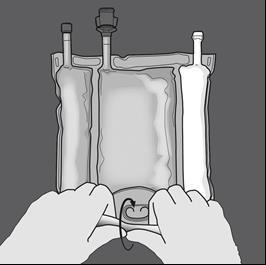
Step 2: Press until the separation membranes are open.
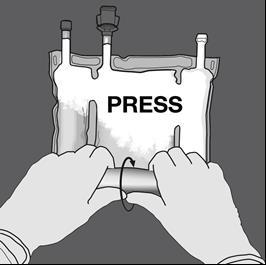
Step 3: Change direction by rolling the bag towards the D-port.
Continue until the membrane is completely open.
Proceed in the same way to complete the opening of the second membrane.
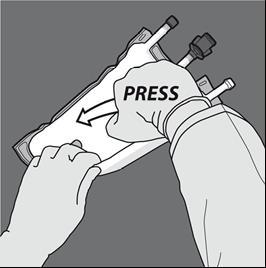
Step 4: Invert the bag at least three times to mix the contents thoroughly.
The appearance of the mixed solution should be similar to a milky white emulsion.








Step 5: Remove the protective cap from the administration port and insert the infusion set.








Activation of 2 compartments (mixing of the 2 solutions through breaking the
non-permanent membrane between the amino acid compartment and the compartment with
glucose)
Step 1: To mix only 2 solutions, roll the bag from the upper corner
(end with the port) of the membrane separating the solutions.
Press to open the membrane separating the glucose and amino acid solutions.








Step 2: Position the bag so that the compartment containing the lipid emulsion
is closest to the operator.
Roll the bag protecting the lipid emulsion compartment with the palms of your
hands.
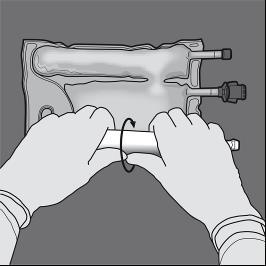
Step 3: With one hand, press and roll the bag towards the injection points.
















Step 4: Change direction by rolling the bag towards the upper side (end with
the port).
Pressing with the other hand, continuing until the membrane separating the amino acid and glucose solutions is completely open.








Step 5: Invert the bag at least three times to mix the contents thoroughly.
The appearance of the mixed solution should be clear, colorless or slightly yellow.








Step 6: Remove the protective cap from the administration port and insert the infusion set.








The flow rate must be increased gradually during the first hour. The flow rate
of administration must be adjusted based on the following factors:
- dose to be administered
- daily intake volumes
- the duration of the infusion.
Route of administration
When used in newborns and children under 2 years of age, the solution (in bags
and administration sets) must be protected from exposure to light until
administration is complete.
The use of a 1.2 micron filter is recommended for the administration of Numeta
G16E.
Due to its high osmolarity, undiluted Numeta G16E can only be administered
through a central vein. However, sufficient dilution of Numeta G16E with
water for injectable preparations reduces the osmolarity and allows peripheral infusion.
The following formula indicates the effect of dilution on the osmolarity of the bags.

The table below shows examples of osmolarity for mixtures of
2CB activated and 3CB
activated after the addition of water for injectable preparations:
| Amino Acids and Glucose (2CB activated) | m Amino Acids, Glucose and Lipids (3CB activated) | |
| Initial volume in the bag (mL) | 376 | 500 |
| Initial osmolarity (approx. mOsm/L) | 1585 | r a 1230 |
| Volume of water added (mL) | 376 | 500 |
| Final volume after addition (mL) | 752 | F 1000 |
| Osmolarity after addition (approx. mOsm/L) | e 792.5 | l 615 |
Additives:
Exposure to light of solutions for parenteral nutrition, especially
after the addition of trace elements and/or vitamins, can have adverse effects on clinical outcome
in neonates, due to the generation of peroxides and other degradation products. When
used in neonates and children under 2 years of age, Numeta G16E must be protected
from ambient light until the completion of administration.
Compatible additives can be added through the injection site into the reconstituted mixture
(after opening the non-permanent membranes and after mixing the
contents of the two or three compartments).
Vitamins can also be added to the glucose compartment before
the mixture is reconstituted (before opening the non-permanent separation membranes and before mixing the solutions and the emulsion).
Any additions of trace element solutions (identified as TE1, TE2 and TE4),
vitamins (identified as lyophilized V1 and emulsion V2), and electrolytes available on the market in
defined quantities are shown in tables 1-6.
- 1.Compatibility with TE4, V1 and V2
Table 1: Compatibility of the 3-in-1 bag (3CB activated) with and without dilution with water
| a For 500 mL (3 in 1 mixture with lipids) | ||||||
| Non-diluted mixture | Diluted mixture | |||||
| Additives | Level included | Further maximum addition | Maximum total level | Level r included | m Further maximum addition | Maximum total level |
| Sodium (mmol) | 12.0 | 25.6 | 37.6 | a 12.0 | 25.6 | 37.6 |
| Potassium (mmol) | 11.4 | 26.2 | 37.6 | F 11.4 | 26.2 | 37.6 |
| Magnesium (mmol) | 1.6 | 3.6 | 5.2 | 1.6 | 3.6 | 5.2 |
| Calcium (mmol) | 3.1 | 16.4 | l 19.5 | 3.1 | 8.2 | 11.3 |
| Phosphate* (mmol) | 4.4 | 6.9 | e 11.3 | 4.4 | 6.9 | 11.3 |
| Trace elements and vitamins | 10 mL TE4 + 1 vial V1 + 30 mL V2 | d 10 mL TE4 + 1 vial V1 + 30 mL V2 | 5 mL TE4 + ½ vial V1 + 5 mL V2 | 5 mL TE4 + ½ vialV1 + 5 mL V2 | ||
| Water for injections | a | 350 mL | 350 mL | |||
Table 2: Compatibility of the 2-in-1 bag (2CB activated) with and without dilution
| l For 376 mL (2 in 1 mixture without lipids) | ||||||
| a Non-diluted mixture | Diluted mixture | |||||
| Additives | Level I included | t Further maximum addition | Maximum total level | Level included | Further maximum addition | Maximum total level |
| Sodium (mmol) | a 11.6 | 26.0 | 37.6 | 11.6 | 0.0 | 11.6 |
| Potassium (mmol) | i 11.4 | 26.2 | 37.6 | 11.4 | 0.0 | 11.4 |
| Magnesium (mmol) | z 1.6 | 3.6 | 5.2 | 1.6 | 0.0 | 1.6 |
| Calcium (mmol) | 3.1 | 8.2 | 11.3 | 3.1 | 0.0 | 3.1 |
| n Phosphate* (mmol) | 3.2 | 8.1 | 11.3 | 3.2 | 0.0 | 3.2 |
| e Trace elements and g vitamins | 5 mL TE4 + ½ vial V1 | 5 mL TE4 + ½ vial V1 | 5 mL TE4 + ½ vial V1 | 5 mL TE4 + ½ vial V1 | ||
| Water for injections | 450 mL | 450 mL | ||||
- 2.Compatibility with TE1, V1 and V2
Table 3: Compatibility of the 3-in-1 bag (3CB activated) with and without dilution with water
| For 500 mL (3 in 1 mixture with lipids) | ||||||
| Non-diluted mixture | m Diluted mixture | |||||
| Additives | Level included | Further maximum addition | Maximum total level | r Level a included | Further maximum addition | Maximum total level |
| Sodium (mmol) | 12.0 | 4.0 | 16.0 | F 12.0 | 0.0 | 12.0 |
| Potassium (mmol) | 11.4 | 6.2 | 17.6 | 11.4 | 0.0 | 11.4 |
| Magnesium (mmol) | 1.6 | 0 | l 1.6 | 1.6 | 0.0 | 1.6 |
| Calcium (mmol) | 3.1 | 2.1 | e 5.2 | 3.1 | 0.0 | 3.1 |
| Phosphate* (mmol) | 4.4 | 2.0 | d 6.4 | 4.4 | 0.0 | 4.4 |
| Trace elements and vitamins | 5 mL TE1 + ½ vial V1 + 5 mL V2 | 5 mL TE1 + a ½ vial V1 + 5 mL V2 | 5 mL TE1 + ½ vial V1 + 5 mL V2 | 5 mL TE1 + ½ vialV1 + 5 mL V2 | ||
| Water for injections | n | 350 mL | 350 mL | |||
Table 4: Compatibility of the 2-in-1 bag (2CB activated) with and without dilution with water
| t For 376 mL (2 in 1 mixture without lipids) | ||||||
| I Non-diluted mixture | Diluted mixture | |||||
| Additives | Level a included | Further maximum addition | Maximum total level | Level included | Further maximum addition | Maximum total level |
| Sodium (mmol) | i 11.6 | 26.0 | 37.6 | 11.6 | 0.0 | 11.6 |
| Potassium (mmol) | z 11.4 | 26.2 | 37.6 | 11.4 | 0.0 | 11.4 |
| Magnesium (mmol) | 1.6 | 3.6 | 5.2 | 1.6 | 0.0 | 1.6 |
| Calcium (mmol) | 3.1 | 8.2 | 11.3 | 3.1 | 0.0 | 3.1 |
| n Phosphate* (mmol) | 3.2 | 8.1 | 11.3 | 3.2 | 0.0 | 3.2 |
| A Trace elements and vitamins | 5 mL TE1 + ½ vial V1 | 5 mL TE1 + ½ vial V1 | 5 mL TE1 + ½ vial V1 | 5 mL TE1 + ½ vial V1 | ||
| Water for injections | o 450 mL c | 450 mL |
- 3Compatibility with TE2, V1 and V2
Table 5: Compatibility of the 3-in-1 bag (3CB activated) with and without dilution with water
| For 500 mL (3 in 1 mixture with lipids) | ||||||
| Non-diluted mixture | r Diluted mixture | |||||
| Additives | Level included | Further maximum addition | Maximum total level | a Level F included | Further maximum addition | Maximum total level |
| Sodium (mmol) | 12.0 | 4.0 | 16.0 | 12.0 | 0.0 | 12.0 |
| Potassium (mmol) | 11.4 | 6.2 | l 17.6 | 11.4 | 0.0 | 11.4 |
| Magnesium (mmol) | 1.6 | 0 | e 1.6 | 1.6 | 0.0 | 1.6 |
| Calcium (mmol) | 3.1 | 2.1 | d 5.2 | 3.1 | 0.0 | 3.1 |
| Phosphate* (mmol) | 4.4 | 2.0 | 6.4 | 4.4 | 0.0 | 4.4 |
| Trace elements and vitamins | 5 mL TE2 + n ½ vial V1 + 5 mL V2 | a 5 mL TE2 + ½ vial V1 + 5 mL V2 | 5 mL TE2 + ½ vial V1 + 5 mL V2 | 5 mL TE2 + ½ vialV1 + 5 mL V2 | ||
| Water for injections | a
| 350 mL | 350 mL | |||
Table 6: Compatibility of the 2-in-1 bag (2CB activated) with and without dilution with water
| I For 376 mL (2 in 1 mixture without lipids) | ||||||
| a Non-diluted mixture | Diluted mixture | |||||
| Additives | i Level z included | Further maximum addition | Maximum total level | Level included | Further maximum addition | Maximum total level |
| Sodium (mmol) | 11.6 | 26.0 | 37.6 | 11.6 | 0.0 | 11.6 |
| Potassium (mmol) | 11.4 | 26.2 | 37.6 | 11.4 | 0.0 | 11.4 |
| Magnesium (mmol) | 1.6 | 3.6 | 5.2 | 1.6 | 0.0 | 1.6 |
| Calcium (mmol) | 3.1 | 8.2 | 11.3 | 3.1 | 0.0 | 3.1 |
| n Phosphate* (mmol) | 3.2 | 8.1 | 11.3 | 3.2 | 0.0 | 3.2 |
| Trace elements and vitamins | 5 mL TE2 + ½ vial V1 | 5 mL TE2 + ½ vial V1 | o 5 mL TE2 + c ½ vial V1 | 5 mL TE2 + ½ vial V1 | ||
| Water for injections | a 450 mL | 450 mL |
The composition of vitamin and trace element preparations is illustrated in tables 7 and 8.
Table 7: Composition of the commercial trace element preparation used:
| Composition per 10mL | TE1 | TE2 | a F TE4 |
| Iron | 8.9 µmol o 0.5 mg |
| |
| Zinc | 38.2 µmol o 2.5 mg | 15.3 µmol o 1 mg | e 15.3 µmol o d 1mg |
| Selenium | 0.253 µmol o 0.02 mg | 0.6 µmol o a 0.05 mg | 0.253 µmol o 0.02 mg |
| Copper | 3.15 µmol o 0. 2mg | n 4.7 µmol o 0.3 mg | 3.15 µmol o 0.2 mg |
| Iodine | 0.0788 µmol o 0.01 mg | a 0.4 µmol o i l 0.05 mg | 0.079 µmol o 0.01 mg |
| Fluoride | a 30 µmol o t 0.57 mg | 26.3 µmol o 0.5 mg | |
| Molybdenum | I | 0.5 µmol o 0.05 mg | |
| Manganese | a 0.182 µmol o i 0.01 mg | 1.8 µmol o 0.1 mg | 0.091 µmol o 0.005 mg |
| Cobalt n | z | 2.5 µmol o 0.15 mg | |
| e Chromium | 0.4 µmol o 0.02 mg |
Table 8: Composition of the commercial vitamin preparation used:
| Composition per vial | V1 | V2 |
| Vitamin B1 | 2.5 mg | |
| Vitamin B2 | 3.6 mg | |
| Nicotinamide | 40 mg | |
| Vitamin B6 | 4.0 mg | |
| Pantothenic Acid | 15.0 mg | |
| Biotin | 60 µg | |
| Folic Acid | 400 µg | l |
| Vitamin B12 | 5.0 µg | e |
| Vitamin C | 100 mg | d |
| Vitamin A | 2300 IU | |
| Vitamin D | a 400 IU | |
| Vitamin E | n 7 IU | |
| Vitamin K | a | 200 µg |
To make an addition:
- Operate under aseptic conditions
- Prepare the injection site of the bag
- Puncture the injection site and inject the additives using an injection needle or a reconstitution device
- Mix the contents of the bag and the additives
Infusion preparation:
- Operate under aseptic conditions
- Suspend the bag
- Remove the plastic protection from the administration port
- Firmly insert the spike of the infusion set into the administration port
Infusion administration:
- For single use only
- Administer the product only after opening the non-permanent membranes separating the two or three compartments and mixing the contents of the two or three compartments
- Ensure that the final emulsion for infusion of the 3 activated compartments shows no evidence of phase separation or that the final infusion solution of the 2 activated compartments shows no presence of particles
- After breaking the non-permanent membranes, the contents must be used immediately. Numeta G16E must not be stored for a subsequent infusion. Do not connect any partially used bags
- Do not connect the bags in series to avoid the possibility of gas embolism due to possible residual gas contained in the main bag
- The use of a 1.2 micron filter is recommended for the administration of Numeta G16E
- When used in neonates and children under 2 years of age, protect from exposure to light until the completion of administration. Exposure of Numeta G16E to ambient light, especially after the addition of trace elements and/or vitamins, generates peroxides and other degradation products that can be reduced by protecting it from exposure to light.
- Any unused product, derived waste and all disposable devices necessary must be disposed of correctly and not reused Period d
Period of validity after integration (electrolytes, trace elements, vitamins, water):
For specific mixtures, the in-use stability data of the Numeta formulation has been demonstrated
for 7 days at a temperature between 2°C and 8°C, followed by 48 hours at 30°C.
From a microbiological point of view, the product must be used immediately. If not
used immediately, the storage times and conditions of use are the responsibility
of the user and must not exceed 24 hours, at temperatures between 2°C and 8°C, unless
the reconstitution/dilution/supplementation has taken place under controlled and validated aseptic
conditions.
Do not use Numeta G16E if the bag is damaged. This is what a damaged bag looks like:
- the non-permanent separation membranes are broken
- one of the compartments contains a mixture of the solutions
- the amino acid and glucose solutions are not clear, colorless or slightly yellow and/or contain visible particles
- the lipid emulsion is not a uniform milky white liquid.
Medicines should not be disposed of via drains or household waste. Ask your
pharmacist how to dispose of medicines you no longer use. This will help protect the environment.
What contains Numeta G16E
The active ingredients are:
| a Composition | ||
| Active ingredient | 2CB activated (376 mL) | m 3CB activated (500 mL) |
| Amino Acid Compartment | ||
| Alanine | 1.03 g | r 1.03 g |
| Arginine | 1.08 g | a 1.08 g |
| Aspartic acid | F 0.77 g | 0.77 g |
| Cysteine | 0.24 g | 0.24 g |
| Glutamic acid | l 1.29 g | 1.29 g |
| Glycine | e 0.51 g | 0.51 g |
| Histidine | 0.49 g | 0.49 g |
| Isoleucine | d 0.86 g | 0.86 g |
| Leucine | 1.29 g | 1.29 g |
| n Lysine monohydrate (as lysine) | a 1.59 g (1.42 g) | 1.59 g (1.42 g) |
| Methionine | 0.31 g | 0.31 g |
| a i Ornithine hydrochloride (as ornithine) | 0.41 g (0.32 g) | 0.41 g (0.32 g) |
| l Phenylalanine | 0.54 g | 0.54 g |
| a Proline | 0.39 g | 0.39 g |
| t Serine | 0.51 g | 0.51 g |
| I Taurine | 0.08 g | 0.08 g |
| a Threonine | 0.48 g | 0.48 g |
| Tryptophan | 0.26 g | 0.26 g |
| i Tyrosine | 0.10 g | 0.10 g |
| z Valine | 0.98 g | 0.98 g |
| n Sodium chloride | 0.30 g | 0.30 g |
| e Potassium acetate | 1.12 g | 1.12 g |
| Calcium chloride dihydrate | 0.46 g | 0.46 g |
| g Magnesium acetate tetrahydrate | 0.33 g | 0.33 g |
| A Sodium glycerophosphate hydrate | 0.98 g | 0.98 g |
| Glucose Compartment | ||
| o Composition | ||
| Active ingredient | 2CB activated (376 mL) | c 3CB activated (500 mL) |
| Glucose monohydrate (as anhydrous glucose) | 85.25 g (77.50 g) | a 85.25 g (77.50 g) |
| m Lipid Compartment | ||
| Purified olive oil (approximately 80%) + purified soybean oil (approximately 20%) | r 15.5 g | |
The reconstituted solution/emulsion provides the following:
| Composition | ||||
| l 2CB activated | 3CB activated | |||
| Per unit of volume (mL) Nitrogen (g) Amino acids (g) Glucose (g) Lipids (g) Energy Total calories (kcal) i Non-protein calories (kcal) l Calories from glucose (kcal) a Calorie from lipids (kcal)a t Non-protein calories/nitrogen (kcal/g N) I Calorie from lipids (% non-protein calories) Calorie from lipids (% total calories) a Electrolytes i Sodium (mmol) z Potassium (mmol) n Magnesium (mmol) Calcium (mmol) e Phosphate (mmol) g Acetate (mmol) Malate (mmol) Chloride (mmol) | 376 2.0 13.0 a 77.5 n 0 a 362 310 310 0 158 NA NA 11.6 11.4 1.6 3.1 3.2 14.5 4.3 13.8 | e d 100 0.52 3.5 20.6 0 96 82 82 0 158 N/A N/A 3.1 3.0 0.41 0.82 0.85 3.9 1.1 3.7 | 500 2.0 13.0 77.5 15.5 517 465 310 155 237 33 30 12.0 11.4 1.6 3.1 4.4 14.5 4.3 13.8 | 100 0.39 2.6 15.5 3.1 103 93 62 31 237 33 30 2.4 2.3 0.31 0.62 0.87 2.9 0.86 2.8 |
| A pH (approx.) | 5.5 | 5.5 | 5.5 | 5.5 |
Other components are:
L-malic acid
Hydrochloric acid
Egg phospholipids for
injectable preparations
Glycerol
Sodium oleate
Sodium hydroxide
Water for injections
for pH adjustment
| o Composition | ||||
| 2CB activated | c 3CB activated | |||
| Per unit of volume (mL) Approx. Osmolarity (mOsm/L) | 376 1585 | 100 1585 | 500 1230 | a 100 1230 |
NUMETA G19E, emulsion for infusion
Read this leaflet carefully before using this medicine because
it contains important information for you.
- Keep this leaflet. You may need to read it again.
- If you have any questions, ask your pediatrician, pharmacist, or nurse.
- If your child experiences any side effects, inform your pediatrician or nurse. This could include any side effect not listed in this leaflet. See section 4.
Contents of this leaflet:
- 1. What Numeta G19E is and what it is used for
- 2. What you need to know before Numeta G19E is given to your child
- 3. How Numeta G19E is given
- 4. Possible side effects
- 5. How to store Numeta G19E
- 6. Contents of the pack and other information
1. What is Numeta G19E and what is it used for
Numeta G19E is an emulsion for nutrition specifically designed for children over 2 years of age and adolescents up to 18 years of age. It is administered through a tube inserted into your child's vein when they are unable to take all the necessary nourishment by mouth.
Numeta is presented in a 3-compartment bag in which each separate compartment contains:
a 50% glucose solution
a 5.9% paediatric amino acid solution, with electrolytes
a 12.5% lipid (fat) emulsion
Depending on your child's needs, 2 or 3 of these solutions are mixed together in the bag before being administered to your child.
Numeta G19E must be used exclusively under medical supervision.
2. What you need to know before Numeta G19E is given to your child
Numeta G19E should not be given to your child in the following cases:
With 2 solutions mixed in the bag (2 in 1):
- If your child is allergic to egg proteins, soy, peanuts, or any of the excipients of the glucose or amino acid compartments (listed in paragraph 6).
- If your child's body has problems forming "building blocks" of proteins.
- If your child has high concentrations of any of the electrolytes included in Numeta G19E in their blood.
- If your child suffers from hyperglycemia (particularly high blood sugar levels).
With 3 solutions mixed in the bag (3 in 1):
- All the situations mentioned in “2 in 1” plus the following:
- If your child has particularly high levels of fats in the blood.
In all cases, your doctor will decide whether your child should receive this medicine
based on factors such as age, weight, and clinical condition. Your doctor will also take into account
the results of the tests performed.
Warnings and precautions
Talk to your pediatrician or nurse before they give Numeta G19E.
Allergic Reactions:
The infusion must be stopped immediately if signs or symptoms of
an allergic reaction develop (e.g., fever, sweating, chills, headache, skin rash, or difficulty
breathing). This medicine contains soybean oil, which, rarely, can cause
serious hypersensitivity reactions. It has been rarely observed that some subjects allergic
to peanut proteins are also allergic to soybean proteins.
Numeta G19E contains glucose produced from corn starch. Therefore, Numeta G19E must
be used with caution in patients with a known allergy to corn or products derived from
corn.
Risk of particle formation with ceftriaxone (antibiotic):
An antibiotic called ceftriaxone should not be mixed or administered
simultaneously with any solution containing calcium (including Numeta G19E)
administered with an intravenous drip.
Your doctor knows this and will not administer them together, even through different infusion lines
or different infusion sites.
However, your doctor may administer calcium and ceftriaxone in sequence, one after the other
if different infusion lines are used in different infusion sites or if the infusion lines are
replaced or have been thoroughly washed with saline solution between
infusions to avoid precipitation.
Formation of small particles in the blood vessels of the lungs:
Even difficulty breathing could be a sign of the formation of small
particles that block the blood vessels in the lungs (pulmonary vascular precipitates). If
your child experiences any difficulty breathing, inform the pediatrician or nurse.
They will decide what actions to take.
Infections and Sepsis:
Your doctor will carefully check your child for any signs of infection.
The risk of infection can be reduced by using an “aseptic technique” (germ-free technique)
during catheter placement and maintenance, as well as in the preparation
of the nutritional formula.
Sometimes, children may develop an infection and sepsis (presence of bacteria in the blood)
when a tube is inserted into a vein (central venous catheter). Some medicines and some
diseases can increase the risk of developing an infection or sepsis. Patients who
require parenteral nutrition (administration of nutrients through a tube
inserted into a vein) may be more susceptible to developing an infection due to their medical conditions.
Fat Overload Syndrome:
Fat overload syndrome has been reported with similar products. Reduced or
limited ability to remove lipids present in Numeta G19E or an overdose
can lead to a "fat overload syndrome". (See paragraph 3 and
paragraph 4).
Changes in blood chemical parameters:
Your doctor will monitor and evaluate your child's fluids, blood chemistry, and other
blood parameters, as refeeding severely malnourished patients can sometimes cause changes in blood chemical levels.
In addition, swelling and excess fluid in the tissues may occur.
It is recommended to start parenteral nutrition slowly and with maximum attention.
Monitoring and Adjustments:
Your doctor will keep your child under close supervision and adjust the dosage of
Numeta G19E to respond to the child's individual needs if they have the following
conditions:
- severe post-traumatic conditions
- severe diabetes mellitus
- shock
- infarction
- severe infection
- some types of coma
Use with caution:
Numeta should be used with caution if your child has:
- Pulmonary edema (fluid in the lungs) or heart failure
- Severe liver problems
- Problems with nutrient utilization
- High blood sugar concentrations
- Kidney problems
- Severe metabolic disorders (when the body fails to break down substances normally)
- Coagulation disorders Your child's fluid status, liver function values, and/or blood values will be carefully monitored.
Other medicines and Numeta G19E
Tell your doctor if your child is taking or using, or has recently
taken or might use any other medicine.
Numeta should not be administered at the same time as:
- ceftriaxone(an antibiotic) even through separate infusion lines due to the risk of particle formation.
- bloodthrough the same infusion set due to the risk of pseudoagglutination (formation of red blood cell clumps).
- Ampicillin, fosphenytoin or furosemidethrough the same infusion line due to the risk of particle formation
Coumarin and warfarin (Anticoagulants):
Your doctor will carefully monitor your child if they are taking coumarin or
warfarin. Olive oil and soybean oil have a natural content of vitamin
K1. Vitamin K1 can interfere with medicines such as coumarin and warfarin.
These drugs are anticoagulants that prevent blood from clotting.
Laboratory tests:
The lipids contained in this emulsion may interfere with the results of certain laboratory tests.
Laboratory tests can be performed 5-6 hours after use of the lipids when no additional lipids are administered.
Interactions of Numeta G19E with drugs that can alter levels/metabolism
of potassium:
Numeta G19E contains potassium. High concentrations of potassium in the blood can
cause an abnormal heart rhythm. Take particular care in patients who
are taking diuretics (drugs that reduce fluid retention), ACE inhibitors (drugs
for high blood pressure) or angiotensin II receptor antagonists (drugs for
high blood pressure) or immunosuppressants (drugs that can lower the body's normal immune defenses). These types of drugs can increase potassium levels.
Pregnancy, breastfeeding and fertility
There are no adequate data regarding the use of Numeta in pregnant or
breastfeeding women. Before prescribing Numeta, your doctor must carefully analyze the
potential risks and benefits for each specific patient.
3. How Numeta G19E is given
Your child should always be given Numeta G19 E exactly as indicated by the
doctor. Check with your doctor if you are not sure.
Age groups
Numeta G19E has been designed to meet the nutritional needs of children with age
over 2 years and adolescents up to 18 years of age.
Your doctor will decide if this medicine is suitable for your child.
Administration
This medicine is an emulsion for infusion. It is given via a plastic tube into a
vein in the arm or into a large vein in the chest of your child.
Your pediatrician may decide not to administer lipids to your child. The bag of
Numeta G19E is designed in such a way as to allow breaking only the separation membrane
between the amino acids/electrolytes compartment and the glucose compartment if necessary. The
separation membrane between the amino acids compartment and the lipids compartment remains
intact in this case. The contents of the bag can thus be infused without lipids.
Dosage and duration of treatment
Your pediatrician will decide the dosage and duration of treatment. The dosage depends on the
nutritional needs of your child. The dosage will be based on your child's weight, on the
clinical condition and on the body's ability of your child to metabolize and to utilize the
constituents of Numeta G19E. Additional nutrients or proteins may also be given orally/enterally.
If your child is given too much Numeta G19E
Symptoms
Overdosage of this medicine or administration that is too fast can
cause the following:
- nausea (feeling sick)
- vomiting
- shivering
- electrolyte imbalances (abnormal amounts of electrolytes in the blood)
- signs of hypervolemia (increased blood volume in circulation)
- acidosis (increased blood acidity)
In such situations, stop the infusion immediately. Your child's doctor
will decide if further measures are necessary.
An overdose of the fats contained in Numeta G19E can cause a "fat overload
syndrome", which is usually reversible after stopping the infusion. In
newborns and young children (infants), fat overload syndrome has been
associated with respiratory disorders leading to a reduction of oxygen in the body
(difficulty breathing) and conditions leading to increased blood acidity
(acidosis).
To prevent such events, the doctor will regularly monitor your child's condition and check their blood levels during treatment.
4. Possible side effects
Like all medicines, this medicine can cause side effects, although not all children will experience them.
If you notice any changes in your child's health status during or after treatment,
promptly inform your doctor or nurse.
The tests that the doctor will perform while your child is taking the medicine reduce the
risk of side effects.
If signs of an allergic reaction appear, the infusion must be stopped and
the doctor must be contacted immediately. This may be serious and the signs may
include:
- sweating
- chills
- headache
- skin rashes
- difficulty breathing
Other side effects that have been observed are:
Common (may affect up to 1 in 10 people):
- A low level of phosphates in the blood (hypophosphataemia)
- A high level of sugars in the blood (hyperglycaemia)
- A high level of calcium in the blood (hypercalcaemia)
- A high level of triglycerides in the blood (hypertriglyceridaemia)
- An electrolyte imbalance (hyponatraemia)
Uncommon (may affect up to 1 in 100 people):
- A high level of lipids in the blood (hyperlipidaemia).
- A condition in which bile cannot flow from the liver to the duodenum (cholestasis). The duodenum is part of the intestine.
Not known: frequency cannot be estimated based on available data(These
adverse reactions have only been reported for Numeta G13E and G16E when
administered via peripheral route with insufficient dilutions). :
- Skin necrosis
- Soft tissue injury
- Extravasation
The following side effects have been reported with other parenteral nutrition products:
The reduced or limited ability to remove the lipids contained in Numeta may result in
a “fat overload syndrome”. The following signs and symptoms of this syndrome
are usually reversible after discontinuation of the lipid emulsion infusion:
o sudden and unexpected worsening of the patient's medical condition
o high levels of fat in the blood (hyperlipidaemia)
o fever
o fat infiltration into the liver (hepatomegaly)
o deterioration of liver function
o reduction of red blood cells which can make the skin pale and cause weakness or shortness of breath (anaemia)
o low white blood cell count, which may increase the risk of infection
(leukopenia)
o low platelet count, which may increase the risk of bruising and/or
bleeding (thrombocytopenia)
o coagulation disorders that compromise the blood's ability to
coagulate
o Respiratory disorders involving a reduction of oxygen in the body
(difficulty breathing)
o Conditions leading to an increase in blood acidity (acidosis)
o coma, requiring hospitalization
Formation of small particles that can lead to blockage of blood vessels in the
lungs (pulmonary vascular precipitates), or difficulty breathing.
Reporting of side effects
If your child experiences any of the side effects, inform your doctor or
nurse. This includes any possible side effects not listed in this
leaflet. You can also report side effects directly (see details below). By reporting side effects you can help provide more
information on the safety of this medicine.
Side effects can also be reported directly through the national reporting system at https://www.aifa.gov.it/content/segnalazioni-
reazioni-avverse.
5. How to store Numeta G19E
Keep this medicine out of sight and reach of children when not being
administered.
Do not use this medicine after the expiry date which is stated on the bag and on the
outer packaging (MM/YYYY). The expiry date refers to the last day of the
month.
Do not freeze.
Store in the outer packaging.
Medicines should not be disposed of via wastewater or household waste. Ask your
pharmacist how to dispose of medicines you no longer use. This will help protect
the environment.
6. Package Contents and Other Information
Description of the appearance of Numeta G19E and contents of the pack
Numeta G19E is presented as a three-compartment bag. Each bag contains
a sterile combination of a glucose solution, a pediatric amino acid solution with electrolytes and a lipid emulsion, as described below.
| Container size | 50% Glucose solution | 5.9% Amino acid solution with electrolytes | 12.5% Lipid emulsion |
| 1000 mL | 383 mL | 392 mL | 225 mL |
Appearance before reconstitution:
- The solutions in the amino acid and glucose compartments are clear, colorless or slightly yellow
- The lipid emulsion compartment contains a uniform, milky white liquid Appearance after reconstitution:
- The “2 in 1” infusion solution is clear, colorless or slightly yellow
- The “3 in 1” emulsion for infusion is uniform, milky white The three-compartment bag is a multi-layer plastic bag. To prevent contact with air, the Numeta bag is packaged in an outer oxygen barrier wrapper, which contains an oxygen absorber and an oxygen indicator.
Pack sizes:
1000 mL bag: 6 units per cardboard box
1 bag of 1000 mL
Not all pack sizes may be marketed.
Marketing Authorisation Holder and Manufacturer
Marketing Authorisation Holder
Baxter S.p.A.
Via del Serafico 89
00142 Rome
Manufacturer:
Baxter S.A.
Boulevard Rene Branquart, 80
7860 Lessines
Belgium
This medicinal product is authorised in the Member States of the European Economic Area with
the following denominations:
| Austria Germany | m Numeta G 19 % E Emulsion zur Infusion |
| Belgium Luxembourg | r a NUMETZAH G19%E, émulsion pour perfusion |
| France | F NUMETAH G 19 %E émulsion pour perfusion |
| Denmark Norway Sweden | l e Numeta G19E |
| Czech Republic Greece | d Numeta G 19 % E |
| Netherlands | a Numeta G19%E emulsie voor infusie |
| Ireland United Kingdom | n a Numeta G19%E, Emulsion for Infusion i |
| Italy | l a Numeta G19%E emulsione per infusione |
| Finland | t I Numeta G19E infuusioneste, emulsio |
| a Poland | Numeta G 19 % E |
| i Portugal | Numeta G19%E |
| z n Spain | Numeta G19%E, emulsión para perfusión |
The following information is intended exclusively for medical professionals or
healthcare operators*
*Please note that in some cases this product may be administered at home by
parents or other caregivers. In these cases, parents/or caregivers
must read this information.
Do not add anything to the bag before verifying its compatibility. Particles may
form or the lipid emulsion may break. This would lead to blockage of the
blood vessels.
Numeta G19E must be at room temperature before use.
Before using Numeta G19E, prepare the bag as shown below.
Check that the bag is not damaged. Use the bag only if it is not damaged
The appearance of an intact bag is as follows:
- The non-permanent separation membranes are intact. This indicates the absence of mixing of the contents of the three compartments.
- The amino acid and glucose solutions are clear, colorless or slightly yellow, without visible particles.
- The lipid emulsion is a uniform, milky white liquid.
Before opening the outer packaging, check the color of the oxygen indicator.
- Compare it to the reference color printed next to the OK symbol in the printed area of the indicator label.
- Do not use the bag if the color of the oxygen indicator does not match the reference color printed next to the OK symbol. Figures 1 and 2 illustrate how to remove the protective outer packaging. Dispose of the outer packaging, the oxygen indicator and the oxygen absorber.
















Figure 1 Figure 2
Preparation of the mixed emulsion:
- Ensure that the medicine is at room temperature when breaking the non-permanent separation membranes.
Place the bag on a flat, clean surface.
Activation of the 3-compartment bag (mixing the 3 solutions by
breaking the 2 non-permanent membranes)
Step 1: Start by rolling the bag from the side of the D port.
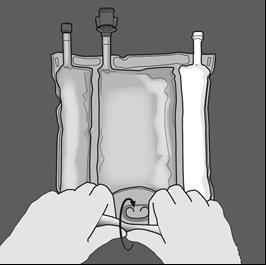
Step 2: Press until the separation membranes are open.
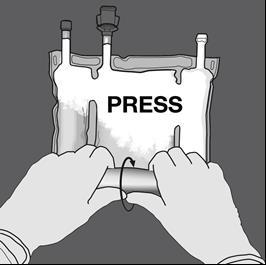
Step 3:
Change direction by rolling the bag towards the D port. Continue until the
membrane is completely open.
Proceed in the same way to complete the opening of the second membrane.
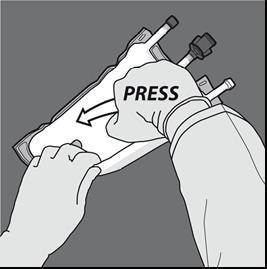
Step 4: Invert the bag at least three times to mix the contents thoroughly.
The appearance of the mixed solution should be similar to a milky white emulsion.








Step 5: Remove the protective cap from the administration port and insert the infusion set.








Activation of 2 compartments (mixing the 2 solutions by breaking the
non-permanent membrane between the amino acid compartment and the compartment with
glucose)
Step 1: To mix only 2 solutions, roll the bag from the upper corner
(end with the D port) of the membrane separating the solutions. Press to
open the membrane separating the glucose and amino acid solutions.








Step 2: Position the bag so that the compartment containing the lipid emulsion
is closest to the operator. Roll the bag protecting the compartment
of the lipid emulsion with the palms of your hands.
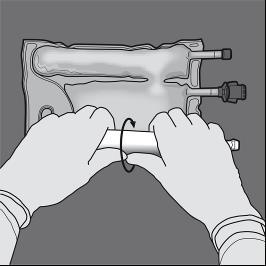
Step 3: With one hand, press and roll the bag towards the injection points.
















Step 4: Change direction by rolling the bag towards the top (end with
the D port).
Press with the other hand, continuing until the membrane separating the amino acid and glucose solutions is completely open.








Step 5: Remove the protective cap from the administration port and insert the infusion set.








Step 6: Remove the protective cap from the administration port and insert the infusion set.








The flow rate must be increased gradually during the first hour. The
flow rate must be adjusted according to the following factors:
- dose to be administered
- daily intake volumes
- infusion duration
Route of administration
The solution (in bags and administration sets) must be protected
from exposure to light from the time of mixing until administration.
The use of a 1.2 micron filter is recommended for the administration of Numeta G19E.
Due to its high osmolarity, undiluted Numeta G19E can only be administered
through a central vein. However
a, a sufficient dilution of Numeta G19E with
water for injectable preparations reduces the osmolarity and allows for peripheral infusion.
The following formula indicates the effect of dilution on the osmolarity of the bags.

The table below shows examples of osmolarity for mixtures of 3CB activated after
the addition of water for injectable preparations:
| Amino acids, glucose and lipids (3CB activated) | |
| Initial volume in the bag (mL) | 1000 |
| Initial osmolarity (approx. mOsm/L) | 1460 |
| Volume of water added (mL) | 1000 |
| Final volume after addition (mL) | 2000 |
| Osmolarity after addition (approx. mOsm/L) | 730 |
Additives:
Mixtures containing trace elements and vitamins must be protected from light, from
the time of mixing until administration. Exposure to ambient light
generates peroxides and other degradation products that can be reduced by
photoprotection.
Compatible additives can be added through the injection site into the reconstituted mixture
(after opening the non-permanent membranes and after mixing the
contents of the two or three compartments).
Vitamins can also be added to the glucose compartment before the
mixture is reconstituted (before opening the non-permanent separation membranes and before mixing the solutions and the emulsion).
Any additions of trace element solutions (identified as TE1, TE2 and TE4),
vitamins (identified as lyophilized V1 and emulsion V2), and electrolytes available on the
market in defined quantities are shown in tables 1-6.
- 3.Compatibility with TE4, V1 and V2
Table 1: Compatibility of the 3-in-1 bag (3CB activated) with and without dilution with water
| n For 1000 mL (3 in 1 mixture with lipids) | ||||||
| e | Undiluted mixture | Diluted mixture | ||||
| g Additives | Included level | Maximum additional addition | Maximum total level | Included level | Maximum additional addition | Maximum total level |
| A Sodium (mmol) | 45.8 | 105 | 151 | 45.8 | 105 | 151 |
| Potassium (mmol) | 32.0 | 118 | 150 | 32.0 | o 118 | 150 |
| Magnesium (mmol) | 2.6 | 7.8 | 10.4 | 2.6 | c 7.8 | 10.4 |
| Calcium (mmol) | 3.8 | 20.5 | 24.3 | 3.8 | a 20.5 | 24.3 |
| Phosphate* (mmol) | 9.4 | 14.6 | 24.0 | 9.4 | 14.6 | 24.0 |
| Trace elements and vitamins | 34 mL TE4 + 3.4 vials V1 + 38 mL V2 | 34 mL TE4 + 3.4 vials V1 + 38 mL V2 |
| m 34 mL TE4 + 3.4 vials V1 + 38 mL V2 | 34 mL TE4 + 3.4 vials V1 + 38 mLV2 | |
| Water for injection | a | 1450 mL | 1450 mL |
Table 2: Compatibility of the 2-in-1 bag (2CB activated)
| e For 775 mL (2 in 1 mixture without lipids) | |||
| Additives | Included level | Maximum additional addition | d Maximum total level |
| Sodium (mmol) | 45.1 | 32.0 | a 77.1 |
| Potassium (mmol) | 32.0 | n 45.6 | 77.6 |
| Magnesium (mmol) | 2.6 | a 5.2 | 7.8 |
| Calcium (mmol) | 3.8 | i 19.4 | 23.2 |
| Phosphate* (mmol) | 7.2 | l 16.0 | 23.2 |
| Trace elements and vitamins | a 10 mL TE4 + 1 t vial V1 | 10 mL TE4 + 1 vial V1 | |
- 4.Compatibility with TE1, V1 and V2Table 3: Compatibility of the 3-in-1 bag (3CB activated)
| For 1000 mL (3 in 1 mixture with lipids) | |||
| Additives | Included level | Maximum additional addition | Maximum total level |
| Sodium (mmol) | 45.8 | 0 | 45.8 |
| Potassium (mmol) | 32.0 | 0 | r 32.0 |
| Magnesium (mmol) | 2.6 | 0 | a 2.6 |
| Calcium (mmol) | 3.8 | 6.4 | 10.2 |
| Phosphate* (mmol) | 9.4 | 0 | F 9.4 |
| Trace elements and vitamins | 15 mL TE1 + 1 vial V1 + 10 mL V2 | l 15 mL TE1 e + 1 vial V1 + 10 mL V2 | |
Table 4: Compatibility of the 2-in-1 bag (2CB activated)
| For 775 mL (2 in 1 mixture without lipids) | |||
| Additives | Included level | a n Maximum additional addition | Maximum total level |
| Sodium (mmol) | 45.1 | a 32.0 | 77.1 |
| Potassium (mmol) | 32.0 | i 45.6 | 77.6 |
| Magnesium (mmol) | 2.6 | l 5.2 | 7.8 |
| Calcium (mmol) | 3.8 | a 19.4 | 23.2 |
| Phosphate* (mmol) | 7.2 | t 16.0 | 23.2 |
| Trace elements and vitamins | I | 10 mL TE1 + 1 vial V1 | 10 mL TE1 + 1 vial V1 |
- 5.Compatibility with TE2, V1 and V2
Table 5: Compatibility of the 2-in-1 bag (2CB activated)
| n For 775 mL (2 in 1 mixture without lipids) | |||
| e Additives | Included level | Maximum additional addition | Maximum total level |
| g Sodium (mmol) | 45.1 | 32.0 | 77.1 |
| A Potassium (mmol) | 32.0 | 45.6 | 77.6 |
| Magnesium (mmol) | 2.6 | 5.2 | 7.8 |
| Calcium (mmol) | 3.8 | 19.4 | 23.2 |
| Phosphate* (mmol) | 7.2 | 16.0 | 23.2 |
| Trace elements and vitamins | 15 mL TE2 + 1 vial V1 | 15 mL TE2 + 1 vial V1 |
Table 6: Compatibility of the 3-in-1 bag (3CB activated)
| a For 1000 mL (3 in 1 mixture with lipids) | |||
| Additives | Included level | Maximum additional addition | F Maximum total level |
| Sodium (mmol) | 45.8 | 0 | l 45.8 |
| Potassium (mmol) | 32.0 | 0 | e 32.0 |
| Magnesium (mmol) | 2.6 | 0 | 2.6 |
| Calcium (mmol) | 3.8 | 6.4 | d 10.2 |
| Phosphate* (mmol) | 9.4 | 0 | 9.4 |
| Trace elements and vitamins | a n 15 mL TE2 + 1 vial V1 + 10 mL V2 | 15 mL TE2 + 1 vial V1 + 10 mL V2 | |
The composition of the vitamin and trace element preparations are illustrated in tables 7 and
8
Table 7: Composition of the commercial trace element preparation used
| Composition per 10mL | TE1 | TE2 | TE4 |
| Iron | 8.9 µmol or 0.5 mg | r
| |
| Zinc | 38.2 µmol or 2.5 mg | 15.3 µmol or 1 mg | F 15.3 µmol or 1 mg |
| Selenium | 0.253 µmol or 0.02 mg | 0.6 µmol or 0.05 mg | l 0.253 µmol or e 0.02 mg |
| Copper | 3.15 µmol or 0.2 mg | d 4.7 µmol or 0.3 mg | 3.15 µmol or 0.2 mg |
| Iodine | 0.0788 µmol or 0.01 mg | a 0.4 µmol or 0.05 mg | 0.079 µmol or 0.01 mg |
| Fluorine | 30 µmol or 0.57 mg | n 26.3 µmol or a 0.5 mg | |
| Molybdenum |
| i 0.5 µmol or 0.05 mg | |
| Manganese | a 0.182 µmol or t I 0.01 mg | 1.8 µmol or 0.1 mg | 0.091 µmol or 0.005 mg |
| Chromium |
| 0.4 µmol or 0.02 mg | |
| Cobalt | i
| 2.5 µmol or 0.15 mg |
Table 8: Composition of the commercial vitamin preparation used:
| e Composition per vial | V1 | V2 |
| g Vitamin B1 | 2.5 mg | |
| A Vitamin B2 | 3.6 mg | |
| Nicotinamide | 40 mg |
To make an addition:
- Work under aseptic conditions
- Prepare the injection site of the bag
- Puncture the injection site and inject the additives using a needle or a reconstitution device
- Mix the contents of the bag and the additives
Infusion preparation:
- Work under aseptic conditions
- Suspend the bag
- Remove the plastic protection from the administration port
- Firmly insert the spike of the infusion set into the administration port
Infusion administration:
- For single use only
- Administer the product only after opening the non-permanent separation membranes between the two or three compartments and mixing the contents of the two or three compartments
- Ensure that the final emulsion for infusion of the 3 activated compartments shows no evidence of phase separation or that the final infusion solution of the 2 activated compartments shows no presence of particles
- After breaking the non-permanent membranes, the contents must be used immediately. Numeta G19E must not be stored for a subsequent infusion. Do not connect any partially used bags
- Do not connect the bags in series to avoid the possibility of gas embolism due to possible residual gases contained in the main bag
- The use of a 1.2 micron filter is recommended for the administration of Numeta G19E
| Vitamin B6 | 4.0 mg | |
| Pantothenic acid | 15.0 mg | |
| Biotin | 60 µg | |
| Folic acid | 400 µg | |
| Vitamin B12 | 5.0 µg | |
| Vitamin C | 100 mg | |
| Vitamin A | 2300 IU | |
| Vitamin D | 400 IU | |
| Vitamin E | 7 IU | |
| Vitamin K | l 200 µg |
- Any unused product, waste materials and all disposable devices required must be disposed of properly and not reused. Period of validity after mixing the solutions: Use the product immediately after opening the non-permanent membranes between the two or three compartments. Stability studies of the mixtures have been conducted for 7 days at a temperature between 2°C and 8°C, followed by 48 hours at 30°C.
Period of validity after integration (electrolytes, trace elements, vitamins, water):
For specific mixtures, the stability data in use of the Numeta formulation have been
demonstrated for 7 days at a temperature between 2°C and 8°C, followed by 48 hours at 30°C.
From a microbiological point of view, the product must be used immediately. If
not used immediately, the storage times and conditions of use are
the responsibility of the user and must not exceed 24 hours, at temperatures between
2°C and 8°C, unless the reconstitution/dilution/supplementation has taken place
under controlled and validated aseptic conditions.
Do not use Numeta if the bag is damaged. This is what a damaged bag looks like:
- the non-permanent separation membranes are broken
- one of the compartments contains a mixture of the solutions
- the amino acid and glucose solutions are not clear, colorless or slightly yellow and/or contain visible particles
- the lipid emulsion is not a uniform milky white liquid.
Medicines should not be disposed of via wastewater or household waste. Ask
your pharmacist how to dispose of medicines you no longer use. This will help protect
the environment.
What contains Numeta G19E
The active ingredients are:
| n Active Ingredient | 2CB activated (775 mL) | 3CB activated (1000 mL) |
| e Amino Acid Compartment | ||
| g Alanine | 1.83 g | 1.83 g |
| Arginine | 1.92 g | 1.92 g |
| A Aspartic acid | 1.37 g | 1.37 g |
| Cysteine | 0.43 g | 0.43 g |
| Active Ingredient | 2CB activated (775 mL) | o c 3CB activated (1000 mL) |
| Glutamic acid | 2.29 g | 2.29 g |
| Glycine | 0.91 g | a 0.91 g |
| Histidine | 0.87 g | 0.87 g |
| Isoleucine | 1.53 g | m 1.53 g |
| Leucine | 2.29 g | 2.29 g |
| Lysine monohydrate (as lysine) | 2.82 g (2.51 g) | r a 2.82 g (2.51 g) |
| Methionine | 0.55 g | 0.55 g |
| Ornithine hydrochloride (as ornithine) | F 0.73 g (0.57 g) | 0.73 g (0.57 g) |
| Phenylalanine | l 0.96 g | 0.96 g |
| Proline | e 0.69 g | 0.69 g |
| Serine | 0.91 g | 0.91 g |
| Taurine | d 0.14 g | 0.14 g |
| Threonine | 0.85 g | 0.85 g |
| Tryptophan | a 0.46 g | 0.46 g |
| Tyrosine | 0.18 g | 0.18 g |
| n Valine | 1.74 g | 1.74 g |
| a Sodium Chloride | 1.79 g | 1.79 g |
| i Potassium acetate | 3.14 g | 3.14 g |
| l Calcium chloride dihydrate | 0.56 g | 0.56 g |
| a Magnesium acetate tetrahydrate | 0.55 g | 0.55 g |
| Sodium glycerophosphate hydrate | 2.21 g | 2.21 g |
| t Glucose Compartment | ||
| I Glucose monohydrate (as anhydrous glucose) | 210.65 g (191.50 g) | 210.65 g (191.50 g) |
| a Lipid Compartment | ||
| i Purified olive oil (approximately 80%) + purified soybean oil (approximately 20%) | 28.1 g | |
The reconstituted solution/emulsion provides the following:
| g Composition | ||||
| 2CB activated | 3CB activated | |||
| A Per unit of volume (ml) Nitrogen (g) | 775 3.5 | 100 0.45 | 1000 3.5 | 100 0.35 |
| o Composition | ||||
| 2CB activated | c 3CB activated | |||
| Per unit of volume (ml) Amino acids (g) Glucose (g) Lipids (g) Energy Total calories (kcal) Non-protein calories (kcal) Calories from glucose (kcal) Calories from lipids (kcal)a Non-protein calories/nitrogen (kcal/g N) Lipid calories/non-protein calories (%) Lipid calories/total calories (%) Electrolytes Sodium (mmol) Potassium (mmol) Magnesium (mmol) Calcium (mmol) Phosphate (mmol)b i Acetate (mmol) l Malate (mmol) Chloride (mmol) | 775 23.0 192 0 858 766 766 0 220 NA NA 45.1 a 32.0 n 2.6 3.8 a 7.2 37.1 8.8 42.6 | 100 3.0 24.7 0 111 99 99 0 l 220 e N/A d N/A 5.8 4.1 0.33 0.50 0.93 4.8 1.1 5.5 | 1000 m 23.0 192 28.1 r a 1139 F 1047 766 281 301 27 25 45.8 32.0 2.6 3.8 9.4 37.1 8.8 42.6 | a 100 2.3 19.2 2.8 114 105 77 28 301 27 25 4.6 3.2 0.26 0.38 0.93 3.71 0.88 4.3 |
| a t pH (approx,) Osmolarity approx. (mOsm/L) | 5.5 1835 | 5.5 1835 | 5.5 1460 | 5.5 1460 |
The other components are:
for pH adjustment
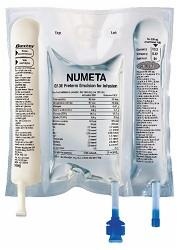
- Kraj rejestracji
- Postać farmaceutycznaEmulsion for intravenous infusion, 500 ML
- Kod ATCB05BA01
- Substancja czynna
- Wymaga receptyTak
- Producent
- Te treści mają charakter wyłącznie informacyjny i nie zastępują konsultacji lekarskiej.
- Zamienniki NUMETAPostać farmaceutyczna: Infusion solution, 500 MLSubstancja czynna: amino acidsProducent: MONICO S.P.A.Wymaga receptyPostać farmaceutyczna: Infusion solution, 4 G/100 MLSubstancja czynna: amino acidsWymaga receptyPostać farmaceutyczna: Infusion solution, 500 MLSubstancja czynna: amino acidsWymaga recepty
Odpowiedniki NUMETA w innych krajach
Leki z tą samą substancją czynną dostępne w innych krajach.
Odpowiednik NUMETA w Polska
Odpowiednik NUMETA w Ukraina
Odpowiednik NUMETA w Hiszpania
Lekarze online w sprawie NUMETA
Omów stosowanie NUMETA, bezpieczeństwo i ocenę zasadności recepty zgodnie z obowiązującymi przepisami.









Uzyskaj receptę na NUMETA online
Wypełnij 2-minutowy formularz
Opisz swoje objawy, historię choroby i lek, o który prosisz.
Wybierz lekarza lub pozwól nam przydzielić
Wybierz specjalistę lub dopasujemy Cię do najbliższego dostępnego lekarza.
Lekarz analizuje Twój przypadek
Zazwyczaj w ciągu 30 minut. Może zadawać dodatkowe pytania przez czat.
Odbierz w dowolnej aptece
Recepta elektroniczna wysłana na Twój e-mail — ważna w całej Polsce.
Często zadawane pytania
NUMETA wymaga recepty w Włochy. Możesz skonsultować się z lekarzem online, aby sprawdzić, czy ten lek może być odpowiedni w Twojej sytuacji.
Substancją czynną w NUMETA jest amino acids. Informacja ta pomaga rozpoznać leki o tym samym składzie, ale pod różnymi nazwami handlowymi.
NUMETA jest produkowany przez BAXTER S.P.A.. Nazwy handlowe i opakowania mogą się różnić w zależności od dystrybutora.
Lekarze, tacy jak Lekarze rodzinni, Psychiatrzy, Dermatolodzy, Kardiolodzy, Endokrynolodzy, Gastroenterolodzy, Pulmonolodzy, Nefrolodzy, Reumatolodzy, Hematolodzy, Zakaźnicy, Alergolodzy, Geriatrzy, Pediatrzy, Onkolodzy, mogą ocenić, czy stosowanie NUMETA jest odpowiednie w Twoim przypadku, w zależności od sytuacji klinicznej i lokalnych przepisów. Możesz umówić konsultację online, aby omówić objawy i możliwe dalsze kroki.
Polska posiada dobrze rozwiniętą infrastrukturę ochrony zdrowia w dużych miastach, takich jak Warszawa, Kraków, Wrocław i Gdańsk. Apteki są łatwo dostępne i działają zgodnie z obowiązującymi przepisami, zapewniając dostęp do leków na receptę.
Możesz kupić NUMETA w Warszawie, Krakowie, Wrocławiu lub Gdańsku w każdej aptece, posiadając ważną receptę.
Aby uzyskać receptę, możesz skorzystać z Oladoctor:
Inne leki zawierające tę samą substancję czynną (amino acids) to m.in. AMINOAKIDI A KATENA RAMIFIKATA MONIKO, AMINOAKIDI A KATENA RAMIFIKATA, AMINOAKIDI KR BIOINDUSTRIA L.I.M.. Mogą one różnić się nazwą handlową lub postacią, ale zawierają ten sam składnik terapeutyczny. Przed zmianą lub rozpoczęciem nowego leku skonsultuj się z lekarzem.
