



NITROGLICERINA 5 mg /24 H Plaster Transdermalny

Ocena recepty online
Lekarz przeanalizuje Twój przypadek i zdecyduje, czy wystawienie recepty jest medycznie uzasadnione.

Porozmawiaj z lekarzem o tym leku
Omów swoje objawy i opcje leczenia podczas szybkiej konsultacji online.



Jak stosować NITROLYKERINA TSENTIVA
Treść ulotki
Nitroglicerina Zentiva 5 mg/24 hours transdermal patches, 10 mg/24 hours transdermal patches, 15 mg/24 hours transdermal patches
Generic medicine
Read this leaflet carefully before you start using this medicine as it contains important
information for you.
- Keep this leaflet. You may need to read it again.
- If you have any questions, ask your doctor or pharmacist.
- This medicine has been prescribed for you only. Do not pass it on to others, even if they have the same symptoms as you, as it may be harmful.
- If you get any side effects, even those not listed in this leaflet, tell your doctor or pharmacist. See section 4.
Contents of this leaflet:
- 1. What Nitroglicerina Zentiva is and what it is used for
- 2. What you need to know before you use Nitroglicerina Zentiva
- 3. How to use Nitroglicerina Zentiva
- 4. Possible side effects
- 5. How to store Nitroglicerina Zentiva
- 6. Contents of the pack and other information
1. What is Nitroglicerina Zentiva and what is it used for
Nitroglicerina Zentiva patches contain the active ingredient nitroglycerin, a vasodilator used for heart conditions that belongs to a group of drugs called organic nitrates.
Nitroglicerina Zentiva is indicated in the prevention and treatment of angina attacks that have occurred both at rest and after exertion in adults.
Angina normally manifests with chest pain or a feeling of oppression that can spread to the neck or arm. The pain occurs when the heart is not sufficiently oxygenated. Nitroglicerina Zentiva is not indicated for the treatment of acute angina episodes.
Nitroglicerina Zentiva patches are for external use only.
Consult your doctor if you do not feel better or if you feel worse.
2. What you need to know before using Nitroglicerina Zentiva
Do not use Nitroglicerina Zentiva
- if you are allergic to nitroglycerin or to similar molecules (organic nitrates related to nitroglycerin) or to any of the other ingredients of this medicine (listed in section 6);
- if you suffer from severe anemia;
- if you suffer from increased intracranial pressure, if you have a head injury, cerebral hemorrhage or suffer from closed-angle glaucoma;
- if you are experiencing or have recently experienced a collapse (acute circulatory failure associated with marked hypotension);
- if you are pregnant and breastfeeding (see section “Fertility, pregnancy and breastfeeding”);
- if you are under 18 years of age (see section “Children and adolescents”);
- if you suffer from an inability of the heart to pump enough blood to meet the body's needs (heart failure) due to obstruction such as, for example, in the presence of a narrowing of the aortic orifice or the atrioventricular orifice of the heart (aortic stenosis or mitral stenosis, respectively), or a thickening of the thin sac-like membrane surrounding the
Page 1of 7
heart (constrictive pericarditis), thickening of the heart muscle (hypertrophic cardiomyopathy), accumulation of
fluid or blood in the space between the heart muscle and the tissue that covers it like a sac
(pericardial tamponade);
- if you are taking medicines for the treatment of erectile dysfunction (e.g. sildenafil or other PDE-5 inhibitors). Patients undergoing nitrate therapy should not take sildenafil or other medicines for the treatment of erectile dysfunction. The combination of a nitrate with sildenafil or other PDE-5 inhibitors may cause a sudden and severe drop in blood pressure, which may lead to fainting, loss of consciousness or even heart attack (see section “Other medicines and Nitroglicerina Zentiva”);
- if you suffer from a condition that causes a strong decrease in blood pressure (systolic blood pressure below 90 mmHg);
- if you suffer from a severe decrease in blood volume in the body due to blood loss or loss of body fluids (severe hypovolemia);
- if you are taking riociguat, a medicine used to treat pulmonary hypertension (see section “Other medicines and Nitroglicerina Zentiva”).
Warnings and precautions
Talk to your doctor or pharmacist before using Nitroglicerina Zentiva:
- if the level of oxygen in the blood is insufficient (hypoxemia) due to severe anemia, or a lung condition, or reduced blood flow to the heart (ischemic heart failure);
- if your angina is caused by thickening of the heart (hypertrophic cardiomyopathy). Nitrates may worsen this type of angina;
- if you experience an increase in the frequency of angina attacks during periods without patch (intermittent therapy). Your doctor may want to re-evaluate your coronary artery disease and consider adjusting treatment by administering an anti-anginal drug at the same time (see section “How to use Nitroglicerina Zentiva”);
- if you are taking other nitrates (e.g. sublingual nitroglycerin), as your body may develop resistance to the effects of these substances after repeated exposure. This can be prevented with intermittent therapy (see section “How to use Nitroglicerina Zentiva”);
- if you stop treatment or if you need to switch to another treatment. Discontinuation of treatment with Nitroglicerina Zentiva must be done gradually and under strict medical supervision;
- if you have, or have recently had, a heart attack (myocardial infarction) or acute heart failure. Treatment should be carried out with caution and under strict medical supervision;
- if you need to undergo electrical stimulation of the heart to restore normal heart rhythm (defibrillation or cardioversion) or procedures using magnetic fields (magnetic resonance imaging). You must remove the Nitroglicerina Zentiva patch before undergoing these treatments or procedures;
- if your blood pressure values are lower than normal (hypotension) and you have a collapse while under treatment with Nitroglicerina Zentiva. In these cases, removal of the patch should be considered;
- if you need to undergo a laboratory test for catecholamines, you should be careful as nitroglycerin may alter the test result (values higher than real or false positives).
During treatment with Nitroglicerina Zentiva, avoid changing position too quickly: it
is possible that Nitroglicerina Zentiva, especially in elderly patients, may cause an excessive reduction in
pressure when moving abruptly from a lying to an upright position (orthostatic hypotension).
Children and adolescents
Nitroglicerina Zentiva should not be used in children and adolescents under 18 years of age as
safety and efficacy have not been established.
Other medicines and Nitroglicerina Zentiva
Tell your doctor or pharmacist if you are taking, have recently taken or might take any
other medicines.
Page 2of 7
Avoid the concomitant administration of medicines for the treatment of erectile dysfunction (e.g.
sildenafil or other PDE-5 inhibitors) as they may potentiate the blood pressure lowering effect of nitrates (see also in the paragraph “Do not use Nitroglicerina Zentiva”).
You may have a further decrease in blood pressure if you are taking medicines indicated for:
- the treatment of high blood pressure (such as calcium antagonists, beta-blockers, ACE inhibitors, diuretics),
- for the treatment of mental illnesses (neuroleptics, major tranquilizers),
- for the treatment of depression (tricyclic antidepressants).
The effect of nitroglycerin may be reduced if you take dihydroergotamine (a drug
used to treat headaches) at the same time, resulting in constriction of the heart vessels.
If you take non-steroidal anti-inflammatory drugs at the same time and except for acetylsalicylic acid, you may have a reduction in the therapeutic response of Nitroglicerina Zentiva.
You may have a further decrease in blood pressure if you are taking acetylsalicylic acid and amifostine at the same time.
Nitroglicerina Zentiva and alcohol
If you drink alcohol, the blood pressure lowering effect of Nitroglicerina Zentiva may
increase.
Fertility, pregnancy and breastfeeding
If you are pregnant, suspect you are pregnant or are planning to become pregnant, or if you are breastfeeding,
ask your doctor or pharmacist for advice before using this medicine.
Fertility
There are no data on the effect of Nitroglicerina Zentiva on fertility in men.
Pregnancy
You should not take Nitroglicerina Zentiva during pregnancy, especially during the first three months. If
pregnancy occurs during regular use of Nitroglicerina Zentiva, inform your doctor immediately who
will decide whether and how to continue therapy.
Breastfeeding
There is insufficient information on the passage of nitroglycerin into breast milk.
The risk to newborns/infants cannot be excluded.
You should decide whether to discontinue breastfeeding or discontinue/abstain from therapy with
Nitroglicerina Zentiva considering the benefit of breastfeeding for the child and the benefit
of therapy for you.
Driving and using machines
Nitroglicerina Zentiva, especially at the beginning of treatment or on dose adjustments, may
alter your reactions or may rarely cause orthostatic hypotension and dizziness (as well as
exceptionally fainting from overdose). If these effects occur, you should refrain from driving
or operating machinery.
Nitroglicerina Zentiva contains propylene glycol
This medicine contains propylene glycol, which may cause skin irritation.
Page 3of 7
3. How to use Nitroglicerina Zentiva
Use this medicine following exactly the instructions of your doctor or pharmacist. If you have doubts
consult your doctor or pharmacist.
The recommended dose is the application of one transdermal patch per day.
Your treating doctor will establish the duration of daily application; your doctor will tell you whether to apply the
transdermal patch continuously for all 24 hours or to suspend the application for a few hours (for
example during the night), in order to avoid the onset of tolerance to the drug (intermittent therapy).
Intermittent therapy applies particularly if you are taking other nitrates (e.g. nitroglycerin
sublingual); it is recommended to apply Nitroglicerina Zentiva daily with a free interval of
8-12 hours.
Duration of treatment with Nitroglicerina Zentiva
Treatment with Nitroglicerina Zentiva can continue for several years; however your doctor will want to
visit you regularly to decide whether to continue the treatment or to modify the therapeutic regimen.
How to apply the patch
You must apply the patch to clean and dry skin and not on wounds, spots or moles or on an area to which you have
just applied a cream, a moisturizing lotion or talcum powder. Apply the transdermal patches of
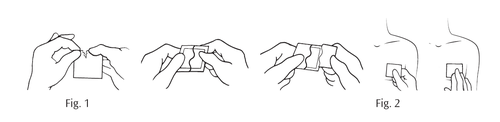
Nitroglicerina Zentiva to the skin of the chest or to the outermost and upper part of the arm (see
Figure 2), free of redness or irritation and vary the sites of patch application. You can shave the application area if necessary.
You should avoid areas that form folds or are subject to friction during movements.
Do not apply two patches consecutively to the same area.
Follow these instructions for applying the patch to the skin of Nitroglicerina Zentiva as soon as you
remove it from its sachet:
- (I) Each patch is packaged in a separate sachet and must be left in this until its use. The sealed sachet is easily opened via a notch on the edge of the sachet itself. Open the sachet by tearing it starting from the notch. Do not use scissors (see Figure 1).
(II) Remove the patch from the sachet and hold it with both hands with the protective layer (the glossy layer) facing up.
(III) Fold the patch so that the central wavy opening line opens. Detach one half of the
protective layer and do not touch the adhesive surface with your fingers.
(IV) Apply the patch to the prepared skin area and remove the other half of the protective layer (see
Figure 2).
- (V) Press the patch firmly with the palm of your hand to ensure that the entire adhesive surface (of the patch) is firmly adhered to the skin.
Page 4of 7
Wash your hands before and after applying Nitroglicerina Zentiva.
To remove the patch, simply lift a flap and pull gently.
If you use more Nitroglicerina Zentiva than you should
In case of accidental intake of an excessive dose of Nitroglicerina Zentiva you must immediately warn
your doctor or go to the nearest hospital.
The risk of overdose is very low due to the controlled release of nitroglycerin.
Symptoms
If you take high doses of nitroglycerin, you may experience severe lowering of blood
pressure, increased heart rate or collapse and fainting, bluish discoloration of the skin and
mucous membranes (cyanosis), coma and convulsions.
Alteration of hemoglobin (metahemoglobinemia) has also been reported following accidental overdose
Treatment
In case of accidental overdose, the effect of nitroglycerin can be rapidly suspended
by removing the patch from the skin.
Hypotension, or collapse, can be treated by raising the lower limbs of the patient in a lying position or, if necessary, by bandaging them; if necessary, this initial intervention can be
followed by adequate therapy in accordance with the judgment of the treating doctor.
In case of metahemoglobinemia, the treating doctor will provide you with adequate therapy.
If you stop taking Nitroglicerina Zentiva
When you stop treatment with Nitroglicerina Zentiva, you may experience a recurrence of angina attacks.
If you have any doubts about the use of this medicine, consult your doctor or pharmacist.
4. Possible side effects
Like all medicines, this medicine can cause side effects, although not everybody gets them.
Side effects are listed in order of decreasing frequency:
Very common (may affect more than 1 in 10 people):
- stomach discomfort (nausea and vomiting).
Common (may affect up to 1 in 10 people):
- headache.
Uncommon (may affect up to 1 in 100 people):
- skin inflammation (dermatitis) from contact
- redness of the skin (erythema) at the patch application site
- itching, burning and irritation.
Rare (may affect up to 1 in 1,000 people):
- increased heart rate (tachycardia) which may also alter diagnostic tests
- sudden drop in blood pressure when moving quickly from a sitting or lying position to an upright position (orthostatic hypotension), hot flushes.
Very rare (may affect up to 1 in 10,000 people):
- dizziness.
Page 5of 7
Like all nitrate-containing preparations, Nitroglicerina Zentiva commonly causes headaches, which vary
depending on the dose, due to dilation of cerebral vessels: these generally occur at the beginning of
treatment and disappear after a few days without interrupting therapy. If the headache persists even
during intermittent therapy, mild analgesics can be used. If the headache does not
respond to this type of treatment, it is advisable to reduce the dose of nitroglycerin, or
discontinue treatment.
A slight increase in heart rate can be avoided by resorting, if necessary, to combined treatment
with a beta-blocker.
After removal of the transdermal patch, any slight skin redness generally disappears after
a few hours. The application site should be changed regularly to prevent local irritation.
Regarding possible side effects on the heart and circulatory system, orthostatic hypotension, tachycardia, palpitations, hot flushes and dizziness are side effects that
manifest especially at the beginning of treatment.
The use, especially if prolonged, of medicines for local application can lead to sensitization phenomena; in such cases it is necessary to discontinue treatment and adopt appropriate therapeutic measures.
The following adverse reactions derive from post-marketing experience with Nitroglicerina Zentiva through
spontaneous reports and case literature. Because these reactions are voluntarily reported by
an uncertain-sized population, it is not possible to reliably estimate their frequency which
therefore is classified as not known:
- effects relating to the heart: palpitations
- effects relating to the skin: skin redness not limited to the application site. Reporting of side effectsIf you get any side effects, even those not listed in this leaflet, tell your doctor or pharmacist. You can also report side effects directly through the national reporting system at http://www.agenziafarmaco.gov.it/content/come-segnalare-una- sospetta-reazione-avversa . By reporting side effects you can help provide more information on the safety of this medicine.
5. How to store Nitroglicerina Zentiva
Keep this medicine out of the sight and reach of children.
Do not use this medicine after the expiry date which is stated on the carton and on the sachets after Scad.
The expiry date refers to the last day of that month.
Nitroglicerina Zentiva must be stored in its intact sachet.
Do not dispose of any medicine in waste water or household waste. Ask your pharmacist how to dispose of
medicines you no longer use. This will help protect the environment.
6. Contents of the pack and other information
What Nitroglicerina Zentiva contains
Nitroglicerina Zentiva 5 mg/24 hours transdermal patches
- The active ingredient is nitroglycerin. Each patch contains 26.60 mg of nitroglycerin, released over 24 hours at a rate of 0.2 mg/hour.
- The other ingredients are: acrylic acid copolymer (durotak 87-2852), sorbitan oleate, propylene glycol, low density polyethylene, polyester.
Nitroglicerina Zentiva 10 mg/24 hours transdermal patches
- The active ingredient is nitroglycerin. Each patch contains 53.00 mg of nitroglycerin, released over 24 hours at a rate of 0.4 mg/hour. Page 6of 7
- The other ingredients are: acrylic acid copolymer (durotak 87-2852), sorbitan oleate, propylene glycol, low density polyethylene, polyester.
Nitroglicerina Zentiva 15 mg/24 hours transdermal patches
- The active ingredient is nitroglycerin. Each patch contains 80.00 mg of nitroglycerin, released over 24 hours at a rate of 0.6 mg/hour.
- The other ingredients are: acrylic acid copolymer (durotak 87-2852), sorbitan oleate, propylene glycol, low density polyethylene, polyester.
Description of the appearance of Nitroglicerina Zentiva and contents of the pack
Nitroglicerina Zentiva 5 mg/24 hours transdermal patch is a transparent rectangular patch.
It is available in packs of 15 transdermal patches.
Nitroglicerina Zentiva 10 mg/24 hours transdermal patch is a transparent rectangular patch.
It is available in packs of 15 transdermal patches.
Nitroglicerina Zentiva 15 mg/24 hours transdermal patch is a transparent square patch.
It is available in packs of 15 transdermal patches.
Marketing Authorisation Holder
Zentiva Italia S.r.l. - Viale L. Bodio n. 37/B, 20158 Milano
Manufacturer
SPA Italiana Laboratori Bouty, S.S. n. 11, Padana Superiore Km 160, Cassina de' Pecchi (MI)
Altergon Italia S.r.l., Zona Industriale, 83040 Morra de Sanctis (AV)
Page 7of 7

Nie jesteś pewien, czy ten lek jest odpowiedni dla ciebie?
Omów swoje objawy i leczenie z lekarzem online.

Zacząłeś przyjmować lek i masz pytania?
Omów swoje objawy i leczenie z lekarzem online.
- Kraj rejestracji
- Postać farmaceutycznaTransdermal patch, 5 MG/24 H
- Kod ATCC01DA02
- Substancja czynna
- Wymaga receptyTak
- Producent
- Te treści mają charakter wyłącznie informacyjny i nie zastępują konsultacji lekarskiej.
- Zamienniki NITROLYKERINA TSENTIVAPostać farmaceutyczna: Transdermal patch, 5 MG/24 HSubstancja czynna: glyceryl trinitrateProducent: Merus Labs Luxco II S.a.r.l.Wymaga receptyPostać farmaceutyczna: Transdermal patch, 5 MG/24 HSubstancja czynna: glyceryl trinitrateProducent: Merus Labs Luxco II S.a.r.l.Wymaga receptyPostać farmaceutyczna: Transdermal patch, 5 MG/24 HSubstancja czynna: glyceryl trinitrateProducent: Viatris Healthcare LimitedWymaga recepty
Odpowiedniki NITROLYKERINA TSENTIVA w innych krajach
Leki z tą samą substancją czynną dostępne w innych krajach.
Odpowiednik NITROLYKERINA TSENTIVA w Hiszpania
Odpowiednik NITROLYKERINA TSENTIVA w Polska
Odpowiednik NITROLYKERINA TSENTIVA w Ukraina
Lekarze online w sprawie NITROLYKERINA TSENTIVA
Omów stosowanie NITROLYKERINA TSENTIVA, bezpieczeństwo i ocenę zasadności recepty zgodnie z obowiązującymi przepisami.
Uzyskaj receptę na NITROLYKERINA TSENTIVA online
Wypełnij 2-minutowy formularz
Opisz swoje objawy, historię choroby i lek, o który prosisz.
Wybierz lekarza lub pozwól nam przydzielić
Wybierz specjalistę lub dopasujemy Cię do najbliższego dostępnego lekarza.
Lekarz analizuje Twój przypadek
Zazwyczaj w ciągu 30 minut. Może zadawać dodatkowe pytania przez czat.
Odbierz w dowolnej aptece
Recepta elektroniczna wysłana na Twój e-mail — ważna w całej Polsce.
Często zadawane pytania
NITROLYKERINA TSENTIVA wymaga recepty w Włochy. Możesz skonsultować się z lekarzem online, aby sprawdzić, czy ten lek może być odpowiedni w Twojej sytuacji.
Substancją czynną w NITROLYKERINA TSENTIVA jest glyceryl trinitrate. Informacja ta pomaga rozpoznać leki o tym samym składzie, ale pod różnymi nazwami handlowymi.
NITROLYKERINA TSENTIVA jest produkowany przez ZENTIVA ITALIA S.R.L.. Nazwy handlowe i opakowania mogą się różnić w zależności od dystrybutora.
Lekarze, tacy jak Lekarze rodzinni, Psychiatrzy, Dermatolodzy, Kardiolodzy, Endokrynolodzy, Gastroenterolodzy, Pulmonolodzy, Nefrolodzy, Reumatolodzy, Hematolodzy, Zakaźnicy, Alergolodzy, Geriatrzy, Pediatrzy, Onkolodzy, mogą ocenić, czy stosowanie NITROLYKERINA TSENTIVA jest odpowiednie w Twoim przypadku, w zależności od sytuacji klinicznej i lokalnych przepisów. Możesz umówić konsultację online, aby omówić objawy i możliwe dalsze kroki.
Polska posiada dobrze rozwiniętą infrastrukturę ochrony zdrowia w dużych miastach, takich jak Warszawa, Kraków, Wrocław i Gdańsk. Apteki są łatwo dostępne i działają zgodnie z obowiązującymi przepisami, zapewniając dostęp do leków na receptę.
Możesz kupić NITROLYKERINA TSENTIVA w Warszawie, Krakowie, Wrocławiu lub Gdańsku w każdej aptece, posiadając ważną receptę.
Aby uzyskać receptę, możesz skorzystać z Oladoctor:
Inne leki zawierające tę samą substancję czynną (glyceryl trinitrate) to m.in. ADESITRIN, DEPONIT, DERMATRANS. Mogą one różnić się nazwą handlową lub postacią, ale zawierają ten sam składnik terapeutyczny. Przed zmianą lub rozpoczęciem nowego leku skonsultuj się z lekarzem.
