



NISEGAL 3 mg /Ml + 1 Mg/Ml Krople Do Uszu, Zawiesina

Ocena recepty online
Lekarz przeanalizuje Twój przypadek i zdecyduje, czy wystawienie recepty jest medycznie uzasadnione.

Porozmawiaj z lekarzem o tym leku
Omów swoje objawy i opcje leczenia podczas szybkiej konsultacji online.



Jak stosować NISEGAL
Treść ulotki
NISEGAL 3 mg/ml / 1 mg/ml ear drops, suspension
ciprofloxacina/desametasone
Generic medicine
Read this leaflet carefully before using this medicine as it contains important
information for you.
- Keep this leaflet. You may need to read it again.
- If you have any questions, ask your doctor or pharmacist.
- This medicine has been prescribed for you only. Do not pass it on to others, even if they have the same symptoms as you, as it may be harmful.
- If you get any side effects, even those not listed in this leaflet, tell your doctor or pharmacist. See section 4.
Contents of this leaflet:
- 1. What NISEGAL is and what it is used for
- 2. What you need to know before you use NISEGAL
- 3. How to use NISEGAL
- 4. Possible side effects
- 5. How to store NISEGAL
- 6. Contents of the pack and other information
1. What is NISEGAL and what is it used for
NISEGAL is an ear suspension (for use in the ear). It contains the active ingredients:
- ciprofloxacin, an antibiotic belonging to the fluoroquinolone group. Ciprofloxacin works by killing the bacteria responsible for infections;
- dexamethasone, a corticosteroid or anti-inflammatory agent that helps to relieve inflammation and redness.
NISEGAL is indicated for the treatment of the following infections in adults, adolescents and children:
- acute otitis media in patients with tympanostomy tubes (AOMT)
- acute otitis externa (AOE).
Official guidelines on the appropriate use of antibacterial agents should be considered.
2. What you need to know before using NISEGAL
Do not use NISEGAL
- if you are allergic to ciprofloxacin, dexamethasone or any of the other ingredients of this medicine (listed in section 6).
- If you are allergic to medicines called quinolone antibiotics, as this medicine may cause the same type of allergic reaction
- if the ear infection is caused by a virus or fungus
Warnings and precautions
Talk to your doctor or pharmacist before using NISEGAL.
- This medicine must be applied exclusively to the ear. It is not suitable for use in the eye and must not be swallowed, injected or inhaled.
- Once you have started treatment, if you notice the first signs of a rash or any other allergic symptoms (e.g. hives (urticaria), sudden swelling of the face, throat or
eyelids, breathing problems), you should immediately stop using the medicine and
consult your doctor. Severe allergic reactions may require immediate emergency treatment.
- Tell your doctor if your symptoms do not improve within a week of starting treatment, worsen or recur suddenly. As with all antibiotics, additional infections caused by organisms that are not sensitive to ciprofloxacin can sometimes occur. In such cases, appropriate treatment should be started under the guidance of your doctor.
- If you experience pain, swelling or inflammation of the tendons during or immediately after using this medicine, stop treatment and contact your doctor. Pay particular attention if you are over 65 years of age or if you are undergoing treatment with corticosteroids.
- Contact your doctor if you experience blurred vision or other visual disturbances.
Children
Clinical experience with the use of NISEGAL for the treatment of middle ear infections in
children under 6 months of age and for the treatment of outer ear infections in children
under 1 year of age is insufficient; therefore, consult your doctor before administering this
medicine to your child if they fall within the specified age ranges.
If these situations apply to you, ask your doctor for advice.
Other medicines and NISEGAL
Tell your doctor or pharmacist if you are taking, have recently taken or might take any other
medicines.
Pregnancy and breastfeeding
If you are pregnant, suspect you may be pregnant or are planning a pregnancy, or if you are breastfeeding
with breast milk, ask your doctor for advice before using this medicine.
Driving and using machines
NISEGAL does not or negligibly alters the ability to drive vehicles or use machinery.
NISEGAL contains benzalkonium chloride
This medicine contains 0.00282 mg of benzalkonium chloride per drop equivalent to 0.1
mg per ml of suspension.
Benzalkonium chloride can irritate the skin.
3. How to use NISEGAL
Use this medicine following the doctor's instructions exactly. If you have any doubts, consult your
doctor.
The recommended dose for adults and children is 4 drops in the ear canal, twice a day – morning
and evening – for 7 days. This medicine is intended for use only in the ear (otic use).
Remove the mobile protective ring from the cap upon first opening of the bottle.
The doctor will inform you about the duration of treatment with this medicine. To prevent the
recurrence of the infection, do not interrupt treatment prematurely, even if you notice improvements
in the health of your ear(s).
Use this medicine for both ears only if the doctor has provided instructions to do so.
Instructions for use
It is preferable for another person to administer the drops for you. You should never allow
children to self-administer the drops.
- 1. Wash your hands The person administering NISEGAL should wash their hands with soap and water.
- 2. Warm and shake the bottle The person administering NISEGAL should hold the bottle in their hands for a few minutes to warm the contents (figure 1) to avoid dizziness resulting from instilling a cold solution into the ear canal, then shake the bottle well before use.
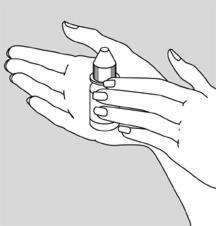
Figure 1
- 3. Administer the drops The patient should be lying down with the infected ear facing upwards (figure 2).
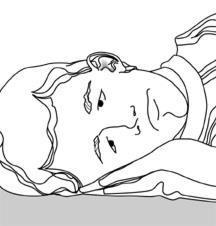
Figure 2
Place 4 drops of NISEGAL into the infected ear (figure 3). Do not touch your fingers or ear or any
other surface with the tip of the bottle as this could infect the drops.
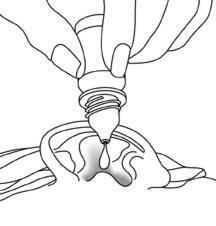
Figure 3
After placing the drops, follow the instructions below relating to the patient's specific ear infection.
- 4. For patients with middle ear infection with otologic drainage catheters (tympanostomy tubes or “Grommets”). While the patient remains lying on their side, the person administering NISEGAL should gently press the skin flap at the entrance of the ear canal (figure 4) 5 times with a pumping motion. This will allow the drops to pass through the tube, reaching the eardrum and middle ear.
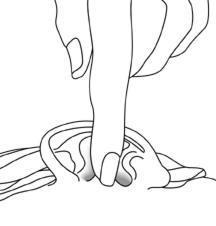
Figure 4
- 5. For patients with outer ear infection. While the patient is lying on their side, the person administering NISEGAL should gently pull the outer earlobe upwards and downwards (figure 5). This will allow the ear drops to flow into the ear canal.
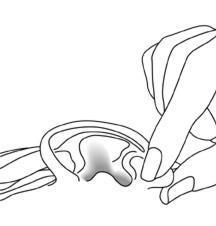
Figure 5
- 6. Remain lying on your side It is recommended that the patient remain lying on their side for about 5 minutes to facilitate the penetration of the drops into the ear.
When you raise your head again, some drops may leak out. You can wipe them away with a non-sterile
paper towel.
It is essential to follow these instructions in order to achieve good efficacy of
the medicine in the ear. Keeping your head in a vertical position or moving your head too quickly
during the instillation of ear drops may result in partial loss of the medicine as
the drops, rather than penetrating deep into the ear canal, would slide down your face.
Keep the bottle tightly closed when not in use.
Keep the bottle until the end of the treatment. Do not keep it for future use.
When applying the medicine, be careful not to let the dropper come into contact
with the ear or your fingers to avoid contamination.
Repeat steps 2 to 5 for the other ear, in case both ears have infections.
If you use more NISEGAL than you should
Inform your doctor or pharmacist.
If you forget to use NISEGAL
Do not worry, simply continue with the next dose. Do not use a double dose to
compensate for a missed dose.
If you stop using NISEGAL
Do not stop administering the medicine without informing your doctor or pharmacist. If the
health of your ear does not improve after a week of treatment, return to your
doctor.
If you have any doubts about using this medicine, ask your doctor or pharmacist.
4. Possible side effects
Like all medicines, NISEGAL may cause side effects, although not everybody gets them.
If you experience a severe allergic reaction and any of the following, stop
taking the medicine and tell your doctor immediately: swelling of hands, feet, ankles,
face, lips, mouth or throat, difficulty swallowing or breathing, rash or hives, sores,
ulcers.
Common: may affect up to 1 in 10 people
Effects on the ear: ear pain.
Uncommon: may affect up to 1 in 100 people
Effects on the ear: ear discomfort, blockage of the ear drainage catheter,
tingling, ear congestion, ear itching, fungal infection of the outer ear,
ear discharge, crusts in the ear.
General side effects: candidiasis, irritability, crying, skin redness, vomiting,
bad taste sensation, fatigue.
Rare side effects: affect up to 1 in 1000
Effects on the ear: hearing loss, tinnitus, drug residue.
General side effects: dizziness, headache, ear redness.
The following side effects have been reported with NISEGAL ear drops. The frequency cannot
be estimated based on available data:
Effects on the eye: blurred vision.
Effects on the ear: ear inflammation
General side effects: allergy
Reporting of side effects
If you get any side effects, even those not listed in this leaflet, tell your
doctor or pharmacist. You can also report side effects directly through the national
reporting system at https://www.aifa.gov.it/content/segnalazioni-reazioni-avverse .
By reporting side effects you can help provide more information on the safety of
this medicine.
5. How to store NISEGAL
Keep this medicine out of the sight and reach of children.
Do not use this medicine after the expiry date which is stated on the bottle and on the packaging. The expiry
date refers to the last day of that month.
Do not freeze.
Keep the bottle in the outer packaging to protect the medicine from light.
Dispose of the bottle after 4 weeks from first opening.
Do not dispose of any medicine in wastewater or household waste. Ask your pharmacist how to
dispose of medicines you no longer use. This will help protect the environment.
6. Package contents and other information
What NISEGAL contains
- The active ingredients are ciprofloxacin and dexamethasone. 1 ml of suspension contains 3 mg of ciprofloxacin (as monohydrate hydrochloride) and 1 mg of dexamethasone. One drop (0.0282 ml of suspension) contains approximately 0.0846 mg of ciprofloxacin (as monohydrate hydrochloride) and 0.0282 mg of dexamethasone.
- The other ingredients are hydroxyethylcellulose, benzalkonium chloride solution, tiloxapol, disodium edetate, sodium chloride, sodium acetate trihydrate, glacial acetic acid, boric acid, sodium hydroxide, hydrochloric acid (1 M), water for injections.
Description of the appearance of NISEGAL and package contents
Ear drops, suspension
NISEGAL is a uniform suspension of colour from white to off-white, free from visible foreign particles
supplied as 5 ml of suspension in a package containing a 10 ml dropper bottle (LDPE) with a
dropper liner (LDPE) and a screw cap (HDPE).
Marketing Authorisation Holder
FARMA GROUP S.r.l.
Via Farfisa, 18
60021 Camerano (AN)
Manufacturer
Rafarm S.A.
Thesi Pousi Xatzi Agiou Louka
190 02 Paiania, Greece
This medicinal product is authorised in the Member States of the European Economic Area with the
following denominations:
Germany: Ciprofloxacin/Dexamethason RAFARM 3 mg/ml + 1 mg/ml Ohrentropfen, Suspension
Greece: Ciprofloxacin+Dexamethasone/RAFARM
Cyprus: Ciprofloxacin/Dexamethasone RAFARM 3mg/ml/1mg/ml ear drops suspension
Italy: NISEGAL
France: CIPROFLOXACINE/DEXAMETHASONE LDD PHARMA 3 mg/1 mg per mL, suspension
auriculaire en gouttes

Nie jesteś pewien, czy ten lek jest odpowiedni dla ciebie?
Omów swoje objawy i leczenie z lekarzem online.

Zacząłeś przyjmować lek i masz pytania?
Omów swoje objawy i leczenie z lekarzem online.
- Kraj rejestracji
- Postać farmaceutycznaEar drops, suspension, 3 MG/ML + 1 MG/ML
- Kod ATCS02CA06
- Substancja czynna
- Wymaga receptyNie
- Producent
- Te treści mają charakter wyłącznie informacyjny i nie zastępują konsultacji lekarskiej.
- Zamienniki NISEGALPostać farmaceutyczna: Ear drops, suspension, 3 MG/ML + 1 MG/MLSubstancja czynna: dexamethasone and antiinfectivesProducent: INFECTOPHARM ARZNEIMITTEL UND CONSILIUM GMBHBez receptyPostać farmaceutyczna: Eye drops, solution, 0.3% + 0.1%Substancja czynna: dexamethasone and antiinfectivesProducent: SCHARPER S.P.A.Wymaga receptyPostać farmaceutyczna: Ear drops, suspension, 0,3% + 0,1%Substancja czynna: dexamethasone and antiinfectivesProducent: LABORATORIO CHIMICO DECA DR.CAPUANI S.R.L.Bez recepty
Odpowiedniki NISEGAL w innych krajach
Leki z tą samą substancją czynną dostępne w innych krajach.
Odpowiednik NISEGAL w Polska
Odpowiednik NISEGAL w Ukraina
Odpowiednik NISEGAL w Hiszpania
Lekarze online w sprawie NISEGAL
Omów stosowanie NISEGAL, bezpieczeństwo i ocenę zasadności recepty zgodnie z obowiązującymi przepisami.
Uzyskaj receptę na NISEGAL online
Wypełnij 2-minutowy formularz
Opisz swoje objawy, historię choroby i lek, o który prosisz.
Wybierz lekarza lub pozwól nam przydzielić
Wybierz specjalistę lub dopasujemy Cię do najbliższego dostępnego lekarza.
Lekarz analizuje Twój przypadek
Zazwyczaj w ciągu 30 minut. Może zadawać dodatkowe pytania przez czat.
Odbierz w dowolnej aptece
Recepta elektroniczna wysłana na Twój e-mail — ważna w całej Polsce.
Często zadawane pytania
NISEGAL nie wymaga recepty w Włochy. Możesz skonsultować się z lekarzem online, aby sprawdzić, czy ten lek może być odpowiedni w Twojej sytuacji.
Substancją czynną w NISEGAL jest dexamethasone and antiinfectives. Informacja ta pomaga rozpoznać leki o tym samym składzie, ale pod różnymi nazwami handlowymi.
NISEGAL jest produkowany przez FARMA GROUP S.R.L.. Nazwy handlowe i opakowania mogą się różnić w zależności od dystrybutora.
Lekarze, tacy jak Lekarze rodzinni, Psychiatrzy, Dermatolodzy, Kardiolodzy, Endokrynolodzy, Gastroenterolodzy, Pulmonolodzy, Nefrolodzy, Reumatolodzy, Hematolodzy, Zakaźnicy, Alergolodzy, Geriatrzy, Pediatrzy, Onkolodzy, mogą ocenić, czy stosowanie NISEGAL jest odpowiednie w Twoim przypadku, w zależności od sytuacji klinicznej i lokalnych przepisów. Możesz umówić konsultację online, aby omówić objawy i możliwe dalsze kroki.
Polska posiada dobrze rozwiniętą infrastrukturę ochrony zdrowia w dużych miastach, takich jak Warszawa, Kraków, Wrocław i Gdańsk. Apteki są łatwo dostępne i działają zgodnie z obowiązującymi przepisami, zapewniając dostęp do leków na receptę.
Możesz kupić NISEGAL w Warszawie, Krakowie, Wrocławiu lub Gdańsku w każdej aptece, posiadając ważną receptę.
Aby uzyskać receptę, możesz skorzystać z Oladoctor:
Inne leki zawierające tę samą substancję czynną (dexamethasone and antiinfectives) to m.in. KILODEX, KOLDETOM, OTODEK. Mogą one różnić się nazwą handlową lub postacią, ale zawierają ten sam składnik terapeutyczny. Przed zmianą lub rozpoczęciem nowego leku skonsultuj się z lekarzem.
