



INOVELON 100 mg Film-Coated Tablets

Запит на рецепт онлайн
Лікар розгляне ваш випадок і визначить, чи є рецепт медично доцільним.

Поговоріть з лікарем про ці ліки
Обговоріть симптоми та можливі подальші кроки під час короткої онлайн-консультації.



Інструкція із застосування INOVELON
Зміст інструкції
- Inovelon 100 mg film-coated tablets, 200 mg film-coated tablets, 400 mg film-coated tablets
- Inovelon 40 mg/ml oral suspension
Inovelon 100 mg film-coated tablets, 200 mg film-coated tablets, 400 mg film-coated tablets
Rufinamide
Read this leaflet carefully before you start taking this medicine as it contains important information for you.
- Keep this leaflet. You may need to read it again.
- If you have any questions, ask your doctor or pharmacist.
- This medicine has been prescribed for you only. Do not pass it on to others, even if their symptoms are the same as yours, as it may be harmful.
- If you get any side effects, even those not listed in this leaflet, tell your doctor or pharmacist. See section 4.
Contents of this leaflet:
- 1. What Inovelon is and what it is used for
- 2. What you need to know before you take Inovelon
- 3. How to take Inovelon
- 4. Possible side effects
- 5. How to store Inovelon
- 6. Contents of the pack and other information
1. What is Inovelon and what is it used for
Inovelon contains a medicine called rufinamide. It belongs to a group of medicines called
antiepileptics, which are used to treat epilepsy (a disorder characterized by seizures or
attacks).
Inovelon is used with other medicines to treat seizures associated with Lennox-Gastaut syndrome in adults, adolescents and children from 1 year of age. Lennox-Gastaut syndrome is
the name given to a group of severe epilepsies, in which repeated seizures of various
types may occur.
Inovelon has been prescribed by your doctor to reduce the number of seizures or attacks.
2. What you need to know before taking Inovelon
Do not take Inovelon
- if you are allergic to rufinamide, triazole derivatives or any of the other ingredients of this medicine (listed in section 6).
Warnings and precautions
Consult your doctor or pharmacist:
- if you have short QT syndrome or a family history of this syndrome (a disorder of the electrical impulse conduction of the heart), because taking rufinamide may worsen it.
- if you suffer from liver problems. There is limited information on the use of rufinamide in this group of patients, so it may be necessary to increase the dosage of the medicine more slowly. If the liver disease is severe, your doctor may decide that Inovelon is not recommended for you.
- if a skin rash or fever appears. These may be signs of an allergic reaction. Consult your doctor immediately, as this condition can very occasionally become serious.
- if you experience an increase in the number or severity or duration of seizures, you should consult your doctor immediately if this happens.
- if you experience difficulty walking, abnormal movements, dizziness or drowsiness, inform your doctor if any of these occur.
- if you are taking this medicine and at any time you have thoughts of harming yourself or committing suicide, contact your doctor or go to hospital immediately(see section 4).
Consult your doctor even if these events have occurred in the past.
Children
Inovelon should not be administered to children under 1 year of age because there is insufficient
information on the use of the medicine in this age group.
Other medicines and Inovelon
Tell your doctor or pharmacist if you are taking or have recently taken any other
medicines, including over-the-counter medicines. If you are taking the following
medicines: phenobarbital, fosphenytoin, phenytoin or primidone, you may need to be monitored closely for two weeks at the start or end of treatment with rufinamide, or after
any substantial change in dose. It may be necessary to adjust the dose of other
medicines, as they may become slightly less effective when administered with
rufinamide.
Antiepileptic drugs and Inovelon
If your doctor prescribes or recommends additional treatment for epilepsy (e.g. valproate),
you should inform them that you are taking Inovelon as the dose may need to be adjusted.
In adults and children, taking valproate together with rufinamide results in high levels of
rufinamide in the blood. Tell your doctor if you are taking valproate, as they may need to
reduce the dose of Inovelon.
Tell your doctor if you are taking hormonal/oral contraceptives, e.g. “the pill”. Inovelon may
make the pill ineffective in preventing pregnancy. Therefore, it is recommended to use
a safe and effective additional method of contraception (such as a barrier method, e.g.
condoms) during treatment with Inovelon.
Tell your doctor if you are taking warfarin, an anticoagulant. It may be necessary for your
doctor to adjust the dose.
Tell your doctor if you are taking digoxin (a medicine used to treat heart disorders). It may be necessary for your
doctor to adjust the dose.
Inovelon with food and drink
See section 3 "How to use Inovelon" for advice on taking Inovelon with food and
drink.
Pregnancy, breastfeeding and fertility
If you are or think you may be pregnant, or if you are planning to become pregnant, ask
your doctor or pharmacist for advice before taking Inovelon. Take Inovelon during pregnancy
only under the direction of your doctor.
It is recommended not to breastfeed during therapy with Inovelon, because it is not known whether rufinamide passes
into breast milk.
If you are a woman of childbearing potential, you should use contraceptive measures during therapy with Inovelon.
Ask your doctor or pharmacist for advice before taking any medicine together with Inovelon.
Driving and operating machinery
Inovelon may cause dizziness, drowsiness or altered vision, especially at the beginning of
treatment or after an increase in dose. If you experience these symptoms, do not drive and do not use
machinery.
Inovelon contains lactose
If your doctor has told you that you have an intolerance to some sugars, consult them before taking this
medicine.
Inovelon contains sodium
This medicine contains less than 1 mmol (23 mg) of sodium per daily dose, i.e.
essentially ‘sodium-free’.
3. How to use Inovelon
Take this medicine following the instructions of your doctor exactly. If you have any doubts, consult your
doctor or pharmacist.
Finding the best dose of Inovelon for you may take time. Your doctor will calculate your dose which
will depend on your age, weight and whether you are taking Inovelon with another medicine called
valproate.
Children aged between 1 and 4 years
The recommended starting dose is 10 mg per kilogram of body weight each day. To be taken in two equal
doses, half in the morning and half in the evening. The dose will be calculated by the doctor and may
be increased by 10 mg per kilogram of body weight, every three days.
The maximum daily dose will depend on whether you are taking valproate or not. The maximum daily
dose if you are not taking valproate is 45 mg per kilogram of body weight each day. The
maximum daily dose if you are taking valproate is 30 mg per kilogram of body weight each
day.
Children of 4 years of age and over weighing less than 30 kg
The recommended starting dose is 200 mg per day. To be taken in two equal doses, half in the morning and
half in the evening. The dose will be calculated by the doctor and may be increased by 200 mg, every three days.
The maximum daily dose will depend on whether you are taking valproate or not. The maximum daily
dose if you are not taking valproate is 1,000 mg each day. The maximum daily dose if you are taking
valproate is 600 mg each day.
Adults, adolescents and children weighing 30 kg or more
The recommended starting dose is 400 mg per day. To be taken in two equal doses, half in the morning and
half in the evening. The dose will be calculated by the doctor and may be increased by 400 mg on alternate days.
The maximum daily dose will depend on whether you are taking valproate or not. The maximum daily
dose if you are not taking valproate is no more than 3,200 mg, depending on body weight. The dose
maximum daily dose if you are taking valproate is no more than 2,200 mg depending on body weight.
Some patients may respond to lower dosages and the doctor may adjust the dose based on the
response to treatment.
If undesirable effects occur, the doctor may increase the dose more slowly.
Inovelon tablets should be taken with water twice a day, in the morning and evening.
Inovelon should be taken with food. If you have difficulty swallowing, you can crush the tablet,
then mix the powder in about half a glass (100 ml) of water and drink it immediately. You can
also break the tablet in two equal parts and swallow them with water.
Do not reduce the dose or stop taking the medicine unless instructed by your doctor.
If you take more Inovelon than you should
If there is a possibility that you have taken more Inovelon than you should have, immediately inform
your doctor or pharmacist, or contact the emergency department of the nearest hospital, bringing with
you the medicine.
If you forget to take Inovelon
If you forget to take a dose, continue taking the medicine as usual. Do not take
a double dose to make up for a missed dose. If you forget to take more than one dose,
consult your doctor.
If you stop taking Inovelon
If your doctor advises you to stop treatment, follow their instructions regarding the
gradual reduction of Inovelon, in order to reduce the risk of an increase in seizures.
If you have any doubts about the use of this medicine, ask your doctor or pharmacist.
4. Possible side effects
Like all medicines, this medicine can cause side effects, although not everybody gets them.
The following side effects can be very serious:
Skin rash and/or fever. These may be signs of an allergic reaction. If they appear,
tell your doctor or go to hospital immediately.
Change in the type of seizures you are having / seizures that are more frequent and
last longer (called status epilepticus). Tell your doctor immediately.
A small number of people taking antiepileptics, such as Inovelon, have had thoughts of
harming themselves or committing suicide. If at any time you have these thoughts, contact
your doctor immediately (see section 2).
The following side effects may occur with the use of this medicine. Tell your doctor
if you experience any of the following:
Very common side effects of Inovelon (more than 1 in 10 people) are:
Dizziness, headache, nausea, vomiting, drowsiness, fatigue.
Common side effects of Inovelon (more than 1 in 100 people) are:
Problems affecting the nervous system, such as: difficulty walking, abnormal movements,
seizures/convulsions, unusual eye movements, blurred vision,
tremor.
Problems affecting the stomach, such as: stomach pain, constipation, indigestion, soft stools
(diarrhea), loss or changes in appetite, weight loss.
Infections: ear infection, influenza, nasal congestion, chest infection.
In addition, patients have reported: anxiety, insomnia, nosebleeds, acne, skin rash, back pain, infrequent
menstruations, bruising, head injuries (as a result of
an accidental injury during a seizure).
Uncommon side effects of Inovelon (between 1 in 100 and 1 in 1000 people) are:
Allergic reactions and increased indicators of liver function (increased liver enzymes).
Reporting of side effects
If you get any side effects, talk to your doctor or pharmacist. This includes any side effects not listed in this leaflet. You can also report side effects directly through the national reporting system listed in Annex V. By reporting side effects you can help provide more information on the safety of this medicine.
5. How to store Inovelon
Keep this medicine out of the sight and reach of children.
Do not use this medicine after the expiry date which is stated on the blister and the packaging. The expiry date refers to the last day of that month.
Do not store at a temperature above 30°C.
Do not use this medicine if you notice that the appearance of the medicine is altered.
Do not dispose of any medicine in wastewater or household waste. Ask your pharmacist how to
dispose of medicines you no longer use. This will help protect the environment.
6. Contents of the pack and other information
What Inovelon contains
- The active ingredient is rufinamide.
Each film-coated tablet containing 100 mg contains 100 mg of rufinamide.
Each film-coated tablet containing 200 mg contains 200 mg of rufinamide.
Each film-coated tablet containing 400 mg contains 400 mg of rufinamide.
- The other ingredients are lactose monohydrate, microcrystalline cellulose (E460), corn starch, sodium croscarmellose (E468), hypromellose (E464), magnesium stearate, sodium lauryl sulfate and anhydrous colloidal silica. The film coating consists of hypromellose (E464), macrogol (8000), titanium dioxide (E171), talc and red iron oxide (E172).
Description of the appearance of Inovelon and contents of the pack
- Inovelon 100 mg tablets are pink, oval, slightly convex, film-coated tablets, with a score line on both sides, with ‘Є261’ imprinted on one side and no markings on the other. They are available in packs of 10, 30, 50, 60 and 100 film-coated tablets.
- Inovelon 200 mg tablets are pink, oval, slightly convex, film-coated tablets, with a score line on both sides, with ‘Є262’ imprinted on one side and no markings on the other. They are available in packs of 10, 30, 50, 60 and 100 film-coated tablets.
- Inovelon 400 mg tablets are pink, oval, slightly convex, film-coated tablets, with a score line on both sides, with ‘Є263’ imprinted on one side and no markings on the other. They are available in packs of 10, 30, 50, 60, 100 and 200 film-coated tablets.
Marketing authorisation holder and manufacturer
Marketing authorisation holder:
Eisai GmbH
Edmund-Rumpler-Straße 3
60549 Frankfurt am Main
Germany
e-mail: [email protected]
Manufacturer:
Eisai GmbH
Edmund-Rumpler-Straße 3
60549 Frankfurt am Main
Germany
For further information on this medicinal product, contact the local representative of the marketing authorisation holder:
België/Belgique/Belgien
Eisai SA/NV
Tél/Tel: +32 (0)800 158 58
Lietuva
Eisai GmbH
Tel: + 49 (0) 69 66 58 50
България
Eisai GmbH
Teл.: + 49 (0) 69 66 58 50
(Germany)
Luxembourg/Luxemburg
Eisai SA/NV
Tél/Tel: +32 (0)800 158 58
(Belgique/Belgien)
Česká republika
Eisai GesmbH organizačni složka
Tel: + 420 242 485 839
Magyarország
Ewopharma Hungary Ltd.
Tel.: +36 1 200 46 50
Danmark
Eisai AB
Tlf: + 46 (0) 8 501 01 600
(Sweden)
Malta
Cherubino LTD
Tel.: +356 21343270
Deutschland
Eisai GmbH
Tel: + 49 (0) 69 66 58 50
Nederland
Eisai B.V.
Tél/Tel: + 31 (0) 900 575 3340
Eesti
Eisai GmbH
Tel: + 49 (0) 69 66 58 50
(Germany)
Norge
Eisai AB
Tlf: + 46 (0) 8 501 01 600
(Sweden)
Ελλάδα
Arriani Pharmaceutical S.A.
Τηλ: + 30 210 668 3000
Österreich
Eisai GesmbH
Tel: + 43 (0) 1 535 1980-0
España
Eisai Farmacéutica, S.A.
Tel: + (34) 91 455 94 55
Polska
Eisai GmbH
Tel: + 49 (0) 69 66 58 50
(Germany)
France
Eisai SAS
Tél: + (33) 1 47 67 00 05
Portugal
Eisai Farmacêtica, Unipessoal Lda
Tel: + 351 214 875 540
Hrvatska
Eisai GmbH
Tel: + 49 (0) 69 66 58 50
România
Eisai GmbH
Tel: + 49 (0) 69 66 58 50
(Germany)
Ireland
Eisai GmbH
Tel: + 49 (0) 69 66 58 50
Slovenija
Ewopharma d.o.o.
Tel: +386 590 848 40
Ísland
Eisai AB
Sími: + 46 (0)8 501 01 600
(Sweden)
Slovenská republika
Eisai GesmbH organizačni složka
Tel.: + 420 242 485 839
(Česká republika)
Italia
Eisai S.r.l.
Tel: + 39 02 5181401
Suomi/Finland
Eisai AB
Puh/Tel: + 46 (0) 8 501 01 600
(Sweden)
Κύπρος
Arriani Pharmaceuticals S.A.
Τηλ: + 30 210 668 3000
(Ελλάδα)
Sverige
Eisai AB
Tel: + 46 (0) 8 501 01 600
Latvija
Eisai GmbH
Tel: + 49 (0) 69 66 58 50
(Germany)
United Kingdom (Northern Ireland)
Eisai GmbH
Tel: + 49 (0) 69 66 58 50
(Germany)
More detailed information on this medicinal product is available on the website of the European Medicines Agency http://www.ema.europa.eu.
Inovelon 40 mg/ml oral suspension
Rufinamide
Read this leaflet carefully before taking this medicine as it contains important information for you.
- Keep this leaflet. You may need to read it again.
- If you have any questions, ask your doctor or pharmacist.
- This medicine has been prescribed for you only. Do not pass it on to others, even if their symptoms are the same as yours, as it could be harmful.
- If you get any side effects, even those not listed in this leaflet, tell your doctor or pharmacist. See section 4.
Contents of this leaflet:
- 1. What Inovelon is and what it is used for
- 2. What you need to know before you take Inovelon
- 3. How to use Inovelon
- 4. Possible side effects
- 5. How to store Inovelon
- 6. Contents of the pack and other information
1. What is Inovelon and what is it used for
Inovelon contains a medicine called rufinamide. It belongs to a group of medicines called
antiepileptics, which are used to treat epilepsy (a disorder characterized by seizures or
attacks).
Inovelon is used with other medicines to treat seizures associated with Lennox-Gastaut
syndrome, in adults, adolescents and children from 1 year of age. Lennox-Gastaut syndrome is the
name given to a group of severe epilepsies, in which repeated seizures of various types may occur.
Inovelon has been prescribed by your doctor to reduce the number of seizures or attacks
2. What you need to know before you take Inovelon
Do not take Inovelon
- if you are allergic to rufinamide, triazole derivatives or any of the other ingredients of this medicine (listed in section 6).
Warnings and precautions
Consult your doctor or pharmacist:
- If you have short QT syndrome or a family history of this syndrome (a disorder of the heart's electrical impulse conduction), because taking rufinamide may worsen it.
- If you have liver problems, because there is limited information on the use of rufinamide in this patient group and it may be necessary to increase the dosage of the medicine more slowly. If the liver disease is severe, your doctor may decide that Inovelon is not recommended for you.
- If you develop a skin rash or fever. These may be signs of an allergic reaction. Consult your doctor immediately, as this condition can very occasionally become severe.
- If you experience an increase in the number or severity or duration of seizures, you should consult your doctor immediately if this happens.
- If you experience difficulty walking, abnormal movements, dizziness or drowsiness, tell your doctor if any of these occur.
- if you take this medicine and at any time have thoughts of harming yourself or committing suicide, contact your doctor or go to hospital immediately(see section 4).
Also consult your doctor if these events have occurred in the past.
Children
Inovelon should not be given to children under 1 year of age because there is insufficient
information on the use of the medicine in this age group.
Other medicines and Inovelon
Tell your doctor or pharmacist if you are taking or have recently taken any other
medicines, including medicines obtained without a prescription. If you are taking the following
medicines: phenobarbital, fosphenytoin, phenytoin or primidone, you may need to be monitored closely for two weeks at the start or end of treatment with rufinamide, or after
any substantial change in dose. It may be necessary to change the dose of other
medicines, because they may become slightly less effective when administered with
rufinamide.
Antiepileptic medicines and Inovelon
If your doctor prescribes or recommends additional treatment for epilepsy (e.g. valproate),
you should inform them that you are taking Inovelon as the dose may need to be adjusted.
In adults and children, taking valproate together with rufinamide results in high levels of
rufinamide in the blood. Tell your doctor if you are taking valproate because they may need to reduce the dose of Inovelon.
Tell your doctor if you are taking hormonal/oral contraceptives (e.g. “the pill”). Inovelon may
make the pill ineffective in preventing pregnancy. Therefore, it is recommended to use
a safe and effective additional contraceptive method (such as a barrier method, e.g. condoms) during treatment with Inovelon.
Tell your doctor if you are taking warfarin, an anticoagulant. It may be necessary for your
doctor to adjust the dose.
Tell your doctor if you are taking digoxin (a medicine used to treat heart disorders). It may be necessary for your doctor to adjust the dose.
Inovelon with food and drink
See section 3 "How to use Inovelon" for advice on taking Inovelon with food and
drink.
Pregnancy, breastfeeding and fertility
If you are or think you may be pregnant, or if you are planning to become pregnant, ask
your doctor or pharmacist for advice before taking Inovelon. Take Inovelon during pregnancy
only under your doctor's instructions.
It is recommended not to breastfeed during therapy with Inovelon, because it is not known whether rufinamide passes
into breast milk.
If you are a woman of childbearing potential, you should use contraceptive measures during therapy with Inovelon.
Ask your doctor or pharmacist before taking any medicine together with Inovelon.
Driving and operating machinery
Inovelon can cause dizziness, drowsiness or alter vision, especially at the beginning of
treatment or after an increase in dose. If you experience these symptoms, do not drive and do not operate
machinery.
Inovelon contains sorbitol (E420)
Inovelon contains 175 mg of sorbitol (E420) per mL. Sorbitol is a source of fructose. If your
doctor has told you that you (or your child) are intolerant to certain sugars, or if you have a diagnosis of hereditary fructose intolerance, a rare genetic disease in which patients cannot metabolize
fructose, talk to your doctor before you (or your child) take this medicine.
Sorbitol can cause gastrointestinal problems and have a mild laxative effect.
Taking Inovelon with another antiepileptic medicine containing sorbitol may
compromise their effectiveness. Tell your doctor or pharmacist if you are taking other antiepileptic medicines
containing sorbitol.
Inovelon contains benzoic acid (E210)
Inovelon contains less than 0.01 mg of benzoic acid (E210) per mL. Benzoic acid can increase
jaundice (yellowing of the skin and eyes) in newborns up to 4 weeks of age.
Inovelon contains sodium
This medicine contains less than 1 mmol (23 mg) of sodium per daily dose, which is
essentially ‘sodium-free’.
Inovelon contains methylparahydroxybenzoate (E218) and propylparahydroxybenzoate
These excipients can cause allergic reactions (including delayed reactions).
3. How to use Inovelon
Take this medicine following exactly the instructions of your doctor. If you have any doubts, ask your doctor or pharmacist.
Finding the best dose of Inovelon for you may take time. The dose will be calculated by your doctor and
will depend on your age, weight and whether you are taking Inovelon with another medicine called
valproate.
Children aged between 1 and 4 years
The recommended starting dose is 10 mg (0.25 mL) for each kilogram of body weight each
day. To be taken in two equal doses, half in the morning and half in the evening. The dose will be calculated by
your doctor and may be increased by 10 mg (0.25 mL) for each kilogram of body weight, every three
days.
The maximum daily dose will depend on whether you are taking valproate or not. The maximum daily
dose if you are not taking valproate is 45 mg (1.125 mL) for each kilogram of body weight each
day. The maximum daily dose if you are taking valproate is 30 mg (0.75 mL) for each kilogram
of body weight each day.
Children of 4 years of age and over weighing less than 30 kg
The recommended starting dose is 200 mg (5 mL) per day. To be taken in two equal doses, half in the
morning and half in the evening. The dose will be calculated by your doctor and may be increased by 200 mg (5 mL)
every three days.
The maximum daily dose will depend on whether you are taking valproate or not. The maximum daily
dose if you are not taking valproate is 1,000 mg (25 mL) every day. The maximum daily dose if
you are taking valproate is 600 mg (15 mL) every day.
Adults, adolescents and children weighing 30 kg or more
The recommended starting dose is 400 mg (10 mL) per day. To be taken in two equal doses, half in the
morning and half in the evening. The dose will be calculated by your doctor and may be increased by 400 mg
(10 mL), on alternate days.
The maximum daily dose will depend on whether you are taking valproate or not. The maximum daily
dose if you are not taking valproate is not more than 3,200 mg (80 mL), depending on body weight.
The maximum daily dose if you are taking valproate is not more than 2,200 mg (55 mL), depending on
body weight.
Some patients may respond to lower dosages and the doctor may adjust the dose based on the
response to treatment.
If undesirable effects occur, the doctor may increase the dose more slowly.
Inovelon oral suspension must be taken twice a day, once in the morning and once in the
evening. Inovelon must be taken with food.
Method of administration
For administration, use the syringe and adapter provided.
Instructions for using the syringe and adapter are given below:
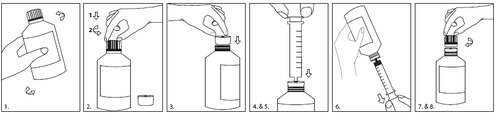
- 1. Shake well before use.
- 2. Press (1) and rotate (2) the cap to open the bottle.
- 3. Insert the adapter into the neck of the bottle until a perfect seal is achieved.
- 4. Press the syringe plunger all the way down.
- 5. Insert the syringe as far as possible into the opening of the adapter.
- 6. Turn upside down and draw the prescribed amount of Inovelon from the bottle.
- 7. Return to the vertical position and remove the syringe.
- 8. Leave the adapter in place and put the cap back on the bottle.
- 9. After administering the dose, separate the syringe body from the plunger and completely immerse both components in WARM soapy water.
- 10. Immerse the syringe body and plunger in water to remove any residual detergent, remove excess water and allow the components to air dry. Do not dry the administration devices by rubbing them with a cloth.
- 11. Do not clean and reuse the syringe after 40 uses, or if the markings on the syringe are removed during washing.
Do not reduce the dose or stop taking the medicine unless instructed by your doctor.
If you take more Inovelon than you should
If there is a possibility that you have taken more Inovelon than you should have, immediately inform
your doctor or pharmacist, or contact the emergency department of the nearest hospital, bringing with
you the medicine.
If you forget to take Inovelon
If you forget to take a dose, continue to take the medicine as usual. Do not take
a double dose to make up for the missed dose. If you forget more than one dose, consult your
doctor.
If you stop taking Inovelon
If your doctor advises you to stop treatment, follow their instructions regarding the
gradual reduction of Inovelon, in order to reduce the risk of an increase in seizures.
If you have any doubts about the use of this medicine, ask your doctor or pharmacist.
4. Possible side effects
Like all medicines, this medicine can cause side effects, although not everybody gets them.
The following side effects can be very serious:
Skin rash and/or fever. These may be signs of an allergic reaction. If they appear,
tell your doctor or go to hospital immediately.
Change in the type of seizures you are having / seizures that are more frequent and
last longer (called status epilepticus). Tell your doctor immediately.
A small number of people treated with antiepileptics, such as Inovelon, have had thoughts of
harming themselves or committing suicide. If at any time you have these thoughts, contact
your doctor immediately (see section 2).
The following side effects may occur with this medicine. Tell your doctor if
you experience any of the following effects:
Very common side effects of Inovelon (more than 1 in 10 people) are:
Dizziness, headache, nausea, vomiting, drowsiness, fatigue.
Common side effects of Inovelon (more than 1 in 100 people) are:
Problems affecting the nervous system, such as: difficulty walking, abnormal movements,
convulsions/seizures, unusual eye movements, blurred vision,
tremor.
Problems affecting the stomach, such as: stomach pain, constipation, indigestion, soft stools
(diarrhea), loss or changes in appetite, weight loss.
Infections: ear infection, influenza, nasal congestion, chest infection.
In addition, patients have reported: anxiety, insomnia, nosebleeds, acne, skin rash, back pain, infrequent
menstruations, bruising, head injuries (as a result of
an accidental injury during a seizure).
Uncommon side effects of Inovelon (between 1 in 100 and 1 in 1000 people) are:
Allergic reactions and increased indicators of liver function (increased liver enzymes).
Reporting of side effects
If you get any side effects, talk to your doctor or pharmacist. You can also report side effects directly
through the national reporting system listed in Annex V. By reporting side effects you can help to provide
more information on the safety of this medicine.
5. How to store Inovelon
Keep this medicine out of the sight and reach of children.
Do not use this medicine after the expiry date which is reported on the label of the bottle and on the
carton. The expiry date refers to the last day of that month.
If any suspension remains in the bottle for more than 90 days from the first opening, do not use it.
Do not use the suspension if you notice changes in the appearance or odour of the medicine. Return the
medicine to the pharmacist.
Do not dispose of any medicine in wastewater or household waste. Ask the pharmacist how to
dispose of medicines you no longer use. This will help protect the environment.
6. Contents of the pack and other information
What Inovelon contains
- The active ingredient is rufinamide. Each millilitre contains 40 mg of rufinamide. 5 ml contain 200 mg of rufinamide.
- The other ingredients are microcrystalline cellulose and sodium carboxymethylcellulose, anhydrous citric acid, simethicone emulsion 30% (containing purified water, silicone oil, polysorbate 65, methylcellulose, silica gel, polyethylene glycol stearate, sorbic acid, benzoic acid (E210) and sulfuric acid), poloxamer 188, orange flavour, hydroxyethylcellulose, methylparahydroxybenzoate (E218), potassium sorbate (E202), propylparahydroxybenzoate, propylene glycol (E1520), sorbitol (E420), liquid (non-crystallizing) and purified water.
Description of Inovelon and contents of the pack
- Inovelon is a slightly viscous, white suspension. It is supplied in a 460 ml bottle, with two identical syringes and a pressure adapter for bottles (PIBA). The syringes are graduated in increments of 0.5 ml.
Marketing authorisation holder and manufacturer
Marketing authorisation holder:
Eisai GmbH
Edmund-Rumpler-Straße 3
60549 Frankfurt am Main
Germany
e-mail: [email protected]
Manufacturer:
Eisai GmbH
Edmund-Rumpler-Straße 3
60549 Frankfurt am Main
Germany
For further information on this medicinal product, contact the local representative of the marketing
authorisation holder:
België/Belgique/Belgien
Eisai SA/NV
Tél/Tel: +32 (0)800 158 58
Lietuva
Eisai GmbH
Tel: + 49 (0) 69 66 58 50
България
Eisai GmbH
Teл.: + 49 (0) 69 66 58 50
(Germany)
Luxembourg/Luxemburg
Eisai SA/NV
Tél/Tel: +32 (0)800 158 58
(Belgique/Belgien)
Česká republika
Eisai GesmbH organizačni složka
Tel: + 420 242 485 839
Magyarország
Eisai GmbH
Tel.: + 49 (0) 69 66 58 50
Danmark
Eisai AB
Tlf: + 46 (0) 8 501 01 600
(Sverige)
Malta
Cherubino LTD
Tel.: +356 21343270
Deutschland
Eisai GmbH
Tel: + 49 (0) 69 66 58 50
Nederland
Eisai B.V.
Tél/Tel: + 31 (0) 900 575 3340
Eesti
Eisai GmbH
Tel: + 49 (0) 69 66 58 50
(Germany)
Norge
Eisai AB
Tlf: + 46 (0) 8 501 01 600
(Sverige)
Ελλάδα
Arriani Pharmaceutical S.A.
Τηλ: + 30 210 668 3000
Österreich
Eisai GesmbH
Tel: + 43 (0) 1 535 1980-0
España
Eisai Farmacéutica, S.A.
Tel: + (34) 91 455 94 55
Polska
Eisai GmbH
Tel: + 49 (0) 69 66 58 50
(Germany)
France
Eisai SAS
Tél: + (33) 1 47 67 00 05
Portugal
Eisai Farmacêtica, Unipessoal Lda
Tel: + 351 214 875 540
Hrvatska
Eisai GmbH
Tel: + 49 (0) 69 66 58 50
România
Eisai GmbH
Tel: + 49 (0) 69 66 58 50
(Germany)
Ireland
Eisai GmbH
Tel: + 49 (0) 69 66 58 50
Slovenija
Eisai GmbH
Tel: + 49 (0) 69 66 58 50
(Germany)
Ísland
Eisai AB
Sími: + 46 (0)8 501 01 600
(Sweden)
Slovenská republika
Eisai GesmbH organizačni složka
Tel.: + 420 242 485 839
(Česká republika)
Italia
Eisai S.r.l.
Tel: + 39 02 5181401
Suomi/Finland
Eisai AB
Puh/Tel: + 46 (0) 8 501 01 600
(Sweden)
Κύπρος
Arriani Pharmaceuticals S.A.
Τηλ: + 30 210 668 3000
(Ελλάδα)
Sverige
Eisai AB
Tel: + 46 (0) 8 501 01 600
Latvija
Eisai GmbH
Tel: + 49 (0) 69 66 58 50
(Germany)
United Kingdom (Northern Ireland)
Eisai GmbH
Tel: + 49 (0) 69 66 58 50
(Germany)
More detailed information on this medicinal product is available on the website of the European
Medicines Agency http://www.ema.europa.eu.

Не впевнені, чи підходить вам цей лікарський засіб?
Обговоріть симптоми та можливі варіанти лікування з лікарем онлайн.

Виникли питання під час прийому ліків?
Обговоріть свої симптоми та лікування з лікарем онлайн.

- Країна реєстрації
- Лікарська формаFilm-coated tablet, 100 MG
- Код АТХN03AF03
- Діюча речовина
- Потрібен рецептТак
- Виробник
- Ця інформація надана лише для ознайомлення і не є медичною порадою. Рішення щодо лікування завжди приймає лікар.
- Альтернативи до INOVELONЛікарська форма: Extended-release tablet, 200 MGДіюча речовина: карбамазепинаВиробник: AUROBINDO PHARMA (ITALIA) S.R.L.Потрібен рецептЛікарська форма: Tablet, 200 MGДіюча речовина: карбамазепинаВиробник: EG S.P.A.Потрібен рецептЛікарська форма: Coated tablet, 800 MGДіюча речовина: eslicarbazepineВиробник: MEDITOP PHARMACEUTICAL LTD.Рецепт не потрібен
Аналоги INOVELON в інших країнах
Препарати з тією самою діючою речовиною, доступні в інших країнах.
Аналог INOVELON у Іспанія
Лікарі онлайн щодо INOVELON
Застосування, безпека та можливість призначення рецепта — за результатами медичної оцінки.



Отримайте рецепт на INOVELON онлайн
Заповніть форму за 2 хвилини
Розкажіть про симптоми, історію хвороби та потрібний препарат.
Оберіть лікаря або ми призначимо
Оберіть спеціаліста або ми підберемо найближчого доступного лікаря.
Лікар розглядає ваш випадок
Зазвичай протягом 30 хвилин. Може ставити уточнювальні запитання в чаті.
Отримайте в будь-якій аптеці
Електронний рецепт надсилається на вашу пошту — дійсний по всій Польщі.
Часті запитання
INOVELON потребує рецепта в Італія. Ви можете обговорити з лікарем онлайн, чи підходить цей лікарський засіб для вашої ситуації.
Діюча речовина у INOVELON — Руфинамид. Це допомагає визначити препарати з тим самим складом, але під іншими торговими назвами.
INOVELON виробляється компанією EISAI GMBH. Назва бренду та упаковка можуть відрізнятися залежно від дистрибʼютора.
Лікарі, зокрема Сімейні лікарі, Психіатри, Дерматологи, Кардіологи, Ендокринологи, Гастроентерологи, Пульмонологи, Нефрологи, Ревматологи, Гематологи, Інфекціоністи, Алергологи, Геріатри, Педіатри, Онкологи, можуть оцінити доцільність застосування INOVELON з урахуванням вашого стану та місцевих правил. Ви можете записатися на онлайн-консультацію, щоб обговорити симптоми та можливі подальші кроки.
Польща має добре розвинену систему охорони здоров'я у великих містах, таких як Варшава, Краків, Вроцлав і Гданськ. Аптеки широко доступні та працюють відповідно до чинного законодавства, забезпечуючи доступ до рецептурних препаратів.
Ви можете придбати INOVELON у Варшаві, Кракові, Вроцлаві або Гданську в будь-якій аптеці за наявності дійсного рецепта.
Щоб отримати рецепт, ви можете скористатися Oladoctor:
Інші препарати з тією самою діючою речовиною (Руфинамид) включають KARBAMATSEPINA AUROBINDO, KARBAMATSEPINA EG, ESLIKARBATSEPINA MEDITOP. Вони можуть відрізнятися торговою назвою або формою випуску, але містять той самий терапевтичний компонент. Перед зміною або початком прийому нового препарату варто проконсультуватися з лікарем.
