



GABAPENTIN 100 mg Kapsułki Twarde

Ocena recepty online
Lekarz przeanalizuje Twój przypadek i zdecyduje, czy wystawienie recepty jest medycznie uzasadnione.

Porozmawiaj z lekarzem o tym leku
Omów swoje objawy i opcje leczenia podczas szybkiej konsultacji online.



Jak stosować GABAPENTIN TEVA
Treść ulotki
Gabapentin Teva 100 mg hard capsules, 300 mg hard capsules, 400 mg hard capsules
gabapentin
Generic medicine
Read this leaflet carefully before you start taking this medicine because it contains
important information for you.
- Keep this leaflet. You may need to read it again.
- If you have any questions, ask your doctor or pharmacist.
- This medicine has been prescribed for you only. Do not pass it on to others, even if their symptoms are the same as yours, as it could be harmful.
- If you get any side effects, even those not listed in this leaflet, tell your doctor or pharmacist. See section 4.
Contents of this leaflet
- 1. What Gabapentin Teva is and what it is used for
- 2. What you need to know before you take Gabapentin Teva
- 3. How to take Gabapentin Teva
- 4. Possible side effects
- 5. How to store Gabapentin Teva
- 6. Contents of the pack and other information
1. What is Gabapentin Teva and what it is used for
Gabapentin Teva belongs to a group of medicines used for the treatment of epilepsy and peripheral neuropathic pain (a long-lasting pain caused by damage to the nerves).
The active substance of Gabapentin Teva is gabapentin.
Gabapentin Teva is used to treat:
- Various forms of epilepsy (seizures initially limited to certain areas of the brain, whether the seizures spread to other parts of the brain or not). Your doctor will prescribe Gabapentin Teva to you or your child aged 6 years or older as an adjunct to epilepsy treatment if the treatment you are already following is unable to completely control the disease. You or your child aged 6 years or older must take Gabapentin Teva in addition to ongoing treatment, unless otherwise indicated by your doctor. Gabapentin Teva can also be used alone to treat adults and children over 12 years of age.
- Peripheral neuropathic pain (long-lasting pain caused by nerve damage). A wide variety of diseases can cause peripheral neuropathic pain (primarily occurs at the level of legs and/or arms), such as diabetes or herpes zoster. Painful sensations are described in various ways, such as heat, burning, throbbing pain, stabbing pain, sharp, penetrating, cramping, dull, stinging, numbness, tingling, etc.
2. What you need to know before taking Gabapentin Teva
Do not take Gabapentin Teva:
- if you are allergic to gabapentin or to any of the other ingredients of this medicine (listed in section 6).
Warnings and precautions
Talk to your doctor or pharmacist before taking Gabapentin Teva
- if you have kidney problems. In this case, your doctor may prescribe a different dosage
- if you are undergoing hemodialysis (to remove waste products due to kidney failure), tell your doctor if you develop muscle pain and/or weakness
- if you develop symptoms such as persistent stomach pain, feeling unwell and a general feeling of illness, contact your doctor immediately as these may be symptoms of acute pancreatitis (inflammation of the pancreas)
- if you suffer from nervous system or respiratory diseases or are over 65 years of age, your doctor may prescribe different doses
- before taking this medicine, tell your doctor if you have ever abused or developed a dependence on alcohol, prescription drugs or illegal drugs; in this case you may have a higher risk of becoming dependent on Gabapentin Teva.
Dependence
Some people may develop a dependence on Gabapentin Teva (a need to continue taking the medicine). These people may experience withdrawal effects when stopping the use of Gabapentin Teva (see section 3, “How to take Gabapentin Teva” and “If you stop taking Gabapentin Teva”). If you are concerned that you may develop a dependence on Gabapentin Teva, it is important that you consult your doctor.
If you notice any of the following signs while taking Gabapentin Teva, this could indicate that you have developed a dependence.
- If you feel the need to take the medicine for a longer period than prescribed by your doctor
- If you think you need to take a higher dose than the one recommended to you
- If you are using the medicine for reasons other than those for which it was prescribed
- If you have repeatedly tried unsuccessfully to stop or control the use of the medicine
- If when you stop taking the medicine you feel unwell and feel better when you start taking it again
If you notice any of these signs, talk to your doctor to discuss the best treatment plan for you, including the appropriate time to stop treatment and how to do so safely.
A small number of patients treated with antiepileptic medicines like gabapentin have experienced self-harmful or suicidal thoughts. If you should have thoughts of this kind at any time, contact your doctor immediately.
Important information about potentially serious reactions
Serious skin reactions, including Stevens-Johnson syndrome, toxic epidermal necrolysis and drug reaction with eosinophilia and systemic symptoms (DRESS), have been reported with gabapentin. Stop using gabapentin and contact your doctor immediately if you notice any of the symptoms related to the serious skin reactions described in section 4.
Immediately contact your doctor if you experience any of the following symptoms after taking this
medicine, as they may be serious”.
Muscle weakness, tenderness or pain, especially if at the same time you do not feel well and have a fever, may be caused by muscle injury that can be life-threatening and can lead to kidney problems. You may also experience discoloration of the urine and abnormalities in blood tests (in particular an increase in creatine phosphokinase). If you experience any of these signs or symptoms, contact your doctor immediately.
Other medicines and Gabapentin Teva
Tell your doctor or pharmacist if you are taking, have recently taken or might take any other medicines. In particular, tell your doctor (or pharmacist) if you are taking or have recently taken medicines for convulsions, sleep disorders, depression, anxiety or other neurological or psychiatric problems.
Medicines containing opioids such as morphine
If you are using medicines that contain opioids (such as morphine), tell your doctor or pharmacist, as opioids can increase the effect of Gabapentin Teva. In addition, the combination of Gabapentin Teva with opioids can cause symptoms such as drowsiness, sedation, decreased breathing or death.
Antacids for indigestion
If Gabapentin Teva and antacids containing aluminum and magnesium are taken simultaneously, the absorption of Gabapentin Teva from the stomach may be reduced. It is therefore recommended to take Gabapentin Teva at least two hours after taking the antacid.
Gabapentin Teva
- is not expected to interact with other antiepileptics or with the contraceptive pill.
- may interfere with some laboratory tests; therefore, if you need to have a urine test, tell your doctor or the hospital what you are taking.
Gabapentin Teva with food
Gabapentin Teva can be taken with or without food.
Pregnancy, breastfeeding and fertility
- If you are pregnant or suspect you may be pregnant, you should immediately inform your doctor about the medicine you are taking and discuss the possible risks to the fetus.
- Do not stop treatment without talking to your doctor.
- If you are planning a pregnancy, talk to your doctor or pharmacist as soon as possible before trying to become pregnant.
- If you are breastfeeding or planning to do so, ask your doctor or pharmacist for advice before taking this medicine.
Pregnancy
Gabapentin Teva can be used during the first trimester of pregnancy, if necessary.
Talk to your doctor immediately if you are planning a pregnancy, if you are pregnant or if you think you may be pregnant.
If you are pregnant and suffer from epilepsy, it is important that you do not stop taking the medicine without first consulting your doctor as stopping it could worsen the condition. Worsening of epilepsy could put you and the fetus at risk.
In a study that examined data on women from Nordic countries who had taken gabapentin in the first 3 months of pregnancy, the risk of birth defects or problems with the development of brain function (neurodevelopmental disorders) was not found to be increased. However, babies born to women who had taken gabapentin during pregnancy had a higher risk of low birth weight and preterm birth.
Contact your doctor immediately if you are pregnant, if you think you may be pregnant or if you are planning a pregnancy while taking Gabapentin Teva. Do not suddenly stop taking this medicine, as this may cause the sudden onset of seizures which can have serious consequences for you and your baby.
If used during pregnancy, gabapentin can cause withdrawal symptoms in newborns. This risk may increase when gabapentin is taken at the same time as opioid pain relievers (medicines for the treatment of severe pain).
Breastfeeding
Gabapentin, the active ingredient of Gabapentin Teva, passes into human breast milk. As the effect on the baby is unknown, breastfeeding is not recommended during treatment with Gabapentin Teva.
Fertility
Animal studies have not shown any effect on fertility.
Driving and using machines
Gabapentin Teva can cause dizziness, drowsiness and fatigue. Therefore, you should not drive, use complex machinery or engage in other potentially dangerous activities until you know how this medicine affects your ability to perform these activities.
Gabapentin Teva contains sodium
This medicine contains less than 1 mmol (23 mg) of sodium per dose, that is to say essentially “sodium-free”.
3. How to take Gabapentin Teva
Take this medicine exactly as your doctor or pharmacist has told you. If you
have any doubts, ask your doctor or pharmacist. Do not take a higher amount of medicine than
prescribed.
Your doctor will determine the most suitable dose for you.
Epilepsy, the recommended dose is
Adults and adolescents
Take the number of capsules prescribed by your doctor. Usually, your doctor will gradually increase the dose
. The initial dose will generally be between 300 mg and 900 mg per day.
Subsequently, the dose may be increased, as directed by your doctor, up to a maximum of
3600 mg per day, and your doctor will tell you to take this dose in 3 separate administrations, i.e., once
in the morning, once in the afternoon, and once in the evening.
Use in children
Children aged 6 years and over
The dose to be administered to the child is determined by the doctor, as it is calculated based on the child's
body weight. Treatment starts with a low initial dose, which is then gradually
increased over approximately 3 days. The usual dose for controlling epilepsy is 25-35
mg/kg/day. It is usually administered in 3 separate doses, taking the capsule(s) each day
generally once in the morning, once in the afternoon, and once in the evening.
The use of Gabapentin Teva is not recommended in children under the age of 6 years.
Peripheral neuropathic pain, the recommended dose is
Adults
Take the number of capsules following your doctor's instructions. Usually, your doctor will gradually increase the
dose. The initial dose will generally be between 300 mg and 900 mg per day.
Subsequently, the dose may be increased, as directed by your doctor, up to a maximum of
3600 mg per day, and your doctor will tell you to take this dose in 3 separate administrations, i.e., once
in the morning, once in the afternoon, and once in the evening.
If you have kidney problems or are undergoing hemodialysis
If you have kidney problems or are undergoing hemodialysis, your doctor may prescribe a different dosing
schedule and/or a different dose.
If you are an elderly patient (over 65 years of age)
You should take the normal dose of Gabapentin Teva, unless you have kidney problems. If you
have kidney problems, your doctor may prescribe a different dosing schedule and/or a
different dose.
If you feel that the effect of Gabapentin Teva is too strong or too weak, tell your
doctor or pharmacist as soon as possible.
Method of administration
Gabapentin Teva is taken orally. Always swallow the capsules whole with plenty of
water.
Gabapentin Teva can be taken with or without food.
Continue treatment with Gabapentin Teva until your doctor tells you to stop.
If you take more Gabapentin Teva than you should
Taking doses higher than those recommended may cause an increase in side
effects, including loss of consciousness, dizziness, double vision, difficulty speaking, drowsiness, and
diarrhea. If you have taken more Gabapentin Teva than prescribed by your doctor, contact your
doctor immediately or go to the nearest emergency room. Bring with you the capsules you have not taken together with the
container and label, so that the hospital doctors can immediately recognize which
medicine you have taken.
If you forget to take Gabapentin Teva
If you forget to take a dose, take it as soon as you remember, unless it is already time to
take the next dose.
Do not take a double dose to make up for the missed dose.
If you stop taking Gabapentin Teva
Do not suddenly stop taking Gabapentin Teva. If you want to stop
taking Gabapentin Teva, talk to your doctor first. Your doctor will tell you what to do. The
discontinuation of treatment must occur gradually, over a period of at least one week. You should know that, once treatment is stopped after a short or long term
with Gabapentin Teva, you may develop some side effects, the so-called withdrawal effects.
These effects may include seizures, anxiety, difficulty sleeping, nausea, pain,
sweating, tremors, headache, depression, altered sensations, dizziness, and general malaise.
These effects usually occur within 48 hours of stopping Gabapentin Teva.
If you experience withdrawal effects, contact your doctor immediately.
If you have any doubts about the use of this medicine, ask your doctor or pharmacist.
4. Possible side effects
Like all medicines, this medicine can cause side effects, although not everyone gets them.
Stop taking Gabapentin Teva and contact your doctor immediately if you notice any of the
following symptoms:
- reddish, non-raised, target-like or circular patches on the trunk, often with blisters in the centre, skin peeling, ulcers of the mouth, throat, nose, genitals and eyes. These severe skin rashes may be preceded by fever and flu-like symptoms (Stevens-Johnson syndrome, toxic epidermal necrolysis).
- widespread rash, high body temperature and swollen lymph nodes (DRESS syndrome or drug reaction with eosinophilia and systemic symptoms).
Contact your doctor immediately if any of the following symptoms occur after taking
this medicine, as they may be serious:
- persistent stomach pain, feeling and being unwell as these can be symptoms of acute pancreatitis (inflammation of the pancreas)
- breathing problems which, if severe, may require emergency and intensive care to allow you to continue breathing normally
- Gabapentin Teva can cause a severe or life-threatening allergic reaction, which can affect the skin or any other part of the body, such as the liver or blood. This type of reaction may or may not cause a rash. This may lead to hospitalisation or discontinuation of treatment with Gabapentin Teva. Call your doctor immediately if you experience any of the following symptoms:
- skin rash and redness and/or hair loss
- hives
- fever
- swollen lymph glands that do not go away
- swelling of the lips, face and tongue
- yellowing of the skin or the whites of the eyes
- unusual bleeding or bruising
- severe fatigue or weakness
- sudden muscle pain
- frequent infections
These symptoms may be the first signs of a severe allergic reaction. A doctor needs to
see you to decide if you can continue to take Gabapentin Teva.
- If you are on haemodialysis, tell your doctor if you experience pain and/or muscle weakness.
Other side effects include:
Very common (may affect more than 1 in 10 people)
- Viral infection
- Feeling sleepy, dizziness, lack of coordination
- Feeling tired, fever
Common (may affect up to 1 in 10 people)
- Pneumonia, respiratory infections, urinary tract infections, ear inflammation or other infections
- Low number of white blood cells
- Loss of appetite, increased appetite
- Anger towards others, confusion, mood changes, depression, anxiety, nervousness, difficulty thinking
- Convulsions, jerky movements, difficulty speaking, memory loss, tremor, difficulty sleeping, headache, skin sensitivity, reduced sensitivity
(numbness), difficulty coordinating, abnormal eye movements, reflexes
increased, decreased or absent
- Blurred vision, double vision
- Dizziness
- High blood pressure, flushing or widening of blood vessels
- Difficulty breathing, bronchitis, sore throat, cough, dry nose
- Vomiting (feeling sick), nausea (feeling unwell), dental problems, inflamed gums, diarrhoea, stomach pain, indigestion, constipation, dry mouth or throat, flatulence
- Swelling of the face, bruising, rash, itching, acne
- Joint pain, muscle pain, back pain, muscle cramps
- Difficulty getting an erection (impotence)
- Swelling of the legs and arms, difficulty walking, weakness, pain, feeling unwell, flu-like symptoms
- Decreased white blood cells, weight gain
- Accidental injuries, fractures, abrasions
In addition, aggressive behaviour and jerky movements have been commonly reported in children in clinical studies.
Uncommon (may affect up to 1 in 100 people)
- Agitation (a state of chronic restlessness and involuntary and unmotivated movements)
- Allergic reactions such as hives
- Reduced movement
- Fast heartbeat
- Difficulty swallowing
- Swelling that can involve the face, trunk and limbs
- Abnormal blood test values suggesting liver problems
- Mental impairment
- Falls
- Increased blood glucose levels (observed more often in patients with diabetes)
Rare (may affect up to 1 in 1000 people)
- Decreased blood glucose levels (observed more often in patients with diabetes)
- Loss of consciousness
- Difficulty breathing, shallow breathing (respiratory depression)
The following side effects have been reported after marketing of gabapentin:
- Decreased platelets (cells for blood clotting)
- Suicidal thoughts, hallucinations
- Problems with abnormal movements such as contortions, jerky movements and rigidity
- Ringing in the ears
- Yellowing of the skin and eyes (jaundice), inflammation of the liver
- Acute kidney failure, incontinence
- Increased breast tissue, breast enlargement
- Adverse events following abrupt discontinuation of gabapentin (anxiety, difficulty sleeping, feeling unwell, pain, sweating), chest pain
- Muscle fibre injury (rhabdomyolysis)
- Abnormalities in blood tests (increased creatine phosphokinase)
- Sexual dysfunction including inability to reach orgasm, delayed ejaculation
- Low sodium levels in the blood
- Anaphylaxis (a serious and potentially life-threatening allergic reaction including difficulty breathing, swelling of lips, throat and tongue, low blood pressure requiring emergency treatment)
- Development of dependence on Gabapentin Teva
After stopping short- or long-term treatment with Gabapentin Teva, you may develop some side effects, so-called withdrawal effects (see “If you stop taking Gabapentin Teva”).
Reporting of side effects
If you get any side effects, talk to your doctor or pharmacist. This includes any side effects not listed in this leaflet. You can also report side effects directly through the
national reporting system at https://www.aifa.gov.it/content/segnalazioni-reazioni-
avverse . By reporting side effects you can help provide more information on the
safety of this medicine.
5. How to store Gabapentin Teva
Keep this medicine out of the sight and reach of children.
Do not use this medicine after the expiry date which is stated on the package and on the blister or on the
bottle after Exp. The expiry date refers to the last day of that month.
This medicine does not require any particular storage conditions.
Do not dispose of any medicine in waste water or household waste. Ask your pharmacist how to
dispose of medicines you no longer use. This will help protect the environment.
6. Package contents and other information
What Gabapentin Teva contains
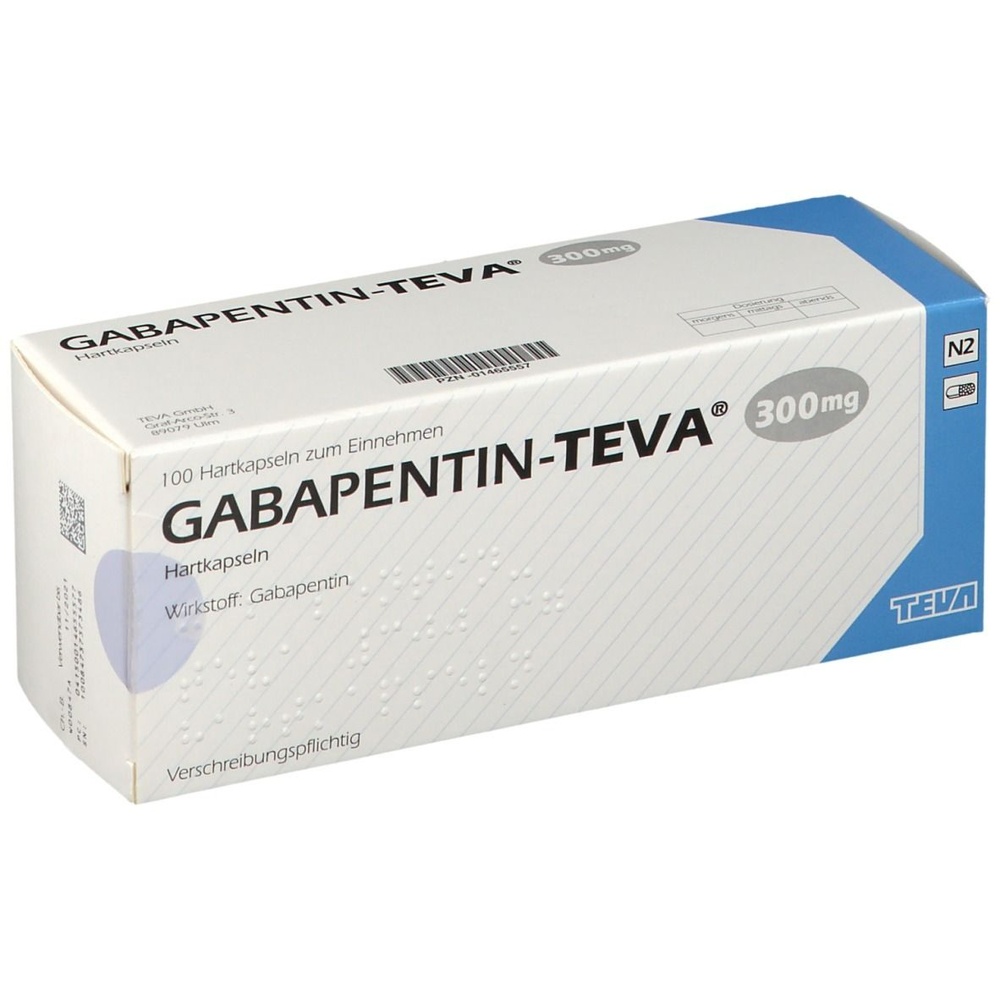
- The active ingredient is gabapentin. Each hard capsule contains 100 mg of gabapentin. Each hard capsule contains 300 mg of gabapentin. Each hard capsule contains 400 mg of gabapentin.
- The other ingredients are:
Capsule content: corn starch, mannitol (E421), talc (E553b)
Capsule shell: gelatin, titanium dioxide (E171), yellow iron oxide (E172), iron oxide
black (E172), iron oxide red (E172), purified water, sodium lauryl sulfate
Printing inks:
Black printing ink: shellac (E904), iron oxide black (E172)
100 mg:
White printing ink: shellac (E904), titanium dioxide (E171)
Description of the appearance of Gabapentin Teva and package contents
Gabapentin Teva 100 mg are hard capsules (approximately 16 mm in length), with an opaque white body with
the inscription TV 3494 printed in black and a light brown opaque cap with the inscription TV 3494 printed
in white.
Gabapentin Teva 300 mg are hard capsules (approximately 19 mm in length), with an opaque yellow body with
the inscription TV 3495 printed in black and a light brown opaque cap with the inscription TV 3495 printed
in black.
Gabapentin Teva 400 mg are hard capsules (approximately 22 mm in length), with an opaque orange body
with the inscription TV 3496 printed in black and a light brown opaque cap with the inscription TV 3496
printed in black.
Gabapentin Teva is available in blisters containing 20, 30, 50, 60, 90, 100 or 200 hard capsules, divisible blisters
for unit dose containing 20x1, 30x1, 50x1, 60x1, 90x1, 100x1 or 200x1 hard capsules or
a bottle containing 50, 100 or 200 hard capsules.
Not all pack sizes may be marketed.
Marketing authorisation holder and manufacturer
Teva B.V.
Swensweg 5
2031 GA Haarlem
Netherlands
Manufacturer
Teva Pharmaceutical Works Private Limited Company, Pallagi út 13. Debrecen H-4042, Hungary
Teva Nederland B.V., Swensweg 5, 2031 GA Haarlem, Netherlands
Teva Operations Poland, Sp. z.o.o, ul. Mogilska 80. 31-546, Krakow, Poland
This medicinal product is authorised in the Member States of the European Economic Area with the
following names:
Austria Gabapentin ratiopharm GmbH 100 mg Hartkapseln
Gabapentin ratiopharm GmbH 300 mg Hartkapseln
Gabapentin ratiopharm GmbH 400 mg Hartkapseln
Belgium Gabapentine Teva 100 mg harde capsules/gélules/Hartkapseln
Gabapentine Teva 300 mg harde capsules/gélules/Hartkapseln
Gabapentine Teva 400 mg harde capsules/gélules/Hartkapseln
Czechia Gabapentin Teva B.V.
Denmark Gabapentin Teva
Estonia Gabapentin Teva
Finland Gabapentin ratiopharm GmbH 300 mg kapseli, kova
Gabapentin ratiopharm GmbH 400 mg kapseli, kova
France Gabapentine Teva Santé 100 mg, gélule
Gabapentine Teva Santé 300 mg, gélule
Gabapentine Teva Santé 400 mg, gélule
Germany Gabapentin Teva 100, 300, 400 mg Hartkapseln
Ireland Gabapentin Teva 100 mg, 300 mg & 400 mg hard capsules
Iceland Gabapentin Teva
Italy Gabapentin Teva
Latvia Gabapentin Teva 300 mg cietās kapsulas
Gabapentin Teva 400 mg cietās kapsulas
Lithuania Gabapentin Teva 300 mg kietosios kapsulės
Gabapentin Teva 400 mg kietosios kapsulės
Netherlands Gabapentine ratiopharm 100 mg, harde capsules
Gabapentine ratiopharm 300 mg, harde capsules
Gabapentine ratiopharm 400 mg, harde capsules
Poland Gabapentin Teva B.V.
Portugal Gabapentina ratiopharm
Romania Gabapentină Teva 100 mg capsule
Gabapentină Teva 300 mg capsule
Gabapentină Teva 400 mg capsule
Slovakia Gabapentin Teva B.V. 100 mg
Gabapentin Teva B.V. 300 mg
Gabapentin Teva B.V. 400 mg
Spain Gabapentina Teva-ratiopharm 100 mg cápsulas duras EFG
Gabapentina Teva-ratiopharm 300 mg cápsulas duras EFG
Gabapentina Teva-ratiopharm 400 mg cápsulas duras EFG
Sweden Gabapentin Teva B.V.

Nie jesteś pewien, czy ten lek jest odpowiedni dla ciebie?
Omów swoje objawy i leczenie z lekarzem online.

Zacząłeś przyjmować lek i masz pytania?
Omów swoje objawy i leczenie z lekarzem online.
- Kraj rejestracji
- Postać farmaceutycznaHard capsule, 100 MG
- Kod ATCN02BF01
- Substancja czynna
- Wymaga receptyTak
- Producent
- Te treści mają charakter wyłącznie informacyjny i nie zastępują konsultacji lekarskiej.
- Zamienniki GABAPENTIN TEVAPostać farmaceutyczna: Hard capsule, 100 MGSubstancja czynna: gabapentinProducent: ABC FARMACEUTICI S.P.A.Wymaga receptyPostać farmaceutyczna: Hard capsule, 100 MGSubstancja czynna: gabapentinProducent: ALMUS S.R.L.Wymaga receptyPostać farmaceutyczna: Hard capsule, 300 MGSubstancja czynna: gabapentinProducent: LABORATORI ALTER S.R.L.Wymaga recepty
Odpowiedniki GABAPENTIN TEVA w innych krajach
Leki z tą samą substancją czynną dostępne w innych krajach.
Odpowiednik GABAPENTIN TEVA w Hiszpania
Odpowiednik GABAPENTIN TEVA w Polska
Odpowiednik GABAPENTIN TEVA w Ukraina
Lekarze online w sprawie GABAPENTIN TEVA
Omów stosowanie GABAPENTIN TEVA, bezpieczeństwo i ocenę zasadności recepty zgodnie z obowiązującymi przepisami.









Uzyskaj receptę na GABAPENTIN TEVA online
Wypełnij 2-minutowy formularz
Opisz swoje objawy, historię choroby i lek, o który prosisz.
Wybierz lekarza lub pozwól nam przydzielić
Wybierz specjalistę lub dopasujemy Cię do najbliższego dostępnego lekarza.
Lekarz analizuje Twój przypadek
Zazwyczaj w ciągu 30 minut. Może zadawać dodatkowe pytania przez czat.
Odbierz w dowolnej aptece
Recepta elektroniczna wysłana na Twój e-mail — ważna w całej Polsce.
Często zadawane pytania
GABAPENTIN TEVA wymaga recepty w Włochy. Możesz skonsultować się z lekarzem online, aby sprawdzić, czy ten lek może być odpowiedni w Twojej sytuacji.
Substancją czynną w GABAPENTIN TEVA jest gabapentin. Informacja ta pomaga rozpoznać leki o tym samym składzie, ale pod różnymi nazwami handlowymi.
GABAPENTIN TEVA jest produkowany przez TEVA B.V.. Nazwy handlowe i opakowania mogą się różnić w zależności od dystrybutora.
Lekarze, tacy jak Lekarze rodzinni, Psychiatrzy, Dermatolodzy, Kardiolodzy, Endokrynolodzy, Gastroenterolodzy, Pulmonolodzy, Nefrolodzy, Reumatolodzy, Hematolodzy, Zakaźnicy, Alergolodzy, Geriatrzy, Pediatrzy, Onkolodzy, mogą ocenić, czy stosowanie GABAPENTIN TEVA jest odpowiednie w Twoim przypadku, w zależności od sytuacji klinicznej i lokalnych przepisów. Możesz umówić konsultację online, aby omówić objawy i możliwe dalsze kroki.
Polska posiada dobrze rozwiniętą infrastrukturę ochrony zdrowia w dużych miastach, takich jak Warszawa, Kraków, Wrocław i Gdańsk. Apteki są łatwo dostępne i działają zgodnie z obowiązującymi przepisami, zapewniając dostęp do leków na receptę.
Możesz kupić GABAPENTIN TEVA w Warszawie, Krakowie, Wrocławiu lub Gdańsku w każdej aptece, posiadając ważną receptę.
Aby uzyskać receptę, możesz skorzystać z Oladoctor:
Inne leki zawierające tę samą substancję czynną (gabapentin) to m.in. GABAPENTIN ABK, GABAPENTIN ALMUS, GABAPENTIN ALTER. Mogą one różnić się nazwą handlową lub postacią, ale zawierają ten sam składnik terapeutyczny. Przed zmianą lub rozpoczęciem nowego leku skonsultuj się z lekarzem.
