



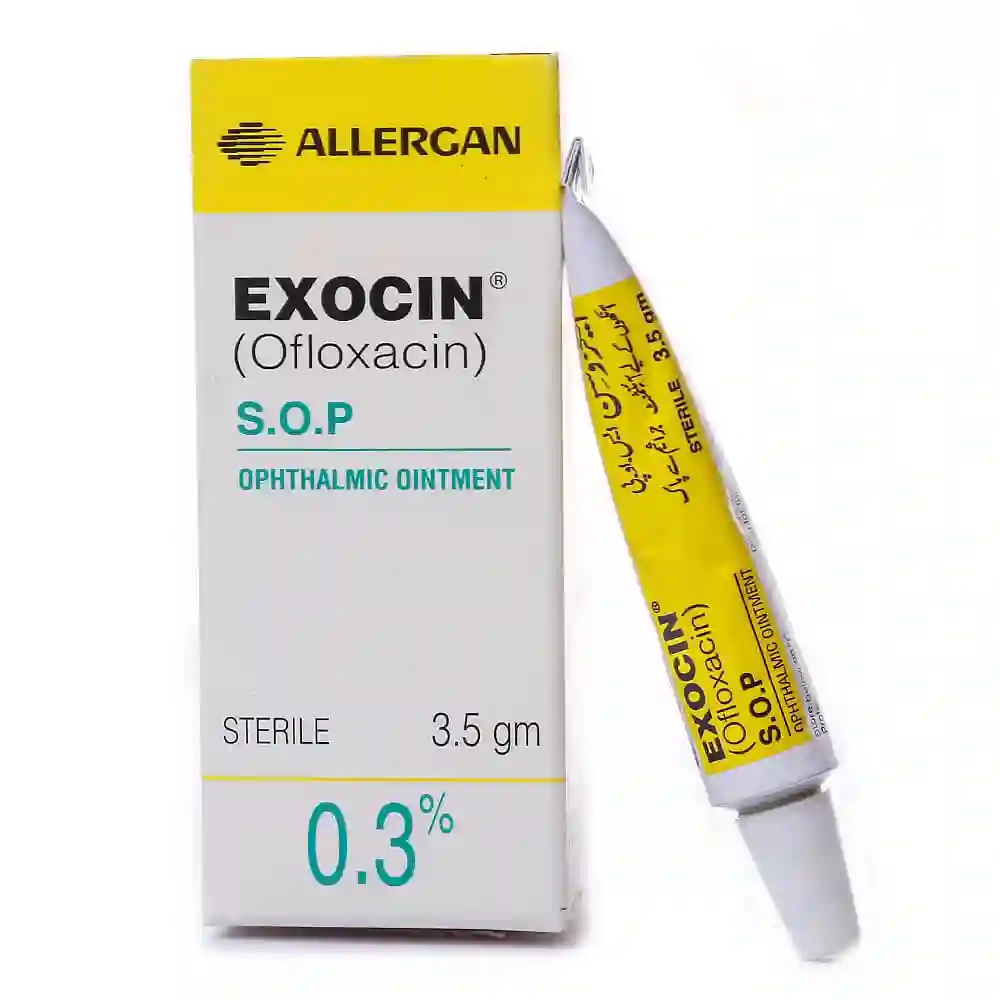
EXOCIN 0.3% Maść

Ocena recepty online
Lekarz przeanalizuje Twój przypadek i zdecyduje, czy wystawienie recepty jest medycznie uzasadnione.

Porozmawiaj z lekarzem o tym leku
Omów swoje objawy i opcje leczenia podczas szybkiej konsultacji online.



Jak stosować EXOKIN
Treść ulotki
- What EXOCIN is and what it is used for
- What you need to know before using EXOCIN
- How to use EXOCIN
- Possible side effects
- How to store EXOCIN
- Contents of the pack and other information
- EXOCIN 3 mg/g ophthalmic ointment
EXOCIN 3 mg/ml eye drops, solution
Ofloxacin
Read this leaflet carefully before you start using this medicine as it contains
important information for you.
- Keep this leaflet. You may need to read it again.
- If you have any questions, ask your doctor or pharmacist.
- This medicine has been prescribed for you only. Do not pass it on to others, even if they have the same symptoms as you, as it may be harmful.
- If you get any side effects, even those not listed in this leaflet, tell your doctor or pharmacist. See section 4.
Contents of this leaflet:
- 1. What EXOCIN is and what it is used for
- 2. What you need to know before you use EXOCIN
- 3. How to use EXOCIN
- 4. Possible side effects
- 5. How to store EXOCIN
- 6. Contents of the pack and other information
1. What EXOCIN is and what it is used for
EXOCIN contains ofloxacin which belongs to a group of medicines called fluoroquinolones.
Contact your doctor if you do not feel better or if you feel worse after 10 days.
EXOCIN 3 mg/ml eye drops are used for the treatment of external eye infections caused by
germs sensitive to ofloxacin, which lead to inflammation of the anterior lining of the eye
(conjunctivitis), or inflammation of the eyelid (blepharitis), simultaneous inflammation of
the anterior lining of the eye and eyelid (blepharoconjunctivitis), simultaneous
inflammation of the cornea and anterior lining of the eye (keratoconjunctivitis), inflammation of the lacrimal sac (dacryocystitis), inflammation of the group of sebaceous glands
present in the eyelid (meibomian glands dysfunction) and inflammation of the cornea (keratitis). EXOCIN is
also indicated for the treatment of ulcers on the surface of the eye caused by infections and
to prevent infections following surgical procedures.
2. What you need to know before using EXOCIN
Do not use EXOCIN
- if you are allergic to ofloxacin (or to other quinolone antibacterial agents) or to any of the other components of this medicine (listed in section 6).
Warnings and precautions
Talk to your doctor or pharmacist before using EXOCIN.
Tell your doctor if:
- you have experienced an allergy to other quinolones
- you wear contact lenses
- you were born with or have a family history of prolonged QT interval (displayed on an ECG, an electrical recording of the heart)
- you have an imbalance of certain minerals in the blood (especially a low level of potassium or magnesium)
- you have a very slow heart rate (called ‘bradycardia’)
- you have a weak heart (heart failure)
- you have a history of heart attack (myocardial infarction)
- you are a woman or elderly patient
- you are taking other medicines that can cause abnormal changes in the ECG (see section ‘ Other medicines and EXOCIN”)
- you have had a lesion/wound or an ulcer on the surface of the eye in the past.
If you experience an allergic reaction to ofloxacin, stop taking the medicine.
In patients who have taken quinolones orally or through a vein, including ofloxacin,
serious and rare allergic (anaphylactic/anaphylactoid) reactions with fatal outcome have been reported, some following the first dose.
Some reactions were accompanied by general circulatory failure, loss of
consciousness, rapid swelling of tissues (including swelling of the larynx, throat or face),
airway obstruction, shortness of breath, hives and itching. These reactions may occur
because a small amount of ofloxacin can be absorbed into the bloodstream after
ocular administration.
Prolonged use may cause a new bacterial infection that cannot be sufficiently
treated with EXOCIN.
When using EXOCIN, the risk of the eye drop passing into the nose and the
back of the throat, which can cause the development of bacterial resistance, must be considered. Like any other
antibiotic, prolonged use can cause an excessive development of microorganisms that do not
respond to ofloxacin; therefore, if you do not notice an improvement after 10 days,
stop use and consult an ophthalmologist.
Corneal precipitates (inflammatory deposits on the surface of the eye) have been reported in
patients who have received ofloxacin eye drops, but it is not clear whether the eye drops were the cause.
Damage to the front of the eye has been reported in patients with pre-existing lesions/wounds or ulcers
on the surface of the eye when treated with fluoroquinolone antibiotic eye drops.
However, significant elements of confusion have been found in many of these reports,
such as advanced age, the presence of large ulcers, concomitant eye conditions (e.g. severe dry eye), systemic inflammatory diseases (e.g. rheumatoid arthritis), and concomitant use of
ocular steroids or non-steroidal anti-inflammatory drugs. However, caution is necessary
regarding the risk of corneal perforation when using EXOCIN for the
treatment of patients with pre-existing lesions/wounds or ulcers on the surface of the eye.
EXOCIN potentially increases sensitivity to sunlight. During the use of EXOCIN, you must
avoid exposure to the sun or direct sunlight.
Children
The safety and efficacy of the product in infants under one year of age have not been
established, therefore use is not recommended.
Newborns (Children up to 28 days of age)
Information on the use of EXOCIN in newborns in the treatment of conjunctivitis is very
limited.
The use of EXOCIN in newborns with ophthalmia neonatorum caused by
Neisseria gonorrhoeae or Chlamydia trachomatis is not recommended as the use of
the product in these patients has not been evaluated.
Your doctor will decide the best treatment for the newborn.
Other medicines and EXOCIN
Tell your doctor or pharmacist if you are taking, have recently taken or might take
any other medicines.
Tell your doctor if:
- you are taking other medicines that can alter the heart rhythm: medicines that belong to the class of antiarrhythmics (for example quinidine, hydroquinidine, disopyramide, amiodarone, sotalol, dofetilide, ibutilide), tricyclic antidepressants, some antimicrobials (that belong to the class of macrolides), some antipsychotics.
It has been shown that the administration of drugs belonging to the same class
as ofloxacin, when taken orally or injected, can affect the way drugs
such as theophylline or caffeine are absorbed by the body, although studies show that
ofloxacin does not have this effect.
Although there has been an increase in the number of reports of drowsiness, depression and seizures
in cases where drugs belonging to the same class as ofloxacin have been taken
in conjunction with drugs in the class of non-steroidal anti-inflammatory drugs (such as aspirin,
ibuprofen, diclofenac, etc.), these have not been reported with the use of ofloxacin.
Pregnancy and breastfeeding
If you are pregnant, suspect you are pregnant or are planning to become pregnant, or if you are breastfeeding
ask your doctor or pharmacist for advice before using this medicine.
Since there are no adequate and well-controlled clinical studies in pregnant women and because systemic use of quinolones has caused problems with the joints in immature animals, it is not recommended to
use the medicine during pregnancy.
The use of the medicine during pregnancy and breastfeeding is not recommended. Your doctor
will assess whether to stop breastfeeding or therapy, taking into account the importance of the medicine for
you.
Driving and using machines
Studies have not been conducted on the ability to drive vehicles and operate machinery.
Transient blurred vision may occur immediately after using
EXOCIN. In this case, do not drive vehicles or use machinery until vision is
clear.
EXOCIN contains benzalkonium chloride
This medicine contains 0.05 mg of benzalkonium chloride in 1 ml of solution, equivalent to
0.05 mg/ml.
Benzalkonium chloride can be absorbed by soft contact lenses and can lead to
changing their color. Remove contact lenses before using this medicine and wait
15 minutes before re-applying them.
Benzalkonium chloride can also cause irritation to the eyes, especially if you have dry eyes or
corneal disorders (the most superficial transparent layer of the eye). If you experience an abnormal
sensation in the eye, burning or pain after using this medicine, talk to your doctor.
3. How to use EXOCIN
Use this medicine following exactly the instructions of your doctor or pharmacist. If you have any doubts, consult your doctor or pharmacist.
The recommended dose is 1-2 drops 4-6 times a day, or as prescribed by your doctor.
For the treatment of bacterial infectious keratitis and corneal ulcers, administration in the first two days of treatment may be more frequent (1-2 drops every 30 minutes, during the day), then in the following 7 days the dose must be gradually reduced to 1-2 drops every hour until completing the treatment with 1-2 drops 4 times a day.
Treatment with EXOCIN should be limited to the period necessary to achieve clinical healing.
EXOCIN can only be used as an ophthalmic eye drop: do not use for injections or intraocular use.
If you use more EXOCIN than you should
Rinse the eye with water.
In case of accidental intake of an excessive dose of EXOCIN, immediately inform your doctor or go to the nearest hospital.
If you forget to use EXOCIN
Do not use a double dose to make up for the missed dose.
If you stop using EXOCIN
If you have any doubts about the use of this medicine, consult your doctor or pharmacist.
4. Possible side effects
Like all medicines, this medicine can cause side effects, although not everybody gets them.
Serious side effects:
If you experience one or more of the following side effects, you may have hada severe
allergic reaction. Stop using Exocin immediately and contact your doctor.
Allergic reactions:
Frequency not known (cannot be estimated from available data)
- Allergic reactions in the eye (including itchy eyes and/or eyelids)
- Skin inflammation due to allergy (including: rash, itching or hives)
- Sudden, severe allergic reaction (anaphylactic) that is life-threatening, presenting with swelling under the skin that can occur in areas such as the face, lips or other parts of the body; swelling of the mouth, tongue or throat that can obstruct the airways, which can cause wheezing, difficulty swallowing, breathing or shortness of breath
- Life-threatening skin rashes (Stevens-Johnson syndrome, toxic epidermal necrolysis) have been reported with the use of EXOCIN, which initially appear as reddish spots resembling a target or circular patches often with central blisters on the trunk.
The following side effects may also occur:
You should contact your doctor if any of these side effects cause you problems or if they
persist.
Common side effects(may affect up to 1 in 10 people)
Side effects affecting the eye
- eye irritation
- eye discomfort
Side effects with frequency not known(cannot be estimated from the data
available)
Side effects affecting the eye
- inflammation of the clear front part of the eye
- redness and inflammation of the thin layer covering the white part of the eye
- blurred vision
- sensitivity to light
- swelling of the eyes
- feeling that something is in the eye
- increased tearing
- swelling around the eyes (including eyelid swelling)
- dry eye
- eye pain
- eye redness
Side effects affecting the body
- Dizziness
- Nausea
Side effects affecting the heart
- abnormally fast heart rate,
- life-threatening irregular heart rhythm,
- alteration of the heart rhythm (called ‘prolongation of the QT interval’, seen on ECG, heart electrical activity).
To reduce the risk of side effects, use EXOCIN as prescribed by your doctor.
Reporting of side effects
If you get any side effects, even those not listed in this leaflet, tell your doctor or
pharmacist. You can also report side effects directly through the national reporting system at
https://www.aifa.gov.it/content/segnalazioni-reazioni-avverse . By reporting side effects you can
help provide more information on the safety of this medicine.
5. How to store EXOCIN
Keep this medicine out of sight and reach of children.
Do not use this medicine after the expiry date which is stated on the pack after Expiry.
The expiry date refers to the last day of that month.
The expiry date indicated refers to the product in intact packaging, correctly
stored.
Discard the bottle 28 days after first opening, even if some solution remains.
Do not dispose of any medicine in wastewater or household waste. Ask your pharmacist how to
dispose of medicines you no longer use. This will help protect the environment.
6. Contents of the pack and other information
What EXOCIN contains
- The active ingredient is ofloxacin 3 mg/ml
- The other ingredients are benzalkonium chloride, sodium chloride, purified water.
Description of the appearance of EXOCIN and contents of the pack
EXOCIN is an eye drop packaged in a 10 ml bottle
Marketing Authorisation Holder
AbbVie S.r.l.
S.R. 148 Pontina km 52 snc
04011 Campoverde di Aprilia (LT)
Italy
Manufacturer
Allergan Pharmaceuticals Ireland
Castlebar Road
Westport, County Mayo, Ireland
EXOCIN 3 mg/g ophthalmic ointment
Ofloxacin
Read this leaflet carefully before using this medicine as it contains important information for you.
- Keep this leaflet. You may need to read it again.
- If you have any questions, ask your doctor or pharmacist.
- This medicine has been prescribed for you only. Do not pass it on to others, even if they have the same symptoms as you, as it may be harmful.
- If you get any side effects, even those not listed in this leaflet, tell your doctor or pharmacist. See section 4.
Contents of this leaflet:
- 1. What EXOCIN is and what it is used for
- 2. What you need to know before you use EXOCIN
- 3. How to use EXOCIN
- 4. Possible side effects
- 5. How to store EXOCIN
- 6. Contents of the pack and other information
1. What EXOCIN is and what it is used for
EXOCIN contains ofloxacin which belongs to a group of medicines called fluoroquinolones.
Contact your doctor if you do not feel better or if you feel worse after 10 days.
EXOCIN 3mg/g ophthalmic ointment is used for the treatment of external eye infections
caused by germs sensitive to ofloxacin, leading to inflammation of the anterior lining
of the eye (conjunctivitis), or inflammation of the eyelid (blepharitis), simultaneous
inflammation of the anterior lining of the eye and the eyelid (blepharoconjunctivitis), simultaneous
inflammation of the cornea and the anterior lining of the eye
(keratoconjunctivitis), inflammations of the tear sac (dacryocystitis), inflammation of the
group of sebaceous glands present in the eyelid (meibomitis) and inflammation of the cornea
(keratitis). EXOCIN is also indicated for preventing infections following surgical procedures.
2. What you need to know before using EXOCIN
Do not use EXOCIN
- if you are allergic to ofloxacin (or to other quinolone antibacterial agents) or to any of the other ingredients of this medicine (listed in section 6).
Warnings and precautions
Talk to your doctor or pharmacist before using EXOCIN.
Tell your doctor if:
- you have experienced an allergy to other quinolones
- you wear contact lenses
- you were born with or have a family history of prolonged QT interval (displayed on an ECG, an electrical recording of the heart),
- you have an imbalance of some minerals in the blood (especially a low level of potassium or magnesium),
- you have a very slow heart rate (called ‘bradycardia’),
- you have a weak heart (heart failure),
- you have a history of heart attack (myocardial infarction),
- you are a woman or elderly patient
- you are taking other medicines that can cause abnormal changes in the ECG (see section ‘ Other medicines and EXOCIN”)
- you have had a lesion/wound or an ulcer on the surface of the eye in the past.
If you experience an allergic reaction to ofloxacin, stop taking the medicine.
In patients who have taken quinolones orally or through a vein, including ofloxacin,
serious and rare allergic (anaphylactic/anaphylactoid) reactions with fatal outcome have been reported, some following the first dose.
Some reactions were accompanied by general circulatory failure, loss of
consciousness, rapid swelling of tissues (including swelling of the larynx, throat or face),
airway obstruction, shortness of breath, hives and itching. These reactions may occur
because a small amount of ofloxacin may be absorbed into the bloodstream after
ocular administration.
Prolonged use may cause a new bacterial infection that cannot be sufficiently
treated with EXOCIN.
When using EXOCIN, consider the risk of the product passing into the nose and into the
back of the throat, which may cause the development of bacterial resistance. Like any other
antibiotic, prolonged use can cause an excessive development of microorganisms that do not
respond to ofloxacin; therefore, if you do not notice an improvement after 10 days,
stop using it and consult an ophthalmologist.
Corneal precipitates (inflammatory deposits on the surface of the eye) have been reported in
patients who have received ofloxacin eye drops, but it is not clear whether the eye drops were the cause.
Damage to the front of the eye has been reported in patients with pre-existing lesions/wounds or ulcers
on the surface of the eye when treated with fluoroquinolone antibiotic eye drops.
However, significant elements of confusion have been found in many of these reports,
such as advanced age, presence of extensive ulcers, concomitant eye conditions (e.g. severe dry eye), systemic inflammatory diseases (e.g. rheumatoid arthritis), and concomitant use of
ocular steroids or non-steroidal anti-inflammatory drugs. However, caution is needed
regarding the risk of corneal perforation when using EXOCIN for the
treatment of patients with pre-existing lesions/wounds or ulcers on the surface of the eye.
EXOCIN potentially increases sensitivity to sunlight. During the use of EXOCIN, avoid
exposure to the sun or direct sunlight.
Children
The safety and efficacy of the product in infants under one year of age have not been
established, so use is not recommended.
Infants (Children up to 28 days of age)
Information on the use of EXOCIN in neonates in the treatment of conjunctivitis is very
limited.
The use of EXOCIN in neonates with ophthalmia neonatorum caused by
Neisseria gonorrhoeae or Chlamydia trachomatis is not recommended as the use of
the product in such patients has not been evaluated.
Your doctor will decide the best treatment for the newborn.
Other medicines and EXOCIN
Tell your doctor or pharmacist if you are taking, have recently taken or might take
any other medicines.
Tell your doctor if:
- you are taking other medicines that can alter the heart rhythm: medicines that belong to the class of antiarrhythmics (for example quinidine, hydroquinidine, disopyramide, amiodarone, sotalol, dofetilide, ibutilide), tricyclic antidepressants, some antimicrobials (that belong to the class of macrolides), some antipsychotics.
It has been shown that the administration of medicines belonging to the same class
as ofloxacin, when taken orally or injected, can affect the way medicines
such as theophylline or caffeine are absorbed by the body, although studies show that
ofloxacin does not have this effect.
Although there has been an increase in reports of drowsiness, depression and seizures
in cases where medicines belonging to the same class as ofloxacin have been taken
in conjunction with medicines of the class of non-steroidal anti-inflammatory drugs (such as aspirin,
ibuprofen, diclofenac, etc.), these have not been reported with the use of ofloxacin.
Pregnancy and breastfeeding
If you are pregnant, suspect you are pregnant or are planning to become pregnant, or if you are
breastfeeding, ask your doctor or pharmacist for advice before using this medicine.
Since there are no adequate and well-controlled clinical studies in pregnant women and because systemic use of quinolones has caused problems with joints in immature animals, it is not recommended
to use the medicine during pregnancy.
The use of the medicine during pregnancy and breastfeeding is not recommended. Your doctor
will assess whether to stop breastfeeding or therapy, taking into account the importance of the medicine for
you.
Driving and using machines
No studies have been conducted on the ability to drive vehicles and operate machinery.
Transient blurred vision may occur immediately after using
EXOCIN. In this case, do not drive vehicles or use machinery until vision returns to
normal.
EXOCIN ophthalmic ointment contains purified lanolinwhich may cause local skin reactions
(e.g. contact dermatitis).
3. How to use EXOCIN
Use this medicine following the instructions of your doctor or pharmacist exactly. If you
have any doubts, consult your doctor or pharmacist.
The recommended dose is 1 application 3-4 times a day, or as prescribed by your doctor.
Treatment with EXOCIN should be limited to the period necessary to achieve clinical
recovery.
EXOCIN can only be used as an ophthalmic ointment.
If you use more EXOCIN than you should
No cases of overdose have been reported.
In case of overdose, rinse the eye with water.
If you accidentally take an excessive dose of EXOCIN, immediately notify your
doctor or go to the nearest hospital.
If you forget to use EXOCIN
Do not use a double dose to make up for a missed dose.
If you stop using EXOCIN
If you have any doubts about the use of this medicine, consult your doctor or pharmacist.
4. Possible side effects
Like all medicines, this medicine can cause side effects, although not everybody gets them.
Serious side effects:
If you experience one or more of the following side effects, you may have hada severe
allergic reaction. Stop using EXOCIN immediately and contact your doctor.
Allergic reactions:
Frequency not known (cannot be estimated from available data)
- Allergic reactions in the eye (including itchy eyes and/or eyelids)
- Skin inflammation due to allergy (including: rash, itching or hives)
- Sudden, severe allergic reaction (anaphylactic) that is life-threatening, presenting with swelling under the skin that can occur in areas such as the face, lips or other parts of the body; swelling of the mouth, tongue or throat that can obstruct the airways, which can cause wheezing, difficulty swallowing, breathing or shortness of breath
- Life-threatening skin rashes (Stevens-Johnson syndrome, toxic epidermal necrolysis) have been reported with the use of EXOCIN, which initially appear as reddish spots resembling a target or circular patches often with central blisters on the trunk.
The following side effects may also occur:
You should see your doctor if any of these side effects become troublesome or persist.
Common side effects(may affect up to 1 in 10 people)
Side effects affecting the eye
- eye irritation
- eye discomfort
Side effects with frequency not known(cannot be estimated from available data)
Side effects affecting the eye
- inflammation of the clear front part of the eye
- redness and inflammation of the thin layer covering the white part of the eye
- blurred vision
- sensitivity to light
- swelling of the eyes
- feeling that something is in the eye
- increased tearing
- dry eye
- eye pain
- eye redness
Side effects affecting the body
- Dizziness
- Nausea
Side effects affecting the heart
- abnormally fast heart rate
- life-threatening irregular heart rhythm
- alteration of the heart rhythm (called prolongation of the QT interval, seen on ECG, heart electrical activity)
To reduce the risk of side effects, use EXOCIN as prescribed by your doctor.
Reporting of side effects
If you get any side effects, talk to your doctor or pharmacist. You can also report side effects directly through the
national reporting system at https://www.aifa.gov.it/content/segnalazioni-
reazioni-avverse . By reporting side effects you can help provide more
information on the safety of this medicine.
5. How to store EXOCIN
Keep this medicine out of the sight and reach of children.
Do not use this medicine after the expiry date which is stated on the pack after Expiry.
The expiry date refers to the last day of that month.
The expiry date indicated refers to the product in intact packaging, correctly
stored.
Dispose of the container 28 days after first opening, even if some of the
ophthalmic ointment remains.
Do not dispose of any medicine in wastewater or household waste. Ask your pharmacist
how to dispose of medicines you no longer use. This will help protect the environment.
6. Contents of the pack and other information
What EXOCIN contains
- The active ingredient is ofloxacin 3mg/g
- The other ingredients are purified lanolin, liquid paraffin, white petrolatum.
Description of the appearance of EXOCIN and contents of the pack
EXOCIN is an ophthalmic ointment packaged in a tube containing 3.5 g.
Marketing Authorisation Holder
AbbVie S.r.l.
S.R. 148 Pontina km 52 snc
04011 Campoverde di Aprilia (LT)
Italy
Manufacturer
Tubilux Pharma S.p.A.
Via Costarica 20/22
Pomezia (Roma)

Nie jesteś pewien, czy ten lek jest odpowiedni dla ciebie?
Omów swoje objawy i leczenie z lekarzem online.

Zacząłeś przyjmować lek i masz pytania?
Omów swoje objawy i leczenie z lekarzem online.
- Kraj rejestracji
- Postać farmaceutycznaOintment, 0.3%
- Kod ATCS01AE01
- Substancja czynna
- Wymaga receptyTak
- Producent
- Te treści mają charakter wyłącznie informacyjny i nie zastępują konsultacji lekarskiej.
- Zamienniki EXOKINPostać farmaceutyczna: Eye drops, solution, 3 MG/MLSubstancja czynna: ofloxacinProducent: BIONATIVA S.P.A.Wymaga receptyPostać farmaceutyczna: Eye drops, solution, 3 MG/MLSubstancja czynna: ofloxacinProducent: FARMIGEA S.P.A.Wymaga receptyPostać farmaceutyczna: Eye drops, solution, 3 MG/MLSubstancja czynna: ofloxacinProducent: GENETIC S.P.A.Wymaga recepty
Odpowiedniki EXOKIN w innych krajach
Leki z tą samą substancją czynną dostępne w innych krajach.
Odpowiednik EXOKIN w Polska
Odpowiednik EXOKIN w Ukraina
Odpowiednik EXOKIN w Hiszpania
Lekarze online w sprawie EXOKIN
Omów stosowanie EXOKIN, bezpieczeństwo i ocenę zasadności recepty zgodnie z obowiązującymi przepisami.









Uzyskaj receptę na EXOKIN online
Wypełnij 2-minutowy formularz
Opisz swoje objawy, historię choroby i lek, o który prosisz.
Wybierz lekarza lub pozwól nam przydzielić
Wybierz specjalistę lub dopasujemy Cię do najbliższego dostępnego lekarza.
Lekarz analizuje Twój przypadek
Zazwyczaj w ciągu 30 minut. Może zadawać dodatkowe pytania przez czat.
Odbierz w dowolnej aptece
Recepta elektroniczna wysłana na Twój e-mail — ważna w całej Polsce.
Często zadawane pytania
EXOKIN wymaga recepty w Włochy. Możesz skonsultować się z lekarzem online, aby sprawdzić, czy ten lek może być odpowiedni w Twojej sytuacji.
Substancją czynną w EXOKIN jest ofloxacin. Informacja ta pomaga rozpoznać leki o tym samym składzie, ale pod różnymi nazwami handlowymi.
EXOKIN jest produkowany przez ABBVIE S.R.L.. Nazwy handlowe i opakowania mogą się różnić w zależności od dystrybutora.
Lekarze, tacy jak Lekarze rodzinni, Psychiatrzy, Dermatolodzy, Kardiolodzy, Endokrynolodzy, Gastroenterolodzy, Pulmonolodzy, Nefrolodzy, Reumatolodzy, Hematolodzy, Zakaźnicy, Alergolodzy, Geriatrzy, Pediatrzy, Onkolodzy, mogą ocenić, czy stosowanie EXOKIN jest odpowiednie w Twoim przypadku, w zależności od sytuacji klinicznej i lokalnych przepisów. Możesz umówić konsultację online, aby omówić objawy i możliwe dalsze kroki.
Polska posiada dobrze rozwiniętą infrastrukturę ochrony zdrowia w dużych miastach, takich jak Warszawa, Kraków, Wrocław i Gdańsk. Apteki są łatwo dostępne i działają zgodnie z obowiązującymi przepisami, zapewniając dostęp do leków na receptę.
Możesz kupić EXOKIN w Warszawie, Krakowie, Wrocławiu lub Gdańsku w każdej aptece, posiadając ważną receptę.
Aby uzyskać receptę, możesz skorzystać z Oladoctor:
Inne leki zawierające tę samą substancję czynną (ofloxacin) to m.in. DUNAFLOT, FLOXIJEN, LIAFLOX. Mogą one różnić się nazwą handlową lub postacią, ale zawierają ten sam składnik terapeutyczny. Przed zmianą lub rozpoczęciem nowego leku skonsultuj się z lekarzem.
