



CALMIRA 1 mg /Ml Krople Do Oczu, Roztwór

Ocena recepty online
Lekarz przeanalizuje Twój przypadek i zdecyduje, czy wystawienie recepty jest medycznie uzasadnione.

Porozmawiaj z lekarzem o tym leku
Omów swoje objawy i opcje leczenia podczas szybkiej konsultacji online.



Jak stosować KALMIRA
Treść ulotki
CALMIRA 1 mg/mL eye drops, solution
olopatadine
Generic medicine
Read this leaflet carefully before you start using this medicine as it contains important
information for you.
Always use this medicine exactly as described in this leaflet or as your doctor or pharmacist
has told you.
- Keep this leaflet. You may need to read it again.
- If you want more information or advice, ask your pharmacist.
- If you get any side effects, even those not listed in this leaflet, tell your doctor or pharmacist. See section 4.
- Talk to your doctor if you do not feel better or if your symptoms get worse after a few days of treatment. Contents of this leaflet
- 1. What CALMIRA is and what it is used for
- 2. What you need to know before you use CALMIRA
- 3. How to use CALMIRA
- 4. Possible side effects
- 5. How to store CALMIRA
- 6. Contents of the pack and other information
1. What is CALMIRA and what is it used for
CALMIRA is indicated for the treatment of signs and symptoms of seasonal allergic conjunctivitis.
Allergic conjunctivitis.Some materials (allergens) such as pollen, house dust or animal hair
can cause allergic reactions, causing itching, redness and even swelling of the surface
of the eye.
CALMIRA is a medicinefor the treatment of allergic conditions of the eye. It works by reducing
the intensity of the allergic reaction.
2. What you need to know before using CALMIRA
Do not use CALMIRA
- If you are allergic(hypersensitive) to olopatadine or any of the other ingredients of this medicine (listed in section 6).
- Do not use CALMIRA if you are breastfeeding.
Warnings and precautions
Talk to your doctor or pharmacist before using CALMIRA.
If you wear contact lenses, you must remove them before using CALMIRA.
Children
Do not use CALMIRA in children under 3 years of age. Do not give this medicine to children under
3 years of age because there is no data to confirm that it is safe and effective in children under 3
years of age.
Other medicines and CALMIRA
Tell your doctor or pharmacist if you are taking, have recently taken or might take any other
medicines.
If you are using other eye drops or eye ointments, allow at least 5 minutes between using one medicine and
the next. Ointments should be used last.
Pregnancy, breastfeeding and fertility
If you are pregnant, suspect you may be pregnant or are planning a pregnancy, or if you are breastfeeding
with breast milk,ask your doctor or pharmacist for advice before using this medicine.
You should not use CALMIRA if you are breastfeeding: ask your doctor for advice before using
this medicine.
Driving and operating machinery
You may experience blurred vision for a certain period after using CALMIRA. Do not drive and do not
operate machinery until this sensation has stopped.
CALMIRA contains benzalkonium chloride
This medicine contains 0.5 mg of benzalkonium chloride per 5 ml, which is equivalent to 0.1 mg/ml.
The preservative benzalkonium chloride, contained in CALMIRA, can be absorbed by soft contact lenses and
may lead to a change in their colour. Remove your contact lenses before using this
medicine and wait 15 minutes before reinserting them. Benzalkonium chloride can also cause irritation to the
eyes, especially if you have dry eyes or corneal disorders (the transparent outer layer
of the eye). If you experience any abnormal eye sensation, burning or pain after using this
medicine, talk to your doctor.
CALMIRA contains Disodium phosphate anhydrous
This medicine contains 16.72 mg of phosphate buffer (in 25 mg of disodium phosphate anhydrous) per
5 ml bottle, which is equivalent to 3.34 mg/ml.
If you have severe damage to the outermost transparent layer of the eye (the cornea), phosphates can, in
very rare cases, cause opaque spots on the cornea due to calcium accumulation during treatment.
3. How to use CALMIRA
Use this medicine following exactly the instructions of your doctor or pharmacist. If you have any doubts
consult your doctor or pharmacist.
The recommended dose is one drop in the eye/eyes, twice a day - morning and evening.
Use this dose, unless your doctor tells you otherwise. Instill CALMIRA in both
eyes only if so prescribed by your doctor. Use the product for the period of time specified by
your doctor.
CALMIRA must be used only as an eye drop.
How to use CALMIRA(continuation)
1 2
How much to use (see previous page)
- Take the CALMIRA bottle and a mirror.
- Wash your hands.
- Take the bottle and unscrew the cap.
- After removing the cap, if the safety ring is loose, remove it before using the product.
- Hold the bottle upside down between your thumb and middle finger.
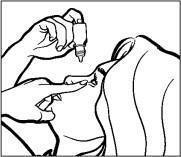
- Tilt your head back. Lower your eyelid with a clean finger to form a pouch between the eyelid and the eye. The drop should be instilled in this area (figure 1).
- Bring the tip of the bottle close to the eye. Use the mirror, if it can be helpful.
- Do not touch the eye, eyelid, surrounding areas or other surfaces with the dropper tip to avoid infecting the drops remaining in the bottle.
- Gently press the base of the bottle releasing one drop of CALMIRA at a time.
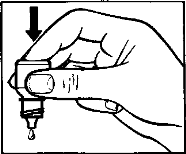
- Do not squeeze the bottle: it is designed so that only a gentle pressure on the bottom is sufficient (figure 2).
- If you instill drops in both eyes, repeat the same operation for the other eye.
- Immediately replace the cap after use, screwing it on properly.
If a drop does not enter the eye, try again.
If you use more CALMIRA than you should
Wash it away with lukewarm water. Do not instill the eye drops again until the time of the next dose.
If you forget to use CALMIRA
Instill one drop as soon as possible and then return to the normal instillation times. However, if it is almost the
time to instill the next dose, do not instill the forgotten dose and return to the normal times of
instillation. Do not use a double dose to make up for the forgotten dose.
If you stop using CALMIRA
Do not stop treatment with this medicine without first talking to your doctor.
If you have any further questions on the use of this medicine, ask your doctor or pharmacist.
4. Possible side effects
Like all medicines, this medicine can cause side effects, although not everybody gets them.
The following side effects have been observed with CALMIRA:
Common (may affect up to 1 in 10 people)
Effects on the eye
Eye pain, eye irritation, dry eye, abnormal sensation in the eyes, eye discomfort.
General side effects
Headache, fatigue, dry nose, bad taste.
Uncommon (may affect up to 1 in 100 people)
Effects on the eye
Blurred, reduced or abnormal vision, corneal disorder, inflammation, with or without damage, of the surface
of the eye, inflammation or infection of the conjunctiva, eye secretion, light sensitivity, increased
tear production, eye itching, eye redness, eyelid abnormality, itching,
redness, swelling, or crusting of the eyelid.
General side effects
Abnormal or reduced sensitivity, dizziness, runny nose, dry skin, skin inflammation.
Not known (frequency cannot be estimated from available data)
Effects on the eye
Eye swelling, corneal swelling, change in pupil size.
General side effects
Shortness of breath, increased allergy symptoms, facial swelling, drowsiness, generalised weakness,
nausea, vomiting, sinusitis, skin redness and itching.
In very rare cases, some patients with severe damage to the transparent layer in front of the eye (cornea) have
developed opaque spots on the cornea due to calcium accumulation during treatment.
Reporting of side effects
If you get any side effects, talk to your doctor or pharmacist. This includes any side effects not listed in this
leaflet. You can also report side effects directly through the national reporting system at https://www.aifa.gov.it/content/segnalazioni- reazioni-avverse.
By reporting side effects you can help provide more information on the safety of this
medicine.
5. How to store CALMIRA
Keep this medicine out of the sight and reach of children.
Do not use this medicine after the expiry date which is stated on the bottle and the carton after Scad. The
expiry date refers to the last day of that month.
This medicine does not require any special storage conditions.
The bottle must be discarded 28 days after first opening ,to prevent possible infections and a
new bottle must be used. Note the date of opening in the appropriate space (i) on the bottle label and
on the carton.
Do not dispose of any medicine in wastewater or household waste. Ask your pharmacist how to eliminate
medicines that you no longer use. This will help protect the environment.
6. Contents of the pack and other information
What CALMIRA contains
- The active ingredient is olopatadine. Each mL of solution contains 1 mg of olopatadine (as hydrochloride).
- The other ingredients are benzalkonium chloride, sodium chloride, disodium phosphate anhydrous (E339), hydrochloric acid (E507) (to adjust the pH) and/or sodium hydroxide (E524) (to adjust the pH) and water for injections. Description of the appearance of CALMIRA and contents of the packCALMIRA is a clear and colorless liquid (a solution) supplied in a pack containing a 10 ml bottle filled to 5 ml or three 10 ml plastic bottles filled to 5 ml with screw caps. Not all pack sizes may be marketed.
Marketing Authorisation Holder
DOC Generici S.r.l.
Via Turati 40
20121 Milano
Italy
Manufacturer
RAFARM S.A.
Korinthou 12
Neo Psihiko Attiki Postal code 15451, Greece
RAFARM S.A.
Thesi Pousi-Xatzi Agiou Louka Paiania Attiki
Postal code: 19002, Greece
This leaflet was last updated in

Nie jesteś pewien, czy ten lek jest odpowiedni dla ciebie?
Omów swoje objawy i leczenie z lekarzem online.

Zacząłeś przyjmować lek i masz pytania?
Omów swoje objawy i leczenie z lekarzem online.
- Kraj rejestracji
- Postać farmaceutycznaEye drops, solution, 1 MG/ML
- Kod ATCS01GX09
- Substancja czynna
- Wymaga receptyNie
- Producent
- Te treści mają charakter wyłącznie informacyjny i nie zastępują konsultacji lekarskiej.
- Zamienniki KALMIRAPostać farmaceutyczna: Eye drops, solution, 1 MG/MLSubstancja czynna: olopatadineProducent: NOVARTIS EUROPHARM LIMITEDBez receptyPostać farmaceutyczna: Eye drops, solution, 2%Substancja czynna: cromoglicic acidProducent: BRUSCHETTINI S.R.L.Bez receptyPostać farmaceutyczna: Eye drops, solution, 250 MICROGRAMMI/MLSubstancja czynna: ketotifenProducent: BRUSCHETTINI S.R.L.Bez recepty
Odpowiedniki KALMIRA w innych krajach
Leki z tą samą substancją czynną dostępne w innych krajach.
Odpowiednik KALMIRA w Hiszpania
Odpowiednik KALMIRA w Polska
Odpowiednik KALMIRA w Ukraina
Lekarze online w sprawie KALMIRA
Omów stosowanie KALMIRA, bezpieczeństwo i ocenę zasadności recepty zgodnie z obowiązującymi przepisami.









Uzyskaj receptę na KALMIRA online
Wypełnij 2-minutowy formularz
Opisz swoje objawy, historię choroby i lek, o który prosisz.
Wybierz lekarza lub pozwól nam przydzielić
Wybierz specjalistę lub dopasujemy Cię do najbliższego dostępnego lekarza.
Lekarz analizuje Twój przypadek
Zazwyczaj w ciągu 30 minut. Może zadawać dodatkowe pytania przez czat.
Odbierz w dowolnej aptece
Recepta elektroniczna wysłana na Twój e-mail — ważna w całej Polsce.
Często zadawane pytania
KALMIRA nie wymaga recepty w Włochy. Możesz skonsultować się z lekarzem online, aby sprawdzić, czy ten lek może być odpowiedni w Twojej sytuacji.
Substancją czynną w KALMIRA jest olopatadine. Informacja ta pomaga rozpoznać leki o tym samym składzie, ale pod różnymi nazwami handlowymi.
KALMIRA jest produkowany przez DOC GENERICI SRL. Nazwy handlowe i opakowania mogą się różnić w zależności od dystrybutora.
Lekarze, tacy jak Lekarze rodzinni, Psychiatrzy, Dermatolodzy, Kardiolodzy, Endokrynolodzy, Gastroenterolodzy, Pulmonolodzy, Nefrolodzy, Reumatolodzy, Hematolodzy, Zakaźnicy, Alergolodzy, Geriatrzy, Pediatrzy, Onkolodzy, mogą ocenić, czy stosowanie KALMIRA jest odpowiednie w Twoim przypadku, w zależności od sytuacji klinicznej i lokalnych przepisów. Możesz umówić konsultację online, aby omówić objawy i możliwe dalsze kroki.
Polska posiada dobrze rozwiniętą infrastrukturę ochrony zdrowia w dużych miastach, takich jak Warszawa, Kraków, Wrocław i Gdańsk. Apteki są łatwo dostępne i działają zgodnie z obowiązującymi przepisami, zapewniając dostęp do leków na receptę.
Możesz kupić KALMIRA w Warszawie, Krakowie, Wrocławiu lub Gdańsku w każdej aptece, posiadając ważną receptę.
Aby uzyskać receptę, możesz skorzystać z Oladoctor:
Inne leki zawierające tę samą substancję czynną (olopatadine) to m.in. OPATANOL, BRUNIKROM, BRUNISTILL. Mogą one różnić się nazwą handlową lub postacią, ale zawierają ten sam składnik terapeutyczny. Przed zmianą lub rozpoczęciem nowego leku skonsultuj się z lekarzem.
