



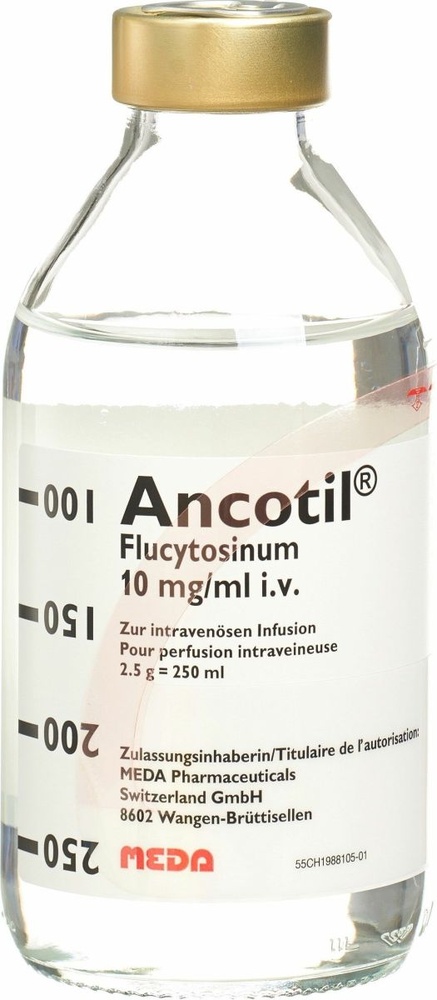
ANCOTIL 2,5 G/250 ML Roztwór do infuzji

Ocena recepty online
Lekarz przeanalizuje Twój przypadek i zdecyduje, czy wystawienie recepty jest medycznie uzasadnione.

Porozmawiaj z lekarzem o tym leku
Omów swoje objawy i opcje leczenia podczas szybkiej konsultacji online.



Jak stosować ANKOTIL
Treść ulotki
ANCOTIL 2.5 g/250 ml solution for infusion
flucytosine
Read this leaflet carefully before using this medicine as it contains important
information for you.
- Keep this leaflet. You may need to read it again.
- If you have any questions, ask your doctor or nurse.
- This medicine has been prescribed for you only. Do not pass it on to others, even if they have the same symptoms as you, as it may be harmful.
- If you get any side effects, even those not listed in this leaflet, tell your doctor or nurse. See section 4.
Contents of this leaflet
- 1. What ANCOTIL is and what it is used for
- 2. What you need to know before you use ANCOTIL
- 3. How to use ANCOTIL
- 4. Possible side effects
- 5. How to store ANCOTIL
- 6. Contents of the pack and other information
1. What is ANCOTIL and what it is used for
Ancotil contains the active ingredient flucytosine, which belongs to a group of medicines called
antifungals, used against infections caused by fungi.
Ancotil is indicated for the treatment of the following serious infections caused by fungi:
- disseminated candidiasis, an infection caused by a fungus of the genus Candida;
- cryptococcosis, an infection that affects the lungs, caused by Cryptococcus neoformans;
- chromoblastomycosis, an infection of the skin and subcutaneous tissues caused by several types of fungi.
2. What you need to know before using ANCOTIL
Do not use ANCOTIL
- if you are allergic to flucytosine or any of the other ingredients of this medicine (listed in section 6);
- if you are being treated with irreversible inhibitors of the dihydropyrimidine dehydrogenase (DPD) enzyme, such as brivudine, sorivudine and their analogues (see “Warnings and precautions” and “Other medicines and ANCOTIL” sections);
- if you are taking tegafur/gimeracil/oteracil (an anti-cancer medicine) at the same time;
- if you know that you have no activity of the dihydropyrimidine dehydrogenase (DPD) enzyme (total absence of DPD activity);
- if you are breastfeeding (see “Pregnancy, breastfeeding and fertility” section).
Warnings and precautions
Talk to your doctor or nurse before using Ancotil.
This medicine will be administered with extreme caution if:
- you suffer from kidney problems or are undergoing hemodialysis. The doctor will determine the dose of this medicine based on your kidney condition (see “Use in people with kidney problems” and “If you use more ANCOTIL than you should” sections);
- if you suffer from liver problems, because you will need to undergo medical checks before and during treatment (see “Use in people with liver problems” section);
- you suffer from severe bone marrow problems (bone marrow depression) or are at risk of bone marrow problems;
- you have a deficiency of dihydropyrimidine dehydrogenase, an enzyme involved in the metabolism and elimination of certain substances from the body.
Children and adolescents
The safety and efficacy of Ancotil in children and adolescents have not yet been established.
Other medicines and ANCOTIL
Tell your doctor or nurse if you are taking, have recently taken or might take
any other medicine.
This medicine must be administered with caution, especially if you are being treated with the
following medicines:
- amphotericin B, a medicine used to treat fungal infections;
- cytarabine, a medicine used to treat some cancers;
- phenytoin, a medicine for epilepsy;
- brivudine, sorivudine and similar medicines, used to treat viral infections (see “Do not use ANCOTIL” and “Warnings and precautions” sections);
- tegafur/gimeracil/oteracil (an anti-cancer medicine);
- myelosuppressive agents, medicines that compromise the production of blood cells in the bone marrow.
Pregnancy, breastfeeding and fertility
If you are pregnant, suspect you are pregnant, are planning a pregnancy or are breastfeeding
ask your doctor or nurse for advice before using this medicine.
Your doctor will decide whether you should take Ancotil if you are pregnant. If Ancotil is administered during
pregnancy, there is a teratogenic risk (risk of birth defects) and careful prenatal and postnatal monitoring must be performed. Do not take Ancotil if you are breastfeeding.
Contraception in men and women
Women of childbearing potential during treatment must use effective contraception during
treatment and for 6 months after the end of treatment. Male patients (or their female partners of
childbearing potential) must use effective contraception during treatment and for 3 months
after the end of treatment. In case of reduced kidney function, the period of
contraception must be extended for an additional 2 months.
Driving and using machines
This medicine does not impair the ability to drive vehicles and operate machinery.
ANCOTIL contains sodium
This medicine contains 792 mg of sodium (the main component of table salt) per vial.
This is equivalent to 40% of the maximum recommended daily intake of salt with the diet for an adult.
The maximum recommended daily dose of this product (14 g of flucytosine) contains 4.4 g of
sodium (the main component of table salt). This is equivalent to 220% of the maximum recommended
daily intake of salt with the diet in an adult.
Talk to your doctor or pharmacist if you need to use Ancotil on a daily basis for a
prolonged period of time, especially if you have been advised to follow a low-sodium
diet.
3. How to use ANCOTIL
Use this medicine following the instructions of your doctor exactly. If you have any doubts, consult your
doctor or nurse.
This medicine is administered intravenously. The recommended dose for each
injection is 37.5-50 mg per kg of body weight. The administration should be repeated every 6 hours via
a slow intravenous infusion (20-40 minutes).
Duration of treatment
The doctor will determine the duration of treatment based on the type of fungus, the location and severity
of the infection, and the response to treatment.
Use in people with kidney problems
If you have kidney problems, the time interval between injections of Ancotil should be longer
than in people with normal kidney function. The doctor will determine the dose based on the condition
of your kidneys (see sections “Warnings and precautions” and “If you use more ANCOTIL than you
should”).
If you are undergoing a blood purification procedure (hemodialysis or peritoneal dialysis), Ancotil
will be administered after each session.
Use in people with liver problems
If you have liver problems, your doctor will need to monitor your health condition particularly carefully
during treatment (see section “Warnings and precautions”).
Use in children
Although some clinical data are available in children, this data is not sufficient to support
exact dosage recommendations for this age group. If this medicine is prescribed to your
child, the doctor will choose the most appropriate dose.
Due to the prolonged elimination of flucytosine in pediatric patients, especially in younger
children, the administration of flucytosine may lead to an excess of its concentration in the
blood. Therefore, your child's blood levels of flucytosine will be measured regularly
during treatment.
If you use more ANCOTIL than you should
No cases of overdose of this medicine are known. If overdose is caused
by a malfunction of your kidneys, the effects are usually temporary and disappear with
dose adjustment or discontinuation of treatment.
If you have any doubts about the use of this medicine, consult your doctor or nurse.
4. Possible side effects
Like all medicines, this medicine can cause side effects, although not everybody gets them.
The frequency is defined as follows: very common (≥1/10), common (≥1/100, <1/10), uncommon
(≥1/1,000, <1/100), rare (≥1/10,000, <1/1,000), very rare (<1/10,000), not known (the frequency
cannot be estimated from the available data).
The following side effects have been reported with the use of this medicine with a frequency not
known:
- haematological alterations, especially reduction in the number of red blood cells (anaemia), reduction in the number of white blood cells (leucopenia) and reduction in the number of platelets (thrombocytopenia);
- allergic reactions (hypersensitivity);
- confusional state, hallucination;
- headache, stupor;
- dizziness;
- nausea, vomiting, diarrhoea;
- liver problems (increased liver enzyme);
- skin rash.
Reporting of side effects
https://www.aifa.gov.it/content/segnalazioni-
reazioni-avverse. Reporting side effects can help provide more information
about the safety of this medicine.
5. How to store ANCOTIL
Keep this medicine out of the sight and reach of children.
Store this medicine at a temperature between 18 and 25°C.
Do not use this medicine after the expiry date which is stated on the pack after “Exp.”. The expiry
date refers to the last day of that month.
Do not use this medicine if you notice solid particles in the solution. This may
occur if Ancotil is stored at a temperature below 18°C.
In case of storage above 25°C, flucytosine may transform in a not evident manner
into 5-fluorouracil, a cytotoxic agent.
Do not dispose of any medicine in wastewater or household waste. Ask your pharmacist how
to eliminate medicines that you no longer use. This will help protect the environment.
6. Contents of the pack and other information
What ANCOTIL contains
- The active ingredient is flucytosine. Each 250 ml bottle contains 2.5 g of flucytosine.
- The other ingredients are: trometamol, sodium chloride, hydrochloric acid (for pH adjustment), water for injections.
Description of the appearance of ANCOTIL and contents of the pack
Ancotil is available in packs containing 5 glass bottles, closed with a pierceable stopper equipped with a
ring for 250 ml of intravenous infusion solution.
Marketing Authorisation Holder and Manufacturer
Marketing Authorisation Holder
Viatris Italia S.r.l.
Via Vittor Pisani, 20
20124 Milan, Italy
Manufacturer
Meda Pharma GmbH & Co. KG
Benzstrasse 1
D-61352 Bad Homburg
Germany
The following information is intended exclusively for healthcare professionals:
Intravenous infusion
The recommended daily dose is 37.5-50 mg/kg to be repeated every 6 hours, with an infusion duration of
20 to 40 minutes.
Duration of treatment
The duration of treatment must be determined on an individual basis. The outcome of therapy will
depend on the sensitivity of the infecting microorganism, its accessibility and its
susceptibility to Ancotil, as well as differences in individual patient responses.
Special populations
Patients with renal impairment
Since Ancotil is mainly excreted by the kidneys, in patients with impaired renal function, doses must be administered at greater intervals based on creatinine clearance values and according to the following scheme:
Ancotil should not be used in patients with impaired renal function unless its plasma concentration can be monitored.
Dialysed patients
Ancotil is largely eliminated by haemodialysis and peritoneal dialysis. For this reason, in
patients undergoing dialysis treatment, the administration of Ancotil must be repeated
after each session.
Laboratory tests
Creatinine measurement:
flucytosine may interfere with the two-stage enzymatic determination of creatinine, generating a
false positive azotemia. Other methods should be used to determine
creatinine. Flucytosine does not interfere with the Jaffe test.
Sensitivity testing
It is recommended that cultures for the identification of strains and sensitivity tests be
performed before treatment and repeated at regular intervals during
therapy.
For sensitivity tests, it is essential that the culture media are free of flucytosine antagonists.
Flucytosine levels in serum
5-FC levels must be monitored to adjust the dosage.
The dosage must ensure the maintenance of serum levels greater than 25 µg/ml due to
the increased risk of developing resistance at low concentrations.
The prolonged existence of serum levels greater than 100 µg/ml should be avoided due to the increased
haematological toxicity.
It is recommended to draw blood for monitoring Ancotil serum levels 2 hours after
administration.
Drug toxicity
In case of suspected drug toxicity, treatment should be considered for discontinuation and appropriate measures taken.
| Creatinine clearance (ml/min) | Dose (mg/kg) | m Interval between individual doses (hours) |
| Over 40 | 37.5 - 50 | r 6 |
| 40-20 | 37.5 - 50 | a 12 |
| 20-10 | 37.5 - 50 | 24 |
| less than 10 | 37.5 – 50 | F Determine the concentration of flucytosine in serum 12 hours after the first dose. l Administer subsequent doses at e appropriate intervals to maintain a therapeutically effective serum concentration of 25 - 50 µg/ml. |
Phenytoin serum level
Patients taking phenytoin and Ancotil concurrently should be monitored
regularly for increased plasma concentrations of phenytoin (see paragraph
- 4.5 of the summary of product characteristics).

Nie jesteś pewien, czy ten lek jest odpowiedni dla ciebie?
Omów swoje objawy i leczenie z lekarzem online.

Zacząłeś przyjmować lek i masz pytania?
Omów swoje objawy i leczenie z lekarzem online.
- Kraj rejestracji
- Postać farmaceutycznaInfusion solution, 2,5 G/250 ML
- Kod ATCJ02AX01
- Substancja czynna
- Wymaga receptyTak
- Producent
- Te treści mają charakter wyłącznie informacyjny i nie zastępują konsultacji lekarskiej.
- Zamienniki ANKOTILPostać farmaceutyczna: Powder for concentrate and solution for infusion, 100 MGSubstancja czynna: anidulafunginProducent: ACCORD HEALTHCARE, S.L.U.Wymaga receptyPostać farmaceutyczna: Powder for concentrate for infusion solution, 100 MGSubstancja czynna: anidulafunginProducent: MEDAC PHARMA SRLWymaga receptyPostać farmaceutyczna: Powder for concentrate and infusion solution, 100 MGSubstancja czynna: anidulafunginProducent: TEVA B.V.Wymaga recepty
Odpowiedniki ANKOTIL w innych krajach
Leki z tą samą substancją czynną dostępne w innych krajach.
Odpowiednik ANKOTIL w Polska
Odpowiednik ANKOTIL w Hiszpania
Lekarze online w sprawie ANKOTIL
Omów stosowanie ANKOTIL, bezpieczeństwo i ocenę zasadności recepty zgodnie z obowiązującymi przepisami.









Uzyskaj receptę na ANKOTIL online
Wypełnij 2-minutowy formularz
Opisz swoje objawy, historię choroby i lek, o który prosisz.
Wybierz lekarza lub pozwól nam przydzielić
Wybierz specjalistę lub dopasujemy Cię do najbliższego dostępnego lekarza.
Lekarz analizuje Twój przypadek
Zazwyczaj w ciągu 30 minut. Może zadawać dodatkowe pytania przez czat.
Odbierz w dowolnej aptece
Recepta elektroniczna wysłana na Twój e-mail — ważna w całej Polsce.
Często zadawane pytania
ANKOTIL wymaga recepty w Włochy. Możesz skonsultować się z lekarzem online, aby sprawdzić, czy ten lek może być odpowiedni w Twojej sytuacji.
Substancją czynną w ANKOTIL jest flucytosine. Informacja ta pomaga rozpoznać leki o tym samym składzie, ale pod różnymi nazwami handlowymi.
ANKOTIL jest produkowany przez VIATRIS ITALIA S.R.L.. Nazwy handlowe i opakowania mogą się różnić w zależności od dystrybutora.
Lekarze, tacy jak Lekarze rodzinni, Psychiatrzy, Dermatolodzy, Kardiolodzy, Endokrynolodzy, Gastroenterolodzy, Pulmonolodzy, Nefrolodzy, Reumatolodzy, Hematolodzy, Zakaźnicy, Alergolodzy, Geriatrzy, Pediatrzy, Onkolodzy, mogą ocenić, czy stosowanie ANKOTIL jest odpowiednie w Twoim przypadku, w zależności od sytuacji klinicznej i lokalnych przepisów. Możesz umówić konsultację online, aby omówić objawy i możliwe dalsze kroki.
Polska posiada dobrze rozwiniętą infrastrukturę ochrony zdrowia w dużych miastach, takich jak Warszawa, Kraków, Wrocław i Gdańsk. Apteki są łatwo dostępne i działają zgodnie z obowiązującymi przepisami, zapewniając dostęp do leków na receptę.
Możesz kupić ANKOTIL w Warszawie, Krakowie, Wrocławiu lub Gdańsku w każdej aptece, posiadając ważną receptę.
Aby uzyskać receptę, możesz skorzystać z Oladoctor:
Inne leki zawierające tę samą substancję czynną (flucytosine) to m.in. ANIDULAFUNJINA AKKORD, ANIDULAFUNJINA MEDAK, ANIDULAFUNJINA TEVA. Mogą one różnić się nazwą handlową lub postacią, ale zawierają ten sam składnik terapeutyczny. Przed zmianą lub rozpoczęciem nowego leku skonsultuj się z lekarzem.
