



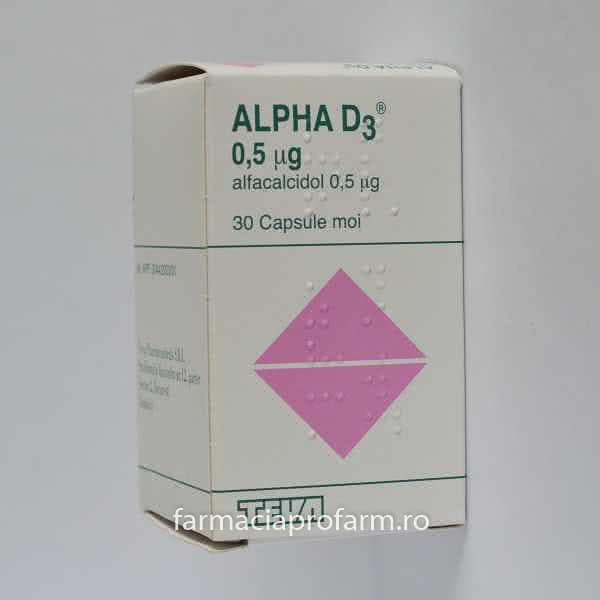
ALPHA D3 0.25 MCG Soft capsule

Запит на рецепт онлайн
Лікар розгляне ваш випадок і визначить, чи є рецепт медично доцільним.

Поговоріть з лікарем про ці ліки
Обговоріть симптоми та можливі подальші кроки під час короткої онлайн-консультації.



Інструкція із застосування ALPA D3
ALPHA D3 0.25 micrograms soft capsules
ALPHA D3 1 microgram soft capsules
ALPHA D3 2 micrograms/ml oral drops, solution
alfacalcidol
PHARMACOTHERAPEUTIC CATEGORY
Vitamin D and analogues.
THERAPEUTIC INDICATIONS
Renal osteodystrophy in dialysis or non-dialysis patients. Hypoparathyroidism. Vitamin D-resistant or D-dependent (pseudo-deficient) rickets and osteomalacia.
Rickets and osteomalacia due to renal alterations caused by vitamin D metabolism. Post-menopausal osteoporosis.
CONTRAINDICATIONS
- Established individual hypersensitivity to alfacalcidol, vitamin D (cholecalciferol, ergocalciferol), or other vitamin D metabolites (calcitriol, calciferol, calcipotriol) or to any of the excipients listed in paragraph “Composition”.
- Hypercalcemia.
- Established vitamin D toxicity/hypervitaminosis.
PRECAUTIONS FOR USE
Since an overdose of ALPHA D3 can cause hypercalcemia and, in some cases, hypercalciuria, calcemia should be
measured at least twice a week during the dosage adjustment phase. Once the optimal daily dose is established,
a monthly check of calcemia is sufficient, which should still be checked promptly if symptoms suggesting
toxicity appear. Similar monitoring is recommended for infants who are breastfed by mothers receiving
pharmacological doses of 1-alpha-hydroxycholecalciferol.
During treatment with 1-alpha-hydroxycholecalciferol, plasma phosphate concentrations should be
monitored to reduce the risk of ectopic calcifications.
A decrease in alkaline phosphatase values generally precedes the onset of hypercalcemia and may be a
warning sign of the latter. If hypercalcemia occurs, the drug and any calcium supplement should be temporarily
discontinued until calcemia generally returns to normal quickly. Treatment may then be resumed at a lower
dose. Because ALPHA D3 influences the transport of phosphates in the intestine, kidney and bones, the
concurrent administration of phosphate-binding substances should be adjusted to phosphate levels (normal
values: 2-5 mg/100 ml).
Vitamin D supplementation to the diet may be harmful in people who are already receiving an adequate intake
through diet and sun exposure, as the difference between therapeutic and toxic concentrations is
relatively small.
Since 1-alpha-hydroxycholecalciferol is the most potent form of vitamin D, a greater risk of toxicity might
be expected; however, its effects are rapidly reversible after discontinuation of treatment.
INTERACTIONS
Inform your doctor or pharmacist if you have recently taken any other medicines, including those without a
prescription.
Vitamin D or its analogues
Pharmacological doses of vitamin D or its analogues should not be administered during
treatment with 1-alpha-hydroxycholecalciferol due to the possibility of an additive effect and an increased
risk of hypercalcemia.
Digitale
Hypercalcemia in patients taking digitalis preparations can worsen a cardiac arrhythmia. Patients taking
digitalis concurrently with 1-alpha-hydroxycholecalciferol should be carefully monitored.
Antiepileptics
Some antiepileptics may increase the requirements for 1-alpha-hydroxycholecalciferol (such as carbamazepine,
phenobarbital, phenytoin and primidone).
Cholestyramine, colestipol, sucralfate, aluminum-based antacids
The absorption of 1-alpha-hydroxycholecalciferol may be impaired by the concomitant use of bile acid
binding agents (Cholestyramine, colestipol), sucralfate or aluminum-based antacids.
Magnesium-containing antacids and laxatives
Caution should be exercised when using magnesium-containing antacids or laxatives in patients
taking 1-alpha-hydroxycholecalciferol, particularly those with chronic renal dialysis. Hypermagnesemia may
occur.
Preparations containing calcium or phosphate or thiazide diuretics
The risk of hypercalcemia is increased in patients taking preparations containing calcium or phosphate or
thiazide diuretics concurrently with 1-alpha-hydroxycholecalciferol. In these situations, plasma calcium
concentrations should be monitored.
Rifampicin and isoniazid
Rifampicin and isoniazid may reduce the effectiveness of vitamin D.
Corticosteroids
Corticosteroids may counteract the effect of vitamin D.
SPECIAL WARNINGS
1-alpha-hydroxycholecalciferol should not be administered to patients with hypercalcemia. It should be used
with caution in infants, who may have an increased sensitivity to its effects, and in patients with
renal impairment or calculi, or heart disease, who are at greater risk of organ damage if
hypercalcemia develops.
Overdosage of any form of vitamin D causes even serious manifestations. Hypercalcemia
caused by an excess dose of vitamin D or its metabolites may also require emergency therapies.
Chronic hypercalcemia could in fact cause widespread vascular calcifications,
nephrocalcinosis and calcification of other soft tissues. It is therefore necessary to ensure that the figure
obtained by multiplying the calcemia value by that of phosphatemia (Ca x P) does not exceed 70. X-ray
examination of the anatomical regions, site of possible calcifications, may be useful for early diagnosis.
The drops contain methyl parahydroxybenzoate, which can cause allergic reactions (even delayed).
The capsules and drops contain sorbitol: if your doctor has diagnosed you with an intolerance to some
sugars, consult him before taking this medicine.
The medicine finally contains small amounts of ethanol (alcohol), less than 100 mg per dose.
For those who engage in sports, the use of medicines containing ethyl alcohol may determine positivity to
doping tests in relation to the concentration limits of alcohol indicated by some sports federations.
Ask your doctor or pharmacist for advice before taking any medicine.
Pregnancy and breastfeeding
There is insufficient evidence on the safety of using alfacalcidol during pregnancy,
although it has been widely used without apparent adverse effects.
Alfacalcidol should be used in pregnancy only if alternative treatments are not available, after
a careful assessment of the risk-benefit ratio.
Increased levels of calcitriol can be found in the breast milk of women treated with
alfacalcidol. This could affect calcium metabolism in breastfed infants (see
- 4.4). Alfacalcidol should be used during breastfeeding only if alternative treatments are not available, after a careful assessment of the risk-benefit ratio.
Driving and operating machinery
At therapeutic doses, this product does not impair these abilities.
DOSAGE, METHOD AND DURATION OF ADMINISTRATION
Suggested starting dose for all indications:
Adults and children over 20 kg body weight:1 microgram per day
Children under 20 kg body weight: 0.05 micrograms/kg/day
Subsequently the dose can be adjusted according to the response and according to the needs and weight of
the patients.
Each drop corresponds to 0.05 micrograms of 1-alpha-hydroxycholecalciferol.
OVERDOSE
In case of accidental ingestion/intake of an excessive dose of ALPHA D3, immediately
inform your doctor or go to the nearest hospital.
Excessive intake of vitamin D leads to the development of hypercalcemia. Symptoms of overdose include
anorexia, fatigue, nausea and vomiting, constipation or diarrhea, polyuria, nocturia, sweating, headache,
thirst, drowsiness and dizziness.
Individual tolerance to vitamin D varies considerably; infants and children are
generally more susceptible to its toxic effect. If toxicity occurs, the vitamin should be discontinued.
In acute overdose, early gastric lavage and/or administration of mineral oils
can reduce absorption and promote fecal elimination.
If you have any doubts about the use of this medicine, consult your doctor or pharmacist.
UNDESIRABLE EFFECTS
Like all medicines, ALPHA D3 can cause side effects, although not everyone
will experience them.
The frequencies of adverse reactions are classified according to the following convention: very common
(≥1/10), common (≥1/100, <1>(<1>
Immune system disorders
Not known: Hypersensitivity
Metabolism and nutrition disorders
Common: Hypercalcemia*, hypercalciuria
Rare: Hyperphosphatemia
*Effects associated with hypercalcemia include hypercalciuria, ectopic calcifications, kidney and
cardiovascular damage, weakness, headache, drowsiness, nausea, vomiting, dry mouth, constipation, bone and
muscle pain, later may appear urinary disorders, conjunctivitis (from calcification),
photophobia, pancreatitis, rhinorrhea, itching, hyperthermia, decreased libido, albuminuria, hypercholesterolemia,
increased SGOT and SGPT, ectopic calcifications, hypertension, cardiac arrhythmias and rarely psychosis.
Because the half-life of calcitriol is short, normalization of any hypercalcemia occurs
within a few days of stopping treatment with ALPHA D3, however more quickly than in
the course of therapy with vitamin D or its metabolites.
If you experience any side effects, including those not listed in this leaflet, tell your
doctor or pharmacist. You can also report side effects directly through the Website:
http://www.agenziafarmaco.gov.it/it/responsabili
By reporting side effects you can help provide more information on the safety of
this medicine
SHELF LIFE AND STORAGE
Keep this medicine out of the sight and reach of children.
Do not use this medicine after the expiry date stated on the packaging after Scad.
The expiry date refers to the last day of that month.
For the capsules
Store in the original packaging to protect the medicine from light.
For the drops
Do not store above 25°C in the original packaging to protect the medicine from
light.
Medicines should not be disposed of via wastewater or household waste. Ask your pharmacist how
to dispose of medicines you no longer use. This will help protect the environment.
COMPOSITION
ALPHA D3 0.25 micrograms soft capsules
Each capsule contains:
Active ingredient
1-alpha-hydroxycholecalciferol (alfacalcidol) micrograms 0.25
Excipients
Anhydrous ethanol, citric acid anhydrous, propyl gallate, d,l-alpha-tocopherol, peanut oil.
Shell composition: gelatin, glycerol 85%, sorbitol special solution (Anidrisorb
85/70), red iron oxide (E172), black ink.
ALPHA D3 1 micrograms soft capsules
Each capsule contains:
Active ingredient
1-alpha-hydroxycholecalciferol (alfacalcidol) micrograms 1.0
Excipients
Anhydrous ethanol, citric acid anhydrous, propyl gallate, d,l-alpha-tocopherol, peanut oil.
Shell composition: gelatin, glycerol 85%, sorbitol special solution (Anidrisorb
85/70), yellow iron oxide (E172), titanium dioxide (E171), black ink.
ALPHA D3 2 micrograms/ml oral drops, solution
Each ml (40 drops) contains:
Active ingredient:
1-alpha-hydroxycholecalciferol (alfacalcidol) micrograms 2.0
(Each drop contains 0.05 micrograms of 1-alpha-hydroxycholecalciferol).
Excipients:
Hydrogenated castor oil polyoxyethylated, citric acid anhydrous, sodium citrate dihydrate, d,l-alpha-tocopherol, methyl p-
hydroxybenzoate, ethanol, sorbitol 70% solution non-crystallizable, purified water.
PHARMACEUTICAL FORM AND CONTENT
Soft capsules: pack of 30 capsules of 0.25 micrograms or 1 microgram
Oral drops, solution: bottle of 10 ml
MARKETING AUTHORISATION HOLDER
THERAMEX IRELAND LIMITED,
3RD FLOOR, KILMORE HOUSE, PARK LANE, SPENCER DOCK, DUBLIN 1, D01 YE64,
IRELAND.
MANUFACTURER
Soft capsules
Teva Pharma B.V. – Swensweg, 5 – 2031 GA Haarlem (Netherlands)
Oral drops, solution
Istituto Biochimico Nazionale Savio S.r.l. – Via del Mare, 36 – Pomezia (Rome)

Не впевнені, чи підходить вам цей лікарський засіб?
Обговоріть симптоми та можливі варіанти лікування з лікарем онлайн.

Виникли питання під час прийому ліків?
Обговоріть свої симптоми та лікування з лікарем онлайн.
- Країна реєстрації
- Лікарська формаSoft capsule, 0.25 MCG
- Код АТХA11CC03
- Діюча речовина
- Потрібен рецептТак
- Виробник
- Ця інформація надана лише для ознайомлення і не є медичною порадою. Рішення щодо лікування завжди приймає лікар.
- Альтернативи до ALPA D3Лікарська форма: Soft capsule, 1 MICROGRAMДіюча речовина: Альфа-кальцидолВиробник: DOC GENERICI SRLПотрібен рецептЛікарська форма: Soft capsule, 0.25 microgramsДіюча речовина: Альфа-кальцидолВиробник: ZENTIVA ITALIA S.R.L.Потрібен рецептЛікарська форма: Soft capsule, 0,25 MCGДіюча речовина: Альфа-кальцидолВиробник: CHEPLAPHARM ARZNEIMITTEL GMBHПотрібен рецепт
Аналоги ALPA D3 в інших країнах
Препарати з тією самою діючою речовиною, доступні в інших країнах.
Аналог ALPA D3 у Польща
Аналог ALPA D3 у Іспанія
Лікарі онлайн щодо ALPA D3
Застосування, безпека та можливість призначення рецепта — за результатами медичної оцінки.









Отримайте рецепт на ALPA D3 онлайн
Заповніть форму за 2 хвилини
Розкажіть про симптоми, історію хвороби та потрібний препарат.
Оберіть лікаря або ми призначимо
Оберіть спеціаліста або ми підберемо найближчого доступного лікаря.
Лікар розглядає ваш випадок
Зазвичай протягом 30 хвилин. Може ставити уточнювальні запитання в чаті.
Отримайте в будь-якій аптеці
Електронний рецепт надсилається на вашу пошту — дійсний по всій Польщі.
Часті запитання
ALPA D3 потребує рецепта в Італія. Ви можете обговорити з лікарем онлайн, чи підходить цей лікарський засіб для вашої ситуації.
Діюча речовина у ALPA D3 — Альфа-кальцидол. Це допомагає визначити препарати з тим самим складом, але під іншими торговими назвами.
ALPA D3 виробляється компанією THERAMEX IRELAND LIMITED. Назва бренду та упаковка можуть відрізнятися залежно від дистрибʼютора.
Лікарі, зокрема Сімейні лікарі, Психіатри, Дерматологи, Кардіологи, Ендокринологи, Гастроентерологи, Пульмонологи, Нефрологи, Ревматологи, Гематологи, Інфекціоністи, Алергологи, Геріатри, Педіатри, Онкологи, можуть оцінити доцільність застосування ALPA D3 з урахуванням вашого стану та місцевих правил. Ви можете записатися на онлайн-консультацію, щоб обговорити симптоми та можливі подальші кроки.
Польща має добре розвинену систему охорони здоров'я у великих містах, таких як Варшава, Краків, Вроцлав і Гданськ. Аптеки широко доступні та працюють відповідно до чинного законодавства, забезпечуючи доступ до рецептурних препаратів.
Ви можете придбати ALPA D3 у Варшаві, Кракові, Вроцлаві або Гданську в будь-якій аптеці за наявності дійсного рецепта.
Щоб отримати рецепт, ви можете скористатися Oladoctor:
Інші препарати з тією самою діючою речовиною (Альфа-кальцидол) включають ALFAKALKIDOLO DOK, ALFAKALKIDOLO TSENTIVA, DEDIOL. Вони можуть відрізнятися торговою назвою або формою випуску, але містять той самий терапевтичний компонент. Перед зміною або початком прийому нового препарату варто проконсультуватися з лікарем.
