



OVITRELLE 250 MCG Powder and solvent for injectable solution

Запит на рецепт онлайн
Лікар розгляне ваш випадок і визначить, чи є рецепт медично доцільним.

Поговоріть з лікарем про ці ліки
Обговоріть симптоми та можливі подальші кроки під час короткої онлайн-консультації.



Інструкція із застосування OVITRELLE
Зміст інструкції
- Ovitrelle 250 micrograms/0.5 mL injectable solution in pre-filled syringe
- Ovitrelle 250 micrograms solution for injection in pre-filled pen
- OVITRELLE 250 micrograms injectable solution in pre-filled pen
Global Version ID: 78691_1822858_4521304
Ovitrelle 250 micrograms/0.5 mL injectable solution in pre-filled syringe
choriogonadotropin alfa
Read this leaflet carefully before you use this medicine as it contains important
information for you.
- Keep this leaflet. You may need to read it again.
- If you have any questions, ask your doctor or pharmacist.
- This medicine has been prescribed for you only. Do not pass it on to others, even if their symptoms are the same as yours, as it could be harmful.
- If you get any side effects, even those not listed in this leaflet, tell your doctor or pharmacist. See section 4.
Contents of this leaflet
- 1. What Ovitrelle is and what it is used for
- 2. What you need to know before you use Ovitrelle
- 3. How to use Ovitrelle
- 4. Possible side effects
- 5. How to store Ovitrelle
- 6. Contents of the pack and other information
1. What is Ovitrelle and what is it used for
What is Ovitrelle
Ovitrelle contains a medicine called “corifollitropin alfa”, produced in the laboratory using particular recombinant DNA techniques. Corifollitropin alfa is very similar to a hormone that is found naturally in the human body, chorionic gonadotropin, which is involved in reproduction and fertility.
What is Ovitrelle used for
Ovitrelle is used together with other medicines:
- to induce the growth and development of numerous follicles (each containing an oocyte) in women undergoing assisted reproductive technologies (a procedure that can help them become pregnant), such as “in vitrofertilization”. Other medicines are first administered to induce the growth of numerous follicles;
- to induce the release of an oocyte from the ovaries (induction of ovulation) in women who do not produce oocytes (a condition called anovulation) or who produce too few (oligo-ovulation). Other medicines are first administered for the growth and development of the follicles;
2. What you need to know before using Ovitrelle
Do not use Ovitrelle
- if you are allergic to chorogonadotropin alfa or any of the other ingredients of this medicine (listed in section 6);
- if you have a tumor of the hypothalamus or pituitary gland (both parts of the brain);
- if you have enlarged ovaries or fluid-filled sacs in the ovaries (ovarian cysts) of unknown origin;
- if you suffer from unexplained vaginal bleeding;
- if you have cancer of the ovaries, uterus or breast;
Global Version ID: 78691_1822858_4521304
- if you have a severe inflammation of the veins or blood clots in the veins (existing thromboembolic disorders);
- if you are subject to conditions that usually make a normal pregnancy impossible, for example menopause or premature menopause (ovarian insufficiency) or malformations of the genital organs.
Do not use Ovitrelle if any of these conditions apply to you. If you have doubts, consult your doctor
before using this medicine.
Warnings and precautions
Before starting treatment, your fertility and that of your partner must be evaluated by a
doctor experienced in the treatment of fertility problems.
Ovarian hyperstimulation syndrome (Ovarian hyperstimulation syndrome,OHSS)
This medicine may increase the risk of developing OHSS. This occurs when the follicles
develop excessively and become large cysts.
If you suffer from lower abdominal pain, gain weight rapidly, feel nauseous or vomit, or have
difficulty breathing, do not give the Ovitrelle injection and talk to your doctor immediately (see
section 4). If you are developing OHSS, you may be told not to have sexual intercourse
or to use a barrier contraceptive method for at least four days.
The risk of OHSS is reduced when the usual dose of Ovitrelle is used and the treatment cycle is
closely monitored (for example, blood tests of estradiol levels and ultrasound).
Multiple pregnancies and/or birth defects
While using Ovitrelle, you have a higher risk of establishing a multiple pregnancy, in
most cases twins, compared to natural conception. Multiple pregnancy can
lead to medical complications for you and your babies. When undergoing assisted reproductive
techniques, the risk of having a multiple pregnancy is related to your age, the quality and
number of embryos or oocytes fertilized that are transferred to you. Multiple pregnancies and
certain characteristics of the couple with fertility problems (e.g. age) may also be
associated with an increased risk of birth defects.
The risk of multiple pregnancies is reduced when the treatment cycle is closely monitored
(for example, blood tests of estradiol levels and ultrasound).
Ectopic pregnancies
In women with damaged fallopian tubes (the tubes that carry the egg from the ovary to the uterus) an
pregnancy outside the uterus (ectopic pregnancy) may occur. The doctor must therefore perform
an ultrasound early on to rule out this possibility.
Abortion
When undergoing assisted reproductive techniques or ovarian stimulation to produce
oocytes, the risk of abortion is higher than in other women.
Blood clotting problems (thromboembolic events)
Consult your doctor before using Ovitrelle if you or a family member has suffered from
blood clots in the legs or lungs, or if you have had a heart attack or stroke. With
taking Ovitrelle you may be at a higher risk of developing serious blood clots or worsening of existing ones.
Global Version ID: 78691_1822858_4521304
Tumors of the genital organs
Cases of tumors of the ovaries and other genital organs, both benign and malignant, have been reported
in women undergoing repeated cycles of drug therapy for the treatment of infertility.
Pregnancy test
If you take a serum or urine pregnancy test after using Ovitrelle and up to ten days later,
you may get a false positive test result. If in doubt, consult your doctor.
Children and adolescents
Ovitrelle should not be used in children and adolescents
Other medicines and Ovitrelle
Tell your doctor if you are taking, have recently taken or might take any other
medicines.
Pregnancy and breastfeeding
Do not use Ovitrelle if you are pregnant or if you are breastfeeding with breast milk.
If you are pregnant or breastfeeding, ask your doctor for advice before
taking this medicine.
Driving and operating machinery
It is believed that Ovitrelle does not affect the ability to drive vehicles and operate machinery.
Ovitrelle contains sodium
This medicine contains less than 1 mmol (23 mg) of sodium per dose, i.e. essentially “sodium-free”.
3. How to use Ovitrelle
Use this medicine following the instructions of your doctor exactly. If you have any doubts, ask your
doctor or pharmacist.
Amount to use
- The recommended dose is 1 pre-filled syringe (250 micrograms/0.5 mL) administered in a single injection.
- Your doctor will have explained exactly when to administer the injection.
Use of this medicine
- Ovitrelle must be administered by subcutaneous route, meaning with an injection under the skin.
- Each pre-filled syringe is for single use only. Use only if the solution is clear and free of particles.
- Your doctor or nurse will show you how to use the Ovitrelle pre-filled syringe to inject the medicine.
- Administer Ovitrelle as explained by your doctor or nurse.
- After the injection, dispose of the used syringe safely.
Global Version ID: 78691_1822858_4521304
If you administer Ovitrelle yourself, read the following instructions carefully:
- 1. Wash your hands. It is important that your hands and the accessories you use are as clean as possible;
- 2. Gather everything you need. Please note that alcohol swabs are not included in the package. Find a clean area and arrange everything you need:
- two alcohol swabs;
- one pre-filled syringe containing the medicine.
- 3. Injection:
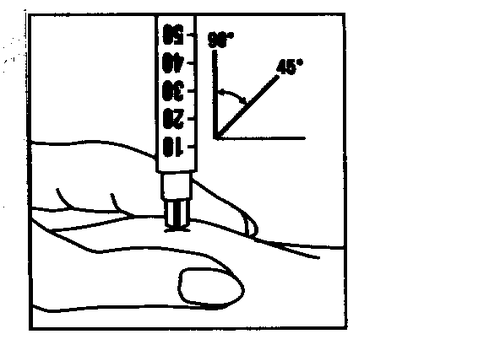
inject the solution immediately: your doctor or nurse
should have already informed you about the injection site (for example:
abdomen, front of the thigh). Clean the chosen area with an
alcohol swab. Firmly hold the skin between your fingers
and insert the injection needle at an angle between 45° and 90°
with an arrow-like movement. Inject under the skin, as you have been
taught. Do not inject directly into a vein. Inject the
solution by slowly pressing the syringe plunger. Take
as much time as needed to inject all the solution. Remove
the needle immediately and clean with an alcohol swab,
making a circular motion;
- 4. Disposal of used items: once the injection is finished, immediately discard the empty syringe in a suitable container. Dispose of any unused solution.
If you use more Ovitrelle than you should
The effects of an Ovitrelle overdose are not known, however ovarian hyperstimulation syndrome (OHSS) may occur as described in paragraph 4.
If you forget to use Ovitrelle
If you forget to use Ovitrelle, contact your doctor as soon as you realise it.
If you have any questions about using this medicine, ask your doctor or pharmacist.
4. Possible side effects
Like all medicines, this medicine can cause side effects, although not everybody gets them.
Stop using Ovitrelle and tell your doctor immediately if you notice any of the following serious side effects, because urgent medical treatment may be needed:
- allergic reactions such as rash, rapid or irregular pulse, swelling of the tongue and throat, sneezing, wheezing or severe breathing difficulties are very rare (may affect up to 1 in 10,000 people);
- lower abdominal pain, abdominal bloating or discomfort with nausea or vomiting may be symptoms of ovarian hyperstimulation syndrome (OHSS). This may indicate that the ovaries are reacting excessively to the treatment and large ovarian cysts have developed (see also paragraph 2, under “Ovarian hyperstimulation syndrome”). This is a common event (may affect up to 1 in 10 people);
Global Version ID: 78691_1822858_4521304
- OHSS can become severe with obvious enlargement of the ovaries, decreased urine production, weight gain, difficulty breathing and possible fluid accumulation in the abdomen or chest. This event is uncommon (may affect up to 1 in 100);
- serious blood clotting complications (thromboembolic events), sometimes independent of OHSS, can be found very rarely. This may cause chest pain, shortness of breath, stroke or heart attack (see also paragraph 2, under “Blood clotting problems”).
Other side effects
Common (may affect up to 1 in 10 people)
- Headache.
- Local reactions at the injection site, such as pain, redness or swelling.
Uncommon (may affect up to 1 in 100)
- Diarrhoea.
Reporting of side effects
If you get any side effects, talk to your doctor or pharmacist. This includes any possible side effects not listed in this leaflet. You can also report side effects directly through the national reporting system listed in Annex V. By reporting side effects you can help provide more information on the safety of this medicine.
5. How to store Ovitrelle
Keep this medicine out of the sight and reach of children
Do not use this medicine after the expiry date which is stated on the label and on the packaging after
Exp. The expiry date refers to the last day of that month.
Store in a refrigerator (2°C - 8°C). Store in the original package. Ovitrelle
250 micrograms injectable solution can be stored for a maximum of 30 days at
room temperature (not exceeding 25°C) without being returned to the refrigerator and, after
this period of 30 days, if not used, must be discarded.
Do not dispose of any medicine in wastewater or household waste. Ask your pharmacist how
to eliminate medicines that you no longer use. This will help protect the environment.
6. Contents of the pack and other information
What Ovitrelle contains
- The active substance is chorionic gonadotropin alfa, produced with recombinant DNA technology.
- Each pre-filled syringe contains 250 micrograms/0.5 mL (equivalent to 6,500 IU).
- The other components are mannitol, methionine, poloxamer 188, phosphoric acid, sodium hydroxide, water for injections.
Description of the appearance of Ovitrelle and contents of the pack
Ovitrelle is supplied as an injectable solution.
It is available in a single pre-filled syringe (pack of 1).
Marketing Authorisation Holder
Merck Europe B.V., Gustav Mahlerplein 102, 1082 MA Amsterdam, Netherlands
Global Version ID: 78691_1822858_4521304
Manufacturer
Merck Serono S.p.A., Via delle Magnolie 15, 70026 Modugno (Bari), Italy
More detailed information on this medicinal product is available on the website of the European
Medicines Agency, http://www.ema.europa.eu .
Global Version ID: 78691_1822858_4521304
Ovitrelle 250 micrograms solution for injection in pre-filled pen
choriogonadotropin alfa
Read this leaflet carefully before you start using this medicine as it contains important
information for you.
- Keep this leaflet. You may need to read it again.
- If you have any questions, ask your doctor or pharmacist.
- This medicine has been prescribed for you only. Do not pass it on to others, even if they have the same symptoms as you, as it may be harmful.
- If you get any side effects, even those not listed in this leaflet, tell your doctor or pharmacist. See section 4.
Contents of this leaflet
- 1. What Ovitrelle is and what it is used for
- 2. What you need to know before you use Ovitrelle
- 3. How to use Ovitrelle
- 4. Possible side effects
- 5. How to store Ovitrelle
- 6. Contents of the pack and other information
1. What is Ovitrelle and what is it used for
What is Ovitrelle
Ovitrelle contains a medicine called “corifollitropin alfa”, produced in the laboratory using particular recombinant DNA techniques. Corifollitropin alfa is very similar to a hormone that is found naturally in the human body, chorionic gonadotropin, which is involved in reproduction and fertility.
What is Ovitrelle used for
Ovitrelle is used together with other medicines:
- to induce the growth and development of numerous follicles (each containing an oocyte) in women undergoing assisted reproductive technologies (a procedure capable of helping them to become pregnant), such as “in vitrofertilization”. Other medicines are first administered to induce the growth of numerous follicles;
- to induce the release of an oocyte from the ovaries (induction of ovulation) in women who do not produce oocytes (a condition called anovulation) or who produce too few (oligo-ovulation). Other medicines are first administered for the growth and development of the follicles;
2. What you need to know before using Ovitrelle
Do not use Ovitrelle
- if you are allergic to chorogonadotropin alfa or any of the other ingredients of this medicine (listed in section 6);
- if you have a tumor of the hypothalamus or pituitary gland (both parts of the brain);
- if you have enlarged ovaries or fluid-filled sacs in the ovaries (ovarian cysts) of unknown origin;
- if you suffer from unexplained vaginal bleeding;
- if you have cancer of the ovaries, uterus or breast;
Global Version ID: 78691_1822858_4521304
- if you have a severe inflammation of the veins or blood clots in the veins (existing thromboembolic disorders);
- if you are subject to conditions that usually make a normal pregnancy impossible, for example menopause or premature menopause (ovarian insufficiency) or malformations of the genital organs.
Do not use Ovitrelle if any of these conditions apply to you. If you have any doubts, consult your doctor
before using this medicine.
Warnings and precautions
Before starting treatment, your fertility and that of your partner must be assessed by a
doctor experienced in the treatment of fertility problems.
Ovarian hyperstimulation syndrome (Ovarian hyperstimulation syndrome,OHSS)
This medicine may increase the risk of developing OHSS. This occurs when the follicles
develop excessively and become large cysts.
If you experience pelvic pain, rapid weight gain, nausea or vomiting, or
difficulty breathing, do not inject Ovitrelle and tell your doctor immediately (see
section 4). If you are developing OHSS, you may be told not to have sexual intercourse
or to use a barrier contraceptive method for at least four days.
The risk of OHSS is reduced when the usual dose of Ovitrelle is used and the treatment cycle is closely monitored
(for example: blood tests of estradiol levels and ultrasound).
Multiple pregnancies and/or birth defects
While using Ovitrelle, you have a higher risk of establishing a multiple pregnancy, in
most cases twins, compared to natural conception. Multiple pregnancies can
lead to medical complications for you and your babies. When undergoing assisted reproductive techniques,
the risk of having a multiple pregnancy is related to your age, the quality and
number of embryos or oocytes fertilized that are transferred to you. Multiple pregnancies and
certain characteristics of the couple with fertility problems (e.g. age) may also be
associated with an increased risk of birth defects.
The risk of multiple pregnancies is reduced when the treatment cycle is closely monitored
(for example, blood tests of estradiol levels and ultrasound).
Ectopic pregnancies
In women with damaged fallopian tubes (the tubes that carry the egg from the ovary to the uterus) may
occur a pregnancy outside the uterus (ectopic pregnancy). The doctor must therefore perform
an ultrasound early to rule out this possibility.
Abortion
When undergoing assisted reproductive techniques or ovarian stimulation to produce
oocytes, the risk of abortion is higher than in other women.
Blood clotting problems (thromboembolic events)
Consult your doctor before using Ovitrelle if you or a family member has suffered from
blood clots in the legs or lungs, or if you have had a heart attack or stroke. With
taking Ovitrelle you may be at a higher risk of developing serious blood clots or worsening of existing ones.
Global Version ID: 78691_1822858_4521304
Tumors of the genital organs
Cases of tumors of the ovaries and other genital organs, both benign and malignant, have been reported in
women undergoing repeated cycles of drug therapy for the treatment of infertility.
Pregnancy test
If you take a serum or urine pregnancy test after using Ovitrelle and up to ten days later,
you may get a false positive test result. If in doubt, consult your doctor.
Children and adolescents
Ovitrelle should not be used in children and adolescents.
Other medicines and Ovitrelle
Tell your doctor if you are taking, have recently taken or might take any other
medicines.
Pregnancy and breastfeeding
Do not use Ovitrelle if you are pregnant or if you are breastfeeding with breast milk.
If you are pregnant or breastfeeding, ask your doctor for advice before
taking this medicine.
Driving and operating machinery
It is believed that Ovitrelle does not affect the ability to drive vehicles and operate machinery.
Ovitrelle contains sodium
This medicine contains less than 1 mmol (23 mg) of sodium per dose, i.e. essentially “sodium-free”.
3. How to use Ovitrelle
Use this medicine following the instructions of your doctor exactly. If you have any doubts, consult your
doctor or pharmacist.
Amount to use
- The recommended dose is 1 pre-filled pen (250 micrograms/0.5 mL) administered in a single injection.
- Your doctor will explain exactly when to administer the injection.
Use of this medicine
- If you administer Ovitrelle alone, carefully read and follow the “Instructions for Use” provided in the box.
- Ovitrelle must be administered by subcutaneous injection (under the skin).
- Each pre-filled pen is for single use only.
- Your doctor or nurse will show you how to use the Ovitrelle pre-filled pen to inject the medicine.
- Inject Ovitrelle as explained by your doctor or nurse.
- After the injection, safely dispose of the used needle and discard the pen.
Global Version ID: 78691_1822858_4521304
If you use more Ovitrelle than you should
The effects of an Ovitrelle overdose are unknown, however ovarian hyperstimulation syndrome (OHSS) may occur as described in paragraph 4.
If you forget to use Ovitrelle
If you forget to use Ovitrelle, contact your doctor as soon as you remember.
If you have any doubts about the use of this medicine, ask your doctor or pharmacist.
4. Possible side effects
Like all medicines, this medicine can cause side effects, although not everybody gets them.
Stop using Ovitrelle and contact a doctor immediately if you notice any of the following serious side effects, as urgent medical treatment may be needed:
- allergic reactions such as rash, rapid or irregular pulse, swelling of the tongue and throat, sneezing, wheezing or severe difficulty breathing are very rare (may affect up to 1 in 10,000 people);
- lower abdominal pain, abdominal bloating or discomfort with nausea or vomiting may be symptoms of ovarian hyperstimulation syndrome (OHSS). This may indicate that the ovaries are reacting excessively to the treatment and large ovarian cysts have developed (see also paragraph 2, under “Ovarian hyperstimulation syndrome”). This is a common event (may affect up to 1 in 10 people);
- OHSS can become severe with noticeable enlargement of the ovaries, decreased urine production, weight gain, difficulty breathing and possible fluid accumulation in the abdomen or chest. This event is uncommon (may affect up to 1 in 100 people);
- serious complications of blood clotting (thromboembolic events), sometimes independent of OHSS, can be very rarely found. This may cause chest pain, shortness of breath, stroke or heart attack (see also paragraph 2, under “Blood clotting problems”).
Other side effects
Common (may affect up to 1 in 10 people)
- Headache.
- Local reactions at the injection site, such as pain, redness or swelling.
Uncommon (may affect up to 1 in 100 people)
- Diarrhoea.
Reporting of side effects
If you get any side effects, even those not listed in this leaflet, tell your doctor or pharmacist. You can also report side effects directly through the national reporting system listed in Annex V. By reporting side effects you can help provide more information on the safety of this medicine.
5. How to store Ovitrelle
Keep this medicine out of the sight and reach of children
Global Version ID: 78691_1822858_4521304
Do not use this medicine after the expiry date which is stated on the label and the packaging after
Exp. The expiry date refers to the last day of that month.
Store in a refrigerator (2°C - 8°C). Do not freeze.
Do not use Ovitrelle if you notice any visible signs of deterioration, if the liquid contains particles or
is not clear.
Do not dispose of any medicine in waste water or household waste. Ask your pharmacist how to
dispose of medicines you no longer use. This will help protect the environment.
6. Contents of the pack and other information
What Ovitrelle contains
- The active substance is chorionic gonadotropin alfa, produced with recombinant DNA technology.
- Each pre-filled pen contains 250 micrograms of chorionic gonadotropin alfa in 0.5 mL (equivalent to approximately 6,500 International Units, IU).
- The other components are mannitol, methionine, disodium phosphate dihydrate, sodium dihydrogen phosphate monohydrate, poloxamer 188, phosphoric acid (for pH adjustment), sodium hydroxide (for pH adjustment), water for injections.
Description of Ovitrelle and contents of the pack
- Ovitrelle is presented as a clear, colorless to slightly yellow liquid, injectable, in a pre-filled pen.
- Each pen contains 0.5 mL of solution.
- It is supplied in packs of 1 pre-filled pen and 2 injection needles (one spare).
Marketing Authorisation Holder
Merck Europe B.V., Gustav Mahlerplein 102, 1082 MA Amsterdam, Netherlands
Manufacturer
Merck Serono S.p.A., Via delle Magnolie 15, 70026 Modugno (Bari), Italy
More detailed information on this medicine is available on the website of the European
Medicines Agency, http://www.ema.europa.eu .
Global Version ID: 78691_1822858_4521304
Instructions for use

Не впевнені, чи підходить вам цей лікарський засіб?
Обговоріть симптоми та можливі варіанти лікування з лікарем онлайн.
OVITRELLE 250 micrograms injectable solution in pre-filled pen
Choriogonadotropin alfa
SUMMARY
1. How to use the Ovitrelle pre-filled pen
2. Before starting to use the Ovitrelle pre-filled pen
3. How to prepare an Ovitrelle pre-filled pen for injection
4. How to set the dose – “How to set the dose to 250”
5. How to inject the dose
6. After the injection
Warning:read these instructions for use before using the Ovitrelle pre-filled pen.
Follow the described procedure exactly, as it may be different from what you used
in the past.
1. How to use the pre-filled pen Ovitrelle
- The pen must be used exclusively for subcutaneous injection.
- Inject Ovitrelle according to the instructions of your doctor or nurse.
- This pen is for single use only. Do not share the pen with anyone.
2. Before starting to use the pre-filled pen Ovitrelle
- Wash your hands with soap and water.
- Choose a clean work surface and a flat surface.
- Check the expiry dateon the pen label.

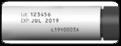
Global Version ID: 78691_1822858_4521304
- Prepare and arrange everything you need on the surface.
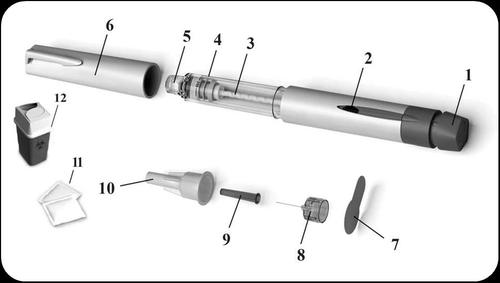
- 1. dose setting knob
- 2. dose window
- 3. plunger piston
- 4. reservoir container
- 5. threaded needle connector
- 6. pen cap
- 7. tear-off tab
- 8. removable needle
- 9. inner needle protection
- 10. outer needle cap
- 11. alcohol-soaked cotton balls
- 12. sharps container
Caution: alcohol-soaked cotton balls and the sharps container are not
supplied in the package.
3. How to prepare a pre-filled Ovitrelle pen for injection
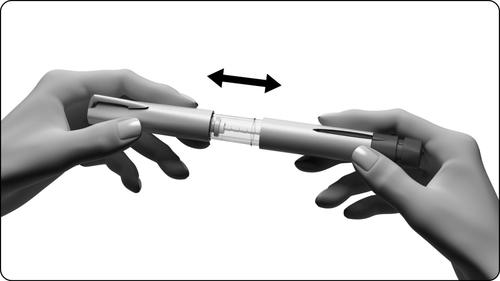
3.1 Remove the pen cap
Global Version ID: 78691_1822858_4521304
3.2 Prepare the needle for injection
- Take a new needle - use only the “single-use” needle provided.
- Hold the outer cap of the needle firmly in your hand.
- Check that the tear-off tab on the outer cap of the needle is not damaged or loose.

Pull off the tab.
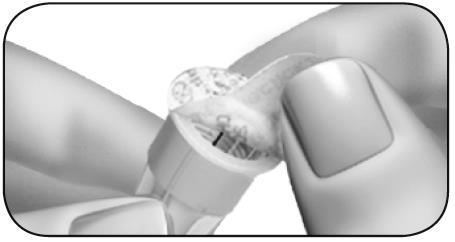
WARNING:
If the tab is damaged or loose, do not use the needle. Dispose of it in a sharps container. Ask your doctor or pharmacist how to obtain a new needle.
3.3 Connect the needle
- Screw the threaded end of the pre-filled pen Ovitrelle into the outer needle cap until you feel slight resistance. Warning:do not overtighten the needle; it may be difficult
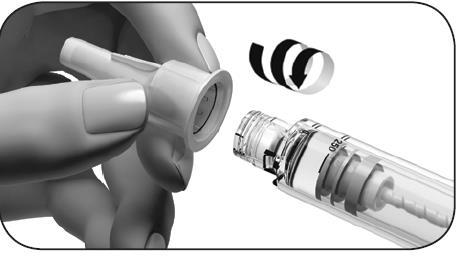
to remove it after the injection.
- Remove the outer needle cap by gently pulling it off.
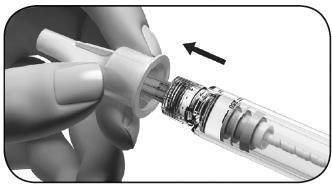
Put it aside to be able to use it later.
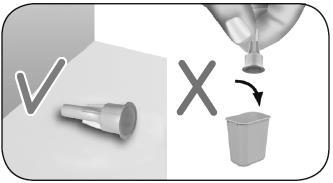
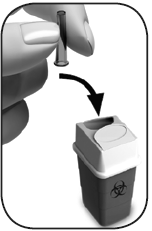
- Hold the pre-filled pen Ovitrelle with the needle pointing upwards.
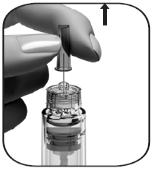
towards the top.
- Carefully remove and discard the inner green protection.
Global Version ID: 78691_1822858_4521304
- 3.4 Carefully observe the needle tip and check if there is one or more droplet ofliquid
- If you observe one or more droplets of liquid, proceed to
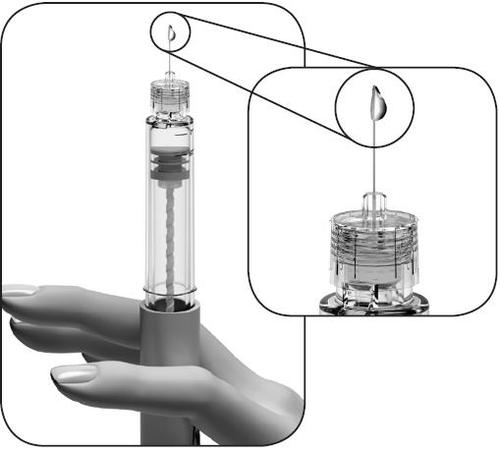
paragraph 4: How to set the dose to 250.
WARNING:
If you do not observe one or more droplets of liquid at or near the needle tip,
follow the steps on the next page.
If you do not observe one or more droplets of liquid at or near the tip
of the needle:
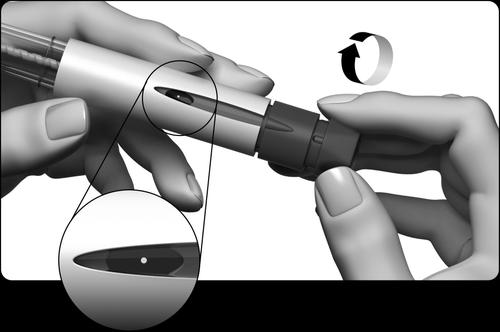
- 1.Gently rotate the dose adjustment knob clockwise until you see a dot (●) in the dose window. If you go past this position, simply move the dose adjustment knob back to the dot (●).
- 2.Hold the pen with the needle pointing upwards.
- 3.Gently tap the reservoir container.
- 4.Press the dose adjustment knob all the way down. A small drop of liquid will appear on the needle tip; this indicates that the pre-filled pen is ready for injection.
Global Version ID: 78691_1822858_4521304
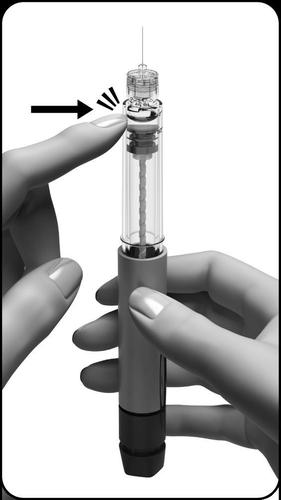
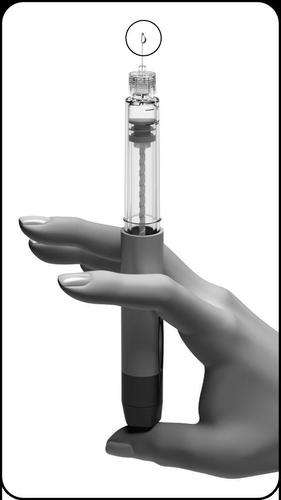
- 5.If you do not see any liquid, you can try again (you can do this a maximum of two times) starting from step 1 of the section “If you do not observe one or more droplets of liquid at or near the needle tip”.
4. How to set the dose to 250
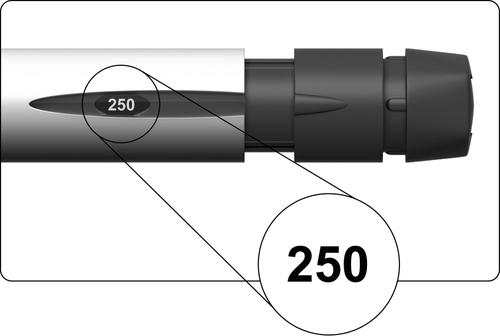
- Gently rotate the dose setting knob clockwise. A straight line will appear on the dose dial and you must continue to rotate until you read the number “ 250”.
- Do not push or pull the dose setting knob while rotating it.
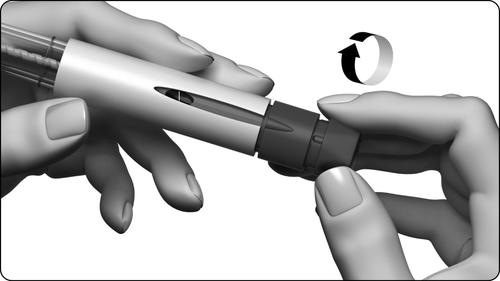
- The dose dial should indicate “250”, as shown in the figure below.
Global Version ID: 78691_1822858_4521304
5. How to inject the dose
- 5.1Choose the injection site in the area indicated by the doctor or nurse.
- 5.2Clean the injection site with a cotton ball soaked in alcohol.
- 5.3Double-check that the number indicated on the dose quadrant is “250”. If it is not, it is necessary to adjust it (see the section “4. How to set the dose to 250”).
5.4 Inject the dose as explained by your doctor or nurse.
- Push the entire needle slowly into the skin (1).
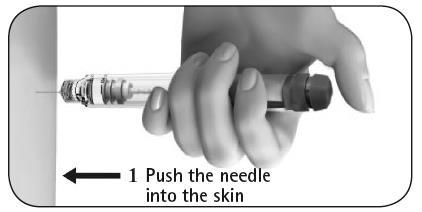
- Press the dose knob all the way downand hold it down to complete the injection.
Global Version ID: 78691_1822858_4521304
- Hold the dose knob pressed for at least 5 seconds,
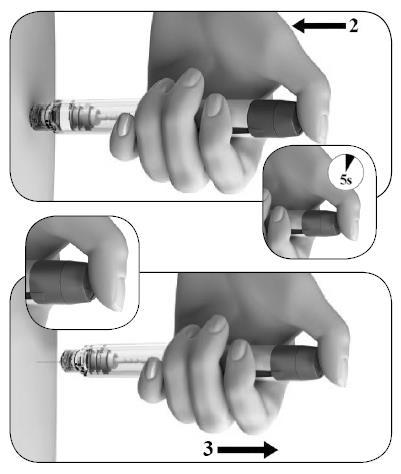
in order to inject the entire dose (2).
- The number that appears in the dose control windowwill return to “0”. This indicates that the entire dose has beenadministered.
- After at least 5 seconds, while still holding the dose setting knob pressed, withdraw the needle from the skin (3).
- Release the dose setting knob.
6. After the injection
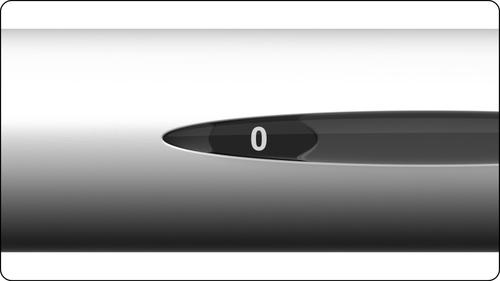
6.1 Make sure that the dose dial indicates “0”
- This confirms that the dose has been administered completely. Do not attempt asecond injection.
- If the dose dial does not indicate 0, contact your doctor or pharmacist.
Global Version ID: 78691_1822858_4521304
6.2 Remove the needle after the injection
- Hold the prefilled pen firmly, grasping it at the reservoir container level.
- Carefully cover the needle with the outer cap.
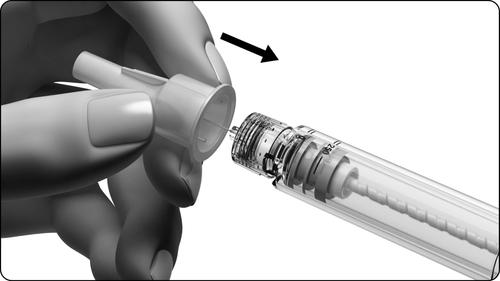
- Then grasp the outer cap of the needle and unscrew the needle.
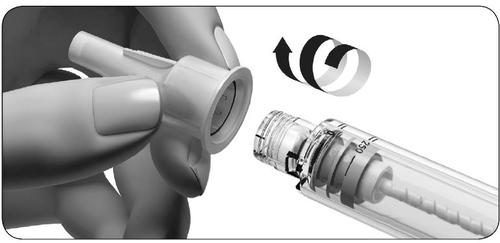
- Be careful not to prick yourself with the needle
- Now put the pen cap back on the pen.
6.3 Disposal
- Use the needle and pen only once.
- Once the injection is finished, dispose of the used needle safely.
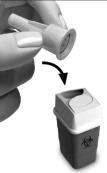
- Dispose of the pen. It is preferable to reinsert it into the original packaging.
- When the pen is empty, ask your pharmacist how to dispose of it.
Global Version ID: 78691_1822858_4521304
Warning:do not dispose of any medicine in the drain or household waste.
These instructions for use were updated on:
Global Version ID: 78691_1822858_4521304

Виникли питання під час прийому ліків?
Обговоріть свої симптоми та лікування з лікарем онлайн.
- Країна реєстрації
- Лікарська формаPowder and solvent for injectable solution, 250 MCG
- Код АТХG03GA08
- Діюча речовина
- Потрібен рецептТак
- Виробник
- Ця інформація надана лише для ознайомлення і не є медичною порадою. Рішення щодо лікування завжди приймає лікар.
- Альтернативи до OVITRELLEЛікарська форма: Injectable solution, 75 IU/0.125 MLДіюча речовина: фоллитропина альфаВиробник: GEDEON RICHTER PLCПотрібен рецептЛікарська форма: Injectable solution, 100 MCGДіюча речовина: корифоллитропина альфаВиробник: N.V. ORGANONПотрібен рецептЛікарська форма: Powder and solvent for injectable solution, 75 UI/MLДіюча речовина: УрофоллитропинВиробник: IBSA FARMACEUTICI ITALIA S.R.L.Потрібен рецепт
Аналоги OVITRELLE в інших країнах
Препарати з тією самою діючою речовиною, доступні в інших країнах.
Аналог OVITRELLE у Україна
Аналог OVITRELLE у Іспанія
Лікарі онлайн щодо OVITRELLE
Застосування, безпека та можливість призначення рецепта — за результатами медичної оцінки.
Отримайте рецепт на OVITRELLE онлайн
Заповніть форму за 2 хвилини
Розкажіть про симптоми, історію хвороби та потрібний препарат.
Оберіть лікаря або ми призначимо
Оберіть спеціаліста або ми підберемо найближчого доступного лікаря.
Лікар розглядає ваш випадок
Зазвичай протягом 30 хвилин. Може ставити уточнювальні запитання в чаті.
Отримайте в будь-якій аптеці
Електронний рецепт надсилається на вашу пошту — дійсний по всій Польщі.
Часті запитання
OVITRELLE потребує рецепта в Італія. Ви можете обговорити з лікарем онлайн, чи підходить цей лікарський засіб для вашої ситуації.
Діюча речовина у OVITRELLE — хориогонадотропин альфа. Це допомагає визначити препарати з тим самим складом, але під іншими торговими назвами.
OVITRELLE виробляється компанією MERCK EUROPE B.V.. Назва бренду та упаковка можуть відрізнятися залежно від дистрибʼютора.
Лікарі, зокрема Сімейні лікарі, Психіатри, Дерматологи, Кардіологи, Ендокринологи, Гастроентерологи, Пульмонологи, Нефрологи, Ревматологи, Гематологи, Інфекціоністи, Алергологи, Геріатри, Педіатри, Онкологи, можуть оцінити доцільність застосування OVITRELLE з урахуванням вашого стану та місцевих правил. Ви можете записатися на онлайн-консультацію, щоб обговорити симптоми та можливі подальші кроки.
Польща має добре розвинену систему охорони здоров'я у великих містах, таких як Варшава, Краків, Вроцлав і Гданськ. Аптеки широко доступні та працюють відповідно до чинного законодавства, забезпечуючи доступ до рецептурних препаратів.
Ви можете придбати OVITRELLE у Варшаві, Кракові, Вроцлаві або Гданську в будь-якій аптеці за наявності дійсного рецепта.
Щоб отримати рецепт, ви можете скористатися Oladoctor:
Інші препарати з тією самою діючою речовиною (хориогонадотропин альфа) включають BEMFOLA, ELONVA, FOSTIMON. Вони можуть відрізнятися торговою назвою або формою випуску, але містять той самий терапевтичний компонент. Перед зміною або початком прийому нового препарату варто проконсультуватися з лікарем.
