



LAPRYSTA 50 mg Film-Coated Tablets

Запит на рецепт онлайн
Лікар розгляне ваш випадок і визначить, чи є рецепт медично доцільним.

Поговоріть з лікарем про ці ліки
Обговоріть симптоми та можливі подальші кроки під час короткої онлайн-консультації.



Інструкція із застосування LAPRYSTA
Зміст інструкції
- Laprysta 10 mg/ml syrup
- Laprysta 50 mg film-coated tablets, 100 mg film-coated tablets, 150 mg film-coated tablets, 200 mg film-coated tablets
Laprysta 10 mg/ml syrup
lacosamide
Generic medicine
Read this leaflet carefully before you start to take this medicine as it contains important
information for you.
- Keep this leaflet. You may need to read it again.
- If you have any questions, ask your doctor or pharmacist.
- This medicine has been prescribed for you only. Do not pass it on to others, even if their symptoms are the same as yours, as it could be harmful.
- If you get any side effects, even those not listed in this leaflet, tell your doctor or pharmacist. See section 4.
Contents of this leaflet
- 1. What Laprysta is and what it is used for
- 2. What you need to know before you take Laprysta
- 3. How to take Laprysta
- 4. Possible side effects
- 5. How to store Laprysta
- 6. Contents of the pack and other information
1. What is Laprysta and what is it used for
What is Laprysta
Laprysta contains lacosamide. It belongs to a group of medicines called “antiepileptic medicines”. These medicines are used to treat epilepsy.
- This medicine has been given to you to reduce the number of seizures (epileptic fits) you experience.
What is Laprysta used for
- Laprysta is used:
- alone and in combination with other antiepileptic medicines in adults, adolescents and children from 2 years of age, to treat a specific form of epilepsy characterized by the occurrence of seizures with partial onset with or without secondary generalization. In this type of epilepsy, the seizures initially involve only one side of your brain. However, they may then spread to larger areas of both sides of your brain;
- in combination with other antiepileptic medicines in adults, adolescents and children from 4 years of age, to treat primary generalized tonic-clonic seizures (complex epileptic fits, including loss of consciousness) in patients with idiopathic generalized epilepsy (the type of epilepsy that is believed to have a genetic cause).
2. What you need to know before taking Laprysta
Do not take Laprysta
- if you are allergic to lacosamide or any of the other ingredients of this medicine (listed in section 6). If you are not sure if you are allergic, consult your doctor.
- if you have a specific type of heart rhythm problem called second or third degree AV block.
Do not take Laprysta if you fall into any of the above cases. If you are not sure, ask your doctor or pharmacist before taking this medicine.
Warnings and precautions
Talk to your doctor before taking Laprysta if:
- you have thought about harming yourself or committing suicide. A small number of people treated with antiepileptic medicines like lacosamide have thought about harming themselves or committing suicide. If you should have any of these thoughts at any time, tell your doctor immediately.
- you have a heart problem that affects your heartbeat and often have a particularly slow, fast or irregular heartbeat (e.g. AV block, atrial fibrillation and flutter)
- you have a serious heart condition, such as heart failure or have had a heart attack.
- you often feel dizzy or fall. Laprysta can cause dizziness - this may increase the risk of accidental injuries or falls. This means you should be careful until you get used to the effects of this medicine. If you fall into any of the above cases (or are not sure), ask your doctor or pharmacist before taking Laprysta. If you are taking Laprysta, talk to your doctor if you have a seizure that is different from usual or your existing seizures get worse. If you are taking Laprysta and experience symptoms of abnormal heartbeat (such as slow, fast or irregular heartbeat, palpitations, shortness of breath, feeling dizzy and fainting), consult your doctor immediately (see section 4).
Children
Laprysta is not recommended for children under 2 years of age with epilepsy characterized by partial-onset seizures and is not recommended for children under 4 years of age with primary generalized tonic-clonic seizures. This is because it is not yet known if it works and is safe for children in this age group.
Other medicines and Laprysta
Tell your doctor or pharmacist if you are taking, have recently taken or might take any other medicines.
In particular, tell your doctor or pharmacist if you are taking any of the following medicines that affect the heart: this is because Laprysta can also affect your heart:
- medicines to treat heart disease;
- medicines that can prolong the “P-R interval” on a heart scan (ECG or electrocardiogram) such as medicines for epilepsy or pain, called carbamazepine, lamotrigine or pregabalin;
- medicines used to treat some forms of irregular heartbeat or heart failure.
If you fall into any of the above cases (or are not sure) ask your doctor or pharmacist before taking Laprysta.
Also tell your doctor or pharmacist if you are taking any of the following drugs - this is because they can increase or decrease the effect of Laprysta on your body:
- medicines for fungal infections such as fluconazole, itraconazole or ketoconazole;
- medicines for HIV such as ritonavir;
- medicines used to treat bacterial infections such as clarithromycin or rifampicin;
- an herbal medicine used to treat mild anxiety and depression called St. John's Wort. If you fall into any of the above cases (or are not sure), ask your doctor or pharmacist before taking Laprysta.
Laprysta with alcohol
As a safety precaution, do not take Laprysta with alcohol.
Pregnancy and breastfeeding
Women of childbearing potential should discuss the use of contraceptive measures with their doctor.
If you are pregnant, suspect you may be pregnant, are planning a pregnancy or are breastfeeding, ask your doctor or pharmacist for advice before taking this medicine.
It is recommended not to take Laprysta during pregnancy as the effects of Laprysta on the fetus are not known. It is recommended not to breastfeed while taking Laprysta, as Laprysta passes into breast milk.
Consult your doctor immediately if you are pregnant or planning a pregnancy. They will help you decide whether or not to take Laprysta. Do not stop treatment without consulting your doctor first, as this may cause an increase in seizures (fits). Worsening of your condition can also be harmful to your baby.
Driving and operating machinery
Do not drive vehicles, ride a bicycle, use tools or operate machinery until you have checked how this medicine affects you. This is because Laprysta can cause dizziness or blurred vision.
Laprysta contains sorbitol (E 420), propylene glycol (E 1520), sodium, sodium methyl p-hydroxybenzoate (E 219), aspartame (E 951) and potassium
- sorbitol (E 420): this medicine contains 280 mg of sorbitol in each ml. Sorbitol is a source of fructose. If your doctor has told you that you (or your child) have an intolerance to certain sugars or if you have been diagnosed with hereditary fructose intolerance (HFI), a rare genetic illness in which a person cannot break down fructose, ask your doctor before you (or your child) take or receive this medicine. Sorbitol can cause gastrointestinal disturbances and mild laxative effect.
- propylene glycol (E 1520): this medicine contains 40.5 mg of propylene glycol in each ml.
- sodium: this medicine contains 4.64 mg of sodium (the main component of table salt/common salt) in each ml. This is equivalent to 0.2% of the recommended daily intake of sodium in the diet for an adult.
- sodium methyl p-hydroxybenzoate (E 219): may cause allergic reactions (including delayed reactions).
- aspartame (E 951): this medicine contains 0.4 mg of aspartame in each ml. Aspartame is a source of phenylalanine. It may be harmful if you have phenylketonuria (PKU), a rare genetic illness in which phenylalanine builds up because the body cannot remove it properly.
- Potassium: this medicine contains potassium, less than 1 mmol (39 mg) per 60 ml, i.e. it is essentially "potassium-free".
3. How to take Laprysta
Take this medicine always exactly as your doctor or pharmacist has told you. If you have
any doubts ask your doctor or pharmacist.
Taking Laprysta
- Take Laprysta twice every day, approximately 12 hours apart.
- Try to take it at about the same time each day.
- You can take Laprysta with or without food.
Usually you will start by taking a reduced dose each day and your doctor will slowly increase it over
a number of weeks. When you reach the dose that is right for you, this is called a "maintenance
dose", so take the same amount each day. Laprysta is used as a long-term treatment.
When the recommended dose cannot be reached with the dosing device in a single
administration, the required dose must be reached with multiple administrations (e.g. for a
dose of 300 mg (30 ml) with a 25 ml dosing cup: a 25 ml dosing cup + a 5 ml
dosing cup). Laprysta is used as a long-term treatment. You must continue to take
Laprysta until your doctor tells you to stop.
How much to take
Below are listed the normal recommended doses of Laprysta for different age groups and
weight. Your doctor may prescribe a different dose if you have kidney or liver problems.
Use the 10 mL oral syringe or the 25 mL dosing cup provided in the box, depending
on the dose needed. See the instructions for use below.
Adolescents and children weighing 50 kg or more and adults
When you take Laprysta alone
- The starting dose of Laprysta is usually 50 mg (5 ml) twice a day.
- Your doctor may also prescribe a starting dose of 100 mg (10 ml) of Laprysta twice a day.
- Your doctor may increase your daily dose by 50 mg (5 ml) twice a day each week, until you reach a maintenance dose, between 100 mg (10 ml) and 300 mg (30 ml) twice a day.
When you take Laprysta with other antiepileptic medicines
- The starting dose of Laprysta is usually 50 mg (5 ml) twice a day.
- Your doctor may increase your daily dose by 50 mg (5 ml) twice a day each week, until you reach a maintenance dose, between 100 mg (10 ml) and 200 mg (20 ml) twice a day.
- If you weigh 50 kg or more, your doctor may decide to start treatment with Laprysta with a single “loading” dose of 200 mg (20 ml). 12 hours later you would then start your maintenance dose.
Children and adolescents weighing less than 50 kg
- In the treatment of partial-onset seizures: note that Laprysta is not recommended in children under 2 years of age.
- In the treatment of primary generalized tonic-clonic seizures: note that Laprysta is not recommended in children under 4 years of age.
When you take Laprysta alone
- The doctor will decide the dose of Laprysta based on your body weight. Usually the starting dose is 1 mg (0.1 ml), per kilogram (kg) of body weight, twice a day.
- The doctor may then increase your daily dose by 1 mg (0.1 ml) per kg of body weight twice a day each week, until you reach a maintenance dose.
- Below are the dosage tables, including the maximum recommended dose. For reference only. Your doctor will calculate the dose suitable for you:
To be taken twice a dayfor children from 2 years of age weighing from 10 kg to less than
40 kg
| Weight | Week 1 Starting dose: 0.1 ml/kg | Week 2 0.2 ml/kg | Week 3 0.3 ml/kg | Week 4 0.4 ml/kg | Week 5 0.5 ml/kg | Week 6 Maximum recommended dose: 0.6 ml/kg |
| a Use the 10 ml syringe for volumes between 1 ml and 20 ml *Use a 25 ml dosing cup for volumes greater than 20 ml | ||||||
| 10 kg | 1 ml | 2 ml | i 3 ml | 4 ml | 5 ml | 6 ml |
| 15 kg | 1.5 ml | 3 ml | l 4.5 ml | 6 ml | 7.5 ml | 9 ml |
| 20 kg | 2 ml | a 4 ml | 6 ml | 8 ml | 10 ml | 12 ml |
| 25 kg | 2.5 ml | t 5 ml | 7.5 ml | 10 ml | 12.5 ml | 15 ml |
| 30 kg | 3 ml | I 6 ml | 9 ml | 12 ml | 15 ml | 18 ml |
| 35 kg | 3.5 ml | 7 ml | 10.5 ml | 14 ml | 17.5 ml | 21 ml* |
To be taken twice a dayfor children and adolescents weighing between 40 kg and less
than 50 kg:
| Weight | z n Week 1 Starting dose: 0.1 ml/kg | Week 2 0.2 ml/kg | Week 3 0.3 ml/kg | Week 4 0.4 ml/kg | Week 5 Maximum recommended dose: 0.5 ml/kg |
| g Use the 10 ml syringe for volumes between 1 ml and 20 ml * Use the 25 ml dosing cup for volumes greater than 20 ml | |||||
| 40 kg | 4 ml | 8 ml | 12 ml | 16 ml | 20 ml |
| 45 kg | A 4.5 ml | 9 ml | 13.5 ml | 18 ml | 22.5 ml* |
When you take Laprysta with other antiepileptic medicines
- The doctor will decide the dose of Laprysta based on your body weight.
- The starting dose is 1 mg (0.1 ml), per kilogram (kg) of body weight, twice a day.
- The doctor may then increase your daily dose by 1 mg (0.1 ml) per kg of body weight twice a day each week, until you reach a maintenance dose.
- The dosage tables below are provided, including the maximum recommended dose. For informational purposes only. For reference only. Your doctor will calculate the dose suitable for you:
To be taken twice a dayfor children from 2 years of age and weighing between 10 kg
and less than 20 kg
To be taken twice a dayfor children and adolescents weighing between 20 kg and
less than 30 kg:
| Weight | Settimana 1 Dose iniziale: 0,1 ml/kg | Settimana 2 0,2 ml/kg | Settimana 3 0,3 ml/kg | Settimana 4 0,4 ml/kg | Settimana a 5 0,5 ml/kg | r Settimana 6 Dose massima raccomandata: 0,6 ml/kg |
| F Use the 10 ml syringe for volumes between 1 ml and 20 ml | ||||||
| 10 kg | 1 ml | 2 ml | 3 ml | 4 ml | 5 ml | 6 ml |
| 12 kg | 1.2 ml | 2.4 ml | 3.6 ml | 4.8 ml | l 6 ml | 7.2 ml |
| 14 kg | 1.4 ml | 2.8 ml | 4.2 ml | e 5.6 ml | 7 ml | 8.4 ml |
| 15 kg | 1.5 ml | 3 ml | 4.5 ml | d 6 ml | 7.5 ml | 9 ml |
| 16 kg | 1.6 ml | 3.2 ml | 4.8 ml | 6.4 ml | 8 ml | 9.6 ml |
| 18 kg | 1.8 ml | 3.6 ml | 5.4 ml | 7.2 ml | 9 ml | 10.8 ml |
| Weight | Settimana 1 Dose iniziale: 0,1 ml/kg | Settimana 2 l 0,2 ml/kg a | i Settimana 3 0,3 ml/kg | Settimana 4 0,4 ml/kg | Settimana 5 Maximum recommended dose: 0.5 ml/kg |
| t *Use the 10 ml syringe for volumes between 1 ml and 20 ml | |||||
| 20 kg | 2 ml | I 4 ml | 6 ml | 8 ml | 10 ml |
| 22 kg | 2.2 ml | 4.4 ml | 6.6 ml | 8.8 ml | 11 ml |
| 24 kg | 2.4 ml | a 4.8 ml | 7.2 ml | 9.6 ml | 12 ml |
| 25 kg | i 2.5 ml | 5 ml | 7.5 ml | 10 ml | 12.5 ml |
| 26 kg | z 2.6 ml | 5.2 ml | 7.8 ml | 10.4 ml | 13 ml |
| 28 kg | 2.8 ml | 5.6 ml | 8.4 ml | 11.2 ml | 14 ml |
To be taken twice a dayfor children and adolescents weighing between 30 kg
and less than 50 kg:
| A Weight | Settimana 1 Dose iniziale: 0,1 ml/kg | Settimana 2 0,2 ml/kg | Settimana 3 0,3 ml/kg | Settimana 4 Maximum recommended dose: 0,4 ml/kg |
| Use the 10 ml syringe for volumes between 1 ml and 20 ml | ||||
Instructions for use
It is important to use the correct dosing device to measure the dose. Your doctor or pharmacist
will tell you which dosing device to use depending on the dose prescribed for you.
| 30 kg | 3 ml | 6 ml | 9 ml | 12 ml |
| 35 kg | 3.5 ml | 7 ml | 10.5 ml | 14 ml |
| 40 kg | 4 ml | 8 ml | 12 ml | o 16 ml |
| 45 kg | 4.5 ml | 9 ml | 13.5 ml | 18 ml |
| Oral dosing syringe for 10 ml | 25 ml dosing cup |
| The 10 ml oral syringe has graduations every 0.25 ml. If the required dose is between 1 ml and 10 ml, use the 10 ml oral syringe and the adapter provided in this package. If the required dose is between 10 ml and 20 ml, you will need to use the 10 ml syringe twice. | The 25 ml dosing cup has graduations every 5 ml. If the required dose is greater than 20 ml, you will need to use the 25 ml dosing cup provided in this package d a |
Instructions for use: dosing cup
- 1. Shake the bottle well before use.
- 2. Fill the dosing cup to the mark for the dose in millilitres (ml) prescribed by your doctor.
- 3. Swallow the dose of syrup.
- 4. Then drink some water.
Instructions for use: oral dosing syringe
Your doctor will show you how to use the oral dosing syringe before your first use. If you have
any questions, ask your doctor or pharmacist again.
Shake the bottle well before use.
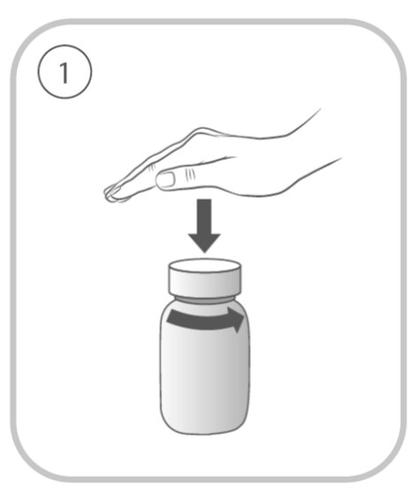
Open the bottle by pressing and turning the cap counterclockwise at the same time (figure 1).
Follow these steps the first time you take Laprysta:
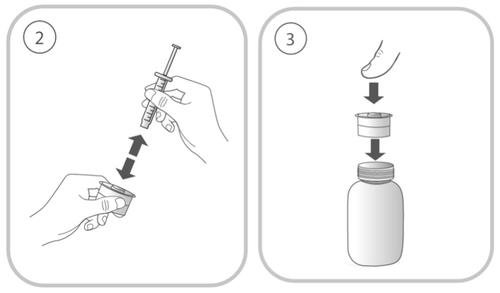
- Remove the adapter from the oral dosing syringe (figure 2).
- Place the adapter in the neck of the bottle (figure 3). Make sure it is firmly attached. You do not need to remove the adapter after use.
Follow these steps each time you take Laprysta:
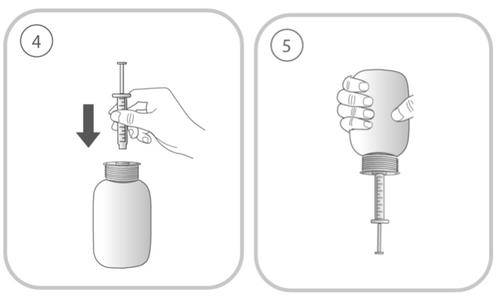
- Insert the oral dosing syringe into the opening of the adapter (figure 4).
- Turn the bottle upside down (figure 5).
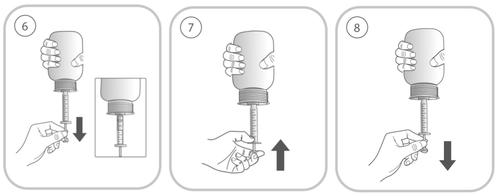
- Hold the upside-down bottle with one hand and use the other hand to fill the oral dosing syringe with a small amount of solution (figure 6).
- Push the plunger down to remove any air bubbles (figure 7).
- Pull the plunger down to the mark for the dose in millilitres (ml) prescribed by your doctor (figure 8).
- Return the bottle to its original position (figure 9).
- Remove the oral dosing syringe from the adapter (figure 10).
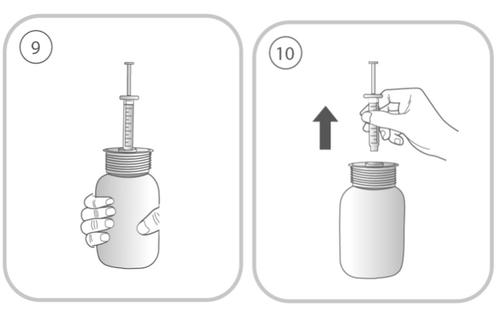
You can choose two ways to drink the medicine:
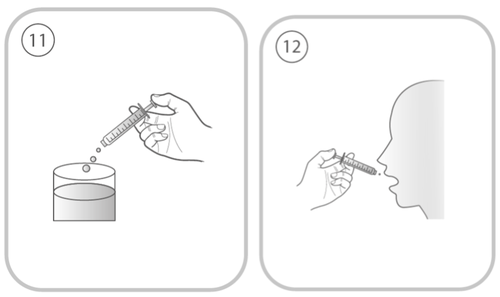
- empty the contents of the oral dosing syringe into a small amount of water by pushing the plunger all the way down (figure 11) - then you will need to drink all the water (so only add the amount of water that makes it easier to drink the syrup) or
- drink the solution directly from the oral dosing syringe, without water (figure 12)
- drink all the contents of the oral dosing syringe.
- Close the bottle with the plastic screw cap (you do not need to remove the adapter).
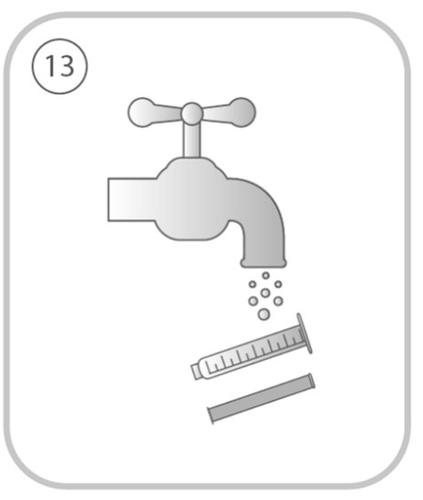
- Wash the oral dosing syringe with water only (figure 13).
If you take more Laprysta than you should
Contact your doctor immediately if you have taken more Laprysta than you should. Do not drive.
You may experience:
- dizziness;
- feeling sick (nausea) or being sick (vomiting);
- fits (seizures), heart problems such as a slow, fast or irregular heartbeat, coma or a drop in blood pressure with a fast heartbeat and sweating.
If you forget to take Laprysta
- If you have forgotten to take a dose of Laprysta and less than 6 hours have passed since the usual time of taking it, take Laprysta as soon as you remember.
- If you have forgotten to take a dose and more than 6 hours have passed since the usual time of taking it, do not take the forgotten dose of syrup. Instead, take the next dose of Laprysta syrup at the usual time.
- Do not take a double dose to make up for a forgotten dose.
If you stop taking Laprysta
- Do not stop treatment with Laprysta without consulting your doctor, as epilepsy may recur or worsen.
- If your doctor decides to stop therapy with Laprysta, they will provide you with instructions on how to gradually reduce the dose. If you have any doubts about the use of this medicine, ask your doctor or pharmacist.
4. Possible side effects
Like all medicines, this medicine can cause side effects, although not everybody gets them.
Side effects affecting the nervous system, such as dizziness, may be more frequent after
a single “loading” dose.
Talk to your doctor or pharmacist if you experience any of the following symptoms:
Very common:may affect more than 1 in 10 people
- Headache;
- Feeling dizzy or unwell (nausea);
- Double vision (diplopia).
Common:may affect up to 1 in 10 people
- Brief spasms in a muscle or group of muscles (myoclonic jerks);
- Difficulty coordinating movements or walking;
- Problems maintaining balance, tremors, tingling (paresthesia) or muscle spasms, easy bruising and getting cuts;
- Memory problems, difficulty thinking or finding the right words, confusion;
- Rapid and uncontrollable eye movements (nystagmus), blurred vision;
- Feeling of “spinning” (vertigo), drunkenness;
- Feeling unwell (vomiting), dry mouth, constipation, indigestion, excess gas in the stomach or intestines, diarrhea;
- Reduced sense of touch or sensation, difficulty articulating words, attention disorder;
- Noises in the ear such as ringing, trilling or whistling;
- Irritability, difficulty sleeping, depression;
- Drowsiness, fatigue or weakness (asthenia);
- Itching, irritation.
Uncommon:may affect up to 1 in 100 people
- Reduced heart rate, palpitations, irregular heartbeat or other changes in your heart's electrical activity (cardiac conduction disorder);
- Exaggerated feeling of well-being, seeing and/or hearing things that are not present;
- Allergic reaction after taking the medicine, hives;
- Blood tests may show abnormal liver function, liver damage;
- Thoughts of self-harm or suicide, attempt to commit suicide, inform your doctor immediately;
- Feeling of anger or agitation;
- Abnormal thoughts or loss of contact with reality;
- Severe allergic reaction causing swelling of the face, throat, hands, feet, ankles or lower legs;
- Fainting;
- Abnormal involuntary movements (dyskinesia).
Not known:frequency cannot be estimated from available data
- Fast heartbeat (ventricular tachycardia);
- Sore throat, high fever and suffering from more infections than usual. Blood tests may show a severe decrease in the number of cells of a specific class of white blood cells (agranulocytosis);
- Severe skin reaction that may include high fever and other flu-like symptoms, a rash on the face, widespread rash, swollen glands (enlarged lymph nodes). Blood tests may show increased levels of liver enzymes and a type of white blood cells (eosinophilia);
- A widespread rash with blisters and peeling skin, especially around the mouth, nose, eyes and genitals (Stevens-Johnson syndrome) and a more severe form that causes skin peeling in more than 30% of the body surface (toxic epidermal necrolysis);
- Convulsion.
Other side effects in children
Additional side effects observed in children have been fever (pyrexia), runny nose
(nasopharyngitis), sore throat (pharyngitis), eating less than usual (decreased appetite), changes in
behavior, behavior different from normal (abnormal behavior) and lack of
energy (lethargy). Drowsiness is a very common side effect in children and may affect
more than 1 in 10 children.
Reporting of side effects
If you get any side effects, even those not listed in this leaflet, tell your
doctor or pharmacist. You can also report side effects directly through the national
reporting system at https://www.aifa.gov.it/content/segnalazioni-reazioni-avverse .
By reporting side effects you can help provide more information on the safety of
this medicine.
5. How to store Laprysta
Keep this medicine out of the sight and reach of children.
Do not use this medicine after the expiry date which is stated on the package and the bottle after
Expiry/EXP. The expiry date refers to the last day of that month.
Do not refrigerate.
Once opened, do not use the syrup bottle for more than 2 months.
Do not dispose of any medicine in wastewater or household waste. Ask your pharmacist how to
dispose of medicines you no longer use. This will help protect the environment.
6. Package contents and other information
What Laprysta contains
- The active ingredient is lacosamide. 1 ml of syrup contains 10 mg of lacosamide.
- The other ingredients are: Acesulfame potassium (E 950), Purified water, Anhydrous citric acid, Strawberry aroma (contains propylene glycol (E 1520)), Aspartame (E 951), Sodium carboxymethylcellulose, Sodium chloride, Glycerol, Propylene glycol (E 1520), Macrogol 4000, Sodium methyl p-hydroxybenzoate (E 219), Liquid sorbitol 70 % (non-crystallizing) (E 420)
Description of Laprysta and package contents
- Laprysta 10 mg/ml syrup is a clear and colorless, slightly viscous liquid.
- Laprysta is available in a 200 ml bottle.
Laprysta syrup packs contain a 25 ml measuring cup with graduated markings and a
10 ml oral syringe with an adapter.
- The measuring cup is suitable for doses greater than 20 ml. The measuring cup shows three different non-linear scales on three different sides to allow for fine graduation of different doses. Each graduated mark is accompanied by the respective volume value in ml. The minimum
drawable volume is 2 ml, which corresponds to 20 mg of lacosamide. The maximum drawable volume is 25
ml, which corresponds to 250 mg of lacosamide.
- The 10 ml oral syringe is suitable for doses between 1 ml and 20 ml. One full 10 ml oral syringe corresponds to 100 mg of lacosamide. The minimum drawable volume is 1 ml, which is 10 mg of lacosamide. Subsequently, each graduation mark (0.25 ml) corresponds to 2.5 mg of lacosamide. The maximum drawable volume is 10 ml, which corresponds to 100 mg of lacosamide.
Marketing authorisation holder
Neuraxpharm Italy S.p.A.
Via Piceno Aprutina, 47
- 63100 – Ascoli Piceno (AP) Italy
Manufacturer
Neuraxpharm Arzneimittel GmbH
Elisabeth-Selbert-Strasse 23
40764 Langenfeld
Germany
Laprysta 50 mg film-coated tablets, 100 mg film-coated tablets, 150 mg film-coated tablets, 200 mg film-coated tablets
lacosamide
Generic Medicine
Read this leaflet carefully before you start taking this medicine as it contains important
information for you.
- Keep this leaflet. You may need to read it again.
- If you have any questions, ask your doctor or pharmacist.
- This medicine has been prescribed for you only. Do not pass it on to others, even if their symptoms are the same as yours, as it may be harmful.
- If you get any side effects, even those not listed in this leaflet, tell your doctor or pharmacist. See section 4.
Contents of this leaflet
- 1. What Laprysta is and what it is used for
- 2. What you need to know before you take Laprysta
- 3. How to take Laprysta
- 4. Possible side effects
- 5. How to store Laprysta
- 6. Contents of the pack and other information
1. What is Laprysta and what is it used for
What is Laprysta
Laprysta contains lacosamide. It belongs to a group of medicines called “antiepileptic medicines”. These medicines are used to treat epilepsy.
- This medicine has been given to you to reduce the number of seizures (epileptic fits) you experience.
What is Laprysta used for
- Laprysta is used:
- alone and in combination with other antiepileptic medicines in adults, adolescents and children starting from 2 years of age, to treat a specific form of epilepsy characterized by the occurrence of seizures with partial onset with or without secondary generalization. In this type of epilepsy, the seizures initially involve only one side of your brain. However, they may then spread to larger areas of both sides of your brain;
- in combination with other antiepileptic medicines in adults, adolescents and children starting from 4 years of age, to treat primary generalized tonic-clonic seizures (complex epileptic fits, including loss of consciousness) in patients with idiopathic generalized epilepsy (the type of epilepsy that is believed to have a genetic cause).
2. What you need to know before taking Laprysta
Do not take Laprysta
- if you are allergic to lacosamide or any of the other ingredients of this medicine (listed in section 6). If you are not sure if you are allergic, consult your doctor.
- if you have a particular type of heart rhythm problem called second or third degree AV block. Do not take Laprysta if you fall into one of the above cases. If you are not sure, ask your doctor or pharmacist before taking this medicine.
Warnings and precautions
Talk to your doctor before taking Laprysta if:
- you have thought about harming yourself or committing suicide. A small number of people treated with antiepileptic medicines like lacosamide have thought about harming themselves or committing suicide. If you should have any of these thoughts at any time, tell your doctor immediately.
- you have a heart problem that affects your heartbeat and often have a particularly slow, fast or irregular heartbeat (e.g. AV block, atrial fibrillation and flutter).
- you have a serious heart condition, such as heart failure or have had a heart attack.
- you often feel dizzy or fall. Laprysta can cause dizziness - this may increase the risk of accidental injury or falls. This means you should be careful until you get used to the effects of this medicine. If you fall into one of the above cases (or are not sure), ask your doctor or pharmacist before taking Laprysta. If you are taking Laprysta, talk to your doctor if you have a seizure that is different from your usual seizures or if your existing seizures get worse. If you are taking Laprysta and experience symptoms of an abnormal heartbeat (such as a slow, fast or irregular heartbeat, palpitations, shortness of breath, feeling dizzy and fainting), consult your doctor immediately (see section 4).
Children
Laprysta is not recommended for children under 2 years of age with epilepsy characterized by seizures
with partial onset and is not recommended for children under 4 years of age with primary generalized tonic-
clonic seizures. This is because it is not yet known if it works and if it is safe for children
in this age group.
Other medicines and Laprysta
Tell your doctor or pharmacist if you are taking, have recently taken or might take
any other medicines.
In particular, tell your doctor or pharmacist if you are taking any of the following medicines that
affect the heart. This is because Laprysta can also affect your heart:
- medicines to treat heart disease;
- medicines that can prolong the “PR interval” on a heart scan (ECG or electrocardiogram), such as medicines for epilepsy or pain, called carbamazepine, lamotrigine or pregabalin;
- medicines used to treat certain forms of irregular heartbeat or heart failure. If you fall into one of the above cases (or are not sure), ask your doctor or pharmacist before taking Laprysta.
Also tell your doctor or pharmacist if you are taking any of the following drugs. This is because they
can increase or decrease the effect of Laprysta on your body:
- medicines for fungal infections such as fluconazole, itraconazole or ketoconazole;
- medicines for HIV such as ritonavir;
- medicines used to treat bacterial infections such as clarithromycin or rifampicin;
- an herbal medicine used to treat mild anxiety and depression called St. John's wort. If you fall into one of the above cases (or are not sure), ask your doctor or pharmacist before taking Laprysta.
Laprysta and alcohol
As a safety precaution, do not take Laprysta with alcohol.
Pregnancy and breastfeeding
Women of childbearing potential should discuss the use of contraceptive measures with their doctor.
If you are pregnant, suspect you are pregnant, are planning a pregnancy or are breastfeeding, ask your doctor or pharmacist for advice before taking this medicine.
It is recommended not to take Laprysta during pregnancy as the effects of Laprysta on
pregnancy and the fetus are unknown. It is recommended not to breastfeed while taking Laprysta, as Laprysta passes into breast milk. Consult your doctor immediately if you are pregnant or
planning a pregnancy. They will help you decide whether to take Laprysta or not.
Do not stop treatment without consulting your doctor first, as this may cause an
increase in seizures (fits). A worsening of your condition can also be harmful to your
baby.
Driving and using machines
Do not drive vehicles, ride a bicycle, use tools or machinery until you have checked how
this medicine affects you. This is because Laprysta can cause dizziness or blurred vision.
3. How to take Laprysta
Take this medicine following exactly the instructions of your doctor or pharmacist. If you have
any doubts, ask your doctor or pharmacist. Other forms of this medicine may be more suitable
for children: ask your doctor or pharmacist.
Taking Laprysta
- Take Laprysta twice every day, approximately 12 hours apart.
- Try to take it at about the same time each day.
- Swallow the Laprysta tablet with a glass of water.
- You can take Laprysta with or without food.
Usually you will start by taking a reduced dose each day and your doctor will slowly increase it over
a number of weeks. When you reach the dose that is right for you, this is called the "maintenance
dose", so take the same amount each day. Laprysta is used as a long-term treatment. You must continue to take Laprysta until your doctor tells you to stop.
How much to take
Below are listed the usual recommended doses of Laprysta for different age groups and
weight ranges. Your doctor may prescribe a different dose if you have kidney or liver problems.
Adolescents and children weighing 50 kg or more and adults
When taking Laprysta alone
- The starting dose of Laprysta is usually 50 mg twice a day.
- Your doctor may also prescribe a starting dose of 100 mg of Laprysta twice a day.
- Your doctor may increase your daily dose by 50 mg twice a day each week, up to a maintenance dose, between 100 mg and 300 mg twice a day.
When taking Laprysta with other antiepileptic medicines
- The starting dose of Laprysta is usually 50 mg twice a day.
- Your doctor may increase your daily dose by 50 mg twice a day each week, up to a maintenance dose, between 100 mg and 200 mg twice a day.
- If you weigh 50 kg or more, your doctor may decide to start treatment with Laprysta with a single “loading” dose of 200 mg. 12 hours later you would then start your maintenance dose.
Children and adolescents weighing less than 50 kg
- In the treatment of partial onset seizures: it should be noted that Laprysta is not recommended in children under 2 years of age.
- In the treatment of primary generalized tonic-clonic seizures: it should be noted that Laprysta is not recommended in children under 4 years of age.
- The dose depends on their body weight. They usually start treatment with the syrup and switch to tablets only if they are able to take them and receive the correct dose with the different tablet strengths. The doctor will prescribe the most suitable formulation for them.
If you take more Laprysta than you should
Contact your doctor immediately if you have taken more Laprysta than you should. Do not try to
drive. You may experience:
- dizziness;
- feeling sick (nausea) or being sick (vomiting);
- fits (seizures), heart problems such as slow, fast or irregular heartbeat, coma or a drop in blood pressure with a fast heartbeat and sweating.
If you forget to take Laprysta
- If you have forgotten to take a dose and less than 6 hours have passed since the usual time of the missed dose, take it as soon as you remember.
- If you have forgotten to take a dose and more than 6 hours have passed since the usual time of the missed dose, do not take the missed dose. Instead, take your next Laprysta dose at the usual time.
- Do not take a double dose to make up for a missed dose.
If you stop taking Laprysta
- Do not stop taking Laprysta without consulting your doctor, as your epilepsy may come back or get worse.
- If your doctor decides to stop your treatment with Laprysta, they will give you instructions on how to gradually reduce your dose. If you have any questions about using this medicine, ask your doctor or pharmacist.
4. Possible side effects
Like all medicines, this medicine can cause side effects, although not everybody gets them.
Side effects affecting the nervous system, such as dizziness, may be more frequent after
a single “loading” dose.
Talk to your doctor or pharmacist if you experience any of the following symptoms:
Very common: may affect more than 1 in 10 people
- Headache;
- Feeling dizzy or unwell (nausea);
- Double vision (diplopia).
Common:may affect up to 1 in 10 people
- Brief spasms in a muscle or group of muscles (myoclonic jerks);
- Difficulty coordinating movements or walking;
- Problems maintaining balance, tremors, tingling (paresthesia) or muscle spasms, easy bruising and getting cuts;
- Memory problems, difficulty thinking or finding the right words, confusion;
- Rapid and uncontrollable eye movements (nystagmus), blurred vision;
- Feeling of “spinning” (vertigo), drunkenness;
- Feeling unwell (vomiting), dry mouth, constipation, indigestion, excess gas in the stomach or intestines, diarrhea;
- Reduced sense of touch or sensitivity, difficulty articulating words, attention disorder;
- Noises in the ear such as ringing, trilling or whistling;
- Irritability, difficulty sleeping, depression;
- Drowsiness, fatigue or weakness (asthenia);
- Itching, irritation.
Uncommon:may affect up to 1 in 100 people
- Decreased heart rate, palpitations, irregular heartbeat or other changes in your heart's electrical activity (cardiac conduction disorder);
- Exaggerated feeling of well-being, seeing and/or hearing things that are not present;
- Allergic reaction after taking the medicine, hives;
- Blood tests may show abnormal liver function, liver damage;
- Thoughts of self-harm or suicide, attempt to commit suicide: inform your doctor immediately;
- Feeling of anger or agitation;
- Abnormal thoughts or loss of contact with reality;
- Severe allergic reaction causing swelling of the face, throat, hands, feet, ankles or lower legs;
- Fainting;
- Abnormal involuntary movements (dyskinesia).
Not known:frequency cannot be estimated based on available data
- Fast heartbeat (ventricular tachycardia);
- Sore throat, high fever and suffering from more infections than usual. Blood tests may show a severe decrease in the number of cells of a specific class of white blood cells (agranulocytosis);
- Severe skin reaction that may include high fever and other flu-like symptoms, a rash on the face, widespread rash, swollen glands (enlarged lymph nodes). Blood tests may show increased levels of liver enzymes and a type of white blood cells (eosinophilia);
- A widespread rash with blisters and peeling skin, especially around the mouth, nose, eyes and genitals (Stevens-Johnson syndrome) and a more severe form causing peeling skin in more than 30% of the body surface (toxic epidermal necrolysis);
- Convulsion.
Additional side effects in children
Additional side effects in children have been fever (pyrexia), runny nose (nasopharyngitis), sore
throat (pharyngitis), eating less than usual (decreased appetite), changes in behavior,
behavior different from normal (abnormal behavior) and lack of energy (lethargy). Drowsiness is a very
common side effect in children and may affect more than 1 in
- 10.
Reporting of side effects
If you get any side effects, talk to your doctor or pharmacist. This includes any possible side effects not
listed in this leaflet. You can also report side effects directly through the national reporting system at
https://www.aifa.gov.it/content/segnalazioni-reazioni-avverse .
By reporting side effects you can help provide more information on the safety of
this medicine.
5. How to store Laprysta
Keep this medicine out of the sight and reach of children.
Do not use this medicine after the expiry date which is stated on the blister and the package after Exp.
The expiry date refers to the last day of that month.
This medicine does not require any particular storage conditions.
Do not dispose of any medicine in waste water or household waste. Ask your pharmacist how
to dispose of medicines you no longer use. This will help protect the environment.
6. Package Contents and Other Information
What Laprysta contains
The active ingredient is lacosamide.
One Laprysta 50 mg tablet contains 50 mg of lacosamide.
One Laprysta 100 mg tablet contains 100 mg of lacosamide.
One Laprysta 150 mg tablet contains 150 mg of lacosamide.
One Laprysta 200 mg tablet contains 200 mg of lacosamide.
The other ingredients are:
Tablet core: microcrystalline cellulose, hydroxypropylcellulose, hydroxypropylcellulose (low
substitution), silicified microcrystalline cellulose, crospovidone (Type B), magnesium stearate
Coating: polyvinyl alcohol, macrogol, talc, titanium dioxide (E171), colorants*
*The colorants are:
50 mg tablets: red iron oxide (E172), black iron oxide (E172), aluminium lake indigotine (E132)
100 mg tablets: yellow iron oxide (E172)
150 mg tablets: yellow iron oxide (E172), red iron oxide (E172), black iron oxide
(E172)
200 mg tablets: aluminium lake indigotine (E132)
Description of Laprysta’s appearance and package contents
Laprysta 50 mg film-coated tablets are pink, oval, with the inscription “LAC” on one
side and “50” on the other.
Laprysta 100 mg film-coated tablets are dark yellow, oval, with the inscription “LAC” on one
side and “100” on the other.
Laprysta 150 mg film-coated tablets are salmon-colored, oval, with the inscription “LAC”
on one side and “150” on the other.
Laprysta 200 mg film-coated tablets are blue, oval, with the inscription “LAC” on one
side and “200” on the other.
Laprysta is available in packs of 14, 56 and 84 film-coated tablets in transparent and colorless PVC/PVDC
blisters sealed with an aluminium foil.
Not all pack sizes may be marketed.
Marketing Authorisation Holder
Neuraxpharm Italy S.p.A.
Via Piceno Aprutina, 47
- 63100 – Ascoli Piceno (AP) Italy
Manufacturer
Combino Pharm (Malta) Ltd.
HF60 Qasam Industrijali Hal Far
Birzebbuga BBG3000
Malta
Or
SVUS Pharma a.s.
Smetanovo nábřeží 1238/20a
500 02 Hradec Králové
Czech Republic
Or
Simvis Pharmaceuticals S.A.
Asklipiou 4-6,
Kryoneri, Attiki,
14568, Greece

Не впевнені, чи підходить вам цей лікарський засіб?
Обговоріть симптоми та можливі варіанти лікування з лікарем онлайн.

Виникли питання під час прийому ліків?
Обговоріть свої симптоми та лікування з лікарем онлайн.
- Країна реєстрації
- Лікарська формаFilm-coated tablet, 50 MG
- Код АТХN03AX18
- Діюча речовина
- Потрібен рецептТак
- Виробник
- Ця інформація надана лише для ознайомлення і не є медичною порадою. Рішення щодо лікування завжди приймає лікар.
- Альтернативи до LAPRYSTAЛікарська форма: Film-coated tablet, 50 MGДіюча речовина: ЛакосамидВиробник: ACCORD HEALTHCARE, S.L.U.Потрібен рецептЛікарська форма: Infusion solution, 10 mg / mlДіюча речовина: ЛакосамидВиробник: EXTROVIS EU LTDПотрібен рецептЛікарська форма: Film-coated tablet, 50 MGДіюча речовина: ЛакосамидВиробник: AUROBINDO PHARMA (ITALIA) S.R.L.Потрібен рецепт
Аналоги LAPRYSTA в інших країнах
Препарати з тією самою діючою речовиною, доступні в інших країнах.
Аналог LAPRYSTA у Іспанія
Аналог LAPRYSTA у Польща
Аналог LAPRYSTA у Україна
Лікарі онлайн щодо LAPRYSTA
Застосування, безпека та можливість призначення рецепта — за результатами медичної оцінки.



Отримайте рецепт на LAPRYSTA онлайн
Заповніть форму за 2 хвилини
Розкажіть про симптоми, історію хвороби та потрібний препарат.
Оберіть лікаря або ми призначимо
Оберіть спеціаліста або ми підберемо найближчого доступного лікаря.
Лікар розглядає ваш випадок
Зазвичай протягом 30 хвилин. Може ставити уточнювальні запитання в чаті.
Отримайте в будь-якій аптеці
Електронний рецепт надсилається на вашу пошту — дійсний по всій Польщі.
Часті запитання
LAPRYSTA потребує рецепта в Італія. Ви можете обговорити з лікарем онлайн, чи підходить цей лікарський засіб для вашої ситуації.
Діюча речовина у LAPRYSTA — Лакосамид. Це допомагає визначити препарати з тим самим складом, але під іншими торговими назвами.
LAPRYSTA виробляється компанією NEURAXPHARM ITALY S.P.A.. Назва бренду та упаковка можуть відрізнятися залежно від дистрибʼютора.
Лікарі, зокрема Сімейні лікарі, Психіатри, Дерматологи, Кардіологи, Ендокринологи, Гастроентерологи, Пульмонологи, Нефрологи, Ревматологи, Гематологи, Інфекціоністи, Алергологи, Геріатри, Педіатри, Онкологи, можуть оцінити доцільність застосування LAPRYSTA з урахуванням вашого стану та місцевих правил. Ви можете записатися на онлайн-консультацію, щоб обговорити симптоми та можливі подальші кроки.
Польща має добре розвинену систему охорони здоров'я у великих містах, таких як Варшава, Краків, Вроцлав і Гданськ. Аптеки широко доступні та працюють відповідно до чинного законодавства, забезпечуючи доступ до рецептурних препаратів.
Ви можете придбати LAPRYSTA у Варшаві, Кракові, Вроцлаві або Гданську в будь-якій аптеці за наявності дійсного рецепта.
Щоб отримати рецепт, ви можете скористатися Oladoctor:
Інші препарати з тією самою діючою речовиною (Лакосамид) включають LAKOSAMIDE AKKORD, LAKOSAMIDE ADROIQ, LAKOSAMIDE AUROBINDO. Вони можуть відрізнятися торговою назвою або формою випуску, але містять той самий терапевтичний компонент. Перед зміною або початком прийому нового препарату варто проконсультуватися з лікарем.
