



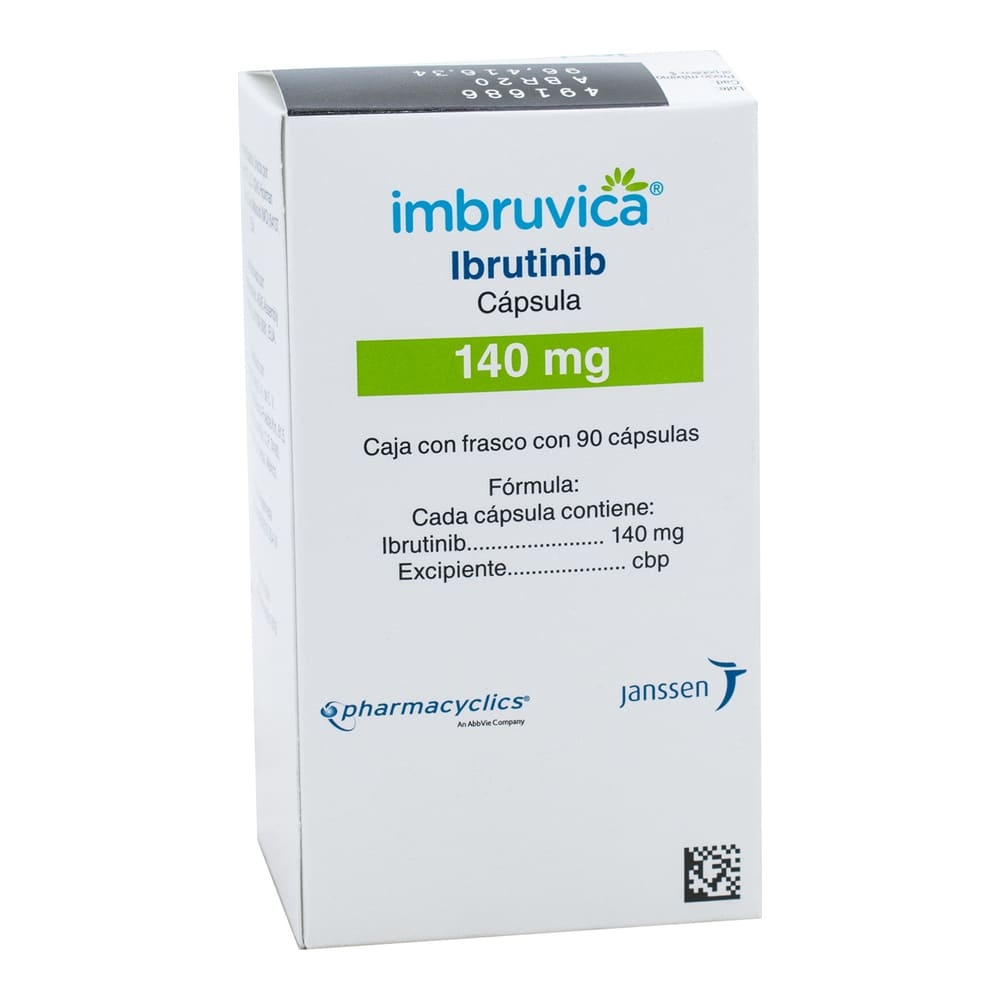
IMBRUVICA 140 mg Hard Capsules

Запит на рецепт онлайн
Лікар розгляне ваш випадок і визначить, чи є рецепт медично доцільним.

Поговоріть з лікарем про ці ліки
Обговоріть симптоми та можливі подальші кроки під час короткої онлайн-консультації.



Інструкція із застосування IMBRUVIKA
Зміст інструкції
- IMBRUVICA 140 mg hard capsules
- IMBRUVICA 140 mg film-coated tablets, 280 mg film-coated tablets, 420 mg film-coated tablets, 560 mg film-coated tablets
IMBRUVICA 140 mg hard capsules
ibrutinib
Read this leaflet carefully before you start taking this medicine as it contains
important information for you.
- Keep this leaflet. You may need to read it again.
- If you have any questions, ask your doctor, pharmacist or nurse.
- This medicine has been prescribed for you only. Do not pass it on to others, even if their symptoms are the same as yours, as it could be harmful.
- If you get any side effects, even those not listed in this leaflet, tell your doctor, pharmacist or nurse. See section 4.
Contents of this leaflet:
- 1. What IMBRUVICA is and what it is used for
- 2. What you need to know before you take IMBRUVICA
- 3. How to take IMBRUVICA
- 4. Possible side effects
- 5. How to store IMBRUVICA
- 6. Contents of the pack and other information
1. What is IMBRUVICA and what is it used for
What is IMBRUVICA
IMBRUVICA is an anti-cancer medicine that contains the active substance ibrutinib. It belongs to the
class of medicines called protein kinase inhibitors.
What is IMBRUVICA used for
IMBRUVICA is used in adult patients for the treatment of the following blood cancers:
- Mantle cell lymphoma (MCL), a type of cancer that affects the lymph nodes. IMBRUVICA is used in patients who have not been previously treated for MCL and for whom hematopoietic stem cell transplantation would be suitable, or when the disease recurs or has not responded to treatment.
- Chronic lymphocytic leukemia (CLL), a type of cancer that affects white blood cells called lymphocytes and also involves the lymph nodes. IMBRUVICA is used in patients who have not been previously treated for CLL or when the disease recurs or has not responded to treatment.
- Waldenström's macroglobulinemia (WM) a type of cancer that affects white blood cells called lymphocytes. It is used in patients who have not been previously treated for WM or when the disease recurs, has not responded to treatment, or for patients for whom chemotherapy given together with an antibody is not appropriate.
How does IMBRUVICA work
In MCL, CLL and WM, IMBRUVICA works by blocking “Bruton’s tyrosine kinase”, a protein
in the body that helps these cancer cells grow and survive. By blocking this
protein, IMBRUVICA helps to kill and reduce the number of cancer cells. IMBRUVICA
also slows down the worsening of cancer.
2. Cosa deve sapere prima di prendere IMBRUVICA
Non prenda IMBRUVICA
- se è allergico a ibrutinib o ad uno qualsiasi degli altri componenti di questo medicinale (elencati al paragrafo 6).
- Se sta prendendo un medicinale erboristico chiamato erba di San Giovanni, usato per la depressione. Se ha dubbi si rivolga al medico, al farmacista o all’infermiere prima di prendere questo medicinale.
Avvertenze e precauzioni
Si rivolga al medico, al farmacista o all’infermiere prima di prendere IMBRUVICA:
- se ha mai avuto lividi o sanguinamento inusuali o sta prendendo un medicinale o un integratore che aumenta il rischio di sanguinamento (vedere Altri medicinali e IMBRUVICA)
- se ha un battito cardiaco irregolare o ha avuto in precedenza un battito cardiaco irregolare o un grave scompenso cardiaco, o se prova una delle seguenti condizioni: mancanza di respiro, debolezza, capogiri, sensazione di testa vuota, svenimento o presvenimento, dolore al torace o gonfiore delle gambe
- se ha problemi al fegato, incluso se ha mai avuto o ha ora un’infezione da epatite B (un’infezione al fegato)
- se soffre di pressione del sangue alta
- se ha recentemente subito un intervento chirurgico, specialmente se questo può condizionare il modo in cui assorbe il cibo o i medicinali dallo stomaco o dall’intestino
- se si deve sottoporre a un intervento chirurgico programmato: il medico può chiederle di interrompere l’assunzione di IMBRUVICA per un breve tempo (da 3 a 7 giorni prima e dopo il suo intervento chirurgico)
- se ha problemi ai reni.
Se uno qualsiasi dei punti sopra elencati la riguarda (o se ha dubbi) si rivolga al medico, al farmacista
o all’infermiere prima di assumere o mentre sta assumendo questo medicinale (vedere paragrafo
“Possibili effetti indesiderati”).
Mentre è in terapia con IMBRUVICA, informi immediatamente il medico nel caso in cui lei, o
qualcun altro, notasse: perdita di memoria, difficoltà nel pensare, difficoltà a camminare o perdita
della vista - questi sintomi possono essere causati da una rara ma grave infezione del cervello che può
essere fatale (leucoencefalopatia multifocale progressiva o PML).
Informi immediatamente il medico se nota o se qualcuno nota in lei: intorpidimento improvviso o
debolezza degli arti (specialmente su un lato del corpo), improvvisa confusione, difficoltà a parlare o a
comprendere il linguaggio, perdita della vista, difficoltà a camminare, perdita dell’equilibrio o
mancanza di coordinazione, improvviso mal di testa grave senza causa nota. Questi possono essere
segni e sintomi di ictus.
Informi immediatamente il medico se avverte dolore nella parte superiore sinistra della pancia
(addome), dolore sotto la parte sinistra della cassa toracica oppure nella parte superiore della spalla
sinistra (possono essere sintomi di rottura della milza) dopo aver interrotto l’assunzione di
IMBRUVICA.
Effetti sul cuore
Il trattamento con IMBRUVICA può avere effetti sul cuore, specialmente se lei soffre già di malattie
cardiache come problemi del ritmo, insufficienza cardiaca, pressione del sangue alta, diabete o ha
un’età avanzata. Gli effetti possono essere gravi e potrebbero essere mortali, provocando a volte morte
improvvisa. La sua funzionalità cardiaca sarà controllata prima e durante il trattamento con
IMBRUVICA. Informi immediatamente il medico se prova affanno, ha difficoltà respiratorie in
posizione sdraiata, gonfiore dei piedi, delle caviglie o alle gambe e debolezza/stanchezza durante il
trattamento con IMBRUVICA, poiché potrebbero essere segni di insufficienza cardiaca.
Infezioni
Nel corso del trattamento con IMBRUVICA, lei potrebbe avere infezioni virali, batteriche o fungine.
Contatti il medico se ha febbre, brividi di freddo, debolezza, confusione mentale, dolori diffusi nel
corpo, sintomi da raffreddamento o influenza, sensazione di stanchezza o di respiro corto,
ingiallimento della pelle o degli occhi (ittero). Potrebbero essere segni di un’infezione.
Linfoistiocitosi emofagocitica
Sono stati riportati casi di eccessiva attivazione dei globuli bianchi associata a infiammazione
(linfoistiocitosi emofagocitica), che può essere fatale se non diagnosticata e trattata in tempo. Se
manifesta molteplici sintomi come febbre, ghiandole gonfie, lividi o eruzioni cutanee, contatti
immediatamente il medico.
Test e controlli prima e durante il trattamento
Sindrome da lisi tumorale (TLS): si sono osservati livelli insoliti di sostanze chimiche nel sangue
causati dalla veloce distruzione delle cellule tumorali durante il trattamento del tumore e a volte anche
senza trattamento. Questo può portare a cambiamenti della funzione del rene, battito cardiaco anomalo
o convulsioni. Il medico o un altro operatore sanitario può sottoporla a degli esami del sangue per
controllare la TLS.
Linfocitosi: gli esami di laboratorio possono mostrare un aumento di globuli bianchi (chiamati
“linfociti”) nel sangue, durante le prime settimane di trattamento. Questo è un fatto atteso e può durare
alcuni mesi. Ciò non significa necessariamente che il tumore ematologico sta peggiorando. Il medico
controllerà la conta delle cellule del sangue prima o durante il trattamento, e in rari casi può essere
necessario darle un altro medicinale. Chieda al medico spiegazioni sul significato dei risultati dei test.
Eventi correlati al fegato: il medico la sottoporrà a degli esami del sangue per controllare se il fegato
funziona correttamente o per escludere un’infezione al fegato, nota come epatite virale, o per
controllare se l’epatite B è diventata nuovamente attiva, in quanto potrebbe essere fatale.
Bambini e adolescenti
IMBRUVICA non deve essere usato nei bambini e adolescenti.
Altri medicinali e IMBRUVICA
Informi il medico o il farmacista se sta assumendo, ha recentemente assunto o potrebbe assumere
qualsiasi altro medicinale. Questi includono i medicinali che non necessitano di prescrizione, i
medicinali erboristici e gli integratori. Ciò è dovuto al fatto che IMBRUVICA può influenzare il modo
di agire di altri medicinali. Inoltre, alcuni medicinali possono influenzare il modo di agire di
IMBRUVICA.
IMBRUVICA può facilitare il sanguinamento.Questo significa che deve informare il medico se
prende altri medicinali che aumentano il rischio di sanguinamento. Questi includono:
- acido acetilsalicilico e anti-infiammatori non steroidei (FANS) come ibuprofene o naprossene
- fluidificanti del sangue come warfarin, eparina o altri medicinali anticoagulanti
- integratori alimentari che possono aumentare il rischio di sanguinamento come olio di pesce, vitamina E o semi di lino.
Se uno qualsiasi dei punti sopra elencati la riguarda (o se ha dubbi) si rivolga al medico, al farmacista
o all’infermiere prima di assumere IMBRUVICA.
Inoltre informi il medico se prende uno qualsiasi dei seguenti medicinali– Gli effetti di
IMBRUVICA o di altri medicinali possono essere influenzati se assume IMBRUVICA insieme ad uno
qualsiasi dei seguenti medicinali:
- medicinali chiamati antibiotici, utilizzati per curare infezioni batteriche: claritromicina, telitromicina, ciprofloxacina, eritromicina o rifampicina
- medicinali per le infezioni da funghi: posaconazolo, ketoconazolo, itraconazolo, fluconazolo o voriconazolo
- medicinali per l’infezione da HIV: ritonavir, cobicistat, indinavir, nelfinavir, saquinavir, amprenavir, atazanavir o fosamprenavir
- medicinali per prevenire nausea e vomito associati alla chemioterapia: aprepitant
- medicinali per la depressione: nefazodone
- medicinali chiamati inibitori delle chinasi per il trattamento di altri tumori: crizotinib o imatinib
- medicinali chiamati calcio-antagonisti, per l’ipertensione o l’angina: diltiazem o verapamil
- medicinali chiamati statine per trattare il colesterolo alto: rosuvastatina
- medicinali per le aritmie: amiodarone o dronedarone
- medicinali per prevenire o trattare le crisi epilettiche o medicinali per trattare una condizione dolorosa della faccia chiamata nevralgia del trigemino: carbamazepina o fenitoina.
Se uno qualsiasi dei punti sopra elencati la riguarda (o ha dubbi su questo fatto) si rivolga al medico, al
farmacista o all’infermiere prima di assumere IMBRUVICA.
Se sta prendendo la digossina, un medicinale usato per i problemi cardiaci, o metotressato, un
medicinale usato per trattare altri tumori e per ridurre l’attività del sistema immunitario (ad es. per
l’artrite reumatoide o la psoriasi) questi devono essere assunti almeno 6 ore prima o dopo
IMBRUVICA.
IMBRUVICA con il cibo
Non prenda IMBRUVICA con del pompelmo o arance di Siviglia (arance amare),il che significa
mangiarli, berne il succo o prendere integratori che possano contenerli. Questo perché possono
aumentare la quantità di IMBRUVICA nel sangue.
Gravidanza e allattamento
Eviti di iniziare una gravidanza durante il trattamento con questo medicinale.
IMBRUVICA non deve essere utilizzato durante la gravidanza.
Non ci sono informazioni sulla sicurezza di IMBRUVICA in donne in gravidanza.
Le donne in età fertile devono usare un metodo contraccettivo altamente efficace durante e fino a tre
mesi dopo l’assunzione di IMBRUVICA per evitare di iniziare una gravidanza mentre è in corso il
trattamento con IMBRUVICA.
- Avverta immediatamente il medico se è in corso una gravidanza.
- Non allatti con latte materno durante il trattamento con questo medicinale.
Guida di veicoli e utilizzo di macchinari
Dopo aver preso IMBRUVICA può sentirsi stanco/a o avere dei capogiri, ciò può influenzare la
capacità di guidare o di utilizzare strumenti o macchinari.
IMBRUVICA contiene sodio
IMBRUVICA contiene meno di 1 mmol (23 mg) di sodio per dose, cioè è essenzialmente ‘senza
sodio’.
3. How to take IMBRUVICA
Take this medicine following exactly the instructions of your doctor, pharmacist or
nurse. If you have any doubts, ask your doctor, pharmacist or nurse.
How much to take
Mantle cell lymphoma (MCL)
The recommended dose of IMBRUVICA is four capsules (560 mg) once a day.
Chronic lymphocytic leukemia (CLL)/Waldenström's macroglobulinemia (WM)
The recommended dose of IMBRUVICA is three capsules (420 mg) once a day.
Your doctor may adjust the dose.
Taking this medicine
- Take the capsules by mouth with a glass of water.
- Take the capsules always around the same time each day.
- Swallow the capsules whole; the capsules must not be opened, broken or chewed.
If you take more IMBRUVICA than you should
If you take more IMBRUVICA than you should, contact your doctor or go to hospital
immediately. Bring the capsules and this leaflet with you.
If you forget to take IMBRUVICA
- If you forget a dose, you can take it as soon as possible on the same day, returning to your normal schedule the next day.
- Do not take a double dose to make up for a forgotten dose.
- If you have any doubts about when to take the next dose, contact your doctor, pharmacist or nurse.
If you stop taking IMBRUVICA
Do not stop taking this medicine unless your doctor tells you to.
If you have any questions about using this medicine, contact your doctor, pharmacist or
nurse.
4. Possible side effects
Like all medicines, this medicine can cause side effects, although not everybody gets them.
The following side effects may occur with this medicine:
If you notice any of the side effects listed in this leaflet, stop taking IMBRUVICA and contact your doctor immediately:
irregular, itchy rash, difficulty breathing, swelling of the face, lips, tongue or throat.
These can be an allergic reaction to the medicine.
Tell your doctor immediately if you notice any of the following side effects:
Patients treated with IMBRUVICA for B-cell tumors:
Very common(affects more than 1 in 10 people)
- fever, chills, muscle aches, feeling tired, cold-like symptoms, shortness of breath - these can be signs of an infection (viral, bacterial or fungal). This may be infections of the nose, sinuses or throat (upper respiratory tract infection) or of the lung or skin
- blood in the stomach, intestines, stools or urine, heavier than normal menstrual bleeding or unstoppable bleeding from a cut
- bruising or increased tendency to bruise
- mouth sores
- dizziness
- headache
- constipation
- nausea or vomiting
- indigestion
- diarrhoea: your doctor may give you fluids and salts or another medicine
- rash
- arm or leg pain
- back or joint pain
- muscle cramps, aches or spasms
- fever
- blood tests showing low numbers of cells that help blood to clot (platelets), very low numbers of white blood cells
- blood tests showing an increase in the number or percentage of white blood cells
- swelling of hands, ankles or feet
- high blood pressure
- increased level of “creatinine” in the blood.
Common(may affect up to 1 in 10 people)
- serious infections throughout the body (sepsis)
- urinary tract infections
- nosebleeds, small red or purple spots caused by bleeding under the skin
- heart failure
- irregular heartbeats, weak or irregular pulse, feeling faint, shortness of breath, chest discomfort (symptoms of heart rhythm problems)
- low number in white blood cell count with fever (febrile neutropenia)
- non-melanoma skin cancer, more frequently squamous cell carcinoma and basal cell carcinoma
- blurred vision
- reddened skin
- inflammation of the lungs that can lead to permanent damage, high level of “uric acid” in the blood (shown by blood tests), which can cause gout
- nail breakage
- hives
- sudden kidney damage
- weakness, numbness, tingling or pain in the hands or feet or other parts of the body (peripheral neuropathy).
Uncommon(may affect up to 1 in 100 people)
- liver failure including events with a fatal outcome
- serious fungal infections
- “reactivation” of hepatitis B (if you were previously infected with hepatitis B, it may return)
- bleeding on the surface of the brain
- confusion, headache with altered speech or feeling faint: these can be signs of serious internal bleeding in the brain
- unusual levels of chemicals in the blood caused by the rapid breakdown of cancer cells during cancer treatment and sometimes even without treatment (tumour lysis syndrome)
- allergic reaction, sometimes severe, which can include swelling of the face, lips, mouth, tongue or throat, difficulty swallowing or breathing, itchy rash (urticaria)
- inflammation of the fatty tissue under the skin
- temporary episode of reduced brain or nerve function caused by reduced blood flow, stroke
- bleeding in the eye (in some cases associated with vision loss)
- heart stopping (the heart stops beating)
- abnormally fast heartbeat
- painful skin ulcers (pyoderma gangrenosum) or raised, red, painful patches on the skin, fever and an increase in white blood cells (may be signs of acute febrile neutrophilic dermatosis or Sweet’s syndrome)
- small red bump on the skin that may bleed easily (pyogenic granuloma).
- inflamed blood vessels in the skin that can lead to a rash (cutaneous vasculitis).
Rare (may affect up to 1 in 1,000)
- serious increase in the white blood cell count which can cause the cells to clump together
- severe rash with blisters and peeling of the skin, especially around the mouth, nose, eyes and genitals (Stevens-Johnson syndrome).
Patients treated with IMBRUVICA for previously untreated MCL
Very common(affects more than 1 in 10 people)
- blood tests showing low numbers of cells that help blood to clot (platelets), very low numbers of white blood cells
- low number in white blood cell count with fever (febrile neutropenia)
- nausea or vomiting
- diarrhoea: your doctor may give you fluids and salts or another medicine
- mouth sores
- constipation
- fever
- fever, chills, muscle aches, feeling tired, cold-like symptoms, shortness of breath - these can be signs of an infection (viral, bacterial or fungal). This may be infections of the lungs or skin
- increased level of “creatinine” in the blood
- arm or leg pain
- weakness, numbness, tingling or pain in the hands or feet or other parts of the body (peripheral neuropathy).
- headache
- sudden kidney damage
- rash
- blood in the stomach, intestines, stools or urine, heavier than normal menstrual bleeding or unstoppable bleeding from a cut
- high blood pressure.
Common(may affect up to 1 in 10 people)
- increase in white blood cell count
- infections of the nose, sinuses or throat (upper respiratory tract infection
- irregular heartbeats, weak or irregular pulse, feeling faint, shortness of breath, chest discomfort (symptoms of heart rhythm problems)
- heart failure
- indigestion
- swelling of hands, ankles or feet
- Inflammation of the lungs that can lead to permanent damage
- serious infections throughout the body (sepsis)
- urinary tract infections
- high level of “uric acid” in the blood (shown by blood tests), which can cause gout
- unusual levels of chemicals in the blood caused by the rapid breakdown of cancer cells during cancer treatment and sometimes even without treatment (tumour lysis syndrome)
- muscle cramps, aches or spasms
- back or joint pain
- non-melanoma skin cancer, including basal cell skin carcinoma
- dizziness
- reddened skin
- nail breakage
- hives
- bruising or increased tendency to bruise
- nosebleeds, small red or purple spots caused by bleeding under the skin.
Uncommon(may affect up to 1 in 100 people)
- blurred vision
- serious fungal infections
- bleeding in the eye
- temporary episode of reduced brain or nerve function caused by reduced blood flow, stroke
- allergic reaction, sometimes severe, which can include swelling of the face, lips, mouth, tongue or throat, difficulty swallowing or breathing, itchy rash (urticaria)
- inflamed blood vessels in the skin that can lead to a rash (cutaneous vasculitis)
- inflammation of the fatty tissue under the skin.
Reporting of side effects
If you get any side effects, even those not listed in this leaflet, tell your
doctor, pharmacist or nurse. You can also report side effects directly
through the national reporting system listed in Annex V.
By reporting side effects you can help provide more information on the safety of
this medicine.
5. How to store IMBRUVICA
Keep this medicine out of sight and reach of children.
Do not use this medicine after the expiry date which is stated on the package and on the label of the
bottle after the wording EXP. The expiry date refers to the last day of that month.
This medicine does not require any particular storage conditions.
Do not dispose of any medicine in wastewater or household waste. Ask your pharmacist how to
dispose of medicines you no longer use. This will help protect the environment.
6. Contents of the pack and other information
What IMBRUVICA contains
- The active ingredient is ibrutinib. Each hard capsule contains 140 mg of ibrutinib.
- The other ingredients are:
- capsule contents: sodium croscarmellose, magnesium stearate, microcrystalline cellulose and sodium lauryl sulfate (E487)
- capsule: gelatin and titanium dioxide (E171)
- printing ink: shellac, black iron oxide (E172) and propylene glycol (E1520).
Description of the appearance of IMBRUVICA and contents of the pack
IMBRUVICA appears as opaque white hard capsules, with “ibr 140 mg” imprinted in black
ink on one side.
The capsules are contained in a plastic bottle with a child-resistant polypropylene closure. Each bottle contains 90 or 120 capsules. Each cardboard box contains one bottle.
Marketing Authorisation Holder
Janssen-Cilag International NV
Turnhoutseweg 30
B-2340 Beerse
Belgium
Manufacturer
Janssen Pharmaceutica NV
Turnhoutseweg 30
2340 Beerse
Belgium
Janssen-Cilag SpA
Via C. Janssen
Loc. Borgo S. Michele
04100 Latina
Italy
For further information on this medicinal product, contact the local representative of the marketing
authorisation holder:
België/Belgique/Belgien
Janssen-Cilag NV
Tel/Tél: +32 14 64 94 11
[email protected]
Lietuva
UAB "JOHNSON & JOHNSON"
Tel: +370 5 278 68 88
[email protected]
България
„Джонсън & Джонсън България” ЕООД
Тел.: +359 2 489 94 00
[email protected]
Luxembourg/Luxemburg
Janssen-Cilag NV
Tél/Tel: +32 14 64 94 11
[email protected]
Česká republika
Janssen-Cilag s.r.o.
Tel: +420 227 012 227
Magyarország
Janssen-Cilag Kft.
Tel.: +36 1 884 2858
[email protected]
Danmark
Janssen-Cilag A/S
Tlf.: +45 45 94 82 82
[email protected]
Malta
AM MANGION LTD
Tel: +356 2397 6000
Deutschland
Janssen-Cilag GmbH
Tel: 0800 086 9247 / +49 2137 955 6955
[email protected]
Nederland
Janssen-Cilag B.V.
Tel: +31 76 711 1111
[email protected]
Eesti
UAB "JOHNSON & JOHNSON" Eesti filiaal
Tel: +372 617 7410
[email protected]
Norge
Janssen-Cilag AS
Tlf: +47 24 12 65 00
[email protected]
Ελλάδα
Janssen-Cilag Φαρμακευτική Μονοπρόσωπη
Α.Ε.Β.Ε.
Tηλ: +30 210 80 90 000
Österreich
Janssen-Cilag Pharma GmbH
Tel: +43 1 610 300
España
Janssen-Cilag, S.A.
Tel: +34 91 722 81 00
[email protected]
Polska
Janssen-Cilag Polska Sp. z o.o.
Tel.: +48 22 237 60 00
France
Janssen-Cilag
Tél: 0 800 25 50 75 / +33 1 55 00 40 03
[email protected]
Portugal
Janssen-Cilag Farmacêutica, Lda.
Tel: +351 214 368 600
Hrvatska
Johnson & Johnson S.E. d.o.o.
Tel: +385 1 6610 700
[email protected]
România
Johnson & Johnson România SRL
Tel: +40 21 207 1800
Ireland
Janssen Sciences Ireland UC
Tel: 1 800 709 122
[email protected]
Slovenija
Johnson & Johnson d.o.o.
Tel: +386 1 401 18 00
[email protected]
Ísland
Janssen-Cilag AB
c/o Vistor ehf.
Sími: +354 535 7000
[email protected]
Slovenská republika
Johnson & Johnson, s.r.o.
Tel: +421 232 408 400
Italia
Janssen-Cilag SpA
Tel: 800 688 777 / +39 02 2510 1
[email protected]
Suomi/Finland
Janssen-Cilag Oy
Puh/Tel: +358 207 531 300
[email protected]
Κύπρος
Βαρνάβας Χατζηπαναγής Λτδ
Τηλ: +357 22 207 700
Sverige
Janssen-Cilag AB
Tfn: +46 8 626 50 00
[email protected]
Latvija
UAB "JOHNSON & JOHNSON" filiāle Latvijā
Tel: +371 678 93561
[email protected]
Other sources of information
More detailed information on this medicinal product is available on the website of the European
Medicines Agency, https://www.ema.europa.eu.
IMBRUVICA 140 mg film-coated tablets, 280 mg film-coated tablets, 420 mg film-coated tablets, 560 mg film-coated tablets
ibrutinib
Read this leaflet carefully before you start taking this medicine because it contains important information for you.
- Keep this leaflet. You may need to read it again.
- If you have any questions, ask your doctor, pharmacist or nurse.
- This medicine has been prescribed for you only. Do not pass it on to others, even if their symptoms are the same as yours, as it could be harmful.
- If you get any side effects, even those not listed in this leaflet, tell your doctor, pharmacist or nurse. See section 4.
Contents of this leaflet:
- 1. What IMBRUVICA is and what it is used for
- 2. What you need to know before you take IMBRUVICA
- 3. How to take IMBRUVICA
- 4. Possible side effects
- 5. How to store IMBRUVICA
- 6. Contents of the pack and other information
1. What is IMBRUVICA and what is it used for
What is IMBRUVICA
IMBRUVICA is an anti-cancer medicine that contains the active substance ibrutinib. It belongs to the
class of medicines called protein kinase inhibitors.
What is IMBRUVICA used for
IMBRUVICA is used in adult patients for the treatment of the following blood cancers:
- Mantle cell lymphoma (MCL), a type of cancer that affects the lymph nodes. IMBRUVICA is used in patients who have not been previously treated for MCL and for whom stem cell transplantation would be suitable, or when the disease recurs or has not responded to treatment.
- Chronic lymphocytic leukemia (CLL), a type of cancer that affects white blood cells called lymphocytes and also involves the lymph nodes. IMBRUVICA is used in patients who have not been previously treated for CLL or when the disease recurs or has not responded to treatment.
- Waldenström's macroglobulinemia (WM) a type of cancer that affects white blood cells called lymphocytes. It is used in patients who have not been previously treated for WM or when the disease recurs, has not responded to treatment, or for patients for whom chemotherapy given together with an antibody is not appropriate.
How does IMBRUVICA work
In MCL, CLL and WM, IMBRUVICA works by blocking "Bruton's tyrosine kinase", a protein
in the body that helps these cancer cells grow and survive. By blocking this
protein, IMBRUVICA helps to kill and reduce the number of cancer cells. IMBRUVICA
also slows down the worsening of cancer.
2. Cosa deve sapere prima di prendere IMBRUVICA
Non prenda IMBRUVICA
- se è allergico a ibrutinib o ad uno qualsiasi degli altri componenti di questo medicinale (elencati al paragrafo 6).
- Se sta prendendo un medicinale erboristico chiamato erba di San Giovanni, usato per la depressione. Se ha dubbi si rivolga al medico, al farmacista o all’infermiere prima di prendere questo medicinale.
Avvertenze e precauzioni
Si rivolga al medico, al farmacista o all’infermiere prima di prendere IMBRUVICA:
- se ha mai avuto lividi o sanguinamento inusuali o sta prendendo un medicinale o un integratore che aumenta il rischio di sanguinamento (vedere Altri medicinali e IMBRUVICA)
- se ha un battito cardiaco irregolare o ha avuto in precedenza un battito cardiaco irregolare o un grave scompenso cardiaco, o se prova una delle seguenti condizioni: mancanza di respiro, debolezza, capogiri, sensazione di testa vuota, svenimento o presvenimento, dolore al torace o gonfiore delle gambe
- se ha problemi al fegato, incluso se ha mai avuto o ha ora un’infezione da epatite B (un’infezione al fegato)
- se soffre di pressione del sangue alta
- se ha recentemente subito un intervento chirurgico, specialmente se questo può condizionare il modo in cui assorbe il cibo o i medicinali dallo stomaco o dall’intestino.
- se si deve sottoporre a un intervento chirurgico programmato: il medico può chiederle di interrompere l’assunzione di IMBRUVICA per un breve tempo (da 3 a 7 giorni prima e dopo il suo intervento chirurgico)
- se ha problemi ai reni.
Se uno qualsiasi dei punti sopra elencati la riguarda (o se ha dubbi) si rivolga al medico, al farmacista
o all’infermiere prima di assumere o mentre sta assumendo questo medicinale (vedere paragrafo
“Possibili effetti indesiderati”).
Mentre è in terapia con IMBRUVICA, informi immediatamente il medico nel caso in cui lei, o
qualcun altro, notasse: perdita di memoria, difficoltà nel pensare, difficoltà a camminare o perdita
della vista - questi sintomi possono essere causati da una rara ma grave infezione del cervello che può
essere fatale (leucoencefalopatia multifocale progressiva o PML).
Informi immediatamente il medico se nota o se qualcuno nota in lei: intorpidimento improvviso o
debolezza degli arti (specialmente su un lato del corpo), improvvisa confusione, difficoltà a parlare o a
comprendere il linguaggio, perdita della vista, difficoltà a camminare, perdita dell’equilibrio o
mancanza di coordinazione, improvviso mal di testa grave senza causa nota. Questi possono essere
segni e sintomi di ictus.
Informi immediatamente il medico se avverte dolore nella parte superiore sinistra della pancia
(addome), dolore sotto la parte sinistra della cassa toracica oppure nella parte superiore della spalla
sinistra (possono essere sintomi di rottura della milza) dopo aver interrotto l’assunzione di
IMBRUVICA.
Effetti sul cuore
Il trattamento con IMBRUVICA può avere effetti sul cuore, specialmente se lei soffre già di malattie
cardiache come problemi del ritmo, insufficienza cardiaca, pressione del sangue alta, diabete o ha
un’età avanzata. Gli effetti possono essere gravi e potrebbero essere mortali, provocando a volte morte
improvvisa. La sua funzionalità cardiaca sarà controllata prima e durante il trattamento con
IMBRUVICA. Informi immediatamente il medico se prova affanno, ha difficoltà respiratorie in
posizione sdraiata, gonfiore dei piedi, delle caviglie o alle gambe e debolezza/stanchezza durante il
trattamento con IMBRUVICA, poiché potrebbero essere segni di insufficienza cardiaca.
Infezioni
Nel corso del trattamento con IMBRUVICA, lei potrebbe avere infezioni virali, batteriche o fungine.
Contatti il medico se ha febbre, brividi di freddo, debolezza, confusione mentale, dolori diffusi nel
corpo, sintomi da raffreddamento o influenza, sensazione di stanchezza o di respiro corto,
ingiallimento della pelle o degli occhi (ittero). Potrebbero essere segni di un’infezione.
Linfoistiocitosi emofagocitica
Sono stati riportati casi di eccessiva attivazione dei globuli bianchi associata a infiammazione
(linfoistiocitosi emofagocitica), che può essere fatale se non diagnosticata e trattata in tempo. Se
manifesta molteplici sintomi come febbre, ghiandole gonfie, lividi o eruzioni cutanee, contatti
immediatamente il medico.
Test e controlli prima e durante il trattamento
Sindrome da lisi tumorale (TLS): si sono osservati livelli insoliti di sostanze chimiche nel sangue
causati dalla veloce distruzione delle cellule tumorali durante il trattamento del tumore e a volte anche
senza trattamento. Questo può portare a cambiamenti della funzione del rene, battito cardiaco anomalo
o convulsioni. Il medico o un altro operatore sanitario può sottoporla a degli esami del sangue per
controllare la TLS.
Linfocitosi: gli esami di laboratorio possono mostrare un aumento di globuli bianchi (chiamati
“linfociti”) nel sangue, durante le prime settimane di trattamento. Questo è un fatto atteso e può durare
alcuni mesi. Ciò non significa necessariamente che il tumore ematologico sta peggiorando. Il medico
controllerà la conta delle cellule del sangue prima o durante il trattamento, e in rari casi può essere
necessario darle un altro medicinale. Chieda al medico spiegazioni sul significato dei risultati dei test.
Eventi correlati al fegato: il medico la sottoporrà a degli esami del sangue per controllare se il fegato
funziona correttamente o per escludere un’infezione al fegato, nota come epatite virale, o per
controllare se l’epatite B è diventata nuovamente attiva, in quanto potrebbe essere fatale.
Bambini e adolescenti
IMBRUVICA non deve essere usato nei bambini e adolescenti.
Altri medicinali e IMBRUVICA
Informi il medico o il farmacista se sta assumendo, ha recentemente assunto o potrebbe assumere
qualsiasi altro medicinale. Questi includono i medicinali che non necessitano di prescrizione, i
medicinali erboristici e gli integratori. Ciò è dovuto al fatto che IMBRUVICA può influenzare il modo
di agire di altri medicinali. Inoltre, alcuni medicinali possono influenzare il modo di agire di
IMBRUVICA.
IMBRUVICA può facilitare il sanguinamento.Questo significa che deve informare il medico se
prende altri medicinali che aumentano il rischio di sanguinamento. Questi includono:
- acido acetilsalicilico e anti-infiammatori non steroidei (FANS) come ibuprofene o naprossene
- fluidificanti del sangue come warfarin, eparina o altri medicinali anticoagulanti
- integratori alimentari che possono aumentare il rischio di sanguinamento come olio di pesce, vitamina E o semi di lino.
Se uno qualsiasi dei punti sopra elencati la riguarda (o se ha dubbi) si rivolga al medico, al farmacista
o all’infermiere prima di assumere IMBRUVICA.
Inoltre, informi il medico se prende uno qualsiasi dei seguenti medicinali– Gli effetti di
IMBRUVICA o di altri medicinali possono essere influenzati se assume IMBRUVICA insieme ad uno
qualsiasi dei seguenti medicinali:
- medicinali chiamati antibiotici, utilizzati per curare infezioni batteriche: claritromicina, telitromicina, ciprofloxacina, eritromicina o rifampicina
- medicinali per le infezioni da funghi: posaconazolo, ketoconazolo, itraconazolo, fluconazolo o voriconazolo
- medicinali per l’infezione da HIV: ritonavir, cobicistat, indinavir, nelfinavir, saquinavir, amprenavir, atazanavir o fosamprenavir
- medicinali per prevenire nausea e vomito associati alla chemioterapia: aprepitant
- medicinali per la depressione: nefazodone
- medicinali chiamati inibitori delle chinasi per il trattamento di altri tumori: crizotinib o imatinib
- medicinali chiamati calcio-antagonisti, per l’ipertensione o l’angina: diltiazem o verapamil
- medicinali chiamati statine per trattare il colesterolo alto: rosuvastatina
- medicinali per le aritmie: amiodarone o dronedarone
- medicinali per prevenire o trattare le crisi epilettiche o medicinali per trattare una condizione dolorosa della faccia chiamata nevralgia del trigemino: carbamazepina o fenitoina.
Se uno qualsiasi dei punti sopra elencati la riguarda (o ha dubbi su questo fatto) si rivolga al medico, al
farmacista o all’infermiere prima di assumere IMBRUVICA.
Se sta prendendo la digossina, un medicinale usato per i problemi cardiaci, o metotressato, un
medicinale usato per trattare altri tumori e per ridurre l’attivita del sistema immunitario (ad es. per
l’artrite reumatoide o la psoriasi) questi devono essere assunti almeno 6 ore prima o dopo
IMBRUVICA.
IMBRUVICA con il cibo
Non prenda IMBRUVICA con del pompelmo o arance di Siviglia (arance amare),il che significa
mangiarli, berne il succo o prendere integratori che possano contenerli. Questo perché possono
aumentare la quantità di IMBRUVICA nel sangue.
Gravidanza e allattamento
Eviti di iniziare una gravidanza durante il trattamento con questo medicinale. IMBRUVICA non deve
essere utilizzato durante la gravidanza.
Non ci sono informazioni sulla sicurezza di IMBRUVICA in donne in gravidanza.
Le donne in età fertile devono usare un metodo contraccettivo altamente efficace durante e fino a tre
mesi dopo l’assunzione di IMBRUVICA per evitare di iniziare una gravidanza mentre è in corso il
trattamento con IMBRUVICA.
- Avverta immediatamente il medico se è in corso una gravidanza.
- Non allatti con latte materno durante il trattamento con questo medicinale.
Guida di veicoli e utilizzo di macchinari
Dopo aver preso IMBRUVICA può sentirsi stanco/a o avere dei capogiri, ciò può influenzare la
capacità di guidare o di utilizzare strumenti o macchinari.
IMBRUVICA contiene lattosio
IMBRUVICA contiene lattosio (un tipo di zucchero). Se il medico le ha diagnosticato una intolleranza
ad alcuni zuccheri, lo contatti prima di prendere questo medicinale.
IMBRUVICA contiene sodio
IMBRUVICA contiene meno di 1 mmol (23 mg) di sodio per dose, cioè è essenzialmente ‘senza
sodio’.
3. How to take IMBRUVICA
Take this medicine following exactly the instructions of your doctor, pharmacist or
nurse. If you have any doubts, ask your doctor, pharmacist or nurse.
How much to take
Mantle cell lymphoma (MCL)
The recommended dose of IMBRUVICA is 560 mg once a day.
Chronic lymphocytic leukemia (CLL)/Waldenström's macroglobulinemia (WM)
The recommended dose of IMBRUVICA is 420 mg once a day.
Your doctor may adjust the dose.
Taking this medicine
- Take the tablets by mouth with a glass of water.
- Take the tablets always at about the same time each day.
- Swallow the tablets whole; the tablets must not be broken or chewed.
If you take more IMBRUVICA than you should
If you take more IMBRUVICA than you should, contact your doctor or go to hospital
immediately. Bring the tablets and this leaflet with you.
If you forget to take IMBRUVICA
- If you forget a dose, you can take it as soon as possible on the same day, returning to your normal schedule the next day.
- Do not take a double dose to make up for a forgotten dose.
- If you have any doubts about when to take the next dose, contact your doctor, pharmacist or nurse.
If you stop taking IMBRUVICA
Do not stop taking this medicine unless your doctor tells you to.
If you have any further questions on the use of this medicine, ask your doctor, pharmacist or
nurse.
4. Possible side effects
Like all medicines, this medicine can cause side effects, although not everyone will experience them.
The following side effects may occur with this medicine:
If you notice any of the side effects listed in this leaflet, stop taking IMBRUVICA and contact your doctor immediately:
irregular, itchy rash, difficulty breathing, swelling of the face, lips, tongue or throat.
These may be an allergic reaction to the medicine.
Tell your doctor immediately if you notice any of the following side effects:
Patients treated with IMBRUVICA for B-cell tumors:
Very common(affects more than 1 in 10 people)
- fever, chills, muscle aches, feeling tired, cold or flu symptoms, shortness of breath - these may be signs of an infection (viral, bacterial or fungal). This may include infections of the nose, sinuses or throat (upper respiratory tract infection) or of the lungs or skin
- blood in the stomach, intestines, stools or urine, heavier than normal menstrual bleeding or unstoppable bleeding from a wound
- bruising or increased tendency to bruise
- mouth sores
- dizziness
- headache
- constipation
- nausea or vomiting
- indigestion
- diarrhea: your doctor may give you fluids and salts or another medicine
- rash
- arm or leg pain
- back or joint pain
- muscle cramps, aches or spasms
- fever
- blood tests showing a low number of cells that help the blood to clot (platelets), very low number of white blood cells
- blood tests showing an increase in the number or percentage of white blood cells
- swelling of the hands, ankles or feet
- high blood pressure
- increased level of “creatinine” in the blood.
Common(may affect up to 1 in 10 people)
- serious infections throughout the body (sepsis)
- urinary tract infections
- nosebleeds, small red or purple spots caused by bleeding under the skin
- heart failure
- irregular heartbeat, weak or irregular pulse, feeling faint, shortness of breath, chest discomfort (symptoms of heart rhythm problems)
- low number in the white blood cell count with fever (febrile neutropenia)
- non-melanoma skin cancer, more frequently squamous cell carcinoma and basal cell carcinoma
- blurred vision
- reddened skin
- hives
- inflammation of the lungs that can lead to permanent damage
- high level of “uric acid” in the blood (shown by blood tests), which can cause gout
- nail breakage
- sudden kidney damage
- weakness, numbness, tingling or pain in the hands or feet or other parts of the body (peripheral neuropathy).
Uncommon(may affect up to 1 in 100 people)
- liver failure including events with fatal outcome
- serious fungal infections
- “reactivation” of hepatitis B (if you were previously infected with hepatitis B, it may reappear)
- bleeding on the surface of the brain
- confusion, headache with altered speech or feeling of fainting: these may be signs of serious internal bleeding in the brain
- unusual levels of chemicals in the blood caused by the rapid breakdown of cancer cells during cancer treatment and sometimes even without treatment (tumour lysis syndrome)
- allergic reaction, sometimes severe, which may include swelling of the face, lips, mouth, tongue or throat, difficulty swallowing or breathing, itchy rash (hives)
- inflammation of the subcutaneous fatty tissue
- temporary episode of reduced brain or nerve function caused by reduced blood flow, stroke
- bleeding in the eye (in some cases associated with vision loss)
- heart stop (the heart stops beating)
- abnormally fast heartbeat
- painful skin ulcers (pyoderma gangrenosum) or raised, red and painful spots on the skin, fever and an increase in white blood cells (may be signs of acute febrile neutrophilic dermatosis or Sweet's syndrome)
- small red bump on the skin that may bleed easily (pyogenic granuloma).
- inflamed blood vessels in the skin that can lead to a rash (cutaneous vasculitis).
Rare (may affect up to 1 in 1,000)
- serious increase in the white blood cell count that can cause the cells to clump together
- severe rash with blisters and peeling of the skin, especially around the mouth, nose, eyes and genitals (Stevens-Johnson syndrome).
Patients treated with IMBRUVICA for previously untreated MCL
Very common(affects more than 1 in 10 people)
- blood tests showing a low number of cells that help the blood to clot (platelets), very low number of white blood cells
- low number in the white blood cell count with fever (febrile neutropenia)
- nausea or vomiting
- diarrhea: your doctor may give you fluids and salts or another medicine
- mouth sores
- constipation
- fever
- fever, chills, muscle aches, feeling tired, cold or flu symptoms, shortness of breath - these may be signs of an infection (viral, bacterial or fungal). This may include infections of the lungs or skin
- increased level of “creatinine” in the blood
- arm or leg pain
- weakness, numbness, tingling or pain in the hands or feet or other parts of the body (peripheral neuropathy).
- headache
- sudden kidney damage
- rash
- blood in the stomach, intestines, stools or urine, heavier than normal menstrual bleeding or unstoppable bleeding from a wound
- high blood pressure.
Common(may affect up to 1 in 10 people)
- increase in the white blood cell count
- infections of the nose, sinuses or throat (upper respiratory tract infection),
- irregular heartbeat, weak or irregular pulse, feeling faint, shortness of breath, chest discomfort (symptoms of heart rhythm problems)
- heart failure
- indigestion
- swelling of the hands, ankles or feet
- Inflammation of the lungs, which can lead to permanent damage
- serious infections throughout the body (sepsis)
- urinary tract infections
- high level of “uric acid” in the blood (shown by blood tests), which can cause gout
- unusual levels of chemicals in the blood caused by the rapid breakdown of cancer cells during cancer treatment and sometimes even without treatment (tumour lysis syndrome)
- muscle cramps, aches or spasms
- back or joint pain
- non-melanoma skin cancer, including basal cell skin cancer
- dizziness
- reddened skin
- nail breakage
- hives
- bruising or increased tendency to bruise
- nosebleeds, small red or purple spots caused by bleeding under the skin.
Uncommon(may affect up to 1 in 100 people)
- blurred vision
- serious fungal infections
- bleeding in the eye
- temporary episode of reduced brain or nerve function caused by reduced blood flow, stroke
- allergic reaction, sometimes severe, which may include swelling of the face, lips, mouth, tongue or throat, difficulty swallowing or breathing, an itchy rash (hives)
- inflamed blood vessels in the skin that can lead to a rash (cutaneous vasculitis)
- inflammation of the subcutaneous fatty tissue.
Reporting of side effects
If you get any side effects, even those not listed in this leaflet, tell your
doctor, pharmacist or nurse. You can also report side effects directly
through the national reporting system listed in Annex V.
By reporting side effects you can help to provide more information on the safety of
this medicine.
5. How to store IMBRUVICA
Keep this medicine out of the sight and reach of children.
Do not use this medicine after the expiry date which is stated on the pack after the designation
EXP. The expiry date refers to the last day of that month.
This medicine does not require any particular storage conditions.
Do not dispose of any medicine in wastewater or household waste. Ask your pharmacist how to
dispose of medicines you no longer use. This will help protect the environment.
6. Contents of the pack and other information
What IMBRUVICA contains
- The active ingredient is ibrutinib.
- IMBRUVICA 140 mg film-coated tablets: each tablet contains 140 mg of ibrutinib.
- IMBRUVICA 280 mg film-coated tablets: each tablet contains 280 mg of ibrutinib.
- IMBRUVICA 420 mg film-coated tablets: each tablet contains 420 mg of ibrutinib.
- IMBRUVICA 560 mg film-coated tablets: each tablet contains 560 mg of ibrutinib.
- The other ingredients are:
- Tablet contents: anhydrous colloidal silica, sodium croscarmellose, lactose monohydrate (see paragraph 2 “IMBRUVICA contains lactose”), magnesium stearate, microcrystalline cellulose, povidone, sodium lauryl sulfate (E487).
- Film coating of tablets: polyvinyl alcohol, macrogol, talc, titanium dioxide (E171); IMBRUVICA 140 mg and IMBRUVICA 420 mg film-coated tablets also contain black iron oxide (E172) and yellow iron oxide (E172); IMBRUVICA 280 mg film-coated tablets also contain black iron oxide (E172) and red iron oxide (E172); IMBRUVICA 560 mg film-coated tablets also contain red iron oxide (E172) and yellow iron oxide (E172).
Description of the appearance of IMBRUVICA and contents of the pack
IMBRUVICA 140 mg film-coated tablets
Round tablets from yellow-green to green (9 mm), with "ibr" written on one side and "140" on the other side.
Each 28-day pack contains 28 film-coated tablets in 2 blisters each
of 14 film-coated tablets. Each 30-day pack contains 30 film-coated tablets
in 3 blisters each of 10 film-coated tablets.
IMBRUVICA 280 mg film-coated tablets
Oblong purple tablets (15 mm long and 7 mm wide), with "ibr" written on one side and
"280" on the other side. Each 28-day pack contains 28 film-coated tablets in 2 blisters
each of 14 film-coated tablets. Each 30-day pack contains 30 film-coated
tablets in 3 blisters each of 10 film-coated tablets.
IMBRUVICA 420 mg film-coated tablets
Oblong tablets from yellow-green to green (17.5 mm long and 7.4 mm wide), with
"ibr" written on one side and "420" on the other side. Each 28-day pack contains 28 film-coated
tablets in 2 blisters each of 14 film-coated tablets. Each 30-day pack
contains 30 film-coated tablets in 3 blisters each of 10 film-coated tablets.
IMBRUVICA 560 mg film-coated tablets
Oblong tablets from yellow to orange (19 mm long and 8.1 mm wide), with
"ibr" written on one side and "560" on the other side. Each 28-day pack contains 28 film-coated
tablets in 2 blisters each of 14 film-coated tablets. Each 30-day pack
contains 30 film-coated tablets in 3 blisters each of 10 film-coated tablets.
Marketing Authorisation Holder
Janssen-Cilag International NV
Turnhoutseweg 30
B-2340 Beerse
Belgium
Manufacturer
Janssen-Cilag SpA
Via C. Janssen
Loc. Borgo S. Michele
04100 Latina
Italy
For further information on this medicine, contact the local representative of the marketing
authorisation holder:
België/Belgique/Belgien
Janssen-Cilag NV
Tel/Tél: +32 14 64 94 11
[email protected]
Lietuva
UAB "JOHNSON & JOHNSON"
Tel: +370 5 278 68 88
[email protected]
България
„Джонсън & Джонсън България” ЕООД
Тел.: +359 2 489 94 00
[email protected]
Luxembourg/Luxemburg
Janssen-Cilag NV
Tél/Tel: +32 14 64 94 11
[email protected]
Česká republika
Janssen-Cilag s.r.o.
Tel: +420 227 012 227
Magyarország
Janssen-Cilag Kft.
Tel.: +36 1 884 2858
[email protected]
Danmark
Janssen-Cilag A/S
Tlf.: +45 45 94 82 82
[email protected]
Malta
AM MANGION LTD
Tel: +356 2397 6000
Deutschland
Janssen-Cilag GmbH
Tel: 0800 086 9247 / +49 2137 955 6955
[email protected]
Nederland
Janssen-Cilag B.V.
Tel: +31 76 711 1111
[email protected]
Eesti
UAB "JOHNSON & JOHNSON" Eesti filiaal
Tel: +372 617 7410
[email protected]
Norge
Janssen-Cilag AS
Tlf: +47 24 12 65 00
[email protected]
Ελλάδα
Janssen-Cilag Φαρμακευτική Μονοπρόσωπη
Α.Ε.Β.Ε.
Tηλ: +30 210 80 90 000
Österreich
Janssen-Cilag Pharma GmbH
Tel: +43 1 610 300
España
Janssen-Cilag, S.A.
Tel: +34 91 722 81 00
[email protected]
Polska
Janssen-Cilag Polska Sp. z o.o.
Tel.: +48 22 237 60 00
France
Janssen-Cilag
Tél: 0 800 25 50 75 / +33 1 55 00 40 03
[email protected]
Portugal
Janssen-Cilag Farmacêutica, Lda.
Tel: +351 214 368 600
Hrvatska
Johnson & Johnson S.E. d.o.o.
Tel: +385 1 6610 700
[email protected]
România
Johnson & Johnson România SRL
Tel: +40 21 207 1800
Ireland
Janssen Sciences Ireland UC
Tel: 1 800 709 122
[email protected]
Slovenija
Johnson & Johnson d.o.o.
Tel: +386 1 401 18 00
[email protected]
Ísland
Janssen-Cilag AB
c/o Vistor ehf.
Sími: +354 535 7000
[email protected]
Slovenská republika
Johnson & Johnson, s.r.o.
Tel: +421 232 408 400
Italia
Janssen-Cilag SpA
Tel: 800 688 777 / +39 02 2510 1
[email protected]
Suomi/Finland
Janssen-Cilag Oy
Puh/Tel: +358 207 531 300
[email protected]
Κύπρος
Βαρνάβας Χατζηπαναγής Λτδ
Τηλ: +357 22 207 700
Sverige
Janssen-Cilag AB
Tfn: +46 8 626 50 00
[email protected]
Latvija
UAB "JOHNSON & JOHNSON" filiāle Latvijā
Tel: +371 678 93561
[email protected]
Other sources of information
More detailed information on this medicine is available on the website of the European Medicines
Agency, https://www.ema.europa.eu.

Не впевнені, чи підходить вам цей лікарський засіб?
Обговоріть симптоми та можливі варіанти лікування з лікарем онлайн.

Виникли питання під час прийому ліків?
Обговоріть свої симптоми та лікування з лікарем онлайн.
- Країна реєстрації
- Лікарська формаHard capsule, 140 MG
- Код АТХL01EL01
- Діюча речовина
- Потрібен рецептТак
- Виробник
- Ця інформація надана лише для ознайомлення і не є медичною порадою. Рішення щодо лікування завжди приймає лікар.
- Альтернативи до IMBRUVIKAЛікарська форма: Hard capsule, 80 mgДіюча речовина: ЗанубрутинибВиробник: BEONE MEDICINES IRELAND LIMITEDПотрібен рецептЛікарська форма: Hard capsule, 100 MGДіюча речовина: акалабрутинибВиробник: ASTRAZENECA ABПотрібен рецептЛікарська форма: Film-coated tablet, 50 mgДіюча речовина: ПиртобрутинибВиробник: ELI LILLY NEDERLAND B.V.Потрібен рецепт
Аналоги IMBRUVIKA в інших країнах
Препарати з тією самою діючою речовиною, доступні в інших країнах.
Аналог IMBRUVIKA у Іспанія
Отримайте рецепт на IMBRUVIKA онлайн
Заповніть форму за 2 хвилини
Розкажіть про симптоми, історію хвороби та потрібний препарат.
Оберіть лікаря або ми призначимо
Оберіть спеціаліста або ми підберемо найближчого доступного лікаря.
Лікар розглядає ваш випадок
Зазвичай протягом 30 хвилин. Може ставити уточнювальні запитання в чаті.
Отримайте в будь-якій аптеці
Електронний рецепт надсилається на вашу пошту — дійсний по всій Польщі.
Часті запитання
IMBRUVIKA потребує рецепта в Італія. Ви можете обговорити з лікарем онлайн, чи підходить цей лікарський засіб для вашої ситуації.
Діюча речовина у IMBRUVIKA — Ибрутиниб. Це допомагає визначити препарати з тим самим складом, але під іншими торговими назвами.
IMBRUVIKA виробляється компанією JANSSEN-CILAG INTERNATIONAL N.V.. Назва бренду та упаковка можуть відрізнятися залежно від дистрибʼютора.
Лікарі, зокрема Сімейні лікарі, Психіатри, Дерматологи, Кардіологи, Ендокринологи, Гастроентерологи, Пульмонологи, Нефрологи, Ревматологи, Гематологи, Інфекціоністи, Алергологи, Геріатри, Педіатри, Онкологи, можуть оцінити доцільність застосування IMBRUVIKA з урахуванням вашого стану та місцевих правил. Ви можете записатися на онлайн-консультацію, щоб обговорити симптоми та можливі подальші кроки.
Польща має добре розвинену систему охорони здоров'я у великих містах, таких як Варшава, Краків, Вроцлав і Гданськ. Аптеки широко доступні та працюють відповідно до чинного законодавства, забезпечуючи доступ до рецептурних препаратів.
Ви можете придбати IMBRUVIKA у Варшаві, Кракові, Вроцлаві або Гданську в будь-якій аптеці за наявності дійсного рецепта.
Щоб отримати рецепт, ви можете скористатися Oladoctor:
Інші препарати з тією самою діючою речовиною (Ибрутиниб) включають BRUKINSA, KALQUENKE, JAYPIRKA. Вони можуть відрізнятися торговою назвою або формою випуску, але містять той самий терапевтичний компонент. Перед зміною або початком прийому нового препарату варто проконсультуватися з лікарем.
