



FEMITY 1.5 MG/0.525 MG Transdermal patch

Запит на рецепт онлайн
Лікар розгляне ваш випадок і визначить, чи є рецепт медично доцільним.

Поговоріть з лікарем про ці ліки
Обговоріть симптоми та можливі подальші кроки під час короткої онлайн-консультації.



Інструкція із застосування FEMITY
Зміст інструкції
Femity 50 micrograms + 7 micrograms/24 hours, transdermal patch
Estradiol hemihydrate
Levonorgestrel
Read this leaflet carefully before you start to use this medicine, as it contains important
information for you
- Keep this leaflet. You may need to read it again.
- If you have any questions, ask your doctor, pharmacist or nurse.
- This medicine has been prescribed for you only. Do not pass it on to others, even if their symptoms are the same as yours, as it could be harmful.
- If you get any side effects, even those not listed in this leaflet, tell your doctor, pharmacist or nurse. See section 4.
Contents of this leaflet:
- 1. What Femity is and what it is used for
- 2. What you need to know before you use Femity
- 3. How to use Femity
- 4. Possible side effects
- 5. How to store Femity
- 6. Contents of the pack and other information
1. What is Femity and what is it used for
Femity is indicated for Hormone Replacement Therapy (HRT). It contains two types of female hormones,
an estrogen (estradiol hemihydrate) and a progestin (levonorgestrel). Femity is used in women in
postmenopause more than one year after menopause.
Femity is used for:
Relief of symptoms that appear after menopause
During menopause, the amount of estrogen produced by a woman's body decreases. This
can cause symptoms such as flushing of the face, neck and chest ("hot flashes"). Femity is
able to relieve these symptoms after menopause. Femity will only be prescribed to you if your
symptoms are such that they prevent you from leading a normal daily life.
Experience in the treatment of women over 65 years of age is limited.
2. What you need to know before using Femity
Medical history and regular check-ups
The use of HRT involves risks that must be taken into consideration when deciding to start or continue treatment.
Experience in the treatment of premature menopause (due to ovarian dysfunction or surgical interventions) is limited. If you are in early menopause, the risk associated with the use of HRT may be of different relevance. Consult your doctor.
Before starting (or resuming) treatment with HRT, your doctor will ask you about your personal and family medical history. The doctor may decide to subject you to a medical examination, which may include a breast check and/or an internal examination, if necessary.
Once you have started therapy with Femity, you must undergo periodic medical check-ups (at least once a year). During these check-ups you can discuss the risks and benefits in relation to continuing therapy with Femity.
Undergo regular mammographic screening, as recommended by your doctor.
Do not use Femity:
If any of the following conditions apply to you. If you have any doubts about any of the points below, consult your doctorbefore using Femity.
Do not use Femity
- If you have or have had in the past breast cancer, or if you suspect you may have it.
- If you have a tumor sensitive to estrogens, such as cancer of the lining of the uterus (endometrium), or if you suspect you may have it.
- If you experience unexplained vaginal bleeding.
- If you suffer from excessive thickening of the lining of the uterus(endometrial hyperplasia) that has not been treated.
- If you have or have been treated in the past for the presence of a blood clot (thrombus) inside a vein(thrombosis), for example in the legs (deep vein thrombosis) or in the lungs (pulmonary embolism).
- If you suffer from blood coagulation disorders(e.g. deficiency of protein C, protein S or antithrombin).
- If you suffer from or have recently suffered from a disease caused by the presence of blood clots in the arteries, such as heart attack, strokeor angina.
- If you have or have had a liver diseaseand your liver function tests have not returned to normal.
- If you suffer from a rare blood disease called "porphyria", which is passed down through families (hereditary).
- If you are allergic(hypersensitive) to estradiol hemihydrate and/or levonorgestrel or to any of the other components of this medicine (listed in paragraph 6) If any of the above conditions occurs for the first time during the use of Femity, stop therapy immediately and consult your doctor immediately.
Warnings and precautions
Tell your doctor if you suffer from or have ever suffered from any of the following conditions before starting treatment, as these problems may recur or worsen during treatment with Femity. In this case, you should have more frequent medical check-ups:
uterine fibroids;
growth of uterine mucosa outside the uterus (endometriosis) or a history of abnormal growth of the uterine mucosa (endometrial hyperplasia);
increased risk of developing blood clots (see “Blood clots in a vein (thrombosis)“);
increased risk of developing cancers whose growth is sensitive to estrogens (such as having a mother, sister or grandmother who has suffered from breast cancer);
high blood pressure;
liver disorders, such as benign liver tumor;
diabetes;
gallstones;
migraine or severe headache;
an autoimmune disease that affects many organs of the body (systemic lupus erythematosus, SLE);
epilepsy;
asthma;
a disease affecting the eardrum and hearing (otosclerosis);
very high levels of fats in the blood (triglycerides);
fluid retention due to heart or kidney problems.
Stop treatment with Femity and consult your doctor immediately:
If any of the following conditions occur during treatment with HRT:
- any of the situations reported in the “Do not use Femity” paragraph;
- yellowing of the skin or whites of the eyes (jaundice). These may be signs of a liver disease;
- significant increase in blood pressure (symptoms may include headache, fatigue, dizziness);
- a migraine-type headache that occurs for the first time;
- pregnancy;
- If you notice signs of a blood clot, such as:
- painful swelling and redness of the legs;
- sudden chest pain;
- difficulty breathing. For more information, see “Blood clots in a vein (thrombosis)”
Note:Femity is not a contraceptive. If less than 12 months have passed since your last menstruation or if you are under 50 years of age, you may need to use additional contraceptive measures to avoid pregnancy. Consult your doctor for advice.
Femity and tumors
Excessive thickening of the lining of the uterus (endometrial hyperplasia) and cancer of the lining of the uterus (endometrial carcinoma).
The use of HRT based on estrogens alone increases the risk of excessive thickening of the lining of the uterus (endometrial hyperplasia) and cancer of the lining of the uterus (endometrial carcinoma).
The progestin present in Femity protects against this additional risk.
On average, 5 women out of 1000 who still have a uterus and who do not use HRT may be diagnosed with endometrial carcinoma in the age range between 50 and 65 years.
In women between 50 and 65 years of age who still have a uterus treated with HRT based on estrogens alone, the number of those who may be diagnosed with endometrial carcinoma is 10-60 women out of 1000 (i.e. between 5 and 55 more cases than non-users), based on the dose and duration of therapy.
Irregular bleeding
You may notice the appearance of irregular bleeding or spotting during the first 3-6 months of using Femity.
However, if irregular bleeding:
- persists for more than the first 6 months of treatment;
- occurs after more than 6 months of treatment with Femity;
- persists after stopping treatment with Femity consult your doctor as soon as possible.Breast cancer:General evidence suggests an increased risk of breast cancer in women who use an estrogen-progestin HRT and possibly also estrogen-only HRT. The increase in risk depends on the duration of HRT use. The additional risk becomes evident within a few years. However, it returns to normal levels after a few years (at most five) after stopping treatment. ComparisonOn average, from 9 to 14 women out of 1000, aged between 50 and 79 who do not use HRT, may be diagnosed with breast cancer over a 5-year period. In women treated with estrogen-progestin HRT for 5 years, aged between 50 and 79, the number of subjects who may develop breast cancer rises to 13 - 20 cases per 1000 (i.e. from 4 to 6 more cases than non-users).
- Check your breasts regularly. Consult your doctor if you notice any changes such as:
- skin depressions;
- changes in the appearance of the nipple;
- any visible or palpable hardening.
In addition, we recommend that you participate in mammographic screening programs when you have the opportunity. For mammographic screening, it is important to inform the nurse/health worker performing the X-ray that you are using hormone replacement therapy (HRT), because this therapy can increase breast density and therefore affect the image obtained with the mammography. In case of greater breast density, mammography may not be able to detect all nodules.
Ovarian cancer:
Ovarian cancer is rare - much rarer than breast cancer. The use of estrogen-only or estrogen-progestin therapy has been associated with a slight increase in the risk of ovarian cancer.
The risk of ovarian cancer varies depending on age. For example, in women aged between 50 and 54 who do not follow HRT, about 2 women out of 2,000 will receive a diagnosis of ovarian cancer within 5 years. For women who are taking HRT for 5 years, there will be about 3 cases in 2,000 women treated (i.e. about 1 more case).
Effect of Femity on the heart and circulation
Blood clots in a vein (thrombosis)
The risk of developing blood clots in the veinsis approximately 1.3 to 3 times higher in women who use HRT compared to non-users of HRT, especially during the first year of treatment.
Blood clots can be dangerous, and if one of them moves to the lungs, it can cause chest pain, shortness of breath, fainting or even death.
The probability of developing blood clots in the veins increases with age and with the presence of one of the conditions specified below. Therefore, tell your doctor if you fall into any of the following situations:
- are unable to walk for prolonged periods due to major surgery, injury or illness (see also paragraph 3 if you are to undergo surgery);
- are severely overweight (BMI > 30 kg/m);
- suffer from blood coagulation problems requiring long-term treatment with anticoagulant drugs;
- one of your close relatives has suffered from blood clots in the legs, lungs or other organs;
- suffer from systemic lupus erythematosus (SLE);
- suffer from cancer.
For signs of the presence of thrombi, see “Stop treatment with Femity and consult your doctor immediately”.
Comparison
Considering women around 50 years of age who do not use HRT, it can be assumed that on average 4 to 7 cases per 1000 of blood clot formations in the veins will be observed over a 5-year period.
In women around 50 years of age who use estrogen-progestin HRT for 5 years, the number of cases with thrombosis rises to 9-12 per 1000 (i.e. 5 more cases than non-HRT users).
Heart disease (heart attack)
There is no evidence of protection from heart attack following the use of HRT.
Women over 60 years of age who use combined estrogen-progestin HRT have a slightly higher likelihood of developing heart disease compared to women who do not use HRT.
Stroke
The risk of stroke is approximately 1.5 times higher in women who use HRT compared to non-users. The higher number of stroke cases due to HRT use increases with age.
Comparison
Considering women around 50 years of age who do not use HRT, it can be assumed that on average 8 cases per 1000 of stroke will be observed over a 5-year period. In women around 50 years of age who use HRT, the number of cases will rise to 11 per 1000 over a 5-year period (i.e. 3 more cases than non-HRT users).
Other conditions
- HRT does not prevent memory loss. There is some evidence of an increased risk of memory loss in women who start HRT after the age of 65. Ask your doctor for advice.
Other medicines and Femity
Some medicines can interfere with the effect of Femity, and this can cause irregular bleeding. These medicines include the following:
- Medicines for epilepsy(such as phenobarbital, phenytoin and carbamazepine);
- Medicines for tuberculosis(such as rifampicin, rifabutin);
- Medicines for HIV infection(such as nevirapine, efavirenz, ritonavir and nelfinavir);
- Herbal preparations containing St. John's Wort(Hypericum perforatum).
Tell your doctor or pharmacist if you are taking, have recently taken or may take any other medicine.
Laboratory tests
If you are to have a blood test, tell your doctor or laboratory personnel that you are taking Femity, as this medicine may affect the results of some tests.
Pregnancy and breastfeeding
The use of Femity is intended exclusively for postmenopausal women. If you realize you are pregnant, stop using Femity and contact your doctor.
3. How to use Femity
Dosage
Use this medicine following exactly the instructions of your doctor or pharmacist. If you have
doubts, consult your doctor or pharmacist.
Femity must be applied once a week, i.e. each patch must be replaced every 7
days. Femity is a combined continuous hormone replacement therapy (HRT) without a period
of interruption: when a patch is removed, the next one is applied immediately.
Forgetting to replace the patch according to the suggested schedule may increase the likelihood of
breakthrough bleeding or spotting.
In women who are not using HRT or those coming from a continuous combined HRT
with another specialty, treatment with Femity can be started on any day.
In women coming from sequential HRT, treatment should begin immediately after the end
of the withdrawal bleeding.
Your doctor will prescribe the lowest effective dose to treat your symptoms for the shortest
possible time. See your doctor if you think the dose is too strong or not sufficient for you.
Method of administration
Femity must be applied to the skin (transdermal use). Wash and clean the area where
the patch will be placed thoroughly and dry the skin before application; if possible, apply the patch
to an area free of hair.
Femity must be applied to clean, dry, healthy skin (not irritated or with abrasions); do not
apply to skin that has been recently treated with cosmetic creams or sun protection products. Avoid the use of bath oils or shower gels containing moisturizing or
oily ingredients, as these may affect the patch's adhesion on any part of the body.
Femity must be applied to a skin area without large folds, i.e. buttocks or hips, which
is not subject to rubbing from clothing (avoid the waist and also avoid wearing tight clothing that may cause the transdermal patch to detach). Do not try to check if it has adhered well
by lifting a flap, as this may cause it to detach.
Wait at least one hour after applying the patch before engaging in strenuous activities or
exercise that may cause you to sweat a lot, as this may compromise the patch's adhesion.
Similarly, wait one hour after applying the patch before performing actions in
close contact with water, such as bathing or showering, swimming, or using steam baths.
Other factors that may affect the patch's adhesion are as follows:
- Excessive sweating, hot flashes, or naturally oily skin
- Hot and/or humid weather conditions
Femity should not be applied to the breast or in its
immediate vicinity. It is advisable to avoid applying the
patch to the same point twice in a row. There should be at least one week between two applications
at the same site.
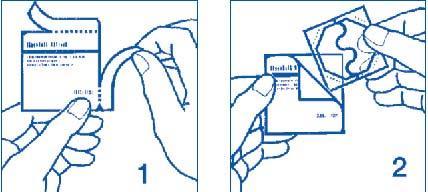
Patch application:
- 1. Remove the patch from the sachet as shown in figures 1 and 2.
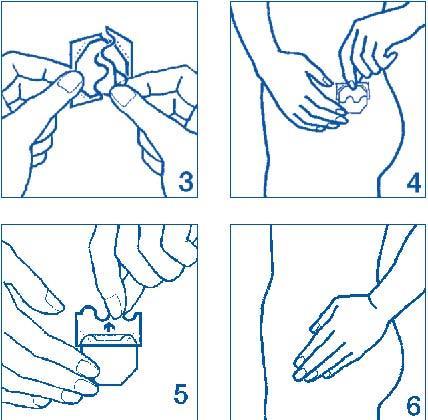
- 2. Remove one half of the protective foil from the side of the S-shaped recess, and apply the patch to the skin as shown in figures 3 and 4. Avoid touching the adhesive part of the patch with your fingers, as this may prevent proper adhesion of the patch later.
- 3. Remove the other half of the protective foil, then press the patch onto the skin with the palm of your hand for at least 30 seconds, as shown in figures 5 and
- 6. The heat of your body will ensure greater adhesion of the patch.
You can take a shower or bath without removing the transdermal patch. If
the latter should detach prematurely, i.e. before the seventh day (due to intense
physical activity, excessive sweating, abnormal rubbing of clothing), you should apply a
new patch (to help ensure correct adherence to the treatment, it is recommended that the
patient continue to change the patch on the initially scheduled day).
Once applied, the transdermal patch should be covered with clothing to avoid
direct exposure to sunlight.
The transdermal patch should be removed slowly to avoid irritating the skin.
If some adhesive remains on the skin, it can usually be removed by gently rubbing
with a creamy or oily lotion.
After use, Femity should be folded in half (with the adhesive surface inwards) and discarded.
If you use more Femity than you should
Overdosage is unlikely, however it may cause the following symptoms:
- breast tenderness;
- abdominal/pelvic swelling;
- anxiety;
- irritability;
- nausea;
- vomiting. These symptoms are expected to disappear gradually with patch removal. If these symptoms persist, ask your doctor for advice. If you forget to change the Femity patchChange the patch as soon as possible, then resume the scheduled schedule. Breakthrough bleeding is more likely if you forget to change the patch at the right time. Do not take a double dose to make up for forgetting to remove the other patch. If you stop using FemityThe signs of premenopause related to a lack of estrogen (such as heat in the face, neck and chest) may reappear.
If you are going to have surgery
If you are going to have surgery, tell the surgeon that you are using Femity. You may
need to stop using Femity about 4-6 weeks before the operation, to reduce
the risk of blood clots (see paragraph 2, Blood clots in a vein).
Ask your doctor when you can start using Femity again.
If you have any doubts about using this medicine, ask your doctor, pharmacist or
nurse.
4. Possible side effects
The following conditions are observed more frequently in women using HRT compared to
women who do not use it:
- breast cancer;
- abnormal growth or carcinoma of the uterine lining (hyperplasia or endometrial carcinoma);
- ovarian cancer;
- formation of blood clots in the veins of the legs or lungs (venous thromboembolism);
- heart disease;
- stroke;
- probable memory loss if HRT is started after the age of 65; For more information on these side effects, see paragraph 2. Like all medicines, this medicine can cause side effects, although not everyone experiences them. The majority of side effects observed with Femity are of mild to moderate intensity, and do not require discontinuation of treatment. If the following symptoms persist, ask your doctor for advice, who will adjust the treatment for you: hot flashes, headache, bothersome vaginal dryness, nausea, vomiting, abdominal pain, chest tightness, eye irritation from contact lenses, irritability, heaviness in the legs and weight gain. If you experience heavy or irregular vaginal bleeding, see your doctor.
The most frequent side effects can occur very commonly (in more than 1 patient
out of 10):
- skin irritation at the application site (which disappears 2 or 3 days after removing the patch);
- breast tenderness;
- bleeding or spotting.
The following side effects can occur commonly (up to 1 patient out of 10):
- breast pain (mastodynia);
- headache;
- indigestion (dyspepsia).
The following side effects can occur uncommonly (up to 1 patient out of 100):
- fluid retention, swelling (edema);
- weight gain/loss;
- fatigue;
- leg cramps;
- dizziness;
- migraine;
- feeling of bloating;
- abdominal cramps;
- feeling unwell (nausea);
- hypertension;
- excessive thickening of the uterine lining (endometrial hyperplasia);
- benign changes in breast tissue;
- depression.
The following potential side effects can occur rarely (up to 1 patient out of
1000):
- presence of gallstones (cholelithiasis);
- yellowing of the skin or whites of the eyes (cholestatic jaundice);
- increase in the size of fibroids within the uterus (uterine fibroids).
The following side effects have been reported with other HRT:
- cholecystopathy
- various skin alterations;
- skin discoloration, especially on the face or neck, a phenomenon known as “melasma” (cloasma);
- painful reddish nodules (erythema nodosum);
- skin rash with redness or target-shaped ulcers (erythema multiforme)
- vascular purpura (occasional skin redness).
Reporting of side effects
If you experience any side effects, including those not listed in this leaflet, please
consult your doctor or pharmacist. You can also report side effects directly through
the national reporting system at www.agenziafarmaco.gov.it/it/responsabili.
By reporting side effects you can help provide more information on the safety
of this medicine.
5. How to store Femity
Keep this medicine out of sight and reach of children.
Do not use this medicine after the expiry date. The expiry date refers to the last day
of that month.
Do not store Femity at a temperature above 30°C.
Keep the patches in their original sachets until the time of use.
Do not dispose of any medicine in wastewater or household waste. Ask your pharmacist how
to dispose of medicines you no longer use. This will help protect the environment.
6. Contents of the pack and other information
What Femity contains
The active ingredients are:
Estradiol hemihydrate and levonorgestrel. Each patch contains 1.5 mg of estradiol hemihydrate and 0.525 mg
of levonorgestrel in a patch of 15 cm surface area, from which 50 micrograms of
estradiol and 7 micrograms of levonorgestrel are released per 24 hours.
The other ingredients are:
Coating layer: Polyethylene terephthalate (PET) sheet.
Adhesive matrix: styrene-isoprene-styrene copolymer, glycerol esters of fully
hydrogenated resins.
Protective film: siliconized polyethylene terephthalate (PET) sheet
Description of the appearance of Femity and contents of the pack
Femity is a transdermal patch contained in a sachet. Each pack contains 4 or 12 sachets.
Marketing Authorisation Holder
Theramex Ireland Limited
Kilmore House, Park Lane, Spencer Dock
Dublin 1, D01 YE64
Ireland
Manufacturer:
Teva Pharmaceuticals Europe B.V. , Swensweg 5, 2031 GA Haarlem, Netherlands
LTS Lohmann Therapie-Systeme AG, Lohmannstr.2, 56626 Andernach, Germany
This medicinal product is authorised in the Member States of the European Economic Area with the
following denominations: FEM7 EVO /FEM7 PLUS /FEM7 CONTI

Не впевнені, чи підходить вам цей лікарський засіб?
Обговоріть симптоми та можливі варіанти лікування з лікарем онлайн.

Виникли питання під час прийому ліків?
Обговоріть свої симптоми та лікування з лікарем онлайн.
- Країна реєстрації
- Лікарська формаTransdermal patch, 1.5 MG/0.525 MG
- Код АТХG03FA11
- Діюча речовина
- Потрібен рецептТак
- Виробник
- Ця інформація надана лише для ознайомлення і не є медичною порадою. Рішення щодо лікування завжди приймає лікар.
- Альтернативи до FEMITYДіюча речовина: norethisterone and estrogenВиробник: NOVO NORDISK S.P.A.Потрібен рецептЛікарська форма: Film-coated tablet, 1 MG/2MGДіюча речовина: drospirenone and estrogenВиробник: BAYER S.P.A.Рецепт не потрібенЛікарська форма: Soft capsule, 1 MG/100 MGДіюча речовина: progesterone and estrogenВиробник: THERAMEX IRELAND LIMITEDПотрібен рецепт
Аналоги FEMITY в інших країнах
Препарати з тією самою діючою речовиною, доступні в інших країнах.
Аналог FEMITY у Іспанія
Лікарі онлайн щодо FEMITY
Застосування, безпека та можливість призначення рецепта — за результатами медичної оцінки.
Отримайте рецепт на FEMITY онлайн
Заповніть форму за 2 хвилини
Розкажіть про симптоми, історію хвороби та потрібний препарат.
Оберіть лікаря або ми призначимо
Оберіть спеціаліста або ми підберемо найближчого доступного лікаря.
Лікар розглядає ваш випадок
Зазвичай протягом 30 хвилин. Може ставити уточнювальні запитання в чаті.
Отримайте в будь-якій аптеці
Електронний рецепт надсилається на вашу пошту — дійсний по всій Польщі.
Часті запитання
FEMITY потребує рецепта в Італія. Ви можете обговорити з лікарем онлайн, чи підходить цей лікарський засіб для вашої ситуації.
Діюча речовина у FEMITY — levonorgestrel and estrogen. Це допомагає визначити препарати з тим самим складом, але під іншими торговими назвами.
FEMITY виробляється компанією THERAMEX IRELAND LIMITED. Назва бренду та упаковка можуть відрізнятися залежно від дистрибʼютора.
Лікарі, зокрема Сімейні лікарі, Психіатри, Дерматологи, Кардіологи, Ендокринологи, Гастроентерологи, Пульмонологи, Нефрологи, Ревматологи, Гематологи, Інфекціоністи, Алергологи, Геріатри, Педіатри, Онкологи, можуть оцінити доцільність застосування FEMITY з урахуванням вашого стану та місцевих правил. Ви можете записатися на онлайн-консультацію, щоб обговорити симптоми та можливі подальші кроки.
Польща має добре розвинену систему охорони здоров'я у великих містах, таких як Варшава, Краків, Вроцлав і Гданськ. Аптеки широко доступні та працюють відповідно до чинного законодавства, забезпечуючи доступ до рецептурних препаратів.
Ви можете придбати FEMITY у Варшаві, Кракові, Вроцлаві або Гданську в будь-якій аптеці за наявності дійсного рецепта.
Щоб отримати рецепт, ви можете скористатися Oladoctor:
Інші препарати з тією самою діючою речовиною (levonorgestrel and estrogen) включають AKTIVELLE, ANJELIQ, BIJUVA. Вони можуть відрізнятися торговою назвою або формою випуску, але містять той самий терапевтичний компонент. Перед зміною або початком прийому нового препарату варто проконсультуватися з лікарем.
