



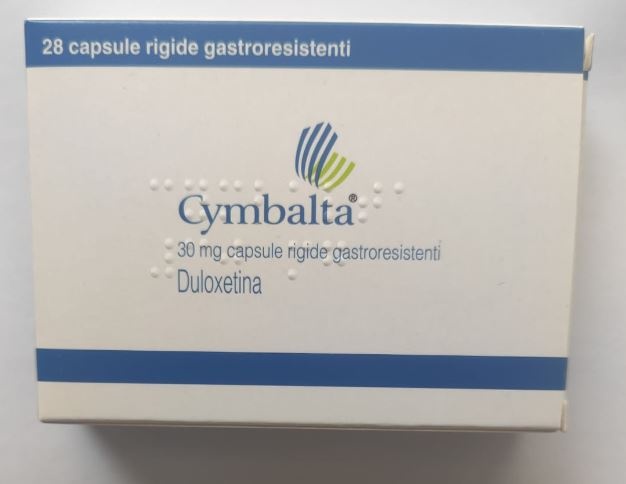
CYMBALTA 30 mg Enteric-Coated Hard Capsules

Запит на рецепт онлайн
Лікар розгляне ваш випадок і визначить, чи є рецепт медично доцільним.

Поговоріть з лікарем про ці ліки
Обговоріть симптоми та можливі подальші кроки під час короткої онлайн-консультації.



Інструкція із застосування KYMBALTA
Зміст інструкції
CYMBALTA 30 mg hard gastro-resistant capsules, 60 mg hard gastro-resistant capsules
duloxetine (as hydrochloride)
Read this leaflet carefully before you start taking this medicine because it contains
important information for you.
- Keep this leaflet. You may need to read it again.
- If you have any questions, ask your doctor or pharmacist.
- This medicine has been prescribed for you only. Do not pass it on to others, even if their symptoms are the same as yours, as it could be harmful.
- If you get any side effects, even those not listed in this leaflet, tell your doctor or pharmacist. See section 4.
Contents of this leaflet:
- 1. What Cymbalta is and what it is used for
- 2. What you need to know before you take Cymbalta
- 3. How to take Cymbalta
- 4. Possible side effects
- 5. How to store Cymbalta
- 6. Contents of the pack and other information
1. What is Cymbalta and what is it used for
Cymbalta contains the active ingredient duloxetine. Cymbalta increases the levels of serotonin and noradrenaline in the nervous system.
Cymbalta is used in adults to treat:
- depression
- generalized anxiety disorder (chronic feeling of anxiety or nervousness)
- diabetic neuropathic pain (often described as burning, sharp, stabbing, shooting, or oppressive, or like an electric shock. In the affected area, there may be loss of sensation, or sensations in which touch, heat, cold, or pressure can cause pain)
Cymbalta begins to be effective in most people with depression or anxiety within
two weeks of starting treatment, but it may take 2-4 weeks before you feel
better. Contact your doctor if you do not start to feel better after this time. Your doctor may
continue to give you Cymbalta when you feel better to prevent depression or anxiety from
returning.
In people with diabetic neuropathic pain, it may take several weeks before
you feel better. Tell your doctor if you do not feel better after 2 months.
2. What you need to know before taking Cymbalta
DO NOT take Cymbalta if you
- are allergic to duloxetine or any of the other ingredients of this medicine (listed in section 6)
- have a liver disease
- have a severe kidney disease
- are taking or have taken within the last 14 days, another medicine known as a Monoamine Oxidase Inhibitor (MAOI) (see ‘Other medicines and Cymbalta’)
- are taking fluvoxamine which is commonly used to treat depression, ciprofloxacin or enoxacin which are used to treat some infections
- are taking other medicines that contain duloxetine (see ‘Other medicines and Cymbalta’) Tell your doctor if you have high blood pressure or a heart condition. Your doctor will tell you if you can take Cymbalta.
Warnings and precautions
The reasons why Cymbalta may not be suitable for you are as follows. Talk to your doctor before
taking Cymbalta if :
- are taking other medicines to treat depression (see ‘Other medicines and Cymbalta’)
- are taking St John's Wort ( Hypericum perforatum), a herbal medicinal product
- have a kidney disease
- have had seizures (convulsions)
- have had a manic episode
- suffer from bipolar disorder
- have problems with your eyes, such as certain types of glaucoma (increased pressure inside the eye)
- have a history of bleeding disorders (tendency to develop bruises), especially if you are pregnant (see “Pregnancy and breastfeeding”)
- you are at risk of having low sodium levels in your blood (for example if you are taking diuretics, especially if you are an elderly person)
- are being treated with another medicine that can cause liver damage
- are taking other medicines that contain duloxetine (see ‘Other medicines and Cymbalta’)
Cymbalta can cause a feeling of restlessness or inability to sit still or remain calm. If this
happens to you, you should tell your doctor.
Also, consult your doctor if:
You experience signs and symptoms of restlessness, hallucinations, loss of coordination, rapid heartbeat,
increased body temperature, rapid changes in blood pressure, overactive reflexes, diarrhea, coma, nausea, vomiting, you may be suffering from serotonin syndrome.
In its most severe form, serotonin syndrome can resemble neuroleptic malignant syndrome (NMS). The signs and symptoms of NMS can include a combination of fever, rapid heartbeat,
sweating, severe muscle stiffness, confusion, increased muscle enzymes (determined by a blood test).
Medicines such as Cymbalta (so-called selective serotonin reuptake inhibitors (SSRIs) and
serotonin-noradrenaline reuptake inhibitors (SNRIs)) can cause symptoms of sexual dysfunction (see
section 4). In some cases, persistence of these symptoms has been observed after discontinuation of
treatment.
Thoughts of suicide and worsening of depression and anxiety
If you are depressed and/or anxious, you may sometimes have thoughts of harming yourself or of
killing yourself. These thoughts may be increased when you first start taking
antidepressants, as these medicines take time to work, usually about 2 weeks but sometimes longer.
You may be more likely to have these thoughts if you:
- have had thoughts of killing yourself or harming yourself in the past
- are a young adult. Data from clinical studies have shown an increased risk of suicidal behaviour in adults under 25 years with psychiatric disorders who were treated with an antidepressant
If at any time you have thoughts of harming yourself or of killing yourself, contact your doctor or go
immediately to hospital.
You may find it helpful to tell a relative or close friend that you are depressed or anxious, and ask them to read this leaflet. You might ask them to tell you if they think your depression or anxiety is getting worse, or if they are worried about changes in your
behaviour.
Children and adolescents under 18 years of age
Normally Cymbalta should not be used in children and adolescents under 18 years of age.
Also, you should know that patients under 18 years of age, when taking this type of medicine,
have an increased risk of undesirable effects such as suicide attempt, suicidal thoughts
and hostility (especially aggressive behaviour, oppositional behaviour and anger). Nevertheless, the
doctor may prescribe Cymbalta to patients under 18 years of age if he/she considers that this is the best solution for them. If the doctor has prescribed Cymbalta to a patient under 18 years of age and you wish
to clarify, return to the doctor. You should inform the doctor if any of the above symptoms
appear or worsen when patients under 18 years of age are taking Cymbalta. Furthermore, in
this age group, long-term safety effects regarding growth, maturity and cognitive and behavioural development have not yet been demonstrated for Cymbalta.
Other medicines and Cymbalta
Tell your doctor or pharmacist if you are taking, have recently taken or might take
any other medicines, including those available without a prescription.
The main component of Cymbalta, duloxetine, is found in other medicines for other conditions:
- diabetic neuropathic pain, depression, anxiety and urinary incontinence. The simultaneous use of more than one of these medicines should be avoided. Check with your doctor if you are already taking medicines that contain duloxetine.
Your doctor needs to decide if you can take Cymbalta with other medicines. Do not start or stop
taking any medicine, including those bought without a prescription and
herbal medicinal products, before consulting your doctor.
Also, tell your doctor if you are taking any of the following medicines:
Monoamine Oxidase Inhibitors (MAOIs): You must not take Cymbalta if you are taking, or
have recently taken (within the last 14 days) another antidepressant medicine called a
monoamine oxidase inhibitor (MAOI). Examples of MAOI medicines include moclobemide (an
antidepressant) and linezolid (an antibiotic). Taking an MAOI together with many prescription medicines, including Cymbalta, can cause serious or even life-threatening side effects. You must wait at least 14 days after stopping taking an
MAOI before you can take Cymbalta. Also, you must wait at least 5 days after stopping taking Cymbalta before taking an MAOI.
Medicines that cause drowsiness: These include medicines prescribed by your doctor, such as
benzodiazepines, strong painkillers, antipsychotics, phenobarbital and antihistamines.
Medicines that increase serotonin levels: Triptans, tramadol, tryptophan, Selective Serotonin
Reuptake Inhibitors (SSRIs) (such as paroxetine and fluoxetine), Serotonin-Noradrenaline Reuptake Inhibitors (SNRIs) (such as venlafaxine), tricyclic antidepressants
(such as clomipramine, amitriptyline), pethidine, St John's Wort (hypericum) and MAOIs (such as
moclobemide and linezolid). These medicines increase the risk of side effects; if you experience
any unusual symptoms while taking one of these medicines together with Cymbalta, you should
consult your doctor.
Oral anticoagulants and antiplatelet agents: Medicines that thin the blood or prevent
blood clots from forming. These medicines may increase the risk of bleeding.
Cymbalta with food, drinks and alcohol
Cymbalta can be taken independently of meals. You should be careful if you drink alcohol while
being treated with Cymbalta.
Pregnancy and breastfeeding
If you are pregnant, suspect you are pregnant or are planning to become pregnant, ask your doctor or pharmacist for advice before taking this medicine.
- Tell your doctor if you are pregnant, or are planning to become pregnant, while taking Cymbalta. You should only use Cymbalta after discussing with your doctor the potential benefits and any potential risk to the unborn child.
- Make sure your midwife and/or doctor knows that you are being treated with Cymbalta. When taken during pregnancy, similar medicines (SSRIs) may increase the risk of a serious condition in newborns, called persistent pulmonary hypertension of the newborn (PPHN), which means the newborn has a fast breathing rate and a bluish skin colour. These symptoms usually appear during the first 24 hours after birth. If this happens to the newborn, contact your midwife or doctor immediately.
- If you take Cymbalta near the end of your pregnancy, your newborn may experience some symptoms just after being born. Generally, these appear at birth or within a few days of birth. These symptoms may include floppy muscles, tremor, nervousness, difficulty feeding, a breathing disorder and seizures. If your newborn experiences any of these symptoms after birth, or you are worried about the health of the baby, contact your doctor or midwife who will be able to advise you.
of excessive vaginal bleeding immediately after childbirth, especially if you have a history
of bleeding disorders. Your doctor or midwife should be informed that you are
taking duloxetine so they can advise you.
Available data on the use of Cymbalta during the first 3 months of pregnancy do not show an
increased risk of overall birth defects in the baby. If Cymbalta
is taken during the second half of pregnancy there may be an increased risk that
the newborn may be born prematurely (6 more newborns born prematurely per 100 women who
take Cymbalta in the second part of pregnancy), mostly between weeks 35 and 36 of
pregnancy).
- Tell your doctor if you are breastfeeding. The use of Cymbalta is not recommended during breastfeeding. Ask your doctor or pharmacist for advice.
Driving and using machines
Cymbalta may cause drowsiness or dizziness. Do not drive or use tools or
machines until you know how Cymbalta affects you.
Cymbalta contains sucrose
Cymbalta contains sucrose. If you have been told by your doctor that you have an intolerance to some
sugars, contact your doctor before taking this medicine.
Cymbalta contains sodium
This medicine contains less than 1 mmol (23 mg) of sodium per capsule, i.e. essentially ‘sodium-free’.
3. How to take Cymbalta
Take this medicine exactly as your doctor or pharmacist has told you. If you
have any doubts, ask your doctor or pharmacist.
Cymbalta is taken orally. Swallow the capsule without chewing, with the help of a
glass of water.
For depression and diabetic neuropathic pain:
The usual dose of Cymbalta is 60 mg once a day, but your doctor will prescribe the dose that
they consider right for you.
For generalized anxiety disorder:
The usual starting dose of Cymbalta is 30 mg once a day, after which most
patients will receive 60 mg once a day, but your doctor will prescribe the dose that they consider right for you.
The dose may be adjusted up to 120 mg per day, depending on your response to Cymbalta.
To help you remember to take Cymbalta, it may be easier for you to take it every day at the same
time.
Talk to your doctor about how long you should continue to take Cymbalta. Do not stop
taking Cymbalta, or change the dose, without talking to your doctor. Appropriate treatment
of the disorder is important to help you feel better. If left untreated, the disorder cannot
improve and may become more serious and difficult to treat.
If you take more Cymbalta than you should
Contact your doctor or pharmacist immediately if you have taken a quantity of Cymbalta
greater than what your doctor has prescribed. Symptoms of overdose include
drowsiness, coma, serotonin syndrome (a rare reaction that can cause feelings of
great happiness, drowsiness, clumsiness, restlessness, feeling drunk, fever, sweating
or muscle rigidity), seizures, vomiting and increased heart rate.
If you forget to take Cymbalta
If you forget a dose, take it as soon as you remember. However, if this is the time to take
the next dose, skip the missed dose and take only a single dose as usual. Do not
take a double dose to make up for a missed dose. Do not take more of Cymbalta than
you have been prescribed for one day.
If you stop taking Cymbalta
Even if you feel better, DO NOT stop taking the capsules without consulting your
doctor. If your doctor thinks you no longer need Cymbalta, they will ask you to reduce
the dose gradually over a period of at least 2 weeks before stopping treatment completely.
Some patients who suddenly stop taking Cymbalta have experienced symptoms
such as:
- dizziness, sensations of tingling like pinpricks and needles or electric shock-like sensations (especially in the head), sleep disturbances (intense dreams, nightmares, inability to sleep), fatigue, drowsiness, feeling restless or agitated, feeling anxious, nausea or unwellness (vomiting), tremor, headache, muscle pain, feeling irritable, diarrhea, excessive sweating or dizziness. Usually these symptoms are not serious and disappear within a few days, but if you experience symptoms that are bothersome you should consult your doctor.
If you have any questions about using this medicine, ask your doctor or pharmacist.
4. Possible side effects
Like all medicines, this medicine can cause side effects, although not everybody gets them.
Normally these effects are mild to moderate and often disappear after a few
weeks.
Very common side effects (may affect more than 1 in 10 people)
- headache, feeling sleepy
- feeling unwell (nausea), dry mouth
Common side effects (may affect up to 1 in 10 people)
- loss of appetite
- difficulty sleeping, feeling agitated, decreased sexual desire, anxiety, difficulty or inability to reach orgasm, unusual dreams
- dizziness, feeling lazy, tremor, numbness, including a sensation of tingling or pins and needles in the skin
- blurred vision
- tinnitus (perception of a sound in the ear in the absence of an external sound stimulus)
- feeling your heart beating in your chest
- increased blood pressure, hot flush
- increased yawning
- constipation, diarrhea, stomach pain, retching (vomiting), heartburn, indigestion, build-up of gas in the intestines
- increased sweating, rash (itchy)
- muscle pain, muscle spasm
- painful urination, frequent urination
- difficulty getting an erection, changes in ejaculation
- falls (especially in elderly people), fatigue
- weight loss
Children and adolescents under 18 years of age with depression treated with this medicine have had
some weight loss when they first started taking this medicine. After
6 months of treatment the weight increased to be the same as that of other children and adolescents
of the same age and sex.
Uncommon side effects (may affect up to 1 in 100 people)
- inflammation of the throat causing a hoarse voice
- suicidal thoughts, difficulty falling asleep, teeth grinding or clenching, feeling disoriented, lack of motivation
- sudden and involuntary spasms or contractions of the muscles, feeling restless or inability to sit still or remain quiet, feeling nervous, difficulty concentrating, changes in the sense of taste, difficulty controlling movements such as lack of coordination or involuntary muscle movements, restless legs syndrome, poor sleep quality
- dilated pupils (the dark center of the eye), vision disturbances
- feeling dizzy or “lightheaded” (vertigo), ear pain
- fast or irregular heartbeat
- fainting, dizziness, feeling lightheaded or about to faint when standing up, feeling cold in the hands and/or feet
- feeling of tightness in the throat, nosebleeds
- vomiting blood or presence of black, tarry stools, gastroenteritis, belching, difficulty swallowing
- liver inflammation which can cause abdominal pain and yellowing of the skin or whites of the eyes
- night sweats, hives, cold sweats, sensitivity to sunlight, increased tendency to develop bruises
- muscle stiffness, muscle contraction
- difficulty or inability to urinate, difficulty starting urination, needing to urinate during the night, needing to urinate more than usual, reduced urine flow
- abnormal vaginal bleeding, abnormal menstrual cycles, including heavy, painful, irregular or prolonged periods, unusually light or absent periods, testicular or scrotal pain
- chest pain, feeling cold, thirst, trembling, feeling hot, abnormal gait
- weight gain
- Cymbalta may cause effects of which you may not be aware, such as increases in liver enzymes, or levels in the blood of potassium, creatine phosphokinase, sugars or cholesterol
Rare side effects (may affect up to 1 in 1,000 people)
- severe allergic reaction causing difficulty breathing or dizziness with swelling of the tongue and lips, allergic reactions
- decreased activity of the thyroid gland which can cause fatigue or weight gain
- dehydration, low levels of sodium in the blood (especially in elderly people; symptoms may include feeling dizzy, weak, confused, sleepy or very tired, or feeling sick or being sick, more serious symptoms are loss of consciousness, seizures or falls), syndrome of inappropriate antidiuretic hormone secretion (SIADH)
- suicidal behavior, mania (hyperactivity, racing thoughts and decreased need for sleep), hallucinations, aggressive behavior and anger
- “Serotonin Syndrome” (a rare reaction that can cause feelings of great happiness, sleepiness, clumsiness, restlessness, feeling drunk, fever, sweating or muscle stiffness), seizures
- increased pressure inside the eye (glaucoma)
- cough, wheezing and shortness of breath possibly accompanied by fever
- inflammation of the mouth, presence of bright red blood in the stools, bad breath, inflammation of the large intestine (colon) (causing diarrhea)
- liver failure, yellowing of the skin or whites of the eyes (jaundice)
- Stevens-Johnson syndrome (a serious condition with the appearance of blisters on the skin, mouth, eyes and genitals), severe allergic reaction causing swelling of the face or throat (angioedema)
- contraction of the muscles of the mouth
- altered smell of urine
- symptoms of menopause, abnormal production of breast milk in men and women
- excessive bleeding from the vagina immediately after childbirth (postpartum hemorrhage)
Very rare side effects (may affect up to 1 in 10,000 people)
- Inflammation of the blood vessels in the skin (cutaneous vasculitis)
Frequency not known (cannot be estimated from available data)
- signs and symptoms of a condition called "stress cardiomyopathy" which may include chest pain, shortness of breath, dizziness, fainting, irregular heartbeat.
Reporting of side effects
If you get any side effects, talk to your doctor or pharmacist. This includes any side effects not listed in
this leaflet. You can also report side effects directly through the national reporting system reported in
Appendix V. By reporting side effects you can help provide more information on the safety of this medicine.
5. How to store Cymbalta
Keep this medicine out of the sight and reach of children
Do not use this medicine after the expiry date which is stated on the pack.
Store in the original package to protect it from moisture. Do not store at a temperature
above 30 °C.
Do not dispose of any medicine in wastewater or household waste. Ask your pharmacist how to
dispose of medicines you no longer use. This will help protect the environment.
6. Package contents and other information
What Cymbalta contains
The active substanceis duloxetine.
Each capsule contains 30 or 60 mg of duloxetine (as hydrochloride).
The otheringredients are:
Capsule contents: hypromellose, hypromellose acetate succinate, sucrose, sugar granules,
talc, titanium dioxide (E171), triethyl citrate.
(see the end of paragraph 2 for further information on sucrose)
Capsule shell: gelatin, sodium lauryl sulfate, titanium dioxide (E171), indigo carmine
(E132), yellow iron oxide (E172) (only for 60 mg) and edible green ink (30 mg) or
edible white ink (60 mg).
Edible green ink: synthetic black iron oxide (E172), synthetic yellow iron oxide (E172),
propylene glycol, shellac.
Edible white ink: titanium dioxide (E171), propylene glycol, shellac, povidone.
Description of Cymbalta and package contents
Cymbalta is a hard, gastro-resistant capsule. Each Cymbalta capsule contains granules of
duloxetine hydrochloride with a coating to protect them from stomach acid.
Cymbalta is available in 2 strengths: 30 mg and 60 mg.
30 mg capsules are blue and white with ‘30 mg’ and the code ‘9543’ printed on them.
60 mg capsules are blue and green with ‘60 mg’ and the code ‘9542’ printed on them.
Cymbalta 30 mg is available in packs of 7, 28 and 98 hard gastro-resistant capsules.
Cymbalta 60 mg is available in packs of 28, 56, 84 and 98 hard gastro-resistant capsules and in
multipacks of 100 (5 packs of 20) and 500 (25 packs of 20) hard gastro-resistant capsules.
Not all pack sizes may be marketed.
Marketing Authorisation Holder and Manufacturer
Marketing Authorisation Holder: Eli Lilly Nederland B.V., Papendorpseweg
83, 3528 BJ Utrecht, The Netherlands.
Manufacturer: Lilly S.A., Avda. de la Industria 30, 28108 Alcobendas, Madrid, Spain.
For further information on this medicine, contact the local representative of the Marketing
Authorisation Holder:
België/Belgique/Belgien
Eli Lilly Benelux S.A./N.V.
Tél/Tel: + 32-(0)2 548 84 84
Lietuva
Eli Lilly Lietuva
Tel. +370 (5) 2649600
България
TP "Eli Lilly Nederland" B.V. - България
tel. + 359 2 491 41 40
Luxembourg/Luxemburg
Eli Lilly Benelux S.A./N.V.
Tél/Tel: + 32-(0)2 548 84 84
Česká republika
ELI LILLY ČR, s.r.o.
Tel: + 420 234 664 111
Magyarország
Lilly Hungária Kft.
Tel: + 36 1 328 5100
Danmark
Eli Lilly Danmark A/S
Tlf: +45 45 26 60 00
Malta
Charles de Giorgio Ltd.
Tel: + 356 25600 500
Deutschland
Lilly Deutschland GmbH
Tel. + 49-(0) 6172 273 2222
Nederland
Eli Lilly Nederland B.V.
Tel: + 31-(0) 30 60 25 800
Eesti
Eli Lilly Nederland B.V
Tel: +372 6817 280
Norge
Eli Lilly Norge A.S.
Tlf: + 47 22 88 18 00
Ελλάδα
ΦΑΡΜΑΣΕΡΒ-ΛΙΛΛΥ Α.Ε.Β.Ε.
Τηλ: +30 210 629 4600
Österreich
Eli Lilly Ges.m.b.H.
Tel: + 43-(0) 1 711 780
España
Dista S.A.
Tel: + 34-91-663 50 00
Polska
Eli Lilly Polska Sp. z o.o.
Tel: +48 22 440 33 00
France
Lilly France
Tél: +33-(0) 1 55 49 34 34
Portugal
Lilly Portugal Produtos Farmacêuticos, Lda
Tel: + 351-21-4126600
Hrvatska
Eli Lilly Hrvatska d.o.o.
Tel: +385 1 2350 999
România
Eli Lilly România S.R.L.
Tel: + 40 21 4023000
Ireland
Eli Lilly and Company (Ireland) Limited
Tel: + 353-(0) 1 661 4377
Slovenija
Eli Lilly farmacevtska družba, d.o.o.
Tel: +386 (0)1 580 00 10
Ísland
Icepharma hf.
Sími + 354 540 8000
Slovenská republika
Eli Lilly Slovakia, s.r.o.
Tel: + 421 220 663 111
Italia
Eli Lilly Italia S.p.A.
Tel: + 39- 055 42571
Suomi/Finland
Oy Eli Lilly Finland Ab
Puh/Tel: +358-(0) 9 85 45 250
Κύπρος
Phadisco Ltd
Τηλ: +357 22 715000
Sverige
Eli Lilly Sweden AB
Tel: + 46-(0) 8 7378800
Latvija
Eli Lilly (Suisse) S.A Pārstāvniecība Latvijā
Tel: +371 67364000
United Kingdom (Northern Ireland)
Eli Lilly and Company (Ireland) Limited
Tel: + 353-(0) 1 661 4377
More detailed information on this medicine is available on the website of the European
Medicines Agency: http://www.ema.europa.eu .
ANNEX IV
SCIENTIFIC CONCLUSIONS AND JUSTIFICATION FOR THE VARIATION OF THE
MARKETING AUTHORISATION
Scientific conclusions
Taking into account the assessment of the Pharmacovigilance and Risk Assessment Committee
(PRAC) of the Periodic Safety Update Report (PSUR) for duloxetine, the PRAC’s scientific
conclusions are as follows:
In light of the available literature data on neuroleptic malignant syndrome (NMS)and on
stress cardiomyopathy (Takotsubo cardiomyopathy), spontaneous reports, including in some
cases a close temporal association, a de-challenge and/or positive re-challenge, and considering a
plausible mechanism, the PRAC considers that a causal relationship between duloxetine and NMS and
stress cardiomyopathy (Takotsubo cardiomyopathy) is at least a reasonable possibility. The PRAC
concluded that the product information for medicines containing duloxetine should be amended
accordingly.
Having examined the PRAC recommendation, the Committee for Human Medicinal Products
(CHMP) agrees with the overall conclusions and with the justification for the recommendation.
Justification for the variation of the terms of the marketing authorisation
Based on the scientific conclusions on duloxetine, the CHMP considers that the benefit/risk
balance of the medicine containing duloxetine remains unchanged, save for the proposed changes to
the product information.
The CHMP recommends the variation of the terms of the marketing authorisation.

Не впевнені, чи підходить вам цей лікарський засіб?
Обговоріть симптоми та можливі варіанти лікування з лікарем онлайн.

Виникли питання під час прийому ліків?
Обговоріть свої симптоми та лікування з лікарем онлайн.
- Країна реєстрації
- Лікарська формаEnteric-coated hard capsule, 30 MG
- Код АТХN06AX21
- Діюча речовина
- Потрібен рецептТак
- Виробник
- Ця інформація надана лише для ознайомлення і не є медичною порадою. Рішення щодо лікування завжди приймає лікар.
- Альтернативи до KYMBALTAЛікарська форма: Enteric-coated hard capsule, 30 MGДіюча речовина: duloxetineВиробник: ECUPHARMA S.R.L.Потрібен рецептЛікарська форма: Hard gastro-resistant capsule, 30 mgДіюча речовина: duloxetineВиробник: ALMUS S.R.L.Потрібен рецептЛікарська форма: Enteric-coated hard capsule, 30 MGДіюча речовина: duloxetineВиробник: LABORATORI ALTER S.R.L.Потрібен рецепт
Аналоги KYMBALTA в інших країнах
Препарати з тією самою діючою речовиною, доступні в інших країнах.
Аналог KYMBALTA у Іспанія
Аналог KYMBALTA у Польща
Аналог KYMBALTA у Україна
Лікарі онлайн щодо KYMBALTA
Застосування, безпека та можливість призначення рецепта — за результатами медичної оцінки.







Отримайте рецепт на KYMBALTA онлайн
Заповніть форму за 2 хвилини
Розкажіть про симптоми, історію хвороби та потрібний препарат.
Оберіть лікаря або ми призначимо
Оберіть спеціаліста або ми підберемо найближчого доступного лікаря.
Лікар розглядає ваш випадок
Зазвичай протягом 30 хвилин. Може ставити уточнювальні запитання в чаті.
Отримайте в будь-якій аптеці
Електронний рецепт надсилається на вашу пошту — дійсний по всій Польщі.
Часті запитання
KYMBALTA потребує рецепта в Італія. Ви можете обговорити з лікарем онлайн, чи підходить цей лікарський засіб для вашої ситуації.
Діюча речовина у KYMBALTA — duloxetine. Це допомагає визначити препарати з тим самим складом, але під іншими торговими назвами.
KYMBALTA виробляється компанією ELI LILLY NEDERLAND B.V.. Назва бренду та упаковка можуть відрізнятися залежно від дистрибʼютора.
Лікарі, зокрема Сімейні лікарі, Психіатри, Дерматологи, Кардіологи, Ендокринологи, Гастроентерологи, Пульмонологи, Нефрологи, Ревматологи, Гематологи, Інфекціоністи, Алергологи, Геріатри, Педіатри, Онкологи, можуть оцінити доцільність застосування KYMBALTA з урахуванням вашого стану та місцевих правил. Ви можете записатися на онлайн-консультацію, щоб обговорити симптоми та можливі подальші кроки.
Польща має добре розвинену систему охорони здоров'я у великих містах, таких як Варшава, Краків, Вроцлав і Гданськ. Аптеки широко доступні та працюють відповідно до чинного законодавства, забезпечуючи доступ до рецептурних препаратів.
Ви можете придбати KYMBALTA у Варшаві, Кракові, Вроцлаві або Гданську в будь-якій аптеці за наявності дійсного рецепта.
Щоб отримати рецепт, ви можете скористатися Oladoctor:
Інші препарати з тією самою діючою речовиною (duloxetine) включають DULEX, DULOXETINA ALMUS, DULOXETINA ALTER. Вони можуть відрізнятися торговою назвою або формою випуску, але містять той самий терапевтичний компонент. Перед зміною або початком прийому нового препарату варто проконсультуватися з лікарем.
