



ACTIKERALL 5 mg /G + 100 Mg/G Topical Solution

Запит на рецепт онлайн
Лікар розгляне ваш випадок і визначить, чи є рецепт медично доцільним.

Поговоріть з лікарем про ці ліки
Обговоріть симптоми та можливі подальші кроки під час короткої онлайн-консультації.



Інструкція із застосування AKTIKERALL
Зміст інструкції
Information for the patient
Actikerall 5 mg/g + 100 mg/g Cutaneous Solution
fluorouracil + salicylic acid
Read this leaflet carefully before you start using this medicine.
- Keep this leaflet. You may need to read it again.
- If you have any questions, ask your doctor or pharmacist.
- This medicine has been prescribed for you personally. Never give it to others. Indeed, this medicine may be dangerous for other individuals, even if their symptoms are the same as yours.
- If any side effect occurs, including those not listed in this leaflet, tell your doctor or pharmacist. See section 4.
Contents of this leaflet:
- 1. What Actikerall is and what it is used for
- 2. What you need to know before you use Actikerall
- 3. How to use Actikerall
- 4. Possible side effects
- 5. How to store Actikerall
- 6. Contents of the pack and other information
1. WHAT IS ACTIKERALL AND WHAT IS IT USED FOR
Actikerall contains two active ingredients, fluorouracil and salicylic acid. Fluorouracil belongs to a group
of medicines called antimetabolites, which inhibit cell growth (cytostatic agent). Salicylic acid
is a substance that softens hardened skin.
Actikerall is a solution for the treatment of actinic keratosis (grade I/II) in adult patients with a
healthy immune system.
Actinic keratoses are small, crusty, scaly or friable skin lesions. They can be red or
light brown or have the same color as your skin. They can be dry or rough to the touch and sometimes
are more noticeable to the touch than to the eye.
These skin lesions commonly occur in people who are excessively exposed to the sun.
2. What you need to know before using Actikerall
Do not use Actikerall
- if you are allergic to fluorouracil, salicylic acid or any of the ingredients of this medicine (listed in section 6)
- during breastfeeding
- during pregnancy or if there is a possibility that you are pregnant
- if you have kidney problems
- if it may come into contact with your eyes, the inside of your mouth, nose or genitals (mucous membranes) Some medicines can intensify the side effects of Actikerall or cause new ones (see “Other medicines and Actikerall”).
Warnings and precautions
Consult your doctor or pharmacist before using Actikerall
- if you know that you have no activity of the dihydropyrimidine dehydrogenase (DPD) enzyme (total absence of DPD activity). It is important that you do not apply more Actikerall than indicated in section 3 of this leaflet.
- If you suffer from a reduced ability to perceive touch, pain and temperature (for example if you have diabetes). In this case the treatment must be carefully monitored by your doctor.
- Actikerall should not be used on bleeding lesions.
- The treated area should be protected as much as possible from direct sunlight during the use of Actikerall and the patient should not use tanning lamps or sunbeds.
- There is no experience regarding the treatment of skin tumors such as basal cell epithelioma (BCC) or Bowen's disease with Actikerall; therefore these should not be treated with the product.
- In the treatment of an area with actinic keratosis that is also affected by other skin diseases, it should be considered that the outcome of the treatment may be altered.
- There is no experience regarding repeated treatment cycles with Actikerall in patients with actinic keratosis or for the treatment of lesions that recur.
Children and adolescents
Actikerall should not be used in children or adolescents under 18 years of age. Generally children are not affected by actinic keratosis.
Other medicines and Actikerall
Tell your doctor or pharmacist if you are taking, have recently taken or might take any other medicines. If more medicines are taken at the same time, the effect of the individual medicines may be intensified or weakened.
In particular tell your doctor if you are taking
- Medicines used to treat chickenpox or shingles (brivudine, sorivudine or similar medicines). You should not use Actikerall if you are using or have used one of these medicines in the last 4 weeks as it may cause an increase in side effects.
- A medicine for epilepsy (phenytoin). The use of Actikerall may determine an increase in phenytoin levels in the blood.
- A medicine used for the treatment of cancer and autoimmune diseases (methotrexate). This medicine may interact with Actikerall causing side effects.
- A medicine used for the treatment of diabetes (sulfonylureas). This medicine may interact with Actikerall causing side effects.
Pregnancy, breastfeeding and fertility
You should not use Actikerall during breastfeeding, if you are pregnant or there is a possibility that you are.
Driving and operating machinery
No particular instructions.
Actikerall contains dimethyl sulfoxide and ethanol.
Dimethyl sulfoxide may be irritating to the skin.
This medicine contains 160 mg of alcohol (ethanol) in each gram. It may cause a burning sensation on damaged skin.
3. How to use Actikerall
Always use this medicine exactly as your doctor has instructed. If you have any doubts, consult your
doctor or pharmacist.
Dosage
Actikerall should be applied once a dayunless otherwise indicated by your doctor.
If you have an actinic keratosis in an area characterized by thin skin such as around the eyes and temples, your
doctor may suggest applying Actikerall less frequently. If severe adverse effects occur, reduce the frequency of application of the medicine to 3 times a week, until the adverse effects improve. Your doctor may also need to monitor your treatment more frequently.
Method of administration
Apply to the skin (cutaneous use).
- Remove the white film on the skin due to the application from the previous day, removing it gently (unless it is the first time you are using the medicine). You can use warm water to facilitate the operation.
- To open the bottle, press down on the cap and rotate it.
- Remove excess solution from the brush by rubbing it on the neck of the bottle, however, making sure to leave enough product to form a film once dry.
- Pat the solution onto the actinic keratoses once a day.
- Multiple actinic keratoses (up to 10 lesions) can be treated simultaneously, but do not use the product on large areas of skin. The total area of skin treated with Actikerall must not exceed 25 cm (5 cm x 5 cm).
- Allow the solution to dry to form a film.
- Do not cover with bandages.
- Close the bottle tightly to prevent drying. If Actikerall dries out, it should no longer be used. Do not use Actikerall if you see crystals.
- Do not apply to areas with hair as these may become attached in the area of Actikerall application, making it difficult to remove the film. To treat such areas, remove the hair adequately before applying the product
Further instructions
Actikerall must not come into contact with the eyes, the inside of the mouth or nose or genitals (mucous
membranes). Avoid contact of Actikerall with clothes, fabrics or acrylic materials (e.g., acrylic
bathtubs), as it may leave indelible stains.
Flammable warning: keep away from fire or flames and do not use near open flame, lit cigarette or some appliances (e.g. hair dryer).
Consult your doctor regularly during treatment.
Duration of treatment
Actikerall is applied to actinic keratoses once a day until the lesions disappear
completely, for a maximum of 12 weeks. Effects on actinic keratoses may be observed as early as 4 weeks of treatment and improvement increases over time, up to 12
weeks. Actinic keratoses may further improve for eight weeks after the end of
treatment. Treatment should be continued even in the absence of improvement after the first 4 weeks.
If you have the impression that the effect of Actikerall is too strong or too weak, consult your doctor or
pharmacist.
If you use more Actikerall than you should
If you apply Actikerall more than once a day, you are more likely to experience skin reactions, even serious ones.
In this case, consult your doctor.
If you forget to use Actikerall
Do not use a double dose to make up for a missed dose. Continue treatment as
If you stop using Actikerall
Consult your doctor if you intend to stop treatment.
If you have any further questions on the use of this medicine, ask your doctor or pharmacist.
4. Possible side effects
Like all medicines, this medicine can cause side effects, although not everybody gets them.
In the majority of patients treated with Actikerall, mild to moderate irritation and inflammation occur at the application
site. If these reactions worsen, consult your doctor.
Since this medicine has a strong softening effect on the skin, it is possible to experience
whitish discoloration and peeling of the skin.
Salicylic acid contained in Actikerall may cause mild signs of irritation, such as skin inflammation (dermatitis) and
allergic contact reactions in patients with sensitive skin or allergy to salicylic acid. Allergic contact reactions may
manifest as itching, redness and small blisters, even in areas not corresponding to where the product has been
applied.
Side effects can occur with the following frequencies:
Very common, may affect more than 1 in 10 people
- Reactions at the application site
- Redness of the skin (erythema), inflammation, irritation (including burning), pain, itching
Common,may affect up to 1 in 10 people
- headache
- skin peeling (exfoliation)
- reactions at the application site
- mild bleeding, loss of the superficial layer of the skin (superficial ulcers), scabs
Uncommon, may affect up to 1 in 100 people
- dry eye, eye itching, increased tearing
- reactions at the application site
- skin inflammation (dermatitis), swelling (edema), ulcer
The frequencies relating to mild bleeding, loss of the superficial layer of the skin (superficial ulcers),
scabs, swelling (edema), ulcer and skin inflammation (dermatitis) were found to be in a higher category in a study
where Actikerall was applied to an affected area of 25 cm².
Reporting of side effects
If you get any side effects, even those not listed in this leaflet, tell your doctor or pharmacist. You can also
report side effects directly through the national reporting system at: http://www.agenziafarmaco.gov.it/content/come-segnalare-una-sospetta-reazione-
avversa . By reporting side effects you can help provide more information on the safety of this medicine.
5. How to store Actikerall
Keep this medicine out of the sight and reach of children.
Do not use this medicine after the expiry date which is stated on the label and the carton after “Exp.”
The expiry date refers to the last day of the month.
Do not store at a temperature above 25ºC. Do not store in the refrigerator or freezer.
Keep the bottle tightly closed to avoid drying out.
Do not use Actikerall after 3 months from the first opening of the bottle.
Do not use Actikerall if you notice any crystals.
Flammable warning: keep away from fire or flames and do not use near open flame, lit cigarette or some appliances (e.g. hairdryer).
Medicines should not be disposed of via wastewater or household waste. Ask your pharmacist how to
dispose of medicines you no longer use. This will help protect the environment.
6. Contents of the pack and other information
What Actikerall contains
The active ingredients are fluorouracil and salicylic acid.
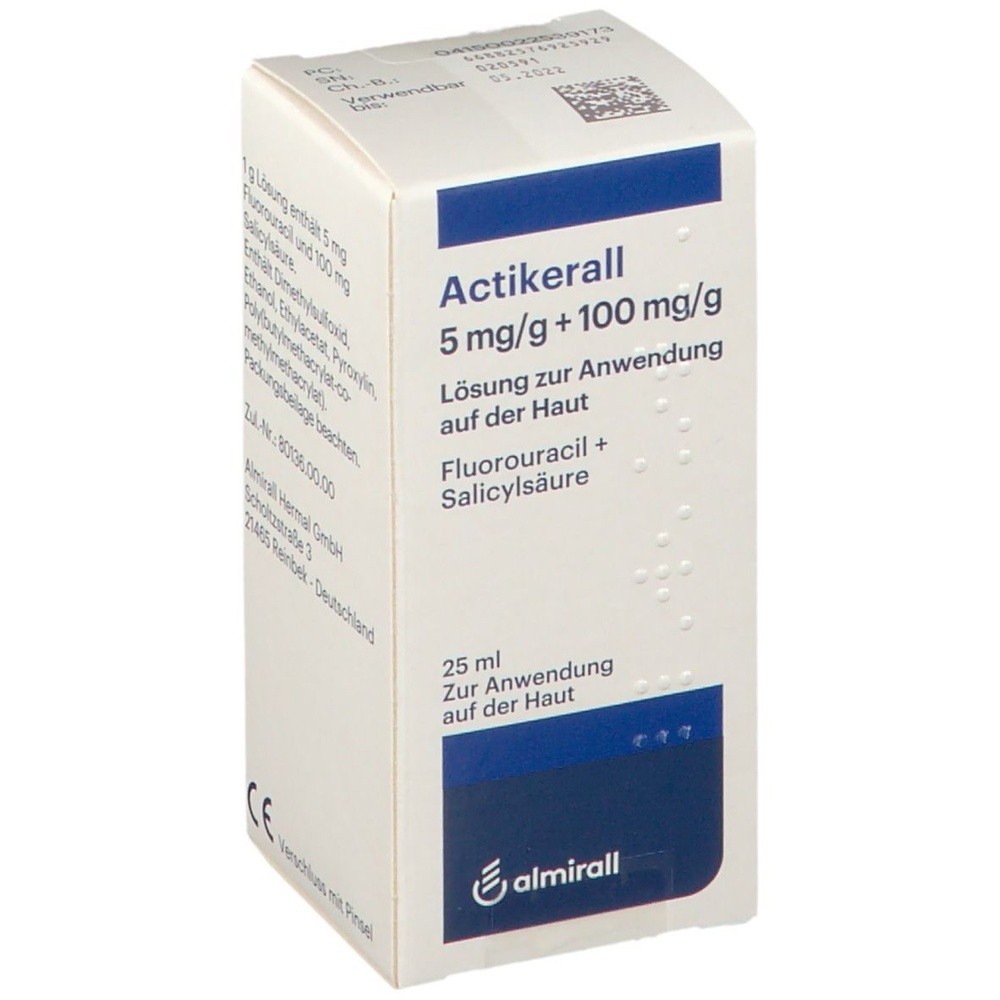
1 g (=1.05 ml) of cutaneous solution contains 5 mg of fluorouracil and 100 mg of salicylic acid.
The other ingredients are: dimethyl sulfoxide; anhydrous ethanol; ethyl acetate; pyroxiline; poly(butyl methacrylate-co-
methyl methacrylate).
Description of the appearance of Actikerall and contents of the pack
Actikerall is a transparent cutaneous solution, from colorless to slightly white-orange.
This medicinal product is packaged in a brown glass bottle with a child-resistant closure system in white propylene and contained in a cardboard box. The bottle cap is
connected to a brush through which to apply the solution. The applicator brush (CE mark) is
made of plastic (polyethylene) with nylon bristles attached to a stainless steel (V2A) rod.
Pack: bottle containing 25 ml of cutaneous solution.
Marketing Authorisation Holder and Manufacturer
Almirall Hermal GmbH
Scholtzstrasse 3
D-21465 Reinbek
Germany
Tel: +49 (0)40 72704-0
Fax: +49 (0)40 7229296
e-mail: [email protected]
This medicinal product is authorised in the Member States of the European Economic Area with the
following denominations:
May 2018
| Country | o Trade name |
| Germany | c Actikerall-Almirall 5 mg/g + 100 mg/g Solution for Topical Use |
| Denmark, Finland, Norway, Sweden, Iceland, Lithuania, Latvia, Estonia, Portugal, Italy | a Actikerall |
| Spain | m Actikerall 5 mg/g + 100 mg/g Cutaneous Solution |

Не впевнені, чи підходить вам цей лікарський засіб?
Обговоріть симптоми та можливі варіанти лікування з лікарем онлайн.

Виникли питання під час прийому ліків?
Обговоріть свої симптоми та лікування з лікарем онлайн.
- Країна реєстрації
- Лікарська формаTopical solution, 5 MG/G + 100 MG/G
- Код АТХL01BC52
- Діюча речовина
- Потрібен рецептТак
- Виробник
- Ця інформація надана лише для ознайомлення і не є медичною порадою. Рішення щодо лікування завжди приймає лікар.
- Альтернативи до AKTIKERALLЛікарська форма: Powder and solvent for injectable solution, 100 MG/5 MLДіюча речовина: ЦитарабинВиробник: PFIZER ITALIA S.R.L.Потрібен рецептЛікарська форма: Powder for injectable suspension, 25 MG/MLДіюча речовина: АзацитидинВиробник: ACCORD HEALTHCARE, S.L.U.Рецепт не потрібенЛікарська форма: Powder for injectable suspension, 25 MG/MLДіюча речовина: АзацитидинВиробник: BETAPHARM ARZNEIMITTEL GMBHРецепт не потрібен
Аналоги AKTIKERALL в інших країнах
Препарати з тією самою діючою речовиною, доступні в інших країнах.
Аналог AKTIKERALL у Іспанія
Аналог AKTIKERALL у Польща
Отримайте рецепт на AKTIKERALL онлайн
Заповніть форму за 2 хвилини
Розкажіть про симптоми, історію хвороби та потрібний препарат.
Оберіть лікаря або ми призначимо
Оберіть спеціаліста або ми підберемо найближчого доступного лікаря.
Лікар розглядає ваш випадок
Зазвичай протягом 30 хвилин. Може ставити уточнювальні запитання в чаті.
Отримайте в будь-якій аптеці
Електронний рецепт надсилається на вашу пошту — дійсний по всій Польщі.
Часті запитання
AKTIKERALL потребує рецепта в Італія. Ви можете обговорити з лікарем онлайн, чи підходить цей лікарський засіб для вашої ситуації.
Діюча речовина у AKTIKERALL — fluorouracil, combinations. Це допомагає визначити препарати з тим самим складом, але під іншими торговими назвами.
AKTIKERALL виробляється компанією ALMIRALL HERMAL GMBH. Назва бренду та упаковка можуть відрізнятися залежно від дистрибʼютора.
Лікарі, зокрема Сімейні лікарі, Психіатри, Дерматологи, Кардіологи, Ендокринологи, Гастроентерологи, Пульмонологи, Нефрологи, Ревматологи, Гематологи, Інфекціоністи, Алергологи, Геріатри, Педіатри, Онкологи, можуть оцінити доцільність застосування AKTIKERALL з урахуванням вашого стану та місцевих правил. Ви можете записатися на онлайн-консультацію, щоб обговорити симптоми та можливі подальші кроки.
Польща має добре розвинену систему охорони здоров'я у великих містах, таких як Варшава, Краків, Вроцлав і Гданськ. Аптеки широко доступні та працюють відповідно до чинного законодавства, забезпечуючи доступ до рецептурних препаратів.
Ви можете придбати AKTIKERALL у Варшаві, Кракові, Вроцлаві або Гданську в будь-якій аптеці за наявності дійсного рецепта.
Щоб отримати рецепт, ви можете скористатися Oladoctor:
Інші препарати з тією самою діючою речовиною (fluorouracil, combinations) включають ARAKYTIN, ATSAKITIDINA AKKORD, ATSAKITIDINA BETAPARM. Вони можуть відрізнятися торговою назвою або формою випуску, але містять той самий терапевтичний компонент. Перед зміною або початком прийому нового препарату варто проконсультуватися з лікарем.
