



WEZENLA 45 mg Инъекционный Раствор

Рассмотрение рецепта онлайн
Врач рассмотрит ваш случай и примет решение о назначении рецепта, если это медицински оправдано.

Поговорите с врачом об этом лекарстве
Обсудите симптомы и возможные дальнейшие шаги на онлайн-консультации.



Инструкция по применению WETSENLA
Содержание инструкции
- WEZENLA 130 mg concentrate for solution for infusion
- WEZENLA during pregnancy, live vaccines are not recommended for your
- WEZENLA 45 mg injectable solution
- What is WEZENLA and what is it used for
- What you need to know before using WEZENLA
- How to use WEZENLA
- Possible side effects
- How to store WEZENLA
- Contents of the pack and other information
- Check the number of vials and prepare the materials
- Choose the injection site and prepare it
- Prepare the dose:
- Inject the dose
- After the injection
- Disposal
- WEZENLA 45 mg injectable solution in pre-filled syringe, 90 mg injectable solution in pre-filled syringe
- WEZENLA 45 mg injectable solution in pre-filled pen, 90 mg injectable solution in pre-filled pen
WEZENLA 130 mg concentrate for solution for infusion
ustekinumab
Medicinal product subject to additional monitoring. This will allow the rapid identification of
new safety information. You can contribute by reporting any adverse effects
experienced during the use of this medicine. See the end of section 4 for
information on how to report adverse effects.
Read this leaflet carefully before using this medicine as it contains important
information for you.
This leaflet is written for people who are taking this medicine.
- Keep this leaflet. You may need to read it again.
- If you have any questions, ask your doctor or pharmacist.
- If you experience any side effects, including those not listed in this leaflet, tell your doctor or pharmacist. See section 4.
Contents of this leaflet
- 1. What WEZENLA is and what it is used for
- 2. What you need to know before you use WEZENLA
- 3. How to use WEZENLA
- 4. Possible side effects
- 5. How to store WEZENLA
- 6. Contents of the pack and other information
1. What is WEZENLA and what is it used for
What is WEZENLA
WEZENLA contains the active substance “ustekinumab”, a monoclonal antibody.
Monoclonal antibodies are proteins that recognize and bind to specific proteins
present in the body.
WEZENLA belongs to a group of medicines called “immunosuppressants”. These medicines
reduce the activity of the immune system to some extent.
What is WEZENLA used for
WEZENLA is used to treat moderate to severe Crohn’s disease in adults and children
weighing at least 40 kg.
Crohn’s disease is an inflammatory bowel disease. If you have Crohn’s disease, you will
first be treated with other medications. If you do not respond well enough or are intolerant to these
medicines, you may be given WEZENLA to reduce the signs and symptoms of your disease.
2. What you need to know before you use WEZENLA
Do not use WEZENLA
- If you are allergic to ustekinumabor to any of the other ingredients of this medicine (listed in section 6)
- If you have an active infectionthat your doctor considers important.
If you are not sure if any of the above conditions apply to you, speak to your doctor or pharmacist before using WEZENLA.
Warnings and precautions
Speak to your doctor or pharmacist before using WEZENLA. Your doctor will check your health before treatment. Make sure to tell your doctor about any medical conditions you have before treatment. Also, tell your doctor if you have recently been in contact with people who may have had tuberculosis. Your doctor will examine you and perform tests for tuberculosis before giving you WEZENLA. If your doctor thinks you are at risk of tuberculosis, they may give you medicines to treat it.
Pay attention to serious side effects
WEZENLA can cause serious side effects, including allergic reactions and infections. You need to be aware of certain signs of illness while taking WEZENLA. See “Serious side effects” in section 4 for a complete list of these side effects.
Contact your doctor before using WEZENLA
- If you have ever had an allergic reactionto WEZENLA. Ask your doctor if you are not sure.
- If you have ever had any type of cancer- because immunosuppressants like WEZENLA weaken the immune system to some extent. This can increase the risk of cancer.
- If you have been treated for psoriasis with other biologic medicines (a medicinal productderived from a biological source and usually given by injection)- the risk of cancer may be higher.
- If you have or have had a recent infection or if you have abnormal openings in your skin (fistulas).
- If you have ever had any new or changed skin lesionwithin the area of psoriasis or on normal skin.
- If you are taking any other type of treatment for psoriasis and/or psoriatic arthritis- such as another immunosuppressant or phototherapy (when the body is treated with a type of ultraviolet (UV) light). These treatments can also reduce the activity of the immune system to some extent. The simultaneous use of these therapies with WEZENLA has not been studied. However, it is possible that it may increase the possibility of conditions related to a weakened immune system.
- If you are using or have ever used injections for the treatment of allergies- it is not known if WEZENLA can have an effect on them.
- If you are 65 years of age or older- you may have a greater chance of getting infections.
If you are not sure if any of the conditions mentioned above may apply to you, speak to your doctor or pharmacist before undergoing treatment with WEZENLA.
During treatment with ustekinumab, some patients have experienced reactions similar to lupus, including cutaneous lupus or lupus-like syndrome. Contact your doctor immediately if you develop a red, raised, and scaly rash, sometimes with a darker border, in areas of skin exposed to the sun or with joint pain.
Heart attack and stroke
In a study of patients with psoriasis treated with ustekinumab, heart attack and stroke were observed. Your doctor will regularly check your risk factors for heart disease and stroke to make sure they are treated appropriately. Contact a doctor immediately if you develop chest pain, weakness or an unusual sensation on one side of your body, facial drooping, or speech or vision problems.
Children and adolescents
WEZENLA is not recommended for the treatment of children weighing less than 40 kg with Crohn’s disease because it has not been studied in this group.
Other medicines, vaccines and WEZENLA
Tell your doctor or pharmacist:
- if you are taking, have recently taken or might take any other medicines
- if you recently had a vaccine or are due to have a vaccine. Some types of vaccines (live vaccines) should not be given while you are using WEZENLA.
- if you received WEZENLA during pregnancy, inform your child’s pediatrician about the WEZENLA treatment before your child receives any vaccines, including live vaccines such as the BCG vaccine (used for the prevention of tuberculosis). If you received
WEZENLA during pregnancy, live vaccines are not recommended for your
child in the first twelve months after birth, unless your child's pediatrician
recommends otherwise.
Pregnancy and breastfeeding
- If you are pregnant, suspect you are pregnant or are planning a pregnancy, ask your doctor for advice before taking this medicine.
- No increased risk of congenital defects has been observed in newborns exposed to WEZENLA in utero. However, there is limited experience with WEZENLA in pregnant women. Therefore, it is preferable to avoid the use of WEZENLA during pregnancy.
- If you are of childbearing potential, it is advisable to avoid becoming pregnant; you should use adequate contraception during the use of WEZENLA and for at least 15 weeks after stopping treatment with WEZENLA.
- Ustekinumab can reach the unborn child through the placenta. If you have received WEZENLA during pregnancy, your child may have an increased risk of contracting an infection.
- If you have received WEZENLA during pregnancy, it is important to inform your pediatrician and other healthcare professionals before your child receives any vaccines. If you have received WEZENLA during pregnancy, live vaccines such as the BCG vaccine (used for the prevention of tuberculosis) are not recommended for your child in the first twelve months after birth, unless your pediatrician recommends otherwise.
- Ustekinumab may be excreted in breast milk in very small amounts. If you are breastfeeding or plan to breastfeed, ask your doctor for advice before using this medicine. You and your doctor will decide whether to breastfeed or use WEZENLA. You cannot do both.
Driving and using machines
WEZENLA does not or negligibly alters the ability to drive vehicles and use
machinery.
WEZENLA contains sodium
WEZENLA contains less than 1 mmol (23 mg) of sodium per dose, i.e. it is essentially "sodium-free".
However, before WEZENLA is administered, it is mixed with a solution containing
sodium. Talk to your doctor if you are on a low-salt diet.
WEZENLA contains polysorbate 80
WEZENLA contains 10.4 mg of polysorbate 80 (E 433) per dose, equivalent to 0.40 mg/mL. Polysorbates can cause allergic reactions. Tell your doctor if you have any known allergies
.
3. How WEZENLA will be used
WEZENLA is intended for use under the guidance and supervision of a physician experienced in the
diagnosis and treatment of Crohn's disease.
WEZENLA 130 mg concentrate for solution for infusion will be administered to you by the physician,
through an intravenous drip in the arm vein (intravenous infusion) for at least one hour. Discuss with the
physician when you will need to undergo the injections and subsequent follow-up visits.
How much WEZENLA is administered
The physician will decide how much WEZENLA you need and for how long.
Adults starting from 18 years
- The physician will calculate the recommended intravenous infusion dose based on body weight.
Body weight Dose
≤ 55 kg 260 mg
> 55 kg to ≤ 85 kg 390 mg
> 85 kg 520 mg
- 8 weeks after the initial intravenous dose, you will take the next dose of 90 mg of WEZENLA with an injection under the skin (subcutaneous injection), and then continue every 12 weeks.
Children with Crohn's disease weighing at least 40 kg
- The physician will calculate the recommended intravenous infusion dose based on body weight.
Body weight Dose
≥ 40 to ≤ 55 kg 260 mg
> 55 kg to ≤ 85 kg 390 mg
> 85 kg 520 mg
- 8 weeks after the initial intravenous dose, you will take the next dose of 90 mg of Wezenla with an injection under the skin (subcutaneous injection) and then continue every 12 weeks.
How WEZENLA is administered
- The first dose of WEZENLA for the treatment of Crohn's disease is administered by the physician through an intravenous drip in a vein in the arm (intravenous infusion). Inform the physician if you have any questions about the use of WEZENLA.
If you forget to use WEZENLA
If you forget or miss the appointment for administering the dose, contact the physician to
schedule a new appointment.
If you stop using WEZENLA
It is not dangerous to stop using WEZENLA. However, if you stop treatment, the
symptoms may reappear.
If you have any doubts about the use of this medicine, ask your doctor or pharmacist.
4. Possible side effects
Like all medicines, this medicine can cause side effects, although not everybody gets them.
Serious side effects
Some patients may experience serious side effects that may require urgent medical treatment.
Allergic reactions – these may require urgent medical treatment, so contact your doctor or seek urgent medical attention if you notice any of the following signs.
- Severe allergic reactions (“anaphylaxis”) are rare in patients taking ustekinumab (affecting up to 1 in 1,000 patients). Signs include:
- difficulty breathing or swallowing
- low blood pressure, which can cause dizziness or feeling lightheaded
- swelling of the face, lips, mouth or throat.
- Common signs of an allergic reaction include skin rash and hives (affecting up to 1 in 100 patients).
Infusion-related reactions – If you are being treated for Crohn's disease, the first dose of
WEZENLA is given through an intravenous infusion (drip). Some patients
have experienced severe allergic reactions during the infusion.
In rare cases, allergic lung reactions and lung inflammation have been reported in
patients receiving ustekinumab. Tell your doctor immediately if you develop symptoms such as
cough, shortness of breath and fever.
If you have a severe allergic reaction, your doctor may decide that you should not use WEZENLA again.
Infections – these may require urgent medical treatment, so contact your doctor immediately
if you notice any of the following signs.
- Infections of the nose and throat and the common cold are common (affecting up to 1 in 10 patients).
- Chest infections are uncommon (can affect up to 1 in 100 patients)
- Inflammation of the tissue under the skin (‘cellulitis’) is uncommon (affects up to 1 in 100 patients).
- Herpes zoster (a type of painful blistering rash) is uncommon (affects up to 1 in 100 patients).
WEZENLA may decrease your ability to fight infections. Some infections may become
serious and may include infections caused by viruses, fungi, bacteria (including tuberculosis) or parasites, including infections that occur mainly in people with weakened immune systems (opportunistic infections). Opportunistic infections of the brain (encephalitis, meningitis), lungs and eyes have been reported in patients treated with ustekinumab.
You should be attentive to signs of infection while using WEZENLA. These include:
- fever, flu-like symptoms, night sweats, weight loss
- feeling tired or short of breath, persistent cough
- warm, red and painful skin, or a painful blistering rash
- burning when urinating
- diarrhoea
- blurred vision or loss of vision
- headache, stiff neck, sensitivity to light, nausea or confusion
Tell your doctor immediately if you notice any of these signs of infection. These may
be signs of infections such as chest infections, skin infections, herpes zoster or opportunistic
infections that may have serious complications. See your doctor if you have any type of
infection that persists or keeps recurring. Your doctor may decide to stop WEZENLA
until the infection resolves. Also tell your doctor if you have any cuts or open wounds
that may become infected.
Skin peeling – increased redness and peeling of the skin over a large
area of the body may be symptoms of erythrodermic psoriasis or exfoliative dermatitis, which are
serious skin conditions. If you notice any of these signs you should tell
your doctor immediately.
Other side effects
Common side effects(affecting up to 1 in 10 patients):
- Diarrhoea
- Nausea
- Vomiting
- Feeling tired
- Feeling dizzy
- Headache
- Itching
- Back, muscle or joint pain
- Sore throat
- Redness and pain at the injection site
- Sinusitis
Uncommon side effects(affecting up to 1 in 100 patients):
- Dental infection
- Vaginal fungal infection
- Depression
- Stuffy or runny nose
- Bleeding, bruising, stiffness, swelling and itching at the injection site
- Feeling weak
- Drooping eyelid and muscle weakness on one side of the face (“facial palsy” or “Bell’s palsy”), which is usually temporary
- A change in psoriasis with redness and small, yellow or white pustules, sometimes accompanied by fever (pustular psoriasis)
- Skin peeling (shedding of the skin)
- Acne
Rare side effects(affecting up to 1 in 1,000 patients):
- Redness and peeling of the skin over a large area of the body, which may be itchy or painful (exfoliative dermatitis). Similar symptoms sometimes develop as a natural progression in the type of psoriasis symptoms (erythrodermic psoriasis)
- Inflammation of small blood vessels, which can lead to a skin rash with small red or purple bumps, fever or joint pain (vasculitis)
Very rare side effects(affecting up to 1 in 10,000 patients):
- Blistering skin with possible redness, itching and pain (bullous pemphigoid).
- Cutaneous lupus or lupus-like syndrome (red, raised and scaly rash on areas of skin exposed to the sun, sometimes with joint pain).
Reporting of side effects
If you get any side effects, talk to your doctor or pharmacist. This includes any side effects not listed in this leaflet. You can also report side effects directly through the national reporting system listed in Annex V. By reporting side effects, you can help provide more information on the safety of this medicine.
5. How to store WEZENLA
- WEZENLA 130 mg concentrate for infusion solution is administered in hospital or clinic and patients do not need to handle or store it.
- Keep this medicine out of the sight and reach of children.
- Store in a refrigerator (2°C - 8°C). Do not freeze.
- Keep the vial in the outer packaging to protect the medicine from light.
- Do not shake the vials of WEZENLA. Prolonged vigorous shaking may damage the medicine.
Do not use this medicine
- After the expiry date that is stated on the label and the carton after “Exp.”. The expiry date refers to the last day of that month.
- If you notice that the liquid has a changed colour, is cloudy or if you see foreign particles floating (see section 6 “Description of WEZENLA and contents of the pack”).
- If you know or believe that the medicine has been exposed to extreme temperatures (for example accidentally frozen or heated).
- If the product has been shaken vigorously.
- If the seal is broken.
WEZENLA is for single use. Any unused diluted solution for infusion remaining in the vial and the
syringe must be disposed of in accordance with local regulations.
6. Contents of the pack and other information
What WEZENLA contains
- The active substance is ustekinumab. Each vial contains 130 mg of ustekinumab in 26 mL.
- The other excipients are disodium edetate dihydrate, L-histidine, L-histidine hydrochloride monohydrate, L-methionine, polysorbate 80 (E 433), sucrose, sodium hydroxide (for pH adjustment), water for injections.
Description of the appearance of WEZENLA and contents of the pack
WEZENLA is a concentrate for infusion solution from clear to opalescent, from colourless to light yellow.
It is supplied in a carton containing 1 single-dose vial made of glass with a volume of
30 mL. Each vial contains 130 mg of ustekinumab in 26 mL of concentrate for infusion solution.
Marketing Authorisation Holder and Manufacturer
Amgen Technology (Ireland) UC,
Pottery Road,
Dun Laoghaire,
Co Dublin,
Ireland
Marketing Authorisation Holder
Amgen Technology (Ireland) UC,
Pottery Road,
Dun Laoghaire,
Co Dublin,
Ireland
Manufacturer
Amgen NV
Telecomlaan 5-7
1831 Diegem
Belgium
For further information on this medicinal product, contact the local representative of the marketing
authorisation holder:
België/Belgique/Belgien
s.a. Amgen n.v.
Tél/Tel: +32 (0)2 7752711
Lietuva
Amgen Switzerland AG Vilniaus filialas
Tel: +370 5 219 7474
България
Амджен България ЕООД
Тел.: +359 (0)2 424 7440
Luxembourg/Luxemburg
s.a. Amgen
Belgique/Belgien
Tél/Tel: +32 (0)2 7752711
Česká republika
Amgen s.r.o.
Tel: +420 221 773 500
Magyarország
Amgen Kft.
Tel.: +36 1 35 44 700
Danmark
Amgen, filial af Amgen AB, Sverige
Tlf.: +45 39617500
Malta
Amgen S.r.l.
Italy
Tel: +39 02 6241121
Deutschland
Amgen GmbH
Tel: +49 89 1490960
Nederland
Amgen B.V.
Tel: +31 (0)76 5732500
Eesti
Amgen Switzerland AG Vilniaus filialas
Tel: +372 586 09553
Norge
Amgen AB
Tlf: +47 23308000
Ελλάδα
Amgen Ελλάς Φαρμακευτικά Ε.Π.Ε.
Τηλ: +30 210 3447000
Österreich
Amgen GmbH
Tel: +43 (0)1 50 217
España
Amgen S.A.
Tel: +34 93 600 18 60
Polska
Amgen Biotechnologia Sp. z o.o.
Tel.: +48 22 581 3000
France
Amgen S.A.S.
Tél: +33 (0)9 69 363 363
Portugal
Amgen Biofarmacêutica, Lda.
Tel: +351 21 4220606
Hrvatska
Amgen d.o.o.
Tel: +385 (0)1 562 57 20
România
Amgen România SRL
Tel: +4021 527 3000
Ireland
Amgen Ireland Limited
Tel: +353 1 8527400
Slovenija
AMGEN zdravila d.o.o.
Tel: +386 (0)1 585 1767
Ísland
Vistor
Sími: +354 535 7000
Slovenská republika
Amgen Slovakia s.r.o.
Tel: +421 2 321 114 49
Italia
Amgen S.r.l.
Tel: +39 02 6241121
Suomi/Finland
Amgen AB, sivuliike Suomessa/Amgen AB, filial
i Finland
Puh/Tel: +358 (0)9 54900500
Kύπρος
C.A. Papaellinas Ltd
Τηλ: +357 22741 741
Sverige
Amgen AB
Tel: +46 (0)8 6951100
Latvija
Amgen Switzerland AG Rīgas filiāle
Tel: +371 257 25888
Other sources of information
More detailed information on this medicinal product is available on the website of the European
Medicines Agency: https://www.ema.europa.eu
---------------------------------------------------------------------------------------------------------------------------
The following information is intended exclusively for healthcare professionals.
Traceability
In order to improve the traceability of biological medicinal products, the name and batch number
of the administered medicinal product must be clearly recorded.
Instructions for dilution.
WEZENLA concentrate for solution for infusion must be diluted, prepared and infused by a
healthcare professional using aseptic technique.
- 1. Calculate the dose and the number of WEZENLA vials needed based on the patient's weight (see section 3, table 1, table 2). Each 26 mL vial of WEZENLA contains 130 mg of ustekinumab.
- 2. Withdraw and discard a volume of sodium chloride 0.9% solution (0.9%) from the 250 mL infusion bag equal to the volume of WEZENLA to be added (discard 26 mL of sodium chloride for each vial of WEZENLA needed, for 2 vials discard 52 mL, for 3 vials discard 78 mL, for 4 vials discard 104 mL).
- 3. Withdraw 26 mL of WEZENLA from each vial needed and add it to the 250 mL infusion bag. The final volume in the infusion bag must be 250 mL. Gently mix.
- 4. Visually inspect the diluted solution before infusion. Do not use if visible opaque particles, discoloration or foreign particles are observed.
- 5. Infuse the diluted solution over a period of at least one hour.
- 6. Use only one sterile, non-pyrogenic, low-protein-binding in-line filter infusion set (pore size 0.2 micrometers).
- 7. Each vial is for single use and unused medicinal product must be disposed of in accordance with current local regulations.
Storage
If necessary, the diluted infusion solution may be stored at room temperature.
After dilution between 0.86 mg/mL and 2.60 mg/mL, chemical and physical stability in use has been demonstrated
for 24 hours at 15°C - 25°C. Do not refrigerate. Do not freeze.

Не уверены, подходит ли вам это лекарство?
Обсудите симптомы и варианты лечения с врачом онлайн.
WEZENLA 45 mg injectable solution
ustekinumab
Medicinal product subject to additional monitoring. This will allow the rapid identification of
new safety information. You can contribute by reporting any adverse effects
experienced during the use of this medicine. See the end of section 4 for
information on how to report adverse effects.
Read this leaflet carefully before using this medicine as it contains important
information for you.
This leaflet is written for people taking this medicine. If you are the parent or
carer of a child to whom WEZENLA needs to be administered, read
these instructions carefully before administration.
- Keep this leaflet. You may need to read it again.
- If you have any questions, ask your doctor or pharmacist.
- This medicine has been prescribed for you only. Do not pass it on to others, even if their symptoms are the same as yours, as it could be harmful.
- If any side effects occur, including those not listed in this leaflet, tell your doctor or pharmacist. See section 4.
Contents of this leaflet
- 1. What WEZENLA is and what it is used for
- 2. What you need to know before you use WEZENLA
- 3. How to use WEZENLA
- 4. Possible side effects
- 5. How to store WEZENLA
- 6. Contents of the pack and other information
1. What is WEZENLA and what is it used for
What is WEZENLA
WEZENLA contains the active substance “ustekinumab”, a monoclonal antibody.
Monoclonal antibodies are proteins that recognize and bind to specific proteins
present in the body.
WEZENLA belongs to a group of medicines called “immunosuppressants”. These medicines
reduce the activity of the immune system to some extent.
What is WEZENLA used for
WEZENLA is used to treat the following inflammatory diseases:
- plaque psoriasis (in adults and children starting from 6 years of age)
- psoriatic arthritis (in adults)
- moderate to severe Crohn’s disease in adults and children weighing at least 40 kg
Plaque psoriasis
Plaque psoriasis is a skin condition that causes inflammation of the skin and nails.
WEZENLA will reduce inflammation and other signs of the disease.
WEZENLA is used in adults with moderate to severe plaque psoriasis, who cannot use
cyclosporine, methotrexate or phototherapy, or in whom these treatments do not work.
WEZENLA is used in children and adolescents starting from 6 years of age with moderate to severe plaque psoriasis,
who cannot tolerate phototherapy or other systemic therapies or when these
treatments have not worked.
Psoriatic arthritis
Psoriatic arthritis is an inflammatory disease of the joints, usually accompanied by
psoriasis. If you have active psoriatic arthritis you will first be treated with other medicines. If you should
not respond adequately to these medicines, you may take WEZENLA to:
- reduce the signs and symptoms of the disease
- improve physical function
- slow down joint damage.
Crohn’s disease
Crohn’s disease is an inflammatory disease of the intestine. If you have Crohn’s disease, you will
first be treated with other medications. If you do not respond well enough or are intolerant to these
medicines, you may be given WEZENLA to reduce the signs and symptoms of your disease.
2. What you need to know before using WEZENLA
Do not use WEZENLA
- If you are allergic to ustekinumabor to any of the other ingredients of this medicine (listed in section 6).
- If you have an active infectionthat your doctor considers significant.
If you are not sure if any of the above conditions apply to you, ask your doctor or pharmacist before using WEZENLA.
Warnings and precautions
Talk to your doctor or pharmacist before using WEZENLA. Your doctor will check your health status before each treatment. Make sure to tell your doctor about any illnesses you have before each treatment. Also, tell your doctor if you have recently been in contact with people who may have had tuberculosis. Your doctor will examine you and perform tests for tuberculosis before giving you WEZENLA. If your doctor believes you are at risk of tuberculosis, they may give you medicines to treat tuberculosis.
Pay attention to serious side effects
WEZENLA can cause serious side effects, including allergic reactions and infections. You should pay attention to certain signs of illness while taking WEZENLA. See “Serious side effects” in section 4 for a complete list of these side effects.
Contact your doctor before using WEZENLA:
- If you have ever had an allergic reactionto WEZENLA. Ask your doctor if you are not sure.
- If you have ever had any type of cancer- this is because immunosuppressants like WEZENLA partially weaken the immune system. This can increase the risk of cancer.
- If you have been treated for psoriasis with other biologic medicines (a medicinal productderived from a biological source and usually administered by injection)- the risk of cancer may be higher.
- If you have or have had a recent infection.
- If you have ever had any new or changed lesionwithin the area of psoriasis or on normal skin.
- If you are taking any other type of treatment for psoriasis and/or psoriatic arthritis- such as another immunosuppressant or phototherapy (when the body is treated with a type of ultraviolet (UV) light). These treatments can also partially reduce the activity of the immune system. The simultaneous use of these therapies with WEZENLA has not been
studied. However, it is possible that it may increase the possibility of conditions related to a weakened immune system.
- If you are using or have ever used injections for the treatment of allergies- it is not known whether WEZENLA can have an effect on them.
- If you are 65 years of age or older- you may have a greater likelihood of contracting infections.
If you are not sure whether any of the conditions mentioned above apply to you, ask your doctor or pharmacist before undergoing treatment with WEZENLA.
During treatment with ustekinumab, some patients have developed reactions similar to lupus, including cutaneous lupus or lupus-like syndrome. Contact your doctor immediately if you develop a red, raised, and scaly rash, sometimes with a darker edge, in areas of skin exposed to the sun or with joint pain.
Heart attack and stroke
In a study of patients with psoriasis treated with ustekinumab, heart attack and stroke were observed. Your doctor will regularly check your risk factors for heart disease and stroke to ensure they are treated appropriately. Contact a doctor immediately if you develop chest pain, weakness or an unusual sensation on one side of the body, facial drooping, or speech or vision abnormalities.
Children and adolescents
WEZENLA is not recommended for the treatment of children with psoriasis under the age of 6, children with Crohn's disease weighing less than 40 kg, or for the treatment of children under the age of 18 with psoriatic arthritis because it has not been studied in this age group.
Other medicines, vaccines and WEZENLA
Tell your doctor or pharmacist:
- if you are taking, have recently taken or might take any other medicines
- if you have recently been vaccinated or are about to be vaccinated. Some types of vaccines (live vaccines) should not be given while you are using WEZENLA.
- if you received WEZENLA during pregnancy, inform your child's pediatrician about the WEZENLA treatment before your child receives any vaccines, including live vaccines such as the BCG vaccine (used for the prevention of tuberculosis). If you received WEZENLA during pregnancy, live vaccines are not recommended for your child in the first twelve months after birth, unless your child's pediatrician recommends otherwise.
Pregnancy and breastfeeding
- If you are pregnant, suspect you may be pregnant, or are planning to become pregnant, ask your doctor for advice before taking this medicine.
- No increased risk of birth defects has been observed in newborns exposed to WEZENLA in the womb. However, there is limited experience with WEZENLA in pregnant women. Therefore, it is preferable to avoid the use of WEZENLA during pregnancy.
- If you are of childbearing potential, it is advisable to avoid becoming pregnant; you should use adequate contraception during use of WEZENLA and for at least 15 weeks after stopping treatment with WEZENLA.
- Ustekinumab can cross the placenta to the unborn child. If you received WEZENLA during pregnancy, your child may have an increased risk of infection.
- If you received WEZENLA during pregnancy, it is important to inform your pediatrician and other healthcare professionals before your child receives any vaccines. If you received WEZENLA during pregnancy, live vaccines such as the BCG vaccine (used for the prevention of tuberculosis) are not recommended for your child in the first twelve months after birth, unless your pediatrician recommends otherwise.
- Ustekinumab may be excreted in small amounts in breast milk. If you are breastfeeding or planning to breastfeed, ask your doctor for advice before using this medicine. You and your doctor will decide whether to breastfeed or use WEZENLA. You cannot do both.
Driving and using machines
WEZENLA does not alter or negligibly alters the ability to drive vehicles and operate machinery.
WEZENLA contains polysorbate 80
WEZENLA contains 0.02 mg of polysorbate 80 (E 433) per unit dose, equivalent to 0.04 mg/mL. Polysorbates can cause allergic reactions. Tell your doctor if you have any known allergies.
3. How to use WEZENLA
WEZENLA is intended for use under the guidance and supervision of a physician experienced in the treatment of the conditions for which WEZENLA is indicated.
Use this medicine following the doctor's instructions exactly at all times. If you have any doubts, consult your
doctor. Discuss with your doctor when you will need to undergo the injections and subsequent follow-up
visits.
How much WEZENLA is administered
Your doctor will decide how much WEZENLA you need and for how long.
Adults starting from 18 years of age
Psoriasis and psoriatic arthritis
- The recommended initial dose is 45 mg of WEZENLA. Patients weighing more than 100 kilograms (kg) may start with a dose of 90 mg instead of 45 mg.
- 4 weeks after the initial dose, you will take the next dose and then continue every 12 weeks. Subsequent doses are usually the same as the initial dose.
Crohn’s Disease
- During treatment, the first dose of approximately 6 mg/kg of WEZENLA is administered by the doctor via an intravenous infusion into your arm (intravenous infusion). 8 weeks after the initial dose, you will receive the next dose of 90 mg of WEZENLA, then continue every 12 weeks with an injection under the skin (subcutaneous route).
- In some patients, after the first subcutaneous injection, the 90 mg dose of WEZENLA may be administered every 8 weeks. The doctor will decide when the next dose needs to be administered.
Use in children and adolescents starting from 6 years of age
Psoriasis
- The doctor will calculate the correct dose, including the amount (volume) of WEZENLA that must be injected to ensure the administration of the correct dose. The correct dose will depend on the child's body weight at the time of each dose.
- If the body weight is less than 60 kg, the recommended dose is 0.75 mg of WEZENLA per kg of body weight.
- If the body weight is between 60 kg and 100 kg, the recommended dose is 45 mg of WEZENLA.
- If the weight exceeds 100 kg, the recommended dose is 90 mg of WEZENLA.
- 4 weeks after the initial dose, you will receive the next dose and then continue every 12 weeks.
Children weighing at least 40 kg
Crohn’s Disease
- During treatment, the first dose of approximately 6 mg/kg of Wezenla is administered by the doctor via an intravenous infusion into the arm (intravenous infusion). 8 weeks after the initial dose, you will receive the next dose of 90 mg of Wezenla, then continue every 12 weeks with an injection under the skin (subcutaneous route).
- In some patients, after the first subcutaneous injection, the 90 mg dose of Wezenla may be administered every 8 weeks. The doctor will decide when the next dose needs to be administered.
How WEZENLA is administered
- WEZENLA is administered by a subcutaneous injection (“subcutaneously”). At the beginning of treatment, medical or nursing staff may inject WEZENLA for you.
- However, you and your doctor can decide whether you can inject WEZENLA yourself. In this case, you will be taught how to inject WEZENLA yourself.
- For instructions on how to inject WEZENLA, see “Instructions for Use” at the end of this
Inform your doctor if you have any questions about the injection to be performed yourself.
If you use more WEZENLA than you should
If you have used or received too much WEZENLA, inform your doctor or pharmacist immediately. Always
bring the outer packaging of the medicine with you, even if it is empty.
If you forget to use WEZENLA
If you forget a dose, contact your doctor or pharmacist. Do not take a double dose to make up for
the missed dose.
If you stop using WEZENLA
It is not dangerous to stop using WEZENLA. However, if you stop treatment, the
symptoms may reappear.
If you have any doubts about the use of this medicine, consult your doctor or pharmacist.
4. Possible side effects
Like all medicines, this medicine can cause side effects, although not everyone will experience them.
Serious side effects
Some patients may experience serious side effects that may require urgent treatment.
Allergic reactions – these may require urgent treatment, so contact your doctor or seek urgent medical attention if you notice any of the following signs.
- Severe allergic reactions (“anaphylaxis”) are rare in patients taking ustekinumab (affecting up to 1 in 1,000 patients). Signs include:
- difficulty breathing or swallowing
- low blood pressure, which can cause dizziness or feeling lightheaded
- swelling of the face, lips, mouth or throat.
- Common signs of an allergic reaction include rash and hives (affecting up to 1 in 100 patients).
In rare cases, allergic lung reactions and pulmonary inflammation have been reported in patients receiving ustekinumab. Tell your doctor immediately if you develop symptoms such as cough, shortness of breath, and fever.
If you experience a severe allergic reaction, your doctor may decide that you should not use WEZENLA again.
Infections – these may require urgent treatment, so contact your doctor immediately if you notice any of the following signs.
- Infections of the nose and throat and the common cold are common (affecting up to 1 in 10 patients).
- Chest infections are uncommon (may affect up to 1 in 100 patients)
- Inflammation of the subcutaneous tissue (‘cellulitis’) is uncommon (affects up to 1 in 100 patients).
- Herpes zoster (a type of painful skin rash with blisters) is uncommon (affects up to 1 in 100 patients).
WEZENLA may decrease your ability to fight infections. Some infections may become serious and may include infections caused by viruses, fungi, bacteria (including tuberculosis) or parasites, including infections that occur primarily in people with weakened immune systems (opportunistic infections). Opportunistic infections of the brain (encephalitis, meningitis), lungs, and eyes have been reported in patients treated with ustekinumab.
You should pay attention to signs of infection while using WEZENLA. These include:
- fever, flu-like symptoms, night sweats, weight loss
- feeling tired or short of breath, persistent cough
- warmth, redness and pain in the skin, or a painful, blistering rash
- burning when urinating
- diarrhea
- blurred vision or loss of vision
- headache, stiff neck, sensitivity to light, nausea or confusion
Tell your doctor immediately if you notice any of these signs of infection. These may be signs of infections such as chest infections, skin infections, herpes zoster or opportunistic infections that may have serious complications. See your doctor if you have any type of infection that persists or keeps recurring. Your doctor may decide to stop WEZENLA until the infection resolves. Also, tell your doctor if you have any cuts or open wounds that may become infected.
Skin peeling – increased redness and peeling of the skin over a large area of the body may be symptoms of erythrodermic psoriasis or exfoliative dermatitis, which are serious skin conditions. If you notice any of these signs, you should tell your doctor immediately.
Other side effects
Common side effects(affect up to 1 in 10 patients):
- Diarrhea
- Nausea
- Vomiting
- Feeling tired
- Feeling dizzy
- Headache
- Itching
- Back, muscle or joint pain
- Sore throat
- Redness and pain at the injection site
- Sinusitis
Uncommon side effects(affect up to 1 in 100 patients):
- Dental infection
- Vaginal fungal infection
- Depression
- Stuffy or runny nose
- Bleeding, bruising, stiffness, swelling and itching at the injection site
- Feeling weak
- Drooping eyelid and muscle relaxation on one side of the face (“facial paralysis” or “Bell’s palsy”), which is usually temporary
- A change in psoriasis with redness and small, yellow or white blisters, sometimes accompanied by fever (pustular psoriasis)
- Skin peeling (shedding of the skin)
- Acne
Rare side effects(affect up to 1 in 1,000 patients):
- Redness and peeling of the skin over a large area of the body, which may be itchy or painful (exfoliative dermatitis). Similar symptoms sometimes develop as a natural evolution in the type of psoriasis symptoms (erythrodermic psoriasis)
- Inflammation of small blood vessels, which can lead to a rash with small red or purple bumps, fever or joint pain (vasculitis)
Very rare side effects(affect up to 1 in 10,000 patients):
- Formation of skin blisters with possible redness, itching and pain (bullous pemphigoid).
- Cutaneous lupus or lupus-like syndrome (red, raised and scaly rash on areas of skin exposed to the sun, sometimes with joint pain).
Reporting of side effects
If you get any side effects, talk to your doctor or pharmacist. This includes any side effects not listed in this leaflet. You can also report side effects directly through the national reporting system listed in Annex V. By reporting side effects you can help to provide more information on the safety of this medicine.
5. How to store WEZENLA
- Keep this medicine out of the sight and reach of children.
- Store in a refrigerator (2°C - 8°C). Do not freeze.
- Keep the vial in the outer packaging to protect the medicine from light.
- If necessary, individual vials of WEZENLA can also be stored at room temperature up to 30°C, for a single period of a maximum of 30 days, in the outer packaging in order to protect them from light. Record the date on which the vial is removed from the refrigerator for the first time and the date on which it must be discarded. The discard date must not exceed the original expiry date printed on the packaging. Once a vial has been stored at room temperature (up to 30°C), it must not be returned to the refrigerator. Discard the vial if not used within 30 days at room temperature or by the original expiry date, whichever is earlier.
- After withdrawal into the single-dose syringe, chemical and physical stability in use has been demonstrated for 24 hours at 15°C - 25°C. Do not return to the refrigerator. From a microbiological point of view, the product must be used immediately. If not used immediately, the storage times and conditions are the responsibility of the user.
- Do not shake the vials of WEZENLA. Prolonged vigorous shaking may damage the medicine.
Do not use this medicine
- After the expiry date stated on the label and the carton after “Exp.”. The expiry date refers to the last day of that month.
- If you notice that the liquid has a discolored appearance, is cloudy, or if you see foreign particles floating (see section 6 “Description of WEZENLA and contents of the pack”).
- If you know or believe that the medicine has been exposed to extreme temperatures (e.g. accidentally frozen or heated).
- If the product has been shaken vigorously.
- If the seal is broken.
WEZENLA is for single use. Unused product remaining in the vial and syringe must be
discarded. Do not dispose of any medicine in wastewater or household waste. Ask your pharmacist
how to dispose of medicines you no longer use. This will help protect the environment.
6. Contents of the pack and other information
What WEZENLA contains
- The active substance is ustekinumab. Each vial contains 45 mg of ustekinumab in 0.5 mL.
- The other excipients are L-histidine, L-histidine hydrochloride monohydrate, polysorbate 80 (E 433), sucrose, water for injections.
Description of the appearance of WEZENLA and contents of the pack
WEZENLA is an injectable solution from clear to opalescent, from colourless to light yellow. It is supplied
in a carton containing 1 single-dose vial, made of glass of 2 mL. Each vial
contains a dose of ustekinumab 45 mg in 0.5 mL of injectable solution.
Marketing Authorisation Holder and Manufacturer
Amgen Technology (Ireland) UC,
Pottery Road,
Dun Laoghaire,
Co Dublin,
Ireland
Marketing Authorisation Holder
Amgen Technology (Ireland) UC,
Pottery Road,
Dun Laoghaire,
Co Dublin,
Ireland
Manufacturer
Amgen NV
Telecomlaan 5-7
1831 Diegem
Belgium
For further information on this medicinal product, contact the local representative of the Marketing
Authorisation Holder:
België/Belgique/Belgien
s.a. Amgen n.v.
Tél/Tel: +32 (0)2 7752711
Lietuva
Amgen Switzerland AG Vilniaus filialas
Tel: +370 5 219 7474
България
Амджен България ЕООД
Тел.: +359 (0)2 424 7440
Luxembourg/Luxemburg
s.a. Amgen
Belgique/Belgien
Tél/Tel: +32 (0)2 7752711
Česká republika
Amgen s.r.o.
Tel: +420 221 773 500
Magyarország
Amgen Kft.
Tel.: +36 1 35 44 700
Danmark
Amgen, filial af Amgen AB, Sverige
Tlf.: +45 39617500
Malta
Amgen S.r.l.
Italy
Tel: +39 02 6241121
Deutschland
Amgen GmbH
Tel: +49 89 1490960
Nederland
Amgen B.V.
Tel: +31 (0)76 5732500
Eesti
Amgen Switzerland AG Vilniaus filialas
Tel: +372 586 09553
Norge
Amgen AB
Tlf: +47 23308000
Ελλάδα
Amgen Ελλάς Φαρμακευτικά Ε.Π.Ε.
Τηλ: +30 210 3447000
Österreich
Amgen GmbH
Tel: +43 (0)1 50 217
España
Amgen S.A.
Tel: +34 93 600 18 60
Polska
Amgen Biotechnologia Sp. z o.o.
Tel.: +48 22 581 3000
France
Amgen S.A.S.
Tél: +33 (0)9 69 363 363
Portugal
Amgen Biofarmacêutica, Lda.
Tel: +351 21 4220606
Hrvatska
Amgen d.o.o.
Tel: +385 (0)1 562 57 20
România
Amgen România SRL
Tel: +4021 527 3000
Ireland
Amgen Ireland Limited
Tel: +353 1 8527400
Slovenija
AMGEN zdravila d.o.o.
Tel: +386 (0)1 585 1767
Ísland
Vistor
Sími: +354 535 7000
Slovenská republika
Amgen Slovakia s.r.o.
Tel: +421 2 321 114 49
Italia
Amgen S.r.l.
Tel: +39 02 6241121
Suomi/Finland
Amgen AB, sivuliike Suomessa/Amgen AB, filial
i Finland
Puh/Tel: +358 (0)9 54900500
Kύπρος
C.A. Papaellinas Ltd
Τηλ: +357 22741 741
Sverige
Amgen AB
Tel: +46 (0)8 6951100
Latvija
Amgen Switzerland AG Rīgas filiāle
Tel: +371 257 25888
Other sources of information
More detailed information on this medicinal product is available on the website of the European
Medicines Agency: https://www.ema.europa.eu .
---------------------------------------------------------------------------------------------------------------------------
Instructions for use
At the beginning of treatment, the doctor will assist you during the first injection. However, you and the doctor
may decide if you can inject WEZENLA on your own. In this case, you will be taught how to inject
WEZENLA on your own. Inform your doctor if you have any questions about the injection to
be performed on your own.
- Do not mix WEZENLA with other liquids for injection.
- Do not shake the vials of WEZENLA, as vigorous shaking may damage the medicine. Do not use the medicine if it has been vigorously shaken.
1. Check the number of vials and prepare the materials
Remove the vial or vials from the refrigerator. Leave the vial out of the refrigerator for
about half an hour. This will allow the liquid to reach a comfortable temperature for
injection (room temperature).
Check that:
- the number of vials and the dose are correct
- if your dose is 45 mg or less, you will take one 45 mg vial of WEZENLA
- if your dose is 90 mg, you will take two 45 mg vials of WEZENLA and you will need to perform two injections. Choose two different body sites for these injections (for example, one injection on the right thigh and the other injection on the left thigh), and proceed with the injections one after the other. Use a new needle and a new syringe for each injection
- the medicine is the correct one
- the medicine has not expired
- the vial is not damaged and the cap is not broken
- the solution in the vial is clear or opalescent and colorless or light yellow
- the liquid does not have an altered or opaque color and does not contain foreign particles
- it is not frozen.
Children with pediatric psoriasis with a body weight less than 60 kg need a dose lower than
45 mg. You must be sure of the appropriate amount (volume) to remove from the vial and the
type of syringe needed for dosing. If you do not know the amount of medicine or the type of syringe
to use, contact your doctor for further instructions.
Take everything you need and place it on a clean surface. There should be a syringe, needle,
antiseptic wipes, a cotton ball or gauze, and a sharps container (see
figure 1).
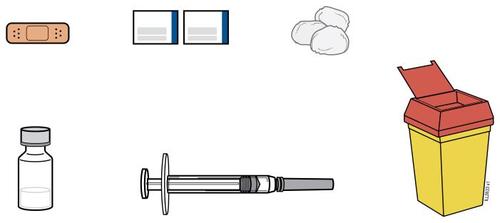
Figure 1
2. Choose the injection site and prepare it
Choose a site for the injection (see figure 2).
- WEZENLA is administered by injection under the skin (subcutaneously).
- A good place for the injection is the upper thigh or around the abdomen at least 5 cm away from the navel.
- If possible, do not choose areas of skin with signs of psoriasis.
- If someone assists you during the injection, you can also choose the upper arms as the injection site.
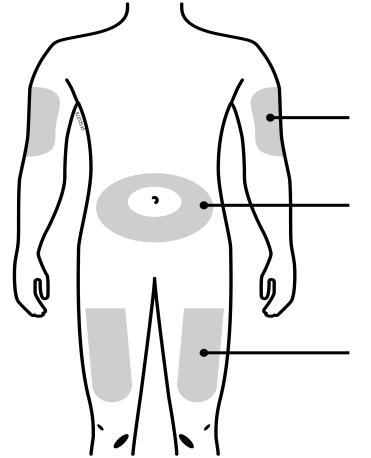
Figure 2
Prepare the injection site
- Wash your hands thoroughly with soap and warm water.
- Rub the injection site on the skin with an antiseptic wipe.
- Do not touch this area again before performing the injection.
3. Prepare the dose:
- Remove the cap on the top of the vial (see figure 3).
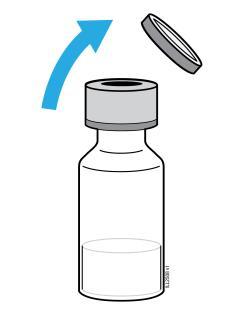
Figure 3
- Do not remove the stopper.
- Clean the stopper with an antiseptic swab.
- Place the vial on a flat surface.
- Take the syringe and remove the protective cap from the needle.
- Do not touch the needle, nor allow the needle to touch anything.
- Push the needle through the rubber stopper.
- Invert the vial and the syringe.
- Pull the syringe plunger to fill the syringe with the amount of liquid, as prescribed by the doctor.
- It is important that the needle is always inside the liquid, so that no air bubbles form in the syringe (see figure 4).
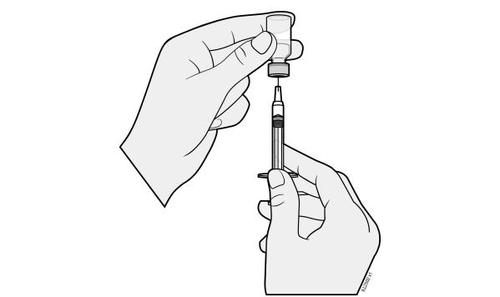
Figure 4
- Remove the needle from the vial.
- Hold the syringe with the needle pointing upwards, to see if there are any bubbles inside.
- If there are air bubbles, gently tap the side of the syringe until the air bubbles reach the top of the syringe (see figure 5).
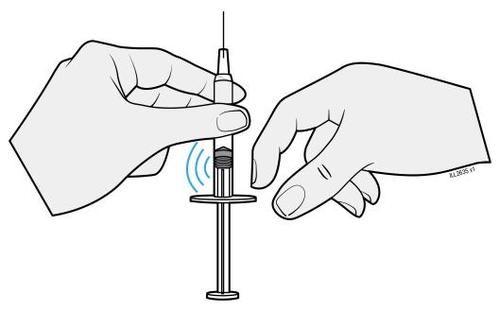
Figure 5
- Then press the plunger until all the air has been eliminated (but not the liquid).
- Do not lay the syringe down and avoid letting the needle touch anything.
4. Inject the dose
- Gently pinch the cleaned skin area between your thumb and index finger. Do not pinch too tightly.
- Push the needle into the pinched skin at a 45-degree angle.
- Push the plunger with your thumb until all the liquid has been injected. Press slowly and steadily, keeping the skin gently pinched.
- When the plunger reaches the end of the syringe, withdraw the needle and release the skin.
5. After the injection
- Press an antiseptic swab on the injection site for a few seconds after the injection.
- There may be a small amount of blood or fluid at the injection site. This is normal.
- You can press a cotton ball or gauze on the injection site and hold it for 10 seconds.
- Do not rub the skin at the injection site: you can cover the injection site with a small bandage if necessary.
6. Disposal
- Used syringes and needles must be placed in a puncture-resistant container, such as a sharps container. For your health and safety and the safety of others, never reuse needles or syringes. Dispose of the sharps container in accordance with local regulations.
WEZENLA 45 mg injectable solution in pre-filled syringe, 90 mg injectable solution in pre-filled syringe
ustekinumab
Medicinal product subject to additional monitoring. This will allow the rapid identification of
new safety information. You can contribute by reporting any adverse effects
experienced during the use of this medicine. See the end of section 4 for
information on how to report adverse effects.
Read this leaflet carefully before using this medicine as it contains important
information for you.
This leaflet is written for people who are taking this medicine. If you are the parent or
carer of a child to whom WEZENLA needs to be administered, read
this information carefully before administration.
- Keep this leaflet. You may need to read it again.
- If you have any questions, ask your doctor or pharmacist.
- This medicine has been prescribed for you only. Do not pass it on to others, even if their symptoms are the same as yours, as it could be harmful.
- If any side effects occur, including those not listed in this leaflet, tell your doctor or pharmacist. See section 4.
Contents of this leaflet
- 1. What WEZENLA is and what it is used for
- 2. What you need to know before you use WEZENLA
- 3. How to use WEZENLA
- 4. Possible side effects
- 5. How to store WEZENLA
- 6. Contents of the pack and other information
1. What is WEZENLA and what is it used for
What is WEZENLA
WEZENLA contains the active substance “ustekinumab”, a monoclonal antibody.
Monoclonal antibodies are proteins that recognize and bind to specific proteins
present in the body.
WEZENLA belongs to a group of medicines called “immunosuppressants”. These medicines
reduce the activity of the immune system to some extent.
What is WEZENLA used for
WEZENLA is used to treat the following inflammatory diseases:
- plaque psoriasis (in adults and children starting from 6 years of age)
- psoriatic arthritis (in adults)
- moderate to severe Crohn’s disease in adults and children weighing at least 40 kg
Plaque psoriasis
Plaque psoriasis is a skin condition that causes inflammation of the skin and nails.
WEZENLA will reduce inflammation and other signs of the disease.
WEZENLA is used in adults with moderate to severe plaque psoriasis, who cannot use
cyclosporine, methotrexate or phototherapy, or in whom these treatments do not work.
WEZENLA is used in children and adolescents starting from 6 years of age with moderate to severe plaque psoriasis,
who cannot tolerate phototherapy or other systemic therapies or when these
treatments have not worked.
Psoriatic arthritis
Psoriatic arthritis is an inflammatory disease of the joints, usually accompanied by
psoriasis. If you have active psoriatic arthritis you will first be treated with other medicines. If you should
not respond adequately to these medicines, you may take WEZENLA to:
- reduce the signs and symptoms of the disease.
- improve physical function.
- slow down joint damage.
Crohn’s disease
Crohn’s disease is an inflammatory disease of the intestine. If you have Crohn’s disease you will
be treated first with other drugs. If you do not respond well enough or are intolerant to these
medicines, you may be given WEZENLA to reduce the signs and symptoms of your disease.
2. What you need to know before using WEZENLA
Do not use WEZENLA
- If you are allergic to ustekinumabor to any of the other ingredients of this medicine (listed in section 6).
- If you have an active infectionthat your doctor considers important.
If you are not sure whether any of the above conditions apply to you, talk to your doctor or pharmacist before using WEZENLA.
Warnings and precautions
Talk to your doctor or pharmacist before using WEZENLA. Your doctor will check your health before each treatment. Make sure to tell your doctor about any illnesses you have before each treatment. Also, tell your doctor if you have recently been in contact with people who may have had tuberculosis. Your doctor will examine you and perform tests for tuberculosis before giving you WEZENLA. If your doctor thinks you are at risk of tuberculosis, they may give you medicines to treat tuberculosis.
Pay attention to serious side effects
WEZENLA can cause serious side effects, including allergic reactions and infections. You need to be aware of certain signs of illness while taking WEZENLA. See “Serious side effects” in section 4 for a complete list of these side effects.
Contact your doctor before using WEZENLA
- If you have ever had an allergic reaction to WEZENLA. Ask your doctor if you are not sure.
- If you have ever had any type of cancer- this is because immunosuppressants like WEZENLA partially weaken the immune system. This can increase the risk of cancer.
- If you have been treated for psoriasis with other biologic medicines (a medicinal product derived from a biological source and usually given by injection)- the risk of cancer may be higher.
- If you have or have had a recent infection.
- If you have ever had any new or changed lesionwithin the area of psoriasis or on normal skin.
- If you are taking any other type of treatment for psoriasis and/or psoriatic arthritis- such as another immunosuppressant or phototherapy (when the body is treated with a type of ultraviolet (UV) light). These treatments can also partially reduce the activity of the immune system. The simultaneous use of these therapies with WEZENLA has not been
studied. However, it is possible that it may increase the possibility of conditions related to a weakened immune system.
- If you are using or have ever used injections for the treatment of allergies- it is not known whether WEZENLA can have an effect on them.
- If you are 65 years of age or older- you may be more likely to get infections.
If you are not sure whether any of the conditions mentioned above apply to you, talk to your doctor or pharmacist before undergoing treatment with WEZENLA.
During treatment with ustekinumab, some patients have developed reactions similar to lupus, including cutaneous lupus or lupus-like syndrome. Contact your doctor immediately if you develop a red, raised, and scaly rash, sometimes with a darker edge, in areas of skin exposed to the sun or with joint pain.
Heart attack and stroke
In a study of patients with psoriasis treated with ustekinumab, heart attack and stroke were observed. Your doctor will regularly check your risk factors for heart disease and stroke to make sure they are treated appropriately. Contact a doctor immediately if you develop chest pain, weakness, or an unusual sensation on one side of your body, facial drooping, or abnormalities in speech or vision.
Children and adolescents
WEZENLA is not recommended for the treatment of children with psoriasis under the age of 6, children with Crohn’s disease weighing less than 40 kg, or for the treatment of children under the age of 18 with psoriatic arthritis because it has not been studied in this age group.
Other medicines, vaccines and WEZENLA
Tell your doctor or pharmacist:
- if you are taking, have recently taken or might take any other medicines
- if you have recently had a vaccine or are about to have a vaccine. Some types of vaccines (live vaccines) should not be given while you are using WEZENLA.
- if you received WEZENLA during pregnancy, inform your child’s pediatrician about the WEZENLA treatment before your child receives any vaccines, including live vaccines such as the BCG vaccine (used to prevent tuberculosis). If you received WEZENLA during pregnancy, live vaccines are not recommended for your child in the first twelve months after birth, unless your child’s pediatrician recommends otherwise.
Pregnancy and breastfeeding
- If you are pregnant, suspect you may be pregnant, or are planning to become pregnant, ask your doctor for advice before taking this medicine.
- No increased risk of birth defects has been observed in newborns exposed to WEZENLA in the womb. However, there is limited experience with WEZENLA in pregnant women. Therefore, it is preferable to avoid using WEZENLA during pregnancy.
- If you are of childbearing potential, it is advisable to avoid becoming pregnant; you should use adequate contraception during use of WEZENLA and for at least 15 weeks after stopping treatment with WEZENLA.
- Ustekinumab can reach the newborn through the placenta. If you received WEZENLA during pregnancy, your child may have an increased risk of infection.
- If you received WEZENLA during pregnancy, it is important to inform your pediatrician and other healthcare professionals before your child receives any vaccines. If you received WEZENLA during pregnancy, live vaccines such as the BCG vaccine (used to prevent tuberculosis) are not recommended for your child in the first twelve months after birth, unless your pediatrician recommends otherwise.
- Ustekinumab can be excreted in small amounts in breast milk. If you are breastfeeding or planning to breastfeed, ask your doctor for advice before using this medicine. You and your doctor will decide whether to breastfeed or use WEZENLA. You cannot do both.
Driving and using machines
WEZENLA does not impair or negligibly impairs the ability to drive and operate machines.
WEZENLA contains polysorbate 80
WEZENLA contains 0.02 mg (45 mg/0.5 mL) or 0.04 mg (90 mg/1.0 mL) of polysorbate 80 (E 433) per unit dose, equivalent to 0.04 mg/mL. Polysorbates can cause allergic reactions. Tell your doctor if you have any known allergies.
3. How to use WEZENLA
WEZENLA is intended for use under the guidance and supervision of a physician experienced in the treatment of the conditions for which WEZENLA is indicated.
Use this medicine following the doctor's instructions exactly at all times. If you have any doubts, consult your
doctor. Discuss with your doctor when you will need to have the injections and subsequent follow-up
visits.
How much WEZENLA is administered
Your doctor will decide how much WEZENLA you need and for how long.
Adults starting from 18 years of age
Psoriasis and psoriatic arthritis
- The recommended initial dose is 45 mg of WEZENLA. Patients with a weight greater than 100 kilograms (kg) may start with a dose of 90 mg instead of 45 mg.
- 4 weeks after the initial dose, you will receive the next dose and then continue every 12 weeks. Subsequent doses are usually the same as the initial dose.
Crohn’s Disease
- During treatment, the first dose of approximately 6 mg/kg of WEZENLA is administered by the doctor via an intravenous infusion into a vein in your arm (intravenous infusion). 8 weeks after the initial dose, you will receive the next dose of 90 mg of WEZENLA and then continue every 12 weeks with an injection under the skin (subcutaneous route).
- In some patients, after the first subcutaneous injection, the 90 mg dose of WEZENLA may be administered every 8 weeks. Your doctor will decide when the next dose needs to be administered.
Use in children and adolescents starting from 6 years of age
Psoriasis
- The doctor will calculate the correct dose, including the amount (volume) of WEZENLA that must be injected to ensure the administration of the correct dose. The correct dose will depend on the child's body weight at the time of each dose.
- A 45 mg vial is available if a dose less than 45 mg is needed.
- If the body weight is less than 60 kg, the recommended dose is 0.75 mg of WEZENLA per kg of body weight.
- If the body weight is between 60 kg and 100 kg, the recommended dose is 45 mg of WEZENLA.
- If the weight exceeds 100 kg, the recommended dose is 90 mg of WEZENLA.
- 4 weeks after the initial dose, you must receive the next dose and then continue every 12 weeks.
Children weighing at least 40 kg
Crohn’s Disease
- During treatment, the first dose of approximately 6 mg/kg of WEZENLA is administered by the doctor via an intravenous infusion into a vein in the arm (intravenous infusion). 8 weeks after the initial dose, you will receive the next dose of 90 mg of WEZENLA, and then continue every 12 weeks with an injection under the skin (subcutaneous route).
- In some patients, after the first subcutaneous injection, the 90 mg dose of WEZENLA may be administered every 8 weeks. The doctor will decide when the next dose needs to be administered.
How WEZENLA is administered
- WEZENLA is administered by a subcutaneous injection (“subcutaneously”). At the beginning of treatment, medical or nursing staff may inject WEZENLA for you.
- However, you and your doctor can decide whether you can inject WEZENLA yourself. In this case, you will be taught how to inject WEZENLA yourself.
- For instructions on how to inject WEZENLA, see “Instructions for Use” at the end of this
Inform your doctor if you have any questions about the injection to perform yourself.
If you use more WEZENLA than you should
If you have used or received too much WEZENLA, inform your doctor or pharmacist immediately. Always
bring the outer packaging of the medicine with you, even if it is empty.
If you forget to use WEZENLA
If you forget a dose, contact your doctor or pharmacist. Do not take a double dose to make up for
the missed dose.
If you stop using WEZENLA
It is not dangerous to stop using WEZENLA. However, if you stop treatment, the
symptoms may reappear.
If you have any doubts about the use of this medicine, consult your doctor or pharmacist.
4. Possible side effects
Like all medicines, this medicine can cause side effects, although not everyone will experience them.
Serious side effects
Some patients may experience serious side effects that may require treatment.
Allergic reactions – these may require urgent medical attention, so contact your
doctor or seek urgent medical help if you notice any of the following signs.
- Severe allergic reactions (“anaphylaxis”) are rare in patients taking ustekinumab (affecting up to 1 in 1,000 patients). Signs include:
- difficulty breathing or swallowing
- low blood pressure, which can cause dizziness or feeling lightheaded
- swelling of the face, lips, mouth or throat.
- Common signs of an allergic reaction include skin rash and hives (affecting up to 1 in 100 patients).
In rare cases, allergic lung reactions and pulmonary inflammation have been reported in
patients receiving ustekinumab. Immediately inform your doctor if you develop symptoms such as
cough, shortness of breath, and fever.
If you experience a severe allergic reaction, your doctor may decide that you should not use WEZENLA
again.
Infections – these may require urgent medical attention, so contact your doctor
immediately if you notice any of the following signs.
- Nasal and throat infections and the common cold are common (affecting up to 1 in 10 patients).
- Chest infections are uncommon (may affect up to 1 in 100 patients)
- Inflammation of the subcutaneous tissue (‘cellulitis’) is uncommon (affects up to 1 in 100 patients).
- Herpes zoster (a type of painful blistering rash) is uncommon (affects up to 1 in 100 patients).
WEZENLA may decrease your ability to fight infections. Some infections may become
serious and may include infections caused by viruses, fungi, bacteria (including tuberculosis)
or parasites, including infections that occur primarily in people with weakened immune systems
(opportunistic infections). Opportunistic infections of the brain (encephalitis, meningitis), lungs and eyes have been reported
in patients treated with ustekinumab.
You should be attentive to signs of infection while using WEZENLA. These include:
- fever, flu-like symptoms, night sweats, weight loss
- feeling tired or short of breath, persistent cough
- warm, red and painful skin, or a painful blistering rash
- burning when urinating
- diarrhea
- vision disturbance or loss of vision
- headache, stiff neck, sensitivity to light, nausea or confusion
Immediately inform your doctor if you notice any of these signs of infection. These may
be signs of infections such as chest infections, skin infections, herpes zoster or opportunistic
infections that may have serious complications. See your doctor if you have any type of
infection that persists or keeps recurring. Your doctor may decide to stop WEZENLA
until the infection resolves. Also, inform your doctor if you have any cuts or open wounds
that may become infected.
Skin peeling – increased redness and peeling of the skin over a large
area of the body may be symptoms of erythrodermic psoriasis or exfoliative dermatitis, which
are serious skin conditions. If you notice any of these signs you should inform
your doctor immediately.
Other side effects
Common side effects(affecting up to 1 in 10 patients):
- Diarrhea
- Nausea
- Vomiting
- Feeling tired
- Feeling dizzy
- Headache
- Itching
- Back, muscle or joint pain
- Sore throat
- Redness and pain at the injection site
- Sinusitis
Uncommon side effects(affecting up to 1 in 100 patients):
- Dental infection
- Vaginal fungal infection
- Depression
- Stuffy or runny nose
- Bleeding, bruising, stiffness, swelling and itching at the injection site
- Feeling weak
- Drooping eyelid and muscle relaxation on one side of the face (“facial palsy” or “Bell’s palsy”), which is usually temporary
- A change in psoriasis with redness and new small, yellow or white blisters, sometimes accompanied by fever (pustular psoriasis)
- Skin peeling (exfoliation of the skin)
- Acne
Rare side effects(affecting up to 1 in 1,000 patients):
- Redness and peeling of the skin over a large area of the body, which may be itchy or painful (exfoliative dermatitis). Similar symptoms sometimes develop as a natural evolution in the type of psoriasis symptoms (erythrodermic psoriasis)
- Inflammation of small blood vessels, which can lead to a rash with small red or purple bumps, fever or joint pain (vasculitis)
Very rare side effects(affecting up to 1 in 10,000 patients):
- Blistering skin formation with possible redness, itching and pain (bullous pemphigoid).
- Cutaneous lupus or lupus-like syndrome (red, raised and scaly rash on areas of skin exposed to the sun, sometimes with joint pain).
Reporting of side effects
If you get any side effect, talk to your doctor or pharmacist. This includes any side effects not listed in this leaflet. You can also report side effects directly through the national reporting system listed in Annex V. By reporting side effects you can help provide more information on the safety of this medicine.
5. How to store WEZENLA
- Keep this medicine out of the sight and reach of children.
- Store in a refrigerator (2°C - 8°C). Do not freeze.
- Keep the pre-filled syringe in the outer packaging to protect the medicine from light.
- If necessary, individual pre-filled syringes of WEZENLA can also be stored at room temperature up to 30°C, for a single period of a maximum of 30 days, in the outer packaging in order to protect them from light. Record the date on which the pre-filled syringe is removed from the refrigerator for the first time and the date on which it should be discarded. The discard date must not exceed the original expiry date printed on the packaging. Once a syringe has been stored at room temperature (up to 30°C), it must not be returned to the refrigerator. Discard the syringe if not used within 30 days at room temperature or by the original expiry date, whichever is earlier.
- Do not shake the pre-filled syringes of WEZENLA. Prolonged vigorous shaking may damage the medicine.
Do not use this medicine
- After the expiry date that is stated on the label and the carton after EXP or Scad. The expiry date refers to the last day of that month.
- If you notice that the liquid has a discoloured appearance, is cloudy, or if you see foreign particles floating (see section 6 “Description of WEZENLA and contents of the pack”).
- If you know or suspect that the medicine has been exposed to extreme temperatures (e.g. accidentally frozen or heated).
- If the product has been shaken vigorously.
WEZENLA is for single use. Any unused product remaining in the syringe must be discarded.
Do not dispose of any medicine in wastewater or household waste. Ask your pharmacist how to
dispose of medicines you no longer use. This will help protect the environment.
6. Content of the pack and other information
What WEZENLA contains
- The active substance is ustekinumab. Each pre-filled syringe contains 45 mg of ustekinumab in 0.5 mL or 90 mg of ustekinumab in 1 mL.
- The other excipients are L-histidine, L-histidine hydrochloride monohydrate, polysorbate 80 (E 433), sucrose, water for injections.
Description of the appearance of WEZENLA and content of the pack
WEZENLA is a solution for injection from clear to opalescent, from colourless to light yellow. It is supplied
in a carton containing 1 single-dose, pre-filled glass syringe of 1 mL. Each
pre-filled syringe contains a dose of ustekinumab 45 mg in 0.5 mL or ustekinumab 90 mg in 1 mL
of solution for injection.
Marketing Authorisation Holder and Manufacturer
Amgen Technology (Ireland) UC,
Pottery Road,
Dun Laoghaire,
Co Dublin,
Ireland
Marketing Authorisation Holder
Amgen Technology (Ireland) UC,
Pottery Road,
Dun Laoghaire,
Co Dublin,
Ireland
Manufacturer
Amgen NV
Telecomlaan 5-7
1831 Diegem
Belgium
For further information on this medicinal product, contact the local representative of the marketing
authorisation holder:
België/Belgique/Belgien
s.a. Amgen n.v.
Tél/Tel: +32 (0)2 7752711
Lietuva
Amgen Switzerland AG Vilniaus filialas
Tel: +370 5 219 7474
България
Амджен България ЕООД
Тел.: +359 (0)2 424 7440
Luxembourg/Luxemburg
s.a. Amgen
Belgique/Belgien
Tél/Tel: +32 (0)2 7752711
Česká republika
Amgen s.r.o.
Tel: +420 221 773 500
Magyarország
Amgen Kft.
Tel.: +36 1 35 44 700
Danmark
Amgen, filial af Amgen AB, Sverige
Tlf.: +45 39617500
Malta
Amgen S.r.l.
Italy
Tel: +39 02 6241121
Deutschland
Amgen GmbH
Tel: +49 89 1490960
Nederland
Amgen B.V.
Tel: +31 (0)76 5732500
Eesti
Amgen Switzerland AG Vilniaus filialas
Tel: +372 586 09553
Norge
Amgen AB
Tlf: +47 23308000
Ελλάδα
Amgen Ελλάς Φαρμακευτικά Ε.Π.Ε.
Τηλ: +30 210 3447000
Österreich
Amgen GmbH
Tel: +43 (0)1 50 217
España
Amgen S.A.
Tel: +34 93 600 18 60
Polska
Amgen Biotechnologia Sp. z o.o.
Tel.: +48 22 581 3000
France
Amgen S.A.S.
Tél: +33 (0)9 69 363 363
Portugal
Amgen Biofarmacêutica, Lda.
Tel: +351 21 4220606
Hrvatska
Amgen d.o.o.
Tel: +385 (0)1 562 57 20
România
Amgen România SRL
Tel: +4021 527 3000
Ireland
Amgen Ireland Limited
Tel: +353 1 8527400
Slovenija
AMGEN zdravila d.o.o.
Tel: +386 (0)1 585 1767
Ísland
Vistor
Sími: +354 535 7000
Slovenská republika
Amgen Slovakia s.r.o.
Tel: +421 2 321 114 49
Italia
Amgen S.r.l.
Tel: +39 02 6241121
Suomi/Finland
Amgen AB, sivuliike Suomessa/Amgen AB, filial
i Finland
Puh/Tel: +358 (0)9 54900500
Kύπρος
C.A. Papaellinas Ltd
Τηλ: +357 22741 741
Sverige
Amgen AB
Tel: +46 (0)8 6951100
Latvija
Amgen Switzerland AG Rīgas filiāle
Tel: +371 257 25888
Other sources of information
More detailed information on this medicinal product is available on the website of the European Medicines
Agency: https://www.ema.europa.eu .
---------------------------------------------------------------------------------------------------------------------------
INSTRUCTIONS FOR USE
These Instructions for Use contain information on how to inject WEZENLA with a pre-filled
syringe.
This pre-filled syringe delivers WEZENLA through an injection under the skin (subcutaneous).
Presentation of the pre-filled syringe
Plunger head
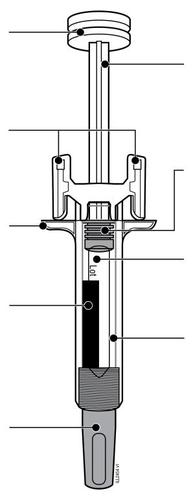
Plunger rod
Plunger (position may vary)
Needle shield clip
Finger flange
Body
Label
Needle cap (needle
Viewing window
inside)
1 Important information you should know before injecting WEZENLA
Dosage:
- WEZENLA is available in two different strengths: 45 mg/0.5 mL and 90 mg/1.0 mL. Check your prescription to make sure you have the correct strength.
- The appearance of the pre-filled syringe will vary depending on the strength. The amount of medicine in the pre-filled syringe will also be different depending on the strength.
- The 45 mg/0.5 mL strength contains a smaller amount of medicine than the 90 mg/1.0 mL strength. See the following illustrations to see what your strength looks like in the pre-filled syringe.
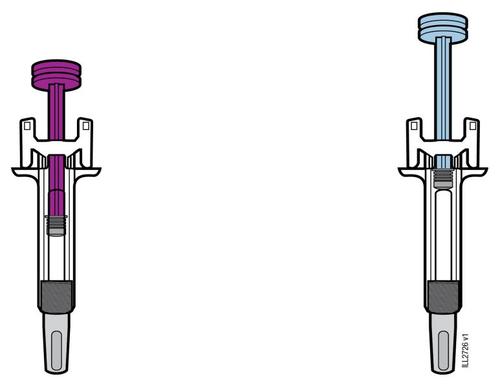
45 mg/0.5 mL90 mg/1.0 mL
Using the WEZENLA pre-filled syringe:
- It is important that you do not attempt to inject yourself unless you have received adequate training from your doctor or healthcare professional.
- In children 12 years of age and older with psoriasis who weigh at least 60 kg, it is recommended that WEZENLA be used by or under the supervision of a parent or caregiver.
- Do notuse the pre-filled syringe if the carton is damaged or the seal is broken.
- Do notuse the pre-filled syringe after the expiry date stated on the label.
- Do notshake the pre-filled syringe.
- Do notremove the needle cap from the pre-filled syringe until you are ready to give the injection.
- Do notuse the pre-filled syringe if it has been frozen.
- Do notuse the pre-filled syringe if it has been dropped onto a hard surface. A part of the pre-filled syringe may be broken even if the break is not visible. If available, use a new pre-filled syringe and call your doctor or healthcare professional.
Important:keep the pre-filled syringe and the sharps disposal container
out of the sight and reach of children.
2 Prepare what you need to give the WEZENLA injection
2a Pick up the pre-filled syringe by the body and remove it from the carton.
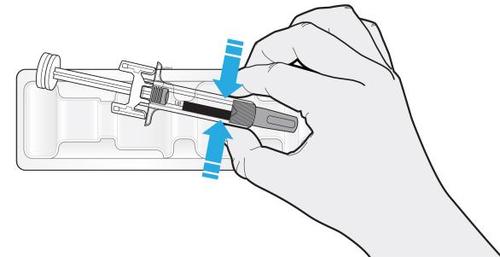
- Do notpick it up by the plunger rod, finger flange or needle cap.
- Do notpick up the needle shield clips.
- Remove the number of pre-filled syringes needed for the injection.
- Place the unused pre-filled syringes back in the refrigerator.
2b Wait 30 minutes to allow the pre-filled syringe to reach room temperature.
WAIT
30
minutes
- The pre-filled syringe must warm up naturally.
- Do notwarm it with hot water, in a microwave or in direct sunlight.
- Do notshake the pre-filled syringe at any time.
- Using the pre-filled syringe at room temperature ensures a more comfortable injection.
2c Gather and place the necessary items for the injection on a clean, well-lit surface.
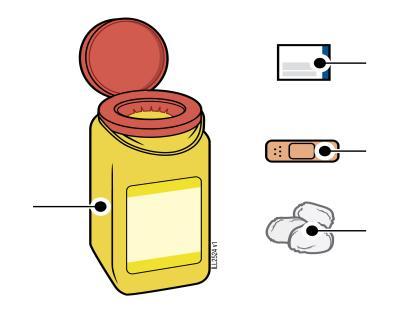
Alcohol swab
Plaster
Sharps disposal
container
Cotton ball or gauze
- WEZENLA pre-filled syringe (room temperature)
- Sharps disposal container
- Alcohol swab
- Plaster
- Cotton ball or gauze
3 Prepare for the injection
3a Inspect the medicine. It should be from clear to opalescent, from colourless to light yellow.
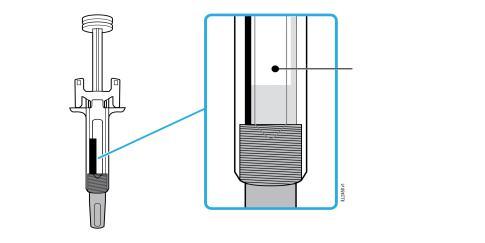
Medicine
- It is normal to see air bubbles in the pre-filled syringe.
- Do notuse the syringe if the medicine is frozen, cloudy, has a change in colour or if you see foreign particles floating in it.
3b Check the expiry date (Exp.) and inspect the pre-filled syringe.
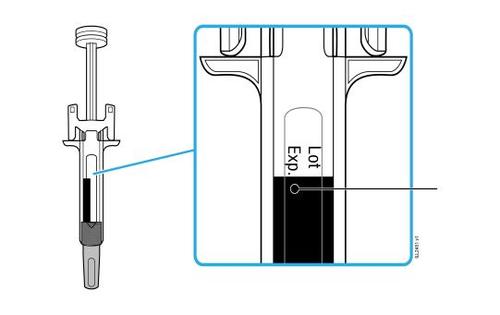
Expiry
date
- Do notuse the syringe if the expiry date has passed.
- Do notuse the pre-filled syringe in the following situations:
- the needle cap is missing or loose;
- there are cracks or broken parts;
- the syringe has been dropped onto a hard surface.
- Make sure you have the correct medicine and dose.
3c Inject into one of the following areas.
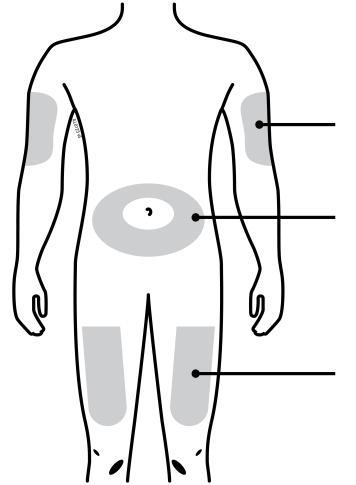
Upper arm
Abdomen
Thigh
- Inject into the thigh or abdomen (avoiding the area 5 cm around the navel).
- Choose a different site for each injection.
- If the injection is given by another person, the medicine can be injected into the thigh, abdomen or the outer area of the upper arm.
Important:avoid areas with scars, stretch marks or where the skin is sore, bruised, red or
hardened. If possible, do not use areas of skin that show signs of psoriasis.
3d Wash your hands thoroughly with soap and water.
3e Clean the injection site with an alcohol swab.
- Allow the skin to dry.
- Do nottouch this area again before giving the injection.
4 Inject WEZENLA
4a Remove the needle cap by pulling it straight off while holding the body of the pre-filled syringe.
Important:remove the needle cap only when you are ready to give the injection
immediately (within 5 minutes) to prevent the medicine from drying out.
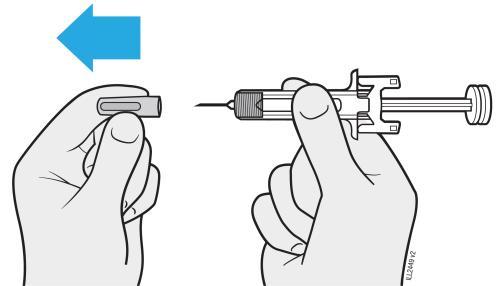
- Do nottwist or bend the needle cap.
- Neverput the needle cap back on, as this could damage the needle.
- After removing the needle cap, the needle must notcome into contact with anything.
- After removing the needle cap, do notplace the uncapped pre-filled syringe on any surface.
- Do nottry to remove any air bubbles from the pre-filled syringe. Air bubbles are normal.
- A drop of medicine may come out.
4b Pinch the skin around the injection site before giving the injection.
PINCH
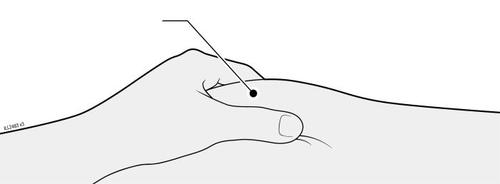
- Hold the skin between your thumb and index finger to create a fold to inject into.
- If possible, this fold should be about 5 cm wide.
Importantcontinue to hold the skin lifted until the injection is complete.
4c Insert the needle into the fold.
INSERT
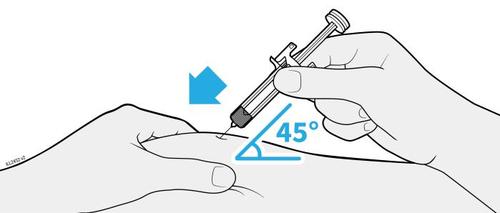
- Insert the needle into the fold at a 45-degree angle.
- Do notplace your finger on the plunger rod while inserting the needle, as this could cause medicine to leak.
4d Slowly press the plunger head all the way down until it is fully
between the needle shield clips.
INJECT
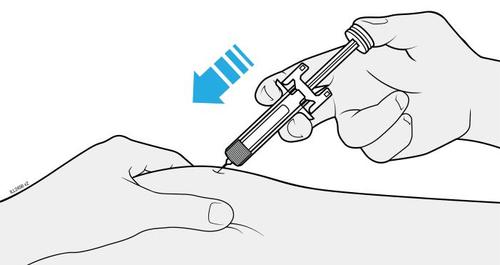
- Do notpull back on the plunger.
- Do notremove the pre-filled syringe before all the medicine has been delivered.
4e Continue to press on the plunger head and withdraw the needle from the skin.
RELEASE
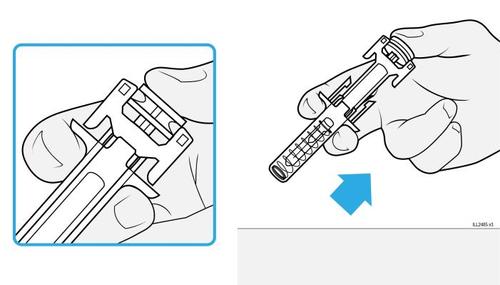
- Continue to press on the plunger head and withdraw the needle from the skin.
- After removing the needle, release the skin.
- Slowly remove your thumb from the plunger head. This will cause the empty syringe to move backwards until all of the needle is fully covered by the safety shield.
If a second injection is necessary…
4f If a second injection is necessary, repeat steps 2a-4e.
- Check the dose that was prescribed to you on the prescription. If your dose is 90 mg, you will receive a prefilled syringe of 90 mg or two prefilled syringes of 45 mg.
- If you receive two prefilled syringes of 45 mg for a 90 mg dose, you will need to administer a second injection immediately after the first.
- Repeat steps 2a-4e for the second injection using a new prefilled syringe. Choose a different site for the second injection.
5 Complete the procedure and dispose of WEZENLA
Important:never replace the needle cap.
5a Dispose of the used prefilled syringe and the needle cap in a sharps container.
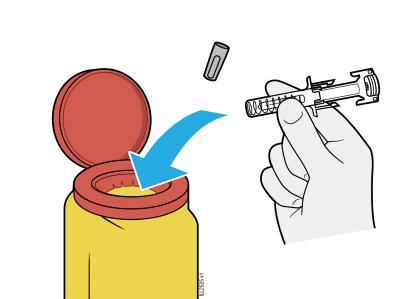
- Do notreuse the prefilled syringe.
Do notdispose of the prefilled syringe in household waste.
5b Check the injection site.
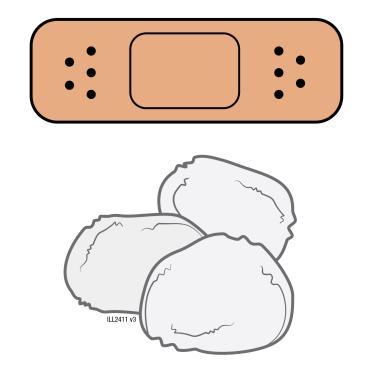
- Do notrub the injection site.
- If bleeding occurs, apply pressure with a cotton ball or gauze. Apply a bandage if necessary.
Unused product remaining in the syringe must be discarded. Do not dispose of any medicine
down the drain or in household waste. Ask your pharmacist how to dispose of medicines you no
longer use. This will help protect the environment.

Уже начали прием и появились вопросы?
Обсудите свое состояние и дальнейшие шаги с врачом онлайн.
WEZENLA 45 mg injectable solution in pre-filled pen, 90 mg injectable solution in pre-filled pen
ustekinumab
Medicinal product subject to additional monitoring. This will allow the rapid identification of
new safety information. You can contribute by reporting any adverse effects
encountered during the use of this medicine. See the end of section 4 for
information on how to report adverse effects.
Read this leaflet carefully before using this medicine as it contains important
information for you.
This leaflet is written for people who are taking this medicine.
- Keep this leaflet. You may need to read it again.
- If you have any questions, ask your doctor or pharmacist.
- This medicine has been prescribed for you only. Do not pass it on to others, even if they have the same symptoms as you, as it may be harmful.
- If any side effects occur, including those not listed in this leaflet, tell your doctor or pharmacist. See section 4.
Contents of this leaflet
- 1. What WEZENLA is and what it is used for
- 3. What you need to know before you use WEZENLA
- 3. How to use WEZENLA
- 4. Possible side effects
- 6. How to store WEZENLA
- 6. Contents of the pack and other information
1. What is WEZENLA and what is it used for
What is WEZENLA
WEZENLA contains the active substance “ustekinumab”, a monoclonal antibody.
Monoclonal antibodies are proteins that recognize and bind to specific proteins
present in the body.
WEZENLA belongs to a group of medicines called “immunosuppressants”. These medicines
reduce the activity of the immune system to some extent.
What is WEZENLA used for
WEZENLA is used to treat the following inflammatory diseases:
- plaque psoriasis (in adults)
- psoriatic arthritis (in adults)
- moderate to severe Crohn’s disease (in adults)
Plaque psoriasis
Plaque psoriasis is a skin condition that causes inflammation of the skin and nails.
WEZENLA will reduce the inflammation and other signs of the disease.
WEZENLA is used in adults with moderate to severe plaque psoriasis who cannot use
cyclosporine, methotrexate or phototherapy, or in whom these treatments do not work.
Psoriatic arthritis
Psoriatic arthritis is an inflammatory disease of the joints, usually accompanied by
psoriasis. If you have active psoriatic arthritis you will first be treated with other medicines. If you do not
respond adequately to these medicines, you may take WEZENLA to:
- reduce the signs and symptoms of the disease.
- improve physical function.
- slow down damage to the joints.
Crohn’s disease
Crohn’s disease is an inflammatory disease of the intestine. If you have Crohn’s disease you will
first be treated with other drugs. If you do not respond well enough or are intolerant to these
medicines, you may be given WEZENLA to reduce the signs and symptoms of your disease.
2. Cosa deve sapere prima di usare WEZENLA
Non usi WEZENLA
- Se è allergico a ustekinumabo ad uno qualsiasi degli altri componenti di questo medicinale (elencati nel successivo paragrafo 6).
- Se è affetto da un’infezione attivache il medico ritiene importante.
Se non è sicuro che una delle condizioni sopra riportate si riferisca a lei, si rivolga al medico o al
farmacista, prima di usare WEZENLA.
Avvertenze e precauzioni
Si rivolga al medico o al farmacista prima di usare WEZENLA. Il medico controllerà il suo stato di
salute prima di ogni trattamento. Si assicuri di informare il medico, prima di ogni trattamento, in
merito alle malattie da cui è affetto. Inoltre, informi il medico anche se è stato a contatto di recente con
persone che avrebbero potuto avere la tubercolosi. Il medico la visiterà ed effettuerà degli esami per la
tubercolosi, prima di somministrarle WEZENLA. Se il medico ritiene che è a rischio tubercolosi è
possibile che le somministri dei medicinali per curare la tubercolosi.
Attenzione agli effetti indesiderati gravi
WEZENLA può causare gravi effetti indesiderati, incluse reazioni allergiche ed infezioni. Deve
prestare attenzione a determinati segni della malattia mentre assume WEZENLA. Vedere “Effetti
indesiderati gravi” al paragrafo 4 per una lista completa di questi effetti indesiderati.
Prima di usare WEZENLA contatti il medico
- Se ha mai avuto una reazione allergicaa WEZENLA. Chieda al medico se non è sicuro.
- Se ha mai avuto un qualsiasi tipo di cancro- questo perché gli immunosoppressori come WEZENLA indeboliscono in parte il sistema immunitario. Questo può aumentare il rischio di cancro.
- Se è stato trattato per la psoriasi con altri medicinali biologici (un prodotto medicinaleproveniente da una fonte biologica e solitamente somministrato mediante iniezione)- il rischio di cancro può essere più elevato.
- Se ha o ha avuto una recente infezione.
- Se ha mai avuto una qualsiasi lesione nuova o modificataentro l’area della psoriasi o sulla pelle normale.
- Se sta assumendo un qualsiasi altro tipo di trattamento per la psoriasi e/o artritepsoriasica- come un altro immunosoppressore o la fototerapia (quando il corpo è trattato con un tipo di luce ultravioletta (UV)). Anche questi trattamenti possono ridurre in parte l’attività del sistema immunitario. L’uso contemporaneo di queste terapie con WEZENLA non è stato studiato. Tuttavia è possibile che possa aumentare la possibilità di patologie correlate ad un indebolimento del sistema immunitario.
- Se sta usando o ha mai usato iniezioni per il trattamento delle allergie- non è noto se WEZENLA può avere un effetto su di esse.
- Se ha un’età uguale o maggiore ai 65 anni- può avere una maggiore probabilità di contrarre infezioni.
Se non è sicuro che una delle condizioni citate in precedenza possa riguardarla, si rivolga al medico o
al farmacista prima di sottoporsi a un trattamento con WEZENLA.
Durante il trattamento con ustekinumab alcuni pazienti hanno manifestato reazioni simili al lupus,
incluso lupus cutaneo o sindrome simile a lupus (sindrome simil-lupoide). Consulti immediatamente il
medico se manifesta un’eruzione cutanea rossa, in rilievo e squamosa, talvolta con un margine più
scuro, in aree della pelle esposte al sole o in presenza di dolore articolare.
Attacco cardiaco e ictus
In uno studio su pazienti affetti da psoriasi trattati con ustekinumab sono stati osservati attacco
cardiaco e ictus. Il medico controllerà regolarmente i fattori di rischio per le malattie cardiache e
l’ictus per assicurarsi che siano trattati in modo appropriato. Si rivolga immediatamente a un medico
se sviluppa dolore toracico, debolezza o una sensazione anomala su un lato del corpo, flaccidità del
volto, o anomalie del linguaggio o della vista.
Bambini e adolescenti
La penna preriempita di WEZENLA non è raccomandata per l’uso in bambini e adolescenti di
età inferiore ai 18 anni con psoriasi o con malattia di Crohn, perché non è stata studiata in questa
fascia di età. Per i bambini, a partire dai 6 anni di età (e gli adolescenti) con psoriasi si devono
invece usare la siringa preriempita o il flaconcino. Per i bambini di almeno 40 kg di peso con
malattia di Crohn, devono essere utilizzati, invece,la soluzione per infusione, il flaconcino o la
siringa preriempita.
WEZENLA non è raccomandato per il trattamento di bambini e adolescenti di età inferiore ai 18 anni
con artrite psoriasica o di bambini con malattia di Crohn di peso inferiore a 40 kg perché non è stato
studiato in questa fascia di età.
Altri medicinali, vaccini e WEZENLA
Informi il medico o il farmacista:
- se sta assumendo, ha recentemente assunto o potrebbe assumere qualsiasi altro medicinale
- se recentemente si è fatto vaccinare o sta per essere vaccinato. Alcuni tipi di vaccini (vaccini vivi) non devono essere somministrati mentre sta usando WEZENLA.
- se ha ricevuto WEZENLA durante la gravidanza, informi il pediatra del/la suo/a bambino/a del trattamento con WEZENLA prima che il/la suo/a bambino/a riceva qualsiasi vaccino, inclusi vaccini vivi come il vaccino BCG (usato per la prevenzione della tubercolosi). Se ha ricevuto WEZENLA durante la gravidanza, i vaccini vivi non sono raccomandati per il/la suo/a bambino/a nei primi dodici mesi dopo la nascita, a meno che il pediatra del/la suo/a bambino/a non raccomandi altrimenti.
Gravidanza e allattamento
- Se è in corso una gravidanza, se sospetta o sta pianificando una gravidanza, chieda consiglio al medico prima di prendere questo medicinale.
- Nei neonati esposti a WEZENLA nell’utero non è stato osservato un rischio maggiore di difetti congeniti. Tuttavia, vi è una limitata esperienza con WEZENLA nelle donne in gravidanza. Pertanto, è preferibile evitare l’uso di WEZENLA in gravidanza.
- Se è in età fertile, è consigliabile evitare di iniziare una gravidanza; deve usare un adeguato metodo contraccettivo durante l’uso di WEZENLA e per almeno 15 settimane dopo la sospensione del trattamento con WEZENLA.
- WEZENLA può raggiungere il nascituro attraverso la placenta. Se ha ricevuto WEZENLA durante la gravidanza, il/la suo/a bambino/a potrebbe avere un rischio maggiore di contrarre un’infezione.
- Se ha ricevuto WEZENLA durante la gravidanza, è importante che ne informi il pediatra e gli altri operatori sanitari prima che il/la suo/a bambino/a riceva qualsiasi vaccino. Se ha ricevuto
WEZENLA durante la gravidanza, i vaccini vivi come il vaccino BCG (usato per la prevenzione
della tubercolosi) non sono raccomandati per il/la suo/a bambino/a nei primi dodici mesi dopo
la nascita, a meno che il pediatra non raccomandi altrimenti.
- Ustekinumab può essere escreto nel latte materno in quantità molto ridotte. Se sta allattando con latte materno o se prevede di allattare chieda consiglio al medico prima di usare questo medicinale. Lei e il medico deciderete se deve allattare o utilizzare WEZENLA. Non può fare entrambe le cose.
Guida di veicoli e utilizzo di macchinari
WEZENLA non altera o altera in modo trascurabile la capacità di guidare veicoli e di usare
macchinari.
WEZENLA contiene polisorbato 80
WEZENLA contiene 0,02 mg (45 mg/0,5 mL) o 0,04 mg (90 mg/1,0 mL) di polisorbato 80 (E 433)
per dose unitaria, equivalente a 0,04 mg/mL. I polisorbati possono provocare reazioni allergiche.
Informi il medico se lei ha una qualsiasi allergia nota.
3. How to use WEZENLA
WEZENLA is intended for use under the guidance and supervision of a physician experienced in the treatment of the conditions for which WEZENLA is indicated.
Use this medicine following the doctor's instructions exactly at all times. If you have any doubts, consult your
doctor. Discuss with your doctor when you will need to have the injections and subsequent follow-up
visits.
How much WEZENLA is administered
Your doctor will decide how much WEZENLA you need and for how long.
Adults starting from 18 years of age
Psoriasis and psoriatic arthritis
- The recommended initial dose is 45 mg of WEZENLA. Patients with a weight greater than 100 kilograms (kg) may start with a dose of 90 mg instead of 45 mg.
- After the initial dose, you will take the next dose 4 weeks later, and then every 12 weeks. Subsequent doses are usually the same as the initial dose.
Crohn's Disease
- During treatment, the first dose of approximately 6 mg/kg of WEZENLA will be administered to you by the doctor via an intravenous infusion into a vein in your arm. After the initial dose, you will receive the next dose of 90 mg of WEZENLA after 8 weeks, then every 12 weeks with an injection under the skin (subcutaneous route).
- In some patients, after the first subcutaneous injection, the 90 mg dose of WEZENLA may be administered every 8 weeks. The doctor will decide when you should receive the next dose.
Use in children and adolescents starting from 6 years of age
Psoriasis
- The doctor will calculate the correct dose, including the amount (volume) of WEZENLA that must be injected to ensure the administration of the correct dose. The correct dose will depend on the child's body weight at the time of administration of each dose.
- The pre-filled pen has not been studied in children aged between 6 and 11 years and its use is not recommended in children in this age group.
- A 45 mg vial is available should you need a dose less than 45 mg.
- If the body weight is less than 60 kg, the recommended dose is 0.75 mg of WEZENLA per kg of body weight.
- If the body weight is between 60 kg and 100 kg, the recommended dose is 45 mg of
WEZENLA.
- If the weight exceeds 100 kg, the recommended dose is 90 mg of WEZENLA.
- After the initial dose, you will need to receive the next dose after 4 weeks, and subsequently every 12 weeks.
How WEZENLA is administered
- WEZENLA is administered by a subcutaneous injection (“subcutaneously”). At the beginning of treatment, medical or nursing staff may inject WEZENLA for you.
- However, you and your doctor can decide whether you can inject WEZENLA yourself. In this case, you will be taught how to inject WEZENLA yourself.
- For instructions on how to inject WEZENLA, see “Instructions for Use” at the end of this
Inform your doctor if you have any questions about the injection to be performed yourself.
If you use more WEZENLA than you should
If you have used or received too much WEZENLA, inform your doctor or pharmacist immediately. Always
bring the outer packaging of the medicine with you, even if it is empty.
If you forget to use WEZENLA
If you forget a dose, contact your doctor or pharmacist. Do not take a double dose to make up for
the missed dose.
If you stop using WEZENLA
It is not dangerous to stop using WEZENLA. However, if you stop treatment, the
symptoms may reappear.
If you have any doubts about the use of this medicine, ask your doctor or pharmacist.
4. Possible side effects
Like all medicines, this medicine can cause side effects, although not everybody gets them.
li manifest.
Serious side effects
Some patients may experience serious side effects that may require treatment.
Allergic reactions – these may require urgent medical attention, so contact your
doctor or seek urgent medical help if you notice any of the following signs.
- Serious allergic reactions (“anaphylaxis”) are rare in patients receiving ustekinumab (affecting up to 1 in 1,000 patients). Signs include:
- difficulty breathing or swallowing
- low blood pressure, which can cause dizziness or feeling lightheaded
- swelling of the face, lips, mouth or throat.
- Common signs of an allergic reaction include skin rash and hives (affecting up to 1 in 100 patients).
In rare cases, allergic lung reactions and lung inflammation have been reported in
patients receiving ustekinumab. Tell your doctor immediately if you develop symptoms such as
cough, shortness of breath and fever.
If you have a serious allergic reaction, your doctor may decide that you should not use WEZENLA
again.
Infections – these may require urgent medical attention, so contact your doctor
immediately if you notice any of the following signs.
- Nasal and throat infections and the common cold are common (affecting up to 1 in 10 patients).
- Chest infections are uncommon (can affect up to 1 in 100 patients)
- Inflammation of the tissue under the skin (‘cellulitis’) is uncommon (affects up to 1 in 100 patients).
- Herpes zoster (a type of painful skin rash with blisters) is uncommon (affects up to 1 in 100 patients).
WEZENLA may decrease your ability to fight infections. Some infections may become
serious and may include infections caused by viruses, fungi, bacteria (including tuberculosis)
or parasites, including infections that occur mainly in people with weakened immune systems
(opportunistic infections). Opportunistic infections of the brain (encephalitis, meningitis), lungs and eyes have been reported
in patients treated with ustekinumab.
You should be careful to look for signs of infection while using WEZENLA. These include:
- fever, flu-like symptoms, night sweats, weight loss
- feeling tired or short of breath, persistent cough
- warm, red and painful skin, or a painful, blistering rash
- burning when you urinate
- diarrhoea
- blurred vision or loss of vision
- headache, stiff neck, sensitivity to light, nausea or confusion
Tell your doctor immediately if you notice any of these signs of infection. These may
be signs of infections such as chest infections, skin infections, herpes zoster or opportunistic
infections that can have serious complications. See your doctor if you have any type of
infection that persists or keeps recurring. Your doctor may decide to stop WEZENLA
until the infection resolves. Also tell your doctor if you have any cuts or open wounds
that may become infected.
Skin peeling – increased redness and peeling of the skin over a large
area of the body may be symptoms of erythrodermic psoriasis or exfoliative dermatitis, which
are serious skin conditions. If you notice any of these signs you should tell
your doctor immediately.
Other side effects
Common side effects(affecting up to 1 in 10 patients):
- Diarrhoea
- Nausea
- Vomiting
- Feeling tired
- Feeling dizzy
- Headache
- Itching
- Back, muscle or joint pain
- Sore throat
- Redness and pain at the injection site
- Sinusitis
Uncommon side effects(affecting up to 1 in 100 patients):
- Dental infection
- Vaginal fungal infection
- Depression
- Stuffy or runny nose
- Bleeding, bruising, stiffness, swelling and itching at the injection site
- Feeling weak
- Drooping eyelid and muscle weakness on one side of the face (“facial paralysis” or “Bell’s palsy”), which is usually temporary
- A change in psoriasis with redness and small, yellow or white bumps, sometimes accompanied by fever (pustular psoriasis)
- Skin peeling (shedding of the skin)
- Acne
Rare side effects(affecting up to 1 in 1,000 patients):
- Redness and peeling of the skin over a large area of the body, which may be itchy or painful (exfoliative dermatitis). Similar symptoms sometimes develop as a natural progression in the type of psoriasis symptoms (erythrodermic psoriasis)
- Inflammation of small blood vessels, which can lead to a skin rash with small red or purple bumps, fever or joint pain (vasculitis)
Very rare side effects(affecting up to 1 in 10,000 patients):
- Blistering skin with possible redness, itching and pain (bullous pemphigoid).
- Cutaneous lupus or lupus-like syndrome (red, raised and scaly rash on areas of skin exposed to the sun, sometimes with joint pain).
Reporting side effects
If you get any side effects, talk to your doctor or pharmacist. This includes any side effects not listed in this leaflet. You can also report side effects directly through the national reporting system reported in Annex V . By reporting side effects you can help provide more information on the safety of this medicine.
5. How to store WEZENLA
- Keep this medicine out of the sight and reach of children.
- Store in a refrigerator (2°C - 8°C). Do not freeze.
- Keep the pre-filled pen in the outer packaging to protect the medicine from light.
- If necessary, individual pre-filled pens of WEZENLA can also be stored at room temperature up to 30°C for a single period of a maximum of 30 days, in the outer packaging in order to protect them from light. Record the date on which the pre-filled pen is removed from the refrigerator for the first time and the date on which it should be discarded. The discard date must not exceed the original expiry date printed on the packaging. Once a pre-filled pen has been stored at room temperature (up to 30°C), it must not be returned to the refrigerator. Discard the pre-filled pen if not used within 30 days at room temperature or by the original expiry date, whichever is earlier.
- Do not shake the pre-filled pens of WEZENLA. Prolonged vigorous shaking may damage the medicine.
Do not use this medicine
- After the expiry date that is stated on the label and the carton after EXP or Scad. The expiry date refers to the last day of that month.
- If you notice that the liquid has a changed colour, is cloudy or if you see foreign particles floating (see section 6 “Description of WEZENLA and contents of the pack”).
- If you know or suspect that the medicine has been exposed to extreme temperatures (e.g. accidentally frozen or heated).
- If the product has been shaken vigorously.
WEZENLA is for single use. The unused product remaining in the pre-filled pen must be
discarded.
Do not dispose of any medicine in wastewater or household waste. Ask your pharmacist how to
dispose of medicines you no longer use. This will help protect the environment.
6. Content of the pack and other information
What WEZENLA contains
- The active substance is ustekinumab. Each pre-filled pen contains 45 mg of ustekinumab in 0.5 mL or 90 mg of ustekinumab in 1 mL.
- The other excipients are L-histidine, L-histidine hydrochloride monohydrate, polysorbate 80 (E 433), sucrose, water for injections.
Description of the appearance of WEZENLA and content of the pack
WEZENLA is a clear to opalescent, colourless to pale yellow injectable solution. It is supplied
in a carton containing 1 single-dose, 1 mL glass pre-filled pen. Each
pre-filled pen contains a dose of ustekinumab 45 mg in 0.5 mL or ustekinumab 90 mg in 1 mL
of injectable solution.
Marketing authorisation holder and manufacturer
Amgen Technology (Ireland) UC,
Pottery Road,
Dun Laoghaire,
Co Dublin,
Ireland
Marketing authorisation holder
Amgen Technology (Ireland) UC,
Pottery Road,
Dun Laoghaire,
Co Dublin,
Ireland
Manufacturer
Amgen NV
Telecomlaan 5-7
1831 Diegem
Belgium
For further information on this medicinal product, contact the local representative of the marketing
authorisation holder:
België/Belgique/Belgien
s.a. Amgen n.v.
Tél/Tel: +32 (0)2 7752711
Lietuva
Amgen Switzerland AG Vilniaus filialas
Tel: +370 5 219 7474
България
Амджен България ЕООД
Тел.: +359 (0)2 424 7440
Luxembourg/Luxemburg
s.a. Amgen
Belgique/Belgien
Tél/Tel: +32 (0)2 7752711
Česká republika
Amgen s.r.o.
Tel: +420 221 773 500
Magyarország
Amgen Kft.
Tel.: +36 1 35 44 700
Danmark
Amgen, filial af Amgen AB, Sverige
Tlf.: +45 39617500
Malta
Amgen S.r.l.
Italy
Tel: +39 02 6241121
Deutschland
Amgen GmbH
Tel: +49 89 1490960
Nederland
Amgen B.V.
Tel: +31 (0)76 5732500
Eesti
Amgen Switzerland AG Vilniaus filialas
Tel: +372 586 09553
Norge
Amgen AB
Tlf: +47 23308000
Ελλάδα
Amgen Ελλάς Φαρμακευτικά Ε.Π.Ε.
Τηλ: +30 210 3447000
Österreich
Amgen GmbH
Tel: +43 (0)1 50 217
España
Amgen S.A.
Tel: +34 93 600 18 60
Polska
Amgen Biotechnologia Sp. z o.o.
Tel.: +48 22 581 3000
France
Amgen S.A.S.
Tél: +33 (0)9 69 363 363
Portugal
Amgen Biofarmacêutica, Lda.
Tel: +351 21 4220606
Hrvatska
Amgen d.o.o.
Tel: +385 (0)1 562 57 20
România
Amgen România SRL
Tel: +4021 527 3000
Ireland
Amgen Ireland Limited
Tel: +353 1 8527400
Slovenija
AMGEN zdravila d.o.o.
Tel: +386 (0)1 585 1767
Ísland
Vistor
Sími: +354 535 7000
Slovenská republika
Amgen Slovakia s.r.o.
Tel: +421 2 321 114 49
Italia
Amgen S.r.l.
Tel: +39 02 6241121
Suomi/Finland
Amgen AB, sivuliike Suomessa/Amgen AB, filial
i Finland
Puh/Tel: +358 (0)9 54900500
Kύπρος
C.A. Papaellinas Ltd
Τηλ: +357 22741 741
Sverige
Amgen AB
Tel: +46 (0)8 6951100
Latvija
Amgen Switzerland AG Rīgas filiāle
Tel: +371 257 25888
Other sources of information
More detailed information on this medicinal product is available on the website of the European
Medicines Agency: https://www.ema.europa.eu .
---------------------------------------------------------------------------------------------------------------------------
INSTRUCTIONS FOR USE
These Instructions for Use contain information on how to inject WEZENLA with a pre-filled
pen (ConfiPen).
This pre-filled pen delivers WEZENLA through an injection under the skin (subcutaneous).
Presentation of the pre-filled pen
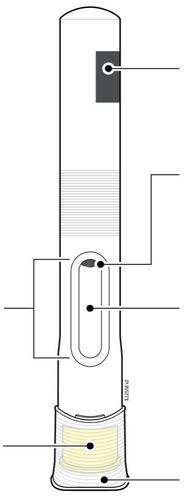
Expiry date
Plunger end (may be
visible in the window; position may vary)
Medicine window
Yellow safety device
under the cap (needle
inside)
Cap
Important information you should know before injecting WEZENLA
Dosage:
- WEZENLA is available in two different doses: 45 mg/0.5 mL and 90 mg/1.0 mL. Check your prescription to ensure you have the correct dose.
- The colour of the label and the size of the pre-filled pen window will change depending on the dose. The amount of medicine in the pre-filled pen will also vary depending on the dose.
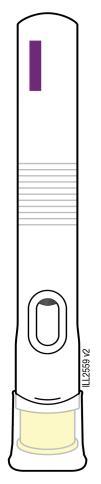
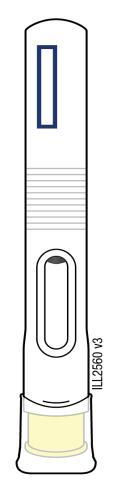
45 mg/0.5 mL 90 mg/1.0 mL
Important:
- If your dose is 90 mg, you will receive a 90 mg pre-filled pen or two 45 mg pre-filled pens.
- If you receive two 45 mg pre-filled pens for a 90 mg dose, you will need to give a second injection immediately after the first.
- Repeat steps 1-14 for the second injection using a new pre-filled pen.
- Choose a different site for the second injection. Using the WEZENLA pre-filled pen:
Important:keep the pre-filled pen and the sharps disposal container out of the sight and reach of
children.
Prepare what you need to give a WEZENLA injection
1Wait 30 minutes to allow the pre-filled pen to reach room
temperature.
WAIT
30
minutes
- Remove the required number of pre-filled pens from the refrigerator for the injection.
- The pre-filled pen must warm up naturally.
- Donot warm it with hot water, in a microwave or in direct sunlight.
- Donot put the pre-filled pen back in the refrigerator once it has reached room temperature.
- Donot shake the pre-filled pen at any time.
- Using the pre-filled pen at room temperature ensures that the entire dose is delivered and a more comfortable injection.
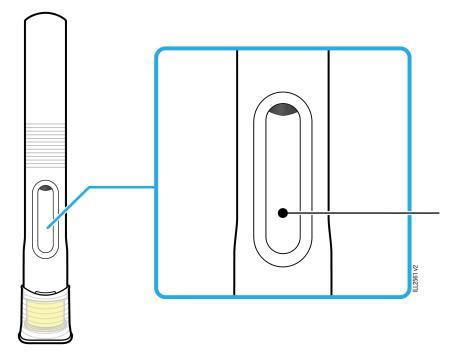
Medicine
2Inspect the medicine. It should be clear to opalescent, colourless to pale
yellow.
- It is normal to see air bubbles.
- Donot use WEZENLA if the medicine is frozen, cloudy, has a change in colour or if you see foreign particles floating around.
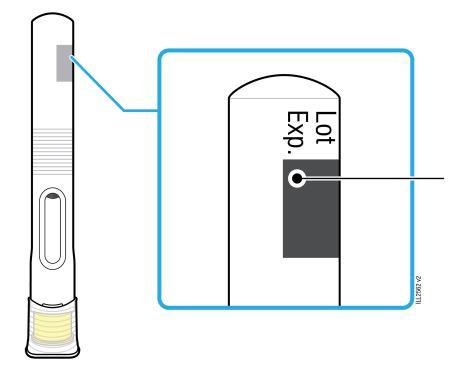
Expiry date
3Check the expiry date (Exp.) and inspect the pre-filled pen for damage.
- Donot use the pre-filled pen if the expiry date has passed.
- Donot use the pre-filled pen if:
- the cap is missing or loose;
- there are cracks or broken parts;
- the pen has been dropped onto a hard surface.
- Make sure you have the correct medicine and dose.
Prepare for the WEZENLA injection
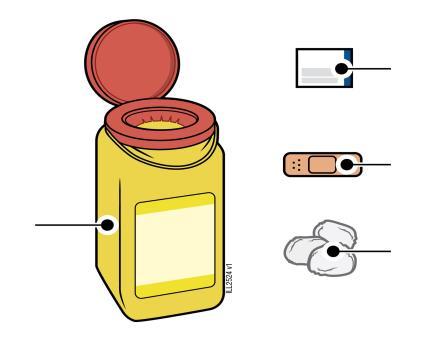
Alcohol wipe
Plaster
Sharps disposal
container
Cotton wool or gauze
4Take and place the following items needed for the injection on a clean,
flat and well-lit surface:
- WEZENLA pre-filled pen (room temperature)
- Sharps disposal container
- Alcohol wipe
- Plaster
- Cotton wool or gauze
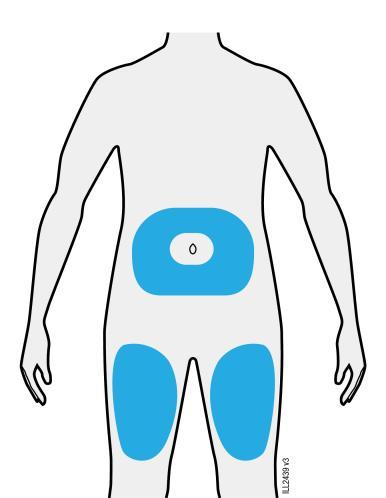
Thigh
Abdomen
5Choose one of these sites for the injection.
- Choose the front of the thigh or abdomen (avoiding the area 5 cm around the navel).
- If the injection is given by another person, the medicine can be injected into the thigh or abdomen.
Important:avoid areas with scars, stretch marks or where the skin is sore, bruised, red or
hardened. If possible, do not use areas of skin that show signs of psoriasis.
6Wash your hands thoroughly with soap and water.
7Clean the injection site with an alcohol wipe.
- Allow the skin to dry.
- Donot touch the disinfected area again before giving the injection.
Inject WEZENLA
Important:remove the cap only when you are able to give the injection immediately (within
5 minutes), as the medicine may dry out. Donot put the cap back on.
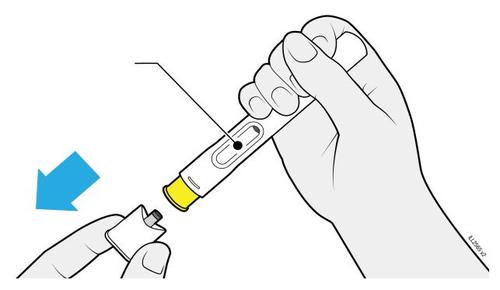
The window must be visible
8Hold the pre-filled pen so that the window is visible. Pull firmly to remove the
cap. You can rotate the cap to make it easier to remove.
- Never put the cap back on. It may damage the needle.
- It is normal to see a drop of medicine at the end of the needle or the yellow safety device.
Important:do not touch or press the yellow safety device. Do not insert your fingers into the
yellow safety device.
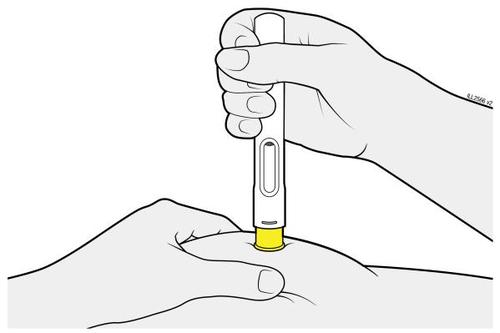
9Pinch the skin to create a skin fold with a firm surface at the injection
site. Apply the yellow safety device directly against the skin.
- Continue to hold the skin folduntil the injection is complete.
- Make sure the window is visible.
- Make sure the pre-filled pen is held straight on the injection site (at a 90-degree angle).
PRESS AND HOLD
against the skin to start the injection
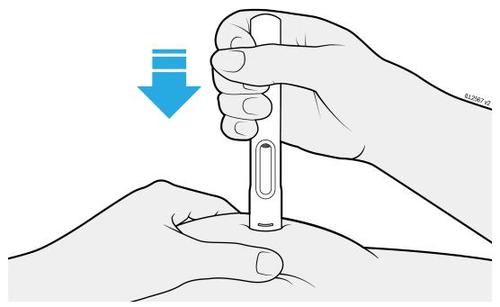
10Press the pre-filled pen firmly until the yellow safety device
stops moving.
Keep pressing the pre-filled pen; do not lift it.
- The needle will automatically insert and start the injection.
- You may hear or feel a click.
- Keep the pre-filled pen straight and firm against the skin.
OBSERVE
the window turns completely yellow
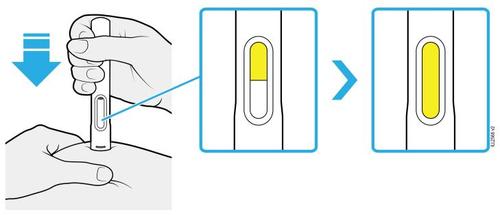
11Continue to press down on the pre-filled pen. Wait for the window to become
completely yellow.
- Completion of the injection may take up to 15seconds. You may hear or feel a click.
- When the window turns completely yellow, lift the pre-filled pen and remove it from the skin.
Check the injection site and dispose of the pre-filled pen
CONFIRM
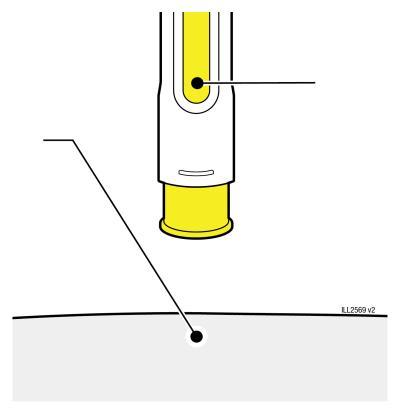
The window is completely yellow
No medicine leakage (a small drop is normal)
12Confirm that the entire dose of medicine has been injected.
- Donot touch the yellow safety device.
- A small amount of liquid on the injection site is normal.
Important:if the window has not turned completely yellow, if you feel that the delivery
of the medicine is still in progress or if you notice several drops of medicine, this indicates that you have
not received a complete dose. Contact the healthcare professional immediately.
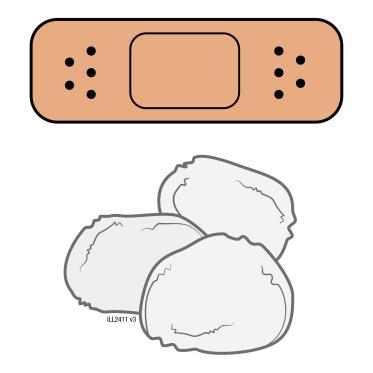
13Check the injection site.
- Do notrub the injection site.
- If blood comes out, apply pressure with a cotton ball or gauze.
- Apply a bandage if necessary.
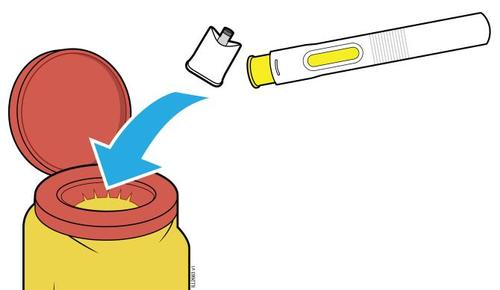
14Replace the used prefilled pen and the cap in the sharps disposal container.
Important:do not throw the prefilled pen in household waste.
- Do notreuse the prefilled pen.
- Do nottouch the yellow safety device.
The unused product remaining in the prefilled pen must be discarded. Do not throw any
medicine down the drain or in household waste. Ask your pharmacist how to dispose of
medicines you no longer use. This will help protect the environment.
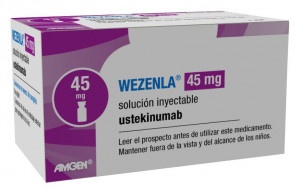
- Страна регистрации
- Форма выпускаInjectable solution, 45 mg
- Код АТХL04AC05
- Действующее вещество
- Отпускается по рецептуДа
- Производитель
- Информация на этой странице носит справочный характер и не является медицинской консультацией. Перед началом приема лекарства обязательно проконсультируйтесь с врачом.
- Аналоги WETSENLAФорма выпуска: Injectable solution in pre-filled syringe, 45 mgДействующее вещество: УстекинумабПроизводитель: ACCORD HEALTHCARE, S.L.U.Отпускается по рецептуФорма выпуска: Injectable solution in pre-filled syringe, 45 mgДействующее вещество: УстекинумабПроизводитель: FORMYCON AGОтпускается по рецептуФорма выпуска: Injectable solution in pre-filled syringe, 45 mgДействующее вещество: УстекинумабПроизводитель: ACCORD HEALTHCARE, S.L.U.Отпускается по рецепту
Аналоги WETSENLA в других странах
Лекарства с тем же действующим веществом, доступные в других странах.
Аналог WETSENLA в Испания
Получите рецепт на WETSENLA онлайн
Заполните форму за 2 минуты
Расскажите о симптомах, истории болезни и нужном препарате.
Выберите врача или мы назначим
Выберите специалиста или мы подберём ближайшего доступного врача.
Врач рассматривает ваш случай
Обычно в течение 30 минут. Может задать уточняющие вопросы в чате.
Получите в любой аптеке
Электронный рецепт отправляется на вашу почту — действителен по всей Польше.
Часто задаваемые вопросы
WETSENLA требует рецепта в Италия. Вы можете уточнить у врача онлайн, подходит ли это лекарство для вашей ситуации.
Действующее вещество WETSENLA — Устекинумаб. Эта информация помогает определить лекарства с тем же составом под другими торговыми названиями.
WETSENLA производится компанией AMGEN TECHNOLOGY (IRELAND) UC. Упаковка и торговое название могут отличаться в зависимости от дистрибьютора.
Врачи, включая Семейные врачи, Психиатры, Дерматологи, Кардиологи, Эндокринологи, Гастроэнтерологи, Пульмонологи, Нефрологи, Ревматологи, Гематологи, Инфекционисты, Аллергологи, Гериатры, Педиатры, Онкологи, могут оценить целесообразность применения WETSENLA с учетом вашей ситуации и местных правил. Вы можете записаться на онлайн-консультацию, чтобы обсудить возможные варианты.
Польша имеет хорошо развитую систему здравоохранения в крупных городах, таких как Варшава, Краков, Вроцлав и Гданьск. Аптеки широко доступны и работают в соответствии с действующим законодательством, обеспечивая доступ к рецептурным препаратам.
Вы можете купить WETSENLA в Варшаве, Кракове, Вроцлаве или Гданьске в любой аптеке при наличии действующего рецепта.
Чтобы получить рецепт, вы можете воспользоваться Oladoctor:
Другие лекарства с тем же действующим веществом (Устекинумаб) включают ABSIMKY, FYMSKINA, IMULDOSA. Они могут отличаться торговым названием или формой выпуска, но содержат одинаковый терапевтический компонент. Перед изменением лечения рекомендуется проконсультироваться с врачом.
