



UPTRAVI 200 MICROGRAMS Фильм-coated таблетки

Рассмотрение рецепта онлайн
Врач рассмотрит ваш случай и примет решение о назначении рецепта, если это медицински оправдано.

Поговорите с врачом об этом лекарстве
Обсудите симптомы и возможные дальнейшие шаги на онлайн-консультации.



Инструкция по применению UPTRAVI
Содержание инструкции
Uptravi 200 micrograms film-coated tablets, 400 micrograms film-coated tablets, 600 micrograms film-coated tablets, 800 micrograms film-coated tablets, 1,000 micrograms film-coated tablets, 1,200 micrograms film-coated tablets, 1,400 micrograms film-coated tablets
Uptravi 1,600 micrograms film-coated tablets
selexipag
Read this leaflet carefully before you start taking this medicine as it contains
important information for you.
- Keep this leaflet. You may need to read it again.
- If you have any questions, ask your doctor or nurse.
- This medicine has been prescribed for you only. Do not pass it on to others, even if they have the same symptoms as you, as it may be harmful.
- If you get any side effects, talk to your doctor or nurse (see section 4).
Contents of this leaflet
- 1. What Uptravi is and what it is used for
- 2. What you need to know before you take Uptravi
- 3. How to take Uptravi
- 4. Possible side effects
- 5. How to store Uptravi
- 6. Contents of the pack and other information
1. What is Uptravi and what it is used for
Uptravi is a medicine that contains the active substance selexipag. It acts on blood vessels in
a similar way to the natural substance prostacyclin, causing them to relax and widen.
Uptravi is used for the long-term treatment of pulmonary arterial hypertension (PAH)
in adult patients who are inadequately controlled with other types of medicines for PAH known
as endothelin receptor antagonists and phosphodiesterase type 5 inhibitors. Uptravi
can be used alone if the patient cannot take these medicines.
PAH is characterized by high pressure in the blood vessels that carry blood from the heart
to the lungs (pulmonary arteries). In people with PAH, these arteries narrow and therefore the
heart has to work harder to pump blood through them. This results in a feeling of fatigue,
dizziness, shortness of breath or other symptoms.
By acting in a similar way to the natural substance prostacyclin, this medicine widens the
pulmonary arteries and reduces their stiffness, making it easier for the heart to pump blood
through the pulmonary arteries. Uptravi reduces the pressure in the pulmonary arteries, relieves the symptoms
of PAH and slows the progression of the disease.
2. What you need to know before taking Uptravi
Do not take Uptravi:
- if you are allergic to selexipag or any of the other ingredients of this medicine (listed in section 6).
- if you have heart problems such as:
- insufficient blood flow to the heart (severe coronary artery disease or unstable angina); symptoms may include chest pain
- a heart attack in the last 6 months
- heart failure (congestive heart failure) that is not kept under strict medical supervision
- severely irregular heartbeat
- a defect in the heart valves (present from birth or acquired) that causes inadequate heart function (not caused by pulmonary hypertension)
- if you have had a stroke in the last 3 months, or any other event that has reduced the oxygen supply to the brain (for example, transient ischemic attack).
- if you are taking gemfibrozil (medicine used to lower the level of fats [lipids] in the blood)
Warnings and precautions
Talk to your doctor experienced in PAH or your nurse before taking Uptravi if:
- you are taking medicines for high blood pressure
- you have low blood pressure, associated with symptoms such as dizziness
- you have recently suffered from significant blood loss or fluid loss as happens with severe diarrhea or vomiting
- you have problems with your thyroid gland
- you have severe kidney problems or are undergoing dialysis
- you have or have had serious problems with the proper functioning of your liver
If you notice any of these signs or a change in your condition, tell your doctor immediately.
Children and adolescents
Do not give this medicine to children under 18 years of age, because Uptravi has not been tested in
children.
Elderly patients
There is limited experience with Uptravi in patients over 75 years of age. Uptravi should be
used with caution in this group of patients.
Other medicines and Uptravi
Tell your doctor if you are taking, have recently taken or might take any other
medicines.
Taking other medicines can change the way Uptravi works.
Tell your doctor or nurse if you are taking any of the following medicines:
- Gemfibrozil (medicine used to lower the level of fats [lipids] in the blood)
- Clopidogrel (medicine used to inhibit the formation of blood clots in coronary artery disease)
- Deferasirox (medicine used to remove iron from the bloodstream)
- Teriflunomide (medicine used to treat relapsing-remitting forms of multiple sclerosis)
- Carbamazepine (medicine used to treat certain forms of epilepsy, neuralgia or to help control severe mood disorders when other medicines do not work)
- Phenytoin (medicine used for epilepsy)
- Valproic acid (medicine used for epilepsy)
- Probenecid (medicine used for gout)
- Fluconazole, rifampicin or rifapentine (antibiotics used to treat infections)
Pregnancy and breastfeeding
The use of Uptravi is not recommended during pregnancy and breastfeeding. If you are a woman of
childbearing potential, you must use effective contraception during treatment with Uptravi. If you are
pregnant, suspect you may be pregnant, or are planning a pregnancy, or if you are breastfeeding
ask your doctor for advice before taking this medicine.
Driving and using machines
Uptravi can cause side effects such as headache and low blood pressure
(see section 4) that may affect your ability to drive; also, the symptoms of your
illness may make you less fit to drive.
3. How to take Uptravi
Uptravi can only be prescribed by a doctor with experience in the treatment of pulmonary arterial hypertension. Take this medicine following exactly the instructions of your doctor. If you have doubts or questions, consult your doctor. Inform your doctor if any undesirable effects occur, as they may recommend a modification of the Uptravi dose. Inform your doctor if you are taking other medicines, as they may recommend that you take Uptravi only once a day. If you have vision problems or experience any type of blindness, always have another person help you during the intake of Uptravi during the titration period (process of gradual dose increase).
How to find the right dose for you
At the beginning of treatment you will take the lowest dose, which consists of one 200 microgram tablet in the morning and another 200 microgram tablet in the evening, at an interval of approximately 12 hours. It is recommended to start treatment in the evening. The doctor will instruct you on how to gradually increase the dose. This procedure is called titration and allows the body to adapt to the new medicine. The goal of titration is to reach the most appropriate dose, i.e. the highest dose you can tolerate, which can reach a maximum dose of 1,600 micrograms in the morning and in the evening.
The first pack of tablets you receive will contain light yellow 200 microgram tablets.
The doctor will tell you to increase the dose in successive steps, usually every week, but the interval between dose increases may be longer.
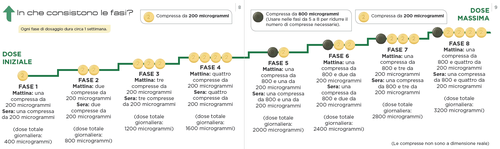
With each increase, you will need to add a 200 microgram tablet to the morning dose and another 200 microgram tablet to the evening dose. It is recommended to take the first increased dose in the evening.The diagram below shows the number of tablets to take each morningand each eveningfor the first 4 steps.
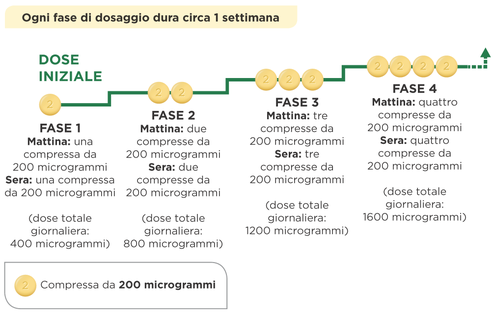
If the doctor tells you to increase the dose further, you will add a 200 microgram tablet to the morning dose and a 200 microgram tablet to the evening dose at each new step. It is recommended to take the first increased dose in the evening.
If the doctor gives you instructions to further increase the dose and move to phase 5, this can be done by taking one 800 microgram green tablet and one light yellow 200 microgram tablet in the morning, and one 800 microgram tablet and one 200 microgram tablet in the evening.
The maximum dose of Uptravi is 1,600 micrograms in the morning and 1,600 micrograms in the evening. However, not all patients will reach this dose, because different patients may need different doses.
The diagram below shows the number of tablets to take each morningand each eveningat each stage starting from phase 5.
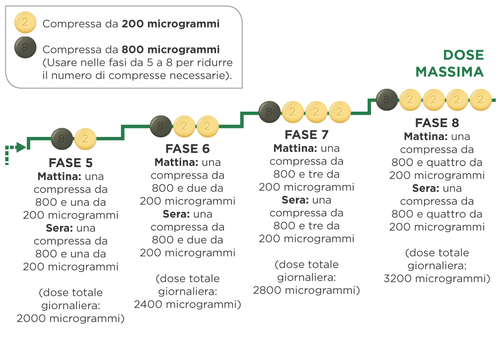
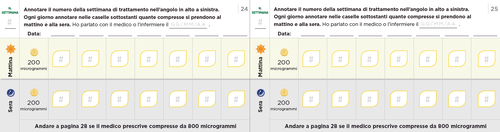
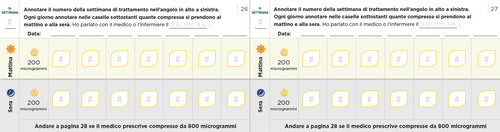
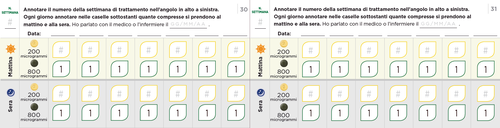
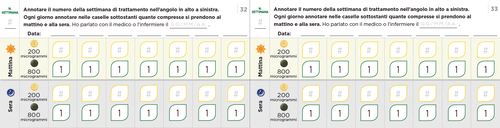
for the patient. The titration guide provides information on the titration process and allows you to record the number of tablets you take each day.
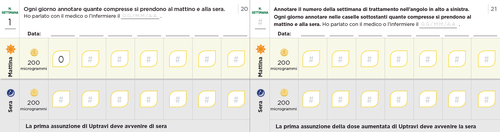
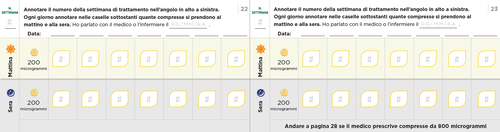
Remember to record the number of tablets you take each day in the titration diary. Titration steps usually last about 1 week. If the doctor tells you to extend each titration step for more than 1 week, some additional pages of the diary are available to allow you to keep track of it. Remember to talk to your PAH expert doctor or nurse regularly during titration.
Decreasing to a lower dose due to undesirable effects
During titration you may notice the onset of undesirable effects such as headache, diarrhea, feeling unwell (nausea), vomiting, jaw pain, muscle pain, leg pain, joint pain, or facial redness (see section 4). If you find these undesirable effects difficult to tolerate, consult your doctor about how to manage or treat them. Several treatments are available that can help relieve the undesirable effects. For example, pain relievers such as paracetamol may be useful in treating pain and headache.
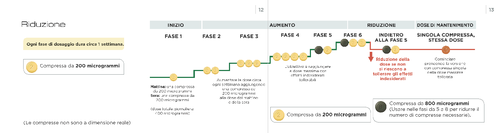
If these undesirable effects cannot be treated or do not gradually improve at the dose you are taking, the doctor may adjust the dose by removing one light yellow 200 microgram tablet from the morning administration and one light yellow 200 microgram tablet from the evening administration. The diagram below shows the steps to decrease the dose. Proceed as shown in the figure, only if indicated by the doctor.
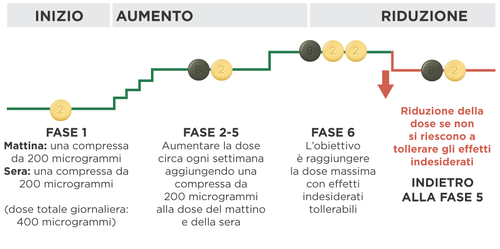
If, after decreasing the dose, the undesirable effects are manageable, the doctor may decide not to change the dose further. For more information, see the section below “Maintenance dose”.
Maintenance dose
The maximum tolerated dose during titration will become your maintenance dose. The maintenance dose is the dose you must continue to take regularly.
The doctor will prescribe you the tablet with the dosage suitable for your maintenance dose. This allows you to take one tablet in the morning and one in the evening, instead of taking multiple tablets at the same time.
For a complete description of the Uptravi tablets, specifying the colors and the marking, see paragraph 6 of this leaflet.
Over time, the doctor may decide to adjust the maintenance dose if necessary.
If, at any time, after taking the same dose for a long time, undesirable effects occur that you cannot tolerate or undesirable effects that affect normal daily activities, contact your doctor as it may be necessary to reduce the dose. The doctor may then prescribe you a single tablet with a lower dose. Remember to dispose of unused tablets correctly (see section 5).
Take Uptravi once in the morning and once in the evening, at an interval of approximately 12 hours.
Take the tablets with meals as you may tolerate the medicine better. The tablet coating provides protection. Swallow the tablet whole with a glass of water. Do not break, crush or chew the tablets.
If you take more Uptravi than you should
If you have taken more tablets than you were told to take, ask your doctor for advice.
If you forget to take Uptravi
If you forget to take Uptravi, take a dose as soon as you remember and then take the tablets at the usual times. If you are close to the time you have to take the next dose (within 6 hours before taking the dose normally scheduled), do not take the forgotten dose and continue to take the medicine at the scheduled time. Do not take a double dose to make up for the forgotten one.
If you stop taking Uptravi
An abrupt interruption of treatment with Uptravi may lead to a worsening of symptoms. Do not stop treatment with Uptravi unless it has been agreed with your doctor.
The doctor may tell you to gradually reduce the dose before stopping treatment completely.
If, for any reason, you stop taking Uptravi for more than 3 consecutive days (e.g. if you do not take the dose for 3 mornings and 3 evenings in a row or 6 consecutive doses or more), contact your doctor immediately as it may be necessary to adjust the dose to avoid undesirable effects. The doctor may decide to restart treatment at a lower dose, gradually increasing to the previous maintenance dose.
If you have any further questions about the use of this medicine, ask your doctor or nurse.
4. Possible side effects
Like all medicines, this medicine can cause side effects, although not everybody gets them.
You may notice some side effects not only during the titration period, when the dose is increased, but also
after taking the same dose for long periods of time.
If you experience any of these side effects: headache, diarrhoea, nausea, vomiting,
jaw pain, muscle pain, leg pain, joint pain or flushing of the face, that you cannot tolerate or that
cannot be treated, contact your doctor because the dose you are taking may be too high for you and
may need to be reduced. Very common side effects(may affect more than 1 in 10 people)
- Headache
- Flushing of the face
- Nausea and vomiting
- Diarrhoea
- Jaw pain, muscle pain, joint pain, leg pain
- Nasopharyngitis (nasal congestion)
Common side effects(may affect up to 1 in 10 people)
- Anemia (reduced number of red blood cells in the blood)
- Hyperthyroidism (overactivity of the thyroid gland)
- Decreased appetite
- Weight loss
- Hypotension (low blood pressure)
- Stomach pain, including dyspepsia
- Pain
- Changes in some blood test results, including the number of red blood cells or indicators of thyroid function
- Skin rashes, including urticaria, may cause a burning or stinging sensation and reddened skin
Uncommon side effects(may affect up to 1 in 100 people)
- Increased heart rate
Reporting of side effects
If you get any side effects, talk to your doctor or pharmacist. You can also report side effects directly
through the national reporting system listed in Annex V. By reporting side effects you can help provide
more information on the safety of this medicine.
5. Come conservare Uptravi
Keep this medicine out of the sight and reach of children.
Do not use Uptravi after the expiry date which is stated on the pack after “Scad.” and on the blister after
“EXP”.
The expiry date refers to the last day of the month indicated.
This medicine does not require any particular storage conditions.
No special instructions for disposal.
6. Contenuto della confezione e altre informazioni
Cosa contiene Uptravi
The active ingredient is selexipag.
Each 200 microgram Uptravi tablet, film-coated, contains 200 micrograms of
selexipag
Each 400 microgram Uptravi tablet, film-coated, contains 400 micrograms of
selexipag
Each 600 microgram Uptravi tablet, film-coated, contains 600 micrograms of
selexipag
Each 800 microgram Uptravi tablet, film-coated, contains 800 micrograms of
selexipag
Each 1,000 microgram Uptravi tablet, film-coated, contains 1,000 micrograms of
selexipag
Each 1,200 microgram Uptravi tablet, film-coated, contains 1,200 micrograms of
selexipag
Each 1,400 microgram Uptravi tablet, film-coated, contains 1,400 micrograms of
selexipag
Each 1,600 microgram Uptravi tablet, film-coated, contains 1,600 micrograms of
selexipag
The other ingredients are:
Tablet core
Mannitol (E421)
Corn starch
Low substitution hydroxypropylcellulose
Hydroxypropylcellulose,
Magnesium stearate
Coating
Hypromellose
Propylene glycol
Titanium dioxide (E171)
Iron oxides (E172)
Carnauba wax
Each 200 microgram Uptravi tablet, film-coated, contains yellow iron oxide
(E172).
Each 400 microgram Uptravi tablet, film-coated, contains red iron oxide
(E172).
Each 600 microgram Uptravi tablet, film-coated, contains red iron oxide and
black iron oxide (E172).
Each 800 microgram Uptravi tablet, film-coated, contains yellow iron oxide and
black iron oxide (E172).
Each 1,000 microgram Uptravi tablet, film-coated, contains red iron oxide and
yellow iron oxide (E172).
Each 1,200 microgram Uptravi tablet, film-coated, contains black iron oxide and
red iron oxide (E172).
Each 1,400 microgram Uptravi tablet, film-coated, contains yellow iron oxide
(E172).
Each 1,600 microgram Uptravi tablet, film-coated, contains black iron oxide,
red iron oxide and yellow iron oxide (E172).
Descrizione dell'aspetto di Uptravi e contenuto della confezione
Uptravi 200 microgrammifilm-coated tablets: Film-coated tablets of light yellow color, round, with "2" imprinted on one side.
Uptravi 400 microgrammifilm-coated tablets: Film-coated tablets of red color, round, with "4" imprinted on one side.
Uptravi 600 microgrammifilm-coated tablets: Film-coated tablets of light purple color, round, with "6" imprinted on one side.
Uptravi 800 microgrammifilm-coated tablets: Film-coated tablets of green color, round, with "8" imprinted on one side.
Uptravi 1.000 microgrammifilm-coated tablets: Film-coated tablets of orange color, round, with "10" imprinted on one side.
Uptravi 1.200 microgrammifilm-coated tablets: Film-coated tablets of dark purple color, round, with "12" imprinted on one side.
Uptravi 1.400 microgrammifilm-coated tablets: Film-coated tablets of dark yellow color, round, with "14" imprinted on one side.
Uptravi 1.600 microgrammifilm-coated tablets: Film-coated tablets of brown color, round, with "16" imprinted on one side.
Uptravi 200 microgram film-coated tablets are available in blisters of 10, 60 or
140 tablets (titration pack).
Uptravi 400 microgram, 600 microgram, 800 microgram,
- 1,000 microgram, 1,200 microgram, 1,400 microgram, and 1,600 microgram film-coated tablets are available in blisters of 60 tablets.
Not all pack sizes may be marketed.
Titolare dell'autorizzazione all'immissione in commercio
Janssen-Cilag International NV
Turnhoutseweg 30
B-2340 Beerse
Belgium
Produttore
Janssen Pharmaceutica NV
Turnhoutseweg 30
B-2340 Beerse
Belgium
For further information on this medicine, contact the local representative of the Marketing Authorisation Holder:
België/Belgique/Belgien
Janssen-Cilag NV
Tel/Tél: +32 14 64 94 11
[email protected]
Lietuva
UAB "JOHNSON & JOHNSON"
Tel: +370 5 278 68 88
[email protected]
България
„Джонсън & Джонсън България” ЕООД
Тел.: +359 2 489 94 00
[email protected]
Luxembourg/Luxemburg
Janssen-Cilag NV
Tél/Tel: +32 14 64 94 11
[email protected]
Česká republika
Janssen-Cilag s.r.o.
Tel: +420 227 012 227
Magyarország
Janssen-Cilag Kft.
Tel.: +36 1 884 2858
[email protected]
Danmark
Janssen-Cilag A/S
Tlf: +45 4594 8282
[email protected]
Malta
AM MANGION LTD
Tel: +356 2397 6000
Deutschland
Janssen-Cilag GmbH
Tel: +49 2137 955 955
[email protected]
Nederland
Janssen-Cilag B.V.
Tel: +31 76 711 1111
[email protected]
Eesti
UAB "JOHNSON & JOHNSON" Eesti filiaal
Tel: +372 617 7410
[email protected]
Norge
Janssen-Cilag AS
Tlf: +47 24 12 65 00
[email protected]
Ελλάδα
Janssen-Cilag Φαρμακευτική Α.Ε.Β.Ε.
Τηλ: +30 210 80 90 000
Österreich
Janssen-Cilag Pharma GmbH
Tel: +43 1 610 300
España
Janssen-Cilag, S.A.
Tel: +34 91 722 81 00
[email protected]
Polska
Janssen-Cilag Polska Sp. z o.o.
Tel.: +48 22 237 60 00
France
Janssen-Cilag
Tél: 0 800 25 50 75 / +33 1 55 00 40 03
[email protected]
Portugal
Janssen-Cilag Farmacêutica, Lda.
Tel: +351 214 368 600
Hrvatska
Johnson & Johnson S.E. d.o.o.
Tel: +385 1 6610 700
[email protected]
România
Johnson & Johnson România SRL
Tel: +40 21 207 1800
IrelandSlovenija
Johnson & Johnson d.o.o.
Tel: +386 1 401 18 00
[email protected]
ÍslandSlovenská republika
| Janssen Sciences Ireland UC | |
| Tel: +353 1 800 709 122 | |
| Janssen-Cilag AB | |
| c/o Vistor hf. | |
| Sími: +354 535 7000 | |
| [email protected] | |
| F Johnson & Johnson, s.r.o. | |
| Tel: +421 232 408 40 | 0 |
Italia
Janssen-Cilag SpA
Tel: 800.688.777 / +39 02 2510 1
[email protected]
Suomi/Finland
Janssen-Cilag Oy
Puh/Tel: +358 207 531 300
[email protected]
Κύπρος
Βαρνάβας Χατζηπαναγής Λτδ
Τηλ: +357 22 207 700
Sverige
Janssen-Cilag AB
Tfn: +46 8 626 50 00
[email protected]
Latvija
UAB "JOHNSON & JOHNSON" filiāle Latvijā
Tel: +371 678 93561
[email protected]
United Kingdom (Northern Ireland)
Janssen Sciences Ireland UC
Tel: +44 1 494 567 444
More detailed information on this medicine is available on the website of the European Medicines Agency: http://www.ema.europa.eu.
GUIDE TO TITRATION - TITRATION PACK
Page 1
Uptravi film-coated tablets
selexipag
Guide to gradual dose increase (titration)
Starting Treatment with Uptravi
Inform your doctor if you experience any side effects, as they may recommend a change
in your dose of Uptravi. Inform your doctor if you are taking other medicines, as they may
recommend that you take Uptravi only once a day.
Page 2Page 3
| Index How to take Uptravi? ....................................4 How to increase the dose? ..................................6 What do the phases consist of? ...........................................8 n When to decrease the dose? ..............................10 a Reduction (of the dose)..............................................12 | l e The transition to the maintenance d dose.....................14 If you forget to take Uptravi..............................16 a If you stop taking Uptravi .................17 Diary for titration.............................................18 |
Page 4Page 5
| a t How to take Uptravi? Uptravi is a medicine to be taken every morning I and every evening for the treatment of pulmonary arterial hypertension (PAH). a The initial dose of Uptravi is 200 micrograms, i one tablet in the morning and one in the evening. z The first dose must be taken in the evening. You should take each dose with a glass of n water, preferably with meals. e g | There are 2 phases of treatment with Uptravi: Titration In the first few weeks, you will work with your doctor to find the right dose of Uptravi for you. Your doctor may increase the initial dose to higher doses of Uptravi. Your doctor may decrease the dose of Uptravi. This process is called "titration" and allows the body to gradually adapt to the medicine. Maintenance Once your doctor has found the right dose for you, this will be the dose you need to take regularly. This dose is called the "maintenance dose". |
Page 6Page 7
Page 8Page 9
| How to increase the dose? You will start by taking a dose of 200 micrograms in the morning and in the evening and, only after discussing this with your doctor or nurse, you will increase the dose to the next one. The first dose of the increased dose must be taken in the evening. Each phase usually lasts about 1 week. It may take several weeks to find the right dose for you. The goal is to find the dose that is most suitable for you. This dose will be the maintenance dose. | o Each patient with PAH is different from others. c Not everyone will have the same maintenance dose. a Some patients may have a maintenance dose of 200 micrograms in the morning and in the m evening, while others will reach the maximum dose of 1,600 micrograms in the morning and in the evening. r Others may reach an intermediate maintenance dose. The goal is to find the dose that is most a suitable for you. F |
Page 10Page 11
l a ↓When to decrease the dose? t As with all medicines, side effects may occur with Uptravi as I you increase the dose. a Contact your doctor or nurse if you notice the onset of side effects. There are i various treatments that can help you relieve these effects. z n The most common side effects (affecting more than 1 in 10 people) that you may notice while taking Uptravi are: e
| If you cannot tolerate the side effects, even after treatment decided together with your doctor or nurse, they may recommend that you decrease the dose. If your doctor or nurse recommends that you decrease the dose, you should take one 200 microgram tablet less in the morning and one less in the evening. Reduce the dose only after consulting the PAH expert doctor or nurse. This process of decreasing the dose will help you find the right dose for you, i.e. the maintenance dose. |
Page 12Page 13
Page 14Page 15
| The transition to the maintenance dose The maximum dose tolerated during titration will become the maintenance dose. The maintenance dose is the dose you need to continue taking regularly. Your doctor or nurse may prescribe a single tablet corresponding to the dose needed for the maintenance dose. This allows you to take one tablet in the morning and one in the evening, instead of taking multiple tablets for each dose. | r a For example, if the maximum dose tolerated during F titration was 1,200 micrograms in the morning and in the evening: l e d Over time, your doctor or nurse may decide to adjust the maintenance dose as needed.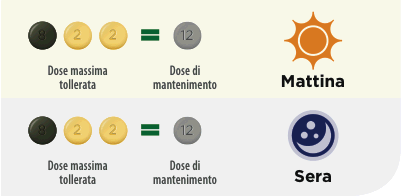 |
Page 16Page 17
| a i If you forget to take Uptravi l a If you forget a dose, take it as soon as you remember and then take the tablets at the usual t times. If this happens less than 6 hours before the I next dose normally scheduled, do not take the missed dose and continue to take the medicine at the scheduled time. a Do not take a double dose to make up for a missed one. i z n | If you stop taking Uptravi Do not stop taking Uptravi unless you have been told to do so by your doctor or nurse. If, for any reason, you stop taking Uptravi for more than 3 consecutive days (if you do not take 6 consecutive doses), immediately contact your IAP specialist doctor or nurse, as it may be necessary to adjust the dose to avoid unwanted effects. Your doctor or nurse may have you restart treatment at a lower dose, gradually increasing it to reach the previous maintenance dose. |
Page 18Page 19
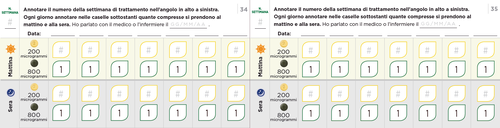
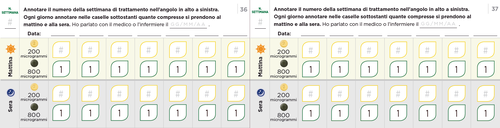
| Titration Diary Read the instructions contained in the package leaflet carefully. The following diary pages will help you keep track of the number of tablets you need to take in the morning and evening during titration. Use these pages to write the number of tablets you take in the morning and evening. Each phase usually lasts 1 week, unless otherwise indicated by your doctor or nurse. If titration phases last longer than 1 week, additional diary pages are available. Use pages 20 to 27 to record the first weeks of treatment with only 200 microgram tablets (phases 1-4). If you have been prescribed both 200 microgram and 800 microgram tablets, use pages 30 to 37 (phases 5-8). | o Remember to talk to your IAP specialist doctor or nurse regularly. c Write down the instructions provided by your doctor or a nurse here: m r Doctor's office phone number or email: F Pharmacist's phone number: l e Notes: d a |
Page 20Page 21
Page 22Page 23
Page 24Page 25
Page 26Page 27
Page 28Page 29
Use the following diary pages if your doctor or nurse prescribes 800 n microgram tablets together with 200 microgram tablets. a Using the diary, check that you i have taken an 800 microgram l tablet a every day in the morning and evening and write the t number of 200 microgram prescribed tablets. I a i | a Remember to talk to your IAP specialist doctor or nurse regularly. Write down the instructions provided by your doctor or nurse here: Doctor's office phone number or email: Pharmacist's phone number: Notes: |
Page 30Page 31
Page 32Page 33
Page 34Page 35
Page 36Page 37
Page 38Page 39
| a t Notes I a i z |
Page 40

Не уверены, подходит ли вам это лекарство?
Обсудите симптомы и варианты лечения с врачом онлайн.

Уже начали прием и появились вопросы?
Обсудите свое состояние и дальнейшие шаги с врачом онлайн.

- Страна регистрации
- Форма выпускаFilm-coated tablet, 200 MICROGRAMS
- Код АТХB01AC27
- Действующее вещество
- Отпускается по рецептуДа
- Производитель
- Информация на этой странице носит справочный характер и не является медицинской консультацией. Перед началом приема лекарства обязательно проконсультируйтесь с врачом.
- Аналоги UPTRAVIФорма выпуска: Enteric-coated tablet, 100 MGДействующее вещество: Ацетилсалициловая кислотаПроизводитель: AUROBINDO PHARMA (ITALIA) S.R.L.Отпускается по рецептуФорма выпуска: Enteric-coated tablet, 100 MGДействующее вещество: Ацетилсалициловая кислотаПроизводитель: DOC GENERICI SRLОтпускается по рецептуФорма выпуска: Enteric-coated tablet, 100 mgДействующее вещество: Ацетилсалициловая кислотаПроизводитель: KRKA D.D. NOVO MESTOОтпускается по рецепту
Аналоги UPTRAVI в других странах
Лекарства с тем же действующим веществом, доступные в других странах.
Аналог UPTRAVI в Испания
Врачи онлайн по UPTRAVI
Обсудите применение UPTRAVI и возможные следующие шаги — по оценке врача.









Получите рецепт на UPTRAVI онлайн
Заполните форму за 2 минуты
Расскажите о симптомах, истории болезни и нужном препарате.
Выберите врача или мы назначим
Выберите специалиста или мы подберём ближайшего доступного врача.
Врач рассматривает ваш случай
Обычно в течение 30 минут. Может задать уточняющие вопросы в чате.
Получите в любой аптеке
Электронный рецепт отправляется на вашу почту — действителен по всей Польше.
Часто задаваемые вопросы
UPTRAVI требует рецепта в Италия. Вы можете уточнить у врача онлайн, подходит ли это лекарство для вашей ситуации.
Действующее вещество UPTRAVI — Селексипаг. Эта информация помогает определить лекарства с тем же составом под другими торговыми названиями.
UPTRAVI производится компанией JANSSEN-CILAG INTERNATIONAL N.V.. Упаковка и торговое название могут отличаться в зависимости от дистрибьютора.
Врачи, включая Семейные врачи, Психиатры, Дерматологи, Кардиологи, Эндокринологи, Гастроэнтерологи, Пульмонологи, Нефрологи, Ревматологи, Гематологи, Инфекционисты, Аллергологи, Гериатры, Педиатры, Онкологи, могут оценить целесообразность применения UPTRAVI с учетом вашей ситуации и местных правил. Вы можете записаться на онлайн-консультацию, чтобы обсудить возможные варианты.
Польша имеет хорошо развитую систему здравоохранения в крупных городах, таких как Варшава, Краков, Вроцлав и Гданьск. Аптеки широко доступны и работают в соответствии с действующим законодательством, обеспечивая доступ к рецептурным препаратам.
Вы можете купить UPTRAVI в Варшаве, Кракове, Вроцлаве или Гданьске в любой аптеке при наличии действующего рецепта.
Чтобы получить рецепт, вы можете воспользоваться Oladoctor:
Другие лекарства с тем же действующим веществом (Селексипаг) включают AKIDO AKETILSALIKILIKO AUROBINDO, AKIDO AKETILSALIKILIKO DOK JENERIKI, AKIDO AKETILSALIKILIKO KRKA. Они могут отличаться торговым названием или формой выпуска, но содержат одинаковый терапевтический компонент. Перед изменением лечения рекомендуется проконсультироваться с врачом.
