



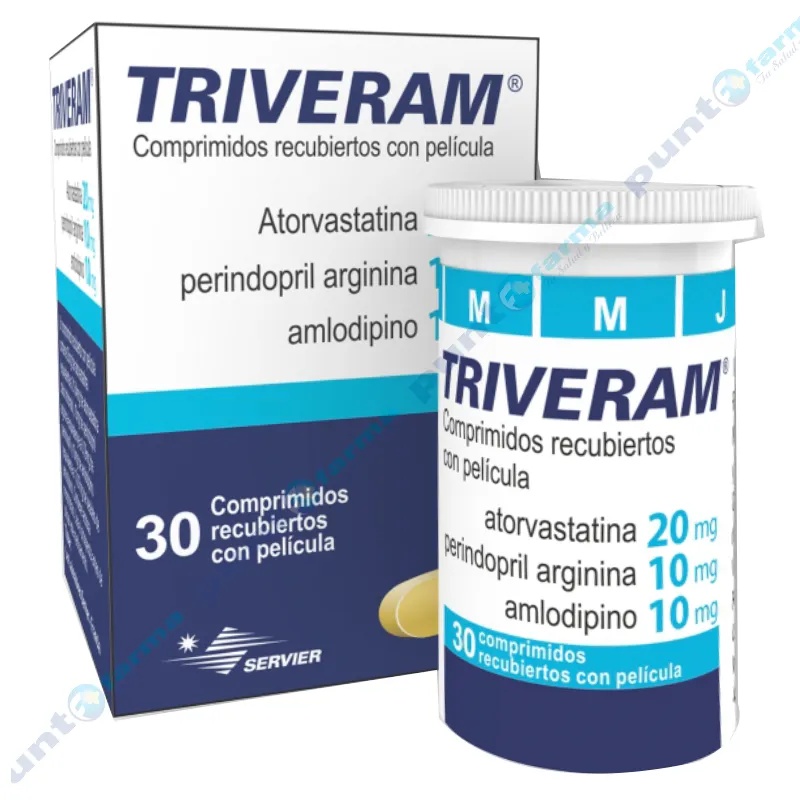
TRIVERAM 10 mg/5 mg /5 Mg Фильм-Coated Таблетки

Рассмотрение рецепта онлайн
Врач рассмотрит ваш случай и примет решение о назначении рецепта, если это медицински оправдано.

Поговорите с врачом об этом лекарстве
Обсудите симптомы и возможные дальнейшие шаги на онлайн-консультации.



Инструкция по применению TRIVERAM
Содержание инструкции
Triveram 10mg/5mg/5mg, film-coated tablets, 20mg/5mg/5mg, film-coated tablets, 20mg/10mg/5mg film-coated tablets, 20mg/10mg/10mg film-coated tablets, 40mg/10mg/10mg film-coated tablets
atorvastatin / perindopril arginine / amlodipine
Read this leaflet carefully before you start taking this medicine as it contains important
information for you.
- Keep this leaflet. You may need to read it again.
- If you have any questions, ask your doctor or pharmacist.
- This medicine has been prescribed for you only. Do not pass it on to others, even if their symptoms are the same as yours, as it could be harmful.
- If you get any side effects, even those not listed in this leaflet, tell your doctor or pharmacist. See section 4.
Contents of this leaflet:
- 1. What Triveram is and what it is used for
- 2. What you need to know before you take Triveram
- 3. How to take Triveram
- 4. Possible side effects
- 5. How to store Triveram
- 6. Contents of the pack and other information
1. What Triveram is and what it is used for
Triveram contains three active ingredients in one tablet: atorvastatin, perindopril arginine and
amlodipine.
Atorvastatin belongs to a group of medicines known as statins, which regulate lipid (fat) levels.
Perindopril arginine is an inhibitor of the angiotensin converting enzyme (ACE). In patients with
high blood pressure, it works by dilating blood vessels, making it easier for the heart to
pump blood.
Amlodipine belongs to a group of medicines defined as calcium antagonists. In patients with high
blood pressure, it works by relaxing blood vessels, making it easier for blood to pass
through them. In patients with angina (which causes chest pain), it works by improving blood flow
to the heart, which therefore receives more oxygen, resulting in the prevention of chest pain.
Triveram is indicated for the treatment of high blood pressure (hypertension) and/or for the treatment of stable coronary
disease (a condition in which the blood supply to the heart is reduced or blocked) in adults suffering from
one of the following conditions:
- high cholesterol levels (primary hypercholesterolemia), or
- high cholesterol and fat (triglyceride) levels (combined or mixed hyperlipidemia).
Triveram is indicated for patients who are already taking atorvastatin, perindopril arginine and amlodipine, but in
separate tablets. Instead of taking separate tablets of atorvastatin, perindopril arginine and
amlodipine, you will take one Triveram tablet containing the three active ingredients at the same dosage.
2. Cosa deve sapere prima di prendere Triveram
Non prenda Triveram:
- se è allergico all’atorvastatina o a qualunque altra statina, a perindopril o a qualunque altro ACE inibitore, oppure all’amlodipina o a qualunque altro calcio-antagonista, oppure ad uno qualsiasi degli altri componenti di questo medicinale (elencati al paragrafo 6),
- se ha una malattia che interessa il fegato,
- se i risultati dei test di funzionalità epatica hanno evidenziato valori inspiegabilmente alterati,
- se è affetto da pressione arteriosa bassa in modo grave (ipotensione),
- se presenta shock cardiogeno (condizione nella quale il cuore non è in grado di apportare all’organismo una quantità di sangue sufficiente),
- se presenta un blocco del flusso sanguigno dal ventricolo sinistro del cuore (per es. cardiomiopatia ipertrofica ostruttiva e un alto grado di stenosi aortica),
- se soffre di insufficienza cardiaca in seguito ad un attacco di cuore,
- se ha manifestato sintomi quali respiro affannoso, gonfiore del viso, della lingua o della gola, prurito intenso o gravi eruzioni cutanee correlabili ad un precedente trattamento con ACE inibitori o se lei o un suo familiare ha accusato tali sintomi in qualunque altra circostanza (disturbo chiamato angioedema),
- se soffre di diabete o la sua funzione renale è compromessa ed è in trattamento con un medicinale che abbassa la pressione del sangue, contenente aliskiren,
- se usa la combinazione glecaprevir/pibrentasvir nel trattamento dell’epatite C,
- se è sottoposto a dialisi, o a qualunque tipo di filtrazione ematica. A seconda del macchinario utilizzato, la terapia con Triveram potrebbe non essere indicata per lei,
- se ha problemi ai reni, per cui l’afflusso di sangue ai reni è ridotto (stenosi dell’arteria renale),
- se è in trattamento con sacubitril/valsartan, un medicinale un medicinale utilizzato per trattare l’insufficienza cardiaca (vedere “Avvertenze e precauzioni” e “Altri medicinali e Triveram”),
- se è in stato di gravidanza o sta pianificando una gravidanza, o se è una donna in età fertile e non utilizza un metodo affidabile di contraccezione,
- se sta allattando al seno.
Avvertenze e precauzioni
Si rivolga al medico o al farmacista prima di prendere Triveram se:
- ha problemi al fegato o una storia di malattia al fegato,
- ha problemi ai reni, da moderati a gravi,
- consuma regolarmente notevoli quantità di alcol,
- assume o ha assunto negli ultimi 7 giorni un medicinale chiamato acido fusidico (medicinale usato per il trattamento di infezioni batteriche) per via orale o iniezione. La combinazione di acido fusidico con Triveram può provocare gravi problemi muscolari (rabdomiolisi),
- ha avuto indolenzimento o dolori muscolari ripetuti o inspiegabili, una storia personale o familiare di problemi muscolari,
- lei o un suo parente stretto soffre di un problema muscolare che ricorrente in famiglia,
- ha avuto precedenti problemi muscolari durante il trattamento con altri medicinali che abbassano il livello dei grassi nel sangue (ipolipemizzanti), (per es., altri medicinali appartenenti alla classe delle statine o dei fibrati),
- ha una ghiandola tiroidea poco funzionante (ipotiroidismo),
- presenta una condizione o situazione che porta ad un aumento dei livelli di atorvastatina nel sangue,
- se durante il trattamento sta sviluppando i sintomi di una grave insufficienza respiratoria,
- ha il diabete (alti livelli di glucosio nel sangue),
- soffre di insufficienza cardiaca o qualunque altro problema al cuore,
- ha o ha avuto di recente un attacco di cuore,
- ha sofferto di recente di diarrea o vomito, oppure è disidratato,
- presenta una stenosi non grave della valvola aortica o mitralica (restringimento del principale vaso sanguigno che parte dal cuore o della valvola mitralica del cuore),
- ha problemi ai reni; ha subito recentemente un trapianto di rene oppure è sottoposto a dialisi,
- se ha un aumento anomalo dei livelli di un ormone chiamato aldosterone nel sangue (aldosteronismo primario),
- è anziano,
- presenta i sintomi di una grave reazione allergica quali gonfiore del viso, delle labbra, della lingua o della gola, con difficoltà a deglutire o a respirare (angioedema). Ciò può accadere in qualsiasi momento durante il trattamento. Se presenta tali sintomi, interrompa l’assunzione di Triveram e consulti un medico immediatamente,
- è di etnia nera, poiché lei può avere un più elevato rischio di sviluppare angioedema e questo medicinale potrebbe essere meno efficace nel ridurre la pressione sanguigna rispetto ai pazienti di etnia non nera,
- sta assumendo uno dei seguenti medicinali, aumenta il rischio di angioedema:
- racecadotril (utilizzato per il trattamento della diarrea),
- sirolimus, everolimus, temsirolimus e altri medicinali appartenenti alla classe dei cosiddetti inibitori di mTOR (utilizzati nella prevenzione del rigetto a seguito di trapianto di organi),
- sacubitril (disponibile come associazione a dose fissa con valsartan), utilizzato nel trattamento a lungo termine dell’insufficienza cardiaca,
- deve sottoporsi ad aferesi delle LDL (la depurazione del sangue dal colesterolo per mezzo di una apparecchiatura),
- deve effettuare un trattamento di desensibilizzazione per ridurre gli effetti di un’allergia alle punture di api o vespe,
- deve sottoporsi ad anestesia generale e/o ad un intervento chirurgico importante,
- soffre di una malattia vascolare del collagene (malattia del tessuto connettivo) come il lupus eritematoso sistemico o la sclerodermia,
- segue una dieta che prevede una limitazione nell’uso del sale o usa sostituti del sale contenenti potassio,
- il medico le ha riferito di avere un’intolleranza verso alcuni zuccheri,
- sta assumendo uno dei seguenti medicinali usati per trattare la pressione alta del sangue:
- un "bloccante del recettore dell’angiotensina II" (BRAII) (anche noti come sartani - per esempio valsartan, telmisartan, irbesartan), in particolare se soffre di problemi renali correlati al diabete.
- aliskiren.
Se una delle condizioni sopra riportate è applicabile al suo caso, consulti il medico prima o durante il
trattamento con Triveram.
Il medico potrebbe ritenere opportuno eseguire un esame del sangue durante il trattamento per controllare i
suoi muscoli (vedere il paragrafo 2 “Altri medicinali e Triveram”).
Inoltre, informi il medico o il farmacista se presenta una costante debolezza muscolare. Potrebbe essere
necessario eseguire ulteriori esami o assumere altri medicinali per diagnosticare e trattare questo disturbo.
Il medico potrà controllare la sua funzionalità renale, la pressione del sangue e la quantità di elettroliti (ad
es., il potassio) nel sangue, a intervalli regolari. Vedere anche le informazioni riportate alla voce "Non
prenda Triveram”.
Durante il trattamento con questo medicinale il medico controllerà attentamente che lei non abbia il diabete o
non sia a rischio di sviluppare il diabete. Si è a rischio di sviluppare il diabete se si hanno alti livelli di
zuccheri e grassi nel sangue, se si è in sovrappeso e si ha un’elevata pressione arteriosa.
Bambini e adolescenti
Triveram va evitato nei bambini e negli adolescenti di età inferiore ai 18 anni.
Altri medicinali e Triveram
Informi il medico o il farmacista se sta assumendo, ha recentemente assunto o potrebbe assumere qualsiasi
altro medicinale.
Alcuni medicinali possono modificare l’effetto di Triveram oppure l’effetto di tali medicinali può essere
modificato da Triveram. Questo tipo di interazione può ridurre l’effetto di uno o entrambi i medicinali. In
alternativa, può aumentare il rischio o la gravità degli effetti indesiderati, inclusa una condizione di
logoramento dei muscoli nota come rabdomiolisi, descritta al paragrafo 4. Si assicuri di informare il medico
se sta assumendo uno dei seguenti medicinali:
- immunosoppressori (medicinali in grado di deprimere i meccanismi di difesa dell’organismo) usati per il trattamento delle malattie autoimmuni o a seguito di un trapianto (per es., ciclosporina, tacrolimus),
- ketoconazolo, itraconazolo, voriconazolo, fluconazolo, posaconazolo (medicinali usati nel trattamento
delle infezioni fungine),
- rifampicina, eritromicina, claritromicina, telitromicina, acido fusidico*, trimetoprim (antibiotici usati nel trattamento di infezioni batteriche),
- colchicina (usata per il trattamento della gotta, una malattia che provoca dolore, gonfiore alle articolazioni a causa della formazione di cristalli di acido urico),
- altri medicinali usati per la regolazione dei livelli dei grassi (lipidi), per es., gemfibrozil, altri fibrati, colestipolo, ezetimibe,
- alcuni bloccanti dei canali del calcio utilizzati per l’angina o per la pressione alta, per es., diltiazem,
- medicinali usati per la regolazione del ritmo cardiaco, per es., digossina, verapamil, amiodarone,
- letermovir, un medicinale che consente di guarire dall’infezione da citomegalovirus,
- medicinali usati per il trattamento dell’HIV o malattie del fegato come l’epatite C, per es. delavirdina, efavirenz, ritonavir, lopinavir, atazanavir, indinavir, darunavir, telaprevir, boceprevir e la combinazione elbasvir/grazoprevir,
- warfarin (che riduce la formazione di coaguli nel sangue),
- contraccettivi orali,
- stiripentolo (un anticonvulsivante per l’epilessia),
- cimetidina (usato per bruciore di stomaco e ulcera peptica),
- fenazone (un antidolorifico),
- antiacidi (prodotti contro l’indigestione contenenti alluminio e magnesio),
- medicinali non soggetti a prescrizione medica: hypericum perforatumo Erba di S. Giovanni (trattamento a base di erbe utilizzato per la depressione),
- dantrolene (infusione per gravi anomalie della temperatura corporea),
- altri medicinali per il trattamento dell’ipertensione, incluso aliskiren, antagonisti del recettore dell'angiotensina II (BRAII) (per es., valsartan), (vedere anche quanto riportato alla voce “Non prenda Triveram” e “Avvertenze e precauzioni”),
- risparmiatori di potassio (per es., triamterene, amiloride, eplerenone, spironolattone), integratori di potassio o sostituti del sale contenenti potassio, altri farmaci che possono far aumentare i livelli di potassio nel sangue (come eparina e co-trimossazolo, noto anche come trimetoprim/sulfametossazolo).
- estramustina (usata nella terapia del cancro),
- litio usato per il trattamento di mania o depressione,
- medicinali utilizzati principalmente per il trattamento della diarrea (racecadotril) o per la prevenzione del rigetto a seguito di trapianto di organi (sirolimus, everolimus, temsirolimus e altri medicinali appartenenti alla classe dei cosiddetti inibitori di mTOR). Vedere paragrafo “Avvertenze e precauzioni”,
- sacubitril/valsartan (utilizzati nel trattamento a lungo termine dell’insufficienza cardiaca). Vedere quanto riportato alla voce “Non prenda Triveram” e “Avvertenze e precauzioni”,
- medicinali per il trattamento del diabete (quali insulina, metformina o gliptina),
- baclofene (usato nel trattamento della rigidità muscolare in patologie quali la sclerosi multipla),
- medicinali antinfiammatori non-steroidei (per es., ibuprofene) per il sollievo dal dolore o il trattamento delle infiammazioni (per es., in caso di artrite remautoide) o aspirina ad alte dosi,
- vasodilatatori, inclusi i nitrati (medicinali che dilatano i vasi sanguigni),
- medicinali per il trattamento dei disturbi mentali quali depressione, ansia, schizofrenia, ecc. (per es., antidepressivi triciclici, antipsicotici),
- medicinali usati per il trattamento della pressione bassa, shock o asma (per es., efedrina, noradrenalina o adrenalina),
- sali di oro, specialmente con somministrazione endovenosa (usati nel trattamento dei sintomi dell’artrite reumatoide),
- allopurinolo (per il trattamento della gotta),
- procainamide (per il trattamento del battito cardiaco irregolare).
*Se deve assumere acido fusidico per via orale per trattare un’infezione batterica, è necessario interrompere
temporaneamente l’assunzione di Triveram. Il medico stabilirà quando è possibile riprendere il trattamento
con Triveram in sicurezza. L’assunzione di Triveram con acido fusidico, può raramente provocare debolezza
muscolare, indolenzimento o dolore (rabdomiolisi). Per ulteriori informazioni riguardanti la rabdomiolisi,
vedere il paragrafo 4.
Triveram con cibi, bevande e alcol
È preferibile assumere Triveram prima del pasto.
Pompelmo e succo di pompelmo
Le persone che assumono Triveram non devono bere succo di pompelmo o mangiare pompelmo. Ciò in
quanto il pompelmo e il relativo succo possono indurre un aumento nel sangue dei livelli del principio attivo
amlodipina, che può determinare un incremento non prevedibile dell’effetto di riduzione della pressione di
Triveram.
Se sta assumendo Triveram, non deve bere più di uno o due piccoli bicchieri al giorno di succo di pompelmo
perché quantità elevate di succo di pompelmo porteranno ad un incremento dell’effetto del principio attivo
atorvastatina.
Alcol
Eviti di bere quantità troppo elevate di alcol mentre assume questo medicinale. Per ulteriori dettagli vedere il
paragrafo 2 “Avvertenze e precauzioni”.
Gravidanza e allattamento
Se è in corso una gravidanza, se sospetta o sta pianificando una gravidanza, o se sta allattando con latte
materno chieda consiglio al medico o al farmacista prima di prendere questo medicinale.
Questo medicinale non deve essere assunto in gravidanza.
Non assuma Triveram se è in corso una gravidanza o se sta pianificando una gravidanza o se vi è la
possibilità di dare inizio ad una gravidanza, a meno che non usi un efficace metodo di contraccezione
(vedere “Non prenda Triveram”).
Non assuma Triveram se sta allattando al seno. Informi immediatamente il medico se sta allattando o se sta
per iniziare l'allattamento al seno.
Driving and operating machinery
Triveram may cause dizziness, headache, fatigue or nausea. If you experience these symptoms, your
ability to drive or operate machinery may be impaired, especially at the beginning of treatment.
Triveram contains lactose
If your doctor has diagnosed you with intolerance to certain sugars, contact them before taking this
medicine.
Triveram contains sodium
Triveram contains less than 1 mmol of sodium (23mg) per tablet, i.e. it is essentially "sodium-free".
3. How to take Triveram
Take this medicine following exactly the instructions of your doctor or pharmacist. If you have
any doubts, consult your doctor or pharmacist.
The recommended dose is one tablet a day. The tablet must be swallowed with a glass
of water, preferably every day at the same time, in the morning before a meal.
Use in children and adolescents
Triveram should be avoided for use in children and adolescents under the age of 18 years.
If you take more Triveramthan you should
If you have taken more tablets than prescribed, go immediately to the nearest emergency room or
consult your doctor. If you take an excessive number of tablets, your blood pressure may drop, even
excessively, and this could be dangerous. This may cause you dizziness, lightheadedness,
weakness or fainting. In these cases, it may be helpful to lie down with your legs raised. The
blood pressure drop may be so severe as to cause you to go into shock. Your skin may become cold and
clammy and you may lose consciousness.
If you forget to take Triveram
It is important to take the medicine every day as regular treatment is more effective. However, if
you forget to take a dose of Triveram, take the next dose as usual.
Do not take a double dose to make up for a missed dose.
If you stop taking Triveram
Since treatment with Triveram for hypertension is usually lifelong, you should talk to your doctor before
stopping taking this medicine.
If you have any further questions on the use of this medicine, ask your doctor or pharmacist.
4. Possible side effects
Like all medicines, this medicine can cause side effects, although not everybody gets them.
manifest them.
If any of the following side effects occur or symptoms which may be serious, stop taking this medicine and inform your doctor immediately:
swelling of eyelids, face, lips, mouth, tongue or throat, difficulty breathing (angioedema) (see section 2 “Warnings and precautions”),
severe skin reactions including intense rash, urticaria, redness of the skin all over the
body, severe itching, blisters, peeling and swelling of the skin, inflammation of the mucous
membranes (Stevens Johnson syndrome, Toxic Epidermal Necrolysis) or other allergic reactions,
muscle weakness, soreness, pain, muscle tearing or reddish-brown
discoloration of the urine, especially if at the same time you do not feel well and have a high fever, this may be
due to abnormal muscle deterioration which can be life-threatening and can lead to
kidney problems,
weakness in the arms or legs, difficulty speaking which may be a sign of a possible
cerebral haemorrhage (stroke),
severe dizziness, due to low blood pressure or fainting,
unusually fast or irregular heartbeat,
chest pain (angina) or heart attack,
sudden shortness of breath, chest pain, wheezing, or difficulty breathing
(bronchospasm),
inflammation of the pancreas which can cause severe abdominal and back pain, combined with
a feeling of severe malaise,
if unexpected or unusual bleeding or bruising occurs, this may be indicative of a
liver disease,
yellowing of the skin or eyes (jaundice) which may be a sign of hepatitis,
rash which often starts with itchy red spots on the face, arms or legs
(erythema multiforme).
lupus-like syndrome (skin rashes, joint disorders and effects on blood cells).
Tell your doctor if you experience any of the following side effects:
Very common(may affect more than 1 in 10 people)
- edema (fluid retention).
Common(may affect up to 1 in 10 people):
nasal passage inflammation, sore throat, nosebleeds
allergic reactions (such as skin rashes, itching)
increased blood sugar levels (if you have diabetes, you should continue to monitor your blood sugar levels regularly), increased creatine kinase in the blood
headache, dizziness, vertigo, pins and needles sensation, feeling tired
vision impairment, double vision
tinnitus (sensation of noise or ringing in the ears)
cough, shortness of breath (dyspnea)
gastrointestinal disorders: feeling unwell (nausea), feeling sick (vomiting), constipation,
flatulence, indigestion, altered bowel habits, diarrhea, abdominal pain, altered taste,
dyspepsia
joint pain, muscle pain, muscle spasms and back pain
fatigue, weakness
swelling of the ankles, palpitations (awareness of your heartbeat), hot flushes
laboratory test results showing abnormal liver function.
Uncommon(may affect up to 1 in 100 people):
anorexia (loss of appetite), increased or decreased body weight
nightmares, insomnia, sleep disorders, drowsiness, altered mood, anxiety, depression
reduced sensitivity or tingling in the fingers of the hands and feet or limbs, reduced sensitivity to pain or
touch, memory loss
blurred vision
sneezing/runny nose due to inflammation of the nasal mucosa (rhinitis)
belching, dry mouth
intense itching or severe skin rashes, red spots on the skin, skin discoloration, formation of
blisters on the skin, urticaria, photosensitivity reaction (increased sensitivity of the skin to
sun), hair loss
kidney problems, problems with passing urine, increased need to urinate at night, increased
frequency of urination
inability to get an erection, impotence, discomfort or enlargement of the breasts in men
neck pain, muscle fatigue
feeling unwell, tremor, fainting, falls, chest pain, malaise, increased body
temperature (fever), increased sweating, pain
tachycardia (fast heartbeat), vasculitis (inflammation of blood vessels)
excess of eosinophils (a type of white blood cells)
urine tests that are positive for white blood cells
changes in laboratory values: high potassium levels in the blood that return to normal after
stopping therapy, low sodium levels, hypoglycemia (very low blood sugar levels)
in diabetic patients, increased urea in the blood and increased creatinine in the blood.
Rare(may affect up to 1 in 1,000 people):
worsening of psoriasis
confusion
unexpected bleeding or bruising
cholestasis (yellowing of the skin and whites of the eyes)
tendon damage
changes in laboratory values: increased levels of liver enzymes, high levels of serum bilirubin
nerve diseases that can cause weakness, tingling or numbness.
Very rare(may affect up to 1 in 10,000 people):
eosinophilic pneumonia (a rare type of pneumonia)
hearing loss
increased muscle tension
swelling of the gums
acute kidney failure
abdominal swelling (gastritis)
abnormal liver function, yellowing of the skin (jaundice), increased liver enzymes which
can lead to changes in some clinical tests
changes in blood values, such as decreased number of white blood cells and red blood cells, decreased
hemoglobin, decreased number of platelets in the blood which can determine unusual
bruising or ease of bleeding (damage to red blood cells), disease due to destruction
of red blood cells.
Frequency not known
persistent muscle weakness
tremor, rigid posture, lack of facial expression, slow movements and unbalanced gait,
dragging the feet
Abnormal color, numbness and pain in the fingers of the hands or feet (Raynaud's phenomenon)
With the use of ACE inhibitors, highly concentrated urine (dark in color), feeling or
state of malaise, muscle cramps, confusion and convulsions may occur, probably due to inappropriate
secretion of ADH (antidiuretic hormone). If you experience these symptoms, seek medical attention immediately.
Reporting of side effects
If you get any side effects, talk to your doctor or pharmacist. This includes any side effects not listed in this leaflet. You can also report side effects directly through the national reporting system at https://www.aifa.gov.it/content/segnalazioni-reazioni-avverse .
By reporting side effects you can help provide more information on the safety of
this medicine.
5. How to store Triveram
Keep this medicine out of the sight and reach of children.
Do not use this medicine after the expiry date which is stated on the package and on the blister pack after Exp.
For the high-density polyethylene container containing 100 film-coated tablets, the expiry date after
first opening is 100 days.
The expiry date refers to the last day of that month.
Keep the container tightly closed to protect the medicine from moisture.
For all dosages lower than 40/10/10 mg in 100-tablet containers: no special storage conditions.
For the 40/10/10 mg dosage in 100-tablet containers: store at a temperature below 30°C.
Do not dispose of any medicine in wastewater or household waste. Ask your pharmacist how to dispose of
medicines you no longer use. This will help protect the environment
6. Package contents and other information
What Triveram contains
- The active ingredients are atorvastatin, perindopril arginine and amlodipine.
- Each tablet of Triveram 10/5/5 mg contains 10.82 mg of atorvastatin calcium trihydrate equivalent to 10 mg of atorvastatin, 5 mg of perindopril arginine equivalent to 3.40 mg of perindopril and 6.94 mg of amlodipine besilate equivalent to 5 mg of amlodipine
- Each tablet of Triveram 20/5/5 mg contains 21.64 mg of atorvastatin calcium trihydrate equivalent to 20 mg of atorvastatin, 5 mg of perindopril arginine equivalent to 3.40 mg of perindopril and 6.94 mg of amlodipine besilate equivalent to 5 mg of amlodipine
- Each tablet of Triveram 20/10/5 mg contains 21.64 mg of atorvastatin calcium trihydrate equivalent to 20 mg of atorvastatin, 10 mg of perindopril arginine equivalent to 6.79 mg of perindopril and 6.94 mg of amlodipine besilate equivalent to 5 mg of amlodipine
- Each tablet of Triveram 20/10/10 mg contains 21.64 mg of atorvastatin calcium trihydrate equivalent to 20 mg of atorvastatin, 10 mg of perindopril arginine equivalent to 6.79 mg of perindopril and 13.87 mg of amlodipine besilate equivalent to 10 mg of amlodipine
- Each tablet of Triveram 40/10/10 mg contains 43.28 mg of atorvastatin calcium trihydrate equivalent to 40 mg of atorvastatin, 10 mg of perindopril arginine equivalent to 6.79 mg of perindopril and 13.87 mg of amlodipine besilate equivalent to 10 mg of amlodipine.
- The other ingredients are:
- tablet core: lactose monohydrate, calcium carbonate (E170), hydroxypropylcellulose (E463), sodium starch glycolate (type A), microcrystalline cellulose (E460), maltodextrin, magnesium stearate (E572).
- film coating: glycerol (E422), hypromellose (E464), macrogol 6000, magnesium stearate (E572), titanium dioxide (E171), yellow iron oxide (E172).
Description of the appearance of Triveram and contents of the pack
The film-coated tablets of Triveram 10/5/5 mg are yellow in colour, round with a diameter of 7
mm, a radius of curvature of 25 mm, with engraved “ ” on one side and on the other.
The film-coated tablets of Triveram 20/5/5 mg are yellow in colour, round with a diameter of 8.8
mm, a radius of curvature of 32 mm, with engraved “ ” on one side and on the other.
The film-coated tablets of Triveram 20/10/5 mg are yellow in colour, square in shape with a length of 9 mm
, a radius of curvature of 16 mm, with engraved “ ” on one side and on the other.
The film-coated tablets of Triveram 20/10/10 mg are yellow in colour, oblong in shape with a length of 12.7 mm
and a width of 6.35 mm, with engraved “ ” on one side and on the other.
The film-coated tablets of Triveram 40/10/10 mg are yellow in colour, oblong in shape with a length of 16 mm
and a width of 8 mm, with engraved “ ” on one side and on the other.
The tablets are available in containers of 10 (available only for the 10 mg/5 mg/5mg dosage), 28, 30
and 100 tablets. A pack of 84 tablets (3 containers of 28 tablets) and 90 tablets (3 containers of 30 tablets) is also available.
10, 28, 30 film-coated tablets in a sealed container with a cap. The cap contains a
desiccant.
100 film-coated tablets in a container with a screw cap. The screw cap contains a
desiccant. There are 1-4 desiccant capsules in the container.
The desiccant capsules must not be removed or ingested.
Not all pack sizes may be marketed.
Marketing Authorisation Holder and Manufacturers
Marketing Authorisation Holder
Les Laboratoires Servier
50, rue Carnot
92284 Suresnes cedex
France
Manufacturers
Les Laboratoires Servier Industrie
905, route de Saran
45520 Gidy
France


and
Servier (Ireland) Industries Ltd (SII)
Moneylands - Gorey Road – Arklow
Co. Wicklow – Ireland
Anpharm Przedsiebiorstwo Farmaceutyczne S.A.
ul. Annopol 6b
03-236 Warszawa
Poland
and
EGIS Pharmaceuticals Private Limited Company
Mátyás király u.65
H-9900 Körmend,
Hungary
This medicinal product is authorised in the Member States of the European Economic Area under the following
names:
Austria Triveram
Belgium Lipertance
Bulgaria Lipertance
Croatia Lipertance
Czech Republic Lipertance
Cyprus Triveram
Estonia Triveram
Finland Triveram
France Triveram
Germany Triveram
Greece Triveram
Ireland Lipertance
Italy Triveram
Latvia Triveram
Lithuania Triveram
Luxembourg Lipertance
Malta Triveram
Netherlands Triveram
Poland Triveram
Portugal Triveram
Romania Lipertance
Slovakia Lipertance
Slovenia Statriam

Не уверены, подходит ли вам это лекарство?
Обсудите симптомы и варианты лечения с врачом онлайн.

Уже начали прием и появились вопросы?
Обсудите свое состояние и дальнейшие шаги с врачом онлайн.
- Страна регистрации
- Форма выпускаFilm-coated tablet, 10MG/5MG/5MG
- Код АТХC10BX11
- Действующее вещество
- Отпускается по рецептуДа
- Производитель
- Информация на этой странице носит справочный характер и не является медицинской консультацией. Перед началом приема лекарства обязательно проконсультируйтесь с врачом.
- Аналоги TRIVERAMФорма выпуска: Hard capsule, 5MG/100MGДействующее вещество: rosuvastatin and acetylsalicylic acidПроизводитель: ADAMED S.R.L.Отпускается по рецептуФорма выпуска: Hard capsule, 10 MG/5 MGДействующее вещество: rosuvastatin and ramiprilПроизводитель: SANDOZ S.P.A.Отпускается по рецептуФорма выпуска: Hard capsule, 10 MG/5 MGДействующее вещество: rosuvastatin and amlodipineПроизводитель: SCHARPER S.P.A.Отпускается по рецепту
Аналоги TRIVERAM в других странах
Лекарства с тем же действующим веществом, доступные в других странах.
Аналог TRIVERAM в Польша
Аналог TRIVERAM в Испания
Врачи онлайн по TRIVERAM
Обсудите применение TRIVERAM и возможные следующие шаги — по оценке врача.
Получите рецепт на TRIVERAM онлайн
Заполните форму за 2 минуты
Расскажите о симптомах, истории болезни и нужном препарате.
Выберите врача или мы назначим
Выберите специалиста или мы подберём ближайшего доступного врача.
Врач рассматривает ваш случай
Обычно в течение 30 минут. Может задать уточняющие вопросы в чате.
Получите в любой аптеке
Электронный рецепт отправляется на вашу почту — действителен по всей Польше.
Часто задаваемые вопросы
TRIVERAM требует рецепта в Италия. Вы можете уточнить у врача онлайн, подходит ли это лекарство для вашей ситуации.
Действующее вещество TRIVERAM — atorvastatin, amlodipine and perindopril. Эта информация помогает определить лекарства с тем же составом под другими торговыми названиями.
TRIVERAM производится компанией LES LABORATOIRES SERVIER. Упаковка и торговое название могут отличаться в зависимости от дистрибьютора.
Врачи, включая Семейные врачи, Психиатры, Дерматологи, Кардиологи, Эндокринологи, Гастроэнтерологи, Пульмонологи, Нефрологи, Ревматологи, Гематологи, Инфекционисты, Аллергологи, Гериатры, Педиатры, Онкологи, могут оценить целесообразность применения TRIVERAM с учетом вашей ситуации и местных правил. Вы можете записаться на онлайн-консультацию, чтобы обсудить возможные варианты.
Польша имеет хорошо развитую систему здравоохранения в крупных городах, таких как Варшава, Краков, Вроцлав и Гданьск. Аптеки широко доступны и работают в соответствии с действующим законодательством, обеспечивая доступ к рецептурным препаратам.
Вы можете купить TRIVERAM в Варшаве, Кракове, Вроцлаве или Гданьске в любой аптеке при наличии действующего рецепта.
Чтобы получить рецепт, вы можете воспользоваться Oladoctor:
Другие лекарства с тем же действующим веществом (atorvastatin, amlodipine and perindopril) включают ASADROX, ASURAMI, KOAREDAM. Они могут отличаться торговым названием или формой выпуска, но содержат одинаковый терапевтический компонент. Перед изменением лечения рекомендуется проконсультироваться с врачом.
