



TOUJEO 100 IU/ML Инъекционный раствор

Рассмотрение рецепта онлайн
Врач рассмотрит ваш случай и примет решение о назначении рецепта, если это медицински оправдано.

Поговорите с врачом об этом лекарстве
Обсудите симптомы и возможные дальнейшие шаги на онлайн-консультации.



Инструкция по применению TOUJEO
Содержание инструкции
- Toujeo 300 units/ml SoloStar injectable solution in a pre-filled pen
- Toujeo 300 units/ml DoubleStar injectable solution in a pre-filled pen
Toujeo 300 units/ml SoloStar injectable solution in a pre-filled pen
Insulin glargine
Each SoloStar pen delivers 1-80 units in 1-unit increments
Read this leaflet carefully before you start to use this medicine as it contains important
information for you.
- Keep this leaflet. You may need to read it again.
- If you have any questions, ask your doctor, pharmacist or nurse.
- This medicine has been prescribed for you only. Do not pass it on to others, even if they have the same symptoms as you, as it may be harmful.
- If you get any side effects, even those not listed in this leaflet, tell your doctor or pharmacist. See section 4.
Contents of this leaflet:
- 1. What Toujeo is and what it is used for
- 2. What you need to know before you use Toujeo
- 3. How to use Toujeo
- 4. Possible side effects
- 5. How to store Toujeo
- 6. Contents of the pack and other information
1. What is Toujeo and what it is used for
Toujeo contains insulin called “insulin glargine”. This is a modified insulin, very similar
to human insulin.
Toujeo contains 3 times more insulin in 1 ml than standard insulin, which contains 100 units/ml.
Toujeo is used to treat diabetes mellitus in adults, adolescents and children from the age of 6 years. Diabetes
mellitus is a disease in which the body does not produce enough insulin to control
blood sugar levels.
Toujeo steadily reduces blood sugar levels for a long period of time. It is used
with once-daily administration. If necessary, the time of injection can be
modified, as this medicine lowers blood sugar levels for a long
period of time (for more information see paragraph 3).
2. What you need to know before using Toujeo
Do not use Toujeo
- if you are allergic to insulin glargine or any of the other ingredients of this medicine (listed in section 6).
Warnings and precautions
Talk to your doctor, pharmacist or nurse before using Toujeo.
Follow the instructions carefully regarding the dose, checks to be performed (blood and urine tests), diet and physical activity (physical work and exercise) and injection technique, as discussed
with your doctor.
Pay particular attention to the following aspects:
- Blood sugar level too low (hypoglycemia). If your blood sugar level is too low, follow the advice for hypoglycemia (see the information in the box at the end of the leaflet).
- If you switch to this product from another type, brand or manufacturer of insulin, you may need to adjust your insulin dose.
- Pioglitazone. See “Pioglitazone used with insulin”.
- Make sure you are using the correct insulin. Therapeutic errors have been reported due to confusion between insulins, particularly between long-acting and short-acting insulins. Always check the insulin label before each injection to avoid exchanging Toujeo with other insulins.
- Never use a syringe to draw Toujeo from the SoloStar prefilled pen. This is to avoid dosing errors and potential overdoses that can lead to low blood sugar levels. See also section 3.
- If you are blind or have severely impaired vision, do not use the prefilled pen without assistance, as you will not be able to read the dosage window on the pen. Get help from a person with good vision who is trained to use the pen. If you are blind or have severely impaired vision, see section 3.
Skin changes at the injection site:
The injection site must be rotated to prevent skin changes, such as the appearance of
lumps under the skin. Insulin may not work as well as it should if you inject it into
an area with lumps (see section How to use Toujeo). If you are currently injecting into
an area with lumps, talk to your doctor before starting to inject into another area. Your
doctor may advise you to check your blood sugar more carefully and adjust your insulin or
other antidiabetic medicines.
Illness and injury
In the following situations, diabetes control may require special attention (e.g.
blood and urine tests):
- if you are ill or have had a major injury. Your blood sugar may increase (hyperglycemia),
- if you are not eating enough. There is a risk that your blood sugar level may become too low (hypoglycemia). In most cases, you will consult a doctor. See a doctor as soon as you become ill or suffer an injury.
If you have “type 1” diabetes and have an illness or injury:
- do not stop taking insulin,
- continue to eat a sufficient amount of carbohydrates. Always inform those who care for you or who are responsible for your treatment that you have diabetes.
Treatment with insulin can cause the formation of anti-insulin antibodies (substances that act
against insulin). However, this will only rarely require a change in your insulin dosage.
Travel
Tell your doctor before you travel. You may need to discuss:
- whether your type of insulin is available in the destination country,
- how to organize your insulin, needles and other supplies,
- how to store insulin correctly during travel,
- meal times and insulin use,
- possible effects of changing time zones,
- potential health risks in the countries you visit,
- what to do in emergency situations if you feel unwell or become ill.
Children and adolescents
This medicine should not be used in children under 6 years of age. There is no
experience with Toujeo in patients in this age group.
Other medicines and Toujeo
Tell your doctor, pharmacist or nurse if you are taking, have recently taken or might
take any other medicines.
Some medicines can change your blood sugar level. This means that your insulin dose may need to be adjusted. Therefore, before taking a medicine, ask your doctor if
this may affect your blood sugar and whether you need to take any countermeasures, and what they are. You
should also be careful when stopping a medicine.
Your blood sugar level may decrease (hypoglycemia) if you take:
- any other medicine to treat diabetes,
- disopyramide, for some heart problems,
- fluoxetine, for depression,
- sulfonamide antibiotics,
- fibrates, to lower high levels of fats in the blood,
- monoamine oxidase inhibitors (MAOIs), to treat depression,
- angiotensin converting enzyme (ACE) inhibitors, for heart problems or high blood pressure,
- medicines to relieve pain and lower fever, such as pentoxifylline, propoxyphene and salicylates (such as acetylsalicylic acid),
- pentamidine, for some parasitic infections. It may cause an excessive decrease in blood sugar, sometimes followed by too high blood sugar.
Your blood sugar level may increase (hyperglycemia) if you take:
- corticosteroids such as cortisone, to treat inflammation,
- danazol, to treat endometriosis,
- diazoxide, for high blood pressure,
- protease inhibitors, for HIV,
- diuretics, for high blood pressure or fluid retention,
- glucagon, for very low blood sugar,
- isoniazid, for tuberculosis,
- somatropin, a growth hormone,
- thyroid hormones, for thyroid problems,
- estrogens and progestins, such as in the birth control pill used for contraception,
- clozapine, olanzapine and phenothiazine derivatives, for mental problems,
- sympathomimetic medicines, such as adrenaline, salbutamol and terbutaline, for asthma.
Your blood sugar level may decrease or increase if you take:
- beta-blockers or clonidine, for high blood pressure,
- lithium salts, for mental health problems.
Beta-blockers
Beta-blockers, like other “sympatholytic” medicines (such as clonidine, guanethidine,
reserpine, for high blood pressure) can make it harder to recognize the warning signs
of low blood sugar (hypoglycemia). They can even mask or block the first signs that indicate that your blood sugar is too low.
Pioglitazone used with insulin
Some patients with long-standing type 2 diabetes mellitus and heart disease or with a previous
stroke treated with pioglitazone and insulin have developed heart failure. Tell your doctor as
soon as possible if you experience signs of heart failure such as unusually short breath, rapid
weight gain or localized swelling (edema).
If any of these situations apply to you or if you are unsure, discuss it with your doctor, pharmacist or nurse before using Toujeo.
Toujeo and alcohol
Blood sugar levels may increase or decrease if you drink alcohol. You should check your blood sugar more frequently than usual.
Pregnancy and breastfeeding
If you are pregnant or breastfeeding, if you suspect you are pregnant or are planning to become
pregnant, ask your doctor for advice before taking this medicine. Your insulin dose may need to be adjusted during pregnancy and after delivery. It is particularly important to control diabetes carefully and prevent hypoglycemia for the health of the baby.
If you are breastfeeding, see your doctor, as your insulin dose and diet may need to be adjusted.
Driving and using machines
Low or high blood sugar or vision problems can affect your ability to drive vehicles and use tools or machines. Your concentration may be impaired, with potentially dangerous consequences for you and others.
Ask your doctor if you can drive in the following cases:
- you often have low blood sugar,
- you have difficulty recognizing when your blood sugar is too low.
Important information about some of the excipients in Toujeo
This medicine contains less than 1 mmol (23 mg) of sodium per dose. This means that it is
essentially ‘sodium-free’.
3. How to use Toujeo
Use this medicine following the doctor's instructions exactly. If you have any doubts, consult your
doctor, pharmacist, or nurse.
Although Toujeo contains the same active substance as insulin glargine 100 units/ml, these medicines
are not interchangeable. Switching from one insulin therapy to another requires a medical prescription,
medical monitoring, and blood sugar level monitoring. Consult your doctor for
further information.
How much to use
The Toujeo SoloStar pre-filled pen can deliver a dose of 1-80 units in a single injection, in
1-unit increments.
The dosage window on the SoloStar pen indicates the number of units of Toujeo to inject. Do not
recalculate the dose.
Based on your lifestyle, blood sugar control tests, and your previous insulin use, your doctor will tell you:
- how much Toujeo you need each day and at what time,
- when you should check your blood sugar and whether you need to perform urine tests,
- when you may need a higher or lower dose.
Toujeo is a long-acting insulin. Your doctor may prescribe using it with a short-acting insulin
or other medicines for high blood sugar levels.
If you are using more than one insulin, always make sure to use the correct one by checking the label before
each injection. Therapeutic errors have been reported due to exchanges between insulins, particularly between
long-acting and short-acting insulins. The concentration “300” is highlighted in gold yellow
on the label of the Toujeo SoloStar pre-filled pen. Ask your doctor or pharmacist if you are not
sure.
Many factors can affect blood sugar levels. You should be aware of these factors in
order to take appropriate countermeasures if your blood sugar level changes,
preventing it from becoming too high or too low. For more information, see the box at the
end of this leaflet.
Flexibility of administration time
- Use Toujeo once a day, preferably at the same time each day.
- If necessary, you can inject it up to 3 hours before or after your usual time.
Use in elderly patients (age 65 years and older)
If you are 65 years of age or older, discuss this with your doctor, as you may need a lower dose.
If you have kidney or liver problems
If you have kidney or liver problems, discuss this with your doctor, as you may need a lower dose.
Before injecting Toujeo
- If you do not follow these instructions completely, you may take too much or too little insulin.
How to perform the injection
- Toujeo is injected under the skin (subcutaneous use or “sc”).
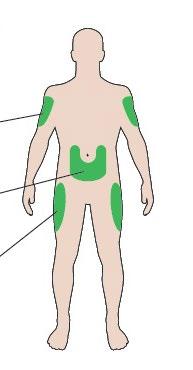
- Inject the medicine into the front of the thigh, the upper arm, or the front of the abdomen.
- Change the injection site within the selected injection area every day. This reduces the risk of the skin thinning or thickening (for more information see section “Other side effects” in paragraph 4).
To prevent the possible transmission of diseases, do not share your insulin pens with anyone
else, even when the needle has been changed.
Always insert a new needle before each injection. Never reuse needles. Reusing needles
increases the risk of blockage and of taking too much or too little insulin.
Dispose of used needles in a puncture-resistant container, or as instructed by your pharmacist or
local authorities.
Do not use Toujeo
- In a vein, as it changes the way it works and can cause excessively low blood sugar.
- In an insulin infusion pump.
- If the insulin contains particles; the solution must be clear, colorless, and water-like.
Never use a syringe to draw Toujeo from the SoloStar pen, as this can cause a serious overdose.
See also paragraph 2.
If the SoloStar pen is damaged, has not been stored correctly, if you are not sure that
it is working properly, or if you notice that your blood sugar control has worsened unexpectedly:
- Discard the pen and use a new one.
- Inform your doctor, pharmacist, or nurse if you think you are having problems with the pen.
If you use more Toujeo than you should
If you have injected too much of the medicine, your blood sugar level may
become too low. Check your blood sugar levels and eat a larger amount of
food to prevent your blood sugar from dropping too low. If your blood sugar
becomes too low, read the advice in the box at the end of this leaflet.
If you forget to use Toujeo
If necessary, Toujeo can be injected up to 3 hours before or after your usual time.
If you have forgotten a dose of Toujeo or have not injected enough insulin, blood sugar levels may become too high (hyperglycemia):
- Do not inject a double dose to make up for the missed dose.
- Check your blood sugar and inject the next dose at your usual time.
- For information on treating hyperglycemia, see the box at the end of this leaflet.
If you stop using Toujeo
Do not stop using this medicine without consulting your doctor. Otherwise, your blood sugar level may become excessively high, and acid may accumulate in the blood (ketoacidosis).
If you have any questions about using this medicine, ask your doctor, pharmacist, or
nurse.
4. Possible side effects
Like all medicines, this medicine can cause side effects, although not everybody gets them.
If you notice that your blood sugar levels are too low (hypoglycemia),immediately take steps to raise your blood sugar level (see the box at the end of this leaflet).
Hypoglycemia can be a very serious event and is very common during treatment with insulin (it may affect more than 1 in 10 people).
A low blood sugar level means that there is not enough sugar in the blood.
If your blood sugar level becomes too low, you may faint (lose consciousness).
Severe hypoglycemic episodes can cause brain damage and can be life-threatening.
For more information, see the box at the end of this leaflet.
Serious allergic reactions(rare, may affect up to 1 in 1,000 people) Signs may include skin rash and widespread itching, swelling of the skin or mouth, shortness of breath, a feeling of fainting (low blood pressure) with a rapid heartbeat and sweating. Serious allergic reactions can be life-threatening. Tell your doctor immediately if you notice signs of a serious allergic reaction.
Other side effects
Tell your doctor, pharmacist or nurse if you notice any of the following side effects:
- Changes to the skin at the injection siteIf you inject insulin too often into the same place, the skin may become thinner (lipoatrophy, may affect up to 1 in 100 people) or thicker (lipohypertrophy, may affect up to 1 in 10 people). Lumps under the skin can also be caused by a build-up of a protein called amyloid (cutaneous amyloidosis, the frequency with which it occurs is not known). Insulin may not work as well if you inject into an area with lumps. Change the injection site to prevent these skin changes.
Common:may affect up to 1 in 10 people
- Skin and allergic reactions at the injection site: signs may include redness, unusual intense pain during injection, itching, hives, swelling or inflammation. These reactions may spread to the area around the injection site. Most minor reactions to insulin usually disappear within a few days or weeks. Rare:may affect up to 1 in 1,000 people
- Eye problems: a noticeable change in blood sugar control (improvement or worsening) can cause visual disturbances. If you have eye problems related to diabetes called “proliferative retinopathy”, an episode of low blood sugar can cause temporary loss of vision.
- Swelling of the ankles and feet, caused by a temporary build-up of water in the body. Very rare:may affect up to 1 in 10,000 people
- Changes in taste (dysgeusia).
- Muscle pain (myalgia).
Tell your doctor, pharmacist or nurse if you notice any of the above side effects.
Reporting of side effects
If you get any side effects, even those not listed in this leaflet, tell your doctor or pharmacist. You can also report side effects directly through the national reporting system listed in Annex V. By reporting side effects you can help provide more information on the safety of this medicine.
5. How to store Toujeo
Keep this medicine out of the sight and reach of children.
Do not use this medicine after the expiry date which is stated on the packaging and on the pen label after “Exp”. The expiry date refers to the last day of that month.
Before first use
Store in a refrigerator (2°C – 8°C).
Do not freeze or put in direct contact with the freezer compartment or with ice packs.
Keep the pen in the outer packaging to protect the medicine from light.
After first use or when carrying as a spare
Do not store the pen in a refrigerator. The pen can be stored for a maximum of 6 weeks
at a temperature below 30°C and away from direct heat or direct light. Discard the pen
after this period. Do not leave the insulin inside the car on particularly
hot or cold days. Always keep the cap on the pen when not in use, to protect the
medicine from light.
Do not dispose of any medicine in wastewater or household waste. Ask your pharmacist how to
dispose of medicines you no longer use. This will help protect the environment.
6. Content of the pack and other information
What Toujeo contains
- The active substance is insulin glargine. Each ml of solution contains 300 units of insulin glargine (equivalent to 10.91 mg). Each pen contains 1.5 ml of injectable solution, equivalent to 450 units.
- The other ingredients are: zinc chloride, metacresol, glycerol, water for injections, and sodium hydroxide (see section 2 “Important information on some excipients of Toujeo”), and hydrochloric acid (for pH adjustment).
Description of Toujeo and content of the pack
Toujeo is a clear and colourless solution.
Each pen contains 1.5 ml of injectable solution (equivalent to 450 units).
Packs of 1, 3, 5 and 10 pens are available.
Not all pack sizes may be marketed.
Marketing authorisation holder and manufacturer
Sanofi-Aventis Deutschland GmbH, D-65926 Frankfurt am Main, Germany.
For further information on this medicine, contact the local representative of the marketing authorisation
holder.
België/Belgique/BelgienLietuva
Sanofi Belgium Swixx Biopharma UAB
Tél/Tel: +32 (0)2 710 54 00 Tel: +370 5 236 91 40
БългарияLuxembourg/Luxemburg
Swixx Biopharma EOOD Sanofi Belgium
Тел.: +359 (0)2 4942 480 Tél/Tel: +32 (0)2 710 54 00 (Belgique/Belgien)
Česká republikaMagyarország
Sanofi s.r.o. sanofi-aventis zrt., Magyarország
Tel: +420 233 086 111 Tel.: +36 1 505 0050
DanmarkMalta
Sanofi A/S Sanofi S.r.l.
Tlf: +45 45 16 70 00 Tel: +39 02 39394275
DeutschlandNederland
Sanofi-Aventis Deutschland GmbH Sanofi B.V.
Tel: 0800 52 52 010 Tel: + 31 20 245 4000
Tel. aus dem Ausland: +49 69 305 21 131
EestiNorge
Swixx Biopharma OÜ sanofi-aventis Norge AS
Tel: +372 640 10 30 Tlf: +47 67 10 71 00
ΕλλάδαÖsterreich
Sanofi-Aventis Μονοπρόσωπη AEBE sanofi-aventis GmbH
Τηλ: +30 210 900 16 00 Tel: +43 1 80 185 – 0
EspañaPolska
sanofi-aventis, S.A. Sanofi Sp. z o.o.
Tel: +34 93 485 94 00 Tel.: +48 22 280 00 00
FrancePortugal
Sanofi Winthrop Industrie Sanofi - Produtos Farmacêuticos, Lda
Tél: 0 800 222 555 Tel: +351 21 35 89 400
Appel depuis l’étranger : +33 1 57 63 23 23
HrvatskaRomânia
Swixx Biopharma d.o.o. Sanofi Romania SRL
Tel: +385 1 2078 500 Tel: +40 (0) 21 317 31 36
IrelandSlovenija
sanofi-aventis Ireland Ltd. T/A SANOFI Swixx Biopharma d.o.o.
Tel: +353 (0) 1 403 56 00 Tel: +386 1 235 51 00
ÍslandSlovenská republika
Vistor hf. Swixx Biopharma s.r.o.
Sími: +354 535 7000 Tel: +421 2 208 33 600
ItaliaSuomi/Finland
Sanofi S.r.l. Sanofi Oy
Tel: 800 13 12 12 (domande di tipo tecnico) Puh/Tel: +358 (0) 201 200 300
800 536389 (altre domande)
ΚύπροςSverige
C.A. Papaellinas Ltd. Sanofi AB
Τηλ: +357 22 741741 Tel: +46 (0)8 634 50 00
LatvijaUnited Kingdom (Northern Ireland)
Swixx Biopharma SIA sanofi-aventis Ireland Ltd. T/A SANOFI
Tel: +371 6 616 47 50 Tel: +44 (0) 800 035 2525
Other sources of information
More detailed information on this medicine is available on the website of the European Medicines
Agency: http://www.ema.europa.eu/
HYPERGLYCAEMIA AND HYPOGLYCAEMIA
If you are taking insulin, you should always carry with you:
- sugar (at least 20 grams).
- information, so that others know you have diabetes.
Hyperglycaemia (high blood sugar levels)
If your blood sugar levels are too high (hyperglycaemia), you may not have injected
enough insulin.
Possible causes of a hyperglycaemic event:
Examples include:
- you did not inject the insulin or did not inject enough.
- The insulin has become less effective, for example because it was not stored correctly.
- The insulin pen is not working correctly.
- You are doing less exercise than usual.
- You are stressed, for example emotional distress or excitement.
- You have an injury, infection or fever, or have undergone surgery.
- You are taking or have taken certain other medicines (see section 2 “Other medicines and Toujeo”).
Warning signs of hyperglycaemia
Thirst, increased need to urinate, weakness, dry skin, flushing of the face, loss of
appetite, low blood pressure, rapid heartbeat and the presence of glucose or ketones in the urine. Stomach pain, deep and rapid breathing, drowsiness or fainting
(loss of consciousness) may indicate a serious condition (ketoacidosis) resulting from insulin deficiency.
What you should do in case of hyperglycaemia
- Check your blood sugar level and for ketones in your urine as soon as possible when you notice any of the signs mentioned above.
- Seek immediate medical attention in case of severe hyperglycaemia or ketoacidosis. These must always be treated by a doctor, usually in hospital.
Hypoglycaemia (low blood sugar levels)
If your blood sugar levels drop too low, you may faint (lose consciousness).
Severe hypoglycaemic episodes can cause a heart attack or brain damage, and can
be life-threatening. You must learn to recognise the signs of low blood sugar, so that you can take action and prevent it from getting worse.
Possible causes of a hypoglycaemic event:
Examples include:
- You inject too much insulin.
- You skip or delay meals.
- You do not eat enough or eat food containing less sugar (carbohydrates) than usual; artificial sweeteners are not carbohydrates.
- You drink alcohol, especially when you have not eaten enough.
- You lose carbohydrates due to illness (vomiting) or diarrhoea.
- You are doing more exercise than usual or a different type of activity.
- You are recovering from injuries, surgery or other stress.
- You are recovering from an illness or fever.
- You are taking or have stopped taking certain other medicines (see section 2 “Other medicines and Toujeo”).
Hypoglycaemia can also occur more easily if:
- You have just started insulin treatment or have changed insulin; if you have a hypoglycaemic episode, it may be more likely to occur in the morning.
- Your blood sugar levels are almost normal or unstable.
- You change the area of skin where you inject the insulin, for example from the thigh to the upper arm.
- You have severe kidney or liver disease, or other diseases such as hypothyroidism.
Warning signs of hypoglycaemia
The first signs can be generalised throughout the body. Examples of symptoms that indicate that your blood sugar levels are dropping too low or too quickly: sweating, clammy skin, feeling anxious, rapid or irregular heartbeat, high blood pressure and palpitations. These
signs can often develop before those indicating a reduction in blood sugar levels in the
brain.
The signs at the brain level include: headache, intense hunger, feeling sick (nausea) or being sick (vomiting), feeling tired, sleepy, restless, sleep disturbances, aggressive behaviour, difficulty concentrating, slowed reactions, depression,
feeling confused, difficulty speaking (sometimes complete loss of speech), changes in
vision, tremors, inability to move (paralysis), tingling in the hands or arms, sensation of
numbness and tingling often around the mouth, dizziness, loss of self-control, inability to
take care of yourself, convulsions, fainting.
When the signs of hypoglycaemia may be less clear:
The early warning signs of hypoglycaemia may change, be weaker or be
completely absent:
- If you are elderly.
- If you have had diabetes for a long time.
- If you suffer from a particular type of nerve disease (called “diabetic autonomic neuropathy”).
- If you have recently had a hypoglycaemic episode (for example the day before).
- If hypoglycaemia develops slowly.
- If your blood sugar levels are always almost “normal” or if your blood sugar levels have improved significantly.
- If you have recently switched from animal insulin to human insulin like Toujeo.
- If you are taking or have taken certain other medicines (see section 2 “Other medicines and Toujeo”).
In these cases you may develop severe hypoglycaemia (and even faint) before understanding
what is happening to you. Learn to recognise the warning symptoms. If necessary, you
may need to check your blood sugar more often, so you can recognise mild episodes
more easily. If you have difficulty recognising the warning symptoms, avoid all those situations (such as
driving a car) that may be risky for you and others due to hypoglycaemia.
What you should do in case of hypoglycaemia
- 1. Do not inject insulin. Take immediately 10 to 20 grams of sugar, such as glucose, sugar cubes or a sugary drink. Do not drink or eat foods that contain artificial sweeteners (such as diet drinks). They do not help to treat hypoglycaemia.
- 2. Then eat something (like bread or pasta) that will raise your blood sugar for a longer period. Ask your doctor or nurse if you are unsure what foods you should eat. With Toujeo, normalising hypoglycaemia may take longer, as it is a long-acting product.
- 3. If you have another hypoglycaemic episode, take another 10 to 20 grams of sugar.
- 4. Seek immediate medical attention if you are unable to control the hypoglycaemia, or if the hypoglycaemia recurs.
What other people should do if you have a hypoglycaemic event
Tell family members, friends and colleagues to call for medical assistance immediately if you are unable to
swallow or if you faint (lose consciousness).
They will need to give you an injection of glucose or glucagon (a medicine that raises blood sugar).
These injections are justified even if they are not sure that a hypoglycaemic event has occurred.
You should measure your blood glucose immediately after taking the glucose, to check that you have
actually had a hypoglycaemic event.
Toujeo 300 units/ml solution for injection in a pre-filled pen (SoloStar)
INSTRUCTIONS FOR USE
Read here first
Toujeo SoloStar contains 300 units/ml of insulin glarginein a disposable pre-filled pen of
1.5 ml
- Never reuse needles.If you do, you may not receive the prescribed dose (underdose) or receive an excessive dose (overdose), because the needle may become blocked.
- Never draw insulin from the pen with a syringe.If you do, the dose of insulin will be excessive. The scale on most syringes is only suitable for non-concentrated insulin.
Important information
Never share the pen, it is intended for you only.

Never use the pen if it is damaged or if you are unsure of its correct operation.

Always perform a safety check.

Always have a spare pen and spare needles available in case of loss or
malfunction.

Learn how to inject
- Discuss with your doctor, pharmacist or nurse how to inject before using the pen.
- Ask for help if you have problems handling the pen, for example if you have vision problems.
- Read these instructions in full before using the pen. If you do not follow these instructions in full, you may take too much or too little insulin.
Need help?
If you have any questions about the pen or diabetes, ask your doctor, pharmacist or nurse
or call the sanofi-aventis number on the cover of the package leaflet.
Additional items needed:
- a new sterile needle (see POINT 2),
- a puncture-resistant container for used needles and pens.
Injection sites
Get to know the pen
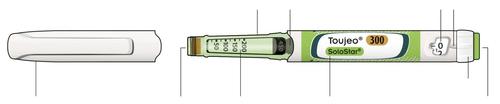
POINT 1: Check the pen
Take a new pen from the refrigerator at least 1 hour before the injection. Injecting
cold insulin is more painful.

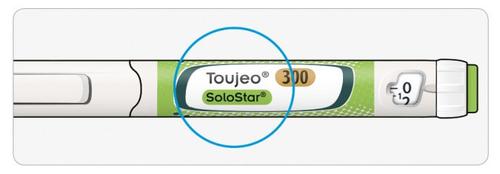
ACheck the name and expiry date on the pen label.
- Make sure you have the correct insulin. This is particularly important if you are using other pen injectors.
- Never use pens after the expiry date.
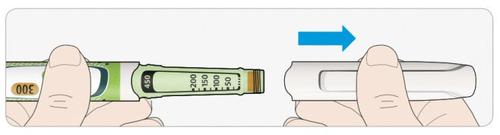
BRemove the cap.
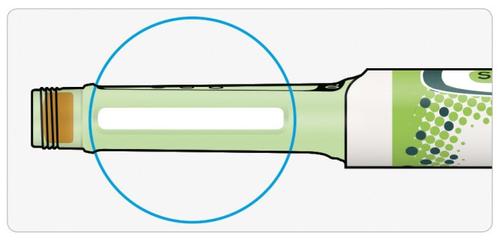
CCheck that the insulin is clear.
- Do not use the pen if the insulin appears cloudy, colored or contains particles.
POINT 2: Insert a new needle
Always use a new sterile needle for each injection. This avoids blocked needles,
contamination and infections.


Use only needles compatible with the use of Toujeo (for example BD, Ypsomed, Artsana or
Owen Mumford needles).
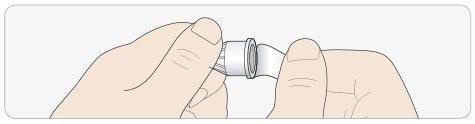
A Take a new needle and remove the protective seal.
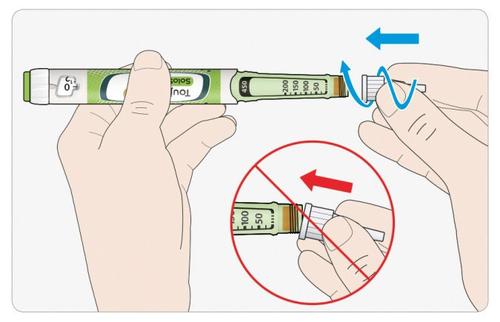
BHold the needle straight and screw it onto the pen until it is firmly in place. Do not overtighten.
CRemove the outer cap of the needle. Keep it for later.
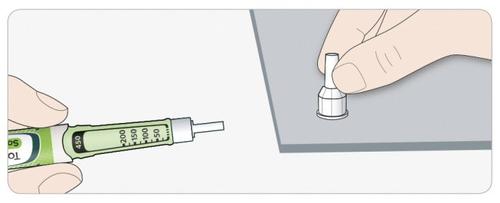
DRemove the inner cap of the needle and discard it.
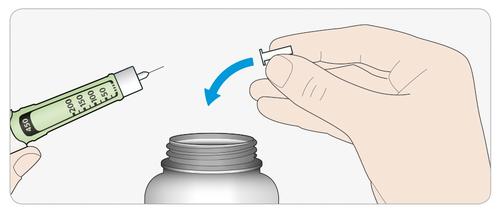
How to handle needles

- Be careful when handling needles, to prevent needle injuries and the transmission of infections.
POINT 3: Perform a safety test

Always perform a safety test before each injection, in order to:
- check that the pen and needle are working correctly,
- make sure you receive the correct dose of insulin.
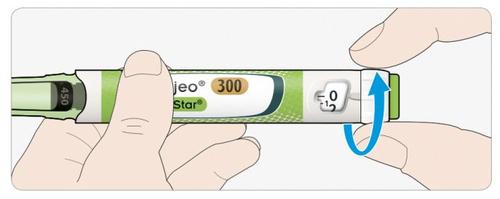
A Select 3 units by rotating the dose selector until the dose indicator is
between 2 and 4.
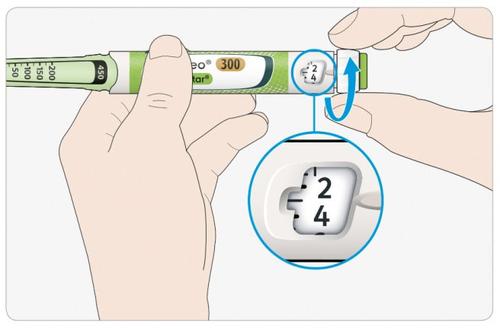
3 units selected
BPress the injection button all the way down.
- If insulin comes out of the needle tip, the pen is working correctly.
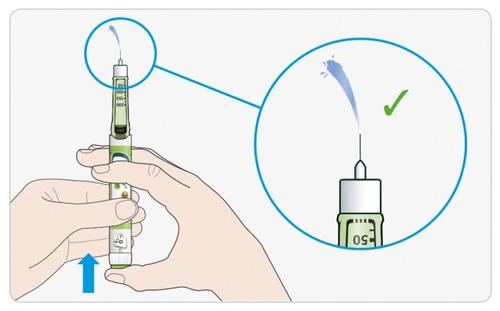
If no insulin comes out:
- You may need to repeat the operation up to 3 times before you see insulin coming out.
- If no insulin comes out after repeating the operation three times, the needle may be blocked. In this case:
- replace the needle (see POINT 6 and POINT 2),
- then repeat the safety test (POINT 3).
- Do not use the pen if insulin still does not come out of the needle even at this point. Use a new pen.
- Never draw insulin from the pen with a syringe.
If air bubbles are present

- Air bubbles may be visible in the insulin. This is normal, they are not dangerous.
POINT 4: Select the dose
Never select a dose or press the injection button without a needle inserted. The pen
may be damaged.

A Make sure a needle is inserted and the dose is set to ‘0’.
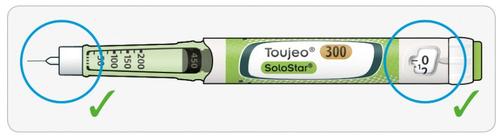
BRotate the dose selector until the dose indicator is aligned with the desired dose.
- If a higher dose has been selected, you can rotate the dosage selector in the opposite direction.
- If the pen does not contain enough units for the dose, the dose selector will stop at the number of units remaining.
- If you cannot select the full prescribed dose, divide the dose into two injections or use a new pen.
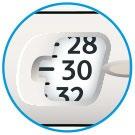
How to read the dosage window
Even numbers are aligned with the dose indicator:
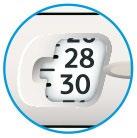
Odd numbers are indicated as a line between even numbers:
Insulin units in the pen

- The pen contains a total of 450 units of insulin. Doses from 1 to 80 units can be selected in increments of 1 unit. The pen contains more than one dose.
- You can see how many units of insulin remain based on the position of the plunger on the insulin scale.
POINT 5: Inject the dose

If pressing the injection button is difficult, do not force it, as the pen could
break. See the following section for tips.

ASelect an injection site as illustrated in the image
BInsert the needle into the skin as shown by your doctor, pharmacist or nurse.
- Do not touch the injection button yet.
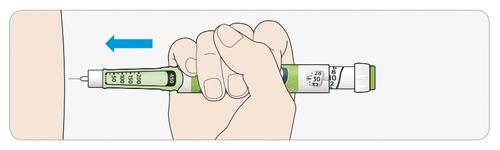
CPlace your thumb on the injection button. Press it all the way down and hold it down.
- Do not press the button diagonally, otherwise your thumb may block the rotation of the dose selector.
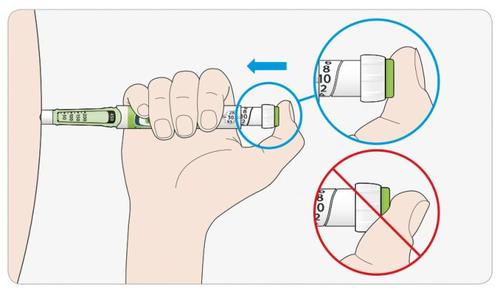
DWhile holding down the injection button, and when the number “0” appears in the window, count slowly to 5.
- This ensures you receive the full dose.
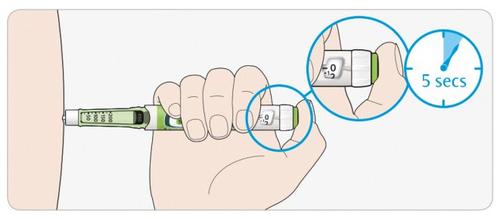
EAfter holding down the button and counting to 5, release the injection button.
Then withdraw the needle from the skin.
If pressing the button is difficult:

- Replace the needle (see POINT 6 and POINT 2) and then perform a safety test (see POINT 3).
- If pressing the button is still difficult, take a new pen.
- Never draw insulin from the pen with a syringe.
POINT 6: Remove the needle
Be careful when handling needles, to prevent needle injuries and the transmission of
infections.

Never reinsert the inner cap of the needle.

APut the outer cap back on the needle and use it to unscrew the needle from the pen.
- To reduce the risk of accidental needle injuries, never reposition the inner cap of the needle.
- If the injection is given by another person, or if you are giving the injection to another person, you must take particular care when removing and disposing of the needle.
- Follow the recommended safety measures for removing and disposing of needles (ask your doctor, pharmacist or nurse) to reduce the risk of accidental needle injuries and the transmission of infectious diseases
BDispose of the used needle in a puncture-resistant container, or as directed by your pharmacist or
local authorities.
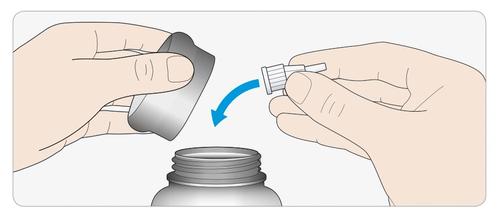
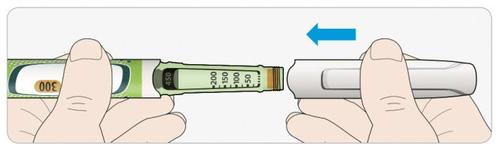
CClose the pen with the cap.
- Do not put the pen back in the refrigerator.
Use by
- Use the pen only for up to 6 weeks after first use.
How to store the pen
Before first use
- Keep new pens in the refrigerator, at 2°C-8°C.
- Do not freeze.
After first use
- Keep the pen at room temperature, below 30°C.
- Never put the pen back in the refrigerator.
- Never store pens with the needle inserted.
- Store pens with the cap on.
Pen maintenance
Handle the pen with care
- Do not drop or bump it against hard surfaces.
- If you believe the pen is damaged, do not attempt to repair it, use a new one.
Protect the pens from dust and dirt
- The outside of the pens can be cleaned with a damp cloth. Do not immerse, wash or lubricate the pen, as it may be damaged.
Disposal of the pen
- Remove the needle before disposing of the pen.
- Dispose of used pens as directed by your pharmacist or local authorities.
Toujeo 300 units/ml DoubleStar injectable solution in a pre-filled pen
Insulin glargine
Each DoubleStar pen delivers 2-160 units in 2-unit increments
Read this leaflet carefully before you start using this medicine as it contains important
information for you.
- Keep this leaflet. You may need to read it again.
- If you have any questions, ask your doctor, pharmacist or nurse.
- This medicine has been prescribed for you only. Do not pass it on to others, even if they have the same symptoms as you, as it may be harmful.
- If you get any side effects, even those not listed in this leaflet, tell your doctor or pharmacist. See section 4.
Contents of this leaflet:
- 1. What Toujeo is and what it is used for
- 2. What you need to know before you use Toujeo
- 3. How to use Toujeo
- 4. Possible side effects
- 5. How to store Toujeo
- 6. Contents of the pack and other information
1. What is Toujeo and what it is used for
Toujeo contains insulin called “insulin glargine”. This is a modified insulin, very similar
to human insulin.
Toujeo contains 3 times more insulin in 1 ml than standard insulin, which contains 100 units/ml.
Toujeo is used to treat diabetes mellitus in adults, adolescents and children from 6 years of age. Diabetes
mellitus is a disease in which the body does not produce enough insulin to control
blood sugar levels.
Toujeo steadily reduces blood sugar levels for a long period of time. It is used
with once-daily administration. If necessary, the time of injection can be
modified, as this medicine lowers blood sugar levels for a long
period of time (for more information see paragraph 3).
2. What you need to know before using Toujeo
Do not use Toujeo
- if you are allergic to insulin glargine or any of the other ingredients of this medicine (listed in section 6).
Warnings and precautions
Talk to your doctor, pharmacist or nurse before using Toujeo.
Follow the instructions carefully regarding the dose, checks to be performed (blood and urine tests), diet and physical activity (physical work and exercise) and the injection technique, as discussed
with your doctor.
Pay particular attention to the following aspects:
- Blood sugar level too low (hypoglycemia). If your blood sugar level is too low, follow the advice for hypoglycemia (see the information in the box at the end of the leaflet).
- If you switch to this product from another type, brand or manufacturer of insulin, you may need to adjust your insulin dose.
- Pioglitazone. See “Pioglitazone used with insulin”.
- Make sure you use the correct insulin. Medication errors have been reported due to confusion between insulins, particularly between long-acting and short-acting insulins. Always check the insulin label before each injection to avoid exchanging Toujeo with other insulins.
- Never use a syringe to draw Toujeo from the prefilled DoubleStar pen. This is to avoid dosing errors and potential overdoses that can lead to low blood sugar levels. See also section 3.
- To avoid an underdose of insulin, perform the safety test before the first use of a new pen and also before each use of the pen (see step 3 of the instructions for use). See also section 3.
- If you are blind or have poor vision, do not use the pre-filled pen without assistance, as you will not be able to read the dosage window on the pen. Get help from a person with good vision who is trained in using the pen.
Changes in the skin at the injection site:
The injection site must be rotated to prevent changes in the skin, such as the appearance of
lumps under the skin. Insulin may not work as well as it should if you inject into
an area with lumps (see section How to use Toujeo). If you are currently injecting into
an area with lumps, talk to your doctor before starting to inject into another area. The
doctor may advise you to check your blood sugar more carefully and adjust your insulin or
other antidiabetic medications.
Illness and injury
In the following situations, diabetes control may require particular attention (e.g.
blood and urine tests):
- if you are ill or have had a major injury. Your blood sugar may increase (hyperglycemia),
- if you are not eating enough. There is a risk that your blood sugar level may become too low (hypoglycemia). In most cases you will need to talk to a doctor. See a doctor as soon as you become ill or injured.
If you suffer from “type 1” diabetes and have an illness or injury:
- do not stop taking insulin,
- continue to eat a sufficient amount of carbohydrates. Always inform those who care for you or who are responsible for your treatment that you have diabetes.
Treatment with insulin can cause the formation of anti-insulin antibodies (substances that act
against insulin). However, only rarely will this require a change in your insulin dosage.
Travel
Tell your doctor before traveling. You may need to discuss:
- whether your type of insulin is available in the destination country,
- how to arrange supplies of insulin, needles and other items,
- how to store insulin correctly during travel,
- the timing of meals and insulin use,
- the possible effects of changing time zones,
- any health risks in the countries you are visiting,
- what to do in emergency situations if you feel unwell or become ill.
Children and adolescents
This medicine should not be used in children under 6 years of age. In fact, there is no
experience with Toujeo in patients in this age group.
Other medicines and Toujeo
Tell your doctor, pharmacist or nurse if you are taking, have recently taken or might
take any other medicines.
Some medicines can change your blood sugar level. This means that your insulin dose may need to be adjusted. Therefore, before taking a medicine, ask your doctor if
this may affect your blood sugar and if you need to take any countermeasures, and what they are. You
should also be careful when stopping a medicine.
Your blood sugar level may decrease (hypoglycemia) if you take:
- any other medicine to treat diabetes,
- disopyramide, for some heart problems,
- fluoxetine, for depression,
- sulfonamide antibiotics,
- fibrates, to lower high levels of fats in the blood,
- monoamine oxidase inhibitors (MAOIs), to treat depression,
- angiotensin converting enzyme (ACE) inhibitors, for heart problems or high blood pressure,
- medicines to relieve pain and lower fever, such as pentoxifylline, propoxyphene and salicylates (such as acetylsalicylic acid),
- pentamidine, for some parasitic infections. It may cause an excessive lowering of blood sugar, sometimes followed by high blood sugar.
Your blood sugar level may increase (hyperglycemia) if you take:
- corticosteroids such as cortisone, to treat inflammation,
- danazol, to treat endometriosis,
- diazoxide, for high blood pressure,
- protease inhibitors, for HIV,
- diuretics, for high blood pressure or fluid retention,
- glucagon, for very low blood sugar,
- isoniazid, for tuberculosis,
- somatotropin, a growth hormone,
- thyroid hormones, for thyroid problems,
- estrogens and progestins, such as in the birth control pill used for contraception,
- clozapine, olanzapine and phenothiazine derivatives, for mental problems,
- sympathomimetic medicines, such as adrenaline, salbutamol and terbutaline, for asthma.
Your blood sugar level may decrease or increase if you take:
- beta-blockers or clonidine, for high blood pressure,
- lithium salts, for mental health problems.
Beta-blockers
Beta-blockers, like other “sympatholytic medicines” (such as clonidine, guanethidine,
reserpine, for high blood pressure) can make it more difficult to recognize the warning signs
of low blood sugar levels (hypoglycemia). They can even mask or block the early signs that indicate that your blood sugar is too low.
Pioglitazone used with insulin
Some patients with long-standing type 2 diabetes mellitus and heart disease or with a previous
stroke treated with pioglitazone and insulin have developed heart failure. Tell your doctor as
soon as possible if you experience signs of heart failure such as unusually short breath, rapid
weight gain or localized swelling (edema).
If any of these situations apply to you or if you are not sure, discuss it with your doctor, pharmacist or nurse before using Toujeo.
Toujeo and alcohol
Your blood sugar levels may increase or decrease if you drink alcohol. You should check your blood
sugar level more often than usual.
Pregnancy and breastfeeding
If you are pregnant or breastfeeding, if you suspect you are pregnant or are planning to become
pregnant, ask your doctor for advice before taking this medicine. Your insulin dose may need to be adjusted during pregnancy and after delivery. It is particularly important to control diabetes carefully and prevent hypoglycemia for the health of the baby.
If you are breastfeeding, see your doctor, as your insulin doses and diet may need to be adjusted.
Driving and using machines
Low or high blood sugar levels or vision problems can affect your ability to drive and use tools or machines. Your concentration may be impaired, with potentially dangerous consequences for you and others.
Ask your doctor if you can drive in the following cases:
- you often have low blood sugar,
- you have difficulty recognizing when your blood sugar is too low.
Important information about some of the ingredients of Toujeo
This medicine contains less than 1 mmol (23 mg) of sodium per dose. This means that it is
essentially ‘sodium-free’.
3. How to use Toujeo
Use this medicine following the doctor's instructions exactly. If you have any doubts, consult your
doctor, pharmacist or nurse.
Although Toujeo contains the same active substance as insulin glargine 100 units/ml, these medicines
are not interchangeable. Switching from one insulin therapy to another requires a medical prescription,
medical monitoring and blood sugar level monitoring. Consult your doctor for
further information.
How much to use
The Toujeo DoubleStar pre-filled pen can deliver a dose of 2 to 160 units in a single
injection, in 2-unit increments. The pen is recommended for a patient who needs
at least 20 units of insulin per day (see section 2).
The dose window of the DoubleStar pen shows the number of units of Toujeo to be injected. Do not
recalculate the dose.
Based on your lifestyle, blood sugar level control tests and your previous insulin use, your doctor will tell you:
- how much Toujeo you need each day and at what time,
- when you should check your blood sugar and whether urine tests are necessary,
- when you may need a higher or lower dose.
Toujeo is a long-acting insulin. Your doctor may prescribe you to use it with a short-acting insulin
or with other medicines for high blood sugar levels.
If you are using more than one insulin, always make sure to use the correct one by checking the label before
each injection. Therapeutic errors have been reported due to exchanges between insulins, in particular between
long-acting and short-acting insulins. The concentration is highlighted in gold yellow
on the label of the Toujeo DoubleStar pre-filled pen. Ask your doctor or pharmacist if you are not
sure.
Many factors can affect blood sugar levels. You should be aware of these factors in
order to be able to take appropriate countermeasures if your blood sugar level changes,
preventing it from becoming too high or too low. For more information, see the box at the
end of this leaflet.
Flexibility of administration time
- Use Toujeo once a day, preferably at the same time each day.
- If necessary, you can inject it up to 3 hours before or after your usual time.
Use in elderly patients (age 65 years and older)
If you are 65 years of age or older, discuss this with your doctor, as you may need a lower dose.
If you have kidney or liver problems
If you have kidney or liver problems, discuss this with your doctor, as you may need a lower dose.
Before injecting Toujeo
- If you do not follow these instructions completely, you may take too much or too little insulin.
- Perform a safety test as described in Point 3 of the instructions for use. If the test is not performed, the entire dose will not be delivered. If this happens, you should increase the frequency of blood sugar monitoring and you may need to administer additional insulin. See also section 2.
How to perform the injection
- Toujeo is injected under the skin (subcutaneous use or “sc”).
- Inject the medicine into the front of the thigh, the upper arm or the front of the abdomen.
- Change the injection site within the selected injection area every day. This reduces the risk of the skin thinning or thickening (for more information see section “Other side effects” in section 4).
To prevent the possible transmission of diseases, do not share your insulin pens with anyone
else, even when the needle has been changed.
Always insert a new needle before each injection. Never reuse needles. Reusing needles
increases the risk of blockage and taking too much or too little insulin.
Dispose of used needles in a puncture-resistant container, or as instructed by your pharmacist or
local authorities.
Do not use Toujeo
- In a vein, as this changes the way it works and can cause a severe drop in blood sugar.
- In an insulin infusion pump.
- If the insulin contains particles; the solution must be clear, colorless and water-like.
Never use a syringe to draw Toujeo from the DoubleStar pen, as this may cause a serious overdose.
See also section 2.
If the DoubleStar pen is damaged, has not been stored correctly, if you are not sure that
it is working properly or if you notice that your blood sugar control has unexpectedly worsened:
- Discard the pen and use a new one.
- Inform your doctor, pharmacist or nurse if you think you are having problems with the pen.
If you use more Toujeo than you should
If you have injected too much of the medicine, your blood sugar level may
become too low. Check your blood sugar levels and eat a larger amount of
food to prevent your blood sugar from dropping too low. If your blood sugar
becomes too low, read the advice in the box at the end of this leaflet.
If you forget to use Toujeo
If necessary, Toujeo can be injected up to 3 hours before or after your usual time.
If you have forgotten a dose of Toujeo or have not injected enough insulin, blood sugar levels may become too high (hyperglycemia):
- Do not inject a double dose to make up for the missed dose.
- Check your blood sugar and inject the next dose at your usual time.
- For information on treating hyperglycemia, see the box at the end of this leaflet.
If you stop using Toujeo
Do not stop using this medicine without consulting your doctor. Otherwise, your blood sugar level may become excessively high, and acid may accumulate in the blood (ketoacidosis).
If you have any questions about using this medicine, ask your doctor, pharmacist or
nurse.
4. Possible side effects
Like all medicines, this medicine can cause side effects, although not everybody gets them.
If you notice that your blood sugar levels are too low (hypoglycemia),immediately take steps to raise your blood sugar level (see the box at the end of this leaflet).
Hypoglycemia can be a very serious event and is very common during treatment with
insulin (may affect more than 1 in 10 people).
- A low blood sugar level means there is not enough sugar in the blood.
- If your blood sugar level becomes too low, you may faint (lose consciousness).
- Severe hypoglycemic episodes can cause brain damage and can be life-threatening.
- For more information, see the box at the end of this leaflet.
Serious allergic reactions(rare, may affect up to 1 in 1,000) Signs may
include skin rash and widespread itching, swelling of the skin or mouth, shortness of breath,
feeling faint (low blood pressure) with a rapid heartbeat and sweating. Severe allergic reactions can be life-threatening. Tell your doctor immediately if
you notice signs of a serious allergic reaction.
Other side effects
Tell your doctor, pharmacist or nurse if you notice any of the following side effects
- Changes to the skin at the injection site:if you inject insulin too often in the same place, the skin may become thinner (lipoatrophy, may affect up to 1 in 100) or thicker (lipohypertrophy, may affect up to 1 in 10). Lumps under the skin can also be caused by a build-up of a protein called amyloid (cutaneous amyloidosis; the frequency with which this occurs is not known). Insulin may not work as well if you inject into an area with lumps. Change the injection site with each injection to prevent these skin changes.
Common:may affect up to 1 in 10 people
- Skin and allergic reactions at the injection site: signs may include redness, unusual intense pain during injection, itching, hives, swelling or inflammation. These reactions may spread to the area surrounding the injection site. Most minor reactions to insulin usually disappear within a few days or weeks. Rare:may affect up to 1 in 1,000
- Eye problems: a noticeable change in blood sugar control (improvement or worsening) can cause vision disturbances. If you have eye problems related to diabetes called “proliferative retinopathy”, an episode of low blood sugar can cause temporary loss of vision.
- Swelling of the ankles and feet, caused by a temporary build-up of water in the body. Very rare:may affect up to 1 in 10,000
- Changes in taste (dysgeusia).
- Muscle pain (myalgia).
Tell your doctor, pharmacist or nurse if you notice any of the side effects
above.
Reporting of side effects
If you get any side effects, talk to your doctor or pharmacist. You can also report side effects directly through
the national reporting system listed in Annex V. By reporting side effects you can help provide more information on the safety of this medicine.
5. How to store Toujeo
Keep this medicine out of the sight and reach of children.
Do not use this medicine after the expiry date which is stated on the packaging and on the pen label after “Exp”. The expiry date refers to the last day of that month.
Before first use
Store in a refrigerator (2°C – 8°C).
Do not freeze or put in direct contact with the freezer compartment or with ice packs.
Keep the pen in the outer packaging to protect the medicine from light.
After first use or when carrying as a spare
Do not store the pen in a refrigerator. The pen can be stored for a maximum of 6 weeks
at a temperature below 30°C and away from direct heat or direct light. Discard the pen
after this period. Do not leave the insulin inside the car on particularly
hot or cold days. Always keep the cap on the pen when not in use, to protect the
medicine from light.
Do not dispose of any medicine in wastewater or household waste. Ask your pharmacist how to
dispose of medicines you no longer use. This will help protect the environment.
6. Content of the pack and other information
What Toujeo contains
- The active substance is insulin glargine. Each ml of solution contains 300 units of insulin glargine (equivalent to 10.91 mg). Each DoubleStar pen contains 3 ml of injectable solution, equivalent to 900 units.
- The other ingredients are: zinc chloride, metacresol, glycerol, water for injections, and sodium hydroxide (see section 2 “Important information on some excipients of Toujeo”), and hydrochloric acid (for pH adjustment).
Description of the appearance of Toujeo and content of the pack
Toujeo is a clear and colourless solution.
Each DoubleStar pen contains 3 ml of injectable solution (equivalent to 900 units).
Packs of 1, 3 and 6 pre-filled pens (2 packs of 3), 9 (3 packs of 3) and
- 10 are available. Not all pack sizes may be marketed.
Marketing Authorisation Holder and Manufacturer
Sanofi-Aventis Deutschland GmbH, D-65926 Frankfurt am Main, Germany.
For further information on this medicine, contact the local representative of the Marketing Authorisation Holder.
België/Belgique/BelgienLietuva
Sanofi Belgium Swixx Biopharma UAB
Tél/Tel: +32 (0)2 710 54 00 Tel: +370 5 236 91 40
БългарияLuxembourg/Luxemburg
Swixx Biopharma EOOD Sanofi Belgium
Тел.: +359 (0)2 4942 480 Tél/Tel: +32 (0)2 710 54 00 (Belgique/Belgien)
Česká republikaMagyarország
Sanofi s.r.o. sanofi-aventis zrt., Magyarország
Tel: +420 233 086 111 Tel.: +36 1 505 0050
DanmarkMalta
Sanofi A/S Sanofi S.r.l.
Tlf: +45 45 16 70 00 Tel: +39 02 39394275
DeutschlandNederland
Sanofi-Aventis Deutschland GmbH Sanofi B.V.
Tel: 0800 52 52 010 + 31 20 245 4000
Tel. aus dem Ausland: +49 69 305 21 131
EestiNorge
Swixx Biopharma OÜ sanofi-aventis Norge AS
Tel: +372 640 10 30 Tlf: +47 67 10 71 00
ΕλλάδαÖsterreich
Sanofi-Aventis Μονοπρόσωπη AEBE sanofi-aventis GmbH
Τηλ: +30 210 900 16 00 Tel: +43 1 80 185 – 0
EspañaPolska
sanofi-aventis, S.A. Sanofi Sp. z o.o.
Tel: +34 93 485 94 00 Tel.: +48 22 280 00 00
FrancePortugal
Sanofi Winthrop Industrie Sanofi - Produtos Farmacêuticos, Lda
Tél: 0 800 222 555 Tel: +351 21 35 89 400
Appel depuis l’étranger : +33 1 57 63 23 23
HrvatskaRomânia
Swixx Biopharma d.o.o. Sanofi Romania SRL
Tel: +385 1 2078 500 Tel: +40 (0) 21 317 31 36
IrelandSlovenija
sanofi-aventis Ireland Ltd. T/A SANOFI Swixx Biopharma d.o.o.
Tel: +353 (0) 1 403 56 00 Tel: +386 1 235 51 00
ÍslandSlovenská republika
Vistor hf. Swixx Biopharma s.r.o.
Sími: +354 535 7000 Tel: +421 2 208 33 600
ItaliaSuomi/Finland
Sanofi S.r.l. Sanofi Oy
Tel: 800 13 12 12 (domande di tipo tecnico) Puh/Tel: +358 (0) 201 200 300
800 536389 (altre domande)
ΚύπροςSverige
C.A. Papaellinas Ltd. Sanofi AB
Τηλ: +357 22 741741 Tel: +46 (0)8 634 50 00
LatvijaUnited Kingdom (Northern Ireland)
Swixx Biopharma SIA sanofi-aventis Ireland Ltd. T/A SANOFI
Tel: +371 6 616 47 50 Tel: +44 (0) 800 035 2525
Altre fonti d’informazioni
More detailed information on this medicine is available on the website of the European Medicines Agency: http://www.ema.europa.eu/
HYPERGLYCEMIA AND HYPOGLYCEMIA
If you are taking insulin, you should always carry with you:
- sugar (at least 20 grams).
- information, so that others know you have diabetes.
Hyperglycemia (high blood sugar levels)
If your blood sugar levels are too high (hyperglycemia), you may not have injected
enough insulin.
Possible causes of a hyperglycemic event:
Examples include:
- you did not inject the insulin or did not inject enough.
- The insulin has become less effective, for example because it was not stored correctly.
- The insulin pen is not working properly.
- You are doing less exercise than usual.
- You are under stress, for example emotional distress or excitement.
- You have an injury, infection or fever, or have undergone surgery.
- You are taking or have taken certain other medicines (see section 2 “Other medicines and Toujeo”).
Warning signs of hyperglycemia
Thirst, increased need to urinate, weakness, dry skin, flushing of the face, loss of
appetite, low blood pressure, rapid heartbeat and the presence of glucose or ketones in the urine. Stomach pain, deep and rapid breathing, drowsiness or fainting
(loss of consciousness) may indicate a serious condition (ketoacidosis) resulting from insulin deficiency.
What you should do in case of hyperglycemia
- Check your blood sugar level and the possible presence of ketones in your urine as soon as you notice any of the signs mentioned above.
- Seek immediate medical attention in case of severe hyperglycemia or ketoacidosis. These must always be treated by a doctor, usually in a hospital setting.
Hypoglycemia (low blood sugar levels)
If your blood sugar levels drop too low, you may faint (lose consciousness).
Severe hypoglycemic episodes can cause a heart attack or brain damage, and can
be life-threatening. You must learn to recognize the signs of a drop in blood sugar, so that you can take action and prevent it from getting worse.
Possible causes of a hypoglycemic event:
Examples include:
- You inject too much insulin.
- You skip or delay meals.
- You do not eat enough or eat food containing less sugar (carbohydrates) than usual; artificial sweeteners are not carbohydrates.
- You drink alcohol, especially when you haven't eaten enough.
- You lose carbohydrates due to illness (vomiting) or diarrhea.
- You are doing more exercise than usual or a different type of activity.
- You are recovering from injuries, surgery or other stress.
- You are recovering from an illness or fever.
- You are taking or have stopped taking certain other medicines (see section 2 “Other medicines and Toujeo”).
Hypoglycemia can also occur more easily if:
- You have just started insulin treatment or changed insulin; if you experience a hypoglycemic episode, it may be more likely to occur in the morning.
- Your blood sugar levels are almost normal or unstable.
- You change the area of skin where you inject the insulin, for example from the thigh to the upper arm.
- You have severe kidney or liver disease, or other illnesses such as hypothyroidism.
Warning signs of hypoglycemia
The first signs may be generalized throughout the body. Examples of symptoms indicating that blood sugar levels are dropping too low or too quickly: sweating, clammy skin, feeling anxious, rapid or irregular heartbeat, high blood pressure and palpitations. These
signs can often develop before those indicating a reduction in sugar levels in the
brain.
Signs at the brain level include: headache, strong feeling of hunger, feeling unwell
(nausea) or feeling sick (vomiting), feeling tired, drowsiness, restlessness, sleep disturbances, aggressive behavior, difficulty concentrating, slow reactions, depression,
feeling confused, difficulty speaking (sometimes complete loss of speech), visual disturbances, tremors, inability to move (paralysis), tingling in the hands or arms, feeling
of numbness and tingling often around the mouth, dizziness, loss of self-control, inability to
take care of oneself, convulsions, fainting.
When the signs of hypoglycemia may be less clear:
- If you are elderly.
- If you have had diabetes for a long time.
- If you suffer from a particular type of nerve disease (called “diabetic autonomic neuropathy”).
- If you have recently had a hypoglycemic episode (e.g. the day before).
- If hypoglycemia develops slowly.
- If blood sugar levels are always almost “normal” or if blood sugar levels have improved significantly.
- If you have recently switched from an animal insulin to a human insulin like Toujeo.
- If you are taking or have taken certain other medicines (see section 2 “Other medicines and Toujeo”).
In these cases, you may develop severe hypoglycemia (and even faint) before understanding
what is happening to you. Learn to recognize the warning signs. If necessary, you
may need to check your blood sugar more often, so that you can recognize mild hypoglycemic
episodes more easily. If you have difficulty recognizing the warning signs, avoid all those situations (such as
driving) that may be risky for you and others due to hypoglycemia.
What you should do in case of hypoglycemia
- 1. Do not inject insulin. Take immediately 10 to 20 grams of sugar, such as glucose, sugar cubes or a sugary drink. Do not drink or eat foods that contain artificial sweeteners (such as diet drinks). They do not help to treat hypoglycemia.
- 2. Then eat something (like bread or pasta) that will raise your blood sugar for a longer period. Ask your doctor or nurse if you are not sure what foods you should eat. With Toujeo, normalizing hypoglycemia may take longer, as it is a long-acting product.
- 3. If you experience another hypoglycemic episode, take another 10 to 20 grams of sugar.
- 4. Seek immediate medical attention if you are unable to control hypoglycemia, or if hypoglycemia recurs.
What others should do if you have a hypoglycemic event
Inform family members, friends and colleagues to seek immediate medical assistance if you are unable to
swallow or if you faint (lose consciousness).
They will need to give you an injection of glucose or glucagon (a medicine that raises blood sugar).
These injections are justified even if they are not sure that a hypoglycemic event has occurred.
You should measure your blood glucose immediately after taking glucose, to check that you have
actually had a hypoglycemic event.
Toujeo 300 units/ml solution for injection in a pre-filled pen (DoubleStar)
INSTRUCTIONS FOR USE
Read here first
Toujeo DoubleStar contains 300 units/ml of insulin glarginein a disposable pre-filled pen
of 3 ml
- Never reuse needles.If you do, you may not receive the prescribed dose (underdose) or receive an excessive dose (overdose), because the needle may become blocked.
- Never draw insulin from the pen with a syringe.If you do, the dose of insulin will be excessive. The scale on most syringes is only suitable for non-concentrated insulin.
- The dose selector on the Toujeo DoubleStar pen selects increments of 2 units.
Important information
Never share the pen, it is intended for you only.

Never use the pen if it is damaged or if you are unsure of its correct operation.

Always perform a safety test, before using a new pen for the first time,
until you see insulin coming out of the needle tip (see section 3).If you see
insulin coming out of the needle tip, the pen is ready for use. If you do not see insulin
coming out before taking the dose, you may not receive any insulin at all or
receive too little. This could cause high blood sugar levels.

To ensure that the pen and needle are working, always perform the safety test until
you see insulin coming out of the needle tip before each injection (see POINT 3). If you do not
perform the safety test before each injection, you may administer an insufficient amount of insulin.

Always have a spare pen and spare needles available in case of loss or
malfunction.

Learning how to give the injection
- Discuss with your doctor, pharmacist or nurse how to give the injection before using the pen.
- This pen is not recommended for use by people who are blind or have poor vision without the assistance of people trained in the appropriate use of the product.
- Read these instructions completely before using the pen. If you do not follow these instructions completely, you may administer too much or too little insulin.
Need help?
If you have any questions about the pen or diabetes, contact your doctor, pharmacist or nurse
or call the sanofi-aventis number listed on the package insert.
Additional items needed:
- a new sterile needle (see POINT 2),
- a puncture-resistant container for used needles and pens.
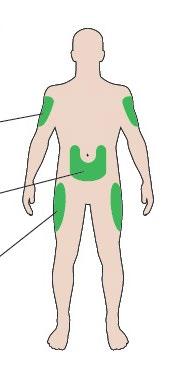
Injection sites
Getting to know the pen
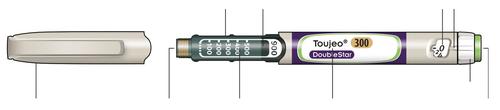
POINT 1: Check the pen
Take a new pen from the refrigerator at least 1 hour before the injection. Cold insulin is more painful to inject.

ACheck the name and expiration date on the pen label.
- Make sure you have the correct insulin. This is especially important if you use other pen injectors.
- Never use pens after the expiration date.
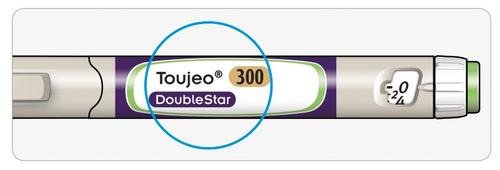
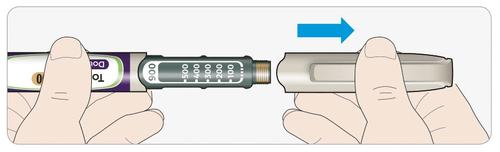
BRemove the cap.
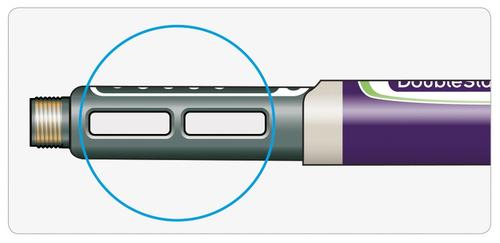
CCheck that the insulin is clear.
- Do not use the pen if the insulin appears cloudy, colored, or contains particles.
POINT 2: Insert a new needle
Always use a new sterile needle for each injection. This avoids clogged needles, contamination and infection.


Use only needles compatible with the use of Toujeo DoubleStar (for example, BD, Ypsomed, Artsana or Owen Mumford needles) that are 8 mm in length or less.
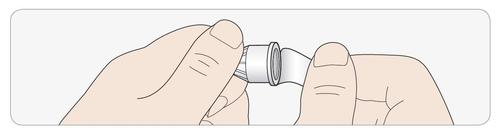
A Take a new needle and remove the protective seal.
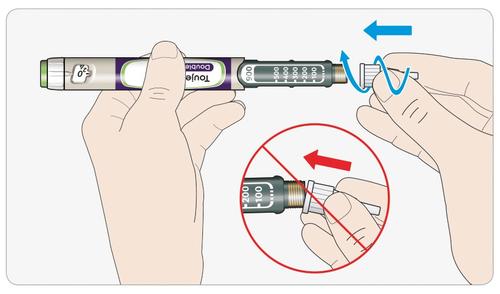
BHold the needle straight and screw it onto the pen until it is firmly seated. Do not overtighten.
CRemove the outer needle cap. Save it for later.
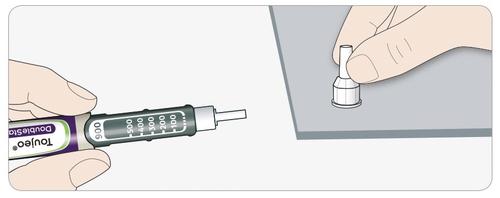
DRemove the inner needle cap and discard it.
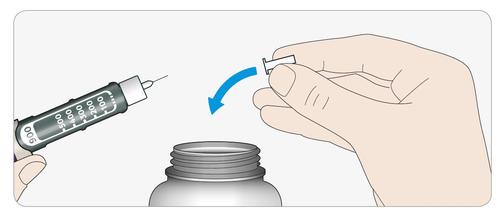
How to handle needles

- Be careful when handling needles to prevent needle stick injuries and the transmission of infections.
POINT 3: Perform a safety test

Always perform a safety test before each injection, in order to:
- check that the pen and needle are working correctly,
- Make sure you receive the correct dose of insulin.

If the pen is new, you must perform the safety test before using the pen for the first time until you see insulin leaking from the tip of the needle.If you see insulin leaking from the tip of the needle, the pen is ready for use. If you do not see insulin leaking before taking the dose, you may not receive any insulin at all or receive too low a dose. This could cause high blood sugar levels.
A Select 4 units by rotating the dose selector until the dose indicator is in the 4 position.
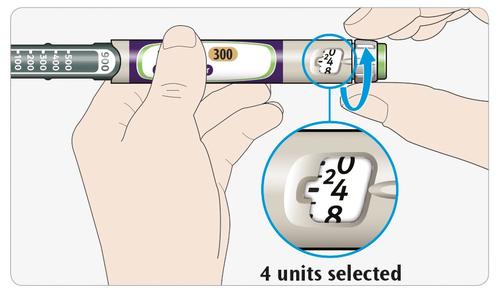
BPress the injection button all the way down.
- If insulin leaks from the tip of the needle, the pen is working correctly.
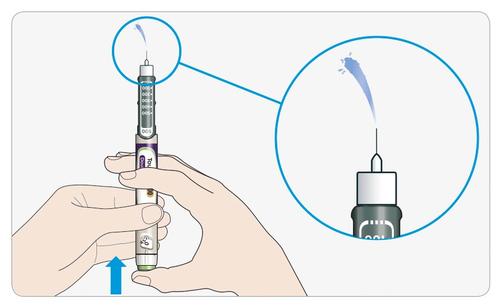
CRepeat this step if insulin does not come out:
- If you are using a new pen for the first timeyou may need to repeat the operation up to 6 timesbefore seeing insulin leak out.
- Do not use the pen if insulin still does not leak from the tip of the needle. Use a new pen.
- For all injections, if insulin still does not come out after repeating the operation, the needle may be blocked. In this case:
- replace the needle (see POINT 6 and POINT 2),
- then repeat the safety test (POINT 3A and POINT 3B). Do not use the pen if insulin still does not leak from the needle. Use a new pen.
- Never draw insulin from the pen with a syringe.
If air bubbles are present

- Air bubbles may be visible in the insulin. This is normal and is not dangerous.
POINT 4: Select the dose
Never select a dose or press the injection button without a needle inserted. The pen could be damaged.

Toujeo DoubleStar is designed to deliver the number of insulin units prescribed by your doctor. You should not recalculate the dose.
AMake sure a needle is inserted and the dose is set to ‘0’.
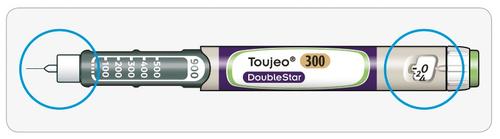
BRotate the dose selector until the dose indicator is aligned with the desired dose.
- Set the dose by rotating the dose selector until a line in the dose window. Each line is equal to 2 units.
- The dial clicks when it rotates.
- Do not select the dose by counting the clicks. You may select the wrong dose. This could lead you to take too much or not enough insulin.
- Always check the number in the dose window to be sure you have selected the correct dose.
- If a higher dose has been selected, you can rotate the dose selector in the opposite direction.
- If the pen does not contain enough units for the dose, the dose selector will stop at the number of units remaining.
- If you cannot select the full prescribed dose, divide the dose into two injections or use a new pen. If you use a new pen, always perform a safety test (see POINT 3).
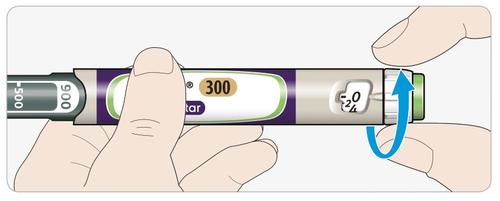
How to read the dose window
The dose selector is adjustable in increments of 2 units.
Each line in the dose window is an even number:
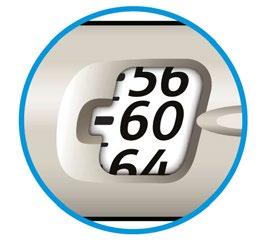
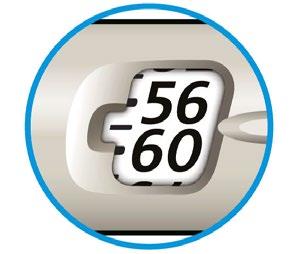
Insulin units in the pen

- The pen contains a total of 900 units of insulin. You can select doses from 2 to 160 units in increments of 2 units at a time. Each pen contains more than one dose.
- You can see how many units of insulin remain based on the position of the plunger on the insulin scale.
POINT 5: Inject the dose

If pressing the injection button is difficult, do not force it, as the pen could break. For tips see the following section.

ASelect an injection site as illustrated in the Injection Sites image.
BInsert the needle into the skin as shown by your doctor, pharmacist or nurse.
- Do not touch the injection button yet.
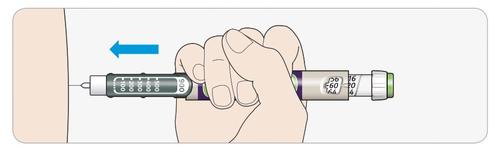
CPlace your thumb on the injection button. Press it all the way down and hold it down.
- Do not press the button diagonally, otherwise your thumb may block the rotation of the dose selector.
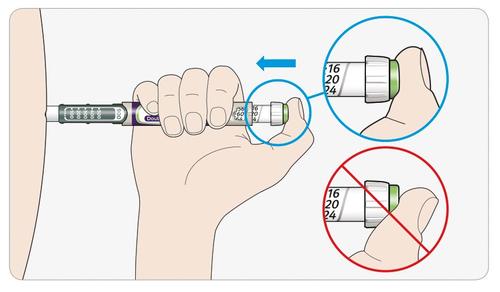
DWhile holding the injection button down, and when the number “0” appears in the window, count slowly to 5.
- This ensures you receive the full dose.
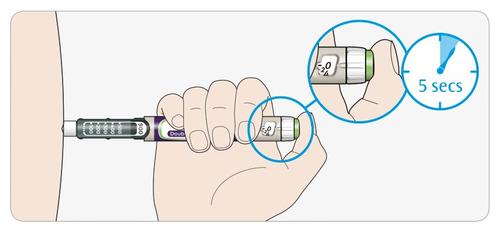
EAfter holding the button down and counting to 5, release the injection button. Then withdraw the needle from the skin.
If pressing the button is difficult:

- Replace the needle (see POINT 6 and POINT 2) and then perform a safety test (see POINT 3).
- If pressing the button is still difficult, take a new pen.
- Never draw insulin from the pen with a syringe.
POINT 6: Remove the needle
Be careful when handling needles to prevent needle stick injuries and the transmission of infections.

Never re-attach the inner needle cap.

APut the outer cap back on the needle and use it to unscrew the needle from the pen.
- To reduce the risk of accidental needle stick injuries, never re-position the inner needle cap.
- If the injection is given by another person, or if you are giving the injection to another person, you must take particular care when removing and disposing of the needle.
- Follow the recommended safety measures for removing and disposing of needles (ask your doctor, pharmacist or nurse) to reduce the risk of accidental needle stick injuries and the transmission of infectious diseases
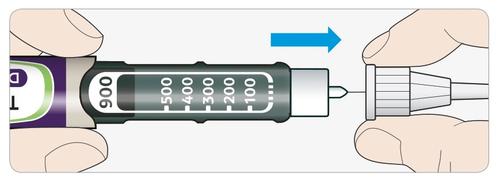
BDispose of the used needle in a puncture-resistant container, or as directed by your pharmacist or local authorities.
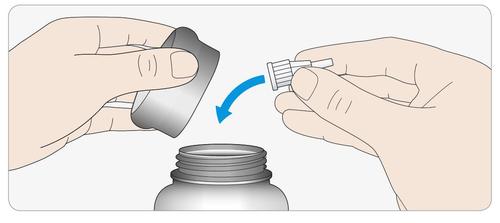
CClose the pen with the cap.
- Do not put the pen back in the refrigerator.
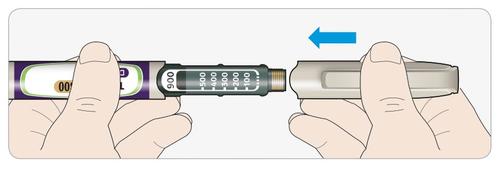
Use by
- Use the pen only for up to 6 weeks after first use.
How to store the pen
Before first use
- Keep new pens in the refrigerator, at 2°C-8°C.
- Do not freeze.
After first use
- Keep the pen at room temperature, below 30°C.
- Never put the pen back in the refrigerator.
- Never store pens with the needle attached.
- Store pens with the cap on.
Pen maintenance
Handle the pen with care
- Do not drop or bump it against hard surfaces.
- If you believe the pen is damaged, do not attempt to repair it, use a new one.
Protect the pens from dust and dirt
- The exterior of the pens can be cleaned with a damp cloth. Do not immerse, wash or lubricate the pen, as it may be damaged.
Pen disposal
- Remove the needle before discarding the pen.
- Dispose of used pens as indicated by the pharmacist or local authorities.

Не уверены, подходит ли вам это лекарство?
Обсудите симптомы и варианты лечения с врачом онлайн.

Уже начали прием и появились вопросы?
Обсудите свое состояние и дальнейшие шаги с врачом онлайн.
- Страна регистрации
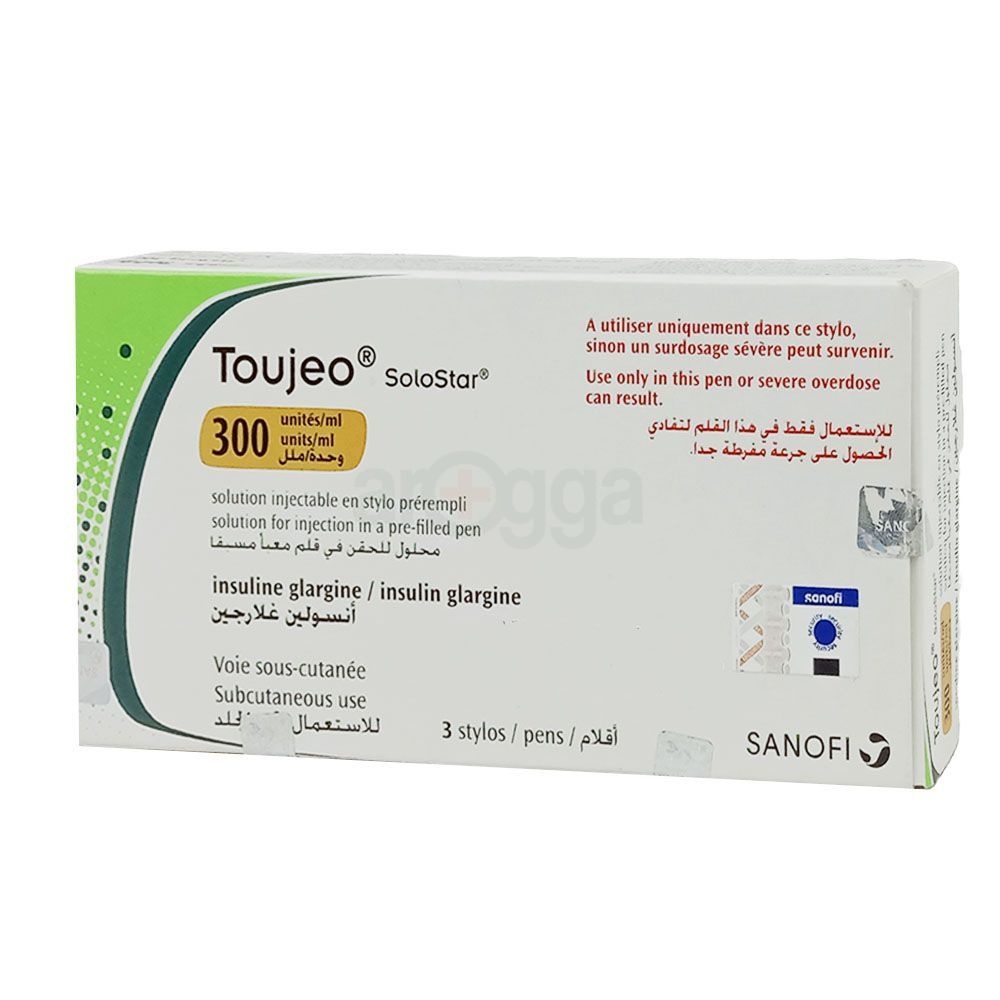
- Форма выпускаInjectable solution, 100IU/ML
- Код АТХA10AE04
- Действующее вещество
- Отпускается по рецептуДа
- Производитель
- Информация на этой странице носит справочный характер и не является медицинской консультацией. Перед началом приема лекарства обязательно проконсультируйтесь с врачом.
- Аналоги TOUJEOФорма выпуска: Injectable solution, 100 UNITS/MLДействующее вещество: инсулин гларгинПроизводитель: ELI LILLY NEDERLAND B.V.Отпускается по рецептуФорма выпуска: Injectable solution, 100 IU/MLДействующее вещество: инсулин гларгинПроизводитель: SANOFI-AVENTIS DEUTSCHLAND GMBHОтпускается по рецептуФорма выпуска: Injectable suspension, 100 UNITS/MLДействующее вещество: инсулин гларгинПроизводитель: BIOSIMILAR COLLABORATIONS IRELAND LIMITEDОтпускается без рецепта
Аналоги TOUJEO в других странах
Лекарства с тем же действующим веществом, доступные в других странах.
Аналог TOUJEO в Испания
Аналог TOUJEO в Украина
Врачи онлайн по TOUJEO
Обсудите применение TOUJEO и возможные следующие шаги — по оценке врача.









Получите рецепт на TOUJEO онлайн
Заполните форму за 2 минуты
Расскажите о симптомах, истории болезни и нужном препарате.
Выберите врача или мы назначим
Выберите специалиста или мы подберём ближайшего доступного врача.
Врач рассматривает ваш случай
Обычно в течение 30 минут. Может задать уточняющие вопросы в чате.
Получите в любой аптеке
Электронный рецепт отправляется на вашу почту — действителен по всей Польше.
Часто задаваемые вопросы
TOUJEO требует рецепта в Италия. Вы можете уточнить у врача онлайн, подходит ли это лекарство для вашей ситуации.
Действующее вещество TOUJEO — инсулин гларгин. Эта информация помогает определить лекарства с тем же составом под другими торговыми названиями.
TOUJEO производится компанией SANOFI-AVENTIS DEUTSCHLAND GMBH. Упаковка и торговое название могут отличаться в зависимости от дистрибьютора.
Врачи, включая Семейные врачи, Психиатры, Дерматологи, Кардиологи, Эндокринологи, Гастроэнтерологи, Пульмонологи, Нефрологи, Ревматологи, Гематологи, Инфекционисты, Аллергологи, Гериатры, Педиатры, Онкологи, могут оценить целесообразность применения TOUJEO с учетом вашей ситуации и местных правил. Вы можете записаться на онлайн-консультацию, чтобы обсудить возможные варианты.
Польша имеет хорошо развитую систему здравоохранения в крупных городах, таких как Варшава, Краков, Вроцлав и Гданьск. Аптеки широко доступны и работают в соответствии с действующим законодательством, обеспечивая доступ к рецептурным препаратам.
Вы можете купить TOUJEO в Варшаве, Кракове, Вроцлаве или Гданьске в любой аптеке при наличии действующего рецепта.
Чтобы получить рецепт, вы можете воспользоваться Oladoctor:
Другие лекарства с тем же действующим веществом (инсулин гларгин) включают ABASALAR, LANTUS, SEMLEE. Они могут отличаться торговым названием или формой выпуска, но содержат одинаковый терапевтический компонент. Перед изменением лечения рекомендуется проконсультироваться с врачом.
