



TISSEEL 2 ML Тканевый клей

Рассмотрение рецепта онлайн
Врач рассмотрит ваш случай и примет решение о назначении рецепта, если это медицински оправдано.

Поговорите с врачом об этом лекарстве
Обсудите симптомы и возможные дальнейшие шаги на онлайн-консультации.



Инструкция по применению TISSEEL
Содержание инструкции
- TISSEEL 2 ml tissue adhesive solution, 4 ml tissue adhesive solution, 10 ml tissue adhesive solution
TISSEEL 2 ml tissue adhesive solution, 4 ml tissue adhesive solution, 10 ml tissue adhesive solution
Human fibrinogen, human thrombin, synthetic aprotinin, calcium chloride dihydrate
Read this leaflet carefully before you are given this medicine
because it contains important information for you.
- Keep this leaflet. You may need to read it again.
- If you have any questions, ask your doctor.
- If any side effects occur, including any not listed in this leaflet, tell your doctor, pharmacist or nurse. See section 4.
Contents of this leaflet:
- 1. What TISSEEL is and what it is used for
- 2. What you need to know before you are given TISSEEL
- 3. How TISSEEL will be given to you
- 4. Possible side effects
- 5. How to store TISSEEL
- 6. Contents of the pack and other information
1. What is TISSEEL and what is it used for
What is it
TISSEEL is a medicine composed of two components in solution, fibrinogen (sealing protein) and
thrombin. These two blood proteins are very important for coagulation and when mixed, they form a clot at the application site.
The clot formed by TISSEEL is very similar to the one that forms normally during
blood coagulation and, like this, is degraded without leaving any trace. To prevent premature elimination of the clot in TISSEEL, a third synthetic protein,
aprotinin, has been added.
What is it used for
TISSEEL is applied to tissues of various organs, during surgical procedures of different kinds, in
adultpatients, in order to stop bleeding, seal the affected area and promote
tissue regeneration.
TISSEEL adheres quickly and permanently; after the surgical procedure it is left in place
and over time is reabsorbed by the body.
TISSEEL finds application in all areas of general and specialist surgery.
2. What you need to know before you are given TISSEEL
You will not be given TISSEEL
- If you are allergic to products derived from human blood (human fibrinogen, human thrombin) or to any of the other ingredients of this medicine (listed in section 6).
- If you are allergic to aprotinin, a protein (see section “Warnings and precautions”).
- Via intravascular route
- For the treatment of severe or profuse venous or arterial bleeding. The administration of TISSEEL alone is not indicated in such a situation.
- For injection into soft tissues as there is a risk of anaphylactic reactions and/or local tissue damage.
Warnings and precautions
Talk to your doctor, pharmacist or nurse before you are given TISSEEL:
- if you are prone to allergies or have an allergy to proteins (e.g. aprotinin);
- if you are pregnant;
- if you are allergic to bovine proteins, as the synthetic aprotinin present in TISSEEL is structurally similar to bovine aprotinin;
- if you suffer from a blood disease (e.g. hemolytic anemia);
- if you have a disease that alters the immune system, the body's defense system (immunodeficiency);
- if you have previously been given aprotinin, a protein.
- Very rarely, cases of potentially lethal/lethal gas embolism (entry of air into the bloodstream, which can be serious or life-threatening) have been reported with the use of spray devices using pressure regulators for the administration of fibrin sealants. This event appears to be related to the use of the spray device at pressures higher than those recommended and/or too close to the tissue surface. The risk appears to be greater when fibrin sealants are nebulized with air instead of with CO, therefore it cannot be excluded with TISSEEL when nebulized onto open surgical wounds.
- Spray devices and accessory tips are supplied with instructions for use and recommendations on pressure ranges and nebulization distance from the tissue surface.
- TISSEEL must be administered strictly following the indicated instructions and only with the devices recommended for this product.
- When spraying TISSEEL, any changes in blood pressure, pulse, oxygen saturation and end-tidal COmust be monitored, as gas embolism may occur.
Viral safety
TISSEEL is a medicine derived from human plasma (the liquid component of blood). When
medicines are produced from human blood or plasma, a number of safety measures are applied to prevent the transmission of infections to patients. These include careful
selection of plasma and blood donors, to ensure that potential carriers of infection are
excluded, and analysis of each donation and plasma pool to reveal the possible presence of viruses and
infections. Manufacturers of these medicines apply procedures during the processing of blood
or plasma that inactivate or remove viruses. Nevertheless, whenever medicines prepared from human blood or plasma are taken, the possibility of transmitting an infection cannot
be completely excluded. This also applies to unknown or emerging viruses or other types of infections.
The measures taken for the production of TISSEEL are considered effective for viruses with a lipid envelope, such as the human immunodeficiency virus (HIV), the hepatitis B virus (HBV) and the hepatitis C virus (HCV), and for the non-enveloped hepatitis A virus.
The measures taken may have limited effectiveness against non-enveloped viruses such as
parvovirus B19. Parvovirus B19 infection can be severe for pregnant women (fetal infection) and for individuals with immunodeficiency or increased red blood cell production (e.g., hemolytic anemia).
Children and adolescents
The safety and efficacy of the product have not been established in pediatric patients.
Other medicines and TISSEEL
Tell your doctor if you are taking, have recently taken or might take any other
medicines.
TISSEEL with food and drink
Ask your doctor, he will assess whether you can drink or eat before the application of TISSEEL.
Pregnancy, breastfeeding and fertility
If you are pregnant, suspect you are pregnant, are planning to become pregnant, or are breastfeeding, ask your doctor for advice before you are given this medicine.
TISSEEL will only be given during pregnancy and breastfeeding if it is really necessary.
The effects of TISSEEL on fertility have not been established.
Driving and operating machinery
Not applicable.
3. How TISSEEL will be administered to you
TISSEEL will be administered by surgeons experienced in the use of this type of medicine.
The surgeon will apply TISSEEL during the operation.
The amount of TISSEEL to be applied and the frequency of application will be determined by the surgeon, based on the type of surgery and the surface to be treated.
The use of TISSEEL is limited to experienced surgeons, specialized in the use of TISSEEL.
Before applying TISSEEL, the wound surface must be dried using standard techniques
(e.g. intermittent application of compresses, swabs, use of suction devices).
When applying TISSEEL using a spray device, make sure to use the pressure
and the distance from the tissue within the ranges recommended by the manufacturer as indicated
below:
| Pressure, distance and recommended devices for Tisseel spray application | |||||
| Surgical procedures | Spray to use | Applicator tips to use | Pressure regulator to use | Distance from tissue recommended | c a Recommended spray pressure |
| Open wound | Tisseel/Artiss Spray Set | n.a. | EasySpray | m r 10-15 cm a | 1.5-2.0 bar (21.5-28.5 psi). |
| 10-pack of Tisseel/Artiss Spray Set | n.a. | EasySpray | |||
| F | |||||
| Laparoscopic /minimally invasive procedures z n | n.a. a t I a i | Duplospray MIS 20 cm applicator | l e d Duplospray MIS 1.5 bar regulator | 2-5 cm | 1.2-1.5 bar (18-22 psi) |
| Duplospray MIS 30 cm applicator | |||||
| a Duplospray n MIS 40 cm applicator | |||||
| a Endoscopic i 360° applicator l a with spray and snap-on stop set | |||||
| Endoscopic 360° applicator with spray and fixing set | |||||
| Replaceable tip | |||||
When spraying TISSEEL, any changes in blood pressure, pulse,
oxygen saturation and end-tidal COconcentration must be monitored, as gas embolism may occur (see section 2).
4. Possible side effects
Like all medicines, this medicine can cause side effects, although not everybody gets them.
During or after the administration of Tisseel, you may experience the following side effects:
- blockage of a blood vessel caused by a gas bubble (gas embolism);
- serious allergic reactions. These reactions may occur, in particular, if the product is applied repeatedly or administered to patients with a known allergy to aprotinin (see section 2 You will not be given TISSEEL) or to any of the other ingredients of the medicine. Even if you have been given TISSEEL in the past and have tolerated it well, further administration of TISSEEL or accidental injection into a blood vessel may cause serious allergic reactions;
- allergic reactions (anaphylactic reactions, anaphylactic shock) which may include
- swelling of the skin (angioedema),
- a burning and tingling sensation at the site of administration,
- difficulty breathing (bronchospasm),
- chills,
- redness,
- widespread hives,
- headache,
- low blood pressure, drowsiness,
- nausea, vomiting,
- agitation, increased heart rate,
- a feeling of tightness in the chest,
- tingling, shortness of breath;
- formation of blood clots that obstruct or prevent normal blood flow (thrombosis, thromboembolism, disseminated intravascular coagulation - DIC);
- reduced blood flow to the body (shock);
- rarely, antibodies to the components of the fibrin/hemostatic glue may develop.
If you experience these side effects during the administration of TISSEEL, the doctor will
IMMEDIATELY STOPthe administration at the first sign of alarm, eliminate the
residual medicine and give you appropriate therapy.
Immediate availability of equipment, medicines and qualified personnel
for emergency treatment is necessary, as serious, sometimes fatal, side effects have been reported, in rare cases, following the use of tissue adhesives, even in the absence of a known allergy.
Regarding safety in relation to transmissible agents, see the section “Viral Safety”.
Gas embolism or air embolism, potentially lethal/fatal, has occurred when using
devices with pressurized gas or air; this event appears to be related to inappropriate use
of the spray device (e.g. at a pressure higher than recommended and at close range
to the tissue surface).
The side effects observed with TISSEEL and their frequency are summarized below:
very common (may affect more than 1 in 10 people)
- Accumulation of lymph fluid under the skin (seroma) common (may affect up to 1 in 10 people)
- Wound infection after surgery
- Sensory disturbances
- Blockage of the axillary vein
- Pain in arms and legs
- Increased body temperature
- Skin rash uncommon (may affect up to 1 in 100 people)
- Changes in blood tests (Increased fibrin degradation products)
- Pain caused by the procedure
not known (frequency cannot be estimated from available data)
- Numbness
- Itching
- Erythema
- Decreased or increased heart rate
- Bruising
- Skin redness
- Blockage of a blood vessel, including the brain (Arterial embolism, cerebral artery embolism)
- Lack of blood flow to the brain (cerebral infarction)
- Difficulty breathing (dyspnea)
- Bowel obstruction
- Decreased ability to heal
- Swelling (edema)
Other side effects that have been reported with other medicines containing the same active ingredients as
Tisseel (fibrinogen and thrombin), and which may therefore be potential side effects of
Tisseel:
- Blockage of a blood vessel (gas embolism or air embolism)
- Allergic reactions including:
- irritation at the application site
- a feeling of tightness in the chest
- chills
- headache
- drowsiness
- agitation
- vomiting.
Reporting of side effects
If you get any side effects, talk to your doctor, pharmacist or nurse. You can also report side effects directly
through the national reporting system at https://www.aifa.gov.it/content/segnalazioni-
reazioni- avverseBy reporting side effects you can help provide more information
on the safety of this medicine.
5. How to store TISSEEL
Store and transport in a freezer (at a temperature of -20°C or below). The cold chain must not be interrupted until the time of use.
Store in the original package to protect the medicine from light.
Keep this medicine out of the sight and reach of children.
Do not use this medicine after the expiry date which is stated on the pack after SCAD.
The expiry date refers to the last day of that month.
Storage after thawing:
The unopened product, thawed at room temperature, can be stored for up to 72 hours at controlled room temperature (not exceeding 25 ° C).
After thawing, the solution must not be refrozen or refrigerated!
Do not dispose of any medicine in wastewater or household waste. Ask your pharmacist how to dispose of medicines you no longer use. This will help protect the environment.
6. Contents of the pack and other information
What TISSEEL contains
TISSEEL consists of 2 components:
- Component 1
- The active ingredients in 1 ml of solution are Human fibrinogen (coagulating protein), 91 mg/ml; Synthetic aprotinin, 3000 KIU/ml.
- The other ingredients are Human albumin, L-Histidine, Niacinamide, Polysorbate 80 (Tween 80), Sodium citrate dihydrate, Water for injections.
- Component 2 thrombin
- The active ingredients in 1 ml of thrombin solution are: Human thrombin, 500 IU/ml; Calcium chloride dihydrate, 40 mol/ml.
- The other ingredients are Human albumin, Sodium chloride, Water for injections.
Description of the appearance of TISSEEL and contents of the pack
The Coagulable protein solution and the Thrombin solution are contained in plastic syringes
ready-to-use, single-use, double-chambered.
TISSEEL, when frozen, appears as colorless or light yellow solutions, clear or
slightly opalescent.
After thawing it appears as colorless or light yellow liquids.
TISSEEL is available in the following packs:
TISSEEL 2 ml solution for tissue adhesive
(consisting of 1 ml of Coagulable protein solution and 1 ml of Thrombin solution)
- One pre-filled double-chambered syringe containing one of the two components in each chamber.
- A set of application instruments (Duploject Combi - Set): 2 connectors, 4 blunt-tipped applicator needles.
TISSEEL 4 ml solution for tissue adhesive
(consisting of 2 ml of Coagulable protein solution and 2 ml of Thrombin solution)
- One pre-filled double-chambered syringe containing one of the two components in each chamber.
- A set of application instruments (Duploject Combi - Set): 2 connectors, 4 blunt-tipped applicator needles,.
TISSEEL 10 ml solution for tissue adhesive
(consisting of 5 ml of Coagulable protein solution and 5 ml of Thrombin solution)
- One pre-filled double-chambered syringe containing one of the two components in each chamber.
- A set of application instruments (Duploject Combi - Set): 2 connectors, 4 blunt-tipped applicator needles,.
It is possible that not all pack sizes are marketed.
Further accessories for product application can be requested from BAXTER.
Marketing Authorisation Holder and Manufacturer
Baxter S.p.A. Piazzale dell’Industria, 20 I-00144 Roma
Takeda Manufacturing Austria AG
Industriestraße 67
1221 Wien
Austria
---------------------------------------------------------------------------------------------------------------------------
The following information is intended exclusively for physicians or healthcare professionals:
What TISSEEL contains
TISSEEL contains two components:
Component 1
Sealing or adhesive protein solution.
1 ml of solution contains human coagulable plasma proteins in an amount equal to 96-125 mg/ml of
which:
Human fibrinogen (coagulating protein) 91 mg
Synthetic aprotinin 3000 KIU
Component 2
Thrombin solution.
1 ml of solution contains:
Human thrombin 500 IU
Calcium chloride dihydrate 40 μmol
1 pre-filled double-chambered syringe ready for use contains in one chamber the sealing or adhesive
coagulable protein solution (with synthetic aprotinin) in frozen form of 1 ml, 2 ml and 5 ml and
in the other chamber the thrombin solution (with calcium chloride dihydrate) in frozen form of 1 ml, 2 ml
and 5 ml
allowing to obtain a total volume of 2 ml, 4 ml and 10 ml of product ready for use.
| After mixing of the two components | 2 ml | 4 ml | 10 ml |
| Component 1: Sealing protein Human Fibrinogen (as coagulable protein) Aprotinin (synthetic) | 91 mg (45.5 mg/ml of solution) 3000 KIU (1500 KIU/ml of solution) | 182 mg (45.5 mg/ml of solution) 6000 KIU (1500 KIU/ml of solution) | 455 mg (45.5 mg/ml of solution) 15000 KIU (1500 KIU/ml of solution) |
| Component 2: Thrombin Solution Human Thrombin Calcium Chloride Dihydrate | 500 IU (250 IU/ml of solution) 40 mol (20 mol/ ml of solution) | 1000 IU (250 IU/ml of solution) 80 mol (20 mol/ ml of solution) | 2500 IU (250 IU/ml of solution) 200 mol (20 mol/ ml of solution) |
The product also contains Factor XIII in an amount less than or equal to 10 IU/ml.
Warnings for use
It is strongly recommended that whenever TISSEEL is administered to a patient, the
name and batch number of the product are recorded in order to maintain a link between the patient and the batch
of the product.
Intravascular application may increase the probability and severity of acute hypersensitivity reactions in
sensitive patients.
INSTRUCTIONS FOR USE AND HANDLING AND DISPOSAL
General information
Before administering TISSEEL, ensure that body parts external to the application area of the product are
adequately covered to prevent tissue adhesion to undesired sites.
To prevent TISSEEL from adhering to gloves and instruments, moisten them with saline solution before
contact.
Like other similar products or thrombin solutions, the product may denature if exposed to
solutions containing alcohol, iodine or heavy metals (e.g. antiseptic solutions). Remove as much of these
substances as possible before applying the product.
Separate and sequential application of the two components of TISSEEL must be avoided
Handling and preparation of the product for use
The Coagulable protein solution and the Thrombin solution are contained in a single-use double-chambered
syringe ready for use. The nozzles of the pre-filled double-chambered syringe are closed with a
protective cap and each cylinder of the syringe is closed with a silicone rubber stopper. The whole is
packaged and hermetically sealed in aseptic conditions within two sterilized pouches of a
plastic-aluminum material.
The inner pouch and its contents are sterile unless the integrity of the outer packaging is compromised.
Thaw the pre-filled syringe according to one of the following methods:
It is recommended to thaw and warm the two adhesive components using a sterile water bath at a
temperature of 33 – 37°C. The water in the water bath must not exceed 37°C. (To maintain
the established temperature range, the water temperature must be checked with a
thermometer and the water replaced if necessary. If a sterile water bath is used for thawing
and warming, the pre-filled double-chambered syringe system must be removed from the
plastic-aluminum pouches).
The protective cap of the syringe must not be removed until thawing is complete and the application device is
ready to be assembled. Do not use
TISSEEL until it is completely thawed and warmed.
The ready-to-use syringe can also be thawed and stored at room temperature (not
exceeding 25 ° C) for a maximum of 72 hours. Warming is required before use.
- 1) Rapid thawing (with sterile water bath) – recommended method
Table 1 below shows the thawing and warming times when using a
sterile water bath. If a sterile water bath is used for thawing and warming, the
pre-filled double-chambered syringe system must be removed from the plastic-
aluminum pouches. Make sure the syringe is completely immersed in water.
Table 1: Thawing and warming times with sterile water bath from 33 °C to a maximum of
37 °C
- 2) Thawing with non-sterile water bath
Leave the ready-to-use syringe inside both pouches and place it in a water bath outside the
sterile area for the time required (see Table 2). Make sure the pouches
remain immersed in water throughout the thawing time. After thawing,
remove the pouches from the water bath, dry the outer pouch and bring the ready-to-use syringe and
| i z Pack | Thawing and warming times in sterile water bath (product removed from plastic- aluminum pouches) |
| n 2 ml | 5 minutes |
| e 4 ml | 5 minutes |
| 10 ml | 10 minutes |
the plunger into the sterile area.
Table 2 - Thawing and warming times with a non-sterile water bath from 33 °C to a maximum of
37 °C
| Pack | c Thawing and warming times in non-sterile water bath (product kept in plastic- aluminum pouches) |
| 2 ml | m 15 minutes |
| 4 ml | 20 minutes |
| 10 ml | 35 minutes |
- 3) Thawing in incubator
Alternatively, the adhesive components can be thawed and warmed in an incubator between 33 °C and 37
°C. The thawing and warming times in the incubator are shown in Table 3 below and refer to the product
packaged in plastic-aluminum pouches.
Table 3: Thawing and warming times in incubator from 33 °C to a maximum of 37
°C.
| Pack | a Thawing and warming times in incubator n (product kept in plastic-aluminum pouches) |
| 2 ml | 40 minutes |
| 4 ml | 50 minutes |
| 10 ml | 90 minutes |
- 4) Thawing at room temperature
A fourth alternative is to thaw the product at room temperature. The times indicated
in Table 4 are the minimum thawing times at room temperature not exceeding 25°C.
When thawing at room temperature, the product must be further warmed to 33 °C
- 37 °C in an incubator immediately before use. Table 4 also shows the warming times in an incubator.
Table 4: Thawing and warming times at room temperature (T.A.) followed by
additional warming, before use, in an incubator from 33°C to a maximum of 37°C.
| g A Pack | Thawing times at Room temperature (product kept in plastic-aluminum pouches) | Warming times at 33- 37°C in incubator after thawing at T.A. (product kept in plastic-aluminum pouches) |
| 2 ml | 80 minutes + 11 minutes | |
| 4 ml | 90 minutes + 13 minutes | |
| 10 ml | 160 minutes + 25 minutes | |
Note: Do not thaw the product by holding it in your hand.
Do not microwave.
Do not refreeze or refrigerate after thawing.
Stability after thawing
After thawing and warming (at temperatures between 33 ° C and 37 ° C, methods 1, 2 and 3), the chemical and
physical stability of the product has been demonstrated for 12 hours at 33 ° C to 37 ° C.
For product thawed at room temperature (method 4), the chemical and physical stability of the product has
been demonstrated for 72 hours at temperatures not exceeding 25 ° C. Warm to 33 ° C
immediately before use.
From a microbiological point of view, unless the opening/thawing method precludes
the risk of microbial contamination, the product must be used immediately after being
warmed to 33 ° C to 37 ° C.
Handling after thawing / before application
To facilitate optimal mixing of the two solutions, the two adhesive components must be warmed
to a temperature of 33-37 °C immediately before use. (The temperature of 37 °C
must never be exceeded in any case!)
The coagulable protein and thrombin solutions must be clear or slightly opalescent.
Do not use opaque solutions or those with deposits.
Before administration, the thawed product must be visually inspected for the presence of particulate matter and
abnormal coloration, or any change in physical appearance. If so, discard the solution.
The thawed protein solution must appear as a slightly viscous liquid.
If the solution has the consistency of a solidified gel, it should be considered that it has denatured, for example
due to a break in the cold chain or overheating. In this case, do not use TISSEEL.
The thawed product cannot be refrozen or refrigerated.
Protect from light.
Storage after thawing:
After thawing, the product, if kept in its intact plastic-aluminum pouches, can be
stored for 72 hours at a room temperature not exceeding 25°C. If not used within 72
hours of thawing, TISSEEL must be disposed of.
After rapid thawing (at a temperature between 33 °C and 37 °C) without plastic-aluminum
pouches, the product must be used immediately.
The thawed product cannot be refrozen or refrigerated.
Administration
For application, the double-chamber syringe containing the Adhesive or Sealant Protein Solution
coagulable and the Thrombin Solution must be connected to a junction element and an applicator needle
which are included in the kit packaging. The single plunger of the double-chamber syringe
ensures that equal volumes are dispensed through the junction element before being mixed
in the applicator needle and dispensed.
The dose to be used depends on some variables, such as, but not limited to, the type of surgical
intervention, the extent of the area to be treated, the intended method of application and the number of
applications.
The application of the product must always be decided on a case-by-case basis by the attending physician.
In clinical trials, the range of individual doses was generally between 4 and 20 ml. For
some procedures (e.g. liver trauma or repair of extensive burn areas), larger volumes may be
necessary.
The initial amount of product to be applied to a specific anatomical site or target area must be sufficient to cover the entire area intended for treatment. Application may
be repeated, if necessary. However, avoid reapplying TISSEEL to a pre-existing polymerized layer of TISSEEL, as this will not adhere.
As a guideline for bonding surfaces, consider the following table:
Surface to be bonded TISSEEL package required
8 cm TISSEEL 2 ml tissue adhesive solution
16 cm TISSEEL 4 ml tissue adhesive solution
40 cm TISSEEL 10 ml tissue adhesive solution
With the TISSEEL 2 ml package using the spray application technique, surfaces from 25 to 100 cm can be treated,
depending on the indications.
To avoid the formation of excessively granular tissue and ensure gradual
absorption of the solidified fibrin glue, apply only a thin layer of TISSEEL.
Preparations containing oxidized cellulose must not be used with TISSEEL.
Preparations containing oxidized cellulose may reduce the effectiveness of TISSEEL and must not be
used as carrier materials.
How to use
For epilesional use only.
To ensure the optimal safety of TISSEEL use by spray application, the following recommendations must be
followed:
In open surgical wounds, a pressure regulator device must be used that delivers a
maximum pressure not exceeding 2.0 bar (28.5 psi).
In minimally invasive/laparoscopic procedures, a pressure regulator device must be used that delivers a maximum pressure not exceeding 1.5 bar (22 psi) and uses exclusively
carbon dioxide.
Before applying TISSEEL, the wound surface must be dried using standard techniques
(e.g. intermittent application of compresses, swabs, use of suction devices).
Do not use air or pressurized gas to dry the site.
TISSEEL must only be sprayed onto visible application sites.
If fibrin glues are applied in confined spaces, the risk of
compression complications should be considered.
Instructions for use
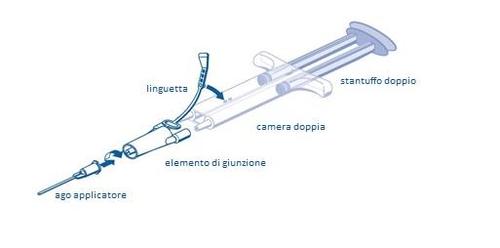
- Attach the nozzles of the two-chamber syringe to the junction element, verifying that the assembly is stable. Lock the junction element by hooking the tab onto the double-chamber syringe. If the tab breaks, use the spare junction element. If no other junction elements are available, it is equally possible to use the device, ensuring that the connection is sufficiently tight to prevent leaks.
- Insert an applicator needle into the junction element. Do not release any residual air from the junction element or the applicator needle until application begins, as the needle opening may become blocked.
- Apply the mixed solution of coagulable proteins and thrombin to the surface to be treated or to the surfaces of the parts to be bonded.
Important note:If the application of the fibrin glue components is interrupted, the needle will become blocked
immediately. In this case, replace the applicator needle with a new needle immediately before
resuming application. If the openings of the junction element are blocked, use
the spare element provided in the package.
At the end of mixing the glue components, the fibrin glue begins to
form within a few seconds due to the high concentration of thrombin (500 IU/ml).
In cases where very small volumes of TISSEEL are administered, immediately before
application, expel and discard the first drops from the applicator needle, in order to
ensure adequate mixing of the Adhesive Protein or Sealant Protein Solution
coagulable with the Thrombin Solution.
Application can also be performed with other accessories supplied by BAXTER which are
particularly suitable, for example, for endoscopic use, minimally invasive surgery or
applications on large or hard-to-reach areas. If you use these application devices, follow the instructions for use of these devices scrupulously.
Use only authorized/CE-marked devices for the administration of
TISSEEL.
After applying TISSEEL, hold the two parts coated with glue together, applying
slight compression, for about 3-5 minutes, in order to allow a
sufficient degree of polymerization to be reached.
In some applications, a biocompatible material is used, for example a collagen fleece, as a carrier substance or as a reinforcement.
Spray application
When applying TISSEEL using a spray device, make sure to use the pressure
and distance from the tissue within the ranges recommended by the manufacturer as
indicated below:
| r Pressure, distance and recommended devices for spray application of TISSEEL | |||||
| Surgical procedures | Spray to use | Applicator tips to use | Pressure regulator to use | a Distance from F tissue recommended | Recommended spray pressure |
| Open wound | Tisseel/Artiss Spray Set | n.a. | EasySpray | 10-15 cm | 1.5-2.0 bar (21.5-28.5 psi) . |
| 10 pack of Tisseel/Artiss Spray Set | n.a. | l e EasySpray d | |||
| Laparoscopic /minimally invasive g | n.a. a i z n e | Duplospray MIS 20 cm applicator | a n Duplospray MIS regulator 1.5 bar | 2-5 cm | 1.2-1.5 bar (18-22 psi) |
| Duplospray MIS 30 cm applicator | |||||
| Duplospray MIS 40 cm applicator | |||||
| 360° endoscopic applicator with spray set and snap lock | |||||
| 360° endoscopic applicator with fastening | |||||
| Replaceable tip | |||||
When spraying TISSEEL, any changes in blood pressure, pulse, oxygen saturation and end-tidal COmust be monitored, as gaseous embolism may occur (see section “Warnings and precautions”).
For spray application of TISSEEL in thoracoscopy and laparoscopic abdominal surgery, the use of the DuploSpray MIS applicator and regulator is recommended. However, the
information for use provided in the manual of this device must be followed strictly.
Very rarely, cases of potentially lethal/lethal gas embolism (entry of air into the bloodstream, which can be serious or life-threatening) have occurred with the use of spray devices using pressure regulators for the administration of fibrin glues. This event appears to be related to the use of the spray device at pressures higher than those recommended and/or too close to the tissue surface. The risk appears to be greater when fibrin glues are nebulized with air instead of CO, therefore it cannot be excluded with TISSEEL when nebulized onto open surgical wounds.
Spray devices and accessory tips are supplied with instructions for use and recommendations on pressure and nebulization distance ranges from the tissue surface.
TISSEEL must be administered strictly following the indicated instructions and only with the devices recommended for this product.
When spraying TISSEEL, any changes in blood pressure, pulse, oxygen saturation and end-tidal COmust be monitored, as gaseous embolism may occur.
Before administering TISSEEL, ensure that body parts external to the product application area are adequately protected/covered to prevent tissue adhesion in unwanted sites.
Disposal
Unused product and waste derived from this medicine must be disposed of in accordance with
local regulations.

Не уверены, подходит ли вам это лекарство?
Обсудите симптомы и варианты лечения с врачом онлайн.

Уже начали прием и появились вопросы?
Обсудите свое состояние и дальнейшие шаги с врачом онлайн.

- Страна регистрации
- Форма выпускаTissue adhesive, 2 ML
- Код АТХB02BC30
- Действующее вещество
- Отпускается по рецептуДа
- Производитель
- Информация на этой странице носит справочный характер и не является медицинской консультацией. Перед началом приема лекарства обязательно проконсультируйтесь с врачом.
- Аналоги TISSEELФорма выпуска: Tissue adhesive, 1 MLДействующее вещество: combinationsПроизводитель: BAXTER S.P.A.Отпускается по рецептуФорма выпуска: Tissue adhesive, 9.5 CM X 4.8 CMДействующее вещество: combinationsПроизводитель: CORZA MEDICAL GMBHОтпускается по рецептуФорма выпуска: Powder and solvent for injectable solution, 250 IUДействующее вещество: фактор свертывания крови VIIIПроизводитель: TAKEDA MANUFACTURING AUSTRIA AGОтпускается по рецепту
Аналоги TISSEEL в других странах
Лекарства с тем же действующим веществом, доступные в других странах.
Аналог TISSEEL в Испания
Аналог TISSEEL в Украина
Врачи онлайн по TISSEEL
Обсудите применение TISSEEL и возможные следующие шаги — по оценке врача.








Получите рецепт на TISSEEL онлайн
Заполните форму за 2 минуты
Расскажите о симптомах, истории болезни и нужном препарате.
Выберите врача или мы назначим
Выберите специалиста или мы подберём ближайшего доступного врача.
Врач рассматривает ваш случай
Обычно в течение 30 минут. Может задать уточняющие вопросы в чате.
Получите в любой аптеке
Электронный рецепт отправляется на вашу почту — действителен по всей Польше.
Часто задаваемые вопросы
TISSEEL требует рецепта в Италия. Вы можете уточнить у врача онлайн, подходит ли это лекарство для вашей ситуации.
Действующее вещество TISSEEL — combinations. Эта информация помогает определить лекарства с тем же составом под другими торговыми названиями.
TISSEEL производится компанией BAXTER S.P.A.. Упаковка и торговое название могут отличаться в зависимости от дистрибьютора.
Врачи, включая Семейные врачи, Психиатры, Дерматологи, Кардиологи, Эндокринологи, Гастроэнтерологи, Пульмонологи, Нефрологи, Ревматологи, Гематологи, Инфекционисты, Аллергологи, Гериатры, Педиатры, Онкологи, могут оценить целесообразность применения TISSEEL с учетом вашей ситуации и местных правил. Вы можете записаться на онлайн-консультацию, чтобы обсудить возможные варианты.
Польша имеет хорошо развитую систему здравоохранения в крупных городах, таких как Варшава, Краков, Вроцлав и Гданьск. Аптеки широко доступны и работают в соответствии с действующим законодательством, обеспечивая доступ к рецептурным препаратам.
Вы можете купить TISSEEL в Варшаве, Кракове, Вроцлаве или Гданьске в любой аптеке при наличии действующего рецепта.
Чтобы получить рецепт, вы можете воспользоваться Oladoctor:
Другие лекарства с тем же действующим веществом (combinations) включают ARTISS, TAKOSIL, ADVATE. Они могут отличаться торговым названием или формой выпуска, но содержат одинаковый терапевтический компонент. Перед изменением лечения рекомендуется проконсультироваться с врачом.
