



SIGNIFOR 0.3 MG Инъекционный раствор

Рассмотрение рецепта онлайн
Врач рассмотрит ваш случай и примет решение о назначении рецепта, если это медицински оправдано.

Поговорите с врачом об этом лекарстве
Обсудите симптомы и возможные дальнейшие шаги на онлайн-консультации.



Инструкция по применению SINYIFOR
Содержание инструкции
- Signifor 0.3 mg injectable solution, 0.6 mg injectable solution, 0.9 mg injectable solution
- Signifor 10 mg powder and solvent for injectable suspension, 20 mg powder and solvent for injectable suspension, 30 mg powder and solvent for injectable suspension, 40 mg powder and solvent for injectable suspension, 60 mg powder and solvent for injectable suspension
Signifor 0.3 mg injectable solution, 0.6 mg injectable solution, 0.9 mg injectable solution
pasireotide
Read this leaflet carefully before you start to use this medicine as it contains important
information for you.
- Keep this leaflet. You may need to read it again.
- If you have any questions, ask your doctor, nurse or pharmacist.
- This medicine has been prescribed for you only. Do not pass it on to others, even if their symptoms are the same as yours, as it could be harmful.
- If you get any side effects, even those not listed in this leaflet, tell your doctor, nurse or pharmacist. See section 4.
Contents of this leaflet
- 1. What Signifor is and what it is used for
- 2. What you need to know before you use Signifor
- 3. How to use Signifor
- 4. Possible side effects
- 5. How to store Signifor
- 6. Contents of the pack and other information
1. What is Signifor and what is it used for
Signifor is a medicine that contains the active substance pasireotide. It is used for the treatment of
Cushing's disease in adult patients for whom surgery is not indicated or has proven
ineffective.
Cushing's disease is caused by the enlargement of the pituitary gland (a gland at the base
of the brain) called a pituitary adenoma. This causes an excess production of a hormone
called adrenocorticotropic hormone (ACTH), which in turn has the effect of overproduction of
another hormone called cortisol.
The human body naturally produces a substance called somatostatin, which blocks the production
of some hormones, including ACTH. Pasireotide acts very similarly to somatostatin.
Signifor is therefore able to block the production of ACTH, helping to control the overproduction
of cortisol and to improve the symptoms of Cushing's disease.
If you have any questions about how Signifor works or why this medicine has been prescribed to you,
ask your doctor.
2. What you need to know before using Signifor
Do not use Signifor
- if you are allergic to pasireotide or any of the other ingredients of this medicine (listed in section 6).
- if you have severe liver problems.
Warnings and precautions
Talk to your doctor before using Signifor if you currently have or have ever had:
- problems with your blood sugar levels, if too high (such as in hyperglycemia/diabetes) or if too low (hypoglycemia);
- heart problems such as a recent heart attack, congestive heart failure (a type
of heart disease in which the heart cannot pump enough blood
around the body) or sudden, oppressive chest pain (usually felt as
pressure, heaviness, tightness, compression or a persistent pain in the chest);
- a heart rhythm disorder, such as irregular heartbeat or an abnormal electrical signal called “prolonged QT interval” or “QT prolongation”;
- low levels of potassium or magnesium in your blood;
- gallstones.
During treatment with Signifor
- Signifor controls the overproduction of cortisol. The control may be excessive and signs or symptoms associated with a lack of cortisol may occur, such as extreme weakness, fatigue, weight loss, nausea, vomiting or low blood pressure. If this happens, tell your doctor immediately.
- Signifor may cause an increase in blood sugar levels. Your doctor may decide to check your blood sugar and start or adjust your antidiabetic therapy.
- Signifor may lower your heart rate. Your doctor may decide to check your heart rate with a device that measures your heart's activity (an “ECG” or electrocardiogram). If you are using medicines to treat a heart condition, your doctor may assess the need to adjust the dose.
- Your doctor may also decide to periodically check for gallstones, liver enzymes and pituitary hormones, as all of these may be affected by this medicine.
Children and adolescents
This medicine should not be used in children and adolescents under 18 years of age because there
is no data available in this age group.
Other medicines and Signifor
Signifor can interact with the way other medicines work. If you are taking other medicines
at the same time as Signifor (including over-the-counter medicines), your doctor
may need to monitor your heart very carefully or change the dose of Signifor or the other
medicines. Tell your doctor or pharmacist if you are taking, have recently taken or might
take any other medicines. In particular, tell your doctor if you are taking:
- medicines to treat irregular heartbeat, such as medicines containing disopyramide, procainamide, quinidine, sotalol, dofetilide, ibutilide, amiodarone or dronedarone;
- medicines to treat bacterial infections (orally: clarithromycin, moxifloxacin; by injection: erythromycin, pentamidine);
- medicines to treat fungal infections (ketoconazole, except in shampoo);
- medicines to treat certain mental disorders (chlorpromazine, thioridazine, fluphenazine, pimozide, haloperidol, tiapride, amisulpride, sertindole, methadone);
- medicines to treat hay fever and other allergies (terfenadine, astemizole, mizolastine);
- medicines used for the prevention or treatment of malaria (chloroquine, halofantrine, lumefantrine);
- medicines to control blood pressure such as:
- beta blockers (metoprolol, carteolol, propranolol, sotalol)
- calcium channel blockers (bepridil, verapamil, diltiazem)
- cholinesterase inhibitors (rivastigmine, physostigmine);
- medicines to control the balance of electrolytes in the body (potassium, magnesium).
It is particularly important that the following medicines are also mentioned:
- cyclosporine (used in organ transplantation to reduce the activity of the immune system);
- medicines to control blood sugar levels when they are too high (as in diabetes) or too low (hypoglycemia), such as:
- insulin;
- metformin, liraglutide, vildagliptin, nateglinide (antidiabetic medicines).
Pregnancy, breastfeeding and fertility
Ask your doctor or pharmacist for advice before taking any medicine.
- Do not use Signifor during pregnancy unless strictly necessary. If you are pregnant or think you may be, it is important to inform your doctor who will assess with you the possibility of using Signifor during pregnancy.
- Do not breastfeed while using Signifor. It is not known whether Signifor passes into breast milk.
- If you are a woman of childbearing potential, you should use a reliable method of contraception during treatment. Ask your doctor about the need for contraception before taking this medicine.
Driving and using machines
Signifor may have a mild effect on the ability to drive or operate machines, because
some of the side effects that may occur during the use of Signifor, such as dizziness, headache and
fatigue, may reduce the ability to drive or use machines safely.
Important information about some of the ingredients of Signifor
Signifor contains less than 1 mmol (23 mg) of sodium per dose, i.e. it is practically “sodium-free”.
3. How to use Signifor
Use this medicine following the instructions of your doctor exactly. If you have any doubts, consult your
doctor or pharmacist. This medicine is contained in a vial, i.e., a small glass container.
How much Signifor to use
The recommended dose is one vial of Signifor 0.6 mg twice a day. Using Signifor at the same
time each day will help you remember when to take the medicine. After you have started the
treatment, the doctor may also decide to increase the dose to one vial of Signifor 0.9 mg twice
a day.
If undesirable effects occur, the doctor may temporarily reduce the dose to 0.3 mg per
injection.
If you have liver problems before starting treatment with Signifor, the doctor may decide to
start treatment with a dose of one vial of Signifor 0.3 mg twice a day.
Vials of Signifor are available in different doses (0.3 mg, 0.6 mg and 0.9 mg) to meet the specific
dose prescribed by the doctor.
The doctor will regularly check how you respond to treatment with Signifor and will establish the
best dose for you.
How to use Signifor
The doctor or nurse will teach you how to give yourself an injection with Signifor. It is recommended to
consult the nurse or pharmacist.
Signifor is for subcutaneous use. This means that it is injected through a short needle into the
fatty tissue under the skin. The thighs and abdomen are excellent areas for subcutaneous injection.
By choosing a different site for each injection from the previous one, you can avoid pain and
skin irritation. You should also avoid injections in areas that are painful or where the skin is irritated.
Do not use Signifor if you notice that the solution is not clear or contains particles. The solution must be
free from visible particles, clear and colorless.
For how long to use Signifor
You must continue to use Signifor for the time indicated by your doctor.
If you use more Signifor than you should
If you accidentally take more Signifor than prescribed by your doctor, contact your doctor, nurse or
pharmacist immediately.
If you forget to use Signifor
Do not inject a double dose of Signifor to make up for a missed dose. If you forget to
inject a dose of Signifor, simply inject the next dose at the scheduled time.
If you stop using Signifor
If you stop treatment with Signifor, cortisol levels may rise again and symptoms may
worsen. Therefore, do not stop using Signifor unless your doctor decides to.
If you have any doubts about the use of this medicine, ask your doctor, nurse or
pharmacist.
4. Possible side effects
Like all medicines, this medicine can cause side effects, although not everybody gets them.
Some side effects can be serious. Tell your doctor immediately if you
experience any of the following:
Very common (may affect more than 1 in 10 people)
- Changes in blood sugar levels. This may include excessive thirst, increased urination, increased appetite with weight loss, fatigue, nausea, vomiting, and abdominal pain.
- Gallstones or associated complications. This may include fever, chills, yellowing of the skin/eyes, back pain, or pain in the upper right side of the abdomen.
- Excessive fatigue.
Common (may affect up to 1 in 10 people)
- Low levels of cortisol. This may include excessive fatigue, weakness, weight loss, nausea, vomiting, and low blood pressure.
- Slow heartbeat.
- Low blood pressure. This may include dizziness, lightheadedness, feeling faint, or fainting when standing up.
- Problems with bile flow (cholestasis). This may include yellowing of the skin, dark urine, pale stools, and itching.
- Inflammation of the gallbladder (cholecystitis).
Other side effects of Signifor may include:
Very common (may affect more than 1 in 10 people)
- Diarrhea
- Nausea
- Stomach pain
- Pain at the injection site
Common (may affect up to 1 in 10 people)
- Prolongation of the QT interval (an abnormal electrical signal in the heart that can be seen on tests)
- Loss of appetite
- Vomiting
- Headache
- Dizziness
- Hair loss
- Itching
- Muscle pain (myalgia)
- Joint pain (arthralgia)
- Abnormal liver function test results
- Abnormal pancreatic function test results
- Abnormal blood coagulation parameters
Uncommon (may affect up to 1 in 100 people)
- Low levels of red blood cells (anemia)
Not known (frequency cannot be estimated from available data)
- Increased levels of ketone bodies (a group of substances produced in the liver) in the urine or blood (diabetic ketoacidosis) as a complication of increased blood sugar levels. You may experience fruity-smelling breath, difficulty breathing, and confusion.
- Oily or greasy stools
- Altered stool color
Reporting of side effects
If you get any side effects, talk to your doctor, nurse or pharmacist. This includes any side effects not listed
in this leaflet. You can also report side effects directly through the national reporting system listed in
Appendix V. By reporting side effects you can help provide more information on the safety of this medicine.
5. How to store Signifor
- Keep this medicine out of the sight and reach of children.
- Do not use this medicine after the expiry date which is stated on the vial label and the packaging box after “EXP” or “Scad”. The expiry date refers to the last day of that month.
- Store in the original package to protect the medicine from light.
- Do not dispose of any medicine in waste water or household waste. Ask your pharmacist how to dispose of medicines you no longer use. This will help protect the environment.
6. Contents of the pack and other information
What Signifor contains
- The active substance is pasireotide. Signifor 0.3 mg: One 1 ml vial of solution contains 0.3 mg of pasireotide (as pasireotide diaspartate). Signifor 0.6 mg: One 1 ml vial of solution contains 0.6 mg of pasireotide (as pasireotide diaspartate). Signifor 0.9 mg: One 1 ml vial of solution contains 0.9 mg of pasireotide (as pasireotide diaspartate).
- The other ingredients are mannitol, tartaric acid, sodium hydroxide and water for injections.
Description of Signifor and contents of the pack.
Signifor injectable solution is a clear, colourless solution in a vial. Each vial contains 1 ml of
injectable solution.
Signifor is available in packs containing 6 vials or in multiple packs containing
18 (3 packs of 6), 30 (5 packs of 6) or 60 (10 packs of 6) vials.
Not all pack sizes may be marketed.
Marketing Authorisation Holder
Recordati Rare Diseases
Immeuble Le Wilson
70 avenue du Général de Gaulle
92800 Puteaux
France
Manufacturer
Recordati Rare Diseases
Immeuble Le Wilson
70 avenue du Général de Gaulle
92800 Puteaux
France
Recordati Rare Diseases
Eco River Parc
30 rue des Peupliers
92000 Nanterre
France
For further information on this medicinal product, contact the local representative of the marketing
authorisation holder:
België/Belgique/Belgien
Recordati
Tél/Tel: +32 2 46101 36
Lietuva
Recordati AB.
Tel: + 46 8 545 80 230
Švedija
България
Recordati Rare Diseases
Teл.: +33 (0)1 47 73 64 58
Франция
Luxembourg/Luxemburg
Recordati
Tél/Tel: +32 2 46101 36
Belgique/Belgien
Česká republika
Recordati Rare Diseases
Tel: +33 (0)1 47 73 64 58
Francie
Magyarország
Recordati Rare Diseases
Tel: +33 (0)1 47 73 64 58
Franciaország
Danmark
Recordati AB.
Tlf.: + 46 8 545 80 230
Sverige
Malta
Recordati Rare Diseases
Tel: +33 1 47 73 64 58
Franza
Deutschland
Recordati Rare Diseases Germany GmbH
Tel: +49 731 140 554 0
Nederland
Recordati
Tel: +32 2 46101 36
België
Eesti
Recordati AB.
Tel: + 46 8 545 80 230
Rootsi
Norge
Recordati AB.
Tlf: + 46 8 545 80 230
Sverige
Ελλάδα
Recordati Hellas
Τηλ: +30 210 6773822
Österreich
Recordati Rare Diseases Germany GmbH
Tel: +49 731 140 554 0
Deutschland
España
Recordati Rare Diseases Spain S.L.U.
Tel: + 34 91 659 28 90
Polska
Recordati Rare Diseases
Tel: +33 (0)1 47 73 64 58
Francja
France
Recordati Rare Diseases
Tél: +33 (0)1 47 73 64 58
Portugal
Jaba Recordati S.A.
Tel: +351 21 432 95 00
Hrvatska
Recordati Rare Diseases
Tél: +33 (0)1 47 73 64 58
Francuska
România
Recordati Rare Diseases
Tel: +33 (0)1 47 73 64 58
Franţa
Ireland
Recordati Rare Diseases
Tél: +33 (0)1 47 73 64 58
France
Slovenija
Recordati Rare Diseases
Tel: +33 (0)1 47 73 64 58
Francija
Ísland
Recordati AB.
Simi: + 46 8 545 80 230
Svíþjóð
Slovenská republika
Recordati Rare Diseases
Tel: +33 (0)1 47 73 64 58
Francúzsko
Italia
Recordati Rare Diseases Italy Srl
Tel: +39 02 487 87 173
Suomi/Finland
Recordati AB.
Puh/Tel : +46 8 545 80 230
Sverige
Κύπρος
Recordati Rare Diseases
Τηλ : +33 1 47 73 64 58
Γαλλία
Sverige
Recordati AB.
Tel : +46 8 545 80 230
Latvija
Recordati AB.
Tel: + 46 8 545 80 230
Zviedrija
Other sources of information
More detailed information on this medicinal product is available on the website of the European Medicines
Agency, https://www.ema.europa.eu. Also, links to other websites on rare diseases and related
therapeutic treatments are provided.
INSTRUCTIONS FOR USE OF SIGNIFOR INJECTABLE SOLUTION
This medicinal product is contained in a vial, i.e. a small glass container. Signifor must be
administered using a sterile single-use syringe and injection needles.
The doctor or nurse will teach you how to use the Signifor vials. However, before using the
vial, please read the following information carefully. If you are not sure how to perform
self-injection or if you have any doubts, please consult your doctor or nurse.
The injection can be prepared using either two different needles for drawing up and injecting the solution or a
short, thin injection needle for both operations. The doctor or nurse will tell you which
method they prefer you to use. Please follow their instructions.
Store the Signifor vials according to the storage conditions described on the pack.
Important safety information
Caution: Keep the vials out of the reach of children.
What you need
To perform self-injection you will need:
- 1. One vial of Signifor
- 2. Alcohol swab or something similar
- 3. A sterile syringe
- 4. A sterile, long, thick and luer needle for drawing up the solution (the doctor or nurse will tell you if necessary)
- 5. A sterile, short, thin needle
- 6. A sharps container or other rigid, closed container for disposal
The injection site
The injection site is the place on the body where you will give the injection. Signifor is for subcutaneous
use.
This means that it must be injected into the fatty tissue under the skin through a short needle. The
thighs and abdomen are excellent areas for subcutaneous injection. By choosing a different site for each injection,
you can avoid pain and skin irritation. Injections should also be avoided in areas that are sore or where the skin is
irritated.
How to start
When you are ready for self-injection, follow the following operations carefully:
- Wash your hands thoroughly with soap and water.
- Use new, single-use syringes and needles for each injection. Use syringes and needles only once. Never share needles and syringes.
- Take the vial out of the pack.
- Inspect the vial. DO NOT USE if it is broken or if the liquid appears cloudy or contains particles. In all these cases, return the entire pack to the pharmacy.
To reduce local discomfort, it is recommended to bring the solution to room temperature before
administration.
The vials must only be opened before administration and any unused quantity must be
discarded.
Check the expiry date and dose
Check the expiry date indicated on the vial label (after “EXP”) and verify that the vial
contains the dose prescribed by your doctor.
DO NOT USE if the medicinal product is expired or if the dose is incorrect. In both cases, return
the entire pack to the pharmacy.
How to inject Signifor
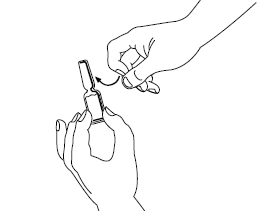
Operation 1:
Signifor injectable solution is contained in a vial
to be broken. The coloured mark on the top
indicates the position of the breaking line on the neck of the
vial. Tap the vial with your fingers to make sure there is no more liquid in the
upper part where it opens.
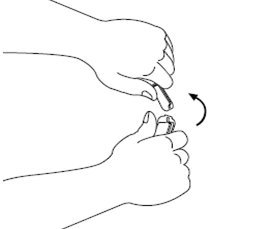
Operation 2:
Recommended procedure: hold the vial in a vertical
position with the coloured mark facing you. Hold the
base of the vial in one hand. Holding one thumb above and
one below the neck of the vial, break the top
at the breaking line. Once the
vial has been opened, place it upright on a
clean, flat surface.

Operation 3:
Take the sterile syringe and insert the needle. If you have
been told to use two needles, use the long, thick and luer needle for this operation.
Before proceeding to operation 4, clean the injection site with an alcohol swab.
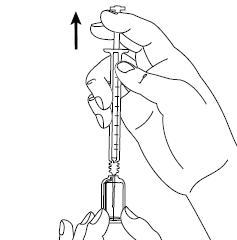
Operation 4:
Remove the cap from the needle. Insert the needle into
the vial and pull the plunger to draw the entire contents
of the vial into the syringe.
If you have been told to use two needles, you now need to
replace the long needle with the short one.
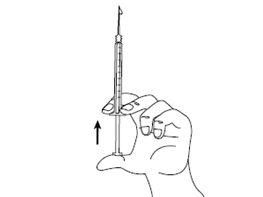
Operation 5:
Hold the syringe in one hand between two fingers with the
thumb on the bottom of the plunger. Tap the
syringe with your fingers to remove air bubbles.
Make sure there are no air bubbles in the syringe by
pressing the plunger until the first drop
comes out of the tip of the needle.
Do not let the needle come into contact with any
surface. Now you are ready for the injection.
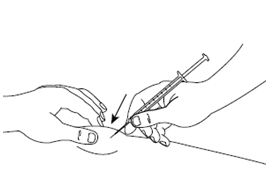
Operation 6:
Gently pinch the skin at the injection site
and, holding the needle at an angle of
approximately 45 degrees (as shown in
figure) insert it into the injection site.
Gently pull the plunger to check that no
blood vessel has been punctured. If you see
blood in the syringe, first remove the needle
from the skin, then replace the short needle with a new one and
insert it into a different injection site.
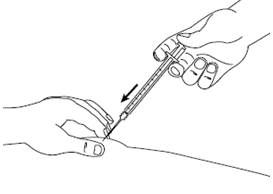
Operation 7:
Still holding the skin raised, slowly push
the syringe plunger all the way down to inject all the
solution. Keep the plunger pressed down and
hold the syringe in this position for 5 seconds.
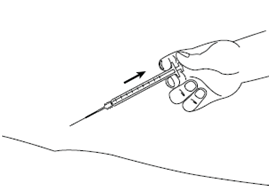
Operation 8:
Slowly release the pinched skin and gently remove
the needle. Put the cap on the needle.
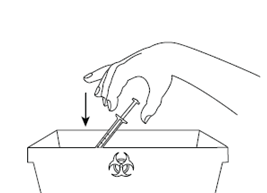
Operation 9:
Immediately dispose of the used syringe and needle in a
sharps container or other rigid, closed container for disposal. Any unused product or waste must be disposed of
in accordance with local regulations.
Signifor 10 mg powder and solvent for injectable suspension, 20 mg powder and solvent for injectable suspension, 30 mg powder and solvent for injectable suspension, 40 mg powder and solvent for injectable suspension, 60 mg powder and solvent for injectable suspension
pasireotide
Read this leaflet carefully before you use this medicine, as it contains important information for you.
- Keep this leaflet. You may need to read it again.
- If you have any questions, ask your doctor, nurse or pharmacist.
- This medicine has been prescribed for you only. Do not pass it on to others, even if their symptoms are the same as yours, as it could be harmful.
- If you get any side effects, even those not listed in this leaflet, tell your doctor, nurse or pharmacist. See section 4.
Contents of this leaflet
- 1. What Signifor is and what it is used for
- 2. What you need to know before you use Signifor
- 3. How to use Signifor
- 4. Possible side effects
- 5. How to store Signifor
- 6. Contents of the pack and other information
1. What Signifor is and what it is used for
Signifor is a medicine that contains the active substance pasireotide. It is used for the treatment
of acromegaly in adult patients. It is also used for the treatment of Cushing's disease in
adult patients for whom surgery is not indicated or has proven ineffective.
Acromegaly
Acromegaly is caused by a type of tumor called a pituitary adenoma that develops in the
pituitary gland (at the base of the brain). The adenoma causes an excessive production of hormones that
control the growth of tissues, organs and bones, resulting in an increase in the size
of bones and tissues, especially in the hands and feet.
Signifor reduces the production of these hormones and possibly also the size of the adenoma. Consequently, it reduces the symptoms of acromegaly, which include headache, increased
sweating, numbness of the hands and feet, fatigue and joint pain.
Cushing's disease
Cushing's disease is caused by the enlargement of the pituitary gland (a gland at the base
of the brain) called a pituitary adenoma. This causes an excessive production of a hormone
called adrenocorticotropic hormone (ACTH), which in turn has the effect of overproduction of
another hormone called cortisol.
The human body naturally produces a substance called somatostatin, which blocks the production
of some hormones, including ACTH. Pasireotide acts very similarly to somatostatin.
Signifor is therefore able to block the production of ACTH, helping to control the overproduction
of cortisol and to improve the symptoms of Cushing's disease.
If you have any questions about how Signifor works or why this
medicine has been prescribed to you, please ask your doctor.
2. What you need to know before using Signifor
Do not use Signifor
- if you are allergic to pasireotide or any of the other ingredients of this medicine (listed in section 6).
- if you have severe liver problems.
Warnings and precautions
Talk to your doctor before using Signifor if you currently have or have ever had:
- problems with your blood sugar levels, if too high (such as in hyperglycemia/diabetes) or if too low (hypoglycemia);
- heart problems such as a recent heart attack, congestive heart failure (a type of heart disease in which the heart cannot pump enough blood around the body) or sudden, severe chest pain (usually felt as pressure, heaviness, tightness, compression or a persistent pain in the chest);
- an irregular heartbeat, such as an irregular heartbeat or an abnormal electrical signal called “QT prolongation”, or “prolonged QT”;
- low levels of potassium or magnesium in your blood;
- gallstones;
- or if you are taking anticoagulants (medicines used to reduce the blood's ability to clot), your doctor will check your coagulation parameters and may adjust the dose of the anticoagulant.
During treatment with Signifor:
- Signifor may cause an increase in blood sugar levels. Your doctor may decide to check your blood sugar and start or adjust your antidiabetic therapy.
- Signifor controls the overproduction of cortisol. The control may be excessive and signs or symptoms associated with a lack of cortisol may occur, such as extreme weakness, fatigue, weight loss, nausea, vomiting or low blood pressure. If this happens, tell your doctor immediately.
- Signifor may lower your heart rate. Your doctor may decide to check your heart rate with a device that measures your heart's activity (an “ECG”, or electrocardiogram). If you are using medicines to treat a heart condition, your doctor may assess the need to adjust the dose.
- Your doctor may also decide to check gallstones, liver enzymes and pituitary hormones periodically, as all of these may be affected by this medicine.
Children and adolescents
This medicine should not be used in children and adolescents under 18 years of age because there is no
data available in this age group.
Other medicines and Signifor
Signifor can interact with the way other medicines work. If you are taking other medicines
at the same time as Signifor (including over-the-counter medicines), your doctor
may need to monitor your heart very carefully or change the dose of Signifor or the other
medicines. Tell your doctor or pharmacist if you are taking, have recently taken or might
take any other medicines. In particular, tell your doctor if you are taking:
- medicines used in organ transplants to reduce the activity of the immune system (cyclosporine);
- medicines to treat blood sugar levels that are too high (such as in diabetes) or too low (hypoglycemia) such as:
- insulin
- metformin, liraglutide, vildagliptin, nateglinide (antidiabetic medicines);
- medicines to treat irregular heartbeat, such as medicines containing disopyramide, procainamide, quinidine, sotalol, dofetilide, ibutilide, amiodarone or dronedarone;
- medicines to treat bacterial infections (orally: clarithromycin, moxifloxacin; by
injection: erythromycin, pentamidine);
- medicines to treat fungal infections (ketoconazole, except in shampoo);
- medicines to treat some mental disorders (chlorpromazine, thioridazine, fluphenazine, pimozide, haloperidol, tiapride, amisulpride, sertindole, methadone);
- medicines to treat hay fever and other allergies (terfenadine, astemizole, mizolastine);
- medicines used for the prevention or treatment of malaria (chloroquine, halofantrine, lumefantrine);
- medicines to control blood pressure such as:
- beta blockers (metoprolol, carteolol, propranolol, sotalol)
- calcium channel blockers (bepridil, verapamil, diltiazem)
- cholinesterase inhibitors (rivastigmine, physostigmine);
- medicines to control the balance of electrolytes in the body (potassium, magnesium).
Pregnancy, breastfeeding and fertility
Ask your doctor or pharmacist for advice before taking any medicine.
- Do not use Signifor during pregnancy unless strictly necessary. If you are pregnant or suspect you are pregnant or are planning to become pregnant, ask your doctor for advice before taking this medicine.
- If you are breastfeeding, ask your doctor for advice before taking this medicine. It is not known whether Signifor passes into breast milk.
- If you are a woman of childbearing potential, you should use contraception during treatment. Ask your doctor about the need for contraception before taking this medicine.
Driving and operating machinery
Signifor may have a mild effect on the ability to drive or operate machinery, because
some of the effects that may occur during the use of Signifor, such as headache, dizziness and
fatigue, may reduce the ability to drive or operate machinery safely.
Important information about some of the ingredients of Signifor
Signifor contains less than 1 mmol (23 mg) of sodium per dose, that is to say it is practically “sodium-free”.
3. How to use Signifor
This medicine will be administered to you by a qualified healthcare professional.
How much Signifor to use
Acromegaly
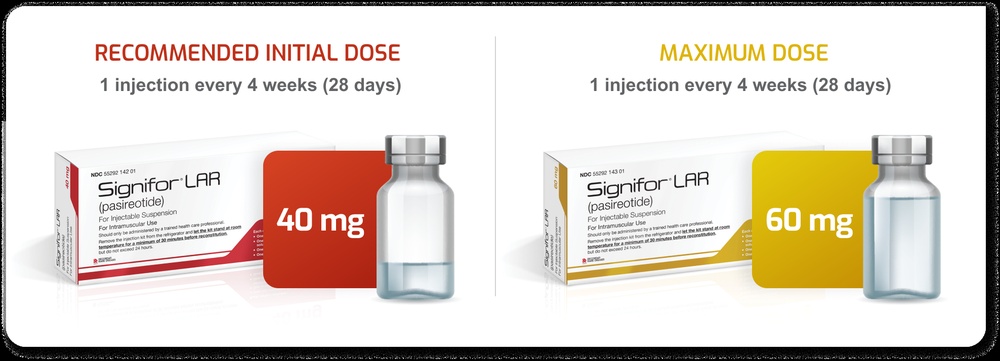
The recommended starting dose of Signifor in acromegaly is 40 mg every 4 weeks. After you have
started treatment, the doctor will reassess the dose. This may involve measuring the
levels of growth hormone and other hormones in the blood. Depending on the results and how you feel,
the dose of Signifor administered in each injection may need to be reduced or
increased. The dose should not exceed 60 mg. If you have liver disease before starting treatment
with Signifor for acromegaly, the doctor may decide to start treatment with a dose of
20 mg.
Cushing's Disease
The usual starting dose of Signifor in Cushing's disease is 10 mg every 4 weeks. After you have
started treatment, the doctor may reassess the dose. This may involve measuring the
levels of cortisol in the blood or urine. Depending on the results and how you feel, the dose of Signifor
administered in each injection may need to be reduced or increased. The dose should not
exceed 40 mg.
The doctor will regularly check how you respond to treatment with Signifor and will establish the best
dose for you.
How to use Signifor
Signifor will be injected by a doctor or nurse. If you have any doubts about the use of this
medicine, ask your doctor, nurse or pharmacist.
Signifor is for intramuscular use. This means that it is injected through a needle into the muscles of
the buttocks.
For how long to use Signifor
This is a long-term treatment that can last for years. The doctor will regularly check your
condition to ensure that the treatment is having the desired effect. Treatment with
Signifor should continue as long as the doctor deems it necessary.
If you stop using Signifor
If you stop treatment with Signifor, symptoms may reappear. Therefore, do not stop using
Signifor unless your doctor tells you to.
If you have any doubts about the use of this medicine, ask your doctor, nurse or
pharmacist.
4. Possible side effects
Like all medicines, this medicine can cause side effects, although not everybody gets them.
Some side effects can be serious. Tell your doctor immediately if you
experience any of the following:
Very common (may affect more than 1 in 10 people)
- High levels of sugar in the blood. This may include excessive thirst, increased urination, increased appetite with weight loss, tiredness, nausea, vomiting, abdominal pain
- Gallstones or complications associated with them. This may include fever, chills, yellowing of the skin/eyes, back pain or pain in the upper right side of the abdomen.
Common (may affect up to 1 in 10 people)
- Low levels of cortisol. This may include excessive tiredness, weakness, weight loss, nausea, vomiting and low blood pressure.
- Slow heartbeat.
- Prolongation of the QT interval (an abnormal electrical signal in the heart that can be seen on tests).
- Problems with bile flow (cholestasis). This may include yellowing of the skin, dark urine, pale stools and itching.
- Inflammation of the gallbladder (cholecystitis).
Other side effects of Signifor may include:
Very common (may affect more than 1 in 10 people)
- Diarrhoea
- Nausea
- Abdominal pain
- Tiredness
Common (may affect up to 1 in 10 people)
- Tiredness, fatigue, paleness of the skin (signs of low red blood cells)
- Loss of appetite
- Headache
- Swelling
- Vomiting
- Dizziness
- Pain, discomfort, itching and swelling at the injection site
- Changes in liver function tests
- Abnormal blood test results (signs of high levels of creatine phosphokinase, glycosylated haemoglobin and lipase in the blood)
- Hair loss
Uncommon (may affect up to 1 in 100 people)
- Changes in blood tests for pancreatic function (amylase)
- Abnormal blood clotting
Not known (frequency cannot be estimated from available data)
- Increased levels of ketone bodies (a group of substances produced in the liver) in the urine or blood (diabetic ketoacidosis) as a complication of increased blood sugar levels. You may experience fruity-smelling breath, difficulty breathing and confusion.
- Oily or greasy stools
- Altered stool color
Reporting of side effects
If you get any side effects, talk to your doctor, nurse or pharmacist. This includes any side effects not listed
in this leaflet. You can also report side effects directly through the national reporting system listed in
Appendix V. By reporting side effects you can help provide more information on the safety of this medicine.
5. How to store Signifor
- Keep this medicine out of the sight and reach of children.
- Do not use this medicine after the expiry date which is stated on the package, vial and pre-filled syringe after “EXP”/“Scad”. The expiry date refers to the last day of that month.
- Store in a refrigerator (2°C-8°C). Do not freeze.
- Do not dispose of any medicine in wastewater or household waste. Ask your pharmacist how to dispose of medicines you no longer use. This will help protect the environment.
6. Content of the pack and other information
What Signifor contains
- The active substance is pasireotide. Signifor 10 mg: each vial contains 10 mg of pasireotide (as pasireotide pamoate). Signifor 20 mg: each vial contains 20 mg of pasireotide (as pasireotide pamoate). Signifor 30 mg: each vial contains 30 mg of pasireotide (as pasireotide pamoate). Signifor 40 mg: each vial contains 40 mg of pasireotide (as pasireotide pamoate). Signifor 60 mg: each vial contains 60 mg of pasireotide (as pasireotide pamoate).
- The other ingredients are:
- In the powder: poly(D,L-lactide-co-glycolide) (50-60:40.50), poly(D,L-lactide-co-glycolide) (50:50).
- In the solvent: sodium carboxymethylcellulose, mannitol, poloxamer 188, water for injections.
Description of the appearance of Signifor and content of the pack.
Signifor powder, is a powder from slightly yellowish to yellowish contained in a vial, the
solvent is a clear solution of colour from slightly yellow to slightly brown in a
pre-filled syringe.
Signifor 10 mg is available in single packs containing a vial of powder with 10 mg of
pasireotide and a pre-filled syringe with 2 ml of solvent.
Signifor 20 mg is available in single packs containing a vial of powder with 20 mg of
pasireotide and a pre-filled syringe with 2 ml of solvent.
Signifor 30 mg is available in single packs containing a vial of powder with 30 mg of
pasireotide and a pre-filled syringe with 2 ml of solvent.
Signifor 40 mg is available in single packs containing a vial of powder with 40 mg of
pasireotide and a pre-filled syringe with 2 ml of solvent.
Signifor 60 mg is available in single packs containing a vial of powder with 60 mg of
pasireotide and a pre-filled syringe with 2 ml of solvent.
Each single pack contains the vial and a pre-filled syringe in a sealed blister tray
with a vial adapter and a safety device injection needle.
Signifor 40 mg and Signifor 60 mg are also available in multipacks containing 3 intermediate
packs.
Not all pack sizes or strengths may be marketed.
Marketing Authorisation Holder
Recordati Rare Diseases
Immeuble Le Wilson
70 avenue du Général de Gaulle
92800 Puteaux
France
Manufacturer
Recordati Rare Diseases
Immeuble Le Wilson
70 avenue du Général de Gaulle
92800 Puteaux
France
Recordati Rare Diseases
Eco River Parc
30 rue des Peupliers
92000 Nanterre
France
For further information on this medicine, contact the local representative of the marketing
authorisation holder:
België/Belgique/Belgien
Recordati
Tél/Tel: +32 2 46101 36
Lietuva
Recordati AB.
Tel: + 46 8 545 80 230
Sweden
България
Recordati Rare Diseases
Teл.: +33 (0)1 47 73 64 58
France
Luxembourg/Luxemburg
Recordati
Tél/Tel: +32 2 46101 36
Belgique/Belgien
Česká republika
Recordati Rare Diseases
Tel: +33 (0)1 47 73 64 58
France
Magyarország
Recordati Rare Diseases
Tel: +33 (0)1 47 73 64 58
France
Danmark
Recordati AB.
Tlf.: + 46 8 545 80 230
Sweden
Malta
Recordati Rare Diseases
Tel: +33 1 47 73 64 58
France
Deutschland
Recordati Rare Diseases Germany GmbH
Tel: +49 731 140 554 0
Nederland
Recordati
Tel: +32 2 46101 36
België
Eesti
Recordati AB.
Tel: + 46 8 545 80 230
Sweden
Norge
Recordati AB.
Tlf: + 46 8 545 80 230
Sweden
Ελλάδα
Recordati Hellas
Τηλ: +30 210 6773822
Österreich
Recordati Rare Diseases Germany GmbH
Tel: +49 731 140 554 0
Germany
España
Recordati Rare Diseases Spain S.L.U.
Tel: + 34 91 659 28 90
Polska
Recordati Rare Diseases
Tel: +33 (0)1 47 73 64 58
France
France
Recordati Rare Diseases
Tél: +33 (0)1 47 73 64 58
Portugal
Jaba Recordati S.A.
Tel: +351 21 432 95 00
Hrvatska
Recordati Rare Diseases
Tél: +33 (0)1 47 73 64 58
France
România
Recordati Rare Diseases
Tel: +33 (0)1 47 73 64 58
France
Ireland
Recordati Rare Diseases
Tél: +33 (0)1 47 73 64 58
France
Slovenija
Recordati Rare Diseases
Tel: +33 (0)1 47 73 64 58
France
Ísland
Recordati AB.
Simi: + 46 8 545 80 230
Sweden
Slovenská republika
Recordati Rare Diseases
Tel: +33 (0)1 47 73 64 58
France
Italia
Recordati Rare Diseases Italy Srl
Tel: +39 02 487 87 173
Suomi/Finland
Recordati AB.
Puh/Tel : +46 8 545 80 230
Sweden
Κύπρος
Recordati Rare Diseases
Τηλ : +33 1 47 73 64 58
France
Sverige
Recordati AB.
Tel : +46 8 545 80 230
Latvija
Recordati AB.
Tel: + 46 8 545 80 230
Sweden
Other sources of information
More detailed information on this medicine is available on the European Medicines Agency website, https://www.ema.europa.eu. Additionally, links to other websites on rare diseases and related therapeutic treatments are provided.
The following information is intended exclusively for healthcare professionals:
INSTRUCTIONS FOR USE OF SIGNIFOR POWDER AND SOLVENT FOR SUSPENSION
FOR INJECTION
FOR DEEP INTRAMUSCULAR INJECTION ONLY
WARNING:
There are two critical steps in the reconstitution of Signifor. Failure to perform them may compromise the
success of the injection.
- The injection kit must reach room temperature. Before reconstitution, remove the injection kit from the refrigerator and allow it to reach room temperature for at least 30 minutes but for no longer than 24 hours.
- After adding the solvent, gently shake the vialfor at least 30 seconds until a uniform suspension is formed.
Included in the injection kit:
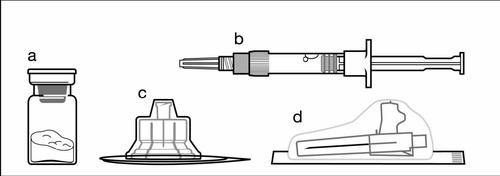
a A vial containing the powder
b A pre-filled syringe containing the solvent
c A vial adapter for reconstituting the medicine
d An injection needle (20G x 1.5″) with safety device
Follow the following instructions carefully to ensure the correct reconstitution of Signifor powder and
solvent for injectable suspension before deep intramuscular injection.
Signifor suspension must be prepared only immediately before administration.
Signifor must only be administered by a qualified healthcare professional.

Operation 1
Remove the Signifor injection kit from the
refrigerator.
WARNING: it is essential to start the
reconstitution procedure only after
bringing the kit to room temperature. Before
reconstitution, leave the kit at
room temperature for at least
30 minutes, but do not exceed 24 hours.
Note: The injection kit can be returned to the
refrigerator if not used within 24 hours.
min
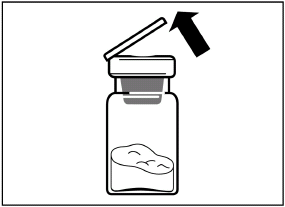
Operation 2
Remove the plastic cap from the vial and
clean the rubber stopper of the vial with a
swab soaked in alcohol.
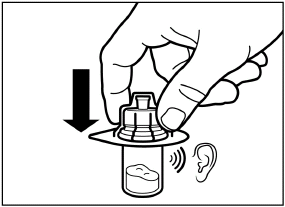
Remove the foil covering the packaging
of the vial adapter, but DO NOT
remove the adapter from the packaging.
Holding the vial adapter packaging, place it on top of
the vial and push it completely down until it clicks into place,
operation confirmed by a “click”.
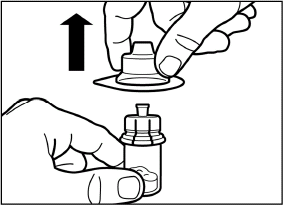
Remove the vial adapter packaging by lifting it up as
shown in the figure.
| Operation 3 Remove the cap from the pre-filled syringe with the solvent and screw the syringe onto the vial adapter. Slowly push the plunger all the way down to transfer all the solvent into the vial. | l F a r m a c o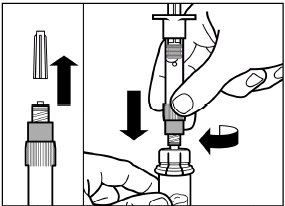 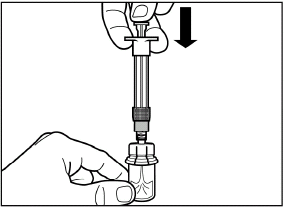 |
| Operation 4 WARNING: hold the plunger pressed and gently shake the vial for at least 30 seconds so that the powder is completely suspended. Shake again gently for another 30 seconds if the powder is not completely suspended. a | a d e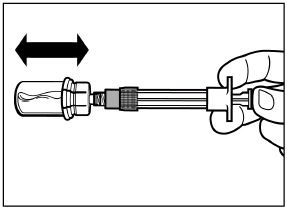 |
| i l Operation 5 Invert the syringe and vial, slowly pull the plunger and aspirate the entire contents of the vial into the syringe. t I a i z Unscrew the syringe from the vial adapter. n e g A | 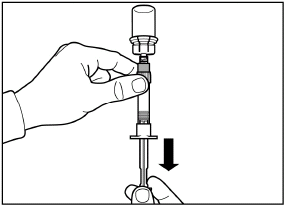 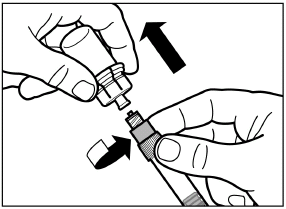 |
| Operation 6 Screw the injection needle with safety protection onto the syringe. Remove the needle protection cap. To avoid sedimentation, you can gently shake the syringe to maintain a uniform suspension. Gently tap the syringe to remove any visible bubbles and expel them. Reconstituted Signifor is now ready for immediate administration. | l F a r m a c o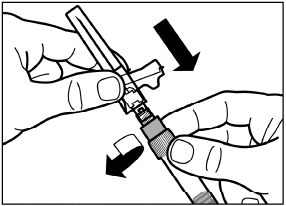 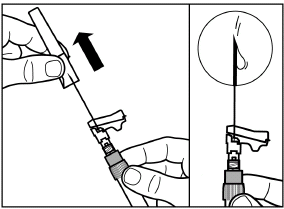 | ||
| Operation 7 Signifor must be administered only with a deep intramuscular injection. Prepare the injection site with a swab soaked in alcohol. Insert the needle completely into the left or n right gluteus muscle at a 90° angle to the skin. a Slowly pull back the plunger to check that no blood vessel has been affected. Remove the needle from the injection site and activate the safety device (as shown in Operation 8). | e d a Angle Injection sites | ||
a Operation 8 t Activate the safety device on the needle in one of the two methods indicated:
| 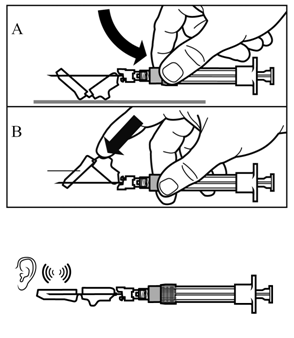 | ||
Annex IV
Scientific conclusions and justification for the variation of the terms of the
authorisation/authorisations to place the medicinal product on the market
Scientific conclusions
In light of the PRAC assessment report on PSURs for pasireotide, the PRAC scientific conclusions are as follows:
In light of the available data on the risk of steatorrhea/discolored stools from spontaneous reports, including 17 cases with a close temporal association and 4 cases with a positive dechallenge, and considering a plausible mechanism of action, the PRAC considers a causal relationship between pasireotide and steatorrhea/discolored stools is at least a reasonable possibility. The PRAC concluded that the product information for pasireotide-containing products should be amended accordingly.
After reviewing the PRAC recommendation, the CHMP agrees with the PRAC’s overall conclusions and the reasons for the recommendation.
Justification for the variation of the terms of the authorisation/authorisations
to place the medicinal product on the market
Based on the scientific conclusions on pasireotide, the CHMP is of the opinion that the benefit-risk ratio of the medicinal product(s) containing pasireotide remains unchanged, subject to the proposed changes to the product information.
The CHMP recommends amending the terms of the authorisation(s) to place the medicinal product on the market.

Не уверены, подходит ли вам это лекарство?
Обсудите симптомы и варианты лечения с врачом онлайн.

Уже начали прием и появились вопросы?
Обсудите свое состояние и дальнейшие шаги с врачом онлайн.
- Страна регистрации
- Форма выпускаInjectable solution, 0.3 MG
- Код АТХH01CB05
- Действующее вещество
- Отпускается по рецептуДа
- Производитель
- Информация на этой странице носит справочный характер и не является медицинской консультацией. Перед началом приема лекарства обязательно проконсультируйтесь с врачом.
- Аналоги SINYIFORФорма выпуска: Injectable solution, <120 mgДействующее вещество: ЛанреотидПроизводитель: IPSEN S.P.AОтпускается по рецептуФорма выпуска: Injectable solution in pre-filled syringe, 60 MGДействующее вещество: ЛанреотидПроизводитель: SUN PHARMACEUTICAL INDUSTRIES (EUROPE) B.V.Отпускается по рецептуФорма выпуска: Injectable solution in pre-filled syringe, 60 MGДействующее вещество: ЛанреотидПроизводитель: ZENTIVA ITALIA S.R.L.Отпускается по рецепту
Аналоги SINYIFOR в других странах
Лекарства с тем же действующим веществом, доступные в других странах.
Аналог SINYIFOR в Испания
Аналог SINYIFOR в Украина
Врачи онлайн по SINYIFOR
Обсудите применение SINYIFOR и возможные следующие шаги — по оценке врача.
Получите рецепт на SINYIFOR онлайн
Заполните форму за 2 минуты
Расскажите о симптомах, истории болезни и нужном препарате.
Выберите врача или мы назначим
Выберите специалиста или мы подберём ближайшего доступного врача.
Врач рассматривает ваш случай
Обычно в течение 30 минут. Может задать уточняющие вопросы в чате.
Получите в любой аптеке
Электронный рецепт отправляется на вашу почту — действителен по всей Польше.
Часто задаваемые вопросы
SINYIFOR требует рецепта в Италия. Вы можете уточнить у врача онлайн, подходит ли это лекарство для вашей ситуации.
Действующее вещество SINYIFOR — Пасиреотид. Эта информация помогает определить лекарства с тем же составом под другими торговыми названиями.
SINYIFOR производится компанией RECORDATI RARE DISEASES SARL. Упаковка и торговое название могут отличаться в зависимости от дистрибьютора.
Врачи, включая Семейные врачи, Психиатры, Дерматологи, Кардиологи, Эндокринологи, Гастроэнтерологи, Пульмонологи, Нефрологи, Ревматологи, Гематологи, Инфекционисты, Аллергологи, Гериатры, Педиатры, Онкологи, могут оценить целесообразность применения SINYIFOR с учетом вашей ситуации и местных правил. Вы можете записаться на онлайн-консультацию, чтобы обсудить возможные варианты.
Польша имеет хорошо развитую систему здравоохранения в крупных городах, таких как Варшава, Краков, Вроцлав и Гданьск. Аптеки широко доступны и работают в соответствии с действующим законодательством, обеспечивая доступ к рецептурным препаратам.
Вы можете купить SINYIFOR в Варшаве, Кракове, Вроцлаве или Гданьске в любой аптеке при наличии действующего рецепта.
Чтобы получить рецепт, вы можете воспользоваться Oladoctor:
Другие лекарства с тем же действующим веществом (Пасиреотид) включают IPSTYL, LANREOTIDE SUN, LANREOTIDE TSENTIVA. Они могут отличаться торговым названием или формой выпуска, но содержат одинаковый терапевтический компонент. Перед изменением лечения рекомендуется проконсультироваться с врачом.
