



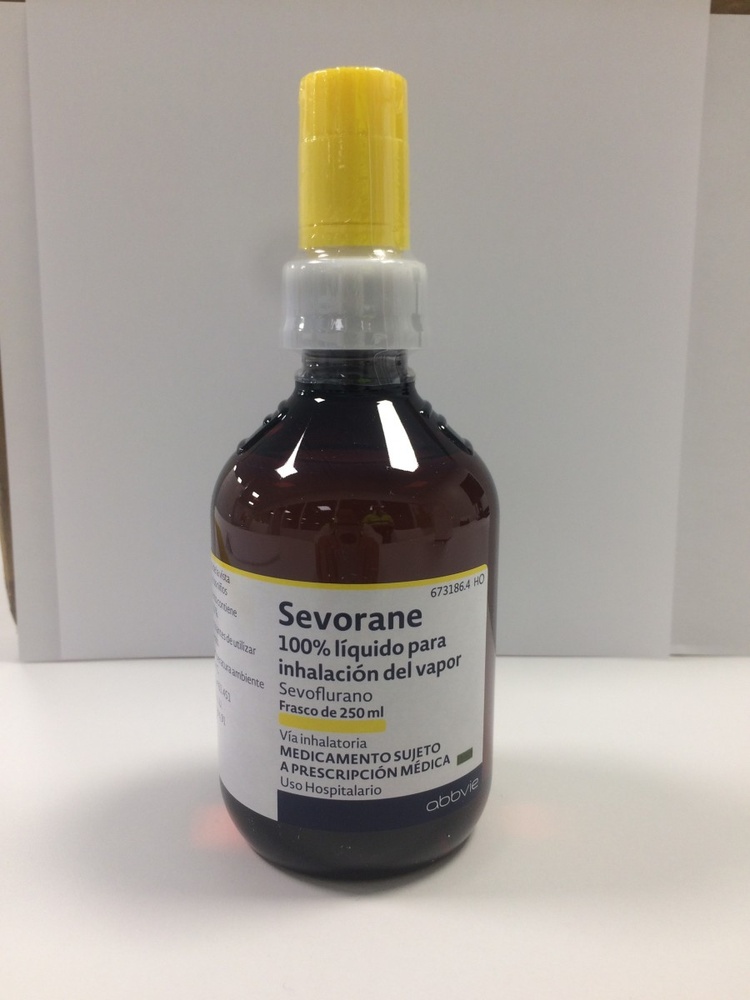
SEVORANE 250 ML Прессurized solution for inhalation

Рассмотрение рецепта онлайн
Врач рассмотрит ваш случай и примет решение о назначении рецепта, если это медицински оправдано.

Поговорите с врачом об этом лекарстве
Обсудите симптомы и возможные дальнейшие шаги на онлайн-консультации.



Инструкция по применению SEVORANE
Содержание инструкции
SEVORANE 250 ml liquid for inhalation
Sevoflurano
Read this leaflet carefully before this medicine is administered to you as it contains
important information for you.
- Keep this leaflet. You may need to read it again.
- If you have any questions, ask your doctor or nurse.
- If any side effects occur, including those not listed in this leaflet, ask your doctor or nurse. See section 4.
Contents of this leaflet:
- 1. What Sevorane is and what it is used for
- 2. What you need to know before Sevorane is administered to you
- 3. How to use Sevorane
- 4. Possible side effects
- 5. How to store Sevorane
- 6. Contents of the pack and other information
1. What is Sevorane and what is it used for?
Sevorane contains the active ingredient sevoflurane. Sevoflurane is a general anesthetic used in
surgery, which is administered in the form of an inhaled vapor.
Sevorane is indicated in adults and childrento induce and maintain general anesthesia (a condition of
deep sleep without perception of pain) during the performance of a surgical procedure.
2. What you need to know before Sevorane is administered to you
Sevorane must not be administered to you
- If you/the child are allergic to sevoflurane and/or other similar inhalation anesthetics to sevoflurane (e.g. if following anesthesia with one of these medicines you have experienced reactions such as: liver problems with increased liver enzymes, fever, increased number of a type of white blood cells).
- If you/the child know or think you have a predisposition to a condition called malignant hyperthermia (a sudden and dangerously high increase in body temperature during or immediately after surgery) (see section 4 “Possible side effects”).
- If there are medical reasons why you/the child should not undergo general anesthesia.
Warnings and precautions
This medicine will only be administered under strict control of qualified medical personnel
(anesthesiologist).
Consult your doctor or nurse before Sevorane is administered if:
- you/the child suffer from a rare hereditary disease that causes muscle weakness and which worsens over time (Pompe disease),
- you/the child have an alteration of the cells called mitochondrial dysfunction,
- you/the child have or have had liver problems, for example hepatitis (inflammation of the liver) with or without yellowish discoloration of the skin (jaundice),
- you/the child are taking medicines that can cause liver problems (see section “Other medicines and Sevorane”),
- you/the child have been administered sevoflurane or an inhalation anesthetic belonging to the same group, more than once in a short interval of time (less than 3 months),
- you/the child suffer from a disease that affects nerves and muscles (in particular Duchenne muscular dystrophy),
- you/the child have a reduced blood volume (hypovolemia),
- you/the child have low blood pressure (hypotension),
- you/the child suffer from circulatory disorders,
- you/the child suffer from coronary artery disease,
- you/the child have reduced kidney function,
- you/the child have a risk of developing an increase in pressure in the brain,
- you/the child are at risk of experiencing episodes of seizures (violent and uncontrolled contractions of the body muscles) (see section “Children and adolescents” and section 4 “Possible side effects”),
- you are pregnant, breastfeeding or if this medicine is administered during labor (see section “Pregnancy, breastfeeding and fertility”).
The doctor (the anesthesiologist) will stop the administration of sevoflurane and initiate other supportive therapy if you/the child develop malignant hyperthermia (see section 4 “Possible side effects”).
Children
The use of sevoflurane has been associated with seizures in children (starting from 2 months of age) and adolescents,
therefore the doctor must be particularly careful when using this medicine.
Other medicines and Sevorane
Inform your doctor/anesthesiologist if you/the child are taking, have recently taken or might use
any other medicine.
Some medicines can interact if used together with Sevorane.
In particular:
- medicines that act mainly on the sympathetic nervous system, the system that controls the internal organs (mainly circulation and heart), such as for example amphetamine, ephedrine, adrenaline, noradrenaline, epinephrine, isoprenaline. If you/the child are to undergo surgery, the doctor may ask you to stop treatment with these medicines a few days before the operation;
- medicines to treat depression (non-selective monoamine oxidase inhibitors, MAO). If you/the child are to undergo surgery, the doctor may ask you to stop treatment two weeks before;
- St. John's wort, a herbal remedy used to treat depression;
- medicines with a potent analgesic action (opioids), such as alfentanil and sufentanil;
- calcium antagonists, verapamil and beta-blockers (medicines that act at the level of the heart), usually administered to treat high blood pressure or an irregular heartbeat;
- isoniazid, a medicine used in the treatment of some infections. If you/the child are to undergo surgery, the doctor may ask you to stop treatment one week before and not resume it before 15 days later;
- other medicines or substances (including alcohol) that increase the activity of a particular liver enzyme, the CYP2E1 isoenzyme of cytochrome P450;
- other medicines used during general anesthesia (e.g. vecuronium, pancuronium, and atracurium, succinylcholine, nitrous oxide, halogenated inhaled anesthetics).
Pregnancy, breastfeeding and fertility
If you are pregnant, suspect you are pregnant, are planning a pregnancy, or are breastfeeding, ask your doctor for advice before you are administered this medicine.
Pregnancy
Data relating to the use of sevoflurane in pregnant women are non-existent or limited.
Studies conducted on animals have shown reproductive toxicity.
Sevorane should be used during pregnancy only if it is truly necessary. The doctor (the anesthesiologist)
will pay particular attention when using sevoflurane during obstetric anesthesia.
Breastfeeding
It is not known whether sevoflurane is excreted in breast milk.
The doctor (the anesthesiologist) will pay particular attention when administering Sevorane to breastfeeding women.
Fertility
Studies conducted on animals have not shown any adverse effects on fertility.
Driving and using machines
After general anesthesia, the ability to drive vehicles (including bicycles) and use machinery may be
impaired for a certain period of time. This means that until the doctor considers that you/the child have fully
recovered your reaction skills, you/the child must not drive vehicles and use machinery after the surgery.
The doctor will assess whether it is appropriate for you/the child to be accompanied when leaving the hospital.
3. How to use Sevorane
This medicine will be administered only under strict control of qualified medical personnel.
The most suitable dose for you/the child will be established by the anesthesiologist (the doctor who performs the anesthesia), based on
age, body weight and state of health. The doctor will administer the correct dose of Sevorane to
initiate and maintain anesthesia or to achieve the desired level of sedation, by carefully
evaluating your/the child's response and vital signs (pulse, breathing, blood pressure, etc.).
Use in children and adolescents
The dose will be established by the anesthesiologist based on the child's age and weight.
Method of administration
Sevorane will be administered to you by inhalation.
If you are elderly or debilitated, or have problems with the heart and/or blood circulation, kidneys, liver or are in a
condition with reduced blood volume (hypovolemia), the doctor/anesthesiologist will assess a possible
adjustment of the Sevorane dose.
If more Sevorane is administered than you should
It is very unlikely that a higher dose of Sevorane than necessary will be administered, as the
doctor will monitor you during treatment.
However, if you are given an excessive dose of Sevorane, the doctor will adopt the appropriate
supportive therapy.
4. Possible side effects
Like all medicines, this medicine can cause side effects, although not everybody gets them.
During the administration of Sevorane, the following seriousside effects may occur, in
which case the doctor will provide immediatelywith appropriate treatment:
- effects on the heart(heart rhythm abnormalities)
- malignant hyperthermia(a sudden and dangerously high increase in body temperature during or immediately after surgery). In this case, the doctor/anesthesiologist will stop the administration of sevoflurane and initiate appropriate therapy (see section “Warnings and precautions”)
- allergic reactionswhich may manifest with:
- difficulty breathing (dyspnea)
- anaphylactic reaction
- wheezing
- skin rash (rash)
- skin inflammation (contact dermatitis)
- swelling and pain in the face (facial edema)
- feeling of discomfort in the chest
- increased levels of potassium in the blood (hyperkalemia), which can cause heart rhythm abnormalities and can be fatal in children during the postoperative period.
Below are the possible side effects, reported according to frequency, that may occur with this
medicine:
Very common (may affect more than 1 in 10 people)
- agitation
- decreased heart rate (bradycardia)
- decreased blood pressure (hypotension)
- cough
- nausea, vomiting
Common (may affect up to 1 in 10 people)
- drowsiness, dizziness, headache
- increased heart rate (tachycardia)
- increased blood pressure (hypertension)
- breathing difficulties, spasm of the throat muscles (laryngospasm)
- increased salivation (hypersecretion of saliva)
- chills, increased body temperature (pyrexia)
- abnormalities in the results of some laboratory tests: abnormal blood glucose content, abnormal liver function tests, abnormal count of a type of blood cells (white blood cells), increased fluorine content in the blood
- decreased body temperature (hypothermia)
Uncommon (may affect up to 1 in 100 people)
- blockage of heart contractions (complete atrioventricular block)
Not known (frequency cannot be estimated from available data)
- uncontrolled movements of the body muscles (convulsions), especially in children from 2 months of age
- altered body movements (dystonia)
- cardiac arrest
- constriction of the bronchial muscles (bronchospasm)
- liver diseases (hepatitis, liver failure, liver necrosis)
- urticaria, itching
Reporting of side effects
If you/the child experiences any side effects, including those not listed in this leaflet,
please tell your doctor or nurse. You can also report side effects directly through the
national reporting system at www.agenziafarmaco.gov.it/content/come-segnalare-una-
sospetta-reazione-avversa.
By reporting side effects you can help provide more information on the safety of
this medicine.
5. How to store Sevorane
Keep this medicine out of the sight and reach of children.
Do not use this medicine after the expiry date that is stated on the pack after Exp. The expiry date
refers to the last day of that month.
This medicine does not require any special storage conditions.
Do not dispose of any medicine in wastewater or household waste. Ask your pharmacist how to dispose of
medicines you no longer use. This will help protect the environment.
6. Package Contents and Other Information
What Sevorane Contains
The active ingredient is sevoflurane.
The medicine does not contain any other components.
Description of the Appearance of Sevorane and Package Contents
Sevorane is presented as a clear, colorless liquid available in polyethylene naphthalate (PEN) bottles
of 250 ml.
This medicine is available in the following pack sizes:
- 250 ml bottle with Pilfer Proof cap
- 250 ml Quik Fil bottle
Not all pack sizes may be marketed.
Marketing Authorisation Holder
AbbVie S.r.l.,
S.R. 148 Pontina km 52, snc
04011 Campoverde di Aprilia (LT)
Manufacturer
Aesica Queenborough Limited
Queenborough
Kent ME11 5EL
United Kingdom
AbbVie S.r.l.,
S.R. 148 Pontina km 52, snc
04011 Campoverde di Aprilia (LT)
---------------------------------------------------------------------------------------------------------------------------
The following information is intended exclusively for doctors or healthcare professionals:
This section contains practical information relating to administration. Read the Summary of
Product Characteristics for complete information on dosage, method of administration,
contraindications, warnings etc.
DOSAGE AND ADMINISTRATION
Premedication
Premedication must be performed by assessing the patient's characteristics and at the discretion
of the anesthesiologist.
Surgical Anesthesia
Sevorane must only be used with a vaporizer specifically calibrated for its use in
order to accurately control the inspired anesthetic concentration.
Induction
The dosage must be personalized and titrated according to the desired effect and according to the age and
clinical condition of the patient. A short-acting barbiturate or other intravenous drug may be administered during induction followed by inhalation of Sevorane.
Induction with Sevorane can be achieved with oxygen or a mixture of oxygen and nitrous oxide.
In adult and pediatric patients, administration of Sevorane at concentrations up to 8% generally induces
anesthesia in less than two minutes.
Maintenance
Maintenance of surgical anesthesia is achieved with Sevorane concentrations of 0.5 - 3% with or
without the simultaneous administration of nitrous oxide (see paragraph “Other medicines and
sevorane”, Nitrous Oxide).
In elderly patients, as with other inhaled anesthetics, maintenance is normally achieved at
lower concentrations.
Assess the minimum alveolar concentration for adult and pediatric patients according to age.
The MAC (Minimum Alveolar Concentration) values of Sevorane decrease with age and with the
simultaneous administration of nitrous oxide. The following table shows the average MAC values
for different age groups.
Recovery
Recovery times are generally short, which may necessitate the use of analgesics in the post-
operative period.
Elderly
With increasing age, the minimum alveolar concentration (MAC) decreases.
The average concentration of sevoflurane to reach the MAC in an 80-year-old patient is
approximately half that required for a 20-year-old patient.
Paediatric Population
Refer to Table 1 for the MAC values for pediatric patients based on age.
INCOMPATIBILITIES
Sevoflurane Degradation
Sevoflurane is stable when stored under normal light conditions. No appreciable degradation of sevoflurane is detected in the presence of strong acids or
heat. Sevoflurane is not corrosive to stainless steel, brass, aluminum, nickel-plated brass, chrome-plated brass, or beryllium copper alloy.
Chemical degradation can occur following exposure of inhaled anesthetics to CO adsorbents
within the anesthesia machine. When used directly with fresh adsorbents, sevoflurane degradation is minimal and the resulting products are neither detectable nor toxic. The
degradation of sevoflurane and the consequent formation of its products increase with
increasing adsorbent temperature, due to the fact that the CO adsorbent is dehydrated
(especially those containing potassium hydroxide), with increasing sevoflurane concentration and
with reduced fresh gas flow. Sevoflurane can undergo alkaline degradation via two
routes. The first derives from the loss of hydrogen fluoride with the formation of pentafluoroisopropanyl
fluoromethyl ether (PIFE or more commonly known as Compound A). The second route of sevoflurane degradation occurs only in the presence of dehydrated CO adsorbents and leads to
the dissociation of sevoflurane into hexafluoroisopropanol (HFIP) and formaldehyde. HFIP has a toxicity
comparable to that of sevoflurane, is inactive, non-genotoxic, is rapidly glucuronidated and
eliminated. Formaldehyde is present during normal metabolic processes. Following exposure to a
highly dehydrated adsorbent, formaldehyde may be further degraded to methanol and
formate.
| o Table 1. MAC values in adult and pediatric patients based on age | ||
| Patient Age (years) | Sevoflurane in O 2 | c Sevoflurane in 65% N O/35%O 2 2 |
|
| |
|
| a |
| 6 months - <3 years |
|
|
|
| m |
| 25 |
|
|
| 40 |
|
|
| 60 |
| r
|
| 80 |
| a
|
| F * Term neonates. The MAC in premature infants has not been determined. @ In pediatric patients from 1 to <3 years, a mixture consisting of 60% N O/40% O was used. 2 2 | ||
Formate can contribute to the formation of carbon monoxide in the presence of high temperatures. Methanol can react with Compound A to form the methoxylated Compound B.
Compound B can in turn undergo further loss of hydrogen fluoride, thus forming Compounds C,
D, and E. The formation of formaldehyde, methanol, carbon monoxide, Compound A and probably some of its degradation products, Compounds B, C and D, can occur in the presence of
highly dehydrated adsorbents, especially those containing potassium hydroxide.
Degradation by Lewis Acids
The presence of minimal amounts of water (at least 300 ppm) inhibits the formation of Lewis acids. No
other additives or chemical preservatives are used.

Не уверены, подходит ли вам это лекарство?
Обсудите симптомы и варианты лечения с врачом онлайн.

Уже начали прием и появились вопросы?
Обсудите свое состояние и дальнейшие шаги с врачом онлайн.
- Страна регистрации
- Форма выпускаPressurized solution for inhalation, 250 ML
- Код АТХN01AB08
- Действующее вещество
- Отпускается по рецептуДа
- Производитель
- Информация на этой странице носит справочный характер и не является медицинской консультацией. Перед началом приема лекарства обязательно проконсультируйтесь с врачом.
- Аналоги SEVORANEФорма выпуска: Inhalation solution, 250 MLДействующее вещество: СевофлуранПроизводитель: BAXTER S.P.A.Отпускается по рецептуФорма выпуска: Oral suspension, 100% V/VДействующее вещество: СевофлуранПроизводитель: PIRAMAL CRITICAL CARE B.V.Отпускается без рецептаФорма выпуска: Inhalation solution, 100 MLДействующее вещество: ИзофлуранПроизводитель: BAXTER S.P.A.Отпускается без рецепта
Аналоги SEVORANE в других странах
Лекарства с тем же действующим веществом, доступные в других странах.
Аналог SEVORANE в Испания
Аналог SEVORANE в Польша
Аналог SEVORANE в Украина
Врачи онлайн по SEVORANE
Обсудите применение SEVORANE и возможные следующие шаги — по оценке врача.








Получите рецепт на SEVORANE онлайн
Заполните форму за 2 минуты
Расскажите о симптомах, истории болезни и нужном препарате.
Выберите врача или мы назначим
Выберите специалиста или мы подберём ближайшего доступного врача.
Врач рассматривает ваш случай
Обычно в течение 30 минут. Может задать уточняющие вопросы в чате.
Получите в любой аптеке
Электронный рецепт отправляется на вашу почту — действителен по всей Польше.
Часто задаваемые вопросы
SEVORANE требует рецепта в Италия. Вы можете уточнить у врача онлайн, подходит ли это лекарство для вашей ситуации.
Действующее вещество SEVORANE — Севофлуран. Эта информация помогает определить лекарства с тем же составом под другими торговыми названиями.
SEVORANE производится компанией ABBVIE S.R.L.. Упаковка и торговое название могут отличаться в зависимости от дистрибьютора.
Врачи, включая Семейные врачи, Психиатры, Дерматологи, Кардиологи, Эндокринологи, Гастроэнтерологи, Пульмонологи, Нефрологи, Ревматологи, Гематологи, Инфекционисты, Аллергологи, Гериатры, Педиатры, Онкологи, могут оценить целесообразность применения SEVORANE с учетом вашей ситуации и местных правил. Вы можете записаться на онлайн-консультацию, чтобы обсудить возможные варианты.
Польша имеет хорошо развитую систему здравоохранения в крупных городах, таких как Варшава, Краков, Вроцлав и Гданьск. Аптеки широко доступны и работают в соответствии с действующим законодательством, обеспечивая доступ к рецептурным препаратам.
Вы можете купить SEVORANE в Варшаве, Кракове, Вроцлаве или Гданьске в любой аптеке при наличии действующего рецепта.
Чтобы получить рецепт, вы можете воспользоваться Oladoctor:
Другие лекарства с тем же действующим веществом (Севофлуран) включают SEVOFLURANE BAXTER, SEVOFLURANE PIRAMAL, AERRANE. Они могут отличаться торговым названием или формой выпуска, но содержат одинаковый терапевтический компонент. Перед изменением лечения рекомендуется проконсультироваться с врачом.
