



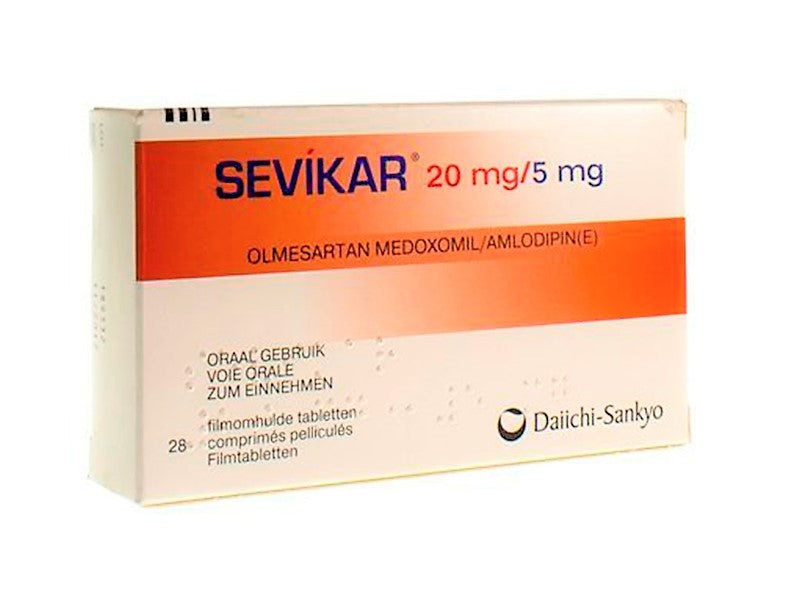
SEVIKAR 20 мг/5 мг Фильм-coated таблетки

Рассмотрение рецепта онлайн
Врач рассмотрит ваш случай и примет решение о назначении рецепта, если это медицински оправдано.

Поговорите с врачом об этом лекарстве
Обсудите симптомы и возможные дальнейшие шаги на онлайн-консультации.



Инструкция по применению SEVIKAR
Содержание инструкции
SEVIKAR 20 mg/5 mg film-coated tablets, 40 mg/5 mg film-coated tablets, 40 mg/10 mg film-coated tablets
olmesartan medoxomil/amlodipine
Read this leaflet carefully before you start taking this medicine as it contains important information for you.
- Keep this leaflet. You may need to read it again.
- If you have any questions, ask your doctor or pharmacist.
- This medicine has been prescribed for you only. Do not pass it on to others, even if their symptoms are the same as yours, as it could be harmful.
- If you get any side effects, even those not listed in this leaflet, tell your doctor or pharmacist. See section 4.
Contents of this leaflet:
- 1. What Sevikar is and what it is used for
- 2. What you need to know before you take Sevikar
- 3. How to take Sevikar
- 4. Possible side effects
- 5. How to store Sevikar
- 6. Contents of the pack and other information
1. What Sevikar is and what it is used for
Sevikar contains two substances called olmesartan medoxomil and amlodipine (as
amlodipine besylate). Both are used to control high blood pressure.
- Olmesartan medoxomil belongs to a group of medicines called “angiotensin II receptor antagonists”. They lower blood pressure by relaxing the blood vessels.
- Amlodipine belongs to a group of substances called “calcium antagonists”. Amlodipine prevents calcium from entering the vessel wall, counteracting its tension and reducing blood pressure.
The action of both substances helps to counteract vascular tension, so that the
vessels relax and blood pressure is reduced.
Sevikar is used to treat high blood pressure (also called “arterial hypertension”) in
patients whose blood pressure is not sufficiently controlled by olmesartan
medoxomil or amlodipine alone.
2. What you need to know before taking Sevikar
Do not take Sevikar
- if you are allergic to olmesartan medoxomil or amlodipine or to a particular group of calcium antagonists, the dihydropyridines, or to any of the other ingredients of this medicine (listed in section 6). If you think you may be allergic, talk to your doctor before taking Sevikar.
- if you are pregnant for more than three months (it is best to avoid taking Sevikar even in the early stages of pregnancy - see the section “Pregnancy and breastfeeding”).
- if you suffer from diabetes or your kidney function is impaired and you are being treated with a medicine that lowers blood pressure, containing aliskiren.
- if you have severe liver problems, if bile secretion is impaired or the outflow from the gallbladder is blocked (for example by gallstones) or if you develop jaundice (yellowing of the skin and eyes)
- if your blood pressure is very low.
- if you suffer from insufficient blood supply to the tissues with symptoms such as low blood pressure, weak pulse, rapid heartbeat (shock, including cardiogenic shock). Cardiogenic shock means shock due to serious heart problems.
- if the blood flow from your heart is obstructed (for example due to a narrowing of the aorta (aortic stenosis).
- if you suffer from reduced cardiac output (causing shortness of breath or peripheral swelling) after a heart attack (acute myocardial infarction).
Warnings and precautions
Talk to your doctor or pharmacist before taking Sevikar.
Consult your doctorif you are taking any of the following medicines used to treat high blood pressure:
- an ACE inhibitor (for example enalapril, lisinopril, ramipril), especially if you suffer from kidney problems related to diabetes.
- Aliskiren.
The doctor may check your kidney function, blood pressure, and the amount of electrolytes (for example potassium) in your blood at regular intervals.
See also what is stated in the section “Do not take Sevikar”
Consult your doctorif you also have any of the following health problems:
- Kidney problems or kidney transplant.
- Liver disease.
- Heart failure or problems with the heart valves or heart muscle.
- Severe vomiting, diarrhea, treatment with high doses of diuretics, or if you are on a low-salt diet.
- Increased levels of potassium in the blood.
- Problems with the adrenal glands (glands that produce hormones, located above the kidneys).
Tell your doctor if you experience severe and prolonged diarrhea with significant weight loss. Your doctor will assess the symptoms and decide whether to continue this antihypertensive treatment.
As with any medicine that lowers blood pressure, an excessive reduction in pressure in patients with circulatory disorders of the heart or brain could lead to a heart attack or stroke. Your doctor will therefore carefully monitor your blood pressure.
You should inform your doctor if you think you are pregnant (or if there is a possibility of becoming pregnant). Sevikar is not recommended in early pregnancy and should not be taken if you are pregnant for more than three months, as it can cause serious harm to the baby if taken during this period (see the section “Pregnancy and breastfeeding”).
Children and adolescents
Sevikar is not recommended in children and adolescents under 18 years of age.
Other medicines and Sevikar
Tell your doctor or pharmacist if you are taking, have recently taken or might take any other medicines, including any of the following:
- Other medicines that lower blood pressurecan increase the effect of Sevikar. Your doctor may need to adjust the dose and/or take other precautions: If you are taking an ACE inhibitor or aliskiren (see also what is stated in the section “Do not take Sevikar” and “Warnings and precautions”).
- Potassium supplements, salt substitutes containing potassium, diuretics or heparin(to thin the blood and prevent thrombosis). Taking these medicines together with Sevikar can increase potassium levels in the blood.
- Lithium(a medicine used to treat mood swings and some types of depression) used together with Sevikar can increase lithium toxicity. If you need to take lithium, your doctor will measure your lithium levels in the blood.
- Non-steroidal anti-inflammatory drugs(NSAIDs, medicines used to reduce pain, swelling and other symptoms of inflammation, including arthritis) used together with Sevikar can increase the risk of kidney failure. The effect of Sevikar may be reduced by NSAIDs.
- Colesevelam hydrochloride, a medicine that lowers cholesterol levels in the blood, which may decrease the effect of Sevikar. Your doctor may advise you to take Sevikar at least 4 hours before colesevelam hydrochloride.
- Some antacids(used for indigestion or heartburn) can slightly reduce the effect of Sevikar.
- Medicines for HIV/AIDS(for example ritonavir, indinavir, nelfinavir) or for the treatment of fungal infections(for example ketoconazole, itraconazole).
- Diltiazem, verapamil,medicines used for heart rhythm problems and high blood pressure.
- Rifampicin, erythromycin, clarithromycin(antibiotics) medicines used for tuberculosis or other infections.
- St John's Wort(Hypericum perforatum), a herbal remedy.
- Dantrolene(infusion for severe temperature alterations).
- Simvastatin,a substance used to reduce cholesterol and fat (triglyceride) levels in the blood.
- Tacrolimus, sirolimus, temsirolimus, everolimus and cyclosporine,used to control the immune response of your body, and thus allow your body to accept transplanted organs.
Tell your doctor or pharmacist if you are taking, have recently taken or might take any other medicines.
Sevikar with food and drink
Sevikar can be taken with or without food. The tablet should be swallowed with some liquid (such as a glass of water). If possible, take your daily dose at the same time each day, for example with breakfast.
People taking Sevikar should not consume grapefruit and grapefruit juice as grapefruit and its juice can increase the levels of the active ingredient amlodipine in the blood, which may lead to an unpredictable increase in the hypotensive effect of Sevikar.
Elderly
If you are over 65 years of age, your doctor will regularly check your blood pressure with each dose increase, to avoid it falling too much.
Black patients
As with other similar medicines, the blood pressure lowering effect of Sevikar may be somewhat reduced in black patients.
Pregnancy and breastfeeding
Pregnancy
You should tell your doctor if you think you are pregnant (or if there is a possibility of becoming pregnant). As a rule, your doctor will advise you to stop taking Sevikar before starting a pregnancy or as soon as you find out you are pregnant and will advise you to take another medicine instead of Sevikar. Sevikar is not recommended in early pregnancy and should not be taken if you are pregnant for more than three months as it can cause serious harm to the baby if taken after the third month of pregnancy.
If you should become pregnant during treatment with Sevikar, inform and see your doctor immediately.
Breastfeeding
Tell your doctor if you are breastfeeding or are planning to start breastfeeding. Amlodipine has been shown to pass into breast milk in small amounts. Sevikar is not recommended for women who are breastfeeding and your doctor may choose another treatment for you if you wish to breastfeed, especially if the baby is newborn or premature.
If you are pregnant, suspect or are planning a pregnancy, or are breastfeeding, ask your doctor or pharmacist for advice before taking this medicine.
Driving and using machines
You may feel drowsy, unwell or dizzy or have a headache during treatment for high blood pressure. If this happens, do not drive or use machines until the symptoms have disappeared. Ask your doctor.
This medicine contains less than 1 mmol of sodium (23 mg) per film-coated tablet, i.e. it is essentially sodium-free.
3. How to take Sevikar
Take this medicine following exactly the instructions of your doctor or pharmacist. If you have any doubts, consult your doctor or pharmacist.
- The recommended dose of Sevikar is one tablet a day.
- The tablets can be taken with or without food. Swallow the tablets with a little liquid (such as a glass of water). The tablets must not be chewed. Do not take them with grapefruit juice.
- If possible, take your daily dose every day at the same time, for example with breakfast.
If you take more Sevikar than you should
If you take more tablets than you should, you may have a reduction in blood pressure with symptoms such as dizziness, acceleration or slowing of the heartbeat.
If you take more tablets than you should or if a child accidentally swallows any, go immediately to your doctor or to the nearest emergency room
Excess fluid can accumulate in the lungs (pulmonary edema) causing shortness of breath that can develop up to 24-48 hours after taking it.
If you forget to take Sevikar
If you forget to take a dose, take your normal dose the next day. Do nottake a double dose to make up for a missed dose.
If you stop taking Sevikar
It is important to continue taking Sevikar unless your doctor tells you to stop.
If you have any doubts about the use of this medicine, ask your doctor or pharmacist.
4. Possible side effects
Like all medicines, this medicine can cause side effects, although not everyone will experience them.
If they do occur, they are usually mild and do not require stopping treatment.
Although they do not occur in all people, the following side effects may be
serious:
during treatment with Sevikar, allergic reactions may occur, which may
affect the whole body, with swelling of the face, mouth and/or larynx (the seat of the
vocal cords), associated with itching and rash. If this happens, stop
taking Sevikar and contact your doctor immediately.
Sevikar may cause excessive reductions in blood pressure in sensitive individuals or
as a result of an allergic reaction. This may cause severe dizziness or
fainting. If this happens, stop taking Sevikar, contact your doctor immediately and remain in a lying position.
Frequency not known: if you experience yellowing of the whites of your eyes, dark urine, skin itching,
even if you have been taking Sevikar for a long time, contact
your doctor immediatelywho will evaluate the symptoms and decide how to proceed with therapy for
the treatment of high blood pressure.
Other possible side effects of Sevikar:
Common (may affect up to 1 in 10 people):
Dizziness; headache; swelling of ankles, feet, legs, hands or arms; fatigue.
Uncommon (may affect up to 1 in 100 people):
Dizziness on standing up; lack of energy; tingling or numbness in the hands or feet;
vertigo; awareness of heartbeat; faster heartbeat; low blood pressure with symptoms such as dizziness, lightheadedness, difficulty breathing; cough; nausea;
vomiting; indigestion; diarrhea; constipation; dry mouth; pain in the upper part of the
abdomen; rash; cramps; pain in arms and legs; back pain; feeling of urgency to urinate; sexual inactivity; inability to obtain or
maintain an erection; weakness.
Some changes in blood tests have also been observed, including the
following:
increase or decrease in potassium in the blood, increased creatinine in the blood,
increased uric acid in the blood, increased liver function tests (levels of
gamma glutamyl transferase).
Rare (may affect up to 1 in 1000):
Hypersensitivity to the drug; fainting; redness and warmth to the face; itchy red and
raised wheals (urticaria); swelling of the face.
Side effects reported with the use of olmesartan medoxomil or amlodipine alone, but
not with Sevikar or with a higher frequency:
Olmesartan medoxomil
Common (may affect up to 1 in 10 people):
Bronchitis; sore throat; stuffy or runny nose; cough; abdominal pain; gastrointestinal
flu; diarrhea; indigestion; nausea; bone or joint pain; back pain; blood in the urine; urinary tract infection; chest pain; flu-like symptoms; pain. Changes in laboratory tests such as increased fats
(hypertriglyceridemia); increased urea or uric acid in the plasma and increased values of
liver and muscle function tests.
Uncommon (may affect up to 1 in 100):
Reduction in the number of a type of blood cells called platelets, which can
make you bruise more easily or prolong bleeding time;
immediate allergic reactions that can affect the whole body and can cause
breathing problems or a rapid drop in blood pressure, which can also cause
weakness (anaphylactic reactions); angina (chest pain or discomfort,
known as angina pectoris); itching; rash; allergic skin rash;
rash with hives, swelling of the face; muscle pain; feeling unwell.
Rare (may affect up to 1 in 1000):
Swelling of the face, mouth and/or larynx (the seat of the vocal cords); acute renal failure
and kidney failure; lethargy.
Amlodipine
Very common (may affect more than 1 in 10 people):
Edema (fluid retention).
Common (may affect up to 1 in 10 people):
Abdominal pain; nausea; swollen ankles; drowsiness; redness and warmth to the
face, changes in vision (including double vision and blurred vision), awareness of
heartbeat; diarrhea; constipation; indigestion; cramps; weakness; difficulty breathing.
Uncommon (may affect up to 1 in 100):
Restless sleep; sleep disturbances; mood disturbances including anxiety; depression;
irritability; tremor; changes in taste; fainting; ringing in the ears (tinnitus);
worsening of angina pectoris (chest pain or discomfort); irregular heartbeat; stuffy or runny nose; hair loss; small red spots on the skin
due to small hemorrhages (purpura); skin discoloration; excessive sweating;
rash; itching; itchy red and raised wheals (urticaria); muscle or joint pain; problems with urination; need to urinate at night; increased need
to urinate; enlargement of the breasts in men; chest pain; pain, malaise;
weight gain or loss.
Rare (may affect up to 1 in 1000):
Confusion.
Very rare (may affect up to 1 in 10000):
Reduction in the number of white blood cells in the blood, which may increase the risk of
infections; reduction in the number of a type of blood cells called platelets, which can
make you bruise more easily or prolong bleeding time;
increased glucose in the blood; increased muscle stiffness or increased resistance to
passive movements (hypertonia); tingling or numbness in the hands or feet; heart attack; inflammation of blood vessels; inflammation of the liver or pancreas;
inflammation of the stomach wall; thickening of the gums; high levels of
liver enzymes; yellowing of the skin and eyes; increased sensitivity of the skin
to light; allergic reactions (itching, rash, swelling of the face, mouth and/or
larynx (the seat of the vocal cords) together with itching and rash, severe skin reactions including intense rash, hives, redness of the skin
over the entire body surface, severe itching, blisters, peeling and swelling
of the skin, inflammation of the mucous membranes (Stevens Johnson syndrome, toxic epidermal
necrosis), sometimes life-threatening.
Not known (frequency cannot be estimated from available data):
Tremor, rigid posture, mask-like face, slow movements and an unbalanced gait,
shuffling walk.
Reporting of side effects
If you get any side effects, even those not listed in this leaflet, tell your doctor or pharmacist. You can also report side effects
directly through the national reporting system at:
https://www.aifa.gov.it/content/segnalazioni-reazioni-avverse .
By reporting side effects you can help provide more information on the
safety of this medicine.
5. How to store Sevikar
Keep this medicine out of the sight and reach of children.
Do not use this medicine after the expiry date which is stated on the pack after
“Exp”. The expiry date refers to the last day of that month.
This medicine does not require any special storage conditions.
Do not dispose of any medicine in waste water or household waste. Ask your pharmacist
how to dispose of medicines you no longer use. This will help protect the environment.
6. Package Contents and Other Information
What Sevikar contains
The active ingredients are olmesartan medoxomil and amlodipine (as besilate).
Each film-coated tablet contains 20 mg of olmesartan medoxomil and 5 mg of
amlodipine (as besilate).
Each film-coated tablet contains 40 mg of olmesartan medoxomil and 5 mg of
amlodipine (as besilate).
Each film-coated tablet contains 40 mg of olmesartan medoxomil and 10 mg of
amlodipine (as besilate).
The other ingredients are:
Tablet core: pregelatinized corn starch, silicified microcrystalline cellulose,
sodium croscarmellose, magnesium stearate.
Coating: polyvinyl alcohol, macrogol 3350, talc, titanium dioxide (E171) and iron (III)
oxide (E172, only Sevikar film-coated tablets 40 mg/5 mg and 40 mg/10 mg).
Description of Sevikar and package contents
Sevikar 20 mg/5 mg, film-coated tablets, round, white in color, with the letters C73 imprinted on
one side;
Sevikar 40 mg/5 mg, film-coated tablets, round, cream-colored, with the letters C75 imprinted on
one side;
Sevikar 40 mg/10 mg, film-coated tablets, round, brownish in color, with
the letters C77 imprinted on one side.
Sevikar is available in packs of 14, 28, 30, 56, 90, 98, 10x28 and 10x30 film-coated
tablets, and in packs of 10, 50 and 500 film-coated tablets with a divisible blister
for a single dose.
Not all pack sizes may be marketed.
Marketing Authorisation Holder and Manufacturer
Marketing Authorisation Holder
Daiichi Sankyo Italia SpA
Via Paolo di Dono, 73
00142 Roma
Italy
Manufacturer responsible for batch release
Daiichi Sankyo Europe GmbH
Luitpoldstrasse,1
85276 Pfaffenhofen (Germany)
Berlin-Chemie AG
Glienicker Weg 125
12489 Berlin (Germany)
This medicinal product is authorised in the Member States of the European Economic Area under
the following designations:
Netherlands (RMS), Austria, Belgium, Denmark, Finland, France, Germany, Greece, Ireland,
Iceland, Luxembourg, Norway, Portugal, United Kingdom, Romania, Spain: Sevikar 20 mg/5
mg; 40 mg/5 mg; 40 mg/10 mg

Не уверены, подходит ли вам это лекарство?
Обсудите симптомы и варианты лечения с врачом онлайн.

Уже начали прием и появились вопросы?
Обсудите свое состояние и дальнейшие шаги с врачом онлайн.
- Страна регистрации
- Форма выпускаFilm-coated tablet, 20MG/5MG
- Код АТХC09DB02
- Действующее вещество
- Отпускается по рецептуДа
- Производитель
- Информация на этой странице носит справочный характер и не является медицинской консультацией. Перед началом приема лекарства обязательно проконсультируйтесь с врачом.
- Аналоги SEVIKARФорма выпуска: Film-coated tablet, 20 MG/5 MGДействующее вещество: olmesartan medoxomil and amlodipineПроизводитель: MENARINI INTERNATIONAL OPERATIONS LUXEMBOURG S.A.Отпускается по рецептуФорма выпуска: Film-coated tablet, 20 MG/5 MGДействующее вещество: olmesartan medoxomil and amlodipineПроизводитель: MENARINI INTERNATIONAL OPERATIONS LUXEMBOURG S.A.Отпускается по рецептуФорма выпуска: Film-coated tablet, 20 MG/5 MGДействующее вещество: olmesartan medoxomil and amlodipineПроизводитель: ADAMED S.R.L.Отпускается по рецепту
Аналоги SEVIKAR в других странах
Лекарства с тем же действующим веществом, доступные в других странах.
Аналог SEVIKAR в Испания
Аналог SEVIKAR в Польша
Аналог SEVIKAR в Украина
Врачи онлайн по SEVIKAR
Обсудите применение SEVIKAR и возможные следующие шаги — по оценке врача.
Получите рецепт на SEVIKAR онлайн
Заполните форму за 2 минуты
Расскажите о симптомах, истории болезни и нужном препарате.
Выберите врача или мы назначим
Выберите специалиста или мы подберём ближайшего доступного врача.
Врач рассматривает ваш случай
Обычно в течение 30 минут. Может задать уточняющие вопросы в чате.
Получите в любой аптеке
Электронный рецепт отправляется на вашу почту — действителен по всей Польше.
Часто задаваемые вопросы
SEVIKAR требует рецепта в Италия. Вы можете уточнить у врача онлайн, подходит ли это лекарство для вашей ситуации.
Действующее вещество SEVIKAR — olmesartan medoxomil and amlodipine. Эта информация помогает определить лекарства с тем же составом под другими торговыми названиями.
SEVIKAR производится компанией DAIICHI SANKYO ITALIA S.P.A.. Упаковка и торговое название могут отличаться в зависимости от дистрибьютора.
Врачи, включая Семейные врачи, Психиатры, Дерматологи, Кардиологи, Эндокринологи, Гастроэнтерологи, Пульмонологи, Нефрологи, Ревматологи, Гематологи, Инфекционисты, Аллергологи, Гериатры, Педиатры, Онкологи, могут оценить целесообразность применения SEVIKAR с учетом вашей ситуации и местных правил. Вы можете записаться на онлайн-консультацию, чтобы обсудить возможные варианты.
Польша имеет хорошо развитую систему здравоохранения в крупных городах, таких как Варшава, Краков, Вроцлав и Гданьск. Аптеки широко доступны и работают в соответствии с действующим законодательством, обеспечивая доступ к рецептурным препаратам.
Вы можете купить SEVIKAR в Варшаве, Кракове, Вроцлаве или Гданьске в любой аптеке при наличии действующего рецепта.
Чтобы получить рецепт, вы можете воспользоваться Oladoctor:
Другие лекарства с тем же действующим веществом (olmesartan medoxomil and amlodipine) включают BIVIS, JIANT, LAMERA. Они могут отличаться торговым названием или формой выпуска, но содержат одинаковый терапевтический компонент. Перед изменением лечения рекомендуется проконсультироваться с врачом.
