



RIFLAX 100 mg Hard Capsule

Рассмотрение рецепта онлайн
Врач рассмотрит ваш случай и примет решение о назначении рецепта, если это медицински оправдано.

Поговорите с врачом об этом лекарстве
Обсудите симптомы и возможные дальнейшие шаги на онлайн-консультации.



Инструкция по применению RIFLAX
Содержание инструкции
RIFLAX 100 mg hard capsules, 150 mg hard capsules, 200 mg hard capsules
Fluconazole
Generic medicine
Read this leaflet carefully before you start to take this medicine as it contains
important information for you.
- Keep this leaflet. You may need to read it again.
- If you have any questions, ask your doctor or pharmacist.
- This medicine has been prescribed for you only. Do not pass it on to others, even if their symptoms are the same as yours, as it may be harmful.
- If any of the side effects gets worse, or if you notice any side effects not listed in this leaflet, tell your doctor or pharmacist.
Contents of this leaflet:
- 1. What RIFLAX is and what it is used for
- 2. What you need to know before you take RIFLAX
- 3. How to take RIFLAX
- 4. Possible side effects
- 5. How to store RIFLAX
- 6. Contents of the pack and other information
1. What is RIFLAX and what is it used for
RIFLAX belongs to a group of medicines called "antifungals”. The active ingredient
is fluconazole.
Riflax is used for the treatment of fungal infections and can be used to
prevent Candidainfections. The most common cause of fungal infections is a yeast
called Candida.
Adults
Your doctor may prescribe this medicine for the treatment of the following fungal infections:
- Cryptococcal meningitis - a fungal infection of the brain
- Coccidioidomycosis - a disease of the bronchopulmonary system
- Infections caused by Candidaand found in the bloodstream, in organs (e.g. heart, lungs) or in the urinary tract
- Candidiasis of the mucous membranes - infection of the oral mucosa, throat infection and inflammation of the mouth from dentures
- Genital candidiasis - infection of the vagina or penis
- Skin infections - e.g. athlete's foot, ringworm, itching in the genital area, nail infections.
RIFLAX may be prescribed for:
- preventing the recurrence of cryptococcal meningitis 1/8
- preventing the recurrence of candidiasis of the mucous membranes
- reducing the recurrence of vaginal candidiasis
- preventing Candidainfections (if your immune system is weak or not functioning properly).
Children and adolescents (from 0 to 17 years)
Your doctor may prescribe this medicine for the treatment of the following fungal infections:
- Candidiasis of the mucous membranes - infection of the oral mucosa, throat infection
- Infections caused by Candidaand found in the bloodstream, in organs (e.g. heart, lungs) or in the urinary tract
- Cryptococcal meningitis - a fungal infection of the brain.
RIFLAX may be prescribed for:
- preventing Candidainfections (if your immune system is weak or not functioning properly)
- preventing the recurrence of cryptococcal meningitis .
2. What you need to know before taking RIFLAX
Do not take RIFLAX
- if you are allergic to fluconazole, to other medicines you have used to treat fungal infections or to any of the other ingredients of this medicine (listed in section 6). The symptoms may be itching, redness of the skin or difficulty in breathing
- if you are taking astemizole, terfenadine (antihistamines used to treat allergies)
- if you are taking cisapride (used to treat stomach disorders)
- if you are taking pimozide (used to treat mental disorders)
- if you are taking quinidine (used to treat heart arrhythmias)
- if you are taking erythromycin (antibiotic used to treat bacterial infections).
Warnings and precautions
Talk to your doctor or pharmacist before taking RIFLAX.
If you develop signs of “adrenal insufficiency”, where the adrenal glands do not produce
adequate amounts of certain steroid hormones such as cortisol (chronic or
long-lasting fatigue, muscle weakness, loss of appetite, weight loss, abdominal pain).
Tell your doctor if:
- you have liver or kidney problems
- you suffer from heart disease, including heart arrhythmia
- you have abnormal levels of potassium, calcium or magnesium in your blood
- severe skin reactions appear (itching, redness of the skin or difficulty in breathing).
Other medicines and RIFLAX
Tell your doctor or pharmacist if you are taking, have recently taken or might
take any other medicines, including those available without a prescription.
2/8
Tell your doctor immediatelyif you are taking astemizole, terfenadine (antihistamine
used to treat allergies) or cisapride (used to treat stomach disorders) or pimozide (used to treat mental disorders) or quinidine (used to treat
heart arrhythmias) or erythromycin (antibiotic used to treat
bacterial infections), as they cannot be taken with RIFLAX (see section: ''Do not
take RIFLAX").
There are some medicines that can interact with RIFLAX .Always tell your doctor or
pharmacist if you are taking any of the following medicines:
- rifampicin or rifabutin (antibiotics for the treatment of bacterial infections)
- alfentanil, fentanyl (anaesthetics)
- amitriptyline, nortriptyline (antidepressants)
- amphotericin B, voriconazole (antifungals)
- medicines that thin the blood to prevent blood clots (warfarin or similar medicines)
- benzodiazepines (midazolam, triazolam or similar medicines) used to help you sleep or for anxiety
- carbamazepine, phenytoin (used to treat seizures)
- nifedipine, isradipine, amlodipine, felodipine and losartan (used to treat hypertension - high blood pressure)
- cyclosporine, everolimus, sirolimus or tacrolimus (used to prevent transplant rejection)
- cyclophosphamide, vinca alkaloids (vincristine, vinblastine or similar medicines) used to treat cancer
- halofantrine (used to treat malaria)
- statins (atorvastatin, simvastatin, fluvastatin and similar medicines) used to reduce high cholesterol levels
- methadone (used to treat pain)
- celecoxib, flurbiprofen, naproxen, ibuprofen, lornoxicam, meloxicam, diclofenac (Non-Steroidal Anti-Inflammatory Drugs - NSAIDs)
- oral contraceptives
- prednisone (steroid)
- zidovudine, also known as AZT; saquinavir (used in patients with HIV)
- medicines for diabetes such as chlorpropamide, glibenclamide, glipizide or tolbutamide
- theophylline (used to control asthma)
- vitamin A (food supplement)
- amiodarone (used to treat irregular heartbeats, “arrhythmias”)
- hydrochlorothiazide (a diuretic) .
RIFLAX with food and drink
You can take this medicine with or without food.
Pregnancy and breastfeeding
If you are pregnant, suspect you are pregnant or are planning a pregnancy, or if you are breastfeeding
ask your doctor or pharmacist for advice before taking this medicine.
3/8
You should not take RIFLAX during pregnancy or while breastfeeding unless
your doctor has prescribed it.
Ask your doctor or pharmacist for advice before taking any medicine.
Driving and using machines
You should be aware that dizziness or convulsions may occur while driving or
using machines.
RIFLAX contains lactose
This medicine contains a small amount of lactose (milk sugar). If you have been
diagnosed with intolerance to some sugars, contact your doctor before taking this medicine.
3. How to take RIFLAX
Take this medicine following strictly the instructions of the doctor or pharmacist.
If you have doubts, consult your doctor or pharmacist.
Swallow the capsule whole with a glass of water. It is preferable to take the capsules every day
at the same time.
The usual doses of this medicine to be taken depending on the infection are listed here
below:
Adults
| Condition | n Dose |
| a Treatment of cryptococcal meningitis i l | 400 mg on the first day, then 200 - 400 mg once a day for 6 - 8 weeks or longer, if necessary. Sometimes the doses are increased up to 800 mg |
| a Prevent the recurrence of cryptococcal meningitis t | 200 mg once a day until you are told to stop |
| I Treatment of coccidioidomycosis |
|
| a i Endemic Candida mucosal infections | 800 mg on the first day, then 400 mg once a day |
| z Treatment of infections of the oral mucosa, n throat infections and denture stomatitis | 200 mg - 400 mg on the first day, then 100mg to 200 mg until you are told to stop |
| e Candida mucosal infections - the dose depends on the site of infection | 50 mg - 400 mg once a day for 7 - 30 days until you are told to stop |
| g Prevention of oral mucosal infections, throat infections | 100 mg - 200 mg once a day, or 200 mg 3 times a week as long as you are at risk of contracting an infection |
| A Genital candidiasis | 150 mg in a single dose |
| Reduce recurrences of vaginal candidiasis | 150 mg every three days for a total of 3 doses (day 1, 4 and 7), and then once a week |
4/8
| for 6 months when you are at risk of contracting an infection | |
| Skin mycoses and nail infections | o Depending on the site of infection, 50 mg once a c day, 150 mg once a week, from 300 a mg to 400 mg once a week for 1 to 4 weeks (Athlete's foot may require up to m a 6 weeks, treatment of nail infections lasts until the infected nail is replaced.) |
| Prevent Candida infections (if your immune system is weak or not functioning properly) | r a
|
Use in children and adolescents
Adolescents from 12 to 17 years
Always take the dose prescribed by the doctor (either the adult dosage or the children's dosage).
Children up to 11 years
The maximum recommended dose in children is 400 mg per day.
The dose will be based on the child's weight in kilograms.
| Condition | n Daily dose |
| a Candida infections of the mucous membranes and throat – the i dosage and duration of treatment l depend on the severity and site of infection | 3 mg per kg of body weight (6 mg per kg of body weight may be given on the first day) |
| a Cryptococcal meningitis or endemic Candida fungal infections | 6 mg to 12 mg per kg of body weight |
| t I Preventing a Candida infection in children (if their immune system is not functioning properly) | 3 mg to 12 mg per kg of body weight |
Children aged from 0 to 4 weeks
Use in children aged 3 to 4 weeks:
The same dosage as described above but administered once every 2 days. The maximum
recommended dose is 12 mg per kg of body weight every 48 hours.
Use in children under 2 weeks of age:
The same dosage as described above but administered once every 3 days. The maximum
recommended dose is 12 mg per kg of body weight every 72 hours.
The doctor may sometimes prescribe doses different from these. Always take the medicine as
indicated by the doctor. If you have any doubts, consult your doctor or pharmacist.
Use in the elderly
5/8
The same dose as intended for adults should be used unless you have kidney problems.
Use in patients with kidney problems
The doctor may adjust the dosage based on kidney function.
If you take more RIFLAX than you should
Taking too many capsules all at once may cause you problems. Immediately
warn your doctor or go to the nearest hospital.
In case of accidental overdose, symptoms may include seeing, hearing, feeling and
thinking things that are not real (hallucinations and paranoid behavior).
If you forget to take RIFLAX
Do not take a double dose to make up for a missed dose.
If you forget to take a dose, take it as soon as possible. If it is time to take the
next dose, do not take the forgotten dose.
If you stop taking RIFLAX
If you have any doubts about using this medicine, consult your doctor or pharmacist.
4. Possible side effects
Like all medicines, this medicine can cause side effects, although not everybody gets them.
Some people experience allergic reactionsalthough serious allergic reactions occur
rarely. If you experience any of the following symptoms inform your doctor immediately:
- sudden shortness of breath, difficulty breathing or a feeling of tightness in the chest
- swelling of the eyelids, face or lips
- itching all over the body, redness of the skin or itchy red spots
- skin rashes
- severe skin reactions, for example, rashes that cause blisters (may affect the mouth and tongue).
RIFLAX may have effects on the liver. Symptoms of liver problems include:
- fatigue
- loss of appetite
- vomiting
- yellowing of the skin and the white of the eyes (jaundice).
If you experience any of these symptoms, stop taking RIFLAX and inform your doctor
immediately.
6/8
Other side effects:
Common side effects (may affect up to 1 in 100 people) are as follows:
- headache
- stomach discomfort, diarrhoea, nausea, vomiting
- increases in liver function values in blood tests
- skin rashes
Uncommon side effects (may affect up to 1 in 1,000 people) are as follows:
- reduction in red blood cells which can cause paleness, weakness or shortness of breath
- decreased appetite
- insomnia, drowsiness
- convulsions, dizziness, feeling faint, tingling, prickling or numbness, altered taste
- constipation, difficulty digesting, flatulence, dry mouth
- muscle pain
- liver damage and yellowing of the skin and eyes (jaundice)
- swellings, blisters (urticaria), itching, increased sweating
- fatigue, general feeling of discomfort, fever.
Rare side effects (may affect up to 1 in 10,000 people) are as follows:
- lower than normal levels of white blood cells (which help defend against infections), and platelets (which make blood clotting possible)
- altered skin colour (red or purple) which may be caused by a reduction in platelets, other changes in blood cells
- changes in the chemical composition of the blood (high levels of cholesterol, fats)
- low levels of potassium in the blood
- shivering
- altered electrocardiogram (ECG), changes in heart rate and rhythm
- liver failure
- allergic reactions (sometimes severe), including skin rashes with widespread blistering and peeling of the skin, severe skin reactions, swelling of the lips and face
- hair loss.
Reporting of side effects
If you get any side effects, talk to your doctor or pharmacist .You can also report side effects directly
through the national reporting system at
http://www.agenziafarmaco.gov.it/it/responsabili .
By reporting side effects you can help provide more information on the
safety of this medicine.
5. How to store RIFLAX
Keep this medicine out of the sight and reach of children.
Do not use this medicine after the expiry date which is stated on the label after Exp.
7/8
The expiry date refers to the last day of that month.
Do not store at a temperature above 30°C.
Do not dispose of any medicine in waste water or household waste. Ask your pharmacist how
to dispose of medicines you no longer use. This will help protect the environment.
6. Contents of the pack and other information
What RIFLAX contains
- The active ingredient is fluconazole. Each hard capsule contains 100 mg, 150 mg or 200 mg of fluconazole.
- The other ingredients are: Capsule core: lactose, corn starch, precipitated silica, magnesium stearate, sodium lauryl sulfate. Capsule shell: gelatin, titanium dioxide (E 171), indigotine (E132) (only in 150 mg and 200 mg capsules), black iron oxide (E 172) (only in 200 mg capsules) and erythrosine (only in 200 mg capsules).
Description of the appearance of RIFLAX and contents of the pack
RIFLAX100 mg hard capsules are available in blisters of 10 capsules of 100 mg.
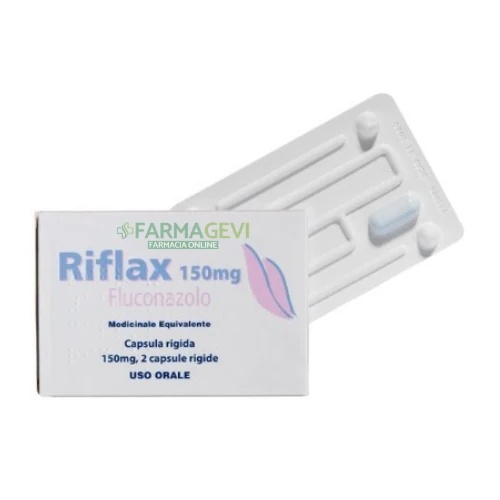
RIFLAX150 mg hard capsules are available in blisters of 2 capsules of 150 mg.
RIFLAX200 mg hard capsules are available in blisters of 7 capsules of 200 mg.
Marketing authorisation holder and manufacturer
Marketing authorisation holder
MORGAN S.R.L.
VIA CANESTRELLO, 2B, 36050 MONTEVIALE (VI)
Manufacturer
Istituto Biochimico Italiano G. Lorenzini S.p.A
Via Fossignano, 2 04011
Aprilia (LT)
Italy
SPECIAL PRODUCT’S LINE S.r.l.
Strada Paduni 240, 03012
Anagni (FR)
Italy
8/8

Не уверены, подходит ли вам это лекарство?
Обсудите симптомы и варианты лечения с врачом онлайн.

Уже начали прием и появились вопросы?
Обсудите свое состояние и дальнейшие шаги с врачом онлайн.
- Страна регистрации
- Форма выпускаHard capsule, 100 MG
- Код АТХJ02AC01
- Действующее вещество
- Отпускается по рецептуДа
- Производитель
- Информация на этой странице носит справочный характер и не является медицинской консультацией. Перед началом приема лекарства обязательно проконсультируйтесь с врачом.
- Аналоги RIFLAXФорма выпуска: Hard capsule, 100 MGДействующее вещество: ФлуконазолПроизводитель: I.B.N. SAVIO S.R.LОтпускается по рецептуФорма выпуска: Hard capsule, 50 MGДействующее вещество: ФлуконазолПроизводитель: BIONATIVA S.P.A.Отпускается по рецептуФорма выпуска: Hard capsule, 100 MGДействующее вещество: ФлуконазолПроизводитель: GENETIC S.P.A.Отпускается по рецепту
Аналоги RIFLAX в других странах
Лекарства с тем же действующим веществом, доступные в других странах.
Аналог RIFLAX в Испания
Аналог RIFLAX в Польша
Аналог RIFLAX в Украина
Врачи онлайн по RIFLAX
Обсудите применение RIFLAX и возможные следующие шаги — по оценке врача.









Получите рецепт на RIFLAX онлайн
Заполните форму за 2 минуты
Расскажите о симптомах, истории болезни и нужном препарате.
Выберите врача или мы назначим
Выберите специалиста или мы подберём ближайшего доступного врача.
Врач рассматривает ваш случай
Обычно в течение 30 минут. Может задать уточняющие вопросы в чате.
Получите в любой аптеке
Электронный рецепт отправляется на вашу почту — действителен по всей Польше.
Часто задаваемые вопросы
RIFLAX требует рецепта в Италия. Вы можете уточнить у врача онлайн, подходит ли это лекарство для вашей ситуации.
Действующее вещество RIFLAX — Флуконазол. Эта информация помогает определить лекарства с тем же составом под другими торговыми названиями.
RIFLAX производится компанией MORGAN S.R.L.. Упаковка и торговое название могут отличаться в зависимости от дистрибьютора.
Врачи, включая Семейные врачи, Психиатры, Дерматологи, Кардиологи, Эндокринологи, Гастроэнтерологи, Пульмонологи, Нефрологи, Ревматологи, Гематологи, Инфекционисты, Аллергологи, Гериатры, Педиатры, Онкологи, могут оценить целесообразность применения RIFLAX с учетом вашей ситуации и местных правил. Вы можете записаться на онлайн-консультацию, чтобы обсудить возможные варианты.
Польша имеет хорошо развитую систему здравоохранения в крупных городах, таких как Варшава, Краков, Вроцлав и Гданьск. Аптеки широко доступны и работают в соответствии с действующим законодательством, обеспечивая доступ к рецептурным препаратам.
Вы можете купить RIFLAX в Варшаве, Кракове, Вроцлаве или Гданьске в любой аптеке при наличии действующего рецепта.
Чтобы получить рецепт, вы можете воспользоваться Oladoctor:
Другие лекарства с тем же действующим веществом (Флуконазол) включают ALOTSOF, AVIFLUKOX, ATSOLIX. Они могут отличаться торговым названием или формой выпуска, но содержат одинаковый терапевтический компонент. Перед изменением лечения рекомендуется проконсультироваться с врачом.
