



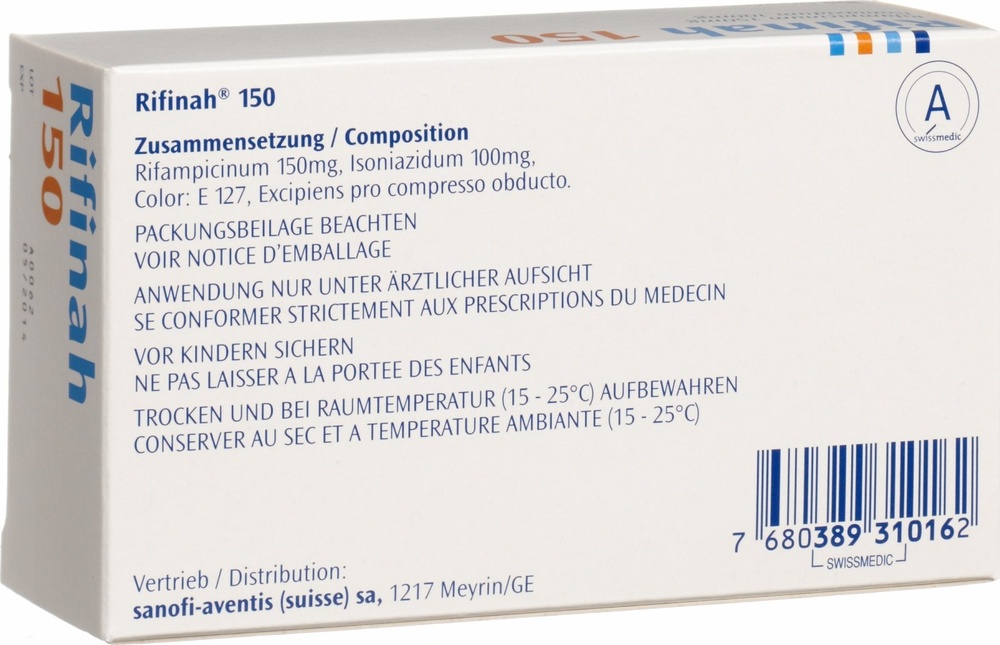
RIFINAH 150 mg/100 mg Coated Tablets

Рассмотрение рецепта онлайн
Врач рассмотрит ваш случай и примет решение о назначении рецепта, если это медицински оправдано.

Поговорите с врачом об этом лекарстве
Обсудите симптомы и возможные дальнейшие шаги на онлайн-консультации.



Инструкция по применению RIFINA
Содержание инструкции
Rifinah 150 mg/100 mg coated tablets, 300 mg/150 mg coated tablets
rifampicin/isoniazid
Read this leaflet carefully before taking this medicine as it contains
important information for you.
- Keep this leaflet. You may need to read it again.
- If you have any questions, ask your doctor or pharmacist.
- This medicine has been prescribed for you only. Do not pass it on to others, even if they have the same symptoms as you, as it may be harmful.
- If any side effects occur, including those not listed in this leaflet, tell your doctor or pharmacist. See section 4.
Contents of this leaflet:
- 1. What Rifinah is and what it is used for
- 2. What you need to know before you take Rifinah
- 3. How to take Rifinah
- 4. Possible side effects
- 5. How to store Rifinah
- 6. Contents of the pack and other information
1. What is Rifinah and what is it used for?
Rifinah is a medicine that contains two active ingredients: rifampicin and isoniazid. These
belong to a class of drugs called antibacterials that work by suppressing the bacteria that
cause tuberculosis (an infectious disease). Rifinah is used in the treatment of pulmonary and extrapulmonary tuberculosis.
2. What you need to know before you use Rifinah
Do not use Rifinah
- if you are allergic to the active ingredients or to any of the other ingredients of this medicine (listed in section 6);
- if you have a disease that causes yellowing of the skin or eyes (jaundice);
- if you are taking a medicine containing saquinavir and ritonavir used to treat HIV infection, the virus that causes AIDS (see section “Other medicines and Rifinah”);
- if you are taking a medicine for schizophrenia and bipolar disorder called lurasidone (see section “Other medicines and Rifinah”).
Warnings and precautions
Talk to your doctor or pharmacist before taking Rifinah if:
- you have problems with your liver;
- you have severe kidney problems;
- if you drink alcohol regularly or have problems with alcoholism, if you take substances intravenously, if you are a black or Hispanic woman, as these conditions increase the likelihood of developing liver inflammation (hepatitis) which can sometimes be fatal. If you experience fatigue, weakness, malaise, loss of appetite (anorexia), nausea or vomiting, tell your doctor as these may be symptoms of liver inflammation;
- if you suffer from porphyria (a rare inherited disorder of blood metabolism);
- if you are malnourished, elderly or adolescent or have diabetes or diseases that affect the nerves (neuropathies): your doctor may decide to administer vitamin B6 to you at the same time;
- you have bleeding problems or a tendency to bruise easily (as this medicine can cause blood clotting disorders);
- you are taking other antibiotics (as some of them may increase the risk of blood clotting disorders);
- you have a history of lung inflammation (interstitial lung disease/pneumonia).
If you are not sure if any of these conditions apply to you, talk to your doctor or pharmacist before
taking Rifinah.
If you experience itching, fatigue, weakness, malaise, loss of appetite, nausea,
vomiting, abdominal pain, yellowing of the eyes or skin, or dark urine, contact
your doctor immediately. These symptoms may be related to inflammation or serious
liver problems (hepatitis or cholestasis).
This medicine can cause a drug reaction (DRESS syndrome) that causes erythema, fever,
inflammation of internal organs, hematological changes and systemic diseases.
If you experience any of these symptoms, stop taking the medicine and contact your doctor
as soon as possible, who will assess whether or not to discontinue treatment.
This medicine can cause severe skin reactions. If you experience any changes in the skin
(for example, ulcers in the mouth, throat, nose, genitals, widespread blisters and peeling), red and
swollen eyes (Stevens-Johnson Syndrome – SJS), or severe and extensive skin damage with separation
of the epidermis and superficial mucous membranes (toxic epidermal necrolysis – TEN) or red and
scaly rash with formation of pustules and blisters (acute generalized exanthematous pustulosis - AGEP), stop
taking the medicine and contact your doctor as soon as possible.
If you notice any of the symptoms related to cerebellar syndrome described in section 4 - Possible
side effects, talk to your doctor or pharmacist. This syndrome has been reported
mainly in patients with chronic kidney disease. Your doctor may reduce the dose or
ask you to stop treatment.
If you develop new or worsening shortness of breath, possibly with a dry cough or fever
that does not respond to antibiotic treatment, inform your doctor immediately. These
may be symptoms of lung inflammation (interstitial lung disease/pneumonia) and
can lead to serious breathing problems due to fluid buildup in the lungs and interfere with
normal breathing which can lead to life-threatening conditions.
If, while taking this medicine, the symptoms of tuberculosis return or worsen, inform
your doctor immediately (see section 4. Possible side effects).
This medicine, if taken in conjunction with other medicines, can decrease their effectiveness. If
you are taking Rifinah, always tell your doctor before taking any other medicine (see also section “Other medicines and Rifinah”).
This medicine can cause a change in color (yellow, orange, red, brown) of the teeth,
urine, sweat, sputum and tears and can permanently stain soft contact lenses.
Laboratory tests
Before taking this medicine, your doctor will prescribe a check of your blood tests.
In addition, during therapy, the doctor will visit you every month.
If you are over 35 years old, your doctor will prescribe you some specific blood tests every month
to check liver function.
Children
This medicine is not suitable for use in children.
Other medicines and Rifinah
Tell your doctor or pharmacist if you are taking, have recently taken or might take
any other medicines.
The use of Rifinah should be avoided simultaneously with the intake of medicines based on
saquinavir/ritonavir (used to treat HIV infection), halothane (an anesthetic) and daclatasvir,
simeprevir, sofosbuvir, telaprevir (used to treat hepatitis C, a liver infection caused by a
virus).
The use of Rifinah should be avoided simultaneously with the intake of lurasidone, a medicine for
schizophrenia and bipolar disorder, as rifampicin can reduce the blood levels of lurasidone.
The use of Rifinah with other antibiotics that cause problems with the blood clotting mechanism
(such as cefazolin) can lead to severe, even fatal, blood clotting disorders and therefore
should be avoided. If this combination cannot be avoided, the doctor will perform
clinical monitoring including monitoring of hemostasis.
In particular, tell your doctor if you are taking any of the following medicines as a dose adjustment may be necessary:
- medicines against convulsions or epilepsy (e.g. phenytoin or carbamazepine);
- medicines against heart rhythm disorders (e.g. disopyramide, mexiletine, quinidine, propafenone, tocainide);
- medicines to treat some cancers (e.g. tamoxifen, toremifene, irinotecan);
- medicines used to thin the blood (e.g. warfarin, clopidogrel);
- medicines against depression and other nervous system diseases (e.g. nortriptyline, haloperidol);
- medicines to treat fungal infections (e.g. caspofungin, fluconazole, itraconazole, ketoconazole);
- medicines to treat HIV infection (e.g. zidovudine, saquinavir, indinavir, efavirenz);
- medicines used to treat anxiety and sleep disorders (e.g. zopiclone, zolpidem, diazepam or barbiturates);
- medicines to treat high blood pressure or other heart diseases (e.g. enalapril, losartan, diltiazem, nifedipine, verapamil and cardiac glycosides and beta-blockers);
- antibiotics (e.g. fluoroquinolones such as telithromycin, quinine, dapsone, doxycycline, chloramphenicol, clarithromycin, para-aminosalicylic acid);
- anti-inflammatory drugs, such as cortisone;
- medicines to lower cholesterol (e.g. clofibrate, statins);
- medicines containing hormones (e.g. gestrinone, oral contraceptives such as the pill, estrogens and progestogens);
- medicines to reduce the body's immune response (e.g. tacrolimus, cyclosporine);
- medicines for diabetes (e.g. sulfonylureas, thiazolidinediones, such as rosiglitazone);
- a medicine for the thyroid (levothyroxine);
- narcotics used to treat pain (e.g. oxycodone, morphine) or to treat drug addiction (e.g. methadone);
- medicines for parasitic infections (e.g. praziquantel, atovaquone);
- a medicine used in amyotrophic lateral sclerosis (riluzole);
- a medicine to treat nausea and vomiting (ondansetron);
- a medicine to treat respiratory diseases (theophylline).
Pay particular attention if you are taking:
- antacids: Rifinah should be taken at least 1 hour before taking the antacid;
- oral contraceptives: to avoid unwanted pregnancy, it is necessary to switch to a different type of contraception, using a reliable barrier method such as a condom or IUD, as Rifinah reduces the action of the pill making it less effective;
- dapsone (an antibiotic): used with rifampicin can cause hematological toxicity including a decrease in bone marrow and red blood cells and methemoglobinemia (decrease in oxygen in the blood caused by alterations in red blood cells);
- paracetamol: used with rifampicin can increase the risk of liver damage.
Tell your doctor or pharmacist if you are pregnant and are planning or need to undergo a pregnancy termination using mifepristone.
Diagnostic tests
Rifinah contains rifampicin and isoniazid. This combination can increase the risk of liver problems, so your doctor may prescribe periodic blood tests.
Rifinah can alter some diagnostic and laboratory tests. Tell your doctor if you need to have medical and laboratory tests, especially if you need to undergo:
- a test to measure the concentration of vitamin B12 or folate in the blood;
- a gallbladder test;
- a urine test to determine the presence of opioids. It is possible that, especially in the first few days of treatment, the values of some laboratory tests relating to the liver, such as bilirubin and transaminases, may increase: your doctor will provide appropriate checks.
Rifinah with food, drinks and alcohol
If you are taking Rifinah, you may experience headache,
sweating, hot flashes, palpitations, low blood pressure with the foods and drinks listed below:
- cheese;
- tuna or other tropical fish;
- red wine.
It is therefore advisable to avoid the foods described above during therapy with Rifinah.
Pregnancy, breastfeeding and fertility
If you are pregnant, suspect or are planning a pregnancy, or if you are breastfeeding with
breast milk, use this medicine only if your doctor has deemed it necessary and under his direct
supervision.
Pregnancy
Rifampicin has been shown to be teratogenic (i.e. can cause fetal malformations) at high doses in studies
on rodents; furthermore, this crosses the placenta and is present in umbilical cord blood, but
its effect on the fetus is not known.
When rifampicin is administered in the last weeks of pregnancy, it can cause
postnatal bleeding in the mother and newborn, therefore its use must be carefully
monitored by qualified healthcare personnel. It has been seen that in the rat and rabbit isoniazid can
exert an effect on the cardiac development of the embryo if administered orally during
pregnancy, although no congenital anomalies have been detected in reproduction studies
in mammals (mouse, rat, rabbit).
Breastfeeding
Rifampicin and isoniazid pass into breast milk. Therefore Rifinah should be used during
breastfeeding only if the potential benefit outweighs the risk to the newborn.
Driving and using machines
Rifinah can cause some side effects (e.g. dizziness and low blood pressure) that can
decrease your ability to concentrate and perform certain activities that require attention. If
this happens to you, avoid driving vehicles or using machinery.
Rifinah contains sucrose, if your doctor has diagnosed you with an intolerance to some sugars, contact
him before taking this medicine.
Rifinah 300 mg/150 mg tablets contains sunset yellowwhich can cause allergic reactions.
3. How to take Rifinah
Take this medicine following exactly the instructions of your doctor or pharmacist. If you
have any doubts, consult your doctor or pharmacist.
The recommended dose is:
Use in adults and the elderly
Rifinah 150 mg/ 100 mg coated tablets:3 to 4 tablets per day.
Rifinah 300 mg/150 mg coated tablets:2 tablets per day.
Take all the tablets at the same time, as a single daily dose.
The tablets must be taken at least 30 minutes before a meal or 2 hours after a meal.
Use in children
This medicine is NOT recommended in children.
If you take more Rifinah than you should
If you take a dose of Rifinah higher than that prescribed, inform your doctor immediately or go to
the nearest hospital. Bring the package of the medicine with you, so that the doctor knows
what you have taken.
Some of the symptoms of overdose may be: nausea, vomiting, stomach pain, itching,
headache, drowsiness, dizziness, speech disorders, blurred vision or hallucinations (seeing things
that are not there, such as bright colors and strange shapes), loss of consciousness (in case of severe
liver disease). Other symptoms include: brownish-reddish or orange discoloration of the skin, urine, sweat,
saliva, tears and stools, the intensity of which is proportional to the dose taken, alteration of
blood tests for the liver (increased liver enzymes and bilirubin). In children, facial, eye or eyelid
swelling may occur. More rarely you may experience: decreased
blood pressure, fast and/or irregular heartbeat, convulsions and cardiac arrest.
In cases where the dose taken is very high, compared to that prescribed, may manifest
difficulty breathing and decreased activity of the central nervous system (which may include a
slowing of breathing, speech disorders, slowed heartbeat, slowed reflexes, etc.)
which can cause coma and severe and intractable seizures.
If you forget to take Rifinah
Do not take a double dose to make up for a missed tablet.
If you stop taking Rifinah
Do not stop treatment without consulting your doctor, because in case of sudden interruption
allergic reactions and anaphylactic shock (severe allergic reaction involving
difficulty breathing, swelling of the face and lips, tongue and other parts of the body) may occur.
If you have any doubts about the use of this medicine, ask your doctor or pharmacist.
4. Possible side effects
Like all medicines, this medicine can cause side effects, although not everybody gets them.
If you experience any of the following side effects, contact your doctor as soon as possible, and
stop taking the medicine:
- inflammation of the pancreas, which causes severe pain in the abdomen and back (pancreatitis, frequency not known);
- severe and widespread skin damage (separation of the epidermis and superficial mucous membranes) (toxic epidermal necrolysis - TEN, can affect up to 1 in 1,000 people);
- a drug reaction that causes erythema, fever, inflammation of internal organs, hematological changes and systemic diseases (DRESS syndrome, can affect up to 1 in 1,000 people);
- jaundice of the skin and whites of the eyes, dark urine and pale stools, fatigue, asthenia, malaise, loss of appetite, nausea or vomiting caused by liver problems (hepatitis, can affect up to 1 in 100 people);
- skin diseases, problems swallowing or breathing, shortness of breath, swelling of the lips, face, throat or tongue. These may be symptoms of anaphylactic shock (severe allergic reaction);
- any change in the skin (for example, mouth, throat, nose, genital ulcers, widespread blisters and scaling), conjunctivitis (red and swollen eyes). These may be symptoms of a severe skin reaction called “Stevens-Johnson Syndrome” - SJS;
- red and scaly skin rash with the formation of pustules and vesicles (acute generalized exanthematous pustulosis - AGEP);
- inflammation of the small blood vessels in the skin that causes the appearance of a reddish-purple skin rash called “purpura”. The medicine can lead to a reduction in the number of certain blood cells called platelets (thrombocytopenia, can affect up to 1 in 10 people) which can lead to this abnormal accumulation of blood under the skin. This condition usually resolves when therapy is stopped while it can worsen leading to brain bleeding and death if therapy is not stopped or if it is resumed after the appearance of this “purpura”.
The following side effects have also been reported with the use of this medicine:
Very common side effects (may affect more than 1 in 10 people)
- fever, chills.
Common side effects (may affect up to 1 in 10 people)
- headache, dizziness;
- nausea, vomiting;
- increased bilirubin in the blood (hyperbilirubinemia);
- altered values in liver function tests (increased aspartate aminotransferase; increased alanine aminotransferase);
- paradoxical reaction to the drug: during treatment, after initial improvement, the symptoms of tuberculosis may reappear or new symptoms may appear. Paradoxical reactions have been reported as early as 2 weeks and up to 18 months after starting anti-tuberculosis treatment. Paradoxical reactions are typically associated with fever, enlarged lymph nodes (lymphadenitis), shortness of breath and cough. Patients with a paradoxical reaction to the drug may also experience headache, loss of appetite and weight loss.
Uncommon side effects (may affect up to 1 in 100 people)
- alteration of blood cells (leukopenia);
- diarrhea.
Side effects with unknown frequency (frequency cannot be estimated on the basis of
available data):
- an inflammatory painful condition of the colon (last part of the intestine) characterized by cramps, persistent diarrhea, weakness and fever (pseudomembranous colitis);
- alterations of blood cells (agranulocytosis, eosinophilia, anemia);
- blood coagulation disorders (vitamin K dependent);
- bleeding;
- allergic reactions;
- breast enlargement in men (gynecomastia);
- a disease called “pellagra” characterized by disorders affecting the digestive system (e.g. diarrhea), nervous, mental disorders (e.g. confusion, insomnia, nervousness, mental slowing, apathy, depression, dementia, delirium) and skin lesions (e.g. scaly skin);
- inflammation of the nerves (polyneuritis) which can cause tingling in the limbs, muscle weakness, loss of tendon reflexes, etc.;
- severe and sometimes fatal liver inflammation (hepatitis);
- alteration of bile flow (cholestasis);
- loss of appetite (anorexia);
- stomach and intestinal disorders, abdominal discomfort;
- inflammation of the pancreas (pancreatitis);
- redness and other skin disorders, with itching, hives, acne;
- severe and widespread redness with skin scaling (exfoliative dermatitis);
- a rare disease affecting the skin and mucous membranes characterized by the appearance of blisters (pemphigus);
- a chronic disease that can affect various organs of the body (systemic lupus erythematosus-like syndrome);
- muscle weakness, diseases affecting the muscles (myopathies);
- postpartum hemorrhage (of the mother and fetus)
- menstrual cycle disorders;
- fluid retention with consequent swelling of some parts of the body (edema);
- malaise and fever;
- hot flashes;
- inflammation of blood vessels causing skin disorders, weakness, fever, joint and muscle pain (vasculitis);
- alteration of the color of tears, mucus, sweat or urine;
- alteration of tooth color (which may be permanent);
- attacks of porphyria in patients already suffering from this disease (a rare inherited metabolic disorder of the blood);
- altered values in liver function tests (increased liver enzymes, increased alkaline phosphatase);
- increased creatinine levels in the blood (creatinine indicates kidney function);
- influenza with bone pain and general malaise;
- difficulty breathing (dyspnea) and wheezing;
- low blood pressure;
- low blood pressure with consequent impairment of consciousness and other mental faculties (shock);
- acute kidney damage due to the onset of kidney diseases (e.g. tubular necrosis or tubulo-interstitial nephritis);
- a severe disease characterized by the formation of widespread blood clots (disseminated intravascular coagulation);
- convulsions;
- a condition characterized by mental confusion, altered level of consciousness and coma due to the accumulation of toxic substances (toxic encephalopathy);
- inflammation of the nerves (neuritis) that can affect the eye causing darkening of vision and decreased visual field (optic atrophy);
- memory disorders;
- mental disorders;
- poor coordination of movements, poor balance, change in speech, involuntary eye movements (cerebellar syndrome);
- alteration of adrenal function in patients who already have adrenal problems;
- inflammation of the lungs (interstitial lung disease/pneumonitis): immediately inform the doctor if you develop new or sudden worsening of shortness of breath, possibly with cough or fever.
Reporting of side effects
If you get any side effects, even those not listed in this leaflet, tell your
doctor or pharmacist. You can also report side effects directly to the address
https://www.aifa.gov.it/content/segnalazioni-reazioni-avverse.
By reporting side effects you can help provide more information on the safety of
this medicine.
5. How to store Rifinah
Do not store at a temperature above 30°C.
Keep this medicine out of the sight and reach of children.
Do not use this medicine after the expiry date which is stated on the box and blister after
“Exp.”. The expiry date refers to the last day of that month.
Do not dispose of any medicine in wastewater or household waste. Ask your pharmacist how to
dispose of medicines you no longer use. This will help protect the environment.
6. Contents of the pack and other information
What Rifinah contains
Rifinah 150 mg/100 mg coated tablets
- The active ingredients are: rifampicin and isoniazid. Each tablet contains 150 mg of rifampicin and 100 mg of isoniazid.
- The other ingredients are: sodium lauryl sulfate, calcium stearate, sodium carboxymethylcellulose, microcrystalline cellulose, gelatin, sucrose, talc, magnesium carbonate, titanium dioxide (E171),
kaolin, aluminium lake and erythrosine (E127), magnesium stearate, gum arabic, anhydrous colloidal silica, povidone.
Rifinah 300 mg/ 150 mg coated tablets
- The active ingredients are: rifampicin and isoniazid. Each tablet contains 300 mg of rifampicin and 150 mg of isoniazid.
- The other ingredients are: sodium lauryl sulfate, calcium stearate, sodium carboxymethylcellulose, microcrystalline cellulose, gelatin, sucrose, talc, magnesium carbonate, titanium dioxide (E171), kaolin, aluminium lake and sunset yellow (E110), magnesium stearate, gum arabic, anhydrous colloidal silica, povidone.
Description of the appearance of Rifinah and contents of the pack
Rifinah 150 mg/ 100 mg coated tablets are presented in a box containing 8 tablets.
Rifinah 300 mg/ 150 mg coated tablets are presented in a box containing 8 tablets or
24 tablets.
Marketing authorisation holder and manufacturer
Sanofi S.r.l. – Viale L. Bodio, 37/B – 20158 Milan
Manufacturer
Sanofi S.r.l. - Via Valcanello, 4 – 03012 Anagni (FR) - Italy

Не уверены, подходит ли вам это лекарство?
Обсудите симптомы и варианты лечения с врачом онлайн.

Уже начали прием и появились вопросы?
Обсудите свое состояние и дальнейшие шаги с врачом онлайн.
- Страна регистрации
- Форма выпускаCoated tablet, 150 MG/100 MG
- Код АТХJ04AM02
- Действующее вещество
- Отпускается по рецептуДа
- Производитель
- Информация на этой странице носит справочный характер и не является медицинской консультацией. Перед началом приема лекарства обязательно проконсультируйтесь с врачом.
- Аналоги RIFINAФорма выпуска: Film-coated tablet, 50 MG/120 MG/300 MGДействующее вещество: rifampicin, pyrazinamide and isoniazidПроизводитель: SANOFI S.R.L.Отпускается по рецептуФорма выпуска: Film-coated tablet, 50 MGДействующее вещество: ДеламанидПроизводитель: OTSUKA NOVEL PRODUCTS GMBHОтпускается по рецептуФорма выпуска: Tablet, 200 MGДействующее вещество: претоманидаПроизводитель: MYLAN IRE HEALTHCARE LIMITEDОтпускается по рецепту
Аналоги RIFINA в других странах
Лекарства с тем же действующим веществом, доступные в других странах.
Аналог RIFINA в Польша
Аналог RIFINA в Украина
Аналог RIFINA в Испания
Врачи онлайн по RIFINA
Обсудите применение RIFINA и возможные следующие шаги — по оценке врача.









Получите рецепт на RIFINA онлайн
Заполните форму за 2 минуты
Расскажите о симптомах, истории болезни и нужном препарате.
Выберите врача или мы назначим
Выберите специалиста или мы подберём ближайшего доступного врача.
Врач рассматривает ваш случай
Обычно в течение 30 минут. Может задать уточняющие вопросы в чате.
Получите в любой аптеке
Электронный рецепт отправляется на вашу почту — действителен по всей Польше.
Часто задаваемые вопросы
RIFINA требует рецепта в Италия. Вы можете уточнить у врача онлайн, подходит ли это лекарство для вашей ситуации.
Действующее вещество RIFINA — rifampicin and isoniazid. Эта информация помогает определить лекарства с тем же составом под другими торговыми названиями.
RIFINA производится компанией SANOFI S.R.L.. Упаковка и торговое название могут отличаться в зависимости от дистрибьютора.
Врачи, включая Семейные врачи, Психиатры, Дерматологи, Кардиологи, Эндокринологи, Гастроэнтерологи, Пульмонологи, Нефрологи, Ревматологи, Гематологи, Инфекционисты, Аллергологи, Гериатры, Педиатры, Онкологи, могут оценить целесообразность применения RIFINA с учетом вашей ситуации и местных правил. Вы можете записаться на онлайн-консультацию, чтобы обсудить возможные варианты.
Польша имеет хорошо развитую систему здравоохранения в крупных городах, таких как Варшава, Краков, Вроцлав и Гданьск. Аптеки широко доступны и работают в соответствии с действующим законодательством, обеспечивая доступ к рецептурным препаратам.
Вы можете купить RIFINA в Варшаве, Кракове, Вроцлаве или Гданьске в любой аптеке при наличии действующего рецепта.
Чтобы получить рецепт, вы можете воспользоваться Oladoctor:
Другие лекарства с тем же действующим веществом (rifampicin and isoniazid) включают RIFATER, DELTYBA, DOVPRELA. Они могут отличаться торговым названием или формой выпуска, но содержат одинаковый терапевтический компонент. Перед изменением лечения рекомендуется проконсультироваться с врачом.
