



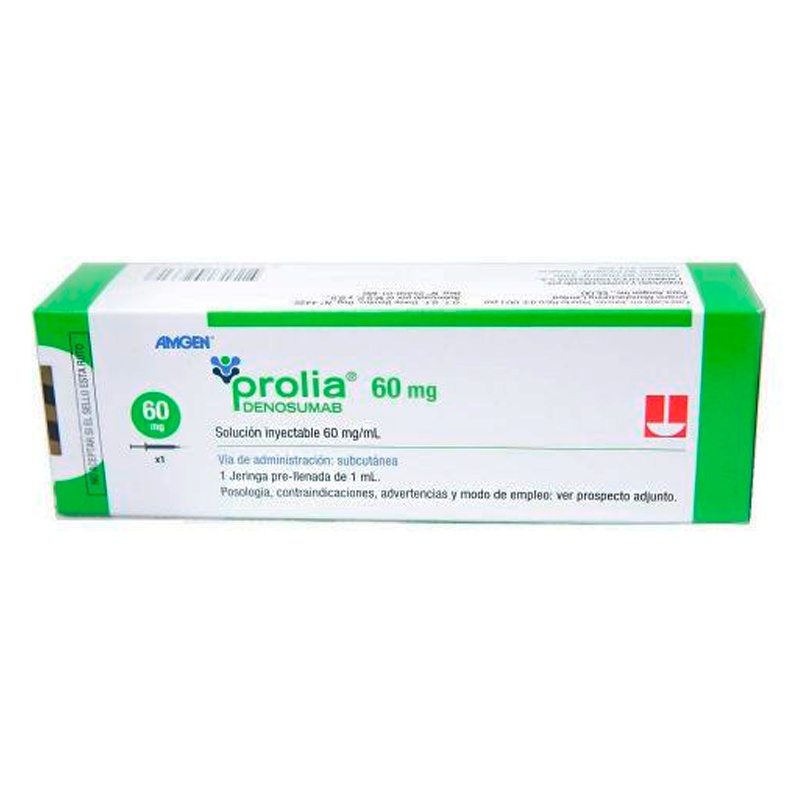
PROLIA 60 мг/мл Инъекционный раствор

Рассмотрение рецепта онлайн
Врач рассмотрит ваш случай и примет решение о назначении рецепта, если это медицински оправдано.

Поговорите с врачом об этом лекарстве
Обсудите симптомы и возможные дальнейшие шаги на онлайн-консультации.



Инструкция по применению PROLIA
Содержание инструкции
Prolia 60 mg injectable solution in pre-filled syringe
denosumab
Read this leaflet carefully before you start to use this medicine as it contains
important information for you.
- Keep this leaflet. You may need to read it again.
- If you have any questions, ask your doctor or pharmacist.
- This medicine has been prescribed for you only. Do not pass it on to others, even if their symptoms are the same as yours, as it could be harmful.
- If you get any side effects, even those not listed in this leaflet, tell your doctor or pharmacist. See section 4.
- Your doctor will give you a patient reminder card containing important safety information that you need to know before and during treatment with Prolia.
Contents of this leaflet
- 1. What Prolia is and what it is used for
- 2. What you need to know before you use Prolia
- 3. How to use Prolia
- 4. Possible side effects
- 5. How to store Prolia
- 6. Contents of the pack and other information
1. What Prolia is and what it is used for
What Prolia is and how it works
Prolia contains denosumab, a protein (monoclonal antibody) that interferes with the action of
another protein, for the treatment of bone loss and osteoporosis. Treatment with Prolia
makes bones stronger and less likely to fracture.
Bone is a living tissue that is constantly being renewed. Estrogens help to keep bones
healthy. After menopause, a decrease in estrogen levels can make bones thin and fragile, which
can lead to the development of a condition called osteoporosis. Osteoporosis can also
occur in men for various reasons including aging and/or a low
level of the male hormone, testosterone. It can also occur in patients receiving
glucocorticoids. Many patients with osteoporosis do not have symptoms, but are still at
risk of bone fractures, especially in the spine, hip and wrists.
Surgical procedures or medications that stop the production of estrogen or testosterone,
used to treat patients with breast or prostate cancer, can also cause
bone loss. Bones thus become more fragile and fracture more easily.
What type of treatment Prolia is used for
Prolia is used for the treatment of:
- osteoporosis in women after menopause (postmenopausal osteoporosis) and in men who have an increased risk of fractures (broken bones), to reduce the risk of vertebral, non-vertebral and hip fractures.
- bone loss in men resulting from a reduction in hormone (testosterone) levels due to surgery or drug therapy in patients with prostate cancer.
- bone loss due to long-term treatment with glucocorticoids in patients at increased risk of fracture.
2. What you need to know before you use Prolia
Do not use Prolia
- if you have reduced levels of calcium in the blood (hypocalcemia).
- if you are allergic to denosumab or any of the other ingredients of this medicine (listed in section 6).
Warnings and precautions
Talk to your doctor or pharmacist before using Prolia.
During treatment with Prolia you may develop a skin infection with symptoms such as
swelling, redness, most commonly in the lower leg, with a sensation of heat and
pain (cellulitis) and with possible feverish symptoms. Tell your doctor immediately if you
experience any of these symptoms.
During treatment with Prolia you must also take calcium and vitamin D supplements. Your doctor
will discuss this with you.
During treatment with Prolia you may have low levels of calcium in the blood. Tell your
doctor immediately if you notice any of the following symptoms: spasms, contractions or cramps in the
muscles, and/or numbness or tingling in the fingers, toes or around the mouth, and/or
convulsions, confusion or loss of consciousness.
In rare cases, severely low levels of calcium in the blood have been reported that have led
to hospitalization and even life-threatening reactions. Before each dose and in patients
prone to developing hypocalcemia within two weeks of the initial dose, blood calcium levels will therefore be checked (by a blood test).
Tell your doctor if you suffer from or have ever suffered from severe kidney problems, kidney impairment or if you
have been on dialysis or are taking medicines called glucocorticoids (such as prednisolone or
dexamethasone), which may increase your risk of having low levels of calcium in the blood if you do not
take calcium supplements.
Problems with the mouth, teeth or jaw/jawbone
An undesirable effect called osteonecrosis of the jaw/jawbone (severe degeneration of the
bone tissue of the jaw/jawbone) has been reported rarely (may occur in up to 1 in 1,000 patients receiving Prolia for osteoporosis). The risk of osteonecrosis of the
jaw/jawbone increases in patients treated for a long period (may occur in up to 1
in 200 if treated for 10 years). Osteonecrosis of the jaw/jawbone can also occur
even after stopping treatment. It is important to try to prevent the development of osteonecrosis
of the jaw/jawbone as it is a painful condition that can be difficult to treat. In order to reduce the risk of developing osteonecrosis of the
jaw/jawbone, take the following
precautions:
Before receiving treatment, tell your doctor or nurse (healthcare professional) if you:
- have any problems with your mouth or teeth, such as poor dental hygiene, gum disease, or are planning to have a tooth extracted;
- do not have regular dental care or have not had a dental check-up for a long period;
- are a smoker (as this may increase the risk of dental problems);
- have been previously treated with a bisphosphonate (used to treat or prevent bone disorders);
- are taking medicines called corticosteroids (such as prednisolone or dexamethasone);
- have cancer.
Your doctor may ask you to have a dental check-up (from the dentist) before starting
treatment with Prolia.
During treatment, it is necessary to maintain good oral hygiene and have regular dental check-ups.
If you wear dentures, you must ensure that they fit properly. If
you are undergoing dental treatment or are planning to have dental surgery (e.g. tooth extractions), tell your doctor about the dental treatment and tell your dentist that you are in
treatment with Prolia.
Contact your doctor and dentist immediately if you notice problems with your mouth or teeth
such as tooth loss, pain or swelling or failure to heal mouth sores or the presence of
discharge, as these may be signs of an undesirable effect called osteonecrosis of the
jaw/jawbone (ONJ).
Atypical femoral fractures
Some people have developed atypical fractures of the femur during treatment with Prolia.
Contact your doctor if you experience new or unusual pain in the hip, groin or thigh.
Children and adolescents
Prolia should not be used in children and adolescents under the age of 18 years.
Other medicines and Prolia
Tell your doctor or pharmacist if you are taking, have recently taken or might take
any other medicines. It is particularly important that you tell your doctor if you are taking other
medicines that contain denosumab.
You must not take Prolia together with other medicines that contain denosumab.
Pregnancy and breastfeeding
Prolia has not been studied in pregnant women. It is important that you tell your doctor if you are
pregnant; if you think you may be pregnant; or if you are planning to become
pregnant. The use of Prolia is not recommended if you are pregnant. Women of childbearing potential
must use effective contraceptive methods while taking Prolia and for at least 5 months after
stopping treatment with Prolia.
If you become pregnant during treatment with Prolia or less than 5 months after stopping
treatment with Prolia, please tell your doctor.
It is not known whether Prolia passes into breast milk. It is important that you tell your doctor if you are breastfeeding or
are planning to breastfeed. Your doctor will then help you decide whether to stop breastfeeding or
taking Prolia, considering the benefit of breastfeeding for the baby and the benefit
of taking Prolia for the mother.
If you are breastfeeding during treatment with Prolia, tell your doctor.
Ask your doctor or pharmacist for advice before using this medicine.
Driving and using machines
Prolia has no or negligible influence on the ability to drive and operate machines.
Prolia contains sorbitol
This medicine contains 47 mg of sorbitol per mL of solution.
Prolia contains sodium
This medicine contains less than 1 mmol of sodium (23 mg) per 60 mg, i.e. essentially ‘sodium-free’.
3. How to use Prolia
The recommended dose is one pre-filled syringe of 60 mg administered once every 6 months, as a
single injection under the skin (subcutaneous). The most suitable injection sites are the upper
thighs and the abdomen. If someone is assisting you with the injection, they can also use the upper
outer part of the arm. Consult your doctor regarding the date of the possible next injection.
Each pack of Prolia contains a reminder card, which can be removed from the box and used to
keep track of the date of the next injection.
During treatment with Prolia, you must also take calcium and vitamin D supplements. Your doctor
will discuss this with you.
Your doctor may decide whether it is better for you or the person assisting you to administer the injection with
Prolia. Your doctor or nursing staff will show you or the person assisting you how to
administer Prolia. For instructions on how to inject Prolia, please refer to the paragraph at the end of this
package leaflet.
Do not shake.
If you forget to take Prolia
If you have forgotten a dose of Prolia, the injection should be given as soon as possible. Subsequently,
the injections should be given every 6 months from the date of the last injection.
If you stop taking Prolia
To get the maximum benefit from treatment in reducing the risk of fractures, it is important to
take Prolia for the entire period prescribed by your doctor. Do not stop treatment without
consulting your doctor.
4. Possible side effects
Like all medicines, this medicine can cause side effects, although not everybody will experience them.
Not commonly, patients treated with Prolia may develop skin infections
(especially cellulitis). Immediately inform your doctorif any of these
symptoms occur while you are taking Prolia: appearance of redness and swelling of the skin, most commonly
on the lower leg, with a sensation of heat and pain and with possible feverish symptoms.
Rarely, patients treated with Prolia may develop pain in the mouth and/or
jaw/mandible, swelling or lesions that do not heal in the mouth or
jaw/mandible, presence of discharge, numbness or feeling of heaviness in the
jaw/mandible, or loosening of a tooth. These could be signs of a serious
degeneration of the bone tissue of the jaw/mandible (osteonecrosis). Immediately inform your
doctor and dentistif you experience such symptoms during treatment with Prolia or after discontinuation of
treatment.
Rarely, patients treated with Prolia may have low levels of calcium in the blood
(hypocalcemia); severely low levels of calcium in the blood can lead to hospitalization and
be life-threatening. Symptoms include spasms, contractions or cramps of the muscles, and/or
numbness or tingling in the fingers of the hands, feet or around the mouth and/or convulsions,
confusion, or loss of consciousness. Immediately inform your doctorif any of these
symptoms occur. Low levels of calcium in the blood can also lead to a change in the heart rhythm
called prolongation of the QT interval, which is detected with an electrocardiogram (ECG).
Rarely, atypical fractures of the femur may occur in patients treated with Prolia.
Contact your doctorif you experience new or unusual pain in the hip, groin or thigh, as
this could be an early sign of a possible fracture of the femur.
Rarely, allergic reactions may occur in patients treated with Prolia. Symptoms
include swelling of the face, lips, tongue, throat or other parts of the body; rash,
itching, hives, wheezing or difficulty breathing. Inform your doctorif you experience any
of these symptoms during treatment with Prolia.
Very common side effects(may affect more than 1 in 10 people):
- bone, joint and/or muscle pain, sometimes severe,
- pain in the arms or legs (limb pain).
Common side effects(may affect up to 1 in 10 people):
- frequent and painful urination, blood in the urine, urinary incontinence,
- upper respiratory tract infections,
- pain, tingling or numbness radiating to the lower limbs (sciatica),
- constipation,
- abdominal discomfort,
- rash,
- itching, redness and/or dryness of the skin (eczema),
- hair loss (alopecia).
Uncommon side effects(may affect up to 1 in 100 people):
- fever, vomiting and abdominal pain or abdominal disorders (diverticulitis),
- ear infections,
- rash that may occur on the skin or ulcers in the mouth (drug-induced lichenoid eruptions).
Very rare side effects(may affect up to 1 in 10,000 people):
- allergic reaction that can damage blood vessels mainly in the skin (e.g. purple or reddish-brown spots, hives or skin ulcers) (hypersensitivity vasculitis).
Not known(frequency cannot be estimated from available data):
- inform your doctor if you experience ear pain, ear discharge, and/or an ear infection. These could be signs of damage to the ear bone.
Reporting of side effects
If you get any side effects, talk to your doctor or pharmacist. This includes any side effects not listed in this leaflet. You can also report side effects directly through the national reporting system listed in Annex V. By reporting side effects, you can help provide more information on the safety of this medicine.
5. How to store Prolia
Keep this medicine out of the sight and reach of children.
Do not use this medicine after the expiry date which is stated on the label and the package after
Exp. The expiry date refers to the last day of that month.
Store in a refrigerator (2 °C – 8 °C).
Do not freeze.
Keep the pre-filled syringe in the outer packaging to protect the medicine from light.
The pre-filled syringe can be left out of the refrigerator in such a way as to reach
room temperature (up to 25 °C) before the injection. This will make the injection more comfortable.
Once the syringe has reached room temperature (up to 25 °C), it must be used
within 30 days.
Do not dispose of any medicine in waste water or household waste. Ask your pharmacist how to
dispose of medicines you no longer use. This will help protect the environment.
6. Contents of the pack and other information
What Prolia contains
- The active substance is denosumab. Each pre-filled syringe of 1 mL contains 60 mg of denosumab (60 mg/mL).
- The other ingredients are glacial acetic acid, sodium hydroxide, sorbitol (E420), polysorbate 20 and water for injections.
Description of Prolia and contents of the pack
Prolia is a clear, injectable solution, from colourless to slightly yellow, in a pre-filled syringe
ready for use.
Each pack contains one pre-filled syringe with needle protection.
Each pack contains one pre-filled syringe.
Not all pack sizes may be marketed.
Marketing Authorisation Holder and Manufacturer
Amgen Europe B.V.
Minervum 7061
4817 ZK Breda
The Netherlands
Marketing Authorisation Holder
Amgen Europe B.V.
Minervum 7061
4817 ZK Breda
The Netherlands
Manufacturer
Amgen Technology (Ireland) Unlimited Company
Pottery Road
Dun Laoghaire
Dublin
Ireland
Manufacturer
Amgen NV
Telecomlaan 5-7
1831 Diegem
Belgium
For further information on this medicinal product, contact the local representative of the marketing
authorisation holder:
België/Belgique/Belgien
s.a. Amgen n.v.
Tél/Tel: +32 (0)2 7752711
Lietuva
Amgen Switzerland AG Vilniaus filialas
Tel: +370 5 219 7474
България
Амджен България ЕООД
Тел.: +359 (0)2 424 7440
Luxembourg/Luxemburg
s.a. Amgen
Belgique/Belgien
Tél/Tel: +32 (0)2 7752711
Česká republika
Amgen s.r.o.
Tel: +420 221 773 500
Magyarország
Amgen Kft.
Tel.: +36 1 35 44 700
Danmark
Amgen, filial af Amgen AB, Sverige
Tlf: +45 39617500
Malta
Amgen S.r.l.
Italy
Tel: +39 02 6241121
Deutschland
Amgen GmbH
Tel.: +49 89 1490960
Nederland
Amgen B.V.
Tel: +31 (0)76 5732500
Eesti
Amgen Switzerland AG Vilniaus filialas
Tel: +372 586 09553
Norge
Amgen AB
Tlf: +47 23308000
Ελλάδα
Amgen Ελλάς Φαρμακευτικά Ε.Π.Ε.
Τηλ: +30 210 3447000
Österreich
Amgen GmbH
Tel: +43 (0)1 50 217
España
Amgen S.A.
Tel: +34 93 600 18 60
Polska
Amgen Biotechnologia Sp. z o.o.
Tel.: +48 22 581 3000
France
Amgen S.A.S.
Tél: +33 (0)9 69 363 363
Portugal
Amgen Biofarmacêutica, Lda.
Tel: +351 21 4220606
Hrvatska
Amgen d.o.o.
Tel: + 385 (0)1 562 57 20
România
Amgen România SRL
Tel: +4021 527 3000
Ireland
Amgen Ireland Limited
Tel: +353 1 8527400
Slovenija
AMGEN zdravila d.o.o.
Tel: +386 (0)1 585 1767
Ísland
Vistor hf.
Sími: +354 535 7000
Slovenská republika
Amgen Slovakia s.r.o.
Tel: +421 2 321 114 49
Italia
Amgen S.r.l.
Tel: +39 02 6241121
Suomi/Finland
Amgen AB, sivuliike Suomessa/Amgen AB, filial
i Finland
Puh/Tel: +358 (0)9 54900500
Kύπρος
C.A. Papaellinas Ltd
Τηλ: +357 22741 741
Sverige
Amgen AB
Tel: +46 (0)8 6951100
Latvija
Amgen Switzerland AG Rīgas filiāle
Tel: +371 257 25888
United Kingdom (Northern Ireland)
Amgen Limited
Tel: +44 (0)1223 420305
Other sources of information
More detailed information on this medicinal product is available on the website of the European Medicines
Agency: http://www.ema.europa.eu/
---------------------------------------------------------------------------------------------------------------------------
Instructions for use:
| o Guide to the parts | |
Before use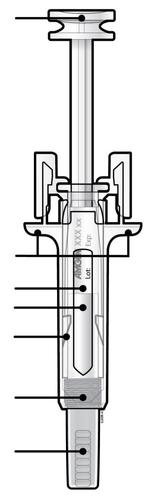 | After use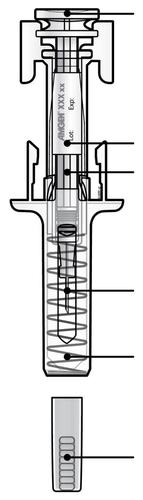 |
| Plunger Base for fingers Syringe label Syringe barrel Syringe safety n Spring safety of the needle i Grey cap l of the inserted needle | c Used plunger a m r a F Syringe label l e d Used needle a Used needle safety spring Grey cap of the removed needle |
Important
Before using a Prolia pre-filled syringe with automatic needle protection, read
this important information:
- It is important that you do not attempt to administer the injection unless you have received adequate instructions from your doctor or healthcare professional.
- Prolia is administered as an injection into the tissue just below the skin (subcutaneous injection). Donot remove the grey cap from the needle of the pre-filled syringe until you are ready to inject.
Donot use the pre-filled syringe if it has fallen onto a hard surface. Use a new pre-filled syringe
and contact your doctor or healthcare professional.
Donot attempt to activate the pre-filled syringe before the injection.
Donot attempt to remove the transparent safety shield from the pre-filled syringe.
Contact your doctor or healthcare professional for any questions.
| Step 1: Preparation | |
| A | l e Remove the pre-filled syringe from its packaging and prepare the materials needed for the injection: alcohol wipes, a cotton ball or gauze, a bandage and a sharps container (not included). |
d a For a more comfortable injection, leave the pre-filled syringe at room temperature for about 30 minutes before the injection. Wash your hands thoroughly with soap and water. n Place the new pre-filled syringe and other necessary materials on a clean a and well-lit surface. Do not try to warm the syringe using a heat source such as hot water or a i microwave oven. Do not expose the pre-filled syringe to direct sunlight. l
| |
| B | a t Open the packaging by tearing the cover. Grasp the safety shield of the pre-filled syringe to remove the pre-filled syringe from the packaging.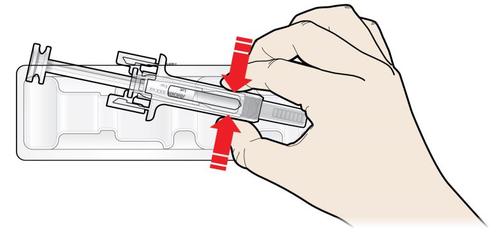 |
| I a i z n e g Grasp here For safety reasons: A Do not grasp the plunger. Do not grasp the grey cap of the needle. | |
| C | Check the medicine and the pre-filled syringe. |
Medicinal o c a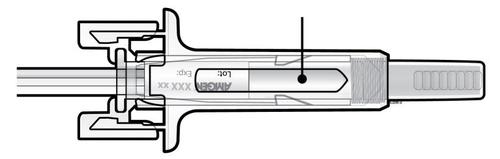 | |
m r Do not use the pre-filled syringe if: a
| |
| Step 2: Preparation | |
| A | e Wash your hands thoroughly. Prepare and clean the injection site.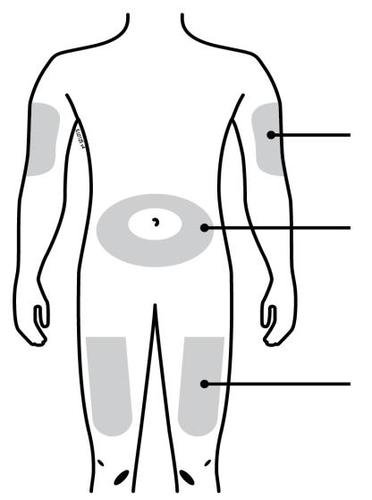 |
d a Upper arm n Abdomen a i l a Upper thigh t You can use: I
| |
| B | Carefully remove the grey cap from the needle by pulling it straight off. |
a r m a c o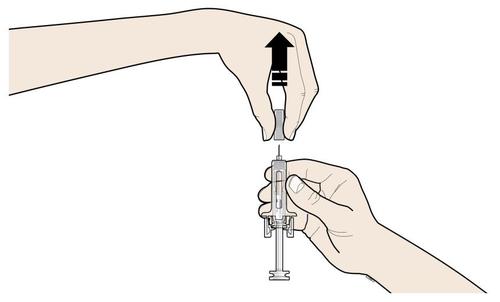 | |
| C | Pinch the skin to create a stable surface. |
| l e d a n a i It is important to keep the skin pinched during the injection. | |
| Step 3: Injection | |
A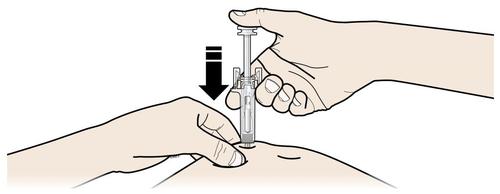 | Keep the skin pinched. INSERT the needle into the skin. |
| t I a i z n e Do not touch the cleaned skin area. | |
B  | PUSH the plunger with a slow and steady pressure until you feel or hear a “click”. Push all the way in until it clicks. |
o c “CLICK” a m r a F l e d It is important to push all the way in until the “click” to inject the entire dose.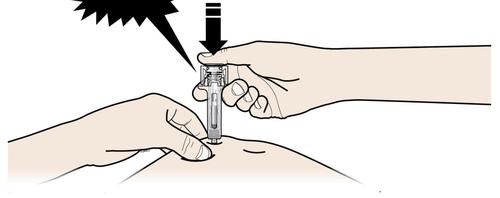 | |
C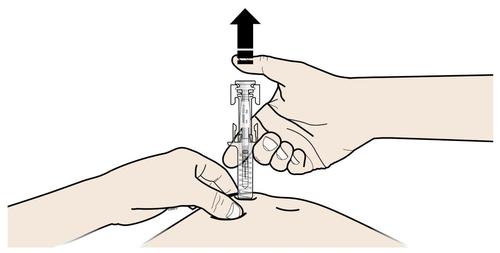 | RELEASE the thumb. Then WITHDRAW the syringe from the skin. |
| a n a i l a t I After releasing the plunger, the safety shield of the pre-filled syringe will cover the injection needle safely. Do not put the grey cap back on the used pre-filled syringes. | |
| Step 4: Finish | |
A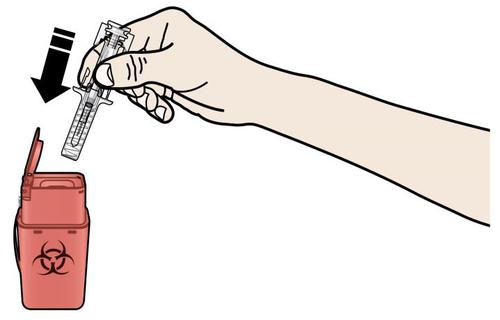 | Dispose of the used pre-filled syringe and other materials in a sharps container. |
| o c a m r a F Medicines should be disposed of in accordance with local regulations. Ask your pharmacist how to dispose of medicines you no longer use. These measures will help protect the environment. l e Keep the syringe and sharps container out of the sight and reach of children. d Do not reuse the pre-filled syringe. Do not recycle the pre-filled syringes or throw them in household waste. | |
| B | Examine the injection site. |
| a If you notice blood, press a cotton ball or gauze on the injection site. Do not rub the injection site. If necessary, apply a bandage. | |
Instructions for injecting Prolia using a pre-filled syringe
This section contains information on how to use the Prolia pre-filled syringe. It is important
that you or the person assisting you do not administer the injection before receiving adequate
instructions from your doctor or nursing staff.Wash your hands before each injection. If you have
questions about the injection, contact your doctor or nursing staff for help.
Before you start
Read all instructions carefully before using the pre-filled syringe.
Donot use the pre-filled syringe if the needle cap has been removed.
How to use the Prolia pre-filled syringe?
Your doctor has prescribed a pre-filled syringe for injecting Prolia under the skin (subcutaneously).
You must inject the entire contents (1 mL) of the Prolia pre-filled syringe, which must be injected
once every 6 months as prescribed by your doctor.
What you need:
To give yourself the injection, you will need:
- 1. A new Prolia pre-filled syringe
- 2. Alcohol wipes or similar disinfectants.
What you must do before the subcutaneous injection of Prolia
- 1. Remove the prefilled syringe from the refrigerator. DO NOThold the prefilled syringe by the plunger or needle cap, as this could damage it.
- 2. Leave the prefilled syringe out of the refrigerator until it reaches room temperature. This will make the injection more comfortable. DO NOTheat the syringe in any other way (for example, in a microwave or in hot water). DO NOTexpose the syringe to direct sunlight.
- 3. DO NOTshake the prefilled syringe.
- 4. DO NOTremove the needle cap from the prefilled syringe until you are ready to give the injection.
- 5. Check the expiration date on the prefilled syringe label (EXP). DO NOTuse it if this date is later than the last day of the indicated month.
- 6. Check the appearance of Prolia. It must be a clear liquid, from colorless to slightly yellow. Do not inject the solution if it contains particles or if it appears cloudy or discolored.
- 7. Find a comfortable, well-lit, and clean surface and keep everything you need within reach.
- 8. Wash your hands thoroughly.
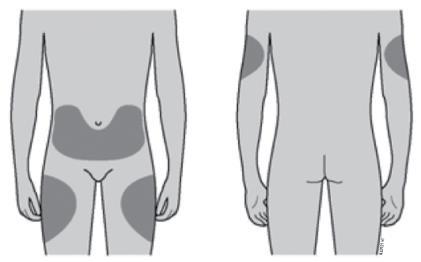
Where to give the injection?
The most suitable injection sites are the upper
part of the thighs and the abdomen.
If someone is assisting you with the injection, they can also use
the upper outer part of the arm.
How to give the injection?
- 1. Disinfect the skin using a cotton ball soaked in alcohol.
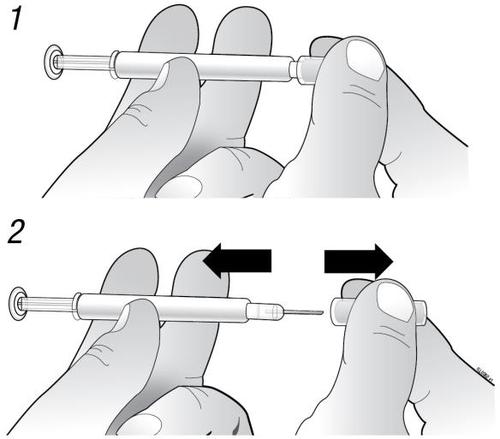
- 2. To avoid bending the needle, gently remove the cap from the needle in a horizontal direction without rotating it, as shown in figures 1 and 2. DO NOTtouch the needle or push the plunger.
- 3. You may notice a small air bubble in the prefilled syringe. You do not need to remove the air bubble before giving the injection. Injecting the solution with the air bubble is harmless.
- 4. Lift the skin between your thumb and index finger (without pinching it). Insert the needle completely into the skin as shown to you by your doctor or nurse.
- 5. Push the plunger with slowand steady pressure, always keeping the skin lifted. Push the plunger all the way down until all the solutionhas been injected.
- 6. Remove the needle and release the skin.
- 7. If you notice a drop of blood, you can gently remove it with a cotton ball or gauze. Do not rub the injection site. If necessary, you can cover the injection site with a bandage.
- 8. Use each prefilled syringe for only one injection. DO NOT reuse Prolia remaining in the syringe.
Remember:if you have problems, do not hesitate to consult your doctor or nurse for
help or advice.
Disposal of used syringes
- DO NOTput the cap back on used needles.
- Keep used syringes out of the reach and sight of children.
- Used syringes must be disposed of in accordance with local regulations. Ask your pharmacist how to dispose of medicines you no longer use. These measures will help protect the environment.
ANNEX IV
SCIENTIFIC CONCLUSIONS AND JUSTIFICATION FOR THE VARIATION OF THE TERMS
OF THE MARKETING AUTHORISATION
Scientific conclusions
Considering the assessment by the Pharmacovigilance and Risk Assessment Committee
(PRAC) of the Periodic Safety Update Reports (PSUR) for denosumab, the scientific conclusions of the
PRAC are as follows:
In light of the available data, from clinical studies and also described in recently published literature,
on the reduction in bone mineral density following discontinuation of denosumab, the PRAC has concluded
that the product information for products containing denosumab (indicated for osteoporosis and bone loss
associated with hormonal ablation in prostate cancer) must be revised accordingly.
Having examined the PRAC recommendation, the Committee for Human Medicinal Products
(CHMP) agrees with the general conclusions and with the justification for the recommendation.
Justification for the variation of the terms of the marketing authorisation
Based on the scientific conclusions on denosumab (indicated for osteoporosis and bone loss
associated with hormonal ablation in prostate cancer) the CHMP considers that the benefit/risk ratio of the
medicinal product containing denosumab (indicated for osteoporosis and bone loss
associated with hormonal ablation in prostate cancer) remains unchanged subject to the proposed changes
to the product information.
The CHMP recommends the variation of the terms of the marketing authorisation.

Не уверены, подходит ли вам это лекарство?
Обсудите симптомы и варианты лечения с врачом онлайн.

Уже начали прием и появились вопросы?
Обсудите свое состояние и дальнейшие шаги с врачом онлайн.
- Страна регистрации
- Форма выпускаInjectable solution, 60 MG/ML
- Код АТХM05BX04
- Действующее вещество
- Отпускается по рецептуДа
- Производитель
- Информация на этой странице носит справочный характер и не является медицинской консультацией. Перед началом приема лекарства обязательно проконсультируйтесь с врачом.
- Аналоги PROLIAФорма выпуска: Injectable solution in pre-filled syringe, 60 mg/mLДействующее вещество: ДеносумабПроизводитель: MABXIENCE RESEARCH SLОтпускается по рецептуФорма выпуска: Injectable solution in pre-filled syringe, 60 mg/mLДействующее вещество: ДеносумабПроизводитель: SANDOZ GMBHОтпускается по рецептуФорма выпуска: Injectable solution, 120 mgДействующее вещество: ДеносумабПроизводитель: ACCORD HEALTHCARE, S.L.U.Отпускается по рецепту
Аналоги PROLIA в других странах
Лекарства с тем же действующим веществом, доступные в других странах.
Аналог PROLIA в Испания
Аналог PROLIA в Украина
Аналог PROLIA в Польша
Врачи онлайн по PROLIA
Обсудите применение PROLIA и возможные следующие шаги — по оценке врача.



Получите рецепт на PROLIA онлайн
Заполните форму за 2 минуты
Расскажите о симптомах, истории болезни и нужном препарате.
Выберите врача или мы назначим
Выберите специалиста или мы подберём ближайшего доступного врача.
Врач рассматривает ваш случай
Обычно в течение 30 минут. Может задать уточняющие вопросы в чате.
Получите в любой аптеке
Электронный рецепт отправляется на вашу почту — действителен по всей Польше.
Часто задаваемые вопросы
PROLIA требует рецепта в Италия. Вы можете уточнить у врача онлайн, подходит ли это лекарство для вашей ситуации.
Действующее вещество PROLIA — Деносумаб. Эта информация помогает определить лекарства с тем же составом под другими торговыми названиями.
PROLIA производится компанией AMGEN EUROPE B.V.. Упаковка и торговое название могут отличаться в зависимости от дистрибьютора.
Врачи, включая Семейные врачи, Психиатры, Дерматологи, Кардиологи, Эндокринологи, Гастроэнтерологи, Пульмонологи, Нефрологи, Ревматологи, Гематологи, Инфекционисты, Аллергологи, Гериатры, Педиатры, Онкологи, могут оценить целесообразность применения PROLIA с учетом вашей ситуации и местных правил. Вы можете записаться на онлайн-консультацию, чтобы обсудить возможные варианты.
Польша имеет хорошо развитую систему здравоохранения в крупных городах, таких как Варшава, Краков, Вроцлав и Гданьск. Аптеки широко доступны и работают в соответствии с действующим законодательством, обеспечивая доступ к рецептурным препаратам.
Вы можете купить PROLIA в Варшаве, Кракове, Вроцлаве или Гданьске в любой аптеке при наличии действующего рецепта.
Чтобы получить рецепт, вы можете воспользоваться Oladoctor:
Другие лекарства с тем же действующим веществом (Деносумаб) включают ITSAMBY, JUBBONTI, JUBEREQ. Они могут отличаться торговым названием или формой выпуска, но содержат одинаковый терапевтический компонент. Перед изменением лечения рекомендуется проконсультироваться с врачом.
