



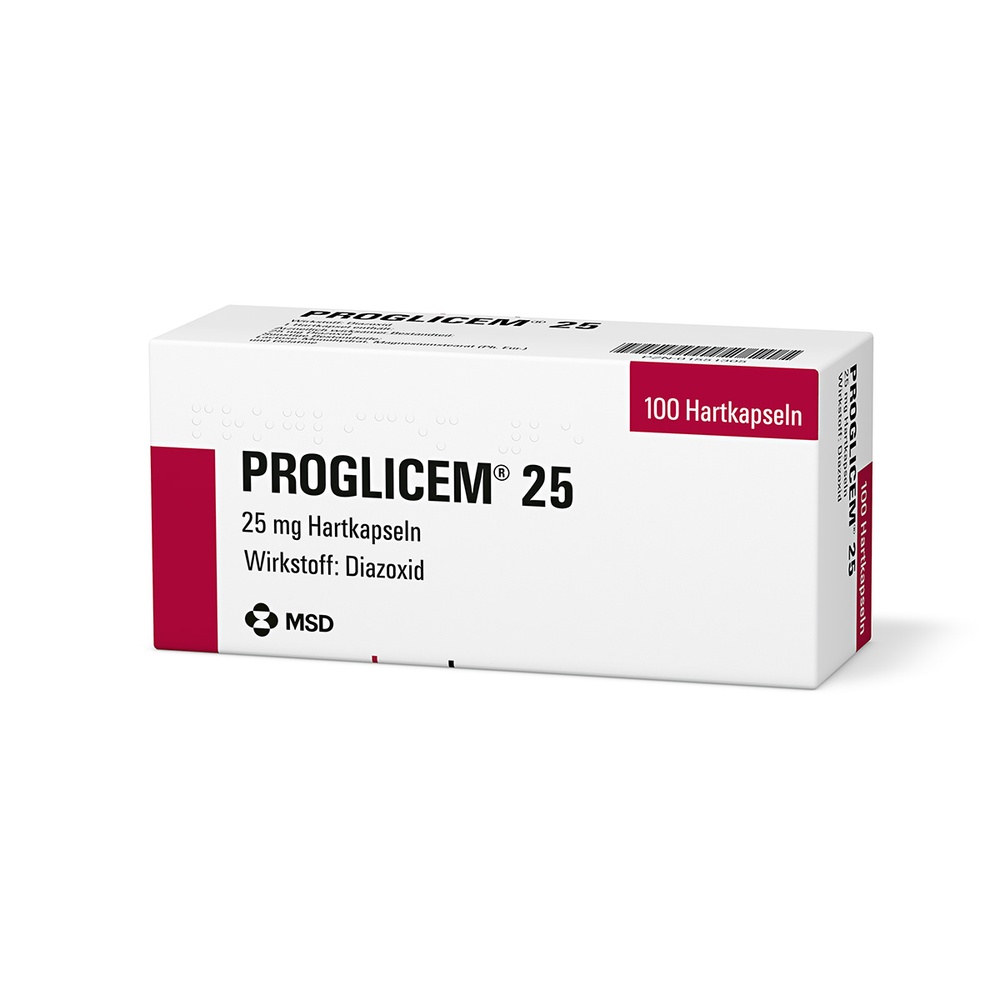
PROGLICEM 25 mg Hard Capsule

Рассмотрение рецепта онлайн
Врач рассмотрит ваш случай и примет решение о назначении рецепта, если это медицински оправдано.

Поговорите с врачом об этом лекарстве
Обсудите симптомы и возможные дальнейшие шаги на онлайн-консультации.



Инструкция по применению PROLYKEM
Содержание инструкции
Proglicem 25 mg hard capsules, 100 mg hard capsules
Diazoxide
Read this leaflet carefully before taking this medicine as it contains important information for you.
- Keep this leaflet. You may need to read it again.
- If you have any questions, ask your doctor or pharmacist.
- This medicine has been prescribed for you only. Do not pass it on to others, even if their symptoms are the same as yours, as it could be harmful.
- If you get any side effects, even those not listed in this leaflet, tell your doctor or pharmacist. See section 4.
Contents of this leaflet:
- 1. What Proglicem is and what it is used for
- 2. What you need to know before you take Proglicem
- 3. How to take Proglicem
- 4. Possible side effects
- 5. How to store Proglicem
- 6. Contents of the pack and other information
1. What is Proglicem and what is it used for
Proglicem contains diazoxide, a substance used for the treatment of hypoglycemia (low blood sugar levels).
Proglicem is indicated in the treatment of hypoglycemia of various origins, as its action is mainly due to the blocking of insulin release (hormone that lowers blood sugar levels).
Proglicem has proven effective in the following conditions:
- if, in your child, due to a hereditary defect, an amino acid called leucine (a substance used to produce proteins) stimulates the production of the hormone insulin, which lowers blood sugar levels (leucine-sensitive idiopathic hypoglycemia of infancy)
- if it is not possible to identify a definite cause for the low blood sugar level in your child (unclassified idiopathic hypoglycemia of infancy)
- if you have a non-operable malignant or benign tumor of the pancreas, the gland that produces insulin
- if you have a tumor that does not involve the pancreas but still causes a decrease in blood sugar levels
- if your newborn has low blood sugar levels (neonatal hypoglycemia)
- if you suffer from glycogenosis, a hereditary disease due to the accumulation of glycogen (a sugar reserve) in one or more organs or tissues
- if it is not possible to identify a definite cause for the low blood sugar level (hypoglycemia of unknown etiology).
Proglicem can be used before and after tumor removal surgery if blood sugar levels remain low.
In cases where other specific medical or surgical remedies prove ineffective or unfeasible, the doctor
will consider treatment with Proglicem.
2. What you need to know before taking Proglicem
Do not take Proglicem
- if you are allergic to diazoxide or any of the other ingredients of this medicine (listed in section 6)
- if you have low blood sugar levels due to improper diet (functional hypoglycemia)
- if you are allergic to thiazide medicines (medicines used to treat high blood pressure)
- if you are pregnant and during breastfeeding. The doctor will assess the benefits that the mother can derive from the therapy compared to the risks of harmful effects on the fetus or newborn.
Warnings and precautions
Consult your doctor or pharmacist before taking Proglicem.
The doctor will ask you to undergo regular laboratory tests during treatment to evaluate the
levels in the blood of white blood cells, platelets, sugars (in the blood and urine) and acidic
substances (ketone bodies) in the urine.
Blood tests must be performed periodically for hematological abnormalities (see
section “Possible side effects”).
If you experience fluid retention during treatment, your doctor may reduce the dose of Proglicem
and prescribe a diuretic medicine, especially if you suffer from a heart condition.
Following the intake of Proglicem, you may develop ketoacidosis (when, in the absence of
sugars, the cells of the body begin to use fatty acids instead of sugars as
an energy source) or non-ketotic hyperosmolar coma (a state of loss of consciousness, due to
dehydration of the cells of the body).
Inform your doctor:
- if you suffer from low potassium levels in the blood (hypokalemia).
- if you suffer from a severe kidney disease (renal failure). The doctor may reduce the dose of Proglicem and ask you to undergo laboratory tests to check the levels of electrolytes (e.g. sodium and potassium) in the blood.
Elderly
Specific information on the use of diazoxide in the elderly is not available.
Children and adolescents
The doctor will monitor the growth and bone and mental development of your child during treatment.
In an infant, transient cataract (temporary clouding of the lens, the lens
of the eye that serves to focus images) occurred together with hyperosmolar coma (a state of
loss of consciousness, due to dehydration of the cells of the body). These conditions are
resolved with correction of the hyperosmolar coma.
Other medicines and Proglicem
Inform your doctor or pharmacist if you or your child are taking, have recently taken or
may take any other medicine, in particular:
- If you are taking anticoagulant medicines, which thin the blood preventing the formation of clots (coumarin and its derivatives). The doctor may reduce the dose of anticoagulant medicines.
- If you are taking medicines for the treatment of high blood pressure such as thiazides and other diuretics, as administration with Proglicem may increase the effects of these medicines and of Proglicem. The doctor may prescribe insulin or tolbutamide to treat hyperglycemia (high blood sugar levels) caused by Proglicem.
- If you are taking diphenylhydantoin, a medicine used to treat epilepsy, as administration with Proglicem may decrease the effect of this medicine.
- If you are taking alpha-blockers used to treat high blood pressure or benign prostatic hypertrophy (benign prostatic hyperplasia), a gland in men that produces seminal fluid.
Inform your doctor:
- If you or your newborn suffers from high levels of bilirubin in the blood, a yellow-red pigment contained in bile (hyperbilirubinemia).
- If you suffer from low potassium levels in the blood (hypokalemia).
Proglicem may alter the results of some laboratory tests (blood glucose and uricemia).
Proglicem with food
For the use of Proglicem with food see section 3 “How to take Proglicem”.
Pregnancy, breastfeeding and fertility
If you are pregnant, suspect or are planning a pregnancy, or if you are breastfeeding with
breast milk, ask your doctor or pharmacist for advice before taking this medicine.
Like other medicines, Proglicem should not be administered during
pregnancy and breastfeeding.
The doctor will assess the benefits that the mother can derive from the therapy compared to the risks of harmful effects
on the fetus and newborn.
There are no data regarding the passage of diazoxide into breast milk. Because many medicines
pass into breast milk and given the possibility of adverse effects of diazoxide in newborns, the
doctor will assess whether to discontinue breastfeeding or the medicine, taking into account
the importance of the medicine for the mother.
Driving and operating machinery
Proglicem impairs the ability to drive vehicles or operate machinery.
If a drop in blood pressure occurs when moving from a sitting to a standing position (postural hypotension) or drowsiness, the risks associated with
driving vehicles and operating machinery must be considered.
Proglicem contains lactose
If your doctor has diagnosed you with intolerance to certain sugars, contact him before taking
this medicine.
3. How to take Proglicem
Take this medicine following exactly the instructions of your doctor or pharmacist. If you
have any doubts, ask your doctor or pharmacist.
Proglicem should, as far as possible, be administered after meals.
The dosage of the medicine must be determined based on the clinical conditions and the patient's response to
therapy.
During the first few days of treatment with Proglicem, blood glucose levels should be measured regularly.
Adults and adolescents
The recommended doseis 3-8 mg/kg to be administered divided into 2-3 equal doses.
The initial doserecommended is 3 mg/kg per day, divided into two or three doses over 24 hours, to
assess your response to the medicine. The doctor may then decide to increase this dose so that
symptoms and blood glucose respond satisfactorily. In patients with benign or
malignant pancreatic tumors that produce large amounts of insulin, doses of up to 1000 mg per day have been exceptionally used.
Proglicem should, as far as possible, be administered after meals.
The duration of treatmentwith Proglicem varies depending on the indication and, in the case of malignant
tumors that cause a lowering of blood sugar levels (hypoglycemia), treatment may
last indefinitely.
Use in children and newborns
The recommended dosein children with leucine-sensitive hypoglycemia (when an amino acid
called leucine, a substance used to produce proteins, due to a hereditary defect, stimulates
the production of the hormone insulin, which lowers blood sugar levels) is 8-15 mg/kg per
day divided into two or three doses, starting from 8 mg/kg per day.
Hypoglycemia in pediatric patients may regress spontaneously, although the age at which this will occur cannot be
predicted. Your doctor will subject your child to regular hospital stays
to try to reduce the dose of diazoxide and to attempt to make therapy easier.
If there is no therapeutic response within 2-3 weeks, your doctor will tell you to stop taking
Proglicem.
If you take more Proglicem than you should
In case of accidental ingestion/intake of an excessive dose of Proglicem, immediately notify
your doctor or go to the nearest hospital.
Symptoms
Increased blood sugar levels (hyperglycemia) or urine (glycosuria) which may
require a dose reduction.
Treatment
Administration of insulin and rehydrating solutions is recommended. With peritoneal dialysis and
hemodialysis (blood purification processes) a decrease in diazoxide levels has been obtained
in the blood.
Following accidental ingestion/intake of an excessive dose of Proglicem, your doctor will keep you
under close observation for 7 days.
If you forget to take Proglicem
Do not take a double dose to make up for a missed dose.
If you stop taking Proglicem
If you have any doubts about the use of this medicine, ask your doctor or pharmacist.
If there is no therapeutic response within 2-3 weeks, the medicine must be discontinued.
4. Possible side effects
Like all medicines, this medicine can cause side effects, although not everybody gets them.
li manifest.
Common and serious
Fluid and salt retention, which usually responds to treatment with diuretics (medicines
used for the treatment of high blood pressure). This retention is more common in adults,
and can lead to a serious heart condition (congestive heart failure) in patients with
compromised cardiac reserve (impaired ability of the heart to increase the volume of blood that
is pumped out).
Side effects with unknown frequency but serious
These can develop very quickly:
- diabetic ketoacidosis (a condition that occurs in patients with diabetes when, in the absence of sugars, the body's cells begin to use fatty acids instead of sugars as an energy source);
- non-ketotic hyperosmolar coma (a state of loss of consciousness due to dehydration of the cells).
Other common side effects
In women, hypertrichosis may occur, i.e. growth of fine hair on the upper face,
on the back and limbs, and which usually regresses after discontinuation of treatment. The appearance
of hypertrichosis should not lead to discontinuation of therapy when the therapeutic effects of
the medicine are vital.
Common:
- loss or reduction of appetite (anorexia),
- nausea,
- vomiting,
- abdominal pain,
- transient loss of taste,
- increased heart rate (tachycardia),
- feeling of increased heartbeats (palpitations),
- low blood pressure (hypotension) which may be increased with the administration of medicines to treat high blood pressure (such as thiazide diuretics),
- hyperuricemia (high levels of uric acid in the blood), usually asymptomatic,
- reduction in the number of platelets, a type of cell contained in the blood (thrombocytopenia) with or without purpura (skin spots of varying sizes with a color ranging from bright red to purple to reddish-brown) which usually requires discontinuation of therapy (see section “Warnings and precautions”),
- decrease in a type of white blood cells (neutropenia), usually transient,
- dizziness,
- movement disorders (extrapyramidal symptoms),
- headache,
- weakness,
- visual disturbances (visual impairment),
- increased blood sugar and urine levels requiring dose reduction, in order to avoid the progressive development of a condition that occurs in patients with diabetes when, in the absence of sugars, the body's cells begin to use fatty acids as an energy source (diabetic ketoacidosis) and a state of loss of consciousness due to dehydration of the cells (hyperosmolar coma) (see section “If you take more Proglicem than you should”).
Uncommon:
- diarrhea.
Rare:
- stoppage of the progression of intestinal contents (ileus),
- chest pain,
- acute inflammation of the pancreas (acute pancreatitis).
Frequency not known:
- transient increase in blood pressure (transient hypertension),
- increase in a type of white blood cells (eosinophilia),
- reduction in the percentage of red blood cells in the blood (hematocrit)/reduction of a protein contained in the blood (hemoglobin),
- excessive bleeding,
- decrease in a type of antibodies (protein substances involved in the body's defense mechanisms),
- increase or decrease in laboratory test values of some parameters relating to liver and kidney function (increase in SGOT, alkaline phosphatase and azotemia; decrease in creatinine clearance),
- reversible kidney disease (reversible nephrotic syndrome),
- decreased urine output (micturition),
- presence of blood in the urine (hematuria),
- presence of albumin, a protein produced by the liver, in the urine (albuminuria),
- anxiety,
- insomnia,
- inflammation of the nerves (polyneuritis),
- feeling of numbness (paresthesia),
- itching,
- malaise,
- drowsiness,
- transient cataract (opacification of the lens of the eye used to focus images),
- presence of blood in the eyes (subconjunctival hemorrhage),
- partial blindness (ring scotoma),
- double vision (diplopia),
- tearing,
- a skin infection (cutaneous candidiasis),
- skin rash,
- herpes,
- aging of the bones,
- hair loss,
- fever,
- swelling of the lymph nodes, small glands located along the pathways in the body that transport lymph (lymphadenopathy),
- a metabolic disease characterized by attacks of pain, redness and swelling of the joints (gout),
- premature death of pancreatic tissue (pancreatic necrosis),
- milk leakage from the breasts (galactorrhea),
- enlargement of breast nodules,
- increase in breast volume (gynecomastia),
- a severe reaction to the medicine affecting the skin, blood and internal organs, called DRESS.
Fluid around the heart (pericardial effusion) has been reported.
The following side effects have also been reported, although the patient's condition sometimes made it
difficult to establish which side effect was caused by the medicine:
Common:
- skin reactions (drug eruption, photosensitization). Frequency not known:
- defective bone tissue formation (osteodystrophy),
- increase in heart volume (cardiomegaly).
Side effects in children and adolescents
Common and serious
Fluid and salt retention, which usually responds to treatment with diuretics (medicines
used for the treatment of high blood pressure). This retention is more common in young children
(infants) and can lead to a serious heart condition (congestive heart failure) in
patients with compromised cardiac reserve (impaired ability of the heart to increase the volume
of blood that is pumped out).
Other side effectscommon
In children, hypertrichosis may occur, i.e. growth of fine hair on the upper face,
on the back and limbs and which usually regresses after discontinuation of the medicine.
Other side effects
Elevated pulmonary arterial pressure has also been observed in
infants, neonates and children; in most reported cases, pulmonary hypertension improved
after discontinuation of Proglicem treatment.
Reporting of side effects
If you get any side effects, even if not listed in this leaflet, tell your
doctor or pharmacist. You can also report side effects directly through the national reporting system at the address: https://www.aifa.gov.it/content/segnalazioni-reazioni-avverse.
By reporting side effects you can help provide more information on the safety of
this medicine.
5. How to store Proglicem
Do not store at a temperature above 25 °C.
Keep this medicine out of sight and reach of children.
Do not use this medicine after the expiry date that is reported on the pack after Scad.
The expiry date refers to the last day of that month.
Do not dispose of any medicine in wastewater or household waste. Ask your pharmacist how
to dispose of medicines you no longer use. This will help protect the environment.
6. Contents of the pack and other information
What Proglicem contains
- The active substance is diazoxide. Proglicem 100 mg hard capsules: each capsule contains 100 mg of diazoxide. Proglicem 25 mg hard capsules: each capsule contains 25 mg of diazoxide.
- The other ingredients are:
- Proglicem 25 mg: lactose, magnesium stearate. Capsule shell composition: gelatin, purified water.
- Proglicem 100 mg: lactose, magnesium stearate. Capsule composition: gelatin, titanium dioxide (E171).
Description of the appearance of Proglicem and contents of the pack
Proglicem is presented as capsules
It is available in
- pack containing 100 capsules of 25 mg in blisters
- pack containing 100 capsules of 100 mg in blisters.
Marketing Authorisation Holder and Manufacturer
Marketing Authorisation Holder
MSD Italia S.r.l., Via Vitorchiano, 151 – 00189 Roma
Manufacturer
Merck Sharp & Dohme B.V., Waarderweg 39, 2031 BN, Haarlem – Netherlands

Не уверены, подходит ли вам это лекарство?
Обсудите симптомы и варианты лечения с врачом онлайн.

Уже начали прием и появились вопросы?
Обсудите свое состояние и дальнейшие шаги с врачом онлайн.
- Страна регистрации
- Форма выпускаHard capsule, 25 MG
- Код АТХV03AH01
- Действующее вещество
- Отпускается по рецептуДа
- Производитель
- Информация на этой странице носит справочный характер и не является медицинской консультацией. Перед началом приема лекарства обязательно проконсультируйтесь с врачом.
- Аналоги PROLYKEMФорма выпуска: Injectable solution, 0,5 MG/5 MLДействующее вещество: флумазенилПроизводитель: CHEPLAPHARM ARZNEIMITTEL GMBHОтпускается по рецептуФорма выпуска: Compressed medical gas, 200 BARДействующее вещество: medical airПроизводитель: AIR LIQUIDE SANTE (INTERNATIONAL)Отпускается по рецептуФорма выпуска: Inhalation gas, 200 BARДействующее вещество: medical airПроизводитель: LINDE MEDICALE SRLОтпускается по рецепту
Врачи онлайн по PROLYKEM
Обсудите применение PROLYKEM и возможные следующие шаги — по оценке врача.









Получите рецепт на PROLYKEM онлайн
Заполните форму за 2 минуты
Расскажите о симптомах, истории болезни и нужном препарате.
Выберите врача или мы назначим
Выберите специалиста или мы подберём ближайшего доступного врача.
Врач рассматривает ваш случай
Обычно в течение 30 минут. Может задать уточняющие вопросы в чате.
Получите в любой аптеке
Электронный рецепт отправляется на вашу почту — действителен по всей Польше.
Часто задаваемые вопросы
PROLYKEM требует рецепта в Италия. Вы можете уточнить у врача онлайн, подходит ли это лекарство для вашей ситуации.
Действующее вещество PROLYKEM — diazoxide. Эта информация помогает определить лекарства с тем же составом под другими торговыми названиями.
PROLYKEM производится компанией MSD ITALIA S.R.L.. Упаковка и торговое название могут отличаться в зависимости от дистрибьютора.
Врачи, включая Семейные врачи, Психиатры, Дерматологи, Кардиологи, Эндокринологи, Гастроэнтерологи, Пульмонологи, Нефрологи, Ревматологи, Гематологи, Инфекционисты, Аллергологи, Гериатры, Педиатры, Онкологи, могут оценить целесообразность применения PROLYKEM с учетом вашей ситуации и местных правил. Вы можете записаться на онлайн-консультацию, чтобы обсудить возможные варианты.
Польша имеет хорошо развитую систему здравоохранения в крупных городах, таких как Варшава, Краков, Вроцлав и Гданьск. Аптеки широко доступны и работают в соответствии с действующим законодательством, обеспечивая доступ к рецептурным препаратам.
Вы можете купить PROLYKEM в Варшаве, Кракове, Вроцлаве или Гданьске в любой аптеке при наличии действующего рецепта.
Чтобы получить рецепт, вы можете воспользоваться Oladoctor:
Другие лекарства с тем же действующим веществом (diazoxide) включают ANEXATE, ARIA AIR LIQUIDE SANITA', ARIA LINDE MEDIKALE. Они могут отличаться торговым названием или формой выпуска, но содержат одинаковый терапевтический компонент. Перед изменением лечения рекомендуется проконсультироваться с врачом.
