



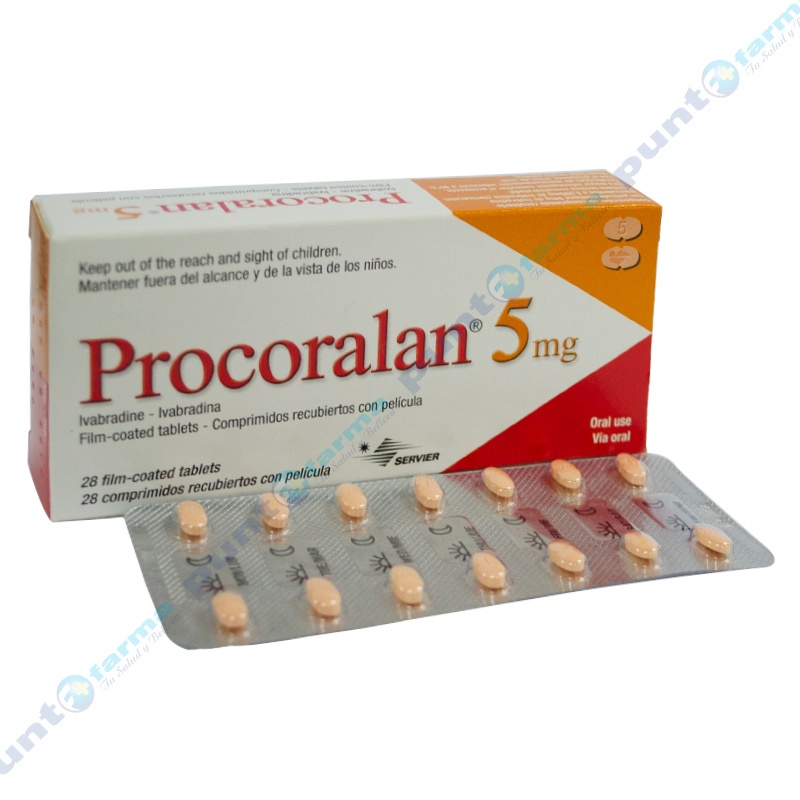
PROCORALAN 5 mg Фильм-Coated Таблетки

Рассмотрение рецепта онлайн
Врач рассмотрит ваш случай и примет решение о назначении рецепта, если это медицински оправдано.

Поговорите с врачом об этом лекарстве
Обсудите симптомы и возможные дальнейшие шаги на онлайн-консультации.



Инструкция по применению PROKORALAN
Содержание инструкции
Procoralan 5 mg film-coated tablets, 7.5 mg film-coated tablets
ivabradina
Read this leaflet carefully before you start taking this medicine as it contains
important information for you.
- Keep this leaflet. You may need to read it again.
- If you have any questions, ask your doctor or pharmacist.
- This medicine has been prescribed for you only. Do not pass it on to others, even if their symptoms are the same as yours, as it could be harmful.
- If you get any side effects, even those not listed in this leaflet, tell your doctor or pharmacist. See section 4.
Contents of this leaflet:
- 1. What Procoralan is and what it is used for
- 2. What you need to know before you take Procoralan
- 3. How to take Procoralan
- 4. Possible side effects 5 How to store Procoralan
- 6. Contents of the pack and other information
1. What Procoralan is and what it is used for
Procoralan (ivabradine) is a heart medicine used for the treatment:
- of symptomatic stable angina pectoris (a disease that causes chest pain) in adult patients whose heart rate is greater than or equal to 70 beats per minute. It is used in adult patients who cannot tolerate or cannot take heart medicines called beta-blockers. It is also used in association with beta-blockers in adult patients whose condition is not fully controlled with a beta-blocker
- of chronic heart failure in adult patients whose heart rate is greater than or equal to 75 beats per minute. It is used in association with conventional therapy, which includes treatment with a beta-blocker or in case beta-blockers are contraindicated or not tolerated.
Information about stable angina pectoris (commonly called “angina”):
Stable angina is a heart disease that occurs when the heart does not receive enough
oxygen. The most common symptom of angina is chest pain or discomfort.
Information about chronic heart failure:
Chronic heart failure is a heart disease that occurs when the heart fails to
pump enough blood to the rest of the body. The most common symptoms of heart failure are
shortness of breath, fatigue, tiredness and swelling of the ankles.
How does Procoralan work?
The specific heart rate-reducing action of ivabradine helps:
- to control and decrease the number of angina attacks by reducing the heart's need for oxygen,
- to improve the functioning of the heart and the life expectancy of patients with chronic heart failure.
2. What you need to know before taking Procoralan
Do not take Procoralan
- if you are allergic to ivabradine or any of the other ingredients of this medicine (listed in section 6);
- if your resting heart rate before treatment is too low (less than 70 beats per minute);
- if you suffer from cardiogenic shock (a heart condition treated in hospital); if you suffer from a heart rhythm disorder (sick sinus syndrome, sino-atrial block, 3rd degree AV block);
- if you are having a heart attack;
- if you suffer from very low blood pressure;
- if you suffer from unstable angina (a severe form in which chest pain occurs very frequently and with or without exertion);
- if you suffer from heart failure that has recently worsened;
- if your heartbeat is exclusively controlled by a pacemaker;
- if you have severe liver problems;
- if you are already taking medicines for the treatment of fungal infections (such as ketoconazole, itraconazole), macrolide antibiotics (such as josamycin, clarithromycin, telithromycin or erythromycin given orally) or medicines to treat HIV infections (such as nelfinavir, ritonavir) or nefazodone (medicine for the treatment of depression) or diltiazem, verapamil (used for high blood pressure or angina pectoris);
- if you are a woman of childbearing potential and not using appropriate contraception;
- if you are pregnant or trying to become pregnant;
- if you are breastfeeding.
Warnings and precautions
Talk to your doctor or pharmacist before taking Procoralan.
- if you suffer from heart rhythm disorders (such as irregular heartbeat, palpitations, increased chest pain) or severe atrial fibrillation (a form of arrhythmia that makes the heartbeat irregular), or an abnormality in the electrocardiogram (ECG) called “long QT syndrome”,
- if you get tired easily, feel dizzy or short of breath (this could mean that your heart is beating too slowly),
- if you suffer from symptoms of atrial fibrillation (unusually high (over 110 beats per minute) or irregular resting heart rate, for no apparent reason, making it difficult to measure),
- if you have recently had a stroke (cerebral attack),
- if you suffer from mild to moderate low blood pressure,
- if you suffer from uncontrolled blood pressure, especially following a change in antihypertensive treatment,
- if you suffer from severe heart failure or heart failure with an abnormality in the electrocardiogram (ECG) called “bundle branch block”,
- if you suffer from a chronic retinal disease,
- if you have moderate liver problems,
- if you have severe kidney problems. If any of the above applies to you, tell your doctor immediately before or during taking Procoralan.
Children
Do not give this medicine to children and adolescents under 18 years of age. The data
available are insufficient in this age group.
Other medicines and Procoralan
Tell your doctor or pharmacist if you are taking, have recently taken or might take
any other medicines.
Make sure you tell your doctor if you are taking any of the following medicines, as
it may be necessary to monitor or adjust the dose of Procoralan:
- fluconazole (an antifungal medicine)
- rifampicin (an antibiotic)
- barbiturates (for insomnia or epilepsy)
- phenytoin (for epilepsy)
- Hypericum perforatumor St John's Wort (herbal product used for depression)
- medicines that prolong the QT interval for the treatment of heart rhythm disorders or other conditions such as:
- quinidine, disopyramide, ibutilide, sotalol, amiodarone (for treating heart rhythm disorders)
- bepridil (for treating angina pectoris)
- certain types of medicines for treating anxiety, schizophrenia or other psychoses (such as pimozide, ziprasidone, sertindole)
- medicines for malaria (such as mefloquine or halofantrine)
- intravenous erythromycin (an antibiotic)
- pentamidine (an antiparasitic)
- cisapride (used for gastro-oesophageal reflux)
- Some types of diuretics that can cause a decrease in blood potassium levels, such as furosemide, hydrochlorothiazide, indapamide (used for the treatment of edema, for high blood pressure)
Procoralan with food and drink
Avoid grapefruit juice during treatment with Procoralan.
Pregnancy and breastfeeding
If you are pregnant, suspect you may be pregnant, or are planning to become pregnant, ask your doctor or pharmacist for advice before taking this medicine.
Do not take Procoralan if you are pregnant or planning a pregnancy (see “Do not take Procoralan”). If you are pregnant and have taken Procoralan, tell your doctor.
Do not take Procoralan if you are able to become pregnant, unless you are using appropriate contraceptive measures (see “Do not take Procoralan”).
Do not take Procoralan if you are breastfeeding (see “Do not take Procoralan”). Talk to your doctor if you are breastfeeding or intend to breastfeed, as breastfeeding must be stopped if you take Procoralan.
Driving and using machines
Procoralan can cause temporary luminous visual phenomena (a temporary brightness in the field
of vision, see “Possible side effects”). If this happens to you, be very careful when
driving or using machines, especially when there may be sudden changes in light intensity,
especially when driving at night.
Procoralan contains lactose
If your doctor has told you that you have an intolerance to some sugars, contact your doctor
before taking this medicine.
3. How to take Procoralan
Take this medicine following exactly the instructions of your doctor or pharmacist. If you
have any doubts, ask your doctor or pharmacist.
Procoralan must be taken during meals.
Procoralan 5 mg tablets can be divided into equal doses.
If you are being treated for stable angina pectoris
The initial dose should not exceed one Procoralan 5 mg tablet twice a day. If you still experience
angina symptoms and tolerate the daily dose of 5 mg twice a day well, the dose may be
increased. The maintenance dose should not exceed 7.5 mg twice a day. Your doctor
will prescribe the most suitable dose. The usual dose is one tablet in the morning and one tablet in the evening.
In some cases (e.g. if you are 75 years of age or older), your doctor may prescribe half the dose, for
example, half a 5 mg Procoralan 5 mg tablet (which corresponds to 2.5 mg of ivabradine) in the morning and
half a 5 mg tablet in the evening.
If you are being treated for chronic heart failure
The usual initial recommended dose is one Procoralan 5 mg tablet twice a day, to be
increased if necessary to one Procoralan 7.5 mg tablet twice a day. Your doctor will decide
the most suitable dose. The usual dose is one tablet in the morning and one tablet in the evening. In some cases
(for example, if you are 75 years of age or older), your doctor may prescribe halving the dose,
that is, half a 5 mg Procoralan 5 mg tablet (which corresponds to 2.5 mg of ivabradine) in the
morning and half a 5 mg tablet in the evening.
If you take more Procoralan than you should
A high dose of Procoralan may make you feel short of breath or tired because your heart rate
has been slowed down too much. If this happens, contact your doctor immediately.
If you forget to take Procoralan
If you forget to take a dose of Procoralan, take the next dose at the usual time.
Do not take a double dose to make up for a missed dose.
The calendar printed on the blister pack containing the tablets will help you remember when you took
your last Procoralan tablet.
If you stop taking Procoralan
Because treatment for angina or chronic heart failure is usually lifelong, you should talk
to your doctor before stopping taking this medicine.
If you feel that the effect of Procoralan is too strong or too weak, consult your doctor or
pharmacist.
If you have any doubts about the use of this medicine, consult your doctor or pharmacist.
4. Possible side effects
Like all medicines, this medicine can cause side effects, although not everybody gets them.
The most common adverse reactions that occur with this medicine are dose-dependent and are
related to its mechanism of action:
Very common (may affect more than 1 in 10 people)
Visual luminous phenomena (brief moments of increased brightness, very often caused by sudden
changes in light intensity). These can also be described as a halo, colored flashes,
image decomposition or multiple images. These phenomena generally develop within the
first two months of treatment after which they may occur repeatedly and resolve during or after
treatment.
Common (may affect up to 1 in 10 people)
Changes in cardiac function (symptoms are a slowing of the heart rate). These
phenomena occur particularly within the first 2-3 months from the start of treatment.
Other side effects have also been reported:
Common (may affect up to 1 in 10 people)
Rapid and irregular heart contraction (atrial fibrillation), abnormal perception of the heartbeat
(Bradycardia, Ventricular extrasystoles, AV block of 1st degree (prolonged PQ interval
ECG)), uncontrolled blood pressure, headache, dizziness and blurred vision (blurred
vision).
Uncommon (may affect up to 1 in 100 people)
Palpitations and irregular heartbeat, feeling unwell (nausea), constipation, diarrhea,
abdominal pain, dizziness (vertigo), difficulty breathing (dyspnea), muscle spasms,
high blood levels of uric acid, excess of eosinophils (a type of white blood cells) and elevated creatinine
(muscle breakdown product) in the blood, skin rash, angioedema (such as swelling of the
face, tongue or throat, difficulty breathing or swallowing), low blood pressure,
fainting, feeling tired, feeling weak, abnormal cardiac tracing on ECG,
double vision, weakened vision.
Rare (may affect up to 1 in 1,000)
Urticaria, itching, skin redness, malaise.
Very rare (may affect up to 1 in 10,000 )
Irregular heartbeat, (AV block of 2nd degree, AV block of 3rd degree, Sick Sinus
Syndrome).
Reporting of side effects
If you get any side effects, even those not listed in this leaflet, tell your doctor or pharmacist.
You can also report side effects directly through the national reporting system listed in Annex V * .
By reporting side effects you can help provide more information on the safety
of this medicine.
5. How to store Procoralan
Keep this medicine out of the sight and reach of children.
Do not use this medicine after the expiry date which is stated on the package and on the blister packs after
“EXP”. The expiry date refers to the last day of the month.
This medicine does not require any special storage conditions.
Do not dispose of any medicine in waste water or household waste. Ask your pharmacist how to
dispose of medicines you no longer use. This will help protect the environment.
6. Contents of the pack and other information
What Procoralan contains
- The active substance is ivabradine (as hydrochloride). Procoralan 5 mg film-coated tablets: each film-coated tablet contains 5 mg of ivabradine (as hydrochloride). Procoralan 7.5 mg film-coated tablets: each film-coated tablet contains 7.5 mg of ivabradine (as hydrochloride).
- The other ingredients are:
- tablet core: lactose monohydrate, magnesium stearate (E470B), corn starch, maltodextrin, anhydrous colloidal silica (E551),
- tablet coating: hypromellose (E464), titanium dioxide (E171), macrogol 6000, glycerol (E422), magnesium stearate (E470B), yellow iron oxide (E172), red iron oxide (E172).
Description of Procoralan and contents of the pack
Procoralan 5 mg tablets are salmon-colored, oblong, film-coated tablets,
divisible on both sides, with “5” engraved on one side and
on the other.
Procoralan 7.5 mg tablets are salmon-colored, triangular, film-coated tablets,
with “7.5” engraved on one side and

on the other.
The tablets are available in calendar packs (aluminium/PVC blisters) containing 14,
28, 56, 84, 98, 100 or 112 tablets. Not all pack sizes may be marketed .
Marketing Authorisation Holder
Les Laboratoires Servier
50, rue Carnot
92284 Suresnes cedex- France
Manufacturer
Les Laboratoires Servier Industrie
905 route de Saran
45520 Gidy - France
Servier (Ireland) Industries Ltd
Gorey Road
Arklow - Co. Wicklow - Ireland
Przedsiebiorstwo Farmaceutyczne ANPHARM S.A.
ul. Annopol 6B – 03-236 Warsaw – Poland
Laboratorios Servier, S.L.
Avda de los Madroños, 33
28043 Madrid
Spain
For further information on this medicinal product, contact the local representative of the marketing
authorisation holder.

België/Belgique/Belgien
S.A. Servier Benelux N.V.
Tél/Tel: +32 (0)2 529 43 11
Lietuva
UAB ”SERVIER PHARMA”
Tel: +370 (5) 2 63 86 28
България
Сервие Медикал ЕООД
Тел.: +359 2 921 57 00
Luxembourg/Luxemburg
S.A. Servier Benelux N.V.
Tél/Tel: +32 (0)2 529 43 11
Česká republika
Servier s.r.o.
Tel: +420 222 118 111
Magyarország
Servier Hungaria Kft.
Tel.: + 36 1 238 77 99
Danmark
Servier Danmark A/S
Tlf: +45 36 44 22 60
Malta
GALEPHARMA Ltd
Tel: +(356) 21 247 082
Deutschland
Servier Deutschland GmbH
Tel: +49 (0)89 57095 01
Nederland
Servier Nederland Farma B.V.
Tel: +31 (0)71 5246700
Eesti
Servier Laboratories OÜ
Tel:+ 372 664 5040
Norge
Servier Danmark A/S
Tlf: +45 36 44 22 60
Ελλάδα
ΣΕΡΒΙΕ ΕΛΛΑΣ ΦΑΡΜΑΚΕΥΤΙΚΗ ΕΠΕ
Τηλ: +30 210 939 1000
Österreich
Servier Austria GmbH
Tel: +43 (1) 524 39 99
España
Laboratorios Servier S.L.
Tel: +34 91 748 96 30
Polska
Servier Polska SP. Z O.O.
Tel.: + 48 (0) 22 594 90 00
France
Les Laboratoires Servier
Tél: +33 (0)1 55 72 60 00
Portugal
Servier Portugal, Lda
Tel: +351 21 312 20 00
Hrvatska
Servier Pharma, d. o. o.
Tel.: +385 (0)1 3016 222
România
Servier Pharma SRL
Tel: +4 021 528 52 80
Ireland
Servier Laboratories (Ireland) Ltd.
Tel: +353 (0)1 663 8110
Slovenija
Servier Pharma d.o.o.
Tel: + 386 (0)1 563 48 11
Ísland
Servier Laboratories
C/o Icepharma hf
Sími: +354 540 8000
Slovenská republika
Servier Slovensko spol. s r.o.
Tel: +421 (0) 2 5920 41 11
Italia
Servier Italia S.p.A.
Tel: +39 06 669081
Suomi/Finland
Servier Finland Oy
P./Tel: +358 (0)9 279 80 80
Κύπρος
C.A. Papaellinas Ltd.
Τηλ: +357 22741741
Sverige
Servier Sverige AB
Tel: +46(8)5 225 08 00
Latvija
SIA Servier Latvia
Tel: + 371 67502039
United Kingdom (Irlanda del Nord)
Servier Laboratories (Ireland)Ltd
Tel: +44 (0)1753 666409
More detailed information on this medicinal product is available on the website of the European Medicines
Agency: http://www.ema.europa.eu

Не уверены, подходит ли вам это лекарство?
Обсудите симптомы и варианты лечения с врачом онлайн.

Уже начали прием и появились вопросы?
Обсудите свое состояние и дальнейшие шаги с врачом онлайн.
- Страна регистрации
- Форма выпускаFilm-coated tablet, 5 MG
- Код АТХC01EB17
- Действующее вещество
- Отпускается по рецептуДа
- Производитель
- Информация на этой странице носит справочный характер и не является медицинской консультацией. Перед началом приема лекарства обязательно проконсультируйтесь с врачом.
- Аналоги PROKORALANФорма выпуска: Film-coated tablet, 5 MGДействующее вещество: ивабрадинаПроизводитель: LES LABORATOIRES SERVIERОтпускается по рецептуФорма выпуска: Film-coated tablet, 5 MGДействующее вещество: ивабрадинаПроизводитель: ACCORD HEALTHCARE, S.L.U.Отпускается по рецептуФорма выпуска: Film-coated tablet, 5 MGДействующее вещество: ивабрадинаПроизводитель: ANPHARM PRZEDSIEBIORSTWO FARMACEUTYCZNE S.A.Отпускается по рецепту
Аналоги PROKORALAN в других странах
Лекарства с тем же действующим веществом, доступные в других странах.
Аналог PROKORALAN в Испания
Аналог PROKORALAN в Польша
Аналог PROKORALAN в Украина
Врачи онлайн по PROKORALAN
Обсудите применение PROKORALAN и возможные следующие шаги — по оценке врача.
Получите рецепт на PROKORALAN онлайн
Заполните форму за 2 минуты
Расскажите о симптомах, истории болезни и нужном препарате.
Выберите врача или мы назначим
Выберите специалиста или мы подберём ближайшего доступного врача.
Врач рассматривает ваш случай
Обычно в течение 30 минут. Может задать уточняющие вопросы в чате.
Получите в любой аптеке
Электронный рецепт отправляется на вашу почту — действителен по всей Польше.
Часто задаваемые вопросы
PROKORALAN требует рецепта в Италия. Вы можете уточнить у врача онлайн, подходит ли это лекарство для вашей ситуации.
Действующее вещество PROKORALAN — ивабрадина. Эта информация помогает определить лекарства с тем же составом под другими торговыми названиями.
PROKORALAN производится компанией LES LABORATOIRES SERVIER. Упаковка и торговое название могут отличаться в зависимости от дистрибьютора.
Врачи, включая Семейные врачи, Психиатры, Дерматологи, Кардиологи, Эндокринологи, Гастроэнтерологи, Пульмонологи, Нефрологи, Ревматологи, Гематологи, Инфекционисты, Аллергологи, Гериатры, Педиатры, Онкологи, могут оценить целесообразность применения PROKORALAN с учетом вашей ситуации и местных правил. Вы можете записаться на онлайн-консультацию, чтобы обсудить возможные варианты.
Польша имеет хорошо развитую систему здравоохранения в крупных городах, таких как Варшава, Краков, Вроцлав и Гданьск. Аптеки широко доступны и работают в соответствии с действующим законодательством, обеспечивая доступ к рецептурным препаратам.
Вы можете купить PROKORALAN в Варшаве, Кракове, Вроцлаве или Гданьске в любой аптеке при наличии действующего рецепта.
Чтобы получить рецепт, вы можете воспользоваться Oladoctor:
Другие лекарства с тем же действующим веществом (ивабрадина) включают KORLENTOR, IVABRADINA AKKORD, IVABRADINA ANPARM. Они могут отличаться торговым названием или формой выпуска, но содержат одинаковый терапевтический компонент. Перед изменением лечения рекомендуется проконсультироваться с врачом.
