



PELMEG 6 mg Инъекционный Раствор

Рассмотрение рецепта онлайн
Врач рассмотрит ваш случай и примет решение о назначении рецепта, если это медицински оправдано.

Поговорите с врачом об этом лекарстве
Обсудите симптомы и возможные дальнейшие шаги на онлайн-консультации.



Инструкция по применению PELMEG
Содержание инструкции
Pelmeg 6 mg injectable solution in pre-filled syringe
pegfilgrastim
Read this leaflet carefully before you use this medicine as it contains important
information for you.
- Keep this leaflet. You may need to read it again.
- If you have any questions, ask your doctor, pharmacist or nurse.
- This medicine has been prescribed for you only. Do not pass it on to others, even if their symptoms are the same as yours, as it could be harmful.
- If you get any side effects, even those not listed in this leaflet, tell your doctor, pharmacist or nurse. See section 4.
Contents of this leaflet
- 1. What Pelmeg is and what it is used for
- 2. What you need to know before you use Pelmeg
- 3. How to use Pelmeg
- 4. Possible side effects
- 5. How to store Pelmeg
- 6. Contents of the pack and other information
1. What is Pelmeg and what is it used for
Pelmeg contains the active substance pegfilgrastim. Pegfilgrastim is a protein produced using a
biotechnological technique in a bacterial cell called Escherichiacoli. It belongs to a
group of proteins called cytokines and is very similar to a natural protein (granulocyte colony-stimulating
factor) produced by our body.
Pelmeg is used in adult patients to reduce the duration of neutropenia (low number of white
blood cells) and the occurrence of febrile neutropenia (low number of white blood cells with fever) that
may be caused by cytotoxic chemotherapy (medicines that destroy rapidly growing cells). White blood cells are important because they help the body fight infections.
These cells are very sensitive to the effects of chemotherapy; this can cause a decrease
in the number of these cells in the body. If the number of white blood cells drops to a
low level, there may not be enough left to fight bacteria and you may be at
increased risk of contracting an infection.
Your doctor has prescribed Pelmeg to stimulate the bone marrow (the part of the bones that produces
blood cells) to produce more white blood cells to help the body fight infections.
2. What you need to know before using Pelmeg
Do not use Pelmeg
if you are allergic to pegfilgrastim, to filgrastim, to proteins derived from Escherichiacolior to any
of the other components of this medicine.
Warnings and precautions
Talk to your doctor, pharmacist or nurse before using Pelmeg:
if you have an allergic reaction including weakness, low blood pressure, difficulty in
breathing, swelling of the face (anaphylaxis), redness and flushing, skin rash and itchy skin areas.
if you have cough, fever and difficulty in breathing. This may be a sign of Acute Respiratory
Distress Syndrome (ARDS).
if you have one or more of the following side effects:
- swelling or bloating, which may be associated with decreased fluid passage, difficulty breathing, abdominal swelling and a feeling of fullness and a general feeling of fatigue. These could be symptoms of a condition called “Capillary Leak Syndrome” which causes blood to leak from the small vessels in the body. See section 4. if you have pain in the upper left side of the abdomen or pain in the tip of the shoulder. These could be signs of a problem with the spleen (splenomegaly). if you have recently had a severe lung infection (pneumonia), fluid in the lungs (pulmonary edema), inflammation of the lungs (interstitial lung disease) or an abnormality found on an X-ray (pulmonary infiltration). if you know you have abnormal blood cell counts (e.g. increased white blood cells or anemia) or a decrease in platelet levels, which reduces the body's ability to clot (thrombocytopenia). The doctor may want to monitor you closely. if you have sickle cell anemia. The doctor may want to monitor you closely if you have breast or lung cancer, Pelmeg in combination with chemotherapy and/or radiotherapy may increase the risk of a pre-cancerous blood condition called myelodysplastic syndrome (MDS) or a blood cancer called acute myeloid leukemia (AML). Symptoms may include fatigue, fever and easy bruising or bleeding. if you suddenly have signs of allergy such as skin rash, hives or itching on the skin, swelling of the face, lips, tongue or other parts of the body, shortness of breath, wheezing or difficulty breathing: these could be signs of a severe allergic reaction. if you have symptoms of inflammation of the aorta (the large blood vessel that carries blood from the heart to the rest of the body), which have been reported rarely in cancer patients and healthy people. Symptoms may include fever, abdominal pain, malaise, back pain and increased markers of inflammation. Tell your doctor if you experience such symptoms.
The doctor will regularly check your blood and urine because Pelmeg can damage the tiny
filters inside your kidneys (glomerulonephritis).
Severe skin reactions (Stevens-Johnson syndrome) have been observed with the use of Pelmeg. If
you notice any of the symptoms described in section 4, stop using Pelmeg and seek
immediate medical attention.
You should talk to your doctor about the risks of developing a blood cancer. If you have or may have
a blood cancer, you should not use Pelmeg unless directed to do so by your
doctor.
Loss of response to pegfilgrastim
If you have a decrease in response or failure to maintain response to treatment
with pegfilgrastim, the doctor will investigate the reasons, including the possibility that you have developed
antibodies that neutralize the activity of pegfilgrastim.
Other medicines and Pelmeg
Tell your doctor or pharmacist if you are taking, have recently taken or might take
any other medicines.
Pregnancy and breastfeeding
Ask your doctor or pharmacist for advice before taking any medicine. Pelmeg has not
been tested on pregnant women. It is important to tell your doctor if:
you are pregnant;
suspect you may be pregnant; or
are planning to become pregnant.
If you find yourself to be pregnant during treatment with Pelmeg, tell your doctor.
Unless your doctor tells you otherwise, you should stop breastfeeding if you use Pelmeg.
Driving and using machines
Pelmeg does not alter or negligibly alters the ability to drive vehicles or use
machinery.
Pelmeg contains sorbitol (E420) and sodium acetate
This medicine contains 30 mg of sorbitol per pre-filled syringe, equivalent to 50 mg/mL.
This medicine contains less than 1 mmol (23 mg) of sodium per 6 mg dose, i.e. essentially
“sodium-free”.
3. How to use Pelmeg
Pelmeg is indicated in adults aged 18 years and over.
Use Pelmeg following the instructions of your doctor exactly. If you have any doubts, consult your doctor or
pharmacist. The usual dose is a subcutaneous injection (injection under the skin) of 6 mg using a
prefilled syringe, which must be administered at least 24 hours after the last dose of chemotherapy
at the end of each chemotherapy cycle.
Do not shake Pelmeg vigorously as this may compromise its activity.
How to self-inject Pelmeg
Your doctor may consider that it is best for you to self-inject Pelmeg. Your doctor or
nurse will show you how to self-inject Pelmeg. Do not attempt to self-inject if
you have not been shown how to do it.
Pelmeg alone.
If you use more Pelmeg than you should
If you use more Pelmeg than you should, you should contact your doctor, pharmacist or nurse.
If you forget to inject Pelmeg
If you have forgotten a dose of Pelmeg, you should contact your doctor to determine when to administer the
next injection.
If you have any doubts about the use of this medicine, ask your doctor, pharmacist or
nurse.
4. Possible side effects
Like all medicines, this medicine can cause side effects, although not everybody gets them.
Tell your doctor immediately if you experience any or a combination of the following side effects:
swelling or oedema, which may be associated with urinating less frequently,
difficulty breathing, abdominal swelling and a feeling of fullness, and a general feeling
of tiredness. These symptoms usually develop rapidly.
These could be symptoms of an uncommon condition (may affect up to 1 in 100 people) called “capillary leak syndrome”, which causes blood to leak from small blood
vessels inside the body and requires urgent medical attention.
Very common side effects(may affect more than 1 in 10 people):
bone pain. Your doctor will tell you what to take to relieve bone pain.
nausea and headache.
Common side effects(may affect up to 1 in 10 people):
pain at the injection site.
general pain and joint and muscle aches.
some changes may occur in the blood, but these will be detected during routine blood tests. The levels of white blood cells may rise for a short period of
time. Platelet levels may decrease causing bruising.
Uncommon side effects(may affect up to 1 in 100 people):
allergic-type reactions, including redness and flushing, skin rash (redness of the skin) and itchy skin swelling.
severe allergic reactions including anaphylaxis (weakness, low blood pressure,
difficulty breathing, facial swelling).
increased spleen volume.
spleen rupture. Some cases of spleen rupture have been fatal. It is important that you contact
your doctor immediately if you feel pain in the upper left side of your abdomen or your left shoulder as this may indicate problems with the spleen.
breathing problems. If you have cough, fever and difficulty breathing contact your doctor.
cases of Sweet syndrome (purple, raised and painful lesions on the limbs and sometimes on the face and neck, associated with fever) have occurred, but other
factors may have contributed.
cutaneous vasculitis (inflammation of blood vessels in the skin).
damage to the tiny filters inside the kidneys (glomerulonephritis).
redness at the injection site.
coughing up blood (haemoptysis).
blood disorders (myelodysplastic syndrome [MDS] or acute myeloid leukaemia [AML]).
Rare side effects(may affect up to 1 in 1,000 people):
inflammation of the aorta (the large blood vessel that carries blood from the heart to the rest of the
body), see section 2.
bleeding from the lung (pulmonary haemorrhage).
Stevens-Johnson syndrome, which can manifest with reddish patches or round spots,
often with central blisters, located on the trunk, skin peeling, ulcers in the mouth,
throat, nose, genitals and eyes and which may be preceded by fever and flu-like symptoms. If
you develop these symptoms stop using Pelmeg and contact your doctor or seek medical
attention immediately. See also section 2.
Reporting of side effects
If you get any side effects, talk to your doctor, pharmacist or nurse. You can also report side effects directly
through the national reporting system listed in Annex V. By reporting side effects you can help provide more information on the safety of this medicine.
5. How to store Pelmeg
Keep this medicine out of the sight and reach of children.
Do not use this medicine after the expiry date which is stated on the pack and on the label of the
syringe after EXP. The expiry date refers to the last day of that month.
Store in a refrigerator (2 °C – 8 °C).
You can take Pelmeg out of the refrigerator and keep it at room temperature (not exceeding 30 °C) for no more than
4 days. Once the syringe has been removed from the refrigerator and has reached room temperature
(not exceeding 30 °C) it must be used within 4 days or be discarded.
Do not freeze. Pelmeg can be used if it is accidentally frozen for two separate periods
less than 72 hours each.
Keep the container in the outer packaging to protect the medicine from light.
Do not use this medicine if you notice that it is cloudy or if you see particles.
Do not dispose of any medicine in wastewater or household waste. Ask your pharmacist how to
dispose of medicines you no longer use. This will help protect the environment.
6. Content of the pack and other information
What Pelmeg contains
The active ingredient is pegfilgrastim. Each pre-filled syringe contains 6 mg of pegfilgrastim in
0.6 mL of solution.
The other ingredients are sodium acetate, sorbitol (E 420), polysorbate 20 and water for
injections. See section 2.
Description of Pelmeg and content of the pack
Pelmeg is a clear, colourless injectable solution in a pre-filled syringe (6 mg/0.6 mL).
Each pack contains 1 pre-filled glass syringe with a stainless steel needle and
needle cap. The syringe is packaged with an automatic needle protection device.
Marketing Authorisation Holder
Mundipharma Corporation (Ireland) Limited,
United Drug House Magna Drive, Magna Business Park,
Citywest Road, Dublin 24,
Ireland
Manufacturer
PharmaKorell GmbH
Georges-Köhler-Str. 2,
79539 Lörrach
Germany
For further information on this medicinal product, contact the local representative of the marketing
authorisation holder:
België/Belgique/Belgien
Mundipharma BV
Tél/Tel: +32 2 358 54 68
[email protected]
Lietuva
EGIS Pharmaceuticals PLC atstovybė
Tel.:+ 370 5 231 4658
[email protected]
България
ТП„Мундифарма Гезелшафт м.б.Х. “
Teл.: + 359 2 962 13 56
[email protected]
Luxembourg/Luxemburg
Mundipharma BV
Tél/Tel: +32 2 358 54 68
[email protected]
Česká republika
Mundipharma Gesellschaft m.b.H.,
organizační složka
Tel: + 420 296 188 338
[email protected]
Magyarország
Egis Gyógyszergyár Zrt.
Tel.: +36 1 803 5555
[email protected]
Danmark
Mundipharma A/S
Tlf: + 45 45 17 48 00
[email protected]
Malta
Mundipharma Corporation (Ireland) Limited
Tel: +353 1 206 3800
Deutschland
Mundipharma GmbH
Tel: + 49 (0) 69 506029-000
[email protected]
Nederland
Mundipharma Pharmaceuticals B.V.
Tel: + 31 (0)33 450 82 70
[email protected]
Eesti
Medis Pharma Lithuania
Tel: +37052512550
[email protected]
Norge
Mundipharma AS
Tlf: + 47 67 51 89 00
[email protected]
Ελλάδα
Mundipharma Corporation (Ireland) Limited
Τηλ: + 353 1 206 3800
Österreich
Mundipharma Gesellschaft m.b.H.
Tel: +43 (0)1 523 25 05-0
[email protected]
España
Mundipharma Pharmaceuticals, S.L.
Tel: +34 91 3821870
[email protected]
Polska
Mundipharma Polska Sp. z o.o.
Tel.: + (48 22) 866 87 12
[email protected]
France
MUNDIPHARMA SAS
Tél: +33 1 40 65 29 29
[email protected]
Portugal
Mundipharma Farmacêutica Lda
Tel: +351 21 901 31 62
[email protected]
Hrvatska
Medis Adria d.o.o.
Tel: + 385 (0) 1 230 34 46
[email protected]
Ireland
Mundipharma Pharmaceuticals Limited
Tel: +353 1 206 3800
România
Egis Rompharma SRL
Tel: +40 21 412 00 17
[email protected]
Slovenija
Medis, d.o.o.
Tel: +386 158969 00
[email protected]
Ísland
Icepharma hf.
Sími: + 354 540 8000
[email protected]
Slovenská republika
Mundipharma Ges.m.b.H.-o.z.
Tel: + 4212 6381 1611
[email protected]
Italia
Mundipharma Pharmaceuticals Srl
Tel: +39 02 3182881
[email protected]
Suomi/Finland
Mundipharma Oy
Puh/Tel: + 358 (0)9 8520 2065
[email protected]
Κύπρος
Mundipharma Pharmaceuticals Ltd
Τηλ: +357 22 815656
[email protected]
Sverige
Mundipharma AB
Tel: + 46 (0)31 773 75 30
[email protected]
Latvija
EGIS Pharmaceuticals PLC parstavniecibas
Tel: + 371 676 13 859
[email protected]
United Kingdom (Northern Ireland)
Mundipharma Pharmaceuticals Limited
Tel: +353 1 206 3800
Altre fonti d’informazioni
More detailed information on this medicinal product is available on the website of the European
Medicines Agency, http://www.ema.europa.eu.
__________________________________________________________________________________
Instructions for use:
Guide to the parts
Before use After use
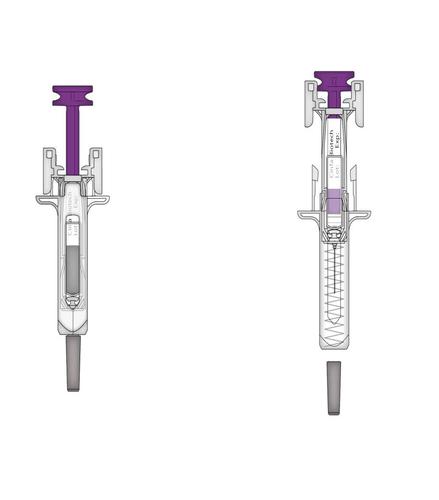
Before use
After use
Plunger
used
Plunger
Syringe
label
Syringe
barrel
used
Finger
support
Syringe label
Syringe barrel Used needle
Syringe safety
shield
Safety
spring
for the
used needle
Safety spring
for the needle
Needle
cap
Needle
cap
removed
inserted
Important
Before using a pre-filled Pelmeg syringe with an automatic needle protection device,
read these important instructions:
- It is important that you do not attempt to administer the injection unless you have received adequate
instructions from your doctor or healthcare professional. - Pelmeg is administered as an injection into the tissue just below the skin (subcutaneous injection). Do notremove the needle cap from the pre-filled syringe until you are ready for
the injection.
Do notuse the pre-filled syringe if it has been dropped onto a hard surface. Use a new
pre-filled syringe and contact your doctor or healthcare professional.
Donot attempt to activate the pre-filled syringe before the injection.
Donot attempt to remove the transparent safety shield from the pre-filled syringe.
Do notattempt to remove the detachable label from the syringe barrel before
receiving the injection.
Contact your doctor or healthcare professional if you have any questions.
| Step 1: Preparation | |
| A | Remove the pre-filled syringe packaging from the pack and collect the necessary materials for the injection: alcohol swabs, cotton ball or gauze, a bandage and a sharps disposal container (not included). |
| c For a more comfortable injection, allow the pre-filled syringe to reach room temperature for about 30 minutes before the injection. Wash your hands thoroughly with soap and water. a Place the new pre-filled syringe and the necessary materials for the injection on a clean and well-lit work surface. Do not try to warm the syringe using a heat source such as hot water or a microwave oven. Do not expose the pre-filled syringe to direct sunlight. r Do not shake the pre-filled syringe vigorously. Keep the pre-filled syringe out of the sight and reach of children. | |
B Open the packaging by tearing the cover. Grab the safety shield of the pre-filled syringe to remove the pre-filled syringe from the packaging.
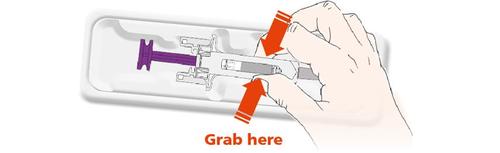
Grip here
For safety reasons:
Donot grip the plunger.
Donot grip the needle cap.
C Check the medicinal product and the pre-filled syringe.

Medicinal product
Donot use the pre-filled syringe if:
- The medicinal product is cloudy or there are particles inside. It should be a clear and colourless liquid.
- Any parts appear cracked or broken.
- The needle cap is missing or is not securely attached.
- The expiry date printed on the label has passed the last day of the month indicated. In all cases, contact your doctor or healthcare professional.
Step 2: Preparation
A Wash your hands thoroughly. Prepare and clean the injection site.
You can use:
- The upper thigh.
- The abdomen, except for an area of 5 centimetres around the navel.
- The outer upper arm (only if someone else is giving you the injection). Clean the injection site with an alcohol swab. Allow the skin to dry.
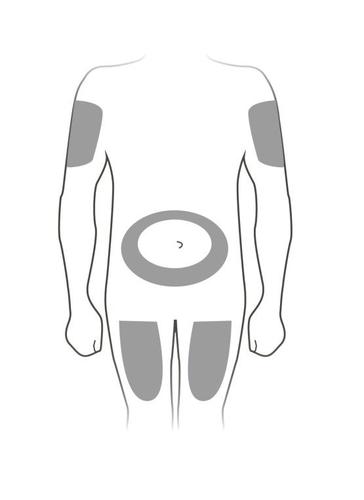
Upper arm
Abdomen
Upper thigh
Donot touch the cleaned skin area.
Donot inject into areas where the skin is sensitive, bruised, red, or hardened. Avoid injecting into
areas with scars or stretch marks.
| B | Carefully remove the needle cap outwards and away from your body. |
e l F a r m a c o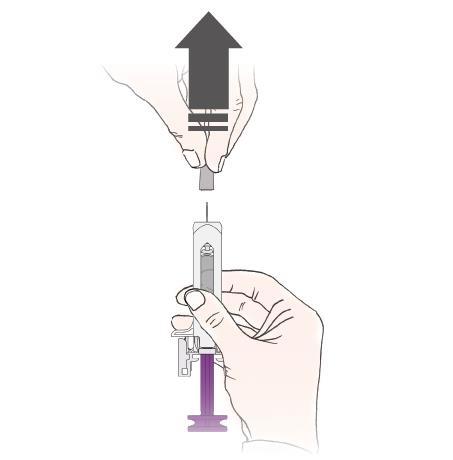 | |
| C | Pinch up the injection site to create a firm surface.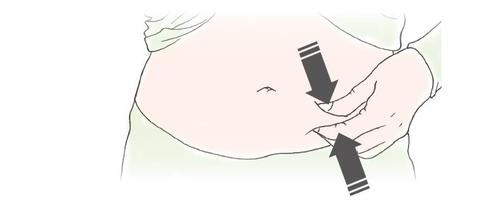 |
| a n a i l a t I It is important to keep the skin pinched up during the injection. | |
| a Step 3: Injection | |
| A | Keeping the skin pinched up, INSERT the needle into the skin.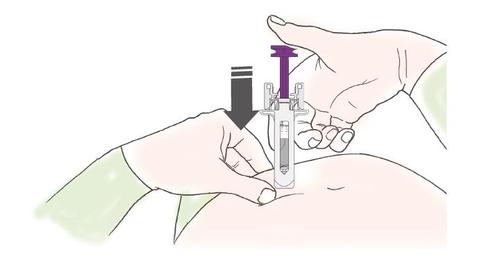 |
| A g e n z i | |
Donot touch the cleaned skin area.
B | o PUSH the plunger with a slow and steady pressure until you feel or hear a “click”. Push all the way down to the end. |
c a m r a F l It is important to push all the way down to the “click” to inject the entire dose.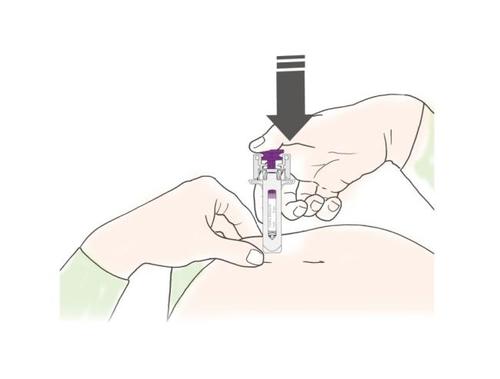 | |
| C | d RELEASE your thumb. Then WITHDRAW the syringe from the skin.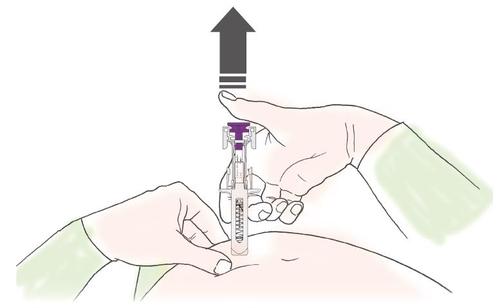 |
| a n a i l a t I After releasing the plunger, the safety shield of the pre-filled syringe will cover the injection needle safely. Do not replace the needle cap on used pre-filled syringes. | |
For healthcare professionals only
The trade name and batch number of the product administered must be clearly
recorded in the patient’s medical record.
Remove and keep the syringe label.
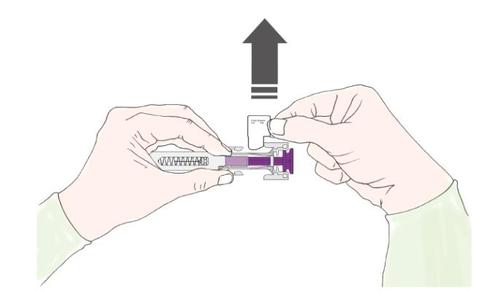
Turn the plunger to move the label to a position where it can be removed.
| Step 4: End | |
A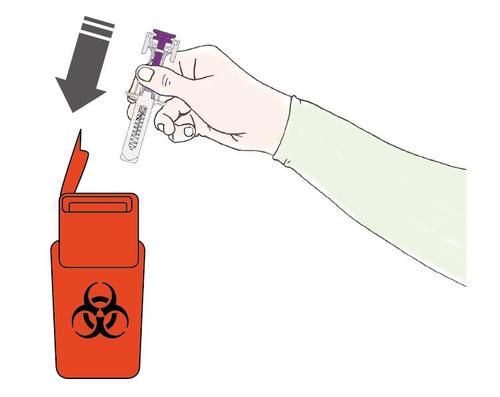 | i l Dispose of the used pre-filled syringe and other materials in a sharps disposal container. |
| A g e n z i a I t a | |
Medicines should be disposed of in accordance with local regulations. Ask your pharmacist
how to dispose of medicines you no longer use. These measures will help protect the environment.
Keep the syringe and sharps disposal container out of the sight and reach of children.
Donot reuse the pre-filled syringe.
Donot recycle pre-filled syringes or dispose of them in household waste.
| B | Examine the injection site. |
| m If you notice blood, press a cotton ball or gauze onto the injection site. Do not rub the injection site. Apply a bandage if necessary. | |

Не уверены, подходит ли вам это лекарство?
Обсудите симптомы и варианты лечения с врачом онлайн.

Уже начали прием и появились вопросы?
Обсудите свое состояние и дальнейшие шаги с врачом онлайн.
- Страна регистрации
- Форма выпускаInjectable solution, 6 MG
- Код АТХL03AA13
- Действующее вещество
- Отпускается по рецептуДа
- Производитель
- Информация на этой странице носит справочный характер и не является медицинской консультацией. Перед началом приема лекарства обязательно проконсультируйтесь с врачом.
- Аналоги PELMEGФорма выпуска: Injectable solution in pre-filled syringe, 6 MGДействующее вещество: ПегфилграстимПроизводитель: MUNDIPHARMA CORPORATION (IRELAND) LIMITEDОтпускается по рецептуФорма выпуска: Injectable solution in pre-filled syringe, 6 mgДействующее вещество: ПегфилграстимПроизводитель: CURATEQ BIOLOGICS S.R.OОтпускается по рецептуФорма выпуска: Injectable solution, 6 MGДействующее вещество: ПегфилграстимПроизводитель: BIOSIMILAR COLLABORATIONS IRELAND LIMITEDОтпускается по рецепту
Аналоги PELMEG в других странах
Лекарства с тем же действующим веществом, доступные в других странах.
Аналог PELMEG в Испания
Аналог PELMEG в Украина
Получите рецепт на PELMEG онлайн
Заполните форму за 2 минуты
Расскажите о симптомах, истории болезни и нужном препарате.
Выберите врача или мы назначим
Выберите специалиста или мы подберём ближайшего доступного врача.
Врач рассматривает ваш случай
Обычно в течение 30 минут. Может задать уточняющие вопросы в чате.
Получите в любой аптеке
Электронный рецепт отправляется на вашу почту — действителен по всей Польше.
Часто задаваемые вопросы
PELMEG требует рецепта в Италия. Вы можете уточнить у врача онлайн, подходит ли это лекарство для вашей ситуации.
Действующее вещество PELMEG — Пегфилграстим. Эта информация помогает определить лекарства с тем же составом под другими торговыми названиями.
PELMEG производится компанией MUNDIPHARMA CORPORATION (IRELAND) LIMITED. Упаковка и торговое название могут отличаться в зависимости от дистрибьютора.
Врачи, включая Семейные врачи, Психиатры, Дерматологи, Кардиологи, Эндокринологи, Гастроэнтерологи, Пульмонологи, Нефрологи, Ревматологи, Гематологи, Инфекционисты, Аллергологи, Гериатры, Педиатры, Онкологи, могут оценить целесообразность применения PELMEG с учетом вашей ситуации и местных правил. Вы можете записаться на онлайн-консультацию, чтобы обсудить возможные варианты.
Польша имеет хорошо развитую систему здравоохранения в крупных городах, таких как Варшава, Краков, Вроцлав и Гданьск. Аптеки широко доступны и работают в соответствии с действующим законодательством, обеспечивая доступ к рецептурным препаратам.
Вы можете купить PELMEG в Варшаве, Кракове, Вроцлаве или Гданьске в любой аптеке при наличии действующего рецепта.
Чтобы получить рецепт, вы можете воспользоваться Oladoctor:
Другие лекарства с тем же действующим веществом (Пегфилграстим) включают KEGFILA, DYRUPEG, FULPILA. Они могут отличаться торговым названием или формой выпуска, но содержат одинаковый терапевтический компонент. Перед изменением лечения рекомендуется проконсультироваться с врачом.
