



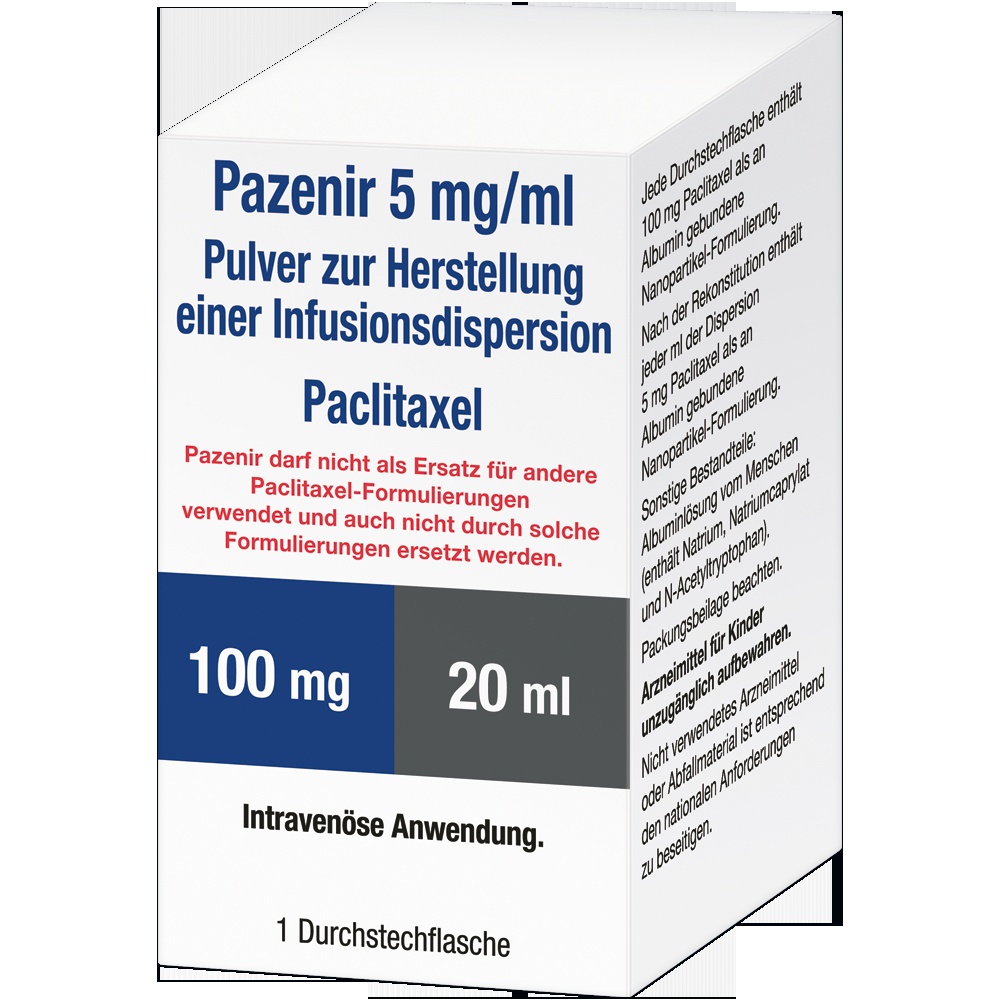
PAZENIR 5 мг/мл Порошок для дисперсии для инфузии

Рассмотрение рецепта онлайн
Врач рассмотрит ваш случай и примет решение о назначении рецепта, если это медицински оправдано.

Поговорите с врачом об этом лекарстве
Обсудите симптомы и возможные дальнейшие шаги на онлайн-консультации.



Инструкция по применению PATSENIR
Содержание инструкции
Pazenir 5 mg/mL powder for dispersion for infusion
paclitaxel
Read this leaflet carefully before you start using this medicine as it contains important
information for you.
- Keep this leaflet. You may need to read it again.
- If you have any questions, ask your doctor or nurse.
- This medicine has been prescribed for you only. Do not pass it on to others, even if their symptoms are the same as yours, as it could be harmful.
- If you get any side effects, even those not listed in this leaflet, tell your doctor or nurse. See section 4.
Contents of this leaflet
- 1. What Pazenir is and what it is used for
- 2. What you need to know before Pazenir is given to you
- 3. How to use Pazenir
- 4. Possible side effects
- 5. How to store Pazenir
- 6. Contents of the pack and other information
1. What is Pazenir and what is it used for
What is Pazenir
Pazenir contains, as the active ingredient, paclitaxel bound to albumin, a human protein, in the form of tiny particles known as nanoparticles. Paclitaxel belongs to a group of medicines called taxanes, which are used in cancer therapy.
- Paclitaxel is the part of the medicine that has an effect on the tumor, it works by stopping the division of tumor cells, which for this reason die.
- Albumin is the part of the medicine that helps paclitaxel dissolve in the blood and cross the walls of blood vessels to reach the tumor. This means that no other chemicals are needed that can cause unwanted effects, which can be life-threatening. These unwanted effects are much less frequent with Pazenir.
What is Pazenir used for
Pazenir is used for the treatment of the following types of cancer:
Breast cancer
- Breast cancer that has spread to other parts of the body (this is called “metastatic” breast cancer).
- Pazenir is used in metastatic breast cancer when at least one other therapy has been attempted, but has not been effective and if the patient is not eligible for treatments containing a group of medicines called “anthracyclines”.
- People with metastatic breast cancer who have received paclitaxel bound to albumin, a human protein, in cases where another therapy had not been successful, were more likely to observe a reduction in tumor size and lived longer compared to people who received an alternative therapy.
Pancreatic cancer
- Pazenir is used together with a medicine called gemcitabine in case of metastatic pancreatic cancer. People with metastatic pancreatic cancer (pancreatic cancer that has spread to other parts of the body) treated with paclitaxel bound to albumin, a human protein, and
gemcitabine in a clinical study lived longer compared to people who received only gemcitabine.
Lung cancer
- Pazenir is used together with a medicine called carboplatin in the treatment of the most common type of lung cancer, called “non-small cell lung cancer”.
- Pazenir is used in non-small cell lung cancer in case surgery or radiotherapy are not suitable for the treatment of the disease.
2. What you need to know before you are given Pazenir
Do not use Pazenir
- if you are allergic (hypersensitive) to paclitaxel or any of the other ingredients of Pazenir (listed in section 6);
- if you are breastfeeding;
- if you have a low number of white blood cells (initial neutrophil count < 1,500 cells/mm - your doctor will provide information on this).
Warnings and precautions
Talk to your doctor or nurse before using Pazenir
- if your kidney function is reduced;
- if you have serious liver problems;
- if you have heart problems.
Consult your doctor or nurse if you experience any of these conditions during treatment
with Pazenir; your doctor may decide to stop treatment or reduce the dose:
- if you develop unexplained bruising, bleeding or signs of infection, such as sore throat or fever;
- if you feel numbness, tingling, prickling sensation, sensitivity to touch or muscle weakness;
- if you experience breathing problems, such as shortness of breath or dry cough.
Children and adolescents
This medicine is only for adults and should not be given to children and adolescents under the age of
18 years.
Other medicines and Pazenir
Tell your doctor if you are taking or have recently taken any other medicines, including
those available without a prescription and herbal medicines. This is because Pazenir can affect
the action of other medicines and other medicines can affect the action of Pazenir.
Be careful and consult your doctor when taking Pazenir together with any of the following:
- medicines for the treatment of infections (i.e. antibiotics, such as erythromycin, rifampicin, etc.; ask your doctor, nurse or pharmacist if you are not sure whether the medicine you are taking is an antibiotic), including medicines for the treatment of fungal infections (e.g. ketoconazole)
- medicines used to stabilise mood, sometimes also called antidepressants (e.g. fluoxetine)
- medicines used to treat seizures (epilepsy) (e.g. carbamazepine, phenytoin)
- medicines used to lower lipid levels in the blood (e.g. gemfibrozil)
- medicines used for heartburn or stomach ulcers (e.g. cimetidine)
- medicines used to treat HIV and AIDS (e.g. ritonavir, saquinavir, indinavir, nelfinavir, efavirenz, nevirapine)
- a medicine called clopidogrel used for the prevention of blood clots.
Pregnancy, breastfeeding and fertility
Paclitaxel can cause serious birth defects and therefore must not be used during
pregnancy. Your doctor will perform a pregnancy test before starting treatment with Pazenir.
Women of childbearing potential must use effective contraceptive methods during therapy with Pazenir and for
1 month after stopping therapy.
Do not breastfeed during treatment with Pazenir, as it is not known whether the active ingredient paclitaxel passes
into breast milk.
Male patients are advised to use effective contraceptive measures and to avoid
conceiving during therapy and for six months after stopping it, and to inquire
about semen preservation before treatment, due to the possibility that therapy with Pazenir
may cause permanent infertility.
Ask your doctor for advice before taking this medicine.
Driving and using machines
Some people may feel tired or dizzy after receiving Pazenir. If this
happens, do not drive vehicles and do not use tools or machinery.
If other medicines are prescribed as part of the therapy, consult your doctor about the possibility of
driving and using machines.
Pazenir contains sodium
This medicine contains less than 1 mmol (23 mg) of sodium per 100 mg, i.e. essentially ‘sodium-free’.
3. How to use Pazenir
Pazenir will be administered intravenously via intravenous infusion by a doctor or nurse.
The amount administered depends on the body surface area and the results of blood tests. The
usual dose for breast cancer is 260 mg/m of body surface area, administered
over 30 minutes. The usual dose for advanced pancreatic cancer is 125 mg/m of
body surface area, administered over 30 minutes. The usual dose for non-small cell lung cancer is 100 mg/m of
body surface area, administered over 30 minutes.
How often is Pazenir administered?
For the treatment of metastatic breast cancer, Pazenir is usually administered once
every three weeks (day 1 of a 21-day cycle).
For the treatment of advanced pancreatic cancer, Pazenir is administered on days 1, 8 and 15 of
each 28-day treatment cycle, with gemcitabine administered immediately after Pazenir.
For the treatment of non-small cell lung cancer, Pazenir is administered once
a week (i.e. days 1, 8 and 15 of a 21-day cycle) with carboplatin administered once
every three weeks (i.e. only day 1 of each 21-day cycle), immediately after the administration
of the Pazenir dose.
If you have any doubts about the use of this medicine, ask your doctor or nurse.
4. Possible side effects
Like all medicines, this medicine can cause side effects, although not everybody gets them.
Very common side effects may affect more than 1 in 10 people:
- Hair loss (most cases of hair loss occurred within one month of starting treatment with paclitaxel. When it occurs, hair loss is pronounced (over 50%) in most patients)
- Skin rash
- Abnormally low number of certain types of white blood cells (neutrophils, lymphocytes, or leukocytes) in the blood
- Red blood cell (erythrocyte) deficiency
- Reduced number of platelets in the blood
- Effects on peripheral nerves (pain, numbness, tingling, or loss of sensation)
- Pain in one or more joints
- Muscle pain
- Nausea, diarrhea, constipation, mouth irritation, loss of appetite
- Vomiting
- Weakness and fatigue, fever
- Dehydration, altered taste, weight loss
- Low potassium levels in the blood
- Depression, sleep disorders
- Headache
- Chills
- Difficulty breathing
- Dizziness
- Swelling of the mucous membranes and soft tissues
- Increased liver function values
- Pain in the extremities
- Cough
- Abdominal pain
- Nosebleeds
Common side effects may affect up to 1 in 10 people:
- Itching, dry skin, nail changes
- Infection, fever with a reduction in the number of a type of white blood cells (neutrophils) in the blood, hot flashes, oral candidiasis, serious blood infection that may be caused by a reduction in white blood cells
- Reduced number of all types of blood cells
- Chest pain or sore throat
- Indigestion, abdominal problems
- Nasal congestion
- Back pain, bone pain
- Reduced muscle coordination or difficulty reading, increased or decreased tearing, eyelash loss
- Changes in heart rate or rhythm, heart failure
- Decreased or increased blood pressure
- Redness or swelling at the injection site
- Anxiety
- Lung infection
- Urinary tract infection
- Blockage in the intestine, inflammation of the colon, inflammation of the bile duct
- Acute kidney failure
- Increased bilirubin in the blood
- Coughing up blood
- Dry mouth, difficulty swallowing
- Muscle weakness
- Blurred vision
Uncommon side effects may affect up to 1 in 100 people:
- Weight gain, increased lactate dehydrogenase in the blood, decreased kidney function, increased blood sugar, increased phosphorus in the blood
- Decreased or absent reflexes, involuntary movements, neuralgia, fainting, dizziness upon standing, tremor, facial nerve paralysis
- Eye irritation, eye pain, eye redness, eye itching, double vision, reduced visual acuity or seeing flashing lights, blurred vision due to swelling of the retina (cystoid macular edema)
- Ear pain, ringing in the ears
- Cough with mucus, shortness of breath when walking or climbing stairs, runny or dry nose, decreased breath sounds, water in the lungs, hoarseness, blood clot in the lung, dry throat
- Intestinal gas, stomach cramps, pain or irritation of the gums, rectal bleeding
- Painful urination, frequent urination, blood in the urine, urinary incontinence
- Nail pain, painful nail sensitivity, nail loss, hives, skin pain, photosensitivity reaction, pigment disorders, increased sweating, night sweats, white spots on the skin, skin lesions, facial swelling
- Decreased phosphorus in the blood, fluid retention, low albumin levels in the blood, increased thirst, decreased calcium in the blood, decreased blood sugar, decreased sodium in the blood
- Nasal pain and congestion, skin infections, catheter infection
- Bruising
- Pain at the site of the tumor, tumor necrosis
- Decreased blood pressure in the upright position, cold extremities (hands and feet)
- Difficulty walking, swelling
- Allergic reaction
- Decreased liver function, enlarged liver
- Chest pain
- Restlessness
- Small hemorrhages in the skin due to blood clots
- A condition involving the destruction of red blood cells and acute kidney failure
Rare side effects may affect up to 1 in 1,000 people:
- Skin reaction to another agent or pulmonary inflammation following radiation
- Blood clot formation
- Very slow pulse, heart attack
- Leakage of the medicine from the vein
- A disorder of the heart's electrical conduction system (atrioventricular block)
Very rare side effects may affect up to 1 in 10,000 people:
- Severe skin/mucous membrane inflammation/rash (Stevens-Johnson syndrome, toxic epidermal necrolysis)
Side effects with unknown frequency (frequency cannot be estimated based on available data):
- Hardening/thickening of the skin (scleroderma)
Reporting of side effects
If you get any side effects, talk to your doctor or nurse. This includes any side effects not listed in this leaflet. You can also report side effects directly through the national reporting system listed in Annex V. By reporting side effects you can help provide more information on the safety of this medicine.
5. How to store Pazenir
Keep this medicine out of the sight and reach of children.
Do not use this medicine after the expiry date which is stated on the pack and vial after
Exp. The expiry date refers to the last day of that month.
Closed vials: keep the container in the outer packaging until use to protect the
medicine from light.
After the first reconstitution, the dispersion must be used immediately. If not
used immediately, the dispersion can be stored in a refrigerator (2 °C - 8 °C) for up to
24 hours in the vial kept in the outer packaging to protect the medicine from light.
The dispersion reconstituted in intravenous infusion can be stored for up to 24 hours at 2 - 8 °C, protected from light, followed by 4 hours at 15-25 °C.
The doctor or pharmacist is responsible for the correct disposal of unused Pazenir.
6. Contents of the pack and other information
What Pazenir contains
The active substance is paclitaxel.
Each vial contains 100 mg of paclitaxel bound to albumin formulated in nanoparticles.
After reconstitution, each mL of dispersion contains 5 mg of paclitaxel bound to albumin
formulated in nanoparticles.
The other component is human albumin (containing sodium caprylate and N-acetyl-DL-tryptophan),
see section 2 “Pazenir contains sodium”.
Description of the appearance of Pazenir and contents of the pack
Pazenir is a white to yellow powder for dispersion for infusion. Pazenir is available in
glass vials containing 100 mg of paclitaxel bound to albumin formulated in nanoparticles.
Each pack contains 1 vial.
Marketing Authorisation Holder
ratiopharm GmbH
Graf-Arco-Straße 3
89079 Ulm
Germany
Manufacturer
Merckle GmbH
Ludwig-Merckle-Straße 3
89143 Blaubeuren
Germany
Pharmachemie B.V.
Swensweg 5
Haarlem
2031 GA
Netherlands
Teva Pharma B.V.
Swensweg 5
2031 GA Haarlem
Netherlands
Teva Nederland B.V.
Swensweg 5
2031 GA Haarlem
Netherlands
For further information on this medicinal product, contact the local representative of the marketing
authorisation holder:
België/Belgique/Belgien
Teva Pharma Belgium N.V./S.A./AG
Tél/Tel: +32 38207373
Lietuva
UAB Teva Baltics
Tel: +370 52660203
България
Тева Фарма ЕАД
Тел: +359 24899585
Luxembourg/Luxemburg
Teva Pharma Belgium N.V./S.A./AG
Belgique/Belgien
Tél/Tel: +32 38207373
Česká republika
Teva Pharmaceuticals CR, s.r.o.
Tel: +420 251007111
Magyarország
Teva Gyógyszergyár Zrt.
Tel: +36 12886400
Danmark
Teva Denmark A/S
Tlf: +45 44985511
Malta
Teva Pharmaceuticals Ireland
L-Irlanda
Τel: +44 2075407117
Deutschland
ratiopharm GmbH
Tel: +49 73140202
Nederland
Teva Nederland B.V.
Tel: +31 8000228400
Eesti
UAB Teva Baltics Eesti filiaal
Tel: +372 6610801
Norge
Teva Norway AS
Tlf: +47 66775590
Ελλάδα
TEVA HELLAS Α.Ε.
Τηλ: +30 2118805000
Österreich
ratiopharm Arzneimittel Vertriebs-GmbH
Tel: +43 1970070
España
Teva Pharma, S.L.U.
Tel: +34 913873280
Polska
Teva Pharmaceuticals Polska Sp. z o.o.
Tel: +48 223459300
France
Teva Santé
Tél: +33 155917800
Portugal
Teva Pharma - Produtos Farmacêuticos,
Lda.
Tel: +351 214767550
Hrvatska
Pliva Hrvatska d.o.o.
Tel: +385 13720000
România
Teva Pharmaceuticals S.R.L.
Tel: +40 212306524
Ireland
Teva Pharmaceuticals Ireland
Tel: +44 2075407117
Slovenija
Pliva Ljubljana d.o.o.
Tel: +386 15890390
Ísland
Teva Pharma Iceland ehf.
Slovenská republika
TEVA Pharmaceuticals Slovakia s.r.o.
Tel: +421 257267911
Italia
Teva Italia S.r.l.
Tel: +39 028917981
Sími: +354 5503300
Suomi/Finland
Teva Finland Oy
Puh/Tel: +358 201805900
Κύπρος
TEVA HELLAS Α.Ε.
Ελλάδα
Τηλ: +30 2118805000
Sverige
Teva Sweden AB
Tel: +46 42121100
United Kingdom (Northern Ireland)
Teva Pharmaceuticals Ireland
Ireland
Tel: +44 2075407117
More detailed information on this medicinal product is available on the website of the European
Medicines Agency, http://www.ema.europa.eu.
-------------------------------------------------------------------------------------------------------------------------
Doctors or healthcare professionals
The following information is intended exclusively for doctors or healthcare professionals:
Instructions for use, handling and disposal
Precautions for preparation and administration
Paclitaxel is a cytotoxic anti-cancer medicinal product; as with other potentially toxic compounds,
certain precautions must be taken when handling Pazenir. Wear gloves, goggles and protective
clothing. If Pazenir dispersion comes into contact with the skin, wash the skin immediately
and thoroughly with soap and water. If contact with Pazenir occurs with the mucous membranes, they
should be rinsed well with plenty of water. Pazenir must be prepared and administered
exclusively by personnel adequately trained in the handling of cytotoxic agents. Pazenir
should not be handled by pregnant women.
Due to the possibility of extravasation, the infusion site should be carefully monitored for
detection of any leakage during administration. Limiting the infusion of Pazenir to 30 minutes, as
indicated, reduces the likelihood of infusion-related reactions.
Reconstitution of the medicinal product and administration
Pazenir must be administered under the supervision of a qualified oncologist in departments
specialized in the administration of cytotoxic agents.
Pazenir is supplied as a sterile lyophilized powder and must be reconstituted before use. After
reconstitution, each mL of dispersion contains 5 mg of paclitaxel bound to albumin formulated in
nanoparticles. The reconstituted dispersion of Pazenir is administered intravenously using
an infusion set equipped with a 15 micron filter.
Reconstitution of 100 mg
Using a sterile syringe, slowly inject 20 mL of sodium chloride 9 mg/mL (0.9%) solution
for infusion into the 100 mg vial of Pazenir over at least 1 minute.
The solution must be directed towards the inner wall of the vial. The solution must not
be injected directly onto the powder as this would create foam.
Once the solution has been added, allow to stand for at least 5 minutes to allow the powder
to be completely permeated. Then, gently and/or slowly rotate and/or invert the vial,
for at least 2 minutes, until all the powder is completely redispersed. Avoid foam formation.
If foam or clumps form, allow the dispersion to stand for at least
15 minutes until the foam disappears.
The reconstituted dispersion should have a milky and homogeneous appearance without visible precipitate.
Deposits may occur in the reconstituted dispersion. If precipitates or deposits are visible,
gently invert the vial again to ensure complete redispersal before
use.
Examine the dispersion in the vial to check for precipitate. Do not administer
the reconstituted dispersion if precipitates are observed in the vial.
The exact total volume of the 5 mg/mL dispersion required for the patient must be calculated
and the appropriate amount of reconstituted Pazenir must be injected into a sterile, empty PVC or other material
intravenous infusion bag.
The use of medical devices containing silicone lubricant oil (syringes and IV bags) for
reconstituting and administering Pazenir may cause the formation of protein filaments.
Administer Pazenir using an infusion set equipped with a 15 micron filter to prevent
the administration of these filaments. The use of a 15 micron filter removes the filaments and does not
alter the physical or chemical properties of the reconstituted product.
The use of filters with a pore diameter less than 15 microns may cause the filter to become clogged.
Special containers or administration sets not containing DEHP are not required for the preparation and administration of Pazenir infusions.
After administration, it is recommended to flush the infusion line with sodium chloride 9 mg/mL (0.9%) injectable solution to ensure the complete dose is administered.
Unused medicinal product and waste derived from such medicinal product must be disposed of in accordance with
current local regulations.
Stability
Closed vials of Pazenir are stable until the date indicated on the packaging, provided that
the vial is stored in the outer packaging to protect the medicinal product from light. Freezing and refrigeration do not have any negative effects on the stability of the medicinal product. This
medicinal product does not require any particular storage temperature.
Stability of the reconstituted dispersion in the vial
After initial reconstitution, the dispersion must be immediately transferred to an infusion bag.
However, the medicinal product has been shown to be chemically and physically stable for 24 hours at
2 °C – 8 °C in the original packaging and protected from intense light.
Stability of the reconstituted dispersion in the infusion bag
After reconstitution, the reconstituted dispersion in the infusion bag must be used
immediately. However, the medicinal product has been shown to be chemically and physically stable for 24 hours at
- 2 - 8 °C, protected from light, followed by 4 hours at 15-25 °C.

Не уверены, подходит ли вам это лекарство?
Обсудите симптомы и варианты лечения с врачом онлайн.

Уже начали прием и появились вопросы?
Обсудите свое состояние и дальнейшие шаги с врачом онлайн.
- Страна регистрации
- Форма выпускаPowder for dispersion for infusion, 5 MG/ML
- Код АТХL01CD01
- Действующее вещество
- Отпускается по рецептуДа
- Производитель
- Информация на этой странице носит справочный характер и не является медицинской консультацией. Перед началом приема лекарства обязательно проконсультируйтесь с врачом.
- Аналоги PATSENIRФорма выпуска: Powder for injectable suspension, 5 MG/MLДействующее вещество: ПаклитакселПроизводитель: BRISTOL-MYERS SQUIBB PHARMA EEIGОтпускается без рецептаФорма выпуска: Powder for dispersion for infusion, 5mg / mlДействующее вещество: ПаклитакселПроизводитель: WHITEOAK PHARMACEUTICAL B.V.Отпускается по рецептуФорма выпуска: Concentrate for infusion solution, 6 MG/MLДействующее вещество: ПаклитакселПроизводитель: ACCORD HEALTHCARE, S.L.U.Отпускается по рецепту
Аналоги PATSENIR в других странах
Лекарства с тем же действующим веществом, доступные в других странах.
Аналог PATSENIR в Испания
Аналог PATSENIR в Польша
Аналог PATSENIR в Украина
Получите рецепт на PATSENIR онлайн
Заполните форму за 2 минуты
Расскажите о симптомах, истории болезни и нужном препарате.
Выберите врача или мы назначим
Выберите специалиста или мы подберём ближайшего доступного врача.
Врач рассматривает ваш случай
Обычно в течение 30 минут. Может задать уточняющие вопросы в чате.
Получите в любой аптеке
Электронный рецепт отправляется на вашу почту — действителен по всей Польше.
Часто задаваемые вопросы
PATSENIR требует рецепта в Италия. Вы можете уточнить у врача онлайн, подходит ли это лекарство для вашей ситуации.
Действующее вещество PATSENIR — Паклитаксел. Эта информация помогает определить лекарства с тем же составом под другими торговыми названиями.
PATSENIR производится компанией RATIOPHARM GMBH. Упаковка и торговое название могут отличаться в зависимости от дистрибьютора.
Врачи, включая Семейные врачи, Психиатры, Дерматологи, Кардиологи, Эндокринологи, Гастроэнтерологи, Пульмонологи, Нефрологи, Ревматологи, Гематологи, Инфекционисты, Аллергологи, Гериатры, Педиатры, Онкологи, могут оценить целесообразность применения PATSENIR с учетом вашей ситуации и местных правил. Вы можете записаться на онлайн-консультацию, чтобы обсудить возможные варианты.
Польша имеет хорошо развитую систему здравоохранения в крупных городах, таких как Варшава, Краков, Вроцлав и Гданьск. Аптеки широко доступны и работают в соответствии с действующим законодательством, обеспечивая доступ к рецептурным препаратам.
Вы можете купить PATSENIR в Варшаве, Кракове, Вроцлаве или Гданьске в любой аптеке при наличии действующего рецепта.
Чтобы получить рецепт, вы можете воспользоваться Oladoctor:
Другие лекарства с тем же действующим веществом (Паклитаксел) включают ABRAXANE, APEXELSIN, PAKLITAXEL AKKORD EALTKARE ITALIA. Они могут отличаться торговым названием или формой выпуска, но содержат одинаковый терапевтический компонент. Перед изменением лечения рекомендуется проконсультироваться с врачом.
