



MYALEPTA 11.3 мг Порошок для инъекционного раствора

Рассмотрение рецепта онлайн
Врач рассмотрит ваш случай и примет решение о назначении рецепта, если это медицински оправдано.

Поговорите с врачом об этом лекарстве
Обсудите симптомы и возможные дальнейшие шаги на онлайн-консультации.



Инструкция по применению MYALEPTA
Содержание инструкции
- Myalepta 3 mg powder for injectable solution
- Myalepta 5.8 mg powder for injectable solution
- Myalepta 11.3 mg powder for injectable solution
Myalepta 3 mg powder for injectable solution
metreleptin
Medicinal product subject to additional monitoring. This will allow the rapid identification of
new safety information. You can contribute by reporting any adverse effects
experienced during the use of this medicine. See the end of section 4 for
information on how to report adverse effects.
Read this leaflet carefully before using this medicine as it contains important
information for you.
- Keep this leaflet. You may need to read it again.
- If you have any questions, ask your doctor, pharmacist or nurse.
- This medicine has been prescribed for you only. Do not give it to other people, even if their symptoms are the same as yours, as it could be harmful.
- If any side effects occur, including those not listed in this leaflet, tell your doctor, pharmacist or nurse. See section 4.
Contents of this leaflet
- 1. What Myalepta is and what it is used for
- 2. What you need to know before you use Myalepta
- 3. How to use Myalepta
- 4. Possible side effects
- 5. How to store Myalepta
- 6. Contents of the pack and other information
1. What is Myalepta and what is it used for
Myalepta contains the active substance metreleptin. Metreleptin is similar to a human hormone
called leptin.
What is Myalepta used for
Myalepta is used for the treatment of complications resulting from a lack of a
sufficient amount of leptin in patients affected by lipodystrophy.
It is used in adults, adolescents and children from 2 years of age affected by:
- generalized lipodystrophy (the entire body does not have a sufficient amount of adipose tissue)
It is used, when other therapies have not been effective, in adults and adolescents
from 12 years of age affected by:
- partial lipodystrophy of a hereditary nature (also called congenital or familial lipodystrophy)
- or by partial lipodystrophy (also called acquired lipodystrophy) caused by the body's response to an event such as a viral illness.
How Myalepta works
Natural leptin is produced by adipose tissue and performs many functions in the body, including:
- controlling the sensation of appetite and energy levels;
- helping the insulin present in the body to manage blood sugar levels. Metreleptin works by mimicking the effects of leptin. This improves the body's ability to control energy levels.
2. What you need to know before you use Myalepta
Do not use Myalepta
- if you are allergic to metreleptin or any of the other ingredients of this medicine (listed in section 6).
Warnings and precautions
Talk to your doctor, pharmacist or nurse before using Myalepta:
- if you are pregnant
- if you have suffered from a type of cancer called lymphoma
- if you have had problems with your blood (such as a low number of blood cells)
- if you have suffered from inflammation of an organ called the pancreas (pancreatitis)
- if you suffer from or have suffered from disorders of the immune system (autoimmune diseases, including autoimmune liver problems)
Lymphoma
People affected by lipodystrophy may develop a type of blood cancer called
lymphoma, regardless of whether or not they are using Myalepta.
Using this medicine, however, you may have a higher risk of developing lymphoma.
The decision as to whether you should use Myalepta is up to your doctor, who will monitor you during this
treatment.
Serious and dangerous infections
During treatment with Myalepta, the body may produce antibodies that can increase
the risk of developing serious and dangerous infections. Tell your doctor immediately if you experience
high fever, accompanied by increasing fatigue (see section 4).
Low blood sugar with insulin or other antidiabetics
If you are using a medicine such as insulin or other medicines for the treatment of diabetes, your
blood sugar will be closely monitored by your doctor. The doctor will adjust the dose of insulin or
other medicines, if necessary.
This will help to avoid your blood sugar becoming too low
(“hypoglycemia”). For signs indicating a lowering of blood sugar, see section 4, under
“Signs of high and low blood sugar”.
High blood sugar and high levels of fats in the blood
During therapy with Myalepta you may have a higher value of sugar (hyperglycemia) or fat
in the blood (hypertriglyceridemia); this may indicate that this medicine is not working as
it should. The signs of hyperglycemia and hypertriglyceridemia are listed in section 4, under “Signs of high
and low blood sugar” and “Signs of high levels of fats in the blood”.
If you notice any of these symptoms, described above and also in section 4 of this leaflet, or
have any doubts, tell your doctor immediately. It may be necessary to change the
treatment.
Autoimmune diseases
People who suffer from or have suffered from disorders of the immune system (autoimmune diseases,
including autoimmune liver problems) may experience a worsening of symptoms with
Myalepta. Talk to your doctor to find out which symptoms to watch out for; the appearance of these symptoms
should require further investigation.
Allergic reactions
During treatment with Myalepta you may develop an allergic reaction. Tell your
doctor immediately if you experience symptoms of an allergic reaction. The signs of an allergic
reaction are reported in section 4, under “Allergic reactions”.
Fertility
Myalepta may increase fertility in women with lipodystrophy (see section “Pregnancy,
breastfeeding and fertility”).
Myalepta contains sodium
This medicine contains less than 1 mmol of sodium (23 mg) per dose, that is to say essentially ‘sodium-free’.
Children and adolescents
Do not give this medicine to children under 2 years of age with generalized lipodystrophy or to children
under 12 years of age with partial lipodystrophy. This is because the effects of this
medicine on children below these age thresholds are not known.
Other medicines and Myalepta
Tell your doctor if you are taking, have recently taken or might take any other medicines.
Myalepta can affect the way other medicines work. Also, there are some medicines that
can affect the way this medicine works.
In particular, tell your doctor if you are taking any of the following medicines:
- hormonal contraceptives, as Myalepta may reduce their effectiveness in preventing pregnancy
- theophylline, used for lung diseases such as asthma
- anticoagulants (such as warfarin or phenprocoumon)
- medicines that suppress the action of the immune system (such as cyclosporine)
- antidiabetic medicines (such as insulin or insulin secretagogues), see section 2 ‘Low blood sugar with insulin or other antidiabetics’
If you are in any of the situations listed above (or have any doubts about it) talk to your doctor
before using Myalepta. During treatment with Myalepta some medicines must be
monitored as it may be necessary to change the dose of these medicines.
Pregnancy, breastfeeding and fertility
If you are pregnant, suspect you are pregnant or are planning to become pregnant, or if you are breastfeeding
ask your doctor or pharmacist for advice before taking this medicine.
Do not use Myalepta if you are pregnant or might become pregnant. It is not known what
the effects of Myalepta are on the unborn child. Women who are able to become pregnant should use
effective contraceptive methods, including non-hormonal methods such as condoms, during treatment with
Myalepta. Talk to your doctor about appropriate contraceptive methods, because Myalepta may reduce
the effectiveness of hormonal contraceptives in preventing pregnancy.
It is not known whether Myalepta passes into breast milk. Talk to your doctor if you are breastfeeding or
intend to do so. Together with your doctor you will decide whether to continue or stop
breastfeeding while you are being treated with this medicine, taking into account the benefit of breastfeeding for the
child and the benefit of Myalepta for the mother.
Myalepta may increase fertility in women with lipodystrophy.
Driving and using machines
Myalepta slightly impairs the ability to drive and use machines. You may feel dizzy or tired while being treated with this medicine. If this
happens, do not drive vehicles or use tools or machinery. If you have any doubts, ask your doctor.
3. How to use Myalepta
Use this medicine following the doctor's instructions exactly. If you have any doubts, consult your
doctor.
Myalepta is administered by an injection under the skin (subcutaneous injection) once
daily. This medicine is used in children starting from 2 years, in adolescents and in
adults with generalized lipodystrophy and also in children starting from 12 years, in adolescents and in
adults with partial lipodystrophy.
During treatment with this medicine, the doctor will monitor you or the child and decide
which dose you will need to use.
The doctor may decide that you inject the medicine yourself. The doctor, nurse or pharmacist will
show you how to prepare and inject this medicine yourself.
- Do nottry to prepare the medicine or inject it yourself if you have not been trained to do so.
How much medicine to inject
The dose of Myalepta may vary over time, based on the effects obtained with this medicine. The
Myalepta powder is dissolved and mixed with water for injectable preparations in order to obtain
the solution for injection. Read the “Instructions for Use” which explain how to prepare the solution
before the injection.
The doctor will prescribe the correct dose based on the following indications:
- If you weigh 40 kg or less:
- Initial dose of 0.06 mg (0.012 ml of solution) per each kilogram of body weight.
- If you are maleand weigh more than 40 kg:
- Initial dose of 2.5 mg (0.5 ml of solution).
- If you are femaleand weigh more than 40 kg:
- Initial dose of 5 mg (1 ml of solution). The doctor or pharmacist will inform you about the amount of solution to inject. If you have any doubts about the amount of solution to inject, consult your doctor or pharmacist before proceeding with the injection.
- The syringe to be used for injecting this medicine depends on the dose that has been prescribed for you. The pharmacist will give you the appropriate syringe for the injection. To know which syringe to use, consult the “Instructions for Use”.
- To know the amount of medicine to inject (in ml), you need to divide the dose (in mg) by 5. For example, if the doctor has prescribed a dose of Myalepta of 5 mg, 5 mg divided by 5 equals 1 ml, which corresponds to the amount of solution to inject with a 1 ml syringe.
- If the dose is 1.50 mg (0.30 ml of solution) or less, you will need to use a 0.3 ml syringe. On the 0.3 ml syringe, the amount of solution to inject is indicated in “Units” instead of “ml”. Consult the “Instructions for Use” (paragraph 7) for further information on how to read and use the various syringes. To know the amount of solution to inject (in Units), you need to divide the dose (in mg) by 5 and then multiply it by 100. If you need to inject 1 ml or more of the Myalepta solution, the doctor may advise you to administer the dose in two separate injections. This can help make the injections more comfortable. For both injections, you will need to use a clean syringe and needle. If you have any doubts about the amount of solution to inject, consult your doctor or pharmacist before proceeding with the injection.
When prescribing doses/volumes in small quantities (e.g. in children), the vials remain
almost completely full of product after taking the necessary dose. The remaining reconstituted
solution must be discarded after use.
If you use more Myalepta than you should
If you use more Myalepta than you should, inform your doctor immediately or go to the hospital
immediately. The doctor will monitor you for the occurrence of any adverse effects.
If you forget to use Myalepta
- If you forget to inject a dose, inject it as soon as you remember.
- Then inject the dose normally the next day.
- Do not use a double dose to make up for a missed dose. If you have injected less Myalepta than you should, inform your doctor immediately. The doctor will monitor you for the occurrence of any adverse effects.
If you stop using Myalepta
Do not stop treatment with Myalepta without first consulting your doctor. The doctor will decide
if you should stop treatment with this medicine.
If it is necessary to stop treatment with Myalepta, the doctor will gradually reduce the dose for
a period of two weeks before completely stopping therapy. The doctor will also advise you to
follow a low-fat diet.
- The gradual reduction of the dose for a period of two weeks is important because it can help prevent a sudden increase in the levels of fats (called “triglycerides”) in the blood.
- A sudden increase in the amount of triglycerides in the blood can cause inflammation of the pancreas (pancreatitis). The gradual reduction of the dose, accompanied by a low-fat diet, can help prevent this problem. Do not stop treatment with Myalepta unless you have been told to do so by your doctor.
If you have any questions about the use of this medicine, ask your doctor.
4. Possible side effects
Like all medicines, this medicine can cause side effects, although not everybody gets them.
Possible side effects of this medicine:
Serious side effects
Seek medical attention immediately if you notice any of the following serious side effects - you may need urgent medical treatment. If you cannot contact
your doctor, seek emergency medical assistance:
- low blood sugar (glucose) level (hypoglycemia), see the section “Signs of high and low blood sugar” below
- high blood sugar (glucose) level (hyperglycemia)
- presence of a blood clot in a vein (deep vein thrombosis) - pain, swelling, warmth and redness, usually in the thigh or lower leg
- fluid accumulation in the lungs - cough or difficulty breathing
- feeling sleepy or confused
Allergic reactions
Seek medical attention immediately if you notice any serious allergic reaction, including:
- difficulty breathing
- swelling and redness of the skin, hives
- swelling of the face, lips, tongue or throat
- stomach pain, feeling unwell (nausea) and sickness (vomiting)
- fainting or dizziness
- severe stomach pain (abdomen)
- very rapid heartbeat
Pancreatitis (inflammation of the pancreas):
Seek medical attention immediately if you notice signs of inflammation of the pancreas, including:
- severe and sudden stomach pain (abdomen)
- feeling unwell (nausea) or sickness (vomiting)
- diarrhea
Other side effects
Seek medical attention if you notice the occurrence of any of the following side effects.
Very common(may affect more than 1 in 10 people):
- weight loss
Common(may affect up to 1 in 10 people):
- loss of interest in food
- headache
- hair loss
- unusually heavy or prolonged menstrual periods
- feeling tired
- bruising, redness, itching or hives at the injection site
- the body producing antibodies against metreleptin, which may increase the risk of developing serious or life-threatening infections. You may notice the development of a fever, accompanied by increased fatigue.
Frequency not known(frequency cannot be estimated from available data):
- influenza
- chest infection
- diabetes
- increased desire to eat or overeating
- faster heartbeat than normal
- cough
- shortness of breath
- muscle pain (myalgia)
- joint pain
- swelling of the hands and feet
- increase in adipose tissue
- swelling or bleeding under the skin, where the injection was given
- pain at the injection site
- itching at the injection site
- feeling generally unwell, discomfort or widespread pain
- increased amount of fat in the blood (triglycerides) (see the section “Signs of high levels of fat” below)
- increased levels of glycated hemoglobin (HbA1c) in the blood, indicated by tests
- weight gain
- swelling or bleeding under the skin (hemorrhage)
- high blood sugar (hyperglycemia) (see the section “Signs of high and low blood sugar” below). Seek medical attention if you notice the occurrence of any of the side effects listed above.
Signs of high and low blood sugar
Symptoms of low blood sugarinclude:
- feeling dizzy
- feeling sleepy or confused
- being clumsy and dropping things
- more hungry than usual
- sweating more than usual
- more irritable or nervous If you notice any of these symptoms, or are unsure, seek medical attention immediately: you may need to adjust your treatment. Symptoms of high blood sugarinclude:
- feeling very thirsty or hungry
- needing to urinate more often than usual
- feeling sleepy
- feeling unwell or sick
- blurred vision
- chest or back pain
- feeling short of breath
Signs of high levels of fat
Symptoms of high levels of fatinclude:
- chest pain
- pain under the ribs, like heartburn or indigestion
- feeling unwell or sick
Seek medical attention if you notice the occurrence of any of the side effects listed above.
Reporting of side effects
If you get any side effects, even those not listed in this leaflet, tell your
doctor, pharmacist or nurse. You can also report side effects directly
through the national reporting system listed in Annex V . By reporting side
effects you can help provide more information on the safety of this medicine.
5. How to store Myalepta
Keep this medicine out of the sight and reach of children.
Do not use this medicine after the expiry date which is stated on the vial and the carton. The
expiry date refers to the last day of that month.
Store in a refrigerator (2 °C-8 °C). Keep the vial in the outer packaging to protect the
medicine from light.
After reconstitution, the solution must be administered immediately and cannot be
stored for later use. Discard any unused medicine.
Do not use this medicine if the solution appears cloudy, discolored or contains clumps or particles.
Do not dispose of any medicine in wastewater or household waste. Ask your pharmacist how to
dispose of medicines you no longer use. This will help protect the environment.
6. Contents of the pack and other information
What Myalepta contains
- The active substance is metreleptin.
- Each vial contains 3 milligrams of metreleptin. After dissolving the contents of the vial in 0.6 millilitres of water for injections, each millilitre contains 5 milligrams of metreleptin.
- The other ingredients are: glycine, sucrose, polysorbate 20, glutamic acid, sodium hydroxide (for pH adjustment).
Description of the appearance of Myalepta and contents of the pack
Myalepta is presented as a powder for solution for injection ( powder for injection). It is a
white-coloured powder supplied in a glass vial fitted with a rubber stopper and an aluminium seal with a
removable red plastic capsule.
Myalepta is available in packs containing 1 or 30 vials.
Not all pack sizes may be marketed in your country.
Your doctor, nurse or pharmacist will separately provide the syringes, needles, swabs and water for
injections to allow you to prepare and administer Myalepta. You will also be given a “sharps container”
where you should place the used vials, syringes and needles.
Marketing Authorisation Holder
Chiesi Farmaceutici S.p.A.
Via Palermo 26/A
43122 Parma
Italy
Manufacturer
Eurofins PHAST GmbH
Kardinal-Wendel-Straße 16
66424 Homburg
Germany
For further information on this medicine, contact the local representative of the marketing authorisation
holder:
België/Belgique/Belgien
Chiesi sa/nv
Tél/Tel: + 32 (0)2 788 42 00
Lietuva
ExCEEd Orphan s.r.o.
Bucharova 2657/12, Prague 5, 158 00
Czech republic
Tel.: +370 661 663 99
[email protected]
България
ExCEEd Orphan s.r.o.
Bucharova 2657/12, Prague 5, 158 00
Czech republic
Teл.: +359 888 918 090
[email protected]
Luxembourg/Luxemburg
Chiesi sa/nv
Tél/Tel: + 32 (0)2 788 42 00
Magyarország
ExCEEd Orphan s.r.o.
Bucharova 2657/12, Prague 5, 158 00
Czech republic
Tel.: +36 20 399 4269
[email protected]
Danmark
Chiesi Pharma AB
Tlf.: + 46 8 753 35 20
Česká republika
ExCEEd Orphan s.r.o.
Bucharova 2657/12, Prague 5, 158 00
Czech republic
Tel: +420 724 321 774
[email protected]
Malta
Amryt Pharmaceuticals DAC
Tel: +44 1604 549952
[email protected]
Deutschland
Chiesi GmbH
Tel: + 49 40 89724-0
Nederland
Chiesi Pharmaceuticals B.V.
Tel: + 31 88 501 64 00
Eesti
ExCEEd Orphan s.r.o.
Bucharova 2657/12, Prague 5, 158 00
Czech republic
Tel.: +370 661 663 99
[email protected]
Norge
Chiesi Pharma AB
Tlf: + 46 8 753 35 20
Ελλάδα
Amryt Pharmaceuticals DAC
Tηλ: +800 44 474447
Tηλ: +44 1604 549952
[email protected]
Österreich
Chiesi Pharmaceuticals GmbH
Tel: + 43 1 4073919
España
Chiesi España, S.A.U.
Tel: + 34 93 494 8000
Polska
ExCEEd Orphan s.r.o.
Bucharova 2657/12, Prague 5, 158 00
Czech republic
Tel.: +48 502 188 023
[email protected]
France
Chiesi S.A.S.
Tél: + 33 1 47688899
Portugal
Chiesi Farmaceutici S.p.A.
Tel: + 39 0521 2791
Hrvatska
ExCEEd Orphan Distribution d.o.o.
Savska cesta 32, Zagreb, 100 00
Croatia
Tel: +385 99 320 0330
[email protected]
România
ExCEEd Orphan s.r.o.
Bucharova 2657/12, Prague 5, 158 00
Czech republic
Tel: +40 744 366 015
[email protected]
Ireland
Chiesi Farmaceutici S.p.A.
Tel: + 39 0521 2791
Slovenija
ExCEEd Orphan s.r.o.
Bucharova 2657/12, Prague 5, 158 00
Czech republic
Tel: +386 30 210 050
[email protected]
Ísland
Chiesi Pharma AB
Sími: +46 8 753 35 20
Slovenská republika
ExCEEd Orphan s.r.o.
Bucharova 2657/12, Prague 5, 158 00
Czech republic
Tel: +420 608 076 274
[email protected]
Italia
Chiesi Italia S.p.A.
Tel: + 39 0521 2791
Suomi/Finland
Chiesi Pharma AB
Puh/Tel: +46 8 753 35 20
Κύπρος
Amryt Pharmaceuticals DAC
Tηλ: +800 44 474447
Tηλ: +44 1604 549952
[email protected]
Sverige
Chiesi Pharma AB
Tel: +46 8 753 35 20
Latvija
ExCEEd Orphan s.r.o.
Bucharova 2657/12, Prague 5, 158 00
Czech republic
Tel.: +370 661 663 99
[email protected]
An authorisation has been granted for this medicinal product in “exceptional circumstances”. This means
that, due to the rarity of the disease, complete information on this medicinal product has not been
possible to obtain. The European Medicines Agency will review any new information on this
Other sources of information
More detailed information on this medicine is available on the website of the European Medicines
Agency, https://www.ema.europa.eu .
Also, links to other websites on rare diseases and related therapeutic treatments are provided.
Instructions for use
Read these Instructions for Use carefully before you start using it.
Before you start self-administering this medicine at home, your doctor, nurse or
pharmacist will instruct you on how to prepare and inject Myalepta. Contact them if you have any
doubts or require further information or assistance. Allow sufficient time to carefully prepare and
inject the medicine, including the time to warm the vial after removing it from the
refrigerator, which is approximately 20 minutes.
Additional information for training
Additional information and explanatory videos are available to help you understand the correct use of
Myalepta. Ask your doctor how to access this information.
Reading the syringe
Align the top edge of the plunger with the line corresponding to the prescribed dose. Examples for
syringes of various sizes are shown below. If the syringe looks different or has a different scale, ask your
doctor, nurse or pharmacist for more information.
Using the 0.3 mL syringe
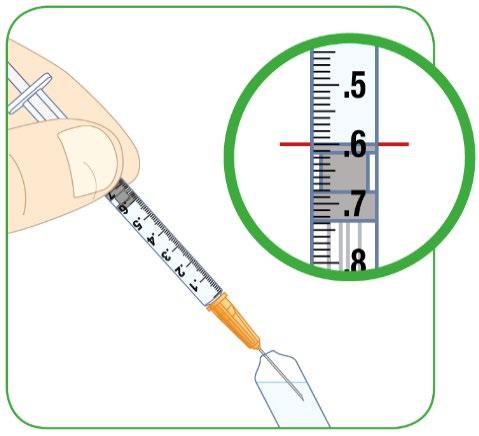
- On the 0.3 mL syringe, the amount of solution to inject is indicated in “U” instead of “mL”.
- “U” means “units”.
- 1 U is equivalent to 0.01 mL.
- Every 5 U is indicated by a number with a thicker line. This indication is equivalent to 0.05 mL.
- Every 1 U is indicated by a shorter line inserted between the thick lines. This indication is equivalent to 0.01 mL.
- Every 0.5 U is indicated by a short line inserted between two lines indicating 1 U. This indication is equivalent to 0.005 mL.
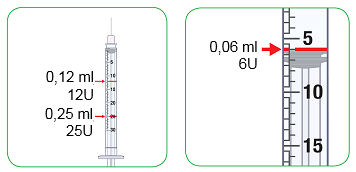
- To inject the Myalepta solution using a small 0.3 mL syringe, the last column in the table below indicates the measurement in “units” on the syringe that corresponds to the different doses of medicine that may be prescribed by your doctor, nurse or pharmacist.
Conversion of the dose from “mL” to “units” using a 0.3 mL syringe
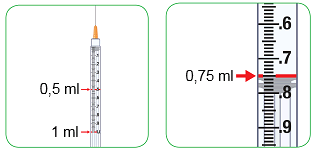
Using the 1 mL syringe
- On this syringe, the amount of solution to inject is reported in mL, so you should inject the amount that your doctor, nurse or pharmacist has indicated. You do not need to convert the amount from mL to units.
- You will be provided with a 1 mL syringe to use if the daily dose is greater than 1.5 mg up to 5 mg, which in terms of volume corresponds to a Myalepta solution greater than 0.3 mL up to 1.0 mL.
- Every 0.1 mL is indicated by a number with a long line.
- Every 0.05 mL is indicated by a line of medium length.
- Every 0.01 mL is indicated by a shorter line.
| Child's weight | Myalepta dose | Amount of mixed Myalepta solution | Amount of mixed Myalepta solution to be injected, expressed in “units” on the 0.3 mL syringe |
| 9 kg | 0.54 mg | 0.10 mL | c 10 |
| 10 kg | 0.60 mg | 0.12 mL | 12 |
| 11 kg | 0.66 mg | 0.13 mL | a 13 |
| 12 kg | 0.72 mg | 0.14 mL | 14 |
| 13 kg | 0.78 mg | 0.15 mL | m 15 |
| 14 kg | 0.84 mg | 0.16 mL | r 16 |
| 15 kg | 0.90 mg | 0.18 mL | 18 |
| 16 kg | 0.96 mg | 0.19 mL | a 19 |
| 17 kg | 1.02 mg | 0.20 mL | F 20 |
| 18 kg | 1.08 mg | 0.21 mL | 21 |
| 19 kg | 1.14 mg | l 0.22 mL | 22 |
| 20 kg | 1.20 mg | 0.24 mL | 24 |
| 21 kg | 1.26 mg | e 0.25 mL | 25 |
| 22 kg | 1.32 mg | d 0.26 mL | 26 |
| 23 kg | 1.38 mg | 0.27 mL | 27 |
| 24 kg | 1.44 mg | 0.28 mL | 28 |
| 25 kg | 1.50 mg | a 0.30 mL | 30 |
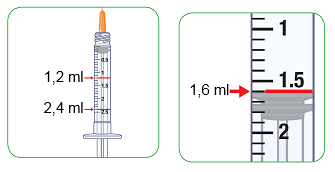
Using the 2.5 mL syringe
- On this syringe, the amount of solution to inject is reported in mL, so you should inject the amount that your doctor, nurse or pharmacist has indicated. You do not need to convert the amount from mL to units.
- You will be provided with a 2.5 mL syringe to use if the daily dose is greater than 5 mg up to 10 mg, which in terms of volume corresponds to a Myalepta solution greater than 1.0 mL.
- Every 0.5 mL is indicated by a number next to a long line.
- Every 0.1 mL is indicated by a shorter line between the long lines.
Step A - Preparation
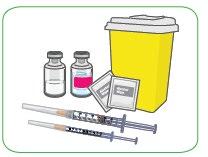
- 1) Gather all the materials needed for the injection, which have been provided by your doctor, nurse or pharmacist.
Arrange the following materials on a clean and well-lit surface:
- a glass vial containing the Myalepta powder
- a container of water for injections, to dissolve the Myalepta powder or Water for injections may be in glass or plastic vials, or in glass vials with a rubber stopper.
- alcohol swabs (to disinfect the skin where the medicine will be injected and the top of the vials)
- sharps container (to safely dispose of the materials used at the end of the injection)
You will also need 2 syringes:
- A 1 mL syringe with a 40 mm, 21 gauge needle, to dissolve the powder
- A syringe for injection, equipped with a much shorter needle, to inject the solution subcutaneously. The size of this syringe will be decided by your doctor, nurse or pharmacist based on the dose of Myalepta. o If the dose is 1.5 mg or less, the syringe to be used will be 0.3 mL. o If the dose is greater than 1.5 mg up to 5 mg, the syringe to be used will be 1 mL. o If the dose is greater than 5 mg, the syringe to be used will be 2.5 mL. o If the dose is greater than 5 mg, your doctor, nurse or pharmacist may indicate to administer the dose with two separate injections. See section 3 “How to use Myalepta” for more information.
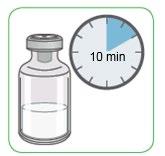
- 2) Before preparing the Myalepta solution, allow the vial containing the powder to reach room temperature, for about 10 minutes.
- 3) Wash your hands before preparing the medicine.
Phase B - Fill the 1 mL syringe with 0.6 mL of water for injections
- 4) Remove the 1 mL syringe from the plastic packaging. Always use a new syringe.
- The 1 mL syringe and needle are supplied separately.
- The way to connect the needle to the syringe depends on the water for injections container provided: a plastic vial, a glass vial, or a glass bottle (see below for specific instructions).
- 5) Draw 0.6 mL of water for injections into the 1 mL syringe.
The water for injections will be provided by your doctor, nurse, or pharmacist along with the
medicine vial and syringes. This is mixed with the Myalepta powder so
that the powder dissolves, making the medicine in liquid form so that it can be injected.
The water for injections may be supplied in one of the following containers:
- a plastic vial
- a glass vial
- a glass bottle (with a rubber stopper). Always use a new vial or bottle of water for injections. Never use the water for injections remaining after preparing the Myalepta solution the day before.
Water for injections in a plastic vial
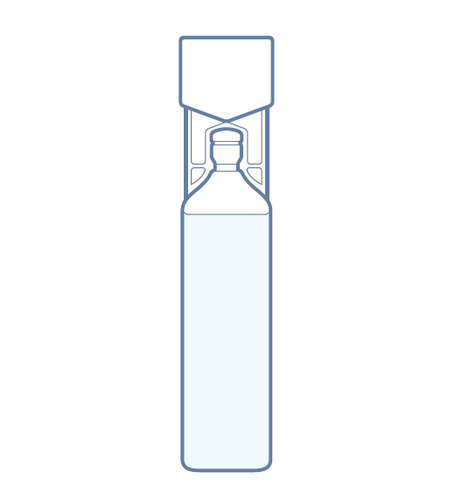
The plastic vial is a sealed container with a top with a twist-off opening.
To extract the water for injections, open the vial.
- Hold the vial with the top facing up.
- Hold the bottom of the vial with one hand and the top with the other hand.
- Keeping the bottom of the vial firm, gently twist the top until it detaches.
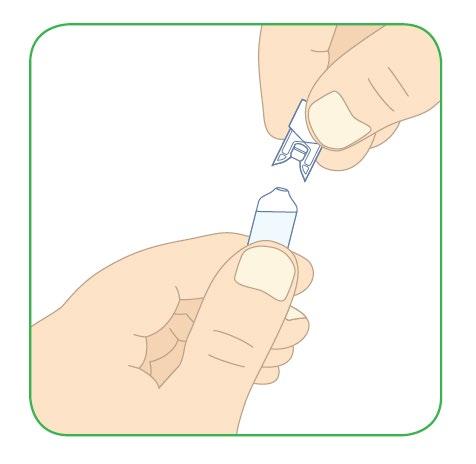
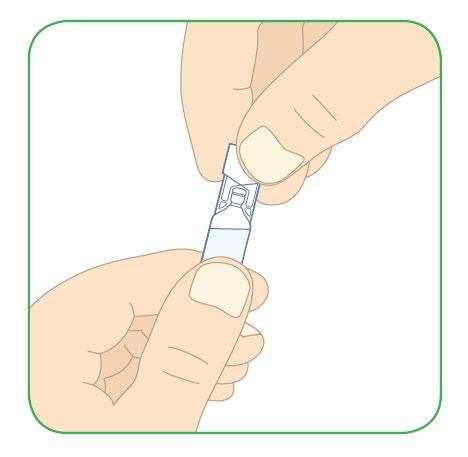
- Do not attach the needle to the syringe.
- Insert the tip of the 1 mL syringe, without a needle attached, into the top of the plastic vial, as far as it will go.
With the syringe still inserted into the vial, turn the vial and syringe upside down. The syringe is now
with the tip facing up.
With the syringe still inserted into the vial, carefully pull the plunger down.
- Pull down until the top edge of the plunger is aligned with the black line indicating 0.6 mL.
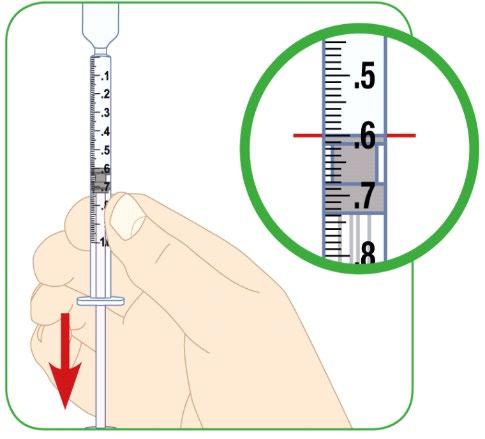
- You need to check for air sacs or air bubbles in the 1 mL syringe. To remove air sacs or air bubbles from the syringe, refer to points 6-8 below.
- Detach the syringe from the plastic vial.
Attach the needle to the syringe.
- Do not overtighten the needle.
- Do not remove the needle protective cap.
- Do not touch the needle.
Water for injections in a glass vial
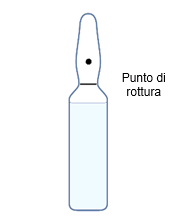
The glass vial is a sealed container.
Before opening the vial containing the water for injections, prepare the 1 mL syringe
by attaching the needle. Do not overtighten the needle.
- Remove the needle protective cap.
- Do not touch the needle.
To extract the water for injections, open the vial by breaking it at the
breaking point, as shown in the figure below.
- Hold the vial with the top facing up.
- Disinfect the vial at the breaking point with an alcohol-soaked swab.
- Hold the bottom of the vial with one hand and the top with the other hand.
- Keeping the bottom of the vial firm, snap off the tip.
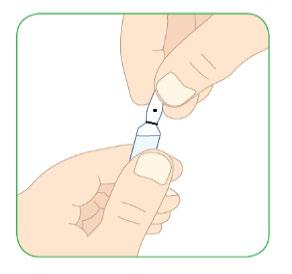
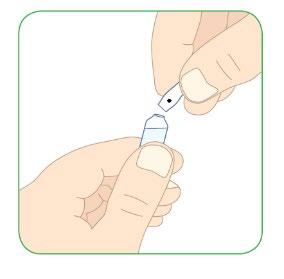
Insert the 1 mL syringe into the glass vial.
- Tilt the glass vial at a 45-degree angle to the floor.
- The needle must be inserted as far as possible inside the vial.
With the needle still inserted into the vial, carefully pull the plunger up.
- Pull the plunger up until the top edge of the plunger is aligned with the black line indicating 0.6 mL.
- You need to check for air sacs or air bubbles in the 1 mL syringe. To remove air sacs or air bubbles from the syringe, refer to points 6-8 below.
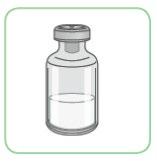
Water for injections in a glass bottle
The glass bottle is equipped with a plastic cap that must be removed to reveal the underlying rubber seal.
Do not remove the rubber seal.
Attach the needle to the 1 mL syringe. Do not overtighten the needle.
- Remove the needle protective cap.
- Do not touch the needle.
- Pull the plunger down to the line indicating 0.6 mL to draw air into the syringe.
Place the bottle on a solid, flat surface.
- Insert the needle of the 1 mL syringe into the bottle through the rubber seal.
- The needle must be facing downwards.
- The needle must penetrate the bottle completely.
Push the plunger all the way down.
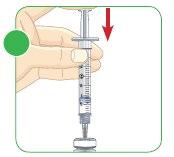
With the needle still inserted into the bottle, turn the bottle and syringe upside down. The needle is now
facing upwards.
- Do not remove the needle from the bottle.
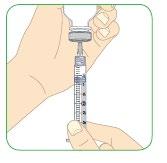
Carefully pull the plunger down.
- Pull the plunger down until the top edge of the plunger is aligned with the black line indicating 0.6 mL.
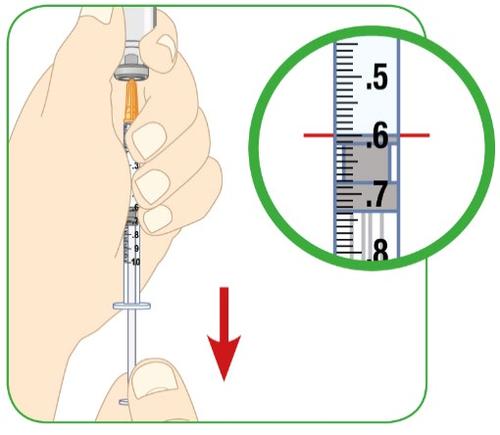
- 6) Regardless of whether you are drawing the water for injections from a vial or a bottle, you must check that there are no air sacs or air bubbles in the 1 mL syringe.
- Sometimes a large amount of air can become trapped inside the syringe (air sac). You may also see smaller air bubbles in the syringe.
- You must remove the air sac and air bubbles from thesyringe, to be sure you have drawn the correct amount of sterile water into the syringe.
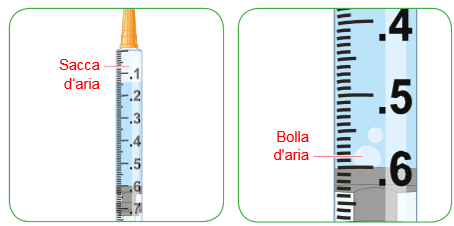
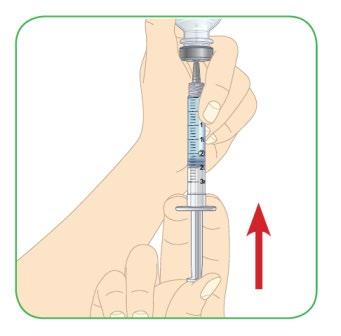
- 7) Remove any air sac or air bubbles.
Using the glass bottle or plastic vial
- With the syringe still inserted into the glass bottle or plastic vial, tap the side of the syringe to move the air sac/air bubbles to the top of the syringe.
- Carefully push the plunger upwards to expel the air from the syringe.
Using the glass vial
- Remove the syringe from the vial and hold it with the needle pointing upwards.
- Tap the side of the syringe to move the air sac/air bubbles to the top of the syringe.
- Carefully push the plunger upwards to expel the air from the syringe.
- 8) Check the amount of water for injections.
- If the amount of water for injections in the syringe is less than 0.6 mL, draw a larger amount of water for injections with the syringe and repeat points 6 and 7 until the syringe contains 0.6 mL of water.
- 9) When the syringe contains 0.6 mL of water for injections, remove the syringe from the bottle or vial.
- Do not move the plunger.
- Do not touch the exposed needle of the syringe as it is sterile and you may damage the needle or injure yourself.
Phase C - Dissolve Myalepta
- 10) Make sure that the vial containing the Myalepta powder has been removed from the refrigerator for at least 10 minutes to reach room temperature.
- 11) Remove the plastic cap from the vial containing the Myalepta powder.
- Place the vial on a solid, flat surface.
- Clean the top of the vial with an alcohol-soaked swab.
- 12) Fully insert the needle of the 1 mL syringe containing 0.6 mL of water for injections into the Myalepta vial containing the powder.
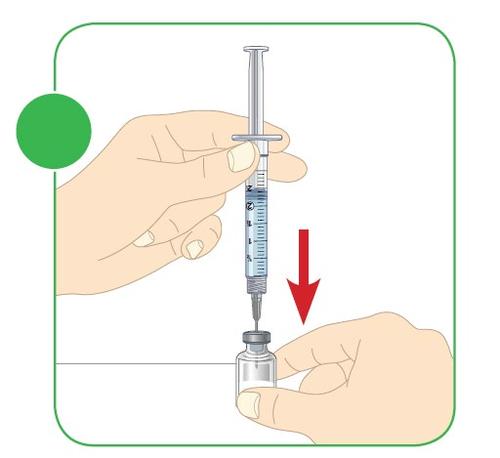
- 13) Hold the vial tilted at a 45-degree angle to the work surface and slowly push the plunger with your thumb all the way down.
- The water for injections must go down along the inner wall of the vial.
- Inject all the water for injections into the vial.
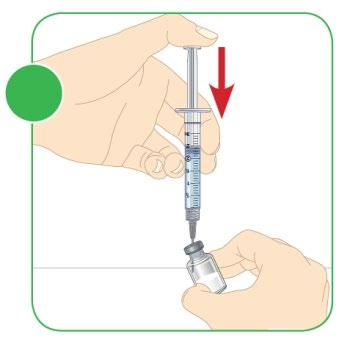
- 14) Remove the needle from the vial and dispose of the syringe in a sharps container.
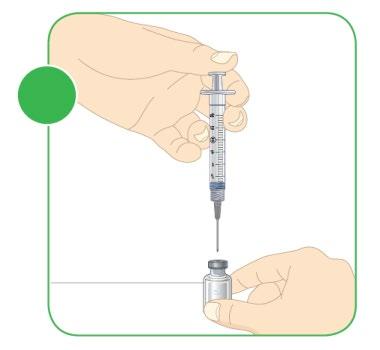
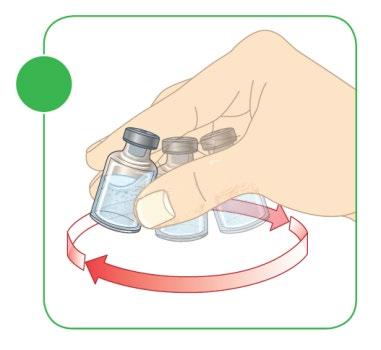
- 15) Mix the powder and water for injections.
- Gently shake the vial with circular movements (rotational movement).
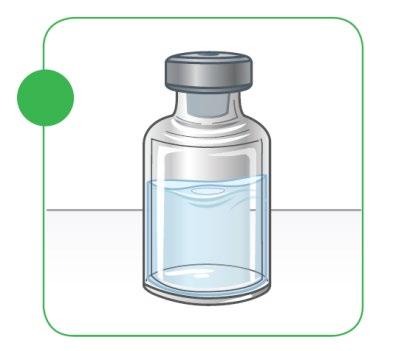
- Until the powder dissolves and the liquid is clear. Do not shake or mixvigorously.
- The solution will become clear in less than 5 minutes. If mixed correctly, the Myalepta solution should be clear and free of dry powder clumps, bubbles or foam. Do not use this medicine if the solution is not clear or contains clumps or particles. Throw it away and start the procedure again from step 1.
Phase D - Fill the syringe with Myalepta for injection
- 16) To inject the Myalepta solution, you must use a new injection syringe, which will be a 0.3 mL, 1.0 mL or 2.5 mL syringe provided by your doctor, nurse or pharmacist. Remove the protective cap from the needle.
- Do nottouch the needle.
- Do notmove the plunger.
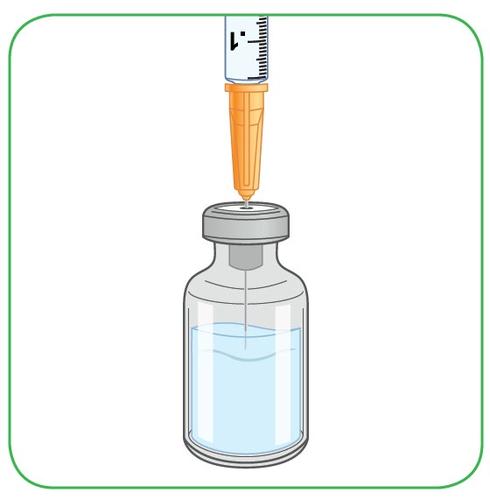
- 17) Fully insert the needle into the vial containing the dissolved Myalepta powder solution, through the center of the rubber stopper.
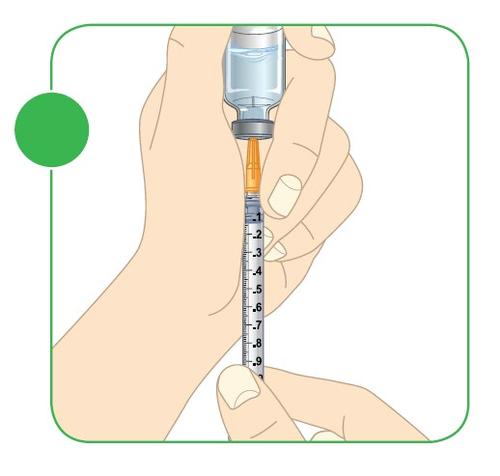
- 18) With the needle inserted into the vial, turn the vial and syringe upside down.
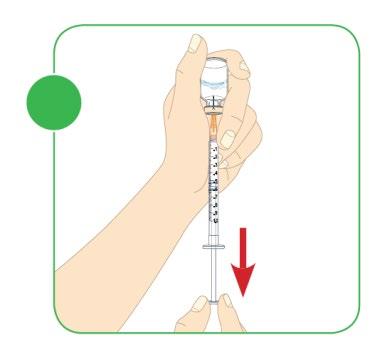
- 19) Keeping the needle inside the vial, pull the plunger down.
- The top edge of the plunger must align with the black line on the syringe corresponding to the amount of Myalepta solution to be injected.
- 20) Check for air sacs or air bubbles.
- If you notice an air sac or air bubbles, follow the same instructionsas illustrated in point 7 to remove air from the syringe.
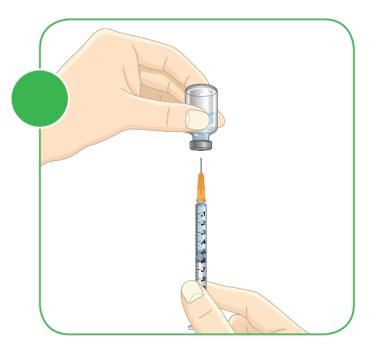
- 21) If the syringe contains the correct dose of Myalepta solution, remove the needle from the vial.
- Do notmove the plunger.
- Do nottouch the syringe’s exposed needle as it is sterile and you may damage the needle or injure yourself.
Phase E - Choose and prepare the injection site
- 22) Carefully choose the point where you intend to inject Myalepta. This medicine can be injected into the following areas:
- stomach area (abdomen), except for the area within 5 cm around the navel
- thighs
- upper arm, in the posterior area
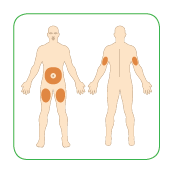
If you intend to use the same area of the body for each injection, avoid the point used for the
last injection.
- If you are injecting other medicines, do not inject Myalepta at the same point where the other medicines were injected.
- 23) Clean the chosen area for the injection with a clean swab moistened with alcohol and allow the skin to dry.
- Avoid touching the cleaned area before performing the Myalepta injection.
Phase F - Inject Myalepta
Important:Myalepta must be injected under the skin (“subcutaneous use”). Do notinject the
medicine into a muscle.
- 24) To perform a subcutaneous injection, pinch the skin of the area where you intend to make the injection with one hand.
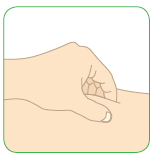
- 25) Hold the syringe with the other hand, as if it were a pen.
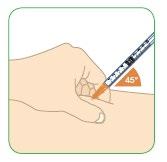
- 26) Gently insert the needle into the skin, tilted about 45 degrees to the body.
- Do notinsert the needle into the muscle.
- The needle is short and should penetrate completely into the skin at a 45-degree angle.
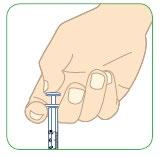
- 27) Gently push the plunger down all the way with your thumb. o Inject all of the medicine. o If medicine remains in the syringe, the dose has not been fully administered.
- 28) Remove the syringe from the skin.
Phase G - Dispose of used materials
- 29) Immediately discard the two used syringes and all caps, vials, or ampoules into the sharps container. o When the sharps container is full, contact your doctor, nurse, or pharmacist for its proper disposal. There may be local regulations regarding this matter.
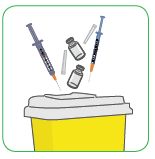
Important
o Do not use the syringes more than once. Use new syringes each time.
o The vials may remain almost completely full of product after drawing the
necessary dose. The remaining solution must be discarded after use.
o Do not dissolve another dose of Myalepta powder with the unused injectable water
remaining in a vial or ampoule. This unused injectable water must be discarded in the
sharps container. Always use a new vial or ampoule of injectable water each time you
prepare to dissolve Myalepta powder.
o Do not recycle the syringes, caps, or sharps container and do not dispose of these
materials in household waste.
o Always keep the sharps container out of the reach of children.
Myalepta 5.8 mg powder for injectable solution
metreleptin
Medicinal product subject to additional monitoring. This will allow the rapid identification of
new safety information. You can contribute by reporting any adverse effects
experienced during the use of this medicine. See the end of section 4 for
information on how to report adverse effects.
Read this leaflet carefully before using this medicine as it contains important
information for you.
- Keep this leaflet. You may need to read it again.
- If you have any questions, ask your doctor, pharmacist or nurse.
- This medicine has been prescribed for you only. Do not pass it on to others, even if their symptoms are the same as yours, as it could be harmful.
- If you get any side effects, even those not listed in this leaflet, tell your doctor, pharmacist or nurse. See section 4.
Contents of this leaflet
- 1. What Myalepta is and what it is used for
- 2. What you need to know before you use Myalepta
- 3. How to use Myalepta
- 4. Possible side effects
- 5. How to store Myalepta
- 6. Contents of the pack and other information
1. What is Myalepta and what is it used for
- Myalepta contains the active substance metreleptin. Metreleptin is similar to a human hormone called leptin.
What is Myalepta used for
Myalepta is used for the treatment of complications resulting from a lack of a
sufficient amount of leptin in patients affected by lipodystrophy.
It is used in adults, adolescents and children from 2 years of age who suffer from:
- generalized lipodystrophy (the entire body does not have a sufficient amount of adipose tissue)
It is used, when other therapies have not been effective, in adults and adolescents
from 12 years of age who suffer from:
- partial hereditary lipodystrophy (also called congenital or familial lipodystrophy)
- or from partial lipodystrophy (also called acquired lipodystrophy) caused by the body's response to an event such as a viral illness.
How Myalepta works
Natural leptin is produced by adipose tissue and performs many functions in the body, including:
- controlling the feeling of appetite and energy levels;
- helping the insulin present in the body to manage blood sugar levels. Metreleptin works by mimicking the effects of leptin. This improves the body's ability to control energy levels.
2. What you need to know before you use Myalepta
Do not use Myalepta
- if you are allergic to metreleptin or any of the other ingredients of this medicine (listed in section 6).
Warnings and precautions
Talk to your doctor, pharmacist or nurse before you use Myalepta:
- if you are pregnant
- if you have suffered from a type of cancer called lymphoma
- if you have had problems with your blood (such as a low number of blood cells)
- if you have suffered from inflammation of an organ called the pancreas (pancreatitis)
- if you suffer from or have suffered from disorders of the immune system (autoimmune diseases, including autoimmune liver problems)
Lymphoma
People affected by lipodystrophy may develop a type of blood cancer called
lymphoma, regardless of whether or not they use Myalepta.
Using this medicine, however, you may have a greater risk of developing lymphoma.
The decision whether you should use Myalepta is up to your doctor, who will monitor you during this
treatment.
Serious and dangerous infections
During treatment with Myalepta, the body may produce antibodies that can increase
the risk of developing serious and dangerous infections. Tell your doctor immediately if you experience
high fever, accompanied by increasing fatigue (see section 4).
Low blood sugar levels with insulin or other antidiabetics
If you are using a medicine such as insulin or other medicines for the treatment of diabetes, your
blood sugar will be closely monitored by your doctor. The doctor will adjust the dose of insulin or
other medicines, if necessary.
This will help prevent your blood sugar from becoming too low
(“hypoglycemia”). For signs indicating a lowering of blood sugar, see section 4, under
“Signs of high and low blood sugar”.
High blood sugar levels and high fat levels in the blood
During therapy with Myalepta you may have a higher value of sugar (hyperglycemia) or fat
in the blood (hypertriglyceridemia); this may indicate that this medicine is not working as
it should. The signs of hyperglycemia and hypertriglyceridemia are listed in section 4, under “Signs of high
and low blood sugar” and “Signs of high fat levels in the blood”.
If you notice any of these symptoms, described above and also in section 4 of this leaflet, or
have any doubts, tell your doctor immediately. It may be necessary to change the
treatment.
Autoimmune diseases
People who suffer from or have suffered from disorders of the immune system (autoimmune diseases,
including autoimmune liver problems) may experience a worsening of symptoms with
Myalepta. Talk to your doctor to find out which symptoms to watch out for; the appearance of these symptoms
should require further investigation.
Allergic reactions
During treatment with Myalepta you may develop an allergic reaction. Tell your
doctor immediately if you experience symptoms of an allergic reaction. The signs of an allergic
reaction are reported in section 4, under “Allergic reactions”.
Fertility
Myalepta may increase fertility in women with lipodystrophy (see section “Pregnancy,
breastfeeding and fertility”).
Myalepta contains sodium
This medicine contains less than 1 mmol of sodium (23 mg) per dose, that is to say essentially ‘sodium free’.
Children and adolescents
Do not give this medicine to children under 2 years of age with generalized lipodystrophy or to children
under 12 years of age with partial lipodystrophy. In fact, it is not known what the effects of this
medicine are on children below these age thresholds.
Other medicines and Myalepta
Tell your doctor if you are taking, have recently taken or might take any other medicines.
Myalepta can affect how other medicines work. Also, there are medicines that
can affect how this medicine works.
In particular, tell your doctor if you are taking any of the following medicines:
- hormonal contraceptives, as Myalepta may reduce their effectiveness in preventing pregnancy
- theophylline, used for lung diseases such as asthma
- anticoagulants (such as warfarin or phenprocoumon)
- medicines that suppress the action of the immune system (such as cyclosporine)
- antidiabetic medicines (such as insulin or insulin secretagogues), see section 2 ‘Low blood sugar levels with insulin or other antidiabetics’
If you are in any of the situations listed above (or have any doubts about it) talk to your doctor
before using Myalepta. During treatment with Myalepta, some medicines must be
monitored as it may be necessary to change the dose of these medicines.
Pregnancy, breastfeeding and fertility
If you are pregnant, suspect you are pregnant, are planning to become pregnant or are breastfeeding
ask your doctor or pharmacist for advice before taking this medicine.
Do not use Myalepta if you are pregnant or might become pregnant. In fact, it is not known what
the effects of Myalepta are on the unborn child. Women who are able to become pregnant should use
effective methods of contraception, including non-hormonal methods such as condoms, during treatment with
Myalepta. Talk to your doctor about appropriate contraceptive methods, because Myalepta may reduce
the effectiveness of hormonal contraceptives in preventing pregnancy.
It is not known whether Myalepta passes into breast milk. Talk to your doctor if you are breastfeeding or
intend to do so. Together with your doctor you will decide whether to continue or discontinue
breastfeeding while you are being treated with this medicine, taking into account the benefit of breastfeeding for the
child and the benefit of Myalepta for the mother.
Myalepta may increase fertility in women with lipodystrophy.
Driving and using machines
Myalepta slightly impairs the ability to drive and use machines. You may feel dizzy or tired while you are being treated with this medicine. If this
happens, do not drive vehicles or use tools or machinery. If you have any doubts, ask your doctor.
3. How to use Myalepta
Use this medicine following the doctor's instructions exactly. If you have any doubts, consult your
doctor.
Myalepta is administered by an injection under the skin (subcutaneous injection) once
daily. This medicine is used in children starting from 2 years of age, adolescents and adults with generalized lipodystrophy and also in children starting from 12 years of age, adolescents and adults with partial lipodystrophy.
During treatment with this medicine, the doctor will monitor you or the child and decide
which dose you will need to use.
The doctor may decide that you inject the medicine yourself. The doctor, nurse or pharmacist will
show you how to prepare and inject this medicine yourself.
- Do nottry to prepare the medicine or inject it yourself if you have not been trained to do so.
How much medicine to inject
The dose of Myalepta may vary over time, based on the effects obtained with this medicine. The
Myalepta powder is dissolved and mixed with water for injectable preparations to obtain
the solution for injection. Read the "Instructions for Use" which explain how to prepare the solution
before the injection.
The doctor will prescribe the correct dose based on the following indications:
- If you weigh 40 kg or less:
- Initial dose of 0.06 mg (0.012 mL of solution) per kilogram of body weight.
- If you are maleand weigh more than 40 kg:
- Initial dose of 2.5 mg (0.5 mL of solution).
- If you are femaleand weigh more than 40 kg:
- Initial dose of 5 mg (1 mL of solution). The doctor or pharmacist will inform you about the amount of solution to inject. If you have any doubts about the amount of solution to inject, consult your doctor or pharmacist before proceeding with the injection.
- The syringe to be used to inject this medicine depends on the dose that has been prescribed to you. The pharmacist will give you the appropriate syringe for the injection. To find out which syringe to use, consult the "Instructions for Use".
- To find out the amount of medicine to inject (in mL), you need to divide the dose (in mg) by 5. For example, if the doctor has prescribed a dose of Myalepta of 5 mg, 5 mg divided by 5 equals 1 mL, which corresponds to the amount of solution to inject with a 1 mL syringe.
- If the dose is 1.50 mg (0.30 mL of solution) or less, you will need to use a 0.3 mL syringe. On the 0.3 mL syringe, the amount of solution to inject is indicated in "Units" instead of "ml". Consult the "Instructions for Use" (paragraph 7) for more information on how to read and use the various syringes. To find out the amount of solution to inject (in Units), you need to divide the dose (in mg) by 5 and then multiply it by 100. If you need to inject 1 ml or more of the Myalepta solution, the doctor may advise you to administer the dose in two separate injections. This can help make the injections more comfortable. For both injections, you will need to use a clean syringe and needle. If you have any doubts about the amount of solution to inject, consult your doctor or pharmacist before proceeding with the injection.
When prescribing doses/volumes in small quantities (e.g. in children), the vials remain
almost completely full of product after taking the necessary dose. The remaining reconstituted
solution must be discarded after use.
If you use more Myalepta than you should
If you use more Myalepta than you should, inform your doctor immediately or go to the hospital immediately. The
doctor will monitor you for the appearance of any adverse effects.
If you forget to use Myalepta
- If you forget to inject a dose, inject it as soon as you remember.
- Then inject the dose normally the next day.
- Do not use a double dose to make up for a missed dose. If you have injected less Myalepta than you should, inform your doctor immediately. The doctor will monitor you for the appearance of any adverse effects.
If you stop using Myalepta
Do not stop treatment with Myalepta without first consulting your doctor. The doctor will decide
if you should stop treatment with this medicine.
If it is necessary to stop treatment with Myalepta, the doctor will gradually reduce the dose for
a period of two weeks before completely stopping therapy. The doctor will also advise you to
follow a low-fat diet.
- The gradual reduction of the dose for a period of two weeks is important because it can help prevent a sudden increase in the levels of fats (called "triglycerides") in the blood.
- A sudden increase in the amount of triglycerides in the blood can cause inflammation of the pancreas (pancreatitis). The gradual reduction of the dose, accompanied by a low-fat diet, can help prevent this problem. Do not stop treatment with Myalepta unless you have been told to do so by your doctor.
If you have any questions about the use of this medicine, ask your doctor.
4. Possible side effects
Like all medicines, this medicine can cause side effects, although not everybody gets them.
Possible side effects of this medicine:
Serious side effects
Seek medical attention immediately if you notice any of the following serious side effects - you may need urgent medical treatment. If you cannot contact
your doctor, seek emergency medical assistance:
- low blood sugar (glucose) level (hypoglycemia), see below the paragraph “Signs of high and low blood sugar”
- high blood sugar (glucose) level (hyperglycemia)
- presence of a blood clot in a vein (deep vein thrombosis) - pain, swelling, warmth and redness, usually in the thigh or lower leg
- fluid accumulation in the lungs - cough or difficulty breathing
- feeling sleepy or confused
Allergic reactions
Seek medical attention immediately if you notice any serious allergic reaction, including:
- difficulty breathing
- swelling and redness of the skin, hives
- swelling of the face, lips, tongue or throat
- stomach pain, feeling unwell (nausea) and sickness (vomiting)
- fainting or feeling dizzy
- severe stomach pain (abdomen)
- very fast heartbeat
Pancreatitis (inflammation of the pancreas):
Seek medical attention immediately if you notice signs of inflammation of the pancreas, including:
- severe and sudden stomach pain (abdomen)
- feeling unwell (nausea) or sickness (vomiting)
- diarrhea
Other side effects
Seek medical attention if you notice the occurrence of any of the following side effects.
Very common(may affect more than 1 in 10 people):
- weight loss
Common(may affect up to 1 in 10 people):
- loss of interest in food
- headache
- hair loss
- unusually heavy or prolonged menstrual periods
- feeling tired
- bruising, redness, itching or hives at the injection site
- the body producing antibodies against metreleptin that may increase the risk of developing serious or life-threatening infections. You may notice the development of a fever, accompanied by increased fatigue.
Frequency not known(frequency cannot be estimated from available data):
- influenza
- chest infection
- diabetes
- increased desire to eat or overeating
- faster than normal heartbeat
- cough
- shortness of breath
- muscle pain (myalgia)
- joint pain
- swelling of the hands and feet
- increased fatty tissue
- swelling or bleeding under the skin, where the injection was given
- pain at the injection site
- itching at the injection site
- feeling generally unwell, discomfort or widespread pain
- increased amount of fat in the blood (triglycerides) (see below the paragraph “Signs of high fat levels”)
- increased levels of glycated hemoglobin (HbA1c) in the blood, indicated by tests
- weight gain
- swelling or bleeding under the skin (hemorrhage)
- high blood sugar (hyperglycemia) (see below the paragraph “Signs of high and low blood sugar”). Seek medical attention if you notice the occurrence of any of the side effects listed above.
Signs of high and low blood sugar
Symptoms of low blood sugarinclude:
- feeling dizzy
- feeling sleepy or confused
- being clumsy and dropping things
- more hungry than usual
- sweating more than usual
- more irritable or nervous If you notice any of these symptoms, or have doubts, seek medical attention immediately: it may be necessary to adjust your treatment. Symptoms of high blood sugarinclude:
- feeling very thirsty or hungry
- needing to urinate more often than usual
- feeling sleepy
- feeling unwell or sick
- blurred vision
- chest or back pain
- feeling short of breath
Signs of high fat levels
Symptoms of high fat levelsinclude:
- chest pain
- pain under the ribs, like heartburn or indigestion
- feeling unwell or sick
Seek medical attention if you notice the occurrence of any of the side effects listed above.
Reporting of side effects
If you get any side effects, even those not listed in this leaflet, tell your
doctor, pharmacist or nurse. You can also report side effects directly
through the national reporting system detailed in Annex V. By reporting side
effects you can help provide more information on the safety of this medicine.
5. How to store Myalepta
Keep this medicine out of the sight and reach of children.
Do not use this medicine after the expiry date which is stated on the vial and the carton. The
expiry date refers to the last day of that month.
Store in a refrigerator (2 °C-8 °C). Keep the vial in the outer packaging to protect the
medicine from light.
After reconstitution, the solution must be administered immediately and cannot be
stored for later use. Discard any unused medicine.
Do not use this medicine if the solution appears cloudy, discolored or contains clumps or particles.
Do not dispose of any medicine in wastewater or household waste. Ask your pharmacist how to
dispose of medicines you no longer use. This will help protect the environment.
6. Content of the pack and other information
What Myalepta contains
- The active substance is metreleptin. Each vial contains 5.8 milligrams of metreleptin. After dissolving the contents of the vial in 1.1 milliliters of water for injections, each milliliter contains 5 milligrams of metreleptin.
- The other ingredients are: glycine, sucrose, polysorbate 20, glutamic acid, sodium hydroxide (for pH adjustment).
Description of the appearance of Myalepta and contents of the pack
Myalepta is presented as a powder for solution for injection ( powder for injection). It is a
white-colored powder supplied in a glass vial fitted with a rubber stopper and an aluminum seal with a
removable blue plastic capsule.
Myalepta is available in packs containing 1 or 30 vials.
Not all pack sizes may be marketed in your country.
The doctor, nurse or pharmacist will separately provide the syringes, needles, swabs and water for
injections to allow you to prepare and administer Myalepta. You will also be given a “sharps
container” in which to place the vials, syringes and needles that have already been used.
Marketing Authorisation Holder
Chiesi Farmaceutici S.p.A.
Via Palermo 26/A
43122 Parma
Italy
Manufacturer
Eurofins PHAST GmbH
Kardinal-Wendel-Straße 16
66424 Homburg
Germany
For further information on this medicinal product, contact the local representative of the marketing
authorisation holder:
België/Belgique/Belgien
Chiesi sa/nv
Tél/Tel: + 32 (0)2 788 42 00
Lietuva
ExCEEd Orphan s.r.o.
Bucharova 2657/12, Prague 5, 158 00
Czech republic
Tel.: +370 661 663 99
[email protected]
България
ExCEEd Orphan s.r.o.
Bucharova 2657/12, Prague 5, 158 00
Czech republic
Teл.: +359 888 918 090
[email protected]
Luxembourg/Luxemburg
Chiesi sa/nv
Tél/Tel: + 32 (0)2 788 42 00
Česká republika
ExCEEd Orphan s.r.o.
Bucharova 2657/12, Prague 5, 158 00
Czech republic
Tel: +420 724 321 774
[email protected]
Magyarország
ExCEEd Orphan s.r.o.
Bucharova 2657/12, Prague 5, 158 00
Czech republic
Tel.: +36 20 399 4269
[email protected]
Danmark
Chiesi Pharma AB
Tlf.: + 46 8 753 35 20
Malta
Amryt Pharmaceuticals DAC
Tel: +44 1604 549952
[email protected]
Deutschland
Chiesi GmbH
Tel: + 49 40 89724-0
Nederland
Chiesi Pharmaceuticals B.V.
Tel: + 31 88 501 64 00
Eesti
ExCEEd Orphan s.r.o.
Bucharova 2657/12, Prague 5, 158 00
Czech republic
Tel.: +370 661 663 99
[email protected]
Norge
Chiesi Pharma AB
Tlf: + 46 8 753 35 20
Ελλάδα
Amryt Pharmaceuticals DAC
Tηλ: +800 44 474447
Tηλ: +44 1604 549952
[email protected]
Österreich
Chiesi Pharmaceuticals GmbH
Tel: + 43 1 4073919
España
Chiesi España, S.A.U.
Tel: + 34 93 494 8000
Polska
ExCEEd Orphan s.r.o.
Bucharova 2657/12, Prague 5, 158 00
Czech republic
Tel.: +48 502 188 023
[email protected]
France
Chiesi S.A.S.
Tél: + 33 1 47688899
Portugal
Chiesi Farmaceutici S.p.A.
Tel: + 39 0521 2791
Hrvatska
ExCEEd Orphan Distribution d.o.o.
Savska cesta 32, Zagreb, 100 00
Croatia
Tel: +385 99 320 0330
[email protected]
România
ExCEEd Orphan s.r.o.
Bucharova 2657/12, Prague 5, 158 00
Czech republic
Tel: +40 744 366 015
[email protected]
Ireland
Chiesi Farmaceutici S.p.A.
Tel: + 39 0521 2791
Slovenija
ExCEEd Orphan s.r.o.
Bucharova 2657/12, Prague 5, 158 00
Czech republic
Tel: +386 30 210 050
[email protected]
Ísland
Chiesi Pharma AB
Sími: +46 8 753 35 20
Slovenská republika
ExCEEd Orphan s.r.o.
Bucharova 2657/12, Prague 5, 158 00
Czech republic
Tel: +420 608 076 274
[email protected]
Suomi/Finland
Chiesi Pharma AB
Puh/Tel: +46 8 753 35 20
Κύπρος
Amryt Pharmaceuticals DAC
Tηλ: +800 44 474447
Tηλ: +44 1604 549952
[email protected]
Italia
Chiesi Italia S.p.A.
Tel: + 39 0521 2791
Sverige
Chiesi Pharma AB
Tel: +46 8 753 35 20
Latvija
ExCEEd Orphan s.r.o.
Bucharova 2657/12, Prague 5, 158 00
Czech republic
Tel.: +370 661 663 99
[email protected]
An authorisation for this medicinal product has been granted in “exceptional circumstances”. This means that
due to the rarity of the disease, complete information on this medicinal product has not been possible to
obtain. The European Medicines Agency will annually review any new information on this
Other sources of information
More detailed information on this medicinal product is available on the website of the European Medicines
Agency, https://www.ema.europa.eu .
Links to other websites on rare diseases and related therapeutic treatments are also provided.
Instructions for use
Read these Instructions for Use carefully before using.
Before starting self-administration of this medicinal product at home, the doctor, nurse or
pharmacist will instruct you on how to prepare and inject Myalepta. Contact them if you have any
doubts or require further information or assistance. Allow sufficient time to carefully prepare and
inject the medicine, including the time to warm the vial after removing it from the
refrigerator, which is approximately 20 minutes.
Additional information for training
Additional information and explanatory videos are available to help you understand the correct use of
Myalepta. Ask your doctor how to access this information.
Reading the syringe
Align the top edge of the plunger with the line corresponding to the prescribed dose. The following
illustrates an example for syringes of various sizes. If the syringe looks different or
has a different graduation, contact your doctor, nurse or pharmacist for more
information.
Using the 0.3 mL syringe
- On the 0.3 mL syringe, the amount of solution to be injected is indicated in “U” instead of “mL”.
- “U” means “units”.
- 1 U is equivalent to 0.01 mL.
- Every 5 U is indicated by a number with a thicker line. This indication is equivalent to 0.05 mL.
- Every 1 U is indicated by a shorter line inserted between the thick lines. This indication is equivalent to 0.01 mL.
- Every 0.5 U is indicated by a short line inserted between two lines indicating 1 U. This indication is equivalent to 0.005 mL.
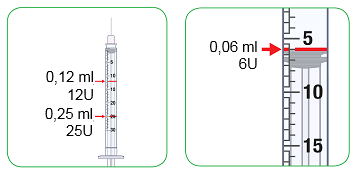
- To inject the Myalepta solution using a small 0.3 mL syringe, the last column of the table below indicates the measure in “units” on the syringe that refers to the different doses of medicine that may be prescribed by the doctor, nurse or pharmacist.
Conversion of the dose from “ml” to “units” using a 0.3 mL syringe
| A Child’s Weight | Myalepta Dose | Amount of Myalepta solution mixed | Amount of Myalepta solution mixed expressed in “units” on the 0.3 mL syringe |
| 9 kg | 0.54 mg | 0.10 mL | 10 |
| Child’s Weight | Myalepta Dose | Amount of Myalepta solution mixed | Amount of Myalepta solution mixed expressed in or “units” on the 0.3 mL syringe |
| 10 kg | 0.60 mg | 0.12 mL | 12 |
| 11 kg | 0.66 mg | 0.13 mL | c 13 |
| 12 kg | 0.72 mg | 0.14 mL | a 14 |
| 13 kg | 0.78 mg | 0.15 mL | 15 |
| 14 kg | 0.84 mg | 0.16 mL | m 16 |
| 15 kg | 0.90 mg | 0.18 mL | 18 |
| 16 kg | 0.96 mg | 0.19 mL | r 19 |
| 17 kg | 1.02 mg | 0.20 mL | a 20 |
| 18 kg | 1.08 mg | 0.21 mL | 21 |
| 19 kg | 1.14 mg | 0.22 mL | F 22 |
| 20 kg | 1.20 mg | 0.24 mL | 24 |
| 21 kg | 1.26 mg | l 0.25 mL | 25 |
| 22 kg | 1.32 mg | e 0.26 mL | 26 |
| 23 kg | 1.38 mg | 0.27 mLl | 27 |
| 24 kg | 1.44 mg | d 0.28 mL | 28 |
| 25 kg | 1.50 mg | 0.30 mL | 30 |
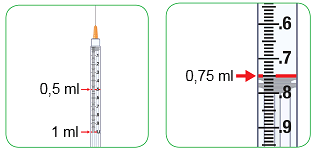
Using the 1 mL syringe
- In this syringe, the amount of solution to be injected is indicated in ml, so you will need to inject the amount indicated by the doctor, nurse or pharmacist. It is not necessary to convert the amount from mL to units.
- You will be provided with the 1 mL syringe to use if the daily dose is greater than 1.5 mg up to 5 mg, which in terms of volume is equivalent to a solution of Myalepta greater than 0.3 mL up to 1.0 mL.
- Every 0.1 mL is indicated by a number with a long line.
- Every 0.05 mL is indicated by a medium-length line.
- Every 0.01 mL is indicated by a shorter line.
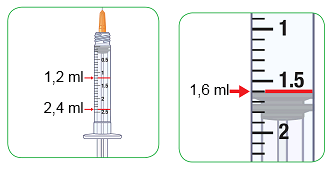
Using the 2.5 mL syringe
- In this syringe, the amount of solution to be injected is indicated in ml, so you will need to inject the amount indicated by the doctor, nurse or pharmacist. It is not necessary to convert the amount from ml to units.
- You will be provided with the 2.5 mL syringe to use if the daily dose is greater than 5 mg up to 10 mg, which in terms of volume is equivalent to a solution of Myalepta greater than 1.0 mL.
- Every 0.5 mL is indicated by a number next to a long line.
- Every 0.1 mL is indicated by a shorter line between the long lines.
Step A - Preparation
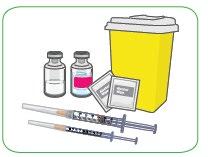
- 1) Gather all the materials needed for the injection, which have been provided by the doctor, nurse or pharmacist.
Arrange the following materials on a clean and well-lit surface:
- a glass vial containing the Myalepta powder
- a container of water for injections, to dissolve the Myalepta powder or The water for injections may be in glass or plastic vials, or in glass vials with a rubber stopper.
- swabs soaked in alcohol (to disinfect the skin where the medicine will be injected and the top of the vials)
- sharps container (to safely dispose of the used materials at the end of the injection)
You will also need 2 syringes:
- A 3 mL syringe with a 40 mm, 21 gauge needle, to dissolve the powder
- A syringe for injection, equipped with a much shorter needle, to inject the solution subcutaneously. The size of this syringe will be decided by the doctor, nurse or pharmacist based on the dose of Myalepta. o If the dose is 1.5 mg or less, the syringe to be used will be 0.3 mL. o If the dose is greater than 1.5 mg up to 5 mg, the syringe to be used will be 1 mL. o If the dose is greater than 5 mg, the syringe to be used will be 2.5 mL. o If the dose is greater than 5 mg the doctor, nurse or pharmacist may indicate to administer the dose with two separate injections. See section 3 “How to use Myalepta” for more information.
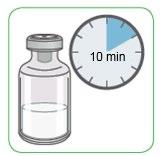
- 2) Before preparing the Myalepta solution, allow the vial containing the powder to reach room temperature, for about 10 minutes.
- 3) Wash your hands before preparing the medicine.
Phase B - Fill the 3 mL syringe with 1.1 mL of water for injectable preparations
- 4) Remove the 3 mL syringe from the plastic wrapper. Always use a new syringe.
- The 3 mL syringe and needle are supplied separately.
- The way to attach the needle to the syringe depends on the water for injectable preparations container provided: a plastic vial, a glass vial, or a glass bottle (see below for specific instructions).
- 5) Draw 1.1 mL of water for injectable preparations into the 3 mL syringe.
The water for injectable preparations will be provided by the doctor, nurse, or pharmacist together with the
medicine vial and syringes. This is mixed with the Myalepta powder so
that the powder dissolves, to make the medicine in liquid form so that it can be injected.
The water for injectable preparations may be supplied in one of the following containers:
- a plastic vial
- a glass vial
- a glass bottle (with a rubber stopper). Always use a new vial or bottle of water for injectable preparations. Never use the water for injectable preparations remaining after preparing the Myalepta solution the day before.
Water for injectable preparations in a plastic vial
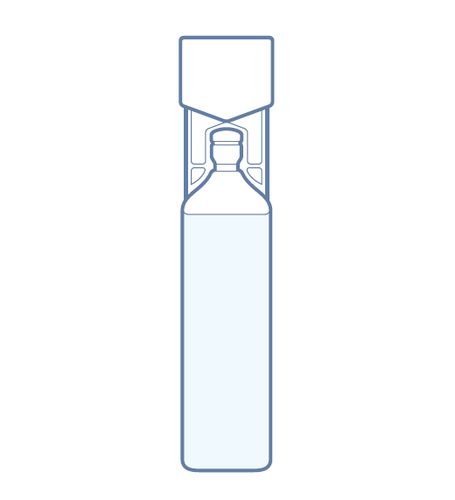
The plastic vial is a sealed container with a top with a twist-off opening.
To extract the water for injectable preparations, open the vial.
- Hold the vial with the top facing up.
- Hold the bottom of the vial with one hand and the top with the other hand.
- Keeping the bottom of the vial firm, gently twist the top until it detaches.
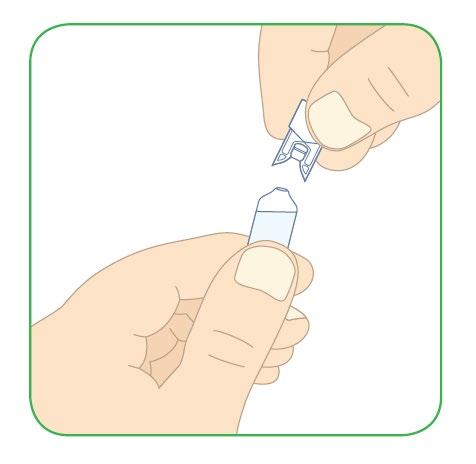
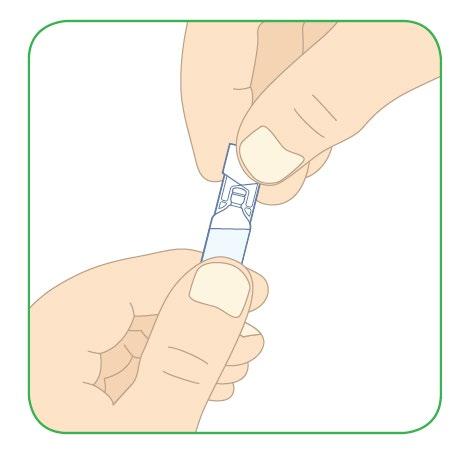
- Do not attach the needle to the syringe.
- Insert the tip of the 3 mL syringe, without a needle attached, into the top of the plastic vial, as far as it will go.
With the syringe still inserted into the vial, turn the vial and syringe upside down. The syringe is now
with the tip facing upwards.
With the syringe still inserted into the vial, carefully pull the plunger downwards.
- Pull down until the top edge of the plunger is aligned with the black line indicating 1.1 mL.
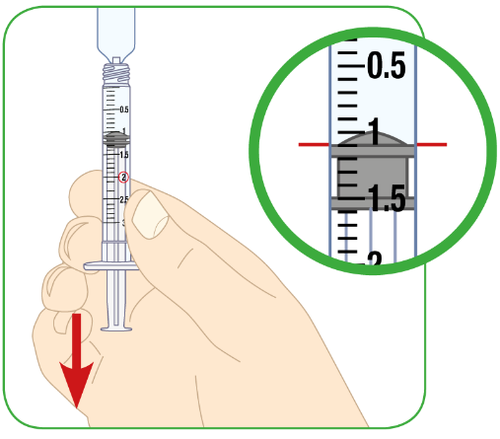
- You must check for any pockets or air bubbles in the 3 mL syringe. To remove air pockets or air bubbles from the syringe, refer to points 6-8 below.
- Detach the syringe from the plastic vial.
Attach the needle to the syringe.
- Do not overtighten the needle.
- Do not remove the needle protective cap.
- Do not touch the needle.
Water for injectable preparations in a glass vial
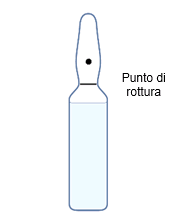
The glass vial is a sealed container.
Before opening the vial containing the water for injectable preparations, prepare the 3 mL syringe
by attaching the needle. Do not overtighten the needle.
- Remove the protective cap from the needle.
- Do not touch the needle.
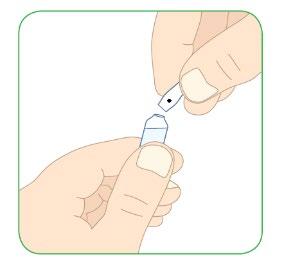
To extract the water for injectable preparations, open the vial by breaking it at the
breaking point, as shown in the figure below.
- Hold the vial with the top facing up.
- Disinfect the vial at the breaking point with an alcohol-soaked swab.
- Hold the bottom of the vial with one hand and the top with the other hand.
- Keeping the bottom of the vial firm, snap off the tip.
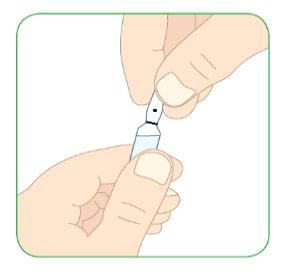
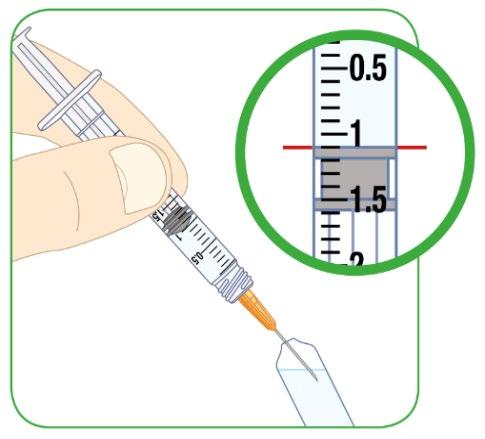
Insert the 3 mL syringe into the glass vial.
- Tilt the glass vial at a 45-degree angle to the floor.
- The needle must be inserted as far as possible inside the vial.
With the needle still inserted into the vial, carefully pull the plunger upwards.
- Pull the plunger upwards until the top edge of the plunger is aligned with the black line indicating 1.1 mL.
- You must check for any pockets or air bubbles in the 3 mL syringe. To remove air pockets or air bubbles from the syringe, refer to points 6-8 below.
Water for injectable preparations in a glass bottle
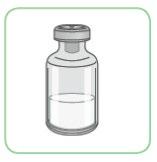
The glass bottle is equipped with a plastic cap that must be removed to reveal the underlying rubber seal.
Do not remove the rubber seal.
- Do not remove the rubber seal.
Attach the needle to the 3 mL syringe. Do not overtighten the needle.
- Remove the protective cap from the needle.
- Do not touch the needle.
- Pull the plunger down to the line indicating 1.1 mL to draw air into the syringe.
Place the bottle on a solid, flat surface.
- Insert the needle of the 3 mL syringe into the bottle through the rubber seal.
- The needle must be oriented downwards.
- The needle must penetrate completely into the bottle.
Push the plunger all the way down.
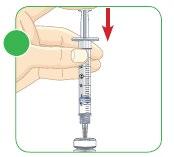
With the needle still inserted into the bottle, turn the bottle and syringe upside down. The needle is now
pointing upwards.
- Do not remove the needle from the bottle.
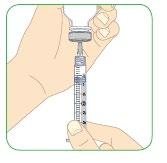
Carefully pull the plunger downwards.
- Pull the plunger down until the top edge of the plunger is aligned with the black line indicating 1.1 mL.
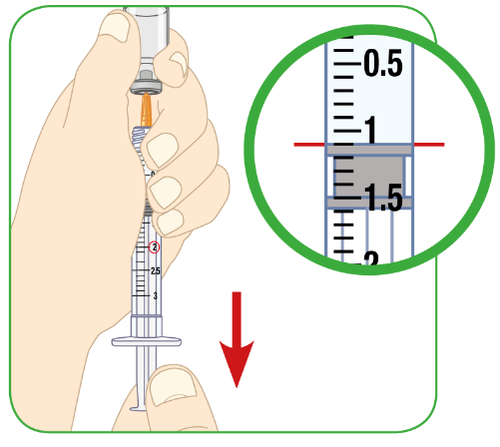
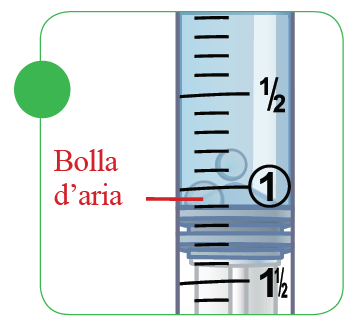
- 6) Regardless of whether you are drawing the water for injectable preparations from a vial or a bottle, you must check that there are no pockets or air bubbles in the 3 mL syringe.
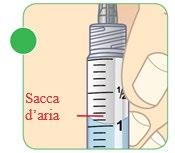
- Sometimes a large amount of air (air pocket) may be trapped inside the syringe. You may also see smaller air bubbles in the syringe.
- You must remove the air pocket and air bubbles from thesyringe, to be sure you have drawn the correct amount of sterile water into the syringe.
- 7) Remove any pockets or air bubbles.
Using the glass bottle or plastic vial
- With the syringe still inserted into the glass bottle or plastic vial, tap the side of the syringe to move the pocket/air bubbles to the top of the syringe.
- Carefully push the plunger upwards to expel the air from the syringe.
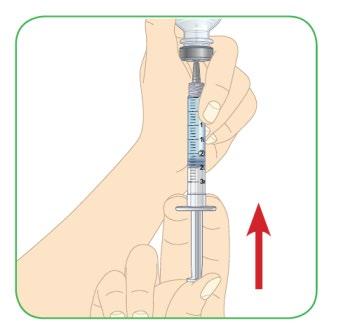
Using the glass vial
- Remove the syringe from the vial and hold it with the needle pointing upwards.
- Tap the side of the syringe to move the pocket/air bubbles to the top of the syringe.
- Carefully push the plunger upwards to expel the air from the syringe.
- 8) Check the amount of water for injectable preparations.
- If the amount of water for injectable preparations in the syringe is less than 1.1 mL, draw more water for injectable preparations with the syringe and repeat points 6 and 7 until the syringe contains 1.1 mL of water.
- 9) When the syringe contains 1.1 mL of water for injectable preparations, remove the syringe from the bottle or vial.
- Do not move the plunger.
- Do not touch the exposed needle of the syringe as it is sterile and you could damage the needle or injure yourself.
Phase C - Dissolve Myalepta
- 10) Make sure that the vial containing the Myalepta powder has been removed from the refrigerator for at least 10 minutes to reach room temperature.
- 11) Remove the plastic cap from the vial containing the Myalepta powder.
- Place the vial on a solid, flat surface.
- Clean the top of the vial with an alcohol-soaked swab.
- 12) Fully insert the needle of the 3 mL syringe containing 1.1 mL of water for injectable preparations into the Myalepta vial containing the powder.
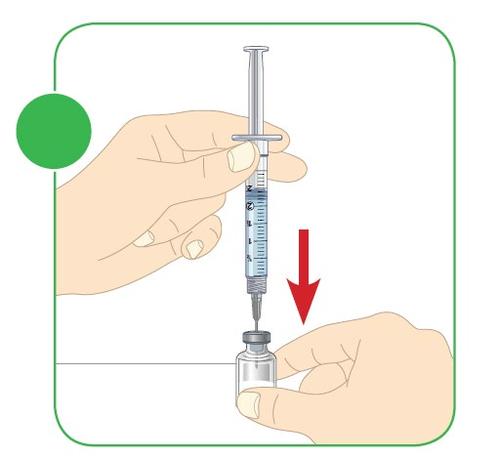
- 13) Hold the vial tilted at a 45-degree angle to the work surface and slowly push the plunger with your thumb all the way down.
- The water for injectable preparations must run down the inner wall of the vial.
- Inject all the water for injectable preparations into the vial.
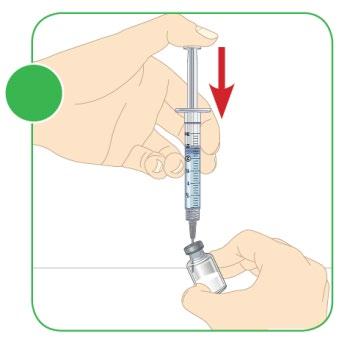
- 14) Remove the needle from the vial and dispose of the syringe in a sharps container.
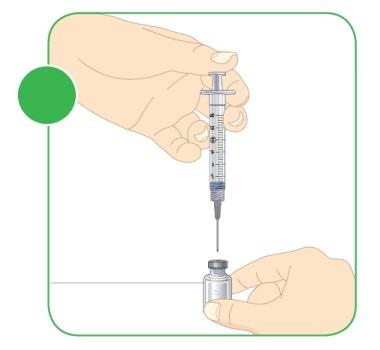
- 15) Mix the powder and water for injectable preparations.
- Gently shake the vial with circular motions (rotational movement).
- Until the powder dissolves and the liquid is clear. Do not shake or mixvigorously.
- The solution will become clear in less than 5 minutes. If mixed correctly, the Myalepta solution should be clear and free of dry powder clumps, bubbles or foam. Do not use this medicine if the solution is not clear or contains clumps or particles. Throw it away and start the procedure again from step 1.
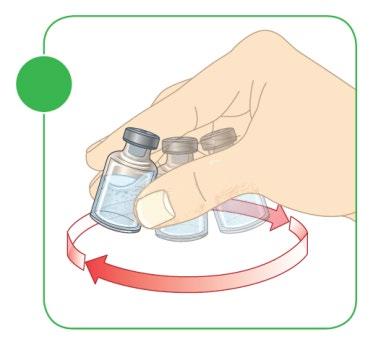
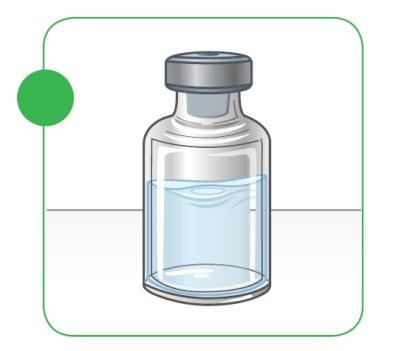
Phase D - Fill the syringe with Myalepta for injection
- 16) To inject the Myalepta solution, you must use a new injection syringe, which will be a 0.3 mL, 1.0 mL, or 2.5 mL syringe provided by the doctor, nurse, or pharmacist. Remove the protective cap from the needle.
- Do nottouch the needle.
- Do notmove the plunger.
- 17) Fully insert the needle into the vial containing the dissolved Myalepta powder solution, through the center of the rubber stopper.
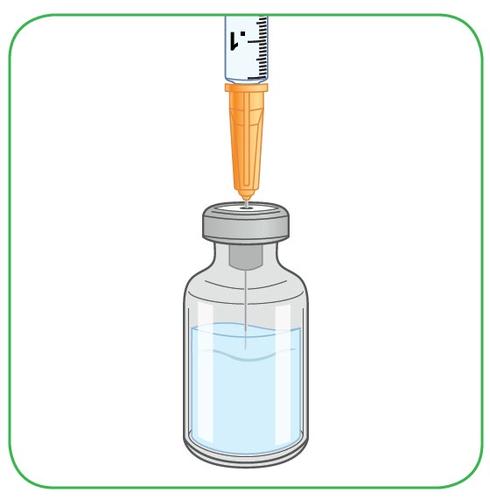
- 18) With the needle inserted into the vial, turn the vial and syringe upside down.
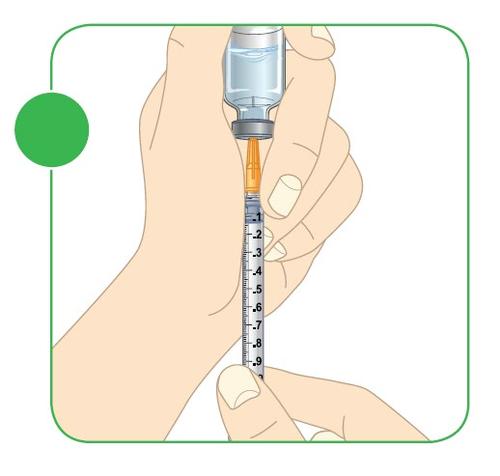
- 19) Keeping the needle inside the vial, pull the plunger downwards.
- The top edge of the plunger must align with the black line on the syringe corresponding to the amount of Myalepta solution to be injected.
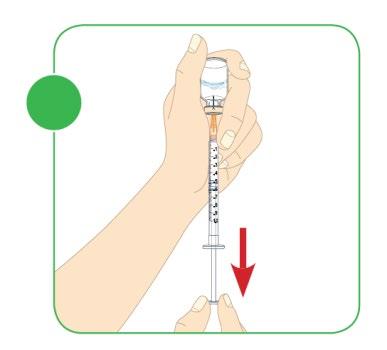
- 20) Check for any air pockets or air bubbles.
- If you notice an air pocket or air bubbles, follow the same instructionsas in point 7 to remove the air from the syringe.
- 21) If the syringe contains the correct dose of Myalepta solution, remove the needle from the vial.
- Do notmove the plunger.
- Do nottouch the exposed needle of the syringe.
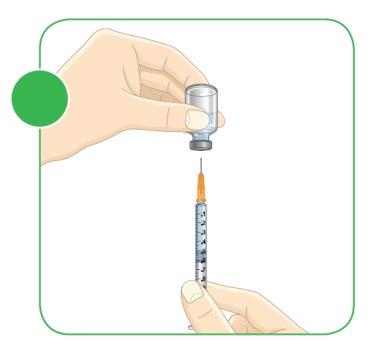
Phase E - Choose and prepare the injection site
- 22) Carefully choose the point where you intend to inject Myalepta. This medicine can be injected into the following areas:
- stomach area (abdomen), except for the area within 5 cm around the navel
- thighs
- upper arm, in the back area
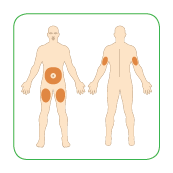
If you intend to use the same area of the body for each injection, avoid the point used for the
last injection.
- If you are injecting other medicines, do not inject Myalepta at the same point where the other medicines have been injected.
- 23) Clean the chosen area for the injection with a clean swab soaked in alcohol and allow the skin to dry.
- Avoid touching the cleaned area before performing the Myalepta injection.
Phase F - Inject Myalepta
Important:Myalepta must be injected under the skin (“subcutaneous use”). Do notinject the
medicine into a muscle.
- 24) To perform a subcutaneous injection, pinch the skin of the area where you intend to make the injection with one hand.
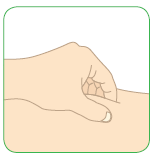
- 25) Hold the syringe with the other hand, as if it were a pen.
- 26) Gently insert the needle into the skin, tilted approximately 45 degrees to the body.
- Do notinsert the needle into the muscle.
- The needle is short and should penetrate completely into the skin at a 45-degree angle.
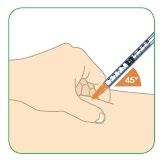
- 27) Gently push the plunger down all the way with your thumb.
- Inject all of the medicine.
- If medicine remains in the syringe, the dose has not been administered completely.
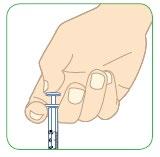
- 28) Remove the syringe from the skin.
Phase G - Dispose of used materials
- 29) Immediately discard the two used syringes and all caps, vials, or ampoules into a sharps container.
- When the sharps container is full, contact your doctor, nurse, or pharmacist for its proper disposal. There may be local regulations in this matter.
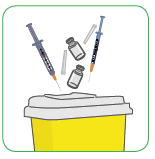
Important
o Do not use the syringes more than once. Use new syringes each time.
o The vials may remain almost completely full of product after drawing the
necessary dose. The remaining solution must be discarded after use.
o Do not dissolve another dose of Myalepta powder with the unused injectable water
remaining in a vial or ampoule. This unused injectable water must be discarded in the
sharps container. Always use a new vial or ampoule of injectable water each time you
prepare to dissolve Myalepta powder.
o Do not recycle the syringes, caps, or sharps container and do not dispose of these
materials in household waste.
o Always keep the sharps container out of the reach of children.

Не уверены, подходит ли вам это лекарство?
Обсудите симптомы и варианты лечения с врачом онлайн.
Myalepta 11.3 mg powder for injectable solution
metreleptin
Medicinal product subject to additional monitoring. This will allow the rapid identification of
new safety information. You can contribute by reporting any adverse effects
experienced during the use of this medicine. See the end of section 4 for
information on how to report adverse effects.
Read this leaflet carefully before using this medicine as it contains important
information for you.
- Keep this leaflet. You may need to read it again.
- If you have any questions, ask your doctor, pharmacist or nurse.
- This medicine has been prescribed for you only. Do not pass it on to others, even if their symptoms are the same as yours, as it could be harmful.
- If any side effects occur, including those not listed in this leaflet, tell your doctor, pharmacist or nurse. See section 4.
Contents of this leaflet
- 1. What Myalepta is and what it is used for
- 2. What you need to know before you use Myalepta
- 3. How to use Myalepta
- 4. Possible side effects
- 5. How to store Myalepta
- 6. Contents of the pack and other information
1. What is Myalepta and what is it used for
Myalepta contains the active substance metreleptin. Metreleptin is similar to a human hormone
called leptin.
What is Myalepta used for
Myalepta is used for the treatment of complications resulting from a lack of a
sufficient amount of leptin in patients affected by lipodystrophy.
It is used in adults, adolescents and children from 2 years of age affected by:
- generalized lipodystrophy (the entire body does not have a sufficient amount of adipose tissue)
It is used, when other therapies have not been effective, in adults and adolescents
from 12 years of age affected by:
- partial lipodystrophy of a hereditary nature (also called congenital or familial lipodystrophy)
- or by partial lipodystrophy (also called acquired lipodystrophy) caused by the body's response to an event such as a viral illness.
How Myalepta works
Natural leptin is produced by adipose tissue and performs many functions in the body, including:
- controlling the sensation of appetite and energy levels;
- helping the insulin present in the body to manage blood sugar levels. Metreleptin works by mimicking the effects of leptin. This improves the body's ability to control energy levels.
2. What you need to know before you use Myalepta
Do not use Myalepta
- if you are allergic to metreleptin or any of the other ingredients of this medicine (listed in section 6).
Warnings and precautions
Talk to your doctor, pharmacist or nurse before you use Myalepta:
- if you are pregnant
- if you have suffered from a type of cancer called lymphoma
- if you have had problems with your blood (such as a low number of blood cells)
- if you have suffered from inflammation of an organ called the pancreas (pancreatitis)
- if you suffer from or have suffered from disorders of the immune system (autoimmune diseases, including autoimmune liver problems)
Lymphoma
People affected by lipodystrophy may develop a type of blood cancer called
lymphoma, regardless of whether or not they are using Myalepta.
Using this medicine, however, you may have a higher risk of developing lymphoma.
The decision as to whether you should use Myalepta is up to your doctor, who will monitor you during this
treatment.
Serious and dangerous infections
During treatment with Myalepta, the body may produce antibodies that can increase
the risk of developing serious and dangerous infections. Tell your doctor immediately if you experience
high fever, accompanied by increasing fatigue (see section 4).
Low blood sugar levels with insulin or other antidiabetics
If you are using a medicine such as insulin or other medicines for the treatment of diabetes, your
blood sugar will be closely monitored by your doctor. The doctor will adjust the dose of insulin or
other medicines, if necessary.
This will help to avoid your blood sugar becoming too low
(“hypoglycemia”). For the signs that indicate a lowering of blood sugar, see section 4, under
“Signs of high and low blood sugar”.
High blood sugar levels and high fat levels in the blood
During therapy with Myalepta you may have a higher value of sugar (hyperglycemia) or fat
in the blood (hypertriglyceridemia); this may indicate that this medicine is not working as
it should. The signs of hyperglycemia and hypertriglyceridemia are listed in section 4, under “Signs of high
and low blood sugar” and “Signs of high fat levels in the blood”.
If you notice any of these symptoms, described above and also in section 4 of this leaflet, or
have any doubts, tell your doctor immediately. It may be necessary to change the
treatment.
Autoimmune diseases
People who suffer from or have suffered from disorders of the immune system (autoimmune diseases,
including autoimmune liver problems) may experience a worsening of symptoms with
Myalepta. Talk to your doctor to find out which symptoms to watch out for; the appearance of these symptoms
should require further investigation.
Allergic reactions
During treatment with Myalepta you may develop an allergic reaction. Tell your
doctor immediately if you experience symptoms of an allergic reaction. The signs of an allergic
reaction are reported in section 4, under “Allergic reactions”.
Fertility
Myalepta may increase fertility in women with lipodystrophy (see section “Pregnancy,
breastfeeding and fertility”).
Myalepta contains sodium
This medicine contains less than 1 mmol of sodium (23 mg) per dose, that is to say essentially ‘sodium-free’.
Children and adolescents
Do not give this medicine to children under 2 years of age with generalized lipodystrophy or to children
under 12 years of age with partial lipodystrophy. In fact, it is not known what the effects of this
medicine are on children below these age thresholds.
Other medicines and Myalepta
Tell your doctor if you are taking, have recently taken or might take any other medicines.
Myalepta can affect the way other medicines work. Also, there are some medicines that
can affect the way this medicine works.
In particular, tell your doctor if you are taking any of the following medicines:
- hormonal contraceptives, as Myalepta may reduce their effectiveness in preventing pregnancy
- theophylline, used for lung diseases such as asthma
- anticoagulants (such as warfarin or phenprocoumone)
- medicines that suppress the action of the immune system (such as cyclosporine)
- antidiabetic medicines (such as insulin or insulin secretagogues), see section 2 ‘Low blood sugar levels with insulin or other antidiabetics’
If you are in any of the situations listed above (or have any doubts about it) talk to your doctor
before using Myalepta. During treatment with Myalepta some medicines must be
monitored as it may be necessary to change the dose of these medicines.
Pregnancy, breastfeeding and fertility
If you are pregnant, suspect you are pregnant or are planning to become pregnant, or if you are breastfeeding,
ask your doctor or pharmacist for advice before taking this medicine.
Do not use Myalepta if you are pregnant or could become pregnant. In fact, it is not known what
the effects of Myalepta are on the unborn child. Women who are able to become pregnant should use effective
contraceptive methods, including non-hormonal methods such as condoms, during treatment with
Myalepta. Talk to your doctor about suitable contraceptive methods, as Myalepta may reduce
the effectiveness of hormonal contraceptives in preventing pregnancy.
It is not known whether Myalepta passes into breast milk. Talk to your doctor if you are breastfeeding or
intend to do so. Together with your doctor, you will decide whether to continue or discontinue
breastfeeding while you are being treated with this medicine, taking into account the benefit of breastfeeding for the
child and the benefit of Myalepta for the mother.
Myalepta may increase fertility in women with lipodystrophy.
Driving and using machines
Myalepta slightly impairs the ability to drive and operate machines. You may feel dizzy or tired while
being treated with this medicine. If this happens, do not drive vehicles or use tools or machinery. If you have any doubts, ask your doctor.
3. How to use Myalepta
Use this medicine following the doctor's instructions exactly. If you have any doubts, consult your
doctor.
Myalepta is administered by an injection under the skin (subcutaneous injection) once
daily. This medicine is used in children starting from 2 years, in adolescents and in
adults with generalized lipodystrophy and also in children starting from 12 years, in adolescents and in
adults with partial lipodystrophy.
During treatment with this medicine, the doctor will monitor you or the child and decide
which dose you will need to use.
The doctor may decide that you inject the medicine yourself. The doctor, nurse or pharmacist will
show you how to prepare and inject this medicine yourself.
- Do nottry to prepare the medicine or inject it yourself if you have not been trained to do so.
How much medicine to inject
The dose of Myalepta may vary over time, based on the effects obtained with this medicine. The
Myalepta powder is dissolved and mixed with water for injectable preparations in order to obtain
the solution for injection. Read the “Instructions for Use” which explain how to prepare the solution
before the injection.
The doctor will prescribe the correct dose based on the following indications:
- If you weigh 40 kg or less:
- Initial dose of 0.06 mg (0.012 mL of solution) per each kilogram of body weight.
- If you are maleand weigh more than 40 kg:
- Initial dose of 2.5 mg (0.5 mL of solution).
- If you are femaleand weigh more than 40 kg:
- Initial dose of 5 mg (1 mL of solution). The doctor or pharmacist will inform you about the amount of solution to inject. If you have doubts about the amount of solution to inject, consult your doctor or pharmacist before proceeding with the injection.
- The syringe to be used for injecting this medicine depends on the dose that has been prescribed to you. The pharmacist will give you the syringe suitable for the injection. To find out which syringe to use, consult the “Instructions for Use”.
- To know the amount of medicine to inject (in mL), you need to divide the dose (in mg) by 5. For example, if the doctor has prescribed a dose of Myalepta of 5 mg, 5 mg divided by 5 equals 1 mL, which corresponds to the amount of solution to inject with a 1 mL syringe.
- If the dose is 1.50 mg (0.30 mL of solution) or less, you will need to use a 0.3 mL syringe. On the 0.3 mL syringe, the amount of solution to inject is indicated in “Units” instead of “mL”. Consult the “Instructions for Use” (paragraph 7) for more information on how to read and use the various syringes. To know the amount of solution to inject (in Units), you need to divide the dose (in mg) by 5 and then multiply it by 100. If you need to inject 1 ml or more of the Myalepta solution, the doctor may advise you to administer the dose in two separate injections. This can help make the injections more comfortable. For both injections, you will need to use a clean syringe and needle. If you have doubts about the amount of solution to inject, consult your doctor or pharmacist before proceeding with the injection.
When prescribing doses/volumes in small quantities (e.g. in children), the vials remain
almost completely full of product after taking the necessary dose. The remaining reconstituted
solution must be discarded after use.
If you use more Myalepta than you should
If you use more Myalepta than you should, inform your doctor immediately or go to the hospital
immediately. The doctor will monitor you for the appearance of any adverse effects.
If you forget to use Myalepta
- If you forget to inject a dose, inject it as soon as you remember.
- Then inject the dose normally the next day.
- Do not use a double dose to make up for the missed dose. If you have injected less Myalepta than you should, inform your doctor immediately. The doctor will monitor you for the appearance of any adverse effects.
If you stop using Myalepta
Do not stop treatment with Myalepta without first consulting your doctor. The doctor will decide
if you should stop treatment with this medicine.
If it is necessary to stop treatment with Myalepta, the doctor will gradually reduce the dose for
a period of two weeks before stopping therapy completely. The doctor will also advise you to
follow a low-fat diet.
- The gradual reduction of the dose for a period of two weeks is important because it can help prevent a sudden increase in the levels of fats (called “triglycerides”) in the blood.
- A sudden increase in the amount of triglycerides in the blood can cause inflammation of the pancreas (pancreatitis). The gradual reduction of the dose, accompanied by a low-fat diet, can help prevent this problem. Do not stop treatment with Myalepta unless you have been told to do so by your doctor.
If you have any further questions on the use of this medicine, ask your doctor.
4. Possible side effects
Like all medicines, this medicine can cause side effects, although not everybody gets them.
Possible side effects of this medicine:
Serious side effects
Seek medical attention immediately if you notice any of the following serious side effects - you may need urgent medical treatment. If you cannot contact
your doctor, seek emergency medical assistance:
- low blood sugar (glucose) level (hypoglycemia), see the section “Signs of high and low blood sugar” below
- high blood sugar (glucose) level (hyperglycemia)
- presence of a blood clot in a vein (deep vein thrombosis) - pain, swelling, warmth and redness, usually in the thigh or lower leg
- fluid accumulation in the lungs - cough or difficulty breathing
- feeling sleepy or confused
Allergic reactions
Seek medical attention immediately if you notice any serious allergic reaction, including:
- difficulty breathing
- swelling and redness of the skin, hives
- swelling of the face, lips, tongue or throat
- stomach pain, feeling unwell (nausea) and sickness (vomiting)
- fainting or dizziness
- severe stomach pain (abdomen)
- very fast heartbeat
Pancreatitis (inflammation of the pancreas):
Seek medical attention immediately if you notice signs of pancreatitis, including:
- severe and sudden stomach pain (abdomen)
- feeling unwell (nausea) or sickness (vomiting)
- diarrhea
Other side effects
Seek medical attention if you notice the occurrence of any of the following side effects.
Very common(may affect more than 1 in 10 people):
- weight loss
Common(may affect up to 1 in 10 people):
- loss of interest in food
- headache
- hair loss
- unusually heavy or prolonged menstrual periods
- feeling tired
- bruising, redness, itching or hives at the injection site
- the body producing antibodies against metreleptin which may increase the risk of developing serious or life-threatening infections. You may notice the development of fever, accompanied by increased fatigue.
Frequency not known(frequency cannot be estimated from the available data):
- flu
- chest infection
- diabetes
- increased desire to eat or overeating
- faster heartbeat than normal
- cough
- shortness of breath
- muscle pain (myalgia)
- joint pain
- swelling of the hands and feet
- increased fatty tissue
- swelling or bleeding under the skin, where the injection was given
- pain at the injection site
- itching at the injection site
- feeling generally unwell, discomfort or widespread pain
- increased amount of fat in the blood (triglycerides) (see the section “Signs of high fat levels” below)
- increased levels of glycated hemoglobin (HbA1c) in the blood, indicated by tests
- weight gain
- swelling or bleeding under the skin (hemorrhage)
- high blood sugar (hyperglycemia) (see the section “Signs of high and low blood sugar” below). Seek medical attention if you notice the occurrence of any of the side effects listed above.
Signs of high and low blood sugar
Symptoms of low blood sugarinclude:
- feeling dizzy
- feeling sleepy or confused
- being clumsy and dropping things
- hunger more than usual
- sweating more than usual
- increased irritability or nervousness If you notice any of these symptoms, or have doubts, seek medical attention immediately: it may be necessary to adjust your treatment. Symptoms of high blood sugarinclude:
- feeling very thirsty or hungry
- needing to urinate more often than usual
- feeling sleepy
- feeling unwell or sick
- blurred vision
- chest or back pain
- feeling short of breath
Signs of high fat levels
Symptoms of high fat levelsinclude:
- chest pain
- pain under the ribs, like heartburn or indigestion
- feeling unwell or sick
Seek medical attention if you notice the occurrence of any of the side effects listed above.
Reporting of side effects
If you get any side effects, even those not listed in this leaflet, tell your
doctor, pharmacist or nurse. You can also report side effects directly
through the national reporting system listed in Annex V . By reporting side
effects you can help provide more information on the safety of this medicine.
5. How to store Myalepta
Keep this medicine out of the sight and reach of children.
Do not use this medicine after the expiry date which is stated on the vial and the packaging. The
expiry date refers to the last day of that month.
Store in a refrigerator (2 °C-8 °C). Keep the vial in the outer packaging to protect the
medicine from light.
After reconstitution, the solution must be administered immediately and cannot be
stored for later use. Discard any unused medicine.
Do not use this medicine if the solution appears cloudy, discolored or contains clumps or particles.
Do not dispose of any medicine in wastewater or household waste. Ask your pharmacist how to
dispose of medicines you no longer use. This will help protect the environment.
6. Content of the pack and other information
What Myalepta contains
- The active substance is metreleptin. Each vial contains 11.3 milligrams of metreleptin. After dissolving the contents of the vial in 2.2 milliliters of water for injections, each milliliter contains 5 milligrams of metreleptin.
- The other ingredients are: glycine, sucrose, polysorbate 20, glutamic acid, sodium hydroxide (for pH adjustment).
Description of the appearance of Myalepta and contents of the pack
Myalepta is presented as a powder for solution for injection ( powder for injection). It is a
white-colored powder supplied in a glass vial fitted with a rubber stopper and an aluminum seal with a
removable white plastic capsule.
Myalepta is available in packs containing 1 or 30 vials.
It is possible that not all pack sizes are marketed in your country.
The doctor, nurse or pharmacist will separately provide the syringes, needles, swabs and water for
injections to allow you to prepare and administer Myalepta. You will also be given a “sharps container” where you should place the used vials, syringes
and needles.
Marketing Authorisation Holder
Chiesi Farmaceutici S.p.A.
Via Palermo 26/A
43122 Parma
Italy
Manufacturer
Eurofins PHAST GmbH
Kardinal-Wendel-Straße 16
66424 Homburg
Germany
For further information on this medicine, contact the local representative of the marketing authorisation holder:
België/Belgique/Belgien
Chiesi sa/nv
Tél/Tel: + 32 (0)2 788 42 00
Lietuva
ExCEEd Orphan s.r.o.
Bucharova 2657/12, Prague 5, 158 00
Czech republic
Tel.: +370 661 663 99
[email protected]
България
ExCEEd Orphan s.r.o.
Bucharova 2657/12, Prague 5, 158 00
Czech republic
Teл.: +359 888 918 090
[email protected]
Luxembourg/Luxemburg
Chiesi sa/nv
Tél/Tel: + 32 (0)2 788 42 00
Česká republika
ExCEEd Orphan s.r.o.
Bucharova 2657/12, Prague 5, 158 00
Czech republic
Tel: +420 724 321 774
[email protected]
Magyarország
ExCEEd Orphan s.r.o.
Bucharova 2657/12, Prague 5, 158 00
Czech republic
Tel.: +36 20 399 4269
[email protected]
Danmark
Chiesi Pharma AB
Tlf.: + 46 8 753 35 20
Malta
Amryt Pharmaceuticals DAC
Tel: +44 1604 549952
[email protected]
Deutschland
Chiesi GmbH
Tel: + 49 40 89724-0
Nederland
Chiesi Pharmaceuticals B.V.
Tel: + 31 88 501 64 00
Eesti
ExCEEd Orphan s.r.o.
Bucharova 2657/12, Prague 5, 158 00
Czech republic
Tel.: +370 661 663 99
[email protected]
Norge
Chiesi Pharma AB
Tlf: + 46 8 753 35 20
Ελλάδα
Amryt Pharmaceuticals DAC
Tηλ: +800 44 474447
Tηλ: +44 1604 549952
[email protected]
Österreich
Chiesi Pharmaceuticals GmbH
Tel: + 43 1 4073919
España
Chiesi España, S.A.U.
Tel: + 34 93 494 8000
Polska
ExCEEd Orphan s.r.o.
Bucharova 2657/12, Prague 5, 158 00
Czech republic
Tel.: +48 502 188 023
[email protected]
France
Chiesi S.A.S.
Tél: + 33 1 47688899
Portugal
Chiesi Farmaceutici S.p.A.
Tel: + 39 0521 2791
Hrvatska
ExCEEd Orphan Distribution d.o.o.
Savska cesta 32, Zagreb, 100 00
Croatia
Tel: +385 99 320 0330
[email protected]
România
ExCEEd Orphan s.r.o.
Bucharova 2657/12, Prague 5, 158 00
Czech republic
Tel: +40 744 366 015
[email protected]
Ireland
Chiesi Farmaceutici S.p.A.
Tel: + 39 0521 2791
Slovenija
ExCEEd Orphan s.r.o.
Bucharova 2657/12, Prague 5, 158 00
Czech republic
Tel: +386 30 210 050
[email protected]
Ísland
Chiesi Pharma AB
Sími: +46 8 753 35 20
Slovenská republika
ExCEEd Orphan s.r.o.
Bucharova 2657/12, Prague 5, 158 00
Czech republic
Tel: +420 608 076 274
[email protected]
Suomi/Finland
Chiesi Pharma AB
Puh/Tel: +46 8 753 35 20
Κύπρος
Amryt Pharmaceuticals DAC
Tηλ: +800 44 474447
Tηλ: +44 1604 549952
[email protected]
Italia
Chiesi Italia S.p.A.
Tel: + 39 0521 2791
Sverige
Chiesi Pharma AB
Tel: +46 8 753 35 20
Latvija
ExCEEd Orphan s.r.o.
Bucharova 2657/12, Prague 5, 158 00
Czech republic
Tel.: +370 661 663 99
[email protected]
An authorisation for this medicine has been granted under “exceptional circumstances”. This means that
because the disease is rare, complete information on this medicine is not available.
The European Medicines Agency will review any new information on this
Other sources of information
More detailed information on this medicine is available on the website of the European Medicines
Agency, https://www.ema.europa.eu .
Also, links to other websites on rare diseases and related therapeutic treatments are provided.
Instructions for use
Read these Instructions for Use carefully before you start using this medicine.
Before starting to self-administer this medicine at home, the doctor, nurse or
pharmacist will instruct you on how to prepare and inject Myalepta. Contact them if you have any doubts or
require further information or assistance. Allow sufficient time to carefully prepare and
inject the medicine, including the time to warm the vial after removing it from the
refrigerator, which is approximately 20 minutes.
Additional information for training
Additional information and explanatory videos are available to help you understand the correct use of
Myalepta. Ask your doctor how to access this information.
Reading the syringe
Align the top edge of the plunger with the line corresponding to the prescribed dose. The following
illustrates an example for syringes of various sizes. If the syringe looks different or
has a different graduation, contact your doctor, nurse or pharmacist for more
information.
Using the 0.3 mL syringe
- On the 0.3 mL syringe, the amount of solution to inject is indicated in “U” instead of “ml”.
- “U” means “units”.
- 1 U is equivalent to 0.01 mL.
- Every 5 U is indicated by a number with a thicker line. This indication is equivalent to 0.05 ml.
- Every 1 U is indicated by a shorter line inserted between the thick lines. This indication is equivalent to 0.01 mL.
- Every 0.5 U is indicated by a short line inserted between two lines indicating 1 U. This indication is equivalent to 0.005 mL.
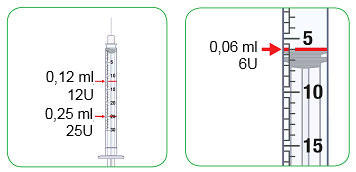
- To inject the Myalepta solution using a small 0.3 mL syringe, the last column of the table below indicates the measurement in “units” on the syringe that corresponds to the different doses of medicine that may be prescribed by the doctor, nurse or pharmacist.
Conversion of the dose from “ml” to “units” using a 0.3 mL syringe
| A Child's weight | Myalepta dose | Amount of Myalepta solution mixed | Amount of Myalepta solution mixed to be injected, expressed in “units” on the 0.3 mL syringe |
| 9 kg | 0.54 mg | 0.10 mL | 10 |
| Child's weight | Myalepta dose | Amount of Myalepta solution mixed | Amount of Myalepta solution mixed to be injected, expressed in or “units” on the 0.3 mL syringe |
| 10 kg | 0.60 mg | 0.12 mL | 12 |
| 11 kg | 0.66 mg | 0.13 mL | c 13 |
| 12 kg | 0.72 mg | 0.14 mL | a 14 |
| 13 kg | 0.78 mg | 0.15 mL | 15 |
| 14 kg | 0.84 mg | 0.16 mL | m 16 |
| 15 kg | 0.90 mg | 0.18 mL | 18 |
| 16 kg | 0.96 mg | 0.19 mL | r 19 |
| 17 kg | 1.02 mg | 0.20 mL | a 20 |
| 18 kg | 1.08 mg | 0.21 mL | 21 |
| 19 kg | 1.14 mg | 0.22 mL | F 22 |
| 20 kg | 1.20 mg | 0.24 mL | 24 |
| 21 kg | 1.26 mg | l 0.25 mL | 25 |
| 22 kg | 1.32 mg | e 0.26 mL | 26 |
| 23 kg | 1.38 mg | 0.27 mL | 27 |
| 24 kg | 1.44 mg | d 0.28 mL | 28 |
| 25 kg | 1.50 mg | 0.30 mL | 30 |
Using the 1 mL syringe
- In this syringe, the amount of solution to inject is indicated in ml, so you should inject the amount indicated by the doctor, nurse or pharmacist. It is not necessary to convert the amount from ml to units.
- You will be provided with a 1 mL syringe to use if the daily dose is greater than 1.5 mg up to 5 mg, which in terms of volume is equivalent to a Myalepta solution greater than 0.3 mL up to 1.0 mL.
- Every 0.1 mL is indicated by a number with a long line.
- Every 0.05 mL is indicated by a medium-length line.
- Every 0.01 mL is indicated by a shorter line.
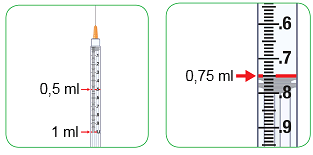
Using the 2.5 mL syringe
- In this syringe, the amount of solution to inject is indicated in mL, so you should inject the amount indicated by the doctor, nurse or pharmacist. It is not necessary to convert the amount from ml to units.
- You will be provided with a 2.5 mL syringe to use if the daily dose is greater than 5 mg up to 10 mg, which in terms of volume is equivalent to a Myalepta solution greater than 1.0 mL.
- Every 0.5 mL is indicated by a number next to a long line.
- Every 0.1 mL is indicated by a shorter line between the long lines.
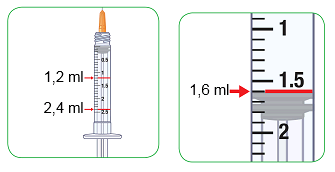
Step A - Preparation
- 1) Gather all the materials needed for the injection, which have been provided by the doctor, nurse or pharmacist.
Arrange the following materials on a clean, well-lit surface:
- a glass vial containing Myalepta powder
- a container of water for injections, in which to dissolve the Myalepta powder or The water for injections may be in glass or plastic vials, or in glass vials with a rubber stopper.
- alcohol swabs (to disinfect the skin where the medicine will be injected and the top of the vials)
- sharps container (to safely dispose of the materials used at the end of the injection)
You will also need 2 syringes:
- A 3 mL syringe with a 40 mm, 21 gauge needle, to dissolve the powder
- A syringe for injection, equipped with a much shorter needle, to inject the solution subcutaneously. The size of this syringe will be decided by the doctor, nurse or pharmacist based on the dose of Myalepta. o If the dose is 1.5 mg or less, the syringe to be used will be 0.3 mL. o If the dose is greater than 1.5 mg up to 5 mg, the syringe to be used will be 1 mL. o If the dose is greater than 5 mg, the syringe to be used will be 2.5 mL. o If the dose is greater than 5 mg the doctor, nurse or pharmacist may indicate to administer the dose with two separate injections. See section 3 “How to use Myalepta” for more information.
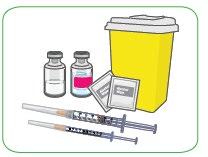
- 2) Before preparing the Myalepta solution, allow the vial containing the powder to reach room temperature, for about 10 minutes.
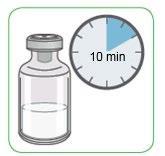
- 3) Wash your hands before preparing the medicine.
Phase B - Fill the 3 mL syringe with 2.2 mL of water for injectable preparations
- 4) Remove the 3 mL syringe from the plastic wrapper. Always use a new syringe.
- The 3 mL syringe and needle are supplied separately.
- The way to connect the needle to the syringe depends on the water for injectable preparations container provided: a plastic vial, a glass vial, or a glass bottle (see below for specific instructions).
- 5) Draw 2.2 mL of water for injectable preparations into the 3 mL syringe.
The water for injectable preparations will be provided by your doctor, nurse, or pharmacist along with the
medicine vial and syringes. This is mixed with the Myalepta powder so
that the powder dissolves, making the medicine liquid so it can be injected.
The water for injectable preparations may be supplied in one of the following containers:
- a plastic vial
- a glass vial
- a glass bottle (with a rubber stopper). Always use a new vial or bottle of water for injectable preparations. Never use any water for injectable preparations left over from preparing the Myalepta solution the day before.
Water for injectable preparations in a plastic vial
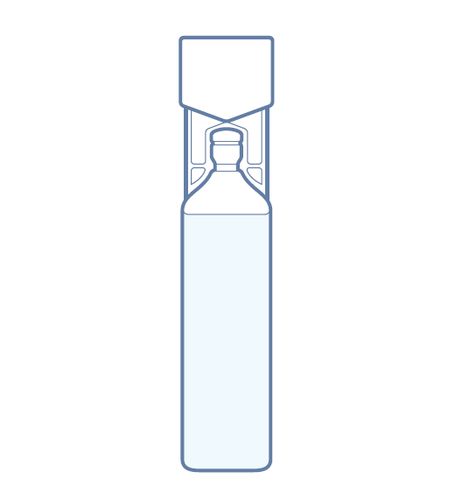
The plastic vial is a sealed container with a top with a twist-off opening.
To remove the water for injectable preparations, open the vial.
- Hold the vial with the top facing up.
- Hold the bottom of the vial with one hand and the top with the other hand.
- Keeping the bottom of the vial firm, gently twist the top until it detaches.
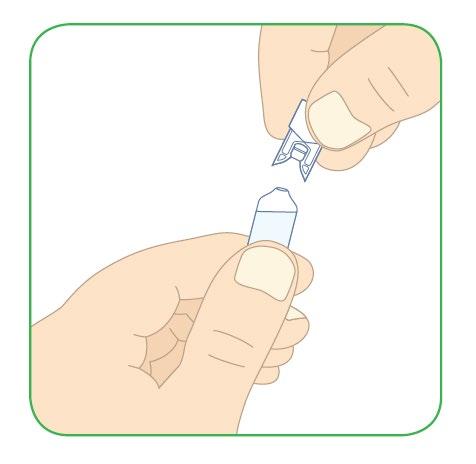
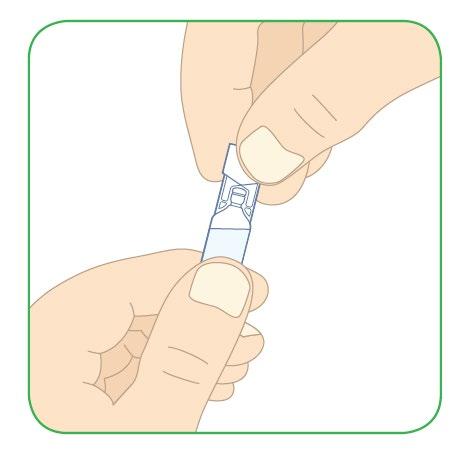
- Do not attach the needle to the syringe.
- Insert the tip of the 3 mL syringe, without a needle attached, into the top of the plastic vial, as far as it will go.
With the syringe still inserted in the vial, turn the vial and syringe upside down. The syringe is now
with the tip pointing upwards.
With the syringe still inserted in the vial, carefully pull the plunger down.
- Pull down until the top edge of the plunger is aligned with the black line indicating 2.2 mL.
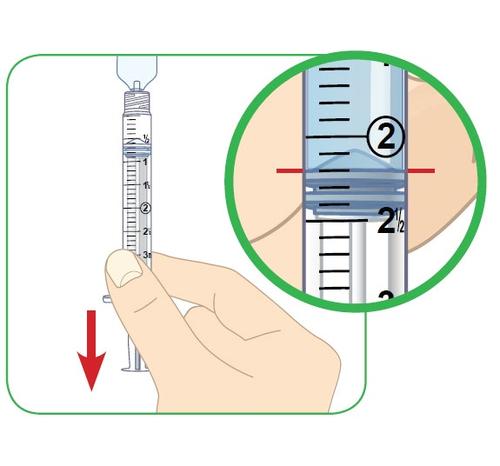
- You need to check if there are any pockets or air bubbles in the 3 mL syringe. To remove air pockets or air bubbles from the syringe, refer to points 6-8 below.
- Detach the syringe from the plastic vial.
Attach the needle to the syringe.
- Do not overtighten the needle.
- Do not remove the needle protective cap.
- Do not touch the needle.
Water for injectable preparations in a glass vial
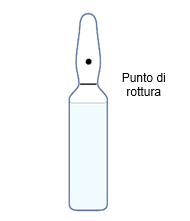
The glass vial is a sealed container.
Before opening the vial containing the water for injectable preparations, prepare the 3 mL syringe
by attaching the needle. Do not overtighten the needle.
- Remove the protective cap from the needle.
- Do not touch the needle.
To remove the water for injectable preparations, open the vial by breaking it at the
breaking point, as shown in the figure below.
- Hold the vial with the top facing up.
- Disinfect the vial at the breaking point with an alcohol-soaked swab.
- Hold the bottom of the vial with one hand and the top with the other hand.
- Keeping the bottom of the vial firm, snap off the tip.
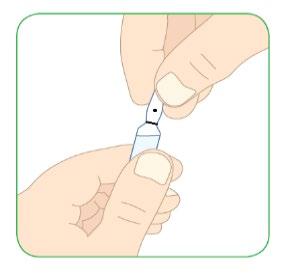
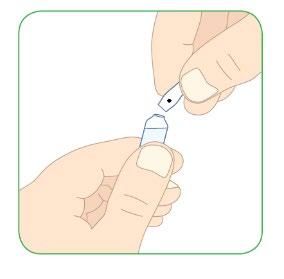
Insert the 3 mL syringe into the glass vial.
- Tilt the glass vial at a 45-degree angle to the floor.
- The needle must be inserted as far as possible inside the vial.
With the needle still inserted in the vial, carefully pull the plunger up.
- Pull the plunger up until the top edge of the plunger is aligned with the black line indicating 2.2 mL.
- You need to check if there are any pockets or air bubbles in the 3 mL syringe. To remove air pockets or air bubbles from the syringe, refer to points 6-8 below.
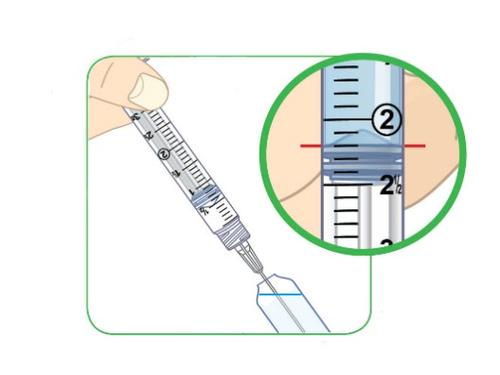
Water for injectable preparations in a glass bottle
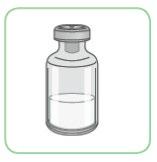
The glass bottle is equipped with a plastic cap that must be removed to reveal the underlying rubber seal.
Do not remove the rubber seal.
- Do not remove the rubber seal.
Attach the needle to the 3 mL syringe. Do not overtighten the needle.
- Remove the protective cap from the needle.
- Do not touch the needle.
- Pull the plunger down to the line indicating 2.2 ml to draw air into the syringe.
Place the bottle on a solid, flat surface.
- Insert the needle of the 3 mL syringe into the bottle through the rubber seal.
- The needle must be oriented downwards.
- The needle must penetrate completely into the bottle.
Push the plunger all the way down.
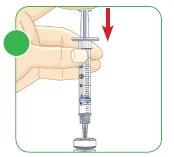
With the needle still inserted into the bottle, turn the bottle and syringe upside down. The needle is now
pointing upwards.
- Do not remove the needle from the bottle.
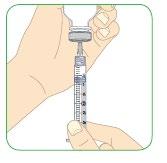
Carefully pull the plunger down.
- Pull the plunger down until the top edge of the plunger is aligned with the black line indicating 2.2 mL.
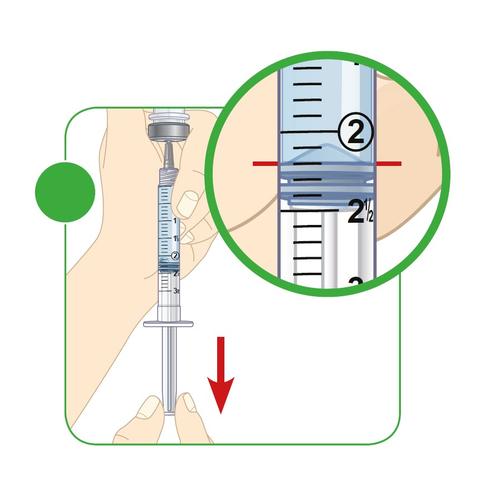
- 6) Regardless of whether you are drawing the water for injectable preparations from a vial or a bottle, you need to check that there are no pockets or air bubbles in the 3 mL syringe.
- Sometimes a large amount of air can get trapped inside the syringe (air pocket). You may also see smaller air bubbles in the syringe.
- You must remove the air pocket and air bubbles from thesyringeto be sure you have drawn the correct amount of sterile water into the syringe.
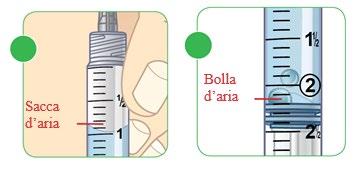
- 7) Remove any air pocket or air bubbles.
Using the glass bottle or plastic vial
- With the syringe still inserted into the glass bottle or plastic vial, tap the side of the syringe to move the air pocket/air bubbles to the top of the syringe.
- Carefully push the plunger up to push the air out of the syringe.
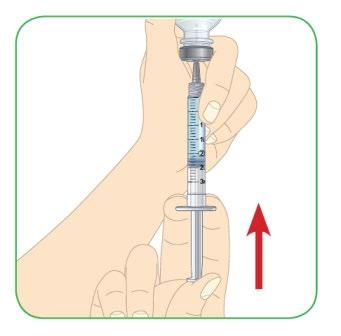
Using the glass vial
- Remove the syringe from the vial and hold it with the needle pointing upwards.
- Tap the side of the syringe to move the air pocket/air bubbles to the top of the syringe.
- Carefully push the plunger up to push the air out of the syringe.
- 8) Check the amount of water for injectable preparations.
- If the amount of water for injectable preparations in the syringe is less than 2.2 mL, draw a larger amount of water for injectable preparations with the syringe and repeat steps 6 and 7 until the syringe contains 2.2 mL of water.
- 9) When the syringe contains 2.2 mL of water for injectable preparations, remove the syringe from the bottle or vial.
- Do not move the plunger.
- Do not touch the exposed needle of the syringe as it is sterile and you may damage the needle or injure yourself.
Phase C - Dissolve Myalepta
- 10) Make sure the vial containing the Myalepta powder has been removed from the refrigerator for at least 10 minutes to reach room temperature.
- 11) Remove the plastic cap from the vial containing the Myalepta powder.
- Place the vial on a solid, flat surface.
- Clean the top of the vial with an alcohol-soaked swab.
- 12) Fully insert the needle of the 3 mL syringe containing 2.2 mL of water for injectable preparations into the Myalepta vial containing the powder.
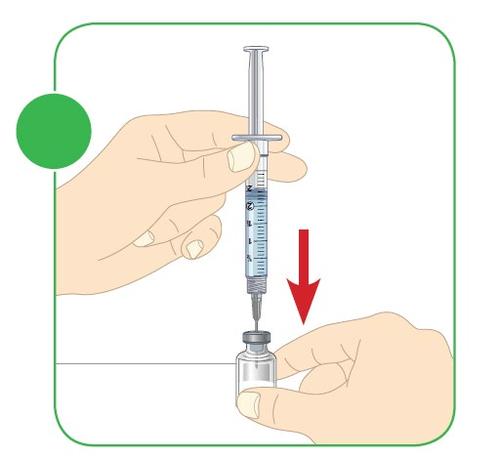
- 13) Hold the vial tilted at a 45-degree angle to the work surface and slowly push the plunger down with your thumb.
- The water for injectable preparations must flow down the inner wall of the vial.
- Inject all the water for injectable preparations into the vial.
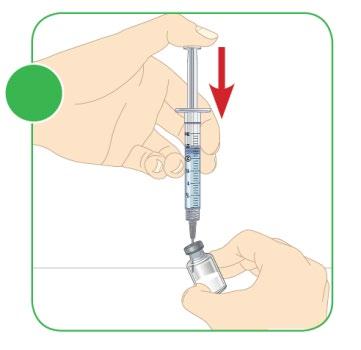
- 14) Remove the needle from the vial and dispose of the syringe in a sharps container.
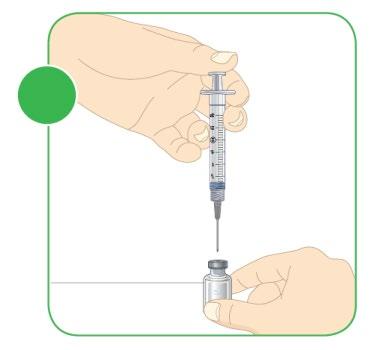
- 15) Mix the powder and water for injectable preparations.
- Gently shake the vial with circular movements (rotational movement).
- Until the powder dissolves and the liquid is clear. Do not shake or mixvigorously.
- The solution will become clear in less than 5 minutes. If mixed correctly, the Myalepta solution should be clear and free of dry powder clumps, bubbles or foam. Do not use this medicine if the solution is not clear or contains clumps or particles. Throw it away and start the procedure again from step 1.
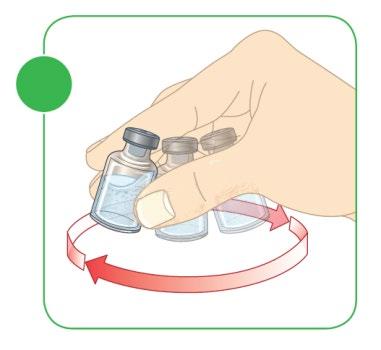
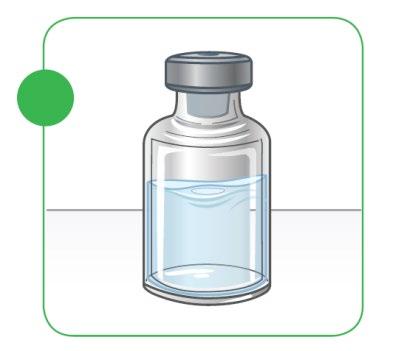
Phase D - Fill the syringe with Myalepta for injection
- 16) To inject the Myalepta solution, you need to use a new injection syringe, which will be a 0.3 mL, 1.0 mL or 2.5 mL syringe provided by your doctor, nurse or pharmacist. Remove the protective cap from the needle.
- Do nottouch the needle.
- Do notmove the plunger.
- 17) Fully insert the needle into the vial containing the dissolved Myalepta powder solution, through the center of the rubber stopper.
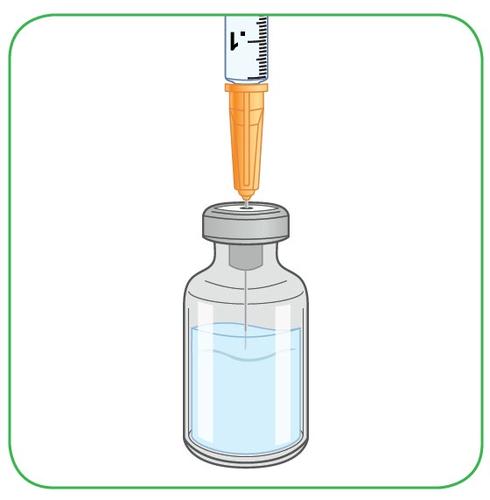
- 18) With the needle inserted in the vial, turn the vial and syringe upside down.
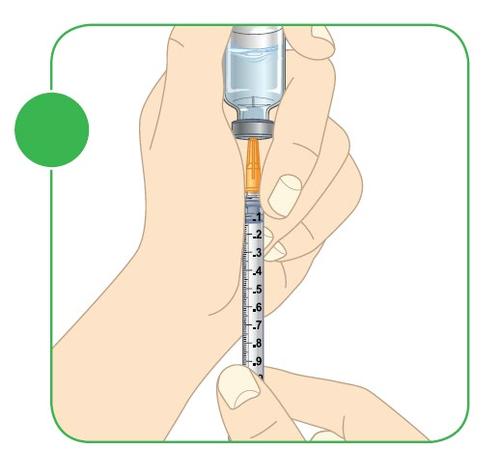
- 19) Keeping the needle inside the vial, pull the plunger down.
- The top edge of the plunger must align with the black line on the syringe corresponding to the amount of Myalepta solution to be injected.
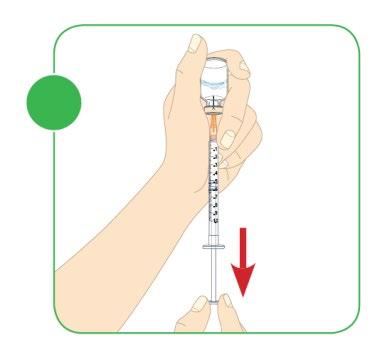
- 20) Check for air pockets or air bubbles.
- If you notice an air pocket or air bubbles, follow the same instructionsas in point 7 to remove air from the syringe.
- 21) If the syringe contains the correct dose of Myalepta solution, remove the needle from the vial.
- Do notmove the plunger.
- Do nottouch the exposed needle of the syringe as it is sterile and you may damage the needle or injure yourself.
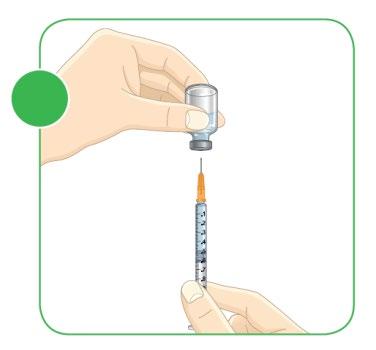
Phase E - Choose and prepare the injection site
- 22) Carefully choose the point where you intend to inject Myalepta. This medicine can be injected into the following areas:
- stomach area (abdomen), except for the area within 5 cm around the navel
- thighs
- upper arm, in the posterior area
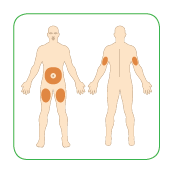
If you intend to use the same area of the body for each injection, avoid the point used for the
last injection.
- If you are injecting other medicines, do not inject Myalepta at the same point where the other medicines have been injected.
- 23) Clean the chosen area for the injection with a clean swab soaked in alcohol and let the skin dry.
- Avoid touching the cleaned area before performing the Myalepta injection.
Phase F - Inject Myalepta
Important:Myalepta must be injected under the skin (“subcutaneous use”). Do notinject the
medicine into a muscle.
- 24) To perform a subcutaneous injection, pinch the skin of the area where you intend to make the injection with one hand.
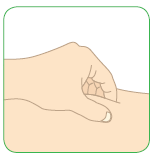
- 25) Hold the syringe with the other hand as if it were a pen.
- 26) Gently insert the needle into the skin, at an angle of approximately 45 degrees to the body.
- Do notinsert the needle into the muscle.
- The needle is short and should penetrate the skin completely at a 45-degree angle.
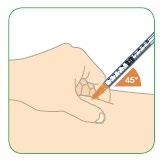
- 27) With your thumb, gently push the plunger down to the end.
- Inject all of the medicine.
- If any medicine remains in the syringe, the dose has not been administered completely.
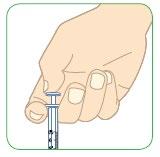
- 28) Remove the syringe from the skin.
Phase G - Dispose of used materials
- 29) Immediately discard the two used syringes and all caps, vials, or ampoules into the sharps container.
- When the sharps container is full, contact your doctor, nurse, or pharmacist for its proper disposal. There may be local regulations in this regard.
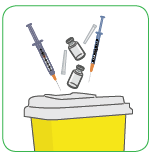
Important
- Do not use the syringes more than once. Use new syringes each time.
- The vials may remain almost completely full of product after drawing the necessary dose. The remaining solution must be discarded after use.
- Do not dissolve another dose of Myalepta powder with the unused water for injection remaining in a vial or ampoule. This unused water for injection must be discarded into the sharps container. Always use a new vial or ampoule of water for injection each time you prepare to dissolve Myalepta powder.
- Do not recycle the syringes, caps, or sharps container and do not dispose of these materials in household waste.
- Always keep the sharps container out of the reach of children.

Уже начали прием и появились вопросы?
Обсудите свое состояние и дальнейшие шаги с врачом онлайн.
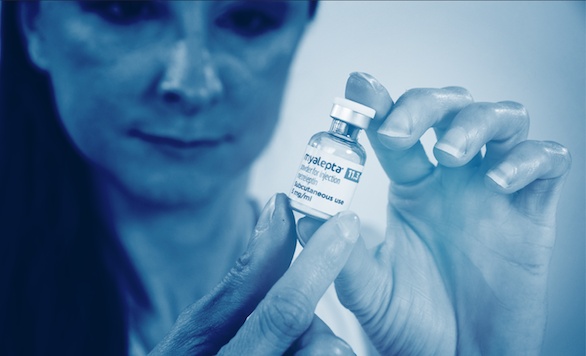
- Страна регистрации
- Форма выпускаPowder for injectable solution, 11.3 MG
- Код АТХA16AA07
- Действующее вещество
- Отпускается по рецептуДа
- Производитель
- Информация на этой странице носит справочный характер и не является медицинской консультацией. Перед началом приема лекарства обязательно проконсультируйтесь с врачом.
- Аналоги MYALEPTAФорма выпуска: Dispersible tablet, 200 MGДействующее вещество: Карглюмиковая кислотаПроизводитель: WAYMADE B.V.Отпускается по рецептуФорма выпуска: Dispersible tablet, 200 MGДействующее вещество: Карглюмиковая кислотаПроизводитель: RECORDATI RARE DISEASES SARLОтпускается по рецепту
Аналоги MYALEPTA в других странах
Лекарства с тем же действующим веществом, доступные в других странах.
Аналог MYALEPTA в Испания
Аналог MYALEPTA в Украина
Врачи онлайн по MYALEPTA
Обсудите применение MYALEPTA и возможные следующие шаги — по оценке врача.









Получите рецепт на MYALEPTA онлайн
Заполните форму за 2 минуты
Расскажите о симптомах, истории болезни и нужном препарате.
Выберите врача или мы назначим
Выберите специалиста или мы подберём ближайшего доступного врача.
Врач рассматривает ваш случай
Обычно в течение 30 минут. Может задать уточняющие вопросы в чате.
Получите в любой аптеке
Электронный рецепт отправляется на вашу почту — действителен по всей Польше.
Часто задаваемые вопросы
MYALEPTA требует рецепта в Италия. Вы можете уточнить у врача онлайн, подходит ли это лекарство для вашей ситуации.
Действующее вещество MYALEPTA — metreleptin. Эта информация помогает определить лекарства с тем же составом под другими торговыми названиями.
MYALEPTA производится компанией CHIESI FARMACEUTICI S.P.A.. Упаковка и торговое название могут отличаться в зависимости от дистрибьютора.
Врачи, включая Семейные врачи, Психиатры, Дерматологи, Кардиологи, Эндокринологи, Гастроэнтерологи, Пульмонологи, Нефрологи, Ревматологи, Гематологи, Инфекционисты, Аллергологи, Гериатры, Педиатры, Онкологи, могут оценить целесообразность применения MYALEPTA с учетом вашей ситуации и местных правил. Вы можете записаться на онлайн-консультацию, чтобы обсудить возможные варианты.
Польша имеет хорошо развитую систему здравоохранения в крупных городах, таких как Варшава, Краков, Вроцлав и Гданьск. Аптеки широко доступны и работают в соответствии с действующим законодательством, обеспечивая доступ к рецептурным препаратам.
Вы можете купить MYALEPTA в Варшаве, Кракове, Вроцлаве или Гданьске в любой аптеке при наличии действующего рецепта.
Чтобы получить рецепт, вы можете воспользоваться Oladoctor:
Другие лекарства с тем же действующим веществом (metreleptin) включают AKIDO KARLUMIKO WAYMADE, AMVERSIO, KARBALU. Они могут отличаться торговым названием или формой выпуска, но содержат одинаковый терапевтический компонент. Перед изменением лечения рекомендуется проконсультироваться с врачом.
