



KINERET 100 mg /0,67 Ml Инъекционный Раствор

Рассмотрение рецепта онлайн
Врач рассмотрит ваш случай и примет решение о назначении рецепта, если это медицински оправдано.

Поговорите с врачом об этом лекарстве
Обсудите симптомы и возможные дальнейшие шаги на онлайн-консультации.



Инструкция по применению KINERET
Содержание инструкции
Kineret 100 mg/0.67 mL injectable solution in pre-filled syringe
anakinra
Read this leaflet carefully before you use this medicine as it contains important
information for you.
- Keep this leaflet. You may need to read it again.
- If you have any questions, ask your doctor or pharmacist.
- This medicine has been prescribed for you only. Do not pass it on to others, even if their symptoms are the same as yours, as it could be harmful.
- If you get any side effects, even those not listed in this leaflet, tell your doctor or pharmacist. See section 4.
Contents of this leaflet
- 1. What Kineret is and what it is used for
- 2. What you need to know before you use Kineret
- 3. How to use Kineret
- 4. Possible side effects
- 5. How to store Kineret
- 6. Contents of the pack and other information
1. What is Kineret and what is it used for
Kineret contains the active substance anakinra, a type of cytokine (a substance with immunosuppressant action) that is used to treat:
- rheumatoid arthritis (RA)
- COVID-19 in patients with pneumonia, who require supplemental oxygen and are at risk of developing respiratory failure
- periodic fever syndromes:
- periodic syndromes associated with cryopyrin (CAPS) or neonatal-onset multisystem inflammatory disease (NOMID), also defined as chronic, infantile, neurological, cutaneous, articular (CINCA) syndrome, or Muckle-Wells syndrome (MWS), or familial cold autoinflammatory syndrome (FCAS)
- familial Mediterranean fever (FMF)
- Still's disease, including systemic juvenile idiopathic arthritis (SJIA) and adult-onset Still's disease (AOSD)
Cytokines are proteins produced by the body that coordinate communication between cells and help control cellular activity. In RA, CAPS, FMF, Still's disease and COVID-19 pneumonia, the body produces an excess of a cytokine called interleukin-1 which causes harmful effects leading to inflammation and causing the symptoms of the disease. Normally the body produces a protein that blocks the harmful effects of interleukin-1. The active ingredient of Kineret is anakinra, which works in the same way as the interleukin-1 blocking protein produced by the body. Anakinra is produced using DNA technology using the microorganism E. coli.
For RA, Kineret is used to treat the signs and symptoms of the disease in adults (age ≥ 18 years) in combination with another medicine called methotrexate. Kineret is intended for patients with an insufficient response to methotrexate that does not allow control of rheumatoid arthritis.
For COVID-19, Kineret is used to treat hyperinflammation (inflammation stronger than common inflammation) associated with the disease in adults (age ≥ 18 years) who have pneumonia, who require supplemental oxygen to help them breathe (low or high flow oxygen) and who are at risk of developing respiratory failure.
For CAPS, Kineret is used to treat the signs and symptoms of inflammation associated with the disease such as rash, joint pain, fever, headache and fatigue in adult and paediatric patients (age ≥ 8 months).
For FMF, Kineret is used to treat the signs and symptoms of inflammation associated with the disease such as recurrent fever, fatigue, abdominal pain, muscle or joint pain and rash. If appropriate, Kineret can be used together with colchicine.
For Still's disease, Kineret is used to treat the signs and symptoms of inflammation associated with the disease such as rash, joint pain and fever.
2. What you need to know before using Kineret
Do not use Kineret
- if you are allergic to anakinra or any of the other ingredients of this medicine (listed in section 6);
- if you are allergic to other products obtained using DNA technology using the microorganism E. coli;
- if you have neutropenia (low white blood cell count) determined based on a blood test.
Contact your doctor immediately
- if you notice a rash all over your body, difficulty breathing, shortness of breath, rapid pulse or sweating after injecting Kineret. These symptoms may indicate that you are allergic to Kineret;
- if you have developed an unusual and widespread skin rash or peeling skin in the past after taking Kineret.
Warnings and precautions
Talk to your doctor before using Kineret:
- if you have a history of recurrent infections or if you suffer from asthma. Kineret may worsen these conditions;
- if you have cancer. Your doctor will need to decide if you can still receive Kineret;
- if you have a history of elevated liver enzyme levels;
- if you are to be vaccinated. You should not receive any live vaccine during treatment with Kineret.
Still’s Disease
- In rare cases, patients with Still’s disease, especially children, may develop a lung disease, even during treatment with Kineret. The risk may be higher in patients with Down syndrome (trisomy 21). Symptoms of lung disease may include, for example, shortness of breath during mild exercise, morning cough, and difficulty breathing. If you experience signs of lung disease, you should contact your doctor as soon as possible.
- This serious skin reaction, called drug reaction with eosinophilia and systemic symptoms (DRESS), has been rarely reported in association with Kineret-based therapy, predominantly in subjects with systemic juvenile idiopathic arthritis (SJIA). Contact your doctor immediately if you notice an atypical and widespread rash, which may be associated with high fever and swollen lymph nodes.
Children and adolescents
- RA: the use of Kineret in children and adolescents with rheumatoid arthritis has not been fully studied and therefore cannot be recommended.
- COVID-19: the use of Kineret in children and adolescents with COVID-19 has not been studied and therefore cannot be recommended.
- CAPS, FMF, Still’s disease: Kineret is not recommended in children under 8 months of age due to the lack of data in this age group.
Other medicines and Kineret
Tell your doctor if you are taking, have recently taken or might take any other
medicine.
So-called tumor necrosis factor (TNF-α) inhibitors, such as etanercept, should not be
taken together with Kineret as the combination may lead to an increased risk of infections.
Following the administration of Kineret, chronic inflammation decreases and therefore the doses of some other medicines, e.g. warfarin or phenytoin, need to be adjusted.
Pregnancy and breastfeeding
If you are pregnant, suspect you may be pregnant or are planning to become pregnant, or if you are
breastfeeding, ask your doctor for advice before taking this medicine.
Kineret has not been studied in pregnant women. The use of Kineret is not recommended
during pregnancy and in women of childbearing potential who are not using contraception. It is important that
you inform your doctor if you are pregnant, suspect you may be pregnant or are planning to become pregnant. The
doctor will discuss with you the possible risks associated with taking Kineret during pregnancy.
It is not known whether anakinra is excreted in human milk. If you are using Kineret you should stop breastfeeding.
Kineret contains sodium
This medicine contains less than 1 mmol of sodium (23 mg) per 100 mg dose, i.e. essentially
‘sodium-free’.
3. How to use Kineret
Use this medicine following the instructions of your doctor exactly. If you have any doubts, consult your
doctor or pharmacist. Kineret must be administered with an injection under the skin (subcutaneous)
once a day. You should try to give the injection at the same time each day.
The recommended dose varies from 20 to 90 mg or 100 mg. Your doctor will tell you the dose you need or
if you need to take a dose higher than 100 mg.
COVID-19: the recommended dose is 100 mg injected subcutaneously (under the skin) every day
for 10 days.
How to self-inject Kineret
Your doctor may consider it more convenient for you to self-inject Kineret. Your doctor or
nurse will show you how to self-inject. Do not try to self-inject if
you have not been shown how to do it.
Kineret alone or how to practice the injection on your child.
If you use more Kineret than you should
If you accidentally use more Kineret than you should, the consequences should not be serious. In
case this happens, you should still contact your doctor, nurse or pharmacist. If you do not feel
well, seek medical attention immediately.
If you forget to use Kineret
If you have forgotten to take a dose of Kineret, contact your doctor to determine when to take the
next dose.
4. Possible side effects
Like all medicines, this medicine can cause side effects, although not everybody gets them.
The possible side effects are similar whether Kineret is taken to treat AR, CAPS, FMF,
Still’s disease or COVID-19.
If you notice any of the following effects, tell your doctor immediately:
- Serious infections, such as pneumonia (an infection in the chest) or skin infections can occur while you are taking Kineret. Symptoms may include high persistent fever, chills, cough, headache and redness and tenderness of the skin. Also, persistent low-grade fever, weight loss and persistent cough can be signs of infection.
- Serious allergic reactionsare uncommon. However, any of the following symptoms may indicate an allergic reaction to Kineret, so tell your doctor immediately. Do not inject Kineret again.
- Swelling of the face, tongue or throat
- Difficulty swallowing or breathing
- Sudden feeling of rapid pulse or sweating
- Itchy skin or rash
Very common side effects(may affect more than 1 in 10 people):
- Redness, swelling, bruising or itching at the injection site. These symptoms range from mild to moderate and are more common at the beginning of treatment.
- Headaches.
- Increased total cholesterol.
Common side effects(may affect up to 1 in 10 people):
- Neutropenia (low number of white blood cells) found after a blood test. This may increase the risk of getting an infection. Symptoms of an infection may include, among others, fever or sore throat.
- Serious infections, such as pneumonia (an infection in the chest) or skin infections.
- Thrombocytopenia (low levels of platelets in the blood).
Uncommon side effects(may affect up to 1 in 100 people):
- Serious allergic reactions including swelling of the face, tongue or throat, difficulty swallowing or breathing, sudden feeling of rapid pulse or sweating and itchy skin or rash.
- Elevated levels of liver enzymes determined by a blood test.
Side effects with unknown frequency(frequency cannot be estimated based on available data):
- Signs of liver disorders such as yellowing of the skin and eyes, nausea, loss of appetite, dark urine and pale stools.
- If Kineret is injected repeatedly in the same area, there is a risk that a nodule (amyloid deposit) may form under the skin. To avoid this, alternate the injection site.
Reporting of side effects
If you get any side effects, even those not listed in this leaflet, tell your
doctor or pharmacist. You can also report side effects directly through the national
reporting system listed in Annex V. By reporting side effects you can help provide
more information on the safety of this medicine.
5. How to store Kineret
Keep this medicine out of the sight and reach of children.
Do not use this medicine after the expiry date which is stated on the label and on the carton after
Exp/EXP. The expiry date refers to the last day of that month.
Store in a refrigerator (2 °C - 8 °C). Do not freeze.
Store in the original package to protect the medicine from light.
Do not use Kineret if you think it has been frozen. Once the syringe has been removed from the refrigerator and
has reached room temperature (up to 25 °C), it must be used within 72 hours, or be
discarded. Do not return it to the refrigerator if it has been stored at room temperature.
Do not dispose of any medicine in wastewater or household waste. Ask your pharmacist how to
dispose of medicines you no longer use. This will help protect the environment.
6. Content of the pack and other information
What Kineret contains
- The active ingredient is anakinra. Each pre-filled graduated syringe contains 100 mg of anakinra.
- The other ingredients are anhydrous citric acid, sodium chloride, disodium edetate dihydrate, polysorbate 80, sodium hydroxide and water for injections.
Description of Kineret and content of the pack
Kineret is a clear, injectable solution, from colourless to milky, supplied ready for use in a
pre-filled syringe. It may contain some protein particles from translucent to white. The presence
of these particles does not affect the quality of the product.
Packs of 1, 7 or 28 (multipack containing 4 packs of 7 pre-filled syringes) syringes
pre-filled.
Not all pack sizes may be marketed.
Marketing Authorisation Holder and Manufacturer
Swedish Orphan Biovitrum AB (publ)
SE-112 76 Stockholm
Sweden
More detailed information on this medicine is available on the European Medicines Agency website, https://www.ema.europa.eu .
--------------------------------------------------------------------------------------------------------------------------
INSTRUCTIONS FOR PREPARATION AND ADMINISTRATION OF A KINERET
INJECTION
This paragraph contains information on how to give yourself an injection of Kineret or give it
to your child. Do not try to give yourself an injection or give it to your child unless you have been
shown how to do so by a doctor, nurse or pharmacist. If you have any questions about how to
give the injection, ask your doctor, nurse or pharmacist.
How should the Kineret pre-filled syringe be used?
The injection should be given at the same time each day. Kineret is injected just under the
skin: this technique is called a subcutaneous injection.
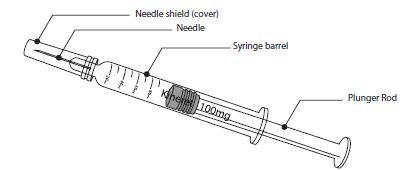
Equipment
To give yourself or your child a subcutaneous injection you will need:
- a Kineret pre-filled syringe
- alcohol swabs or similar; and
- a sterile gauze or tissue.
What you must do before giving yourself or your child a subcutaneous injection of
Kineret?
- 1. Take the Kineret syringe out of the refrigerator.
- 2. Do not shake the pre-filled syringe.
- 3. Check the expiry date on the label of the pre-filled syringe (EXP). Do not use the medicine if the last day of the month shown has passed.
- 4. Check the appearance of Kineret. The medicine should be a clear solution, from colourless to milky. The solution may contain protein particles from translucent to milky. The presence of these particles does not affect the quality of the product. The solution should not be used if it has a change in colour or appears cloudy or if there are particles other than translucent to milky particles.
- 5. For a gentler injection, leave the pre-filled syringe at room temperature for about 30 minutes or hold it gently in your hand for a few minutes. Do notheat Kineret by any other means (for example, do not heat the medicine in a microwave or in hot water).
- 6. Do notremove the cap from the syringe until you are ready to give the injection.
- 7. Wash your hands thoroughly.
- 8. Find a comfortable, well-lit and clean surface and have all the necessary equipment to hand.
- 9. Make sure you know the dose of Kineret that has been prescribed for you by your doctor; 20 - 90 mg, 100 mg or a higher dose.
- If your doctor has prescribed a dose of 100 mg, go to the section “ How to prepare a100 mg dose”.
- If your doctor has prescribed a lower dose, go to the section “ How to prepare a20 - 90 mg dose”.
How to prepare a 100 mg dose
Before giving the Kineret injection you must do the following:
- 1. hold the syringe barrel and gently pull the cap off the needle without twisting it. Pull straight off, as shown in Figure A. Do not touch the needle and do not press the plunger. Immediately discard the needle cap.
- 2. there may be a small air bubble in the pre-filled syringe. It is not necessary to remove it before giving the injection. Injecting the solution with the air bubble will not cause any harm.
- 3. you can now use the pre-filled syringe as described in the sections “ Where togive the injection?” and “ How to give the injection?”.
How to prepare a 20 - 90 mg dose
Before giving the Kineret injection you must do the following:
- 1. hold the syringe barrel and gently pull the cap off the needle without twisting it. Pull straight off, as shown in Figure A. Do not touch the needle and do not press the plunger. Immediately discard the needle cap.
- 2. hold the syringe in one hand with the needle pointing upwards as shown in Figure B. Place your thumb on top of the plunger and slowly press down until a drop of liquid comes out of the tip of the needle.
- 3. rotate the syringe so that the needle points downwards. Place a sterile gauze or tissue on a flat surface and hold the syringe above it with the needle pointing towards the gauze or tissue, as shown in Figure C. Make sure the needle does not touch the gauze or tissue.
- 4. place your thumb on top of the plunger and slowly press down until the front of the plunger reaches the mark on the scale corresponding to the dose of Kineret prescribed (your doctor will have told you which dose to use). The expelled liquid will be absorbed by the gauze or tissue, as shown in Figure C.
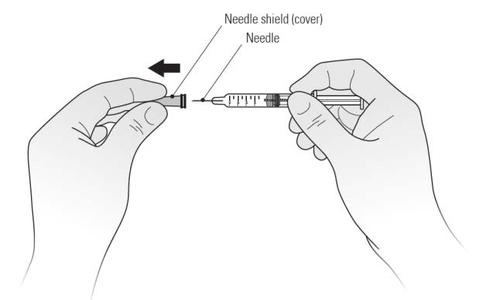
Figure A
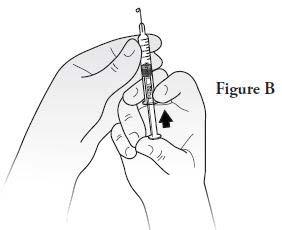
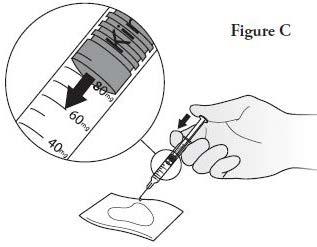
- 5. if you cannot set the correct dose, discard the syringe and use a new one.
- 6. you can now use the pre-filled syringe as described in the sections “ Where to givethe injection?” and “ How to give the injection?”.
Where to give the injection?
The best places to give yourself or your child an injection are (see Figure D):
- the abdomen (except the area around the navel)
- the upper thighs
- the upper outer areas of the buttocks; and
- the outer areas of the arms
AdultChild
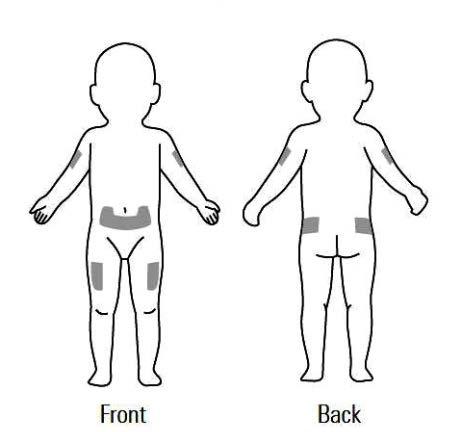
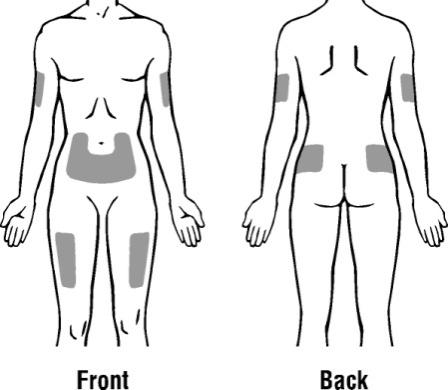
Change the injection site each time so that one area does not become sore. If the injection is given to you by another person, you can also use the back of your arms.
How to give the injection?
- 1. Disinfect the skin using an alcohol swab and pinch the skin between your thumb and index finger, without squeezing.
- 2. Insert the needle completely into the skin as you have been shown by the nurse or doctor.
- 3. Inject the liquid slowly and steadily, keeping the skin pinch as shown in Figure E. Figure D
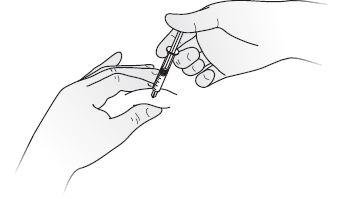
Figure E
- 4. After injecting the liquid, remove the needle and release the skin.
FiE
- 5. The unused solution must be discarded. Use each syringe for only one injection. Do not reuse a syringe as there is a risk of infection.
Remember
If you have any problems, do not hesitate to ask your doctor or nurse for help and advice.
Disposal of syringes and used equipment
- Do not put the caps back on used needles.
- Keep syringes out of the reach and sight of children.
- Never dispose of used pre-filled syringes in your household waste bin.
- If you have used a dose less than 100 mg you will have been told to empty the liquid from the syringe onto a gauze or tissue. After the injection, discard the wet gauze or tissue together with the syringe and clean the surface with a new tissue.
- The used pre-filled syringe and any gauze or tissue with Kineret solution must be disposed of in accordance with local regulations. Ask your pharmacist how to dispose of medicines you no longer use. This will help protect the environment.

Не уверены, подходит ли вам это лекарство?
Обсудите симптомы и варианты лечения с врачом онлайн.

Уже начали прием и появились вопросы?
Обсудите свое состояние и дальнейшие шаги с врачом онлайн.
- Страна регистрации
- Форма выпускаInjectable solution, 100 MG/0,67 ML
- Код АТХL04AC03
- Действующее вещество
- Отпускается по рецептуДа
- Производитель
- Информация на этой странице носит справочный характер и не является медицинской консультацией. Перед началом приема лекарства обязательно проконсультируйтесь с врачом.
- Аналоги KINERETФорма выпуска: Injectable solution in pre-filled syringe, 45 mgДействующее вещество: УстекинумабПроизводитель: ACCORD HEALTHCARE, S.L.U.Отпускается по рецептуФорма выпуска: Concentrate for infusion solution, 20 mg/mLДействующее вещество: ТоцилизумабПроизводитель: CELLTRION HEALTHCARE HUNGARY KFTОтпускается по рецептуФорма выпуска: Injectable solution, 160 mgДействующее вещество: БимекизумабПроизводитель: UCB PHARMA S.A.Отпускается по рецепту
Аналоги KINERET в других странах
Лекарства с тем же действующим веществом, доступные в других странах.
Аналог KINERET в Испания
Получите рецепт на KINERET онлайн
Заполните форму за 2 минуты
Расскажите о симптомах, истории болезни и нужном препарате.
Выберите врача или мы назначим
Выберите специалиста или мы подберём ближайшего доступного врача.
Врач рассматривает ваш случай
Обычно в течение 30 минут. Может задать уточняющие вопросы в чате.
Получите в любой аптеке
Электронный рецепт отправляется на вашу почту — действителен по всей Польше.
Часто задаваемые вопросы
KINERET требует рецепта в Италия. Вы можете уточнить у врача онлайн, подходит ли это лекарство для вашей ситуации.
Действующее вещество KINERET — анакинра. Эта информация помогает определить лекарства с тем же составом под другими торговыми названиями.
KINERET производится компанией SWEDISH ORPHAN BIOVITRUM AB (PUBL). Упаковка и торговое название могут отличаться в зависимости от дистрибьютора.
Врачи, включая Семейные врачи, Психиатры, Дерматологи, Кардиологи, Эндокринологи, Гастроэнтерологи, Пульмонологи, Нефрологи, Ревматологи, Гематологи, Инфекционисты, Аллергологи, Гериатры, Педиатры, Онкологи, могут оценить целесообразность применения KINERET с учетом вашей ситуации и местных правил. Вы можете записаться на онлайн-консультацию, чтобы обсудить возможные варианты.
Польша имеет хорошо развитую систему здравоохранения в крупных городах, таких как Варшава, Краков, Вроцлав и Гданьск. Аптеки широко доступны и работают в соответствии с действующим законодательством, обеспечивая доступ к рецептурным препаратам.
Вы можете купить KINERET в Варшаве, Кракове, Вроцлаве или Гданьске в любой аптеке при наличии действующего рецепта.
Чтобы получить рецепт, вы можете воспользоваться Oladoctor:
Другие лекарства с тем же действующим веществом (анакинра) включают ABSIMKY, AVTOTSMA, BIMTSELX. Они могут отличаться торговым названием или формой выпуска, но содержат одинаковый терапевтический компонент. Перед изменением лечения рекомендуется проконсультироваться с врачом.
