



HOSPASOL 145 MMOL/L Инфузионный раствор

Рассмотрение рецепта онлайн
Врач рассмотрит ваш случай и примет решение о назначении рецепта, если это медицински оправдано.

Поговорите с врачом об этом лекарстве
Обсудите симптомы и возможные дальнейшие шаги на онлайн-консультации.



Инструкция по применению OSPASOL
Содержание инструкции
- HOSPASOL
- WHAT HOSPASOL 145 mmol/l IS AND WHAT IT IS USED FOR
- WHAT YOU NEED TO KNOW BEFORE USING HOSPASOL 145 mmol/l
- HOW TO USE HOSPASOL 145 mmol/l
- POSSIBLE SIDE EFFECTS
- HOW TO STORE HOSPASOL 145 mmol/l
- CONTENTS OF THE PACK AND OTHER INFORMATION
- WHAT IS HOSPASOL 145 MMOL/L AND WHAT IS IT USED FOR
- BEFORE USING HOSPASOL 145 MMOL/L Do not use Hospasol 145 mmol/l
- HOW TO USE HOSPASOL 145 MMOL/L
- POSSIBLE SIDE EFFECTS
- HOW TO STORE HOSPASOL 145 MMOL/L
- FURTHER INFORMATION What Hospasol 145 mmol/l contains
- HOSPASOL
- WHAT IS HOSPASOL 167 mmol/l AND WHAT IS IT USED FOR
- WHAT YOU NEED TO KNOW BEFORE USING HOSPASOL 167 mmol/l
- HOW TO USE HOSPASOL 167 mmol/l
- POSSIBLE SIDE EFFECTS
- HOW TO STORE HOSPASOL 167 mmol/l
- CONTENTS OF THE PACK AND OTHER INFORMATION
- WHAT IS HOSPASOL 167 MMOL/L AND WHAT IS IT USED FOR
- BEFORE USING HOSPASOL 167 MMOL/L Do not use Hospasol 167 mmol/l
- HOW TO USE HOSPASOL 167 MMOL/L
- POSSIBLE SIDE EFFECTS
- HOW TO STORE HOSPASOL 167 MMOL/L
- FURTHER INFORMATION What Hospasol 167 mmol/l contains
HOSPASOL
145 mmol/lInfusion solution
Sodium bicarbonate
Read this leaflet carefully before using this medicine as it contains important
information for you.
- Keep this leaflet. You may need to read it again.
- If you have any questions, ask your doctor, pharmacist or nurse.
- If any side effects occur, including those not listed in this leaflet, ask your doctor, pharmacist or nurse. See section 4.
Contents of this leaflet:
- 1. What Hospasol 145 mmol/l is and what it is used for
- 2. What you need to know before using Hospasol 145 mmol/l
- 3. How to use Hospasol 145 mmol/l
- 4. Possible side effects
- 5. How to store Hospasol 145 mmol/l
- 6. Contents of the pack and other information
1. WHAT HOSPASOL 145 mmol/l IS AND WHAT IT IS USED FOR
Hospasol 145 mmol/l is used in hospitals or specialized centers for hemodialysis treatment to
correct the chemical imbalance of the blood caused by renal failure.
It replaces bicarbonate (hydrogen carbonate) released by the body during:
❖ Biofiltration Without Acetate (AFB) or
❖ Continuous Venous-Venous Hemofiltration Without Acetate (AFCVVH).
It also allows restoring bicarbonate levels in the body that are depleted when
renal function is compromised (renal failure).
2. WHAT YOU NEED TO KNOW BEFORE USING HOSPASOL 145 mmol/l
Do not use Hospasol 145 mmol/l
- during dialysis techniques if buffer supplementation is already being used.
Warnings and precautions
Consult your doctor, pharmacist or nurse before using Hospasol 145 mmol/l. It is important
to check blood salt (electrolyte) concentrations and acid-base balance in the body. Blood
composition will therefore be checked at regular intervals.
Particular attention must be paid:
to the pH value in the blood. If the pH is high (alkalosis), do not use Hospasol 145 mmol/l.
to the sodium level in the blood in case of heart problems and/or kidney failure. An
overdose of sodium could cause fluid retention in the body (hypervolemia) and
particularly in the lungs (pulmonary edema)
to blood vessels because inflammation associated with thrombi (thrombophlebitis) may be induced
if the product is administered into a smaller (peripheral) vein
to the blood levels of proteins, amino acids and water-soluble vitamins, as significant losses of these
substances may occur during dialysis.
Other medicines and Hospasol 145 mmol/l
Tell your doctor, pharmacist or nurse if you are taking, have recently taken or might take any
other medicines. In fact, the concentration in the blood of some of these medicines may decrease during
treatment with Hospasol 145 mmol/l. Your doctor will decide whether any of these medicines needs to be replaced.
Pregnancy, breastfeeding and fertility
There are no adequate data regarding the use of Hospasol 145 mmol/l during pregnancy or breastfeeding. Your
doctor must decide whether to administer Hospasol 145 mmol/l in case of pregnancy or during
breastfeeding.
Driving and operating machinery
Hospasol 145 mmol/l does not affect the ability to drive vehicles or operate machinery.
3. HOW TO USE HOSPASOL 145 mmol/l
Hospasol 145 mmol/l is a product to be used in hospitals or specialized centers with the aid of dialysis machines. It must be administered only by healthcare professionals.
The volume of Hospasol 145 mmol/l, and therefore the dose, will depend on your clinical condition. The volume
of the dose will be determined by the doctor responsible for the treatment.
Do not useHospasol 145 mmol/l if the solution is cloudy or if the outer packaging is damaged. All seals
must be intact.
If you use more Hospasol 145 mmol/l than you should
Overdosage may lead to a too low concentration in the blood of potassium (hypokalemia) and/or of
glucose (hypoglycemia). In case of overdosage, the administration of Hospasol 145 mmol/l must be
immediately stopped and dialysis must be performed with frequent blood gas monitoring.
The doctor will implement all necessary corrective measures and adjust the dose.
If you have any doubts about the use of this medicine, ask your doctor, pharmacist or nurse.
4. POSSIBLE SIDE EFFECTS
Like all medicines, this medicine can cause side effects, although not everybody gets them.
Some side effects may occur, potentially caused by the hemodialysis processsuch as:
o discomfort (nausea)
o disturbances (vomiting)
o muscle cramps
o high blood pressure (hypertension)
o chills
o fever
Reporting of side effects
If you get any side effect, even if not listed in this leaflet, please tell your
doctor, pharmacist or nurse. You can also report side effects directly through
side effects you can help provide more information on the safety of this medicine.
5. HOW TO STORE HOSPASOL 145 mmol/l
Keep this medicine out of the sight and reach of children.
Do not use Hospasol 145 mmol/l after the expiry date which is stated on the label and the carton. The expiry date refers to the last day of the month.
Do not store at a temperature below 4°C.
Hospasol 145 mmol/l can be disposed of in the drains without damaging the environment.
6. CONTENTS OF THE PACK AND OTHER INFORMATION
What Hospasol 145 mmol/l contains
The active ingredientis:
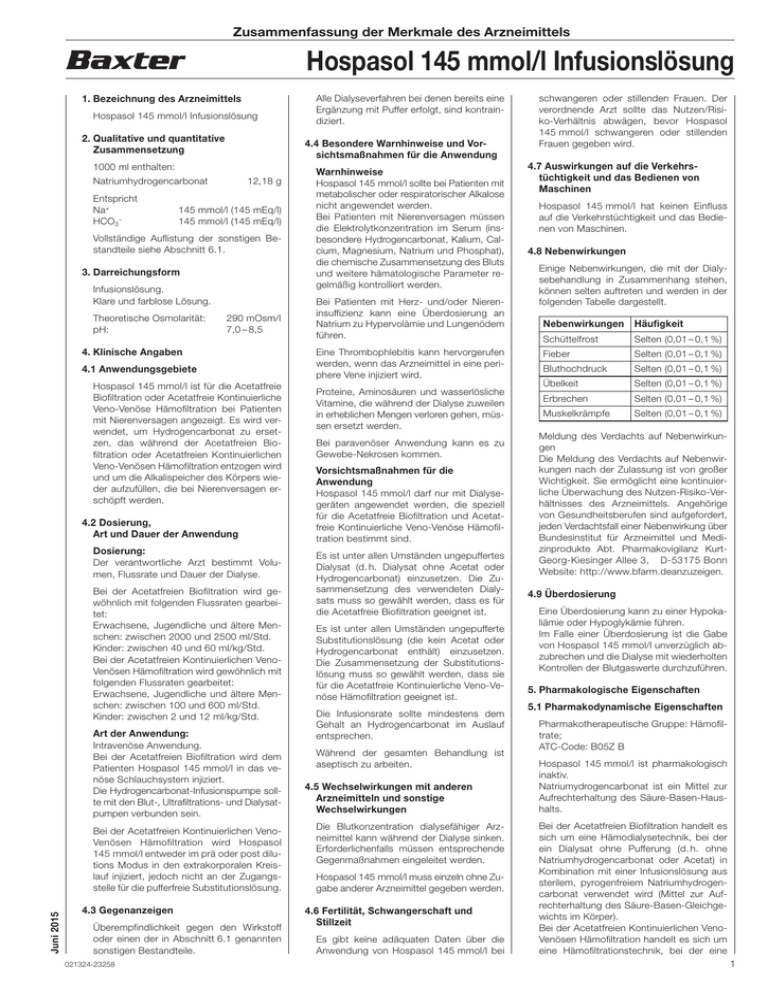
1000 ml of solution contains:
Sodium bicarbonate 12.18 g
Corresponding to
Sodium, Na 145 mmol/l (145 mEq/l)
Bicarbonate, HCO3 145 mmol/l (145 mEq/l)
Theoretical osmolarity: 290 mOsm/l
The excipientsare:
o carbon dioxide (for pH correction)
o water for injections.
Description of the appearance of Hospasol 145 mmol/l and contents of the pack
Hospasol 145 mmol/l is available in a single-compartment bag. The solution is transparent and colourless.
Each bag contains 3000 ml or 5000 ml of infusion solution. The bag is wrapped in a transparent film.
Marketing Authorisation Holder
Vantive Belgium SRL
Boulevard d’Angleterre 2
1420 Braine-l’Alleud
Belgium
Manufacturer responsible for batch release
Bieffe Medital S.p.A. Sondalo Plant, Via Stelvio 94, 23035 Sondalo (SO), Italy
-----------------------------------------------------------------------------------------------------------------------------
The following information is intended exclusively for doctors or healthcare professionals:
HOSPASOL 145 mmol/l solution for infusion
The use of a dialysate without buffer (which does not contain acetate or bicarbonate) is essential. A dialysate with an appropriate composition for Acetate-Free Biofiltration must be selected.
The use of a replacement fluid without buffer (which does not contain acetate or bicarbonate) is essential. A replacement fluid with an appropriate composition for Continuous Veno-Venous Hemofiltration without Acetate must be selected.
Hospasol 145 mmol/l must be administered alone without other medicines, especially solutions containing calcium or magnesium, as they may cause precipitation of calcium or magnesium carbonate.
Hospasol 145 mmol/l is injected into the venous return line or into the extracorporeal circuit before (pre-dilution) or after the hemofilter (post-dilution).
The responsible physician must determine the volume, flow rate and duration of dialysis.
Flow rates commonly used in Acetate-Free Biofiltration are:
Adults, adolescents and the elderly: from 2000 to 2500 ml/hour
Children: from 40 to 60 ml/kg/hour
Flow rates commonly used in Continuous Veno-Venous Hemofiltration without Acetate are:
Adults, adolescents and the elderly: from 100 to 600 ml/hour
Children: from 2 to 12 ml/kg/hour
INSTRUCTIONS FOR USE AND HANDLING
Hospasol 145 mmol/l is designed for exclusive use in dialysis machines specifically designed for Acetate-Free Biofiltration (special hemodialysis technique) or Continuous Veno-Venous Hemofiltration without Acetate.
Consult the instructions for use of the dialysis equipment before starting treatment with Hospasol 145 mmol/l.
Do not remove the product from the secondary packaging until you are ready for use.
Hospasol 145 mmol/l must only be used if the solution is clear, free of particles and all seals are intact.
Use aseptic techniques throughout the duration of administration to the patient.
Before connecting and after removing the cap of the bag connector (safelink), disinfectant must be applied inside the safelink.
Before disconnecting, it is recommended to disinfect the external surfaces of the line connector and the safelink.
The solution is for single use. After use, any unused quantities of solution must be immediately discarded.
From a microbiological point of view, once opened, the product must be used immediately. If not used immediately, the storage times and conditions before use are the responsibility of the user.
HOSPASOL®
145 mmol/lSolution for infusion
Sodium bicarbonate
Read this leaflet carefully before you use this medicine.
- Keep this leaflet. You may need to read it again.
- If you have any questions, ask your doctor or pharmacist.
- If any of the side effects gets serious, or if you notice any side effects not listed in this leaflet, tell your doctor or pharmacist.
Contents of this leaflet:
- 1. What Hospasol 145 mmol/l is and what it is used for
- 2. Before you use Hospasol 145 mmol/l
- 3. How to use Hospasol 145 mmol/l
- 4. Possible side effects
- 5. How to store Hospasol 145 mmol/l
- 6. Further information
1. WHAT IS HOSPASOL 145 MMOL/L AND WHAT IS IT USED FOR
Hospasol 145 mmol/l is used in hospitals or specialized centers for hemodialysis treatment to
correct the chemical imbalance of the blood caused by renal insufficiency.
It replaces the bicarbonate (hydrogen carbonate) released by the body during:
- Acetate-Free Biofiltration (AFB) or
- Continuous Veno-Venous Hemofiltration without Acetate (AFCVVH). It also allows restoring the levels of bicarbonate in the body that are depleted when renal function is compromised (renal insufficiency).
2. BEFORE USING HOSPASOL 145 MMOL/L Do not use Hospasol 145 mmol/l
- during dialysis techniques where buffer supplementation is already being used.
Pay particular attention with Hospasol 145 mmol/l
It is important to verify the concentrations of salts in the blood (electrolytes) and the acid-base balance
in the body. The composition of the blood will therefore be checked at regular intervals.
Particular attention must be paid to:
o the pH value in the blood. If the pH is high (alkalosis), do not use Hospasol 145 mmol/l.
o the level of sodium in the blood in case of heart disorders and/or renal insufficiency. An
overdose of sodium could cause fluid retention in the body (hypervolemia)
and particularly in the lungs (pulmonary edema)
o to blood vessels because inflammation associated with thrombi
(thrombophlebitis) may be induced if the product is administered into a smaller (peripheral) vein
o to the blood levels of proteins, amino acids and water-soluble vitamins, as significant losses of these substances may occur during
dialysis.
Use of Hospasol 145 mmol/l with other medicines
Tell your doctor or pharmacist if you are taking or have recently taken any other medicines,
including those without a prescription. In fact, the concentration of some of these
medicines in the blood may decrease during treatment with Hospasol 145 mmol/l. The doctor will decide if one of these
medicines needs to be replaced.
Pregnancy and breastfeeding
There is no adequate data regarding the use of Hospasol 145 mmol/l during pregnancy or breastfeeding. Your
doctor must decide whether to administer Hospasol 145 mmol/l in case of pregnancy or during
breastfeeding.
3. HOW TO USE HOSPASOL 145 MMOL/L
Hospasol 145 mmol/l is a product to be used in hospitals or specialized centers with the aid of dialysis machines. It must be administered only by healthcare professionals.
The volume of Hospasol 145 mmol/l, and therefore the dose, will depend on your clinical condition. The dose volume will be determined by the doctor responsible for the treatment.
Do not useHospasol 145 mmol/l if the solution is cloudy or if the outer packaging is damaged. All seals
must be intact.
If you use more Hospasol 145 mmol/l than you should
Overdosage may lead to a concentration that is too low in the blood of potassium (hypokalemia) and/or glucose (hypoglycemia). In case of overdosage, the administration of Hospasol 145 mmol/l must be
immediately stopped and dialysis must be performed with frequent blood gas monitoring.
The doctor will implement all necessary corrective measures and adjust the dose.
If you have any doubts about the use of the product, consult your doctor or pharmacist.
4. POSSIBLE SIDE EFFECTS
Like all medicines, Hospasol 145 mmol/l may cause side effects, although not everybody gets them.
Some side effects may occur, potentially caused by the hemodialysis processsuch as:
o discomfort (nausea) o disturbances (vomiting) o muscle cramps
o high blood pressure (hypertension)
o chills
o fever
If any of these side effects get worse, or if you notice any other side effect
5. HOW TO STORE HOSPASOL 145 MMOL/L
Keep out of the reach and sight of children.
Do not use Hospasol 145 mmol/l after the expiry date which is stated on the label and the carton. The expiry date refers to the last day of the month.
Do not store at a temperature below 4°C.
Hospasol 145 mmol/l can be disposed of in the wastewater without harming the environment.
6. FURTHER INFORMATION What Hospasol 145 mmol/l contains
The active substanceis:
1000 ml of solution contains: Sodium bicarbonate 12.18 g
Corresponding to
Sodium, Na+ 145 mmol/l (145 mEq/l)
Bicarbonate, HCO3- 145 mmol/l (145 mEq/l) Theoretical osmolarity: 290 mOsm/l
The excipientsare:
o carbon dioxide (for pH correction)
o water for injections.
Description of the appearance of Hospasol 145 mmol/l and contents of the pack
Hospasol 145 mmol/l is available in a single-compartment bag. The solution is clear and colourless. Each
bag contains 3000 ml or 5000 ml of infusion solution. The bag is wrapped in a transparent film.
Marketing Authorisation Holder
Vantive Belgium SRL
Boulevard d’Angleterre 2
1420 Braine-l’Alleud
Belgium
Manufacturer responsible for batch release
Bieffe Medital S.p.A., Via Stelvio 94, 23035 Sondalo (SO), Italy
-----------------------------------------------------------------------------------------------------------------------------
The following information is intended exclusively for doctors or healthcare professionals:
HOSPASOL® 145 mmol/l solution for infusion
The use of a dialysate without buffer (which does not contain acetate or bicarbonate) is essential. A dialysate with an appropriate composition for biofiltration without acetate must be selected.
The use of a replacement fluid without buffer (which does not contain acetate or bicarbonate) is essential. A replacement fluid with an appropriate composition for continuous veno-venous hemofiltration must be selected.
Hospasol 145 mmol/l must be administered alone without other medicinal products, especially solutions
containing calcium or magnesium, as they may cause precipitation of calcium or magnesium carbonate.
Hospasol 145 mmol/l is injected into the venous return line or into the extracorporeal circuit before (pre
dilution) or after the hemofilter (post dilution).
The responsible physician must determine the volume, flow rate and duration of dialysis.
Flow rates commonly used in biofiltration without acetate are:
Adults, adolescents and the elderly: from 2000 to 2500 ml/hour Children: from 40 to 60 ml/kg/hour
Flow rates commonly used in continuous veno-venous hemofiltration without acetate are: Adults, adolescents
and the elderly: from 100 to 600 ml/hour
Children: from 2 to 12 ml/kg/hour
INSTRUCTIONS FOR USE AND HANDLING
Hospasol 145 mmol/l is designed for exclusive use in dialysis machines specifically designed for
performing biofiltration without acetate (special hemodialysis technique) or continuous veno-venous
hemofiltration without acetate.
Consult the instructions for use of the dialysis equipment before starting treatment with Hospasol
145 mmol/l.
Do not remove the product from the secondary packaging until you are ready for use.
Hospasol 145 mmol/l must only be used if the solution is clear, free from particles and if all seals are
intact.
Use aseptic techniques throughout the duration of administration to the patient.
Before connecting and after removing the cap of the bag connector (safelink), a disinfectant must be
applied inside the safelink.
Before disconnecting, it is recommended to disinfect the external surfaces of the line connector and the safelink.
The solution is for single use only. After use, any unused quantities of solution must be
immediately discarded.
From a microbiological point of view, once opened the product must be used immediately. If not
used immediately, the storage times and conditions before use are the responsibility of the user.
HOSPASOL
167 mmol/lInfusion solution
Sodium bicarbonate
Read this leaflet carefully before you use this medicine as it contains important
information for you.
- Keep this leaflet. You may need to read it again.
- If you have any questions, ask your doctor, pharmacist or nurse.
- If any side effects occur, including those not listed in this leaflet, tell your doctor, pharmacist or nurse. See section 4.
- Contents of this leaflet:
- 1. What Hospasol 167 mmol/l is and what it is used for
- 2. What you need to know before you use Hospasol 167 mmol/l
- 3. How to use Hospasol 167 mmol/l
- 4. Possible side effects
- 6. How to store Hospasol 167 mmol/l
- 6. Contents of the pack and other information
2. WHAT IS HOSPASOL 167 mmol/l AND WHAT IS IT USED FOR
Hospasol 167 mmol/l is used in hospitals or specialized centers for hemodialysis treatment to
correct the chemical imbalance of the blood caused by renal insufficiency.
It replaces bicarbonate (hydrogen carbonate) released by the body during:
❖ Acetate-Free Biofiltration (AFB) or
❖ Continuous Venous-Venous Hemofiltration without Acetate (AFCVVH).
It also allows restoring bicarbonate levels in the body that are depleted when
renal function is compromised (renal insufficiency).
4. WHAT YOU NEED TO KNOW BEFORE USING HOSPASOL 167 mmol/l
Do not use Hospasol 167 mmol/l
- during dialysis techniques where buffer supplementation is already being used.
Warnings and precautions
Consult your doctor, pharmacist or nurse before using Hospasol 167 mmol/l. It is important
to check blood salt (electrolyte) concentrations and acid-base balance in the body. Blood
composition will therefore be checked at regular intervals.
Particular attention must be paid to:
o the pH value in the blood. Do not use Hospasol 167 mmol/l if the pH is high (alkalosis).
o the sodium level in the blood in case of heart and/or kidney failure. An
overdose of sodium could cause fluid retention in the body (hypervolemia) and
particularly in the lungs (pulmonary edema)
o to blood vessels because inflammation associated with thrombi
(thrombophlebitis) may be induced if the product is administered into a smaller (peripheral) vein
o to the blood levels of proteins, amino acids and water-soluble vitamins, as significant losses of these substances may occur during dialysis.
Other medicines and Hospasol 167 mmol/l
Inform your doctor, pharmacist or nurse if you are taking, have recently taken or might take any
other medicines. In fact, the blood concentration of some of these medicines may decrease during
treatment with Hospasol 167 mmol/l. Your doctor will decide whether any of these medicines need to be replaced.
Pregnancy, breastfeeding and fertility
There are no adequate data regarding the use of Hospasol 167 mmol/l during pregnancy or breastfeeding. Your
doctor must decide whether to administer Hospasol 167 mmol/l in case of pregnancy or during
breastfeeding.
Driving and operating machinery
Hospasol 167 mmol/l does not affect the ability to drive vehicles or operate machinery.
5. HOW TO USE HOSPASOL 167 mmol/l
Hospasol 167 mmol/l is a product to be used in hospitals or specialized centers with the aid of dialysis machines. It must be administered only by healthcare professionals.
The volume of Hospasol 167 mmol/l, and therefore the dose, will depend on your clinical condition. The volume
of the dose will be determined by the doctor responsible for the treatment.
Do not useHospasol 167 mmol/l if the solution is cloudy or if the outer packaging is damaged. All seals
must be intact.
If you use more Hospasol 167 mmol/l than you should
Overdosage may lead to a concentration that is too low in the blood of potassium (hypokalemia) and/or
glucose (hypoglycemia). In case of overdosage, the administration of Hospasol 167 mmol/l must be
immediately interrupted and dialysis must be performed with frequent blood gas monitoring.
The doctor will implement all necessary corrective measures and adjust the dose.
If you have any doubts about the use of this medicine, ask your doctor, pharmacist or nurse.
4. POSSIBLE SIDE EFFECTS
Like all medicines, this medicine can cause side effects, although not everybody gets them.
Some side effects may occur, potentially caused by the hemodialysis processsuch as:
o discomfort (nausea)
o disturbances (vomiting)
o muscle cramps
o high blood pressure (hypertension)
o chills
o fever
Reporting of side effects
If you get any side effects, talk to your doctor, pharmacist or nurse. You can also report side effects directly through
side effects you can help provide more information on the safety of this medicine.
5. HOW TO STORE HOSPASOL 167 mmol/l
Keep this medicine out of the sight and reach of children.
Do not use Hospasol 167 mmol/l after the expiry date which is stated on the label and the carton. The expiry date refers to the last day of the month.
Do not store at a temperature below 4°C.
Hospasol 167 mmol/l can be disposed of in the wastewater without harming the environment.
6. CONTENTS OF THE PACK AND OTHER INFORMATION
What Hospasol 167 mmol/l contains
The active ingredientis:
1000 ml of solution contains:
Sodium bicarbonate 14 g
Corresponding to
Sodium, Na 167 mmol/l (167 mEq/l)
Bicarbonate, HCO 167 mmol/l (167 mEq/l)
Theoretical osmolarity: 334 mOsm/l
The excipientsare:
o carbon dioxide (for pH correction)
o water for injections.
Description of the appearance of Hospasol 167 mmol/l and contents of the pack
Hospasol 167 mmol/l is available in a single-compartment bag. The solution is transparent and colourless.
Each bag contains 3000 ml or 5000 ml of infusion solution. The bag is wrapped in a transparent film.
Marketing Authorisation Holder
Vantive Belgium SRL
Boulevard d’Angleterre 2
1420 Braine-l’Alleud
Belgium
Manufacturer responsible for batch release
Bieffe Medital S.p.A. Sondalo Plant, Via Stelvio 94, 23035 Sondalo (SO), Italy
-----------------------------------------------------------------------------------------------------------------------------
The following information is intended exclusively for doctors or healthcare professionals:
HOSPASOL167 mmol/l infusion solution
The use of a dialysate without buffer (which does not contain acetate or bicarbonate) is essential. A dialysate with an appropriate composition for Acetate-Free Biofiltration must be selected.
The use of a buffer-free replacement fluid (which does not contain acetate or bicarbonate) is essential. A replacement fluid with an appropriate composition for Continuous Veno-Venous Hemofiltration without Acetate must be selected.
Hospasol 167 mmol/l must be administered alone without other medicines, especially solutions containing calcium or magnesium, as they may cause precipitation of calcium or magnesium carbonate.
Hospasol 167 mmol/l is injected into the venous return line or into the extracorporeal circuit before (pre-dilution) or after the hemofilter (post-dilution).
The responsible physician must determine the volume, flow rate and duration of dialysis.
Flow rates commonly used in Acetate-Free Biofiltration are:
Adults, adolescents and the elderly: from 1500 to 2000 ml/hour
Children: from 30 to 40 ml/kg/hour
Flow rates commonly used in Continuous Veno-Venous Hemofiltration without Acetate are:
Adults, adolescents and the elderly: from 85 to 530 ml/hour
Children: from 1.70 to 10.5 ml/kg/hour
INSTRUCTIONS FOR USE AND HANDLING
Hospasol 167 mmol/l is designed for use exclusively in dialysis machines specifically designed for performing Acetate-Free Biofiltration (special hemodialysis technique) or Continuous Veno-Venous Hemofiltration without Acetate.
Consult the instructions for use of the dialysis equipment before starting treatment with Hospasol 167 mmol/l.
Do not remove the product from the secondary packaging until you are ready for use.
Hospasol 167 mmol/l must only be used if the solution is clear, free of particles and all seals are intact.
Use aseptic techniques throughout the duration of administration to the patient.
Before connecting and after removing the cap of the bag connector (safelink), it is necessary to apply disinfectant inside the safelink.
Before disconnecting, it is recommended to disinfect the external surfaces of the line connector and the safelink.
The solution is for single use. After use, any unused quantities of solution must be immediately discarded.
From a microbiological point of view, once opened, the product must be used immediately. If not used immediately, the storage times and conditions before use are the responsibility of the user.
HOSPASOL®
167 mmol/lInfusion solution
Sodium bicarbonate
Read this leaflet carefully before you start using this medicine.
- Keep this leaflet. You may need to read it again.
- If you have any questions, ask your doctor or pharmacist.
- If any of the side effects gets worse, or if you notice any side effects not listed in this leaflet, tell your doctor or pharmacist.
Contents of this leaflet:
- 7. What is Hospasol 167 mmol/l and what is it used for
- 8. Before using Hospasol 167 mmol/l
- 9. How to use Hospasol 167 mmol/l
- 10. Possible side effects
- 11. How to store Hospasol 167 mmol/l
- 12. Further information
7. WHAT IS HOSPASOL 167 MMOL/L AND WHAT IS IT USED FOR
Hospasol 167 mmol/l is used in hospitals or specialized centers for hemodialysis treatment to
correct the chemical imbalance of the blood caused by renal failure.
It replaces bicarbonate (hydrogen carbonate) released by the body during:
- Biofiltration Without Acetate (AFB) or Continuous Veno-Venous Hemofiltration Without Acetate (AFCVVH). It also allows restoring the levels of bicarbonate in the body that are depleted when renal function is impaired (renal failure).
8. BEFORE USING HOSPASOL 167 MMOL/L Do not use Hospasol 167 mmol/l
- during dialysis techniques where buffer supplementation is already being used.
Pay particular attention with Hospasol 167 mmol/l
It is important to verify the concentrations of salts in the blood (electrolytes) and the acid-base balance
in the body. The composition of the blood will therefore be checked at regular intervals.
Particular attention must be paid:
o to the pH value in the blood. If the pH is high (alkalosis), do not use Hospasol 167 mmol/l.
o to the sodium level in the blood in case of heart disorders and/or renal insufficiency. An
overdose of sodium could cause fluid retention in the body (hypervolemia)
and particularly in the lungs (pulmonary edema)
o to the blood vessels because inflammation associated with thrombi
(thrombophlebitis) may be induced if the product is administered into a smaller (peripheral) vein
o to the blood level of proteins, amino acids and water-soluble vitamins, as significant losses of these substances may occur during
dialysis.
Use of Hospasol 167 mmol/l with other medicines
Tell your doctor or pharmacist if you are taking or have recently taken any other medicines,
including those available without a prescription. In fact, the concentration in the blood of some of these medicines
may decrease during treatment with Hospasol 167 mmol/l. The doctor will decide whether one of these medicines
needs to be replaced.
Pregnancy and breastfeeding
There is no adequate data regarding the use of Hospasol 167 mmol/l during pregnancy or breastfeeding. Your
doctor must decide whether to administer Hospasol 167 mmol/l in case of pregnancy or during
breastfeeding.
9. HOW TO USE HOSPASOL 167 MMOL/L
Hospasol 167 mmol/l is a product to be used in hospitals or specialized centers with the aid of dialysis machines. It must be administered only by healthcare professionals.
The volume of Hospasol 167 mmol/l, and therefore the dose, will depend on your clinical condition. The volume of the
dose will be determined by the doctor responsible for the treatment.
Do not useHospasol 167 mmol/l if the solution is cloudy or if the outer packaging is damaged. All seals
must be intact.
If you use more Hospasol 167 mmol/l than you should
Overdosage may lead to a concentration that is too low in the blood of potassium (hypokalemia) and/or of
glucose (hypoglycemia). In case of overdosage, the administration of Hospasol 167 mmol/l must be
immediately interrupted and dialysis must be performed with frequent blood gas monitoring.
The doctor will implement all necessary corrective measures and adjust the dose.
If you have any doubts about the use of the product, consult your doctor or pharmacist.
10. POSSIBLE SIDE EFFECTS
Like all medicines, Hospasol 167 mmol/l can cause side effects, although not everybody gets them.
Some side effects may occur, potentially caused by the hemodialysis processsuch as:
o discomfort (nausea) or disturbances (vomiting) o muscle cramps
o high blood pressure (hypertension)
o chills
o fever
If any of these side effects get worse, or if you notice any other side effect
11. HOW TO STORE HOSPASOL 167 MMOL/L
Keep out of the reach and sight of children.
Do not use Hospasol 167 mmol/l after the expiry date which is stated on the label and the carton. The expiry date refers to the last day of the month.
Do not store at a temperature below 4°C.
Hospasol 167 mmol/l can be disposed of in the wastewater without harming the environment.
12. FURTHER INFORMATION What Hospasol 167 mmol/l contains
The active substanceis:
1000 ml of solution contains: Sodium bicarbonate 14 g
Corresponding to
Sodium, Na+ 167 mmol/l (167 mEq/l)
Bicarbonate, HCO3- 167 mmol/l (167 mEq/l) Theoretical osmolarity: 334 mOsm/l
The excipientsare:
o carbon dioxide (for pH correction)
o water for injections.
Description of the appearance of Hospasol 167 mmol/l and contents of the pack
Hospasol 167 mmol/l is available in a single-compartment bag. The solution is transparent and colourless. Each
bag contains 3000 ml or 5000 ml of infusion solution. The bag is wrapped in a transparent film.
Marketing Authorisation Holder
Vantive Belgium SRL
Boulevard d’Angleterre 2
1420 Braine-l’Alleud
Belgium
Manufacturer responsible for batch release
Bieffe Medital S.p.A., Via Stelvio 94, 23035 Sondalo (SO), Italy
-----------------------------------------------------------------------------------------------------------------------------
The following information is intended exclusively for doctors or healthcare professionals:
HOSPASOL® 167 mmol/l solution for infusion
The use of a dialysate without buffer (which does not contain acetate or bicarbonate) is essential. A dialysate with an appropriate composition for biofiltration without acetate must be selected.
The use of a replacement fluid without buffer (which does not contain acetate or bicarbonate) is essential. A replacement fluid with an appropriate composition for continuous veno-venous hemofiltration must be selected.
Hospasol 167 mmol/l must be administered individually without other medicinal products, especially solutions
containing calcium or magnesium, as they may cause precipitation of calcium or magnesium carbonate.
Hospasol 167 mmol/l is injected into the venous return line or into the extracorporeal circuit before (pre
dilution) or after the hemofilter (post dilution).
The responsible doctor must determine the volume, flow rate and duration of dialysis.
Flow rates commonly used in biofiltration without acetate are: Adults, adolescents and elderly: from
1500 to 2000 ml/hour Children: from 30 to 40 ml/kg/hour
Flow rates commonly used in continuous veno-venous hemofiltration without acetate are: Adults,
adolescents and elderly: from 85 to 530 ml/hour
Children: from 1.70 to 10.5 ml/kg/hour
INSTRUCTIONS FOR USE AND HANDLING
Hospasol 167 mmol/l is designed for exclusive use in dialysis machines specifically designed
for performing biofiltration without acetate (a special technique of hemodialysis) or continuous veno-venous
hemofiltration without acetate.
Consult the instructions for use of the dialysis equipment before starting treatment with Hospasol
167 mmol/l.
Do not remove the product from the secondary packaging until you are ready for use.
Hospasol 167 mmol/l must only be used if the solution is clear, free of particles and all seals
are intact.
Use aseptic techniques throughout the duration of administration to the patient.
Before connecting and after removing the cap of the bag connector (safelink), it is necessary
to apply disinfectant inside the safelink.
Before disconnecting, it is recommended to disinfect the external surfaces of the line connector and the safelink.
The solution is for single use. After use, any unused quantities of solution must be
immediately discarded.
From a microbiological point of view, once opened, the product must be used immediately. If not
used immediately, the storage times and conditions before use are the responsibility of the user.

Не уверены, подходит ли вам это лекарство?
Обсудите симптомы и варианты лечения с врачом онлайн.

Уже начали прием и появились вопросы?
Обсудите свое состояние и дальнейшие шаги с врачом онлайн.
- Страна регистрации
- Форма выпускаInfusion solution, 145 MMOL/L
- Отпускается по рецептуНет
- Производитель
- Информация на этой странице носит справочный характер и не является медицинской консультацией. Перед началом приема лекарства обязательно проконсультируйтесь с врачом.
- Аналоги OSPASOLФорма выпуска: Infusion solution, 5% (50G/L)Действующее вещество: АльбуминПроизводитель: BIOTEST PHARMA GMBHОтпускается по рецептуФорма выпуска: Infusion solution, 250 G/LДействующее вещество: АльбуминПроизводитель: KEDRION S.P.A.Отпускается по рецептуФорма выпуска: Infusion solution, 200 G/LДействующее вещество: АльбуминПроизводитель: CSL BEHRING S.P.A.Отпускается по рецепту
Аналоги OSPASOL в других странах
Лекарства с тем же действующим веществом, доступные в других странах.
Аналог OSPASOL в Польша
Аналог OSPASOL в Украина
Аналог OSPASOL в Испания
Врачи онлайн по OSPASOL
Обсудите применение OSPASOL и возможные следующие шаги — по оценке врача.









Получите рецепт на OSPASOL онлайн
Заполните форму за 2 минуты
Расскажите о симптомах, истории болезни и нужном препарате.
Выберите врача или мы назначим
Выберите специалиста или мы подберём ближайшего доступного врача.
Врач рассматривает ваш случай
Обычно в течение 30 минут. Может задать уточняющие вопросы в чате.
Получите в любой аптеке
Электронный рецепт отправляется на вашу почту — действителен по всей Польше.
Часто задаваемые вопросы
OSPASOL не требует рецепта в Италия. Вы можете уточнить у врача онлайн, подходит ли это лекарство для вашей ситуации.
OSPASOL производится компанией VANTIVE BELGIUM SRL. Упаковка и торговое название могут отличаться в зависимости от дистрибьютора.
Врачи, включая Семейные врачи, Психиатры, Дерматологи, Кардиологи, Эндокринологи, Гастроэнтерологи, Пульмонологи, Нефрологи, Ревматологи, Гематологи, Инфекционисты, Аллергологи, Гериатры, Педиатры, Онкологи, могут оценить целесообразность применения OSPASOL с учетом вашей ситуации и местных правил. Вы можете записаться на онлайн-консультацию, чтобы обсудить возможные варианты.
Польша имеет хорошо развитую систему здравоохранения в крупных городах, таких как Варшава, Краков, Вроцлав и Гданьск. Аптеки широко доступны и работают в соответствии с действующим законодательством, обеспечивая доступ к рецептурным препаратам.
Вы можете купить OSPASOL в Варшаве, Кракове, Вроцлаве или Гданьске в любой аптеке при наличии действующего рецепта.
Чтобы получить рецепт, вы можете воспользоваться Oladoctor:
Другие лекарства с тем же действующим веществом () включают ALBIOMIN, ALBITAL, ALBUMEON. Они могут отличаться торговым названием или формой выпуска, но содержат одинаковый терапевтический компонент. Перед изменением лечения рекомендуется проконсультироваться с врачом.
