



GLUCAGEN 1 mg Порошок И Раствор Для Инъекционного Раствора

Рассмотрение рецепта онлайн
Врач рассмотрит ваш случай и примет решение о назначении рецепта, если это медицински оправдано.

Поговорите с врачом об этом лекарстве
Обсудите симптомы и возможные дальнейшие шаги на онлайн-консультации.



Инструкция по применению LUKAJEN
Содержание инструкции
- GlucaGen 1 mg
- What is GlucaGen and what is it used for
- What you need to know before using GlucaGen
- How to use GlucaGen
- Possible side effects
- How to store GlucaGen
- Contents of the pack and other information
- Additional information for medical personnel
- What is GlucaGen HypoKit and what it is used for
- What you need to know before using GlucaGen HypoKit
- How to use GlucaGen HypoKit
- Possible side effects
- How to store GlucaGen HypoKit
- Contents of the pack and other information
- Further information for healthcare professionals
GlucaGen 1 mg
Powder and solvent for injectable solution
glucagon
Read this leaflet carefully before administering this medicine as it contains
important information for you.
- Keep this leaflet. You may need to read it again.
- If you have any questions, ask your doctor, pharmacist or nurse.
- This medicine has been prescribed for you only. Do not pass it on to others, even if their symptoms are the same as yours, as it could be harmful.
- If any side effects occur, including those not listed in this leaflet, tell your doctor. See section 4.
Contents of this leaflet:
- 1. What GlucaGen is and what it is used for
- 2. What you need to know before you use GlucaGen
- 3. How to use GlucaGen
- 4. Possible side effects
- 5. How to store GlucaGen
- 6. Contents of the pack and other information
- 7.Further information for healthcare professionals
1. What is GlucaGen and what is it used for
GlucaGen contains the active ingredient “glucagon”.
GlucaGen is used for the immediate and emergency treatment of children and adults with diabetes who use
insulin. It is used when they lose consciousness (have fainted) due to a very low blood sugar level. This is called “severe hypoglycemia”. GlucaGen is used when they are unable to
take sugar orally.
Glucagon is a natural hormone, which has the opposite effect of insulin in the human body. It helps the
liver in converting glycogen into glucose (sugar). The glucose is then released into the bloodstream – this causes an increase in blood sugar level.
For medical personnel:see section 7.
2. What you need to know before using GlucaGen
Important information
- Make sure that all your family members, people who work with you, or close friends are informed about GlucaGen. Explain that, in the event that you should faint (lose consciousness), they must immediately use GlucaGen.
- Show all your family members and close friends where you keep GlucaGen and how to use it. They must act quickly - if you remain unconscious for a period of time it can be dangerous. It is
important that they have received instructions and know how to use GlucaGen before it is needed.
- Before the injection, mix GlucaGen powder with the solvent. Inform your family members and close friends to follow the instructions in section 3: How to use GlucaGen.
- Any GlucaGen mixture that is not used must be discarded.
- After using GlucaGen, you or someone else must contact a doctor or healthcare professional. It is important that you know why you had a very low blood sugar level and how to avoid it happening again.
Do not use GlucaGen if:
- you are allergic to glucagon or any of the other ingredients of this medicine (listed in section 6)
- you have a tumour of the adrenal gland.
Do not use GlucaGen if any of these apply.
Warnings and precautions
Talk to your doctor, pharmacist or nurse before using GlucaGen.
GlucaGen will not work properly if:
- you have been fasting for a long time
- you have low levels of adrenaline
- your low blood sugar is caused by excessive alcohol consumption
- you have a tumour that releases glucagon or insulin. If any of these apply, talk to your doctor or pharmacist.
Other medicines and GlucaGen
The following medicines can affect the way GlucaGen works:
- insulin - used for the treatment of diabetes
- indometacin - used for the treatment of joint and rheumatic pains. The following medicines may be affected by GlucaGen:
- warfarin - used to prevent blood clots. GlucaGen may increase the anticoagulant effect of warfarin.
- beta blockers - used in the treatment of high blood pressure and irregular heartbeat. GlucaGen may increase blood pressure and heart rate for a short period of time.
If any of the above occur (or you are not sure), talk to your doctor or pharmacist before taking GlucaGen.
Tell your doctor or pharmacist if you are taking, have recently taken or might take any other medicines, including those available without a prescription.
Pregnancy and breastfeeding
If you are pregnant, suspect you are pregnant, are planning to become pregnant or are breastfeeding, and experience a very low blood sugar level, GlucaGen can be used.
Ask your doctor or pharmacist for advice before taking any medicine if you are pregnant.
Driving and using machines
Before driving or using machines, wait until the effects of low blood sugar have ended.
GlucaGen contains sodium
GlucaGen contains less than 1 mmol of sodium (23 mg) per maximum dose (2 ml) which is equivalent to saying essentially “sodium-free”.
3. How to use GlucaGen
Use this medicine following exactly as described in this leaflet or as instructed by your
doctor. If you have any doubts, consult your doctor or pharmacist.
Preparation and administration of the injection
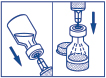
- 1. Remove both plastic protective caps from the vials. Draw all the water into a single-use syringe. Insert the needle into the rubber stopper (inside the marked circle) of the vial containing GlucaGen and inject all the solvent contained in the syringe into the vial.
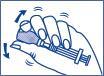
- 2. Without removing the needle from the vial, gently shake the vial until GlucaGen is completely dissolved and the solution appears clear.
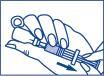
- 3. Make sure that the syringe plunger is fully pushed forward. Keeping the needle in the liquid, slowly draw all the solution into the syringe. Be careful not to let the plunger come out of the syringe. It is important to remove any air bubbles from the syringe:
- Holding the needle pointing upwards, tap the syringe with your fingers.
- Press the plunger slightly to release the air deposited at the top of the syringe. Continue pushing the plunger until it reaches the correct dose for the injection. A small amount of liquid will come out.
See How much to use.
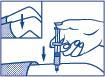
- 4. Inject the dose under the skin or into the muscle.
- 5. Turn the unconscious person onto their side to prevent choking.
- 6. As soon as they regain consciousness and if able to swallow, give the person a high-sugar snack such as candy, cookies, or fruit juice. A high-sugar snack will prevent another episode of low blood sugar.
After using GlucaGen, you or someone else should contact a doctor or healthcare professional.
It is important that you know why you had very low blood sugar and how to avoid
it happening again.
How much to use
The recommended dose is:
- Adults: inject the entire contents of the medicine (1 ml).
- Children under 8 years of age or over 8 years of age, but weighing less than 25 kg: inject half the contents of the medicine (0.5 ml).
- Children over 8 years of age or under 8 years of age, but weighing more than 25 kg: inject the entire contents of the medicine (1 ml)
If you use more GlucaGen than you should
Too much GlucaGen can cause nausea and prolonged vomiting.
Specific treatment is usually not necessary.
4. Possible side effects
Like all medicines, this medicine can cause side effects, although not everybody gets them.
The following side effects may occur with this medicine:
Immediately inform your doctor if you notice any of the following serious side effects:
Very rare:may affect up to 1 in 10,000 people
- allergic reaction -symptoms can include shortness of breath, sweating, rapid heartbeat, rash, swelling of the face and collapse. ► Talk to your doctor immediately,if you notice any of these serious side effects listed above.
Other side effects
Common: may affect up to 1 in 10 people
- Feeling unwell (nausea).
Uncommon:may affect up to 1 in 100 people
- Feeling unwell (vomiting).
Rare:may affect up to 1 in 1,000 people
- Stomach pain (abdominal pain).
Not known:frequency cannot be estimated based on available data
- reactions at the injection site
► If any of the side effects described above occur,including those not listed in this leaflet, tell your doctor.
Reporting of side effects
If you get any side effects, even those not listed in this leaflet, tell your doctor. You can also report side effects directly through the national reporting system for adverse reactions. By reporting side effects you can help to provide more information on the safety of this medicine.
5. How to store GlucaGen
- Keep this medicine out of the sight and reach of children.
- Store in a refrigerator(2°C to 8 °C).
- Store in the original packaging to protect from light.
- Do not freeze, to prevent damage to the product.
- Use immediately after mixing - do not store for subsequent use.
- Do not use this medicine after the expiry date - this is present on the label. The expiry date refers to the last day of the month indicated.
- Do not use the mixed solution if it has a gelatinous appearance or some of the powder has not dissolved correctly.
- Do not use if the plastic caps are loose or missing when you receive the packaging - return the package to the pharmacy.
- Do not dispose of any medicine in the drain or household waste. Ask your pharmacist how to dispose of medicines you no longer use. This will help protect the environment.
6. Contents of the pack and other information
What GlucaGen contains
- The active substance is glucagon 1 mg as hydrochloride, produced in yeast by recombinant DNA.
- The other ingredients are lactose monohydrate, water for injections, hydrochloric acid and/or sodium hydroxide (for pH adjustment).
Description of the appearance of GlucaGen and contents of the pack
GlucaGen is supplied as a sterile white powder of glucagon in a vial accompanied by a solvent
also contained in a vial. The powder is compact. Once mixed, the solution contains
glucagon 1 mg/ml.
It is supplied in packs of 1 x 1 mg and 10 x 1 mg. Not all pack sizes may be
marketed.
Marketing authorisation holder and manufacturer
Novo Nordisk A/S
Novo Allé
DK- 2880 Bagsv æ rd, Denmark
This medicinal product is authorised in the Member States of the European Economic Area and in the United Kingdom
(Northern Ireland) with the following names:
Austria, Belgium, Bulgaria, Croatia, Cyprus, Czech Republic, Denmark, Estonia, Finland, France,
Germany, Greece, Hungary, Iceland, Ireland, Italy, Latvia, Lithuania, Luxembourg, Malta, Netherlands,
Portugal, Slovakia, Slovenia, Spain, United Kingdom (Northern Ireland): GlucaGen
Norway and Sweden: Glucagon Novo Nordisk
7. Additional information for medical personnel
Medical personnel must consult all preceding sections before reading this additional information.
The medicine must be administered immediately after reconstitution, due to
the instability of GlucaGen in solution, and must not be administered by intravenous infusion.
Treatment of severe hypoglycemia
Administer by subcutaneous or intramuscular route. If the patient does not respond within 10 minutes, glucose must
be administered intravenously. When the patient has responded to treatment, carbohydrates must be
administered orally in order to restore hepatic glycogen reserves and prevent the
recurrence of hypoglycemia.
Diagnostic indications
When the procedure is completed, carbohydrates must be administered orally, if compatible with the
diagnostic procedure used. Remember that GlucaGen has an effect opposite to that of insulin. When
performing endoscopic or radiological investigations, pay particular attention when GlucaGen is
administered to diabetic patients or people with heart problems.
Gastrointestinal tract examination:
Doses range from 0.2 – 2 mg depending on the diagnostic technique used and the route of administration.
The dose used in diagnostic examinations to inhibit the motility of the stomach, the duodenal bulb, the
duodenum and the small intestine is 0.2 – 0.5 mg intravenously or 1 mg intramuscularly. The dose for
inhibiting the motility of the colon is 0.5 – 0.75 mg intravenously or 1–2 mg intramuscularly. The onset
of effect after an intravenous administration of 0.2 – 0.5 mg occurs within one minute and the duration
of the effect is between 5 and 20 minutes. The onset of effect after an intramuscular administration of 1 – 2 mg
occurs after 5 – 15 minutes and lasts for approximately 10 – 40 minutes.
Further adverse effects after use in diagnostic indications
Changes in blood pressure, tachycardia, hypoglycemia and hypoglycemic coma.
Other sources of information
More detailed information on this medicine is available on the website of the Italian Medicines Agency
GlucaGenHypoKit 1 mg
Powder and solvent for injectable solution
glucagon
Read this leaflet carefully before administering this medicine as it contains
important information for you.
- Keep this leaflet. You may need to read it again.
- If you have any questions, ask your doctor, pharmacist or nurse.
- This medicine has been prescribed for you only. Never give it to other people, even if they have the same symptoms as you, as it may be dangerous.
- If any side effects occur, including those not listed in this leaflet, ask your doctor. See section 4.
Contents of this leaflet:
- 1. What is GlucaGen HypoKit and what it is used for
- 2. What you need to know before using GlucaGen HypoKit
- 3. How to use GlucaGen HypoKit
- 4. Possible side effects
- 5. How to store GlucaGen HypoKit
- 6. Contents of the pack and other information
- 7. Additional information for medical personnel
1. What is GlucaGen HypoKit and what it is used for
GlucaGen contains the active substance “glucagon”.
GlucaGen HypoKit is for the immediate and emergency treatment of children and adults with diabetes who
use insulin. It is used when they lose consciousness (faint) due to a very low blood sugar level. This is called “severe hypoglycemia”. GlucaGen HypoKit is used when it is no longer
possible to take sugar orally.
Glucagon is a natural hormone, which has the opposite effect of insulin in the human body. It helps the
liver in converting glycogen into glucose (sugar). The glucose is then released into the
bloodstream – this causes an increase in blood sugar level.
For medical personnel:seesection 7.
2. What you need to know before using GlucaGen HypoKit
Important information
- Make sure that your family members, people you work with and all close friends are informed about GlucaGen HypoKit. Explain that, if you were to faint (lose consciousness), they should immediately use GlucaGen HypoKit.
- Show your family members and all close friends where you keep GlucaGen HypoKit and how to use it.
- They must act quickly - if you remain unconscious for a period of time it can be dangerous. It is important that they have received instructions and know how to use GlucaGen HypoKit before you need it.
- The syringe does not contain GlucaGen. Before the injection, always mix GlucaGen powder with the solvent inside the syringe. Inform your family members and close friends to follow the instructions in paragraph 3: How to use Glucagen HypoKit.
- Any GlucaGen that is mixed and not used must be thrown away.
- After using GlucaGen HypoKit, you or someone else must contact a doctor or healthcare professional. It is important that you find out why you had a very low blood sugar level and how to prevent it from happening again.
Do not use GlucaGen HypoKit if:
- you are allergic (hypersensitive) to glucagon or to any of the other ingredients of this medicine (listed in paragraph 6).
- you have a tumour of the adrenal gland.
Do not use GlucaGen HypoKit if any of these apply.
Warnings and precautions
Talk to your doctor, pharmacist or nurse before using GlucaGen HypoKit.
GlucaGen will not work properly if:
- you have been fasting for a long time
- you have low levels of adrenaline
- your low blood sugar level is caused by excessive alcohol consumption
- You have a tumour that releases glucagon or insulin.
If any of these apply, talk to your doctor or pharmacist.
Other medicines and GlucaGen
The following medicines can affect the way GlucaGen HypoKit works:
- insulin - used for the treatment of diabetes
- indometacin - used for the treatment of joint and rheumatic pains.
The following medicines can be affected by GlucaGen HypoKit:
- warfarin - used to prevent blood clots. GlucaGen may increase the anticoagulant effect of warfarin.
- beta blockers - used in the treatment of high blood pressure and irregular heartbeat. GlucaGen HypoKit may increase blood pressure and heart rate for a short period of time.
If any of the above applies (or you are not sure), talk to your doctor or pharmacist before
taking GlucaGen HypoKit.
Tell your doctor or pharmacistif you are taking, have recently taken or might take any other
medicines, including those available without a prescription.
Pregnancy and breastfeeding
If you are pregnant, suspect you are pregnant or are planning a pregnancy, or if you are breastfeeding with
breast milk, and experience a very low blood sugar level, GlucaGen HypoKit can be
used.
Ask your doctor or pharmacist for advice before taking any medicine if you are pregnant.
Driving and using machines
Before driving or using machines, wait until the effects of a low blood sugar level
have worn off.
GlucaGen contains sodium
GlucaGen contains less than 1 mmol of sodium (23 mg) per maximum dose (2 ml), which is equivalent to
essentially “sodium-free”.
3. How to use GlucaGen HypoKit
Use this medicine following the instructions in this leaflet or as directed by your doctor exactly. If you have any doubts, ask your doctor or pharmacist.
Preparation and administration of the injection
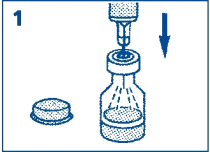
- 1. Remove the protective plastic caps from the vials. Remove the needle cap from the syringe. Do not remove the plastic support from the syringe. Insert the needle into the rubber stopper (inside the marked circle) of the vial containing GlucaGen and inject all the liquid contained in the syringe into the vial.
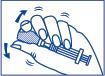
- 2. Without removing the needle from the vial, gently shake the vial until GlucaGen is completely dissolved and the solution appears clear.
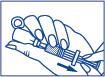
- 3. Make sure the syringe plunger is fully pushed forward. Keeping the needle in the liquid, slowly aspirate all the solution into the syringe. Be careful not to let the plunger come out of the syringe. It is important to remove any air bubbles from the syringe:
- Holding the needle pointing upwards, tap the syringe with your fingers.
- Press the plunger lightly to expel the air deposited at the top of the syringe.
Continue to push the plunger until it reaches the correct dose for the injection. A small amount of liquid will come out.
See below How much to use.
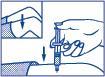
- 4.Inject the dose under the skin or into the muscle.
- 5.Turn the unconscious person onto their side to prevent choking.
- 6.As soon as they regain consciousness and if able to swallow, give the person a high-sugar snack such as candy, cookies, or fruit juice. A high-sugar snack will prevent a new episode of low blood sugar.
After using GlucaGen HypoKit, you or someone else must contact your doctor or healthcare provider. It is important that you know why you had very low blood sugar and how to prevent it from happening again.
How much to use
The recommended dose is:
- Adults: inject the entire contents of the medicine (1 ml)
- Children under 8 years of age or over 8 years of age but weighing less than 25 kg: inject half the contents of the medicine (0.5 ml).
- Children over 8 years of age or under 8 years of age but weighing more than 25 kg: inject the entire contents of the medicine (1 ml) - marked as “1” on the syringe.
If you use more GlucaGen than you should
Too much GlucaGen can cause nausea and prolonged vomiting. Specific treatment is usually not necessary.
4. Possible side effects
Like all medicines, this medicine can cause side effects, although not everybody gets them.
The following side effects may occur with this medicine:
Consult your doctor immediately if you notice any of these serious side effects:
Very rare:(may affect up to 1 in 10,000 people)
- Allergic reaction - signs may include shortness of breath, sweating, rapid heartbeat, skin rash, swelling of the face and collapse. ► Talk to your doctor immediately,if you notice any of these serious side effects listed above
Other side effects
Common:(may affect up to 1 in 10 people)
- Feeling unwell (nausea).
Uncommon:(may affect up to 1 in 100 people)
- Feeling unwell (vomiting).
Rare:(may affect up to 1 in 1,000 people)
- Stomach pain (abdominal pain).
Not known:frequency cannot be estimated based on the available data
- reactions at the injection site. ► If any of the side effects listed above occur, including those not listed in this leaflet, contact your doctor
Reporting of side effects
If you get any side effects, even those not listed in this leaflet, tell your
doctor. You can also report side effects directly through the national reporting system for
adverse reactions. By reporting side effects you can help provide more information on the
safety of this medicine.
5. How to store GlucaGen HypoKit
- Keep this medicine out of the sight and reach of children
- Store either:in a refrigerator(2°C to 8 °C), oroutside the refrigeratorbelow 25°C for up to 18 months within the expiry date
- Store in the original packaging to protect it from light
- Do not freeze, to prevent damage to the product
- Use immediately after mixing - do not store for subsequent use
- Do not use this medicine after the expiry date - this is stated on the label. The expiry date refers to the last day of the month indicated.
- Do not use the mixed solution if it has a gelatinous appearance or if some of the powder has not been correctly dissolved
- Do not use if the plastic caps are loose or missing when you receive the product - return the product to your pharmacy
- Do not dispose of any medicine in drain water or household waste. Ask your pharmacist how to dispose of medicines you no longer use. This will help protect the environment.
6. Contents of the pack and other information
What GlucaGen contains
- The active substance is glucagon 1 mg as hydrochloride, produced in yeast via recombinant DNA.
- The other ingredients are lactose monohydrate, water for injections, hydrochloric acid and/or sodium hydroxide (for pH adjustment).
Description of the appearance of GlucaGen and contents of the pack
GlucaGen is supplied as a sterile white powder of glucagon in a vial accompanied by a
solvent contained in a single-use syringe. The powder is compact. Once mixed, the solution
contains glucagon 1 mg/ml.
Marketing authorisation holder and manufacturer
Novo Nordisk A/S
Novo Allé
DK- 2880 Bagsv æ rd, Denmark
This medicinal product is authorised in the Member States of the European Economic Area and in the United Kingdom
(Northern Ireland) with the following names:
Austria, Belgium, Bulgaria, Croatia, Cyprus, Czech Republic, Denmark, Estonia, Finland, France,
Germany, Greece, Hungary, Iceland, Ireland, Italy, Latvia, Lithuania, Luxembourg, Malta, Netherlands,
Portugal, Slovakia, Slovenia, Spain, United Kingdom (Northern Ireland): GlucaGen
Norway and Sweden: Glucagon Novo Nordisk
7. Further information for healthcare professionals
Healthcare professionals must consult all previous sections before reading this additional information.
The medicine must be administered immediately after reconstitution due to the instability of GlucaGen in solution and must not be administered by intravenous infusion.
Do not attempt to replace the cap on the syringe needle used. Place the used syringe inside the
orange box and as soon as possible dispose of the used needle in a sharps container.
Treatment of severe hypoglycemia
Administer subcutaneously or intramuscularly. If the patient does not respond within 10 minutes, glucose must
be administered intravenously. When the patient has responded to treatment, carbohydrates must be
administered orally to restore liver glycogen stores and prevent the recurrence of hypoglycemia.
Diagnostic indications
When the procedure is finished, carbohydrates should be administered orally, if compatible with the
diagnostic procedure used. Remember that GlucaGen has an opposite effect to that of insulin. When
undergoing endoscopic or radiological investigations, pay particular attention when GlucaGen is
administered to diabetic patients or to people with heart problems.
Note that a syringe with a thinner needle and finer graduation may be more suitable for use in
diagnostic indications.
Examination of the gastrointestinal tract:
Doses range from 0.2 – 2 mg depending on the diagnostic technique used and the route of administration.
The dose used in diagnostic tests to inhibit the motility of the stomach, duodenum, small intestine and
small bowel is 0.2 – 0.5 mg intravenously or 1 mg intramuscularly. The dose to inhibit the motility of the
colon is 0.5 – 0.75 mg intravenously or 1–2 mg intramuscularly. The onset of effect after an intravenous
administration of 0.2 - 0.5 mg occurs within one minute and the duration of effect is 5 – 20 minutes. The
onset of effect after an intramuscular administration of 1 – 2 mg occurs after 5 – 15 minutes and lasts for
approximately 10 – 40 minutes.
Further side effects after use in diagnostic indications.
Changes in blood pressure, tachycardia, hypoglycemia and hypoglycemic coma.
This leaflet was updated MM/YYYY
Other sources of information
More detailed information on this medicine is available on the website of the Italian Medicines Agency

Не уверены, подходит ли вам это лекарство?
Обсудите симптомы и варианты лечения с врачом онлайн.

Уже начали прием и появились вопросы?
Обсудите свое состояние и дальнейшие шаги с врачом онлайн.

- Страна регистрации
- Форма выпускаPowder and solvent for injectable solution, 1 MG
- Код АТХH04AA01
- Действующее вещество
- Отпускается по рецептуДа
- Производитель
- Информация на этой странице носит справочный характер и не является медицинской консультацией. Перед началом приема лекарства обязательно проконсультируйтесь с врачом.
- Аналоги LUKAJENФорма выпуска: Nasal powder, 3 MGДействующее вещество: глюкагонаПроизводитель: AMPHASTAR FRANCE PHARMACEUTICALS SASОтпускается по рецепту
Аналоги LUKAJEN в других странах
Лекарства с тем же действующим веществом, доступные в других странах.
Аналог LUKAJEN в Польша
Аналог LUKAJEN в Украина
Аналог LUKAJEN в Испания
Врачи онлайн по LUKAJEN
Обсудите применение LUKAJEN и возможные следующие шаги — по оценке врача.


Получите рецепт на LUKAJEN онлайн
Заполните форму за 2 минуты
Расскажите о симптомах, истории болезни и нужном препарате.
Выберите врача или мы назначим
Выберите специалиста или мы подберём ближайшего доступного врача.
Врач рассматривает ваш случай
Обычно в течение 30 минут. Может задать уточняющие вопросы в чате.
Получите в любой аптеке
Электронный рецепт отправляется на вашу почту — действителен по всей Польше.
Часто задаваемые вопросы
LUKAJEN требует рецепта в Италия. Вы можете уточнить у врача онлайн, подходит ли это лекарство для вашей ситуации.
Действующее вещество LUKAJEN — глюкагона. Эта информация помогает определить лекарства с тем же составом под другими торговыми названиями.
LUKAJEN производится компанией NOVO NORDISK A/S. Упаковка и торговое название могут отличаться в зависимости от дистрибьютора.
Врачи, включая Семейные врачи, Психиатры, Дерматологи, Кардиологи, Эндокринологи, Гастроэнтерологи, Пульмонологи, Нефрологи, Ревматологи, Гематологи, Инфекционисты, Аллергологи, Гериатры, Педиатры, Онкологи, могут оценить целесообразность применения LUKAJEN с учетом вашей ситуации и местных правил. Вы можете записаться на онлайн-консультацию, чтобы обсудить возможные варианты.
Польша имеет хорошо развитую систему здравоохранения в крупных городах, таких как Варшава, Краков, Вроцлав и Гданьск. Аптеки широко доступны и работают в соответствии с действующим законодательством, обеспечивая доступ к рецептурным препаратам.
Вы можете купить LUKAJEN в Варшаве, Кракове, Вроцлаве или Гданьске в любой аптеке при наличии действующего рецепта.
Чтобы получить рецепт, вы можете воспользоваться Oladoctor:
Другие лекарства с тем же действующим веществом (глюкагона) включают BAQSIMI. Они могут отличаться торговым названием или формой выпуска, но содержат одинаковый терапевтический компонент. Перед изменением лечения рекомендуется проконсультироваться с врачом.
