



FLUIBRON 15 мг/5 мл Сироп

Рассмотрение рецепта онлайн
Врач рассмотрит ваш случай и примет решение о назначении рецепта, если это медицински оправдано.

Поговорите с врачом об этом лекарстве
Обсудите симптомы и возможные дальнейшие шаги на онлайн-консультации.



Инструкция по применению FLUIBRON
Содержание инструкции
- FLUIBRON 7.5 mg/ml oral solution or for nebulisation
- FLUIBRON 15 mg/5 ml syrup, Adults 30 mg granules for oral suspension
- FLUIBRON 15 mg/2 ml solution for nebulization
- FLUIBRON 15 mg/2 ml solution for nebulisation
FLUIBRON 7.5 mg/ml oral solution or for nebulisation
Ambroxol hydrochloride
Read this leaflet carefully before taking this medicine as it contains important information for you.
Always take this medicine exactly as described in this leaflet, or as your doctor or pharmacist has told you.
- Keep this leaflet. You may need to read it again.
- If you would like more information or advice, ask your pharmacist.
- If any side effects occur, including any not listed in this leaflet, tell your doctor or pharmacist. See section 4.
- See a doctor if you do not feel better or if your symptoms worsen after a short period of time.
Contents of this leaflet:
- 1. What FLUIBRON is and what it is used for
- 2. What you need to know before you take FLUIBRON
- 3. How to take FLUIBRON
- 4. Possible side effects
- 5. How to store FLUIBRON
- 6. Contents of the pack and other information
1. What is FLUIBRON and what is it used for
FLUIBRON contains ambroxol, an active ingredient belonging to the class of mucolytics, which
acts by making mucus more fluid and therefore more easily eliminated.
FLUIBRON is used in patients with acute and chronic respiratory diseases
characterized by dense and viscous mucus.
2. What you need to know before you take FLUIBRON
Do not take FLUIBRON if:
- you are allergic to ambroxol or to any of the other ingredients of this medicine (listed in section 6);
- you have severe liver and/or kidney disease.
Do not use FLUIBRON in children under 2 years of age.
Warnings and precautions
Talk to your doctor or pharmacist before taking FLUIBRON:
- if you have stomach lesions (peptic ulcer);
- if you have mild or moderate kidney impairment;
- during the first three months of pregnancy or if you are breastfeeding.
PAY ATTENTION:
Cases of severe skin reactions associated with the administration of ambroxol have been reported.
If you develop a skin rash (including lesions of mucous membranes such as mouth, throat, nose,
eyes, genitals), stop taking FLUIBRON and consult your doctor immediately;
- if you have asthma, before taking FLUIBRON by inhalation (with an aerosol device), you should use your inhaler (bronchodilator) to avoid possible breathing difficulties.
Children
Do not use FLUIBRON in children under 2 years of age, as mucolytics can create
obstruction of the airways (bronchi).
Other medicines and FLUIBRON
Tell your doctor or pharmacist if you are taking, have recently taken or might take
any other medicine.
Pregnancy and breastfeeding
Do not take FLUIBRON during the first three months of pregnancy or if you are breastfeeding with
breast milk, without first consulting your doctor.
Driving and using machines
FLUIBRON does not impair the ability to drive vehicles and operate machinery.
Excipients with known effects
FLUIBRON oral or nebulizer solution contains
- methylparahydroxybenzoate and propylparahydroxybenzoate: may cause allergic reactions (including delayed ones) and, if taken by inhalation, exceptionally bronchospasm;
- sodium: this medicine contains less than 1 mmol (23 mg) of sodium per dose, i.e. it is practically ‘sodium-free’.
3. How to take FLUIBRON
Take this medicine following exactly what is reported in this leaflet or the instructions of your doctor or pharmacist. If you have doubts, consult your doctor or pharmacist.
If you take FLUIBRON orally (by mouth)
Adults:2 - 4 ml (15-30 mg), 3 times a day.
Children from 2 to 5 years of age: 0.5 - 1 ml (3.75-7.5 mg), 2 - 3 times a day.
Children over 5 years: 1 - 2 ml (7.5-15 mg), 2 - 3 times a day.
If you take FLUIBRON by inhalation (with an aerosol device)
Adults: 2 - 3 ml, 1 - 2 times a day.
Children from 2 to 5 years of age: 2 ml, 1 - 2 times a day.
Children over 5 years: 2-3 ml, 1 - 2 times a day.
Method of administration
If you take FLUIBRON orally (by mouth), use the dropper and measuring cup to take the correct dose of medicine. Dilute the dose in a little water or other liquids such as tea, milk or fruit juices.
If you take FLUIBRON by inhalation
This medicine must be nebulized (transformed into very small droplets) by means of an “aerosol device”, equipped with devices for administration through the mouth and/or nose.
Use the dropper or measuring cup to take the correct dose of medicine. Pour the dose into the ampoule of the “aerosol device” and take the medicine by breathing normally through the mouth and/or nose. Breathing too deeply may cause coughing; to reduce this risk, it may be useful to warm the ampoule containing the medicine to body temperature before nebulizing it.
Do not exceed the recommended doses.
Consult your doctor if the disorder occurs repeatedly or if you notice any recent change in its characteristics.
If you take more FLUIBRON than you shouldthe risk of having undesirable effects increases. In case of accidental ingestion/intake of an excessive dose of FLUIBRON, immediately inform your doctor or go to the nearest hospital.
If you forget to take FLUIBRON
Do not take a double dose to make up for the forgotten dose.
4. Possible side effects
Like all medicines, this medicine can cause side effects, although not everybody gets them.
Stop taking FLUIBRON immediately and contact your doctor if any of the following
conditions occur: itching, skin rashes (urticaria, skin rash), swelling (angioedema) of the face,
eyes, lips and/or throat with difficulty breathing, due to allergy (hypersensitivity).
Tell your doctor if you notice:
Common side effects(may affect up to 1 in 10 people)
alteration or decrease in the sense of taste (dysgeusia), decreased sensitivity (hypoesthesia)
of the mouth and pharynx (oral cavity), nausea.
Uncommon side effects(may affect up to 1 in 100 people)
vomiting, diarrhea, indigestion (dyspepsia), abdominal pain, dry mouth.
Rare side effects(may affect up to 1 in 1,000 people)
headache; hypersensitivity reactions; rash, urticaria.
Side effects with unknown frequency(frequency cannot be estimated based on available
data)
obstruction of the airways (bronchi); dry throat; anaphylactic reactions including anaphylactic
shock, angioedema (rapid swelling of the skin, subcutaneous tissues, mucosa and submucosal
tissues) and itching; severe skin adverse reactions (including erythema multiforme, Stevens-Johnson
syndrome/toxic epidermal necrolysis and acute generalized exanthematous pustulosis).
Reporting of side effects
If you get any side effects, talk to your doctor, pharmacist or nurse. You can also report side
effects directly through the national reporting system at
“ https://www.aifa.gov.it/content/segnalazioni-reazioni-avverse ”. By reporting side effects you
can help provide more information on the safety of this medicine.
5. How to store FLUIBRON
Keep this medicine out of the sight and reach of children.
This medicine does not require any particular storage temperature.
Do not use this medicine after the expiry date which is reported on the pack after the words
EXP. The expiry date refers to the last day of that month. This date applies to the
product in intact packaging, correctly stored.
Do not dispose of any medicine in wastewater or household waste. Ask your pharmacist how to
dispose of medicines you no longer use. This will help protect the environment.
6. Contents of the pack and other information
What FLUIBRON contains
The active ingredient is: ambroxol hydrochloride.
1 ml of solution contains 7.5 mg of ambroxol hydrochloride.
The other ingredients are: sodium chloride, methyl parahydroxybenzoate, propyl parahydroxybenzoate,
purified water.
Description of the appearance of FLUIBRON and contents of the pack
FLUIBRON oral or nebulizer solution is available in a 40 ml bottle of solution equipped
with a dropper and measuring cup.
Marketing Authorisation Holder
CHIESI FARMACEUTICI S.p.A. - Via Palermo, 26/A – Parma
Manufacturer
ISTITUTO DE ANGELI S.r.l. - Loc. Prulli, 103/C - Reggello (FI)
CHIESI FARMACEUTICI S.p.A. - Officine di Parma, Via San Leonardo 96
FLUIBRON 15 mg/5 ml syrup, Adults 30 mg granules for oral suspension
Ambroxol hydrochloride
Read this leaflet carefully before taking this medicine as it contains important information for you.
Always take this medicine exactly as described in this leaflet or as your doctor or pharmacist has told you.
- Keep this leaflet. You may need to read it again.
- If you want more information or advice, ask your pharmacist.
- If any side effects occur, including those not listed in this leaflet, tell your doctor or pharmacist. See section 4.
- See a doctor if you do not feel better or if your symptoms worsen after a short period of time.
Contents of this leaflet:
- 1. What FLUIBRON is and what it is used for
- 2. What you need to know before you take FLUIBRON
- 3. How to take FLUIBRON
- 4. Possible side effects
- 5. How to store FLUIBRON
- 6. Contents of the pack and other information
1. What is FLUIBRON and what is it used for
FLUIBRON contains ambroxol, an active ingredient belonging to the class of mucolytics, which
works by making mucus more fluid and therefore more easily eliminated.
FLUIBRON is used in patients with acute respiratory diseases characterized by thick and viscous mucus.
2. What you need to know before you take FLUIBRON
Do not take FLUIBRON if:
- you are allergic to ambroxol or to any of the other ingredients of this medicine (listed in section 6);
- you have severe liver and/or kidney disease.
Do not use FLUIBRON in children under 2 years of age.
Warnings and precautions
Talk to your doctor or pharmacist before taking FLUIBRON:
- if you have stomach lesions (peptic ulcer);
- if you have mild or moderate kidney impairment;
- during the first three months of pregnancy or if you are breastfeeding.
PAY ATTENTION:
Cases of severe skin reactions associated with the administration of ambroxol have been reported. If
you develop a skin rash (including lesions of mucous membranes such as mouth, throat, nose, eyes,
genitals), stop taking FLUIBRON and consult your doctor immediately.
Children
Do not use FLUIBRON in children under 2 years of age, as mucolytics can cause
obstruction of the airways (bronchi).
Other medicines and FLUIBRON
Tell your doctor or pharmacist if you are taking, have recently taken or might take
any other medicine.
Pregnancy and breastfeeding
If you are pregnant, suspect you are pregnant, are planning to become pregnant or are breastfeeding
with breast milk, ask your doctor for advice before taking this medicine. Do not take
FLUIBRON during the first three months of pregnancy, or if you are breastfeeding with breast milk, without
first consulting your doctor.
Driving and operating machinery
FLUIBRON does not impair the ability to drive vehicles and operate machinery.
Excipients with known effects
FLUIBRON oral suspension granules contains
- sorbitol: this medicine contains 2,878.08 mg of sorbitol per sachet. Sorbitol is a source of fructose. If your doctor has told you that you are intolerant to some sugars, or if you have a diagnosis of hereditary fructose intolerance, a rare genetic disease in which patients are unable to metabolize fructose, talk to your doctor before taking this medicine. It may cause gastrointestinal problems and have a mild laxative effect.
- azo dye (E110 yellow orange S): may cause allergic reactions.
- sodium saccharin: this medicine contains less than 1mmol (23mg) of sodium per sachet, i.e. it is essentially sodium-free.
FLUIBRON syrup contains:
- sorbitol: this medicine contains 3,000 mg of sorbitol per 10 ml dose. Sorbitol is a source of fructose. If your doctor has told you that you are intolerant to some sugars, or if you have a diagnosis of hereditary fructose intolerance, a rare genetic disease in which patients are unable to metabolize fructose, talk to your doctor before taking this medicine. It may cause serious gastrointestinal problems and have a mild laxative effect
- this medicine contains 750 mg of sorbitol per 2.5 ml dose and 1,500 mg of sorbitol per 5 ml dose. Sorbitol is a source of fructose. If your doctor has told you that the child is intolerant to some sugars, or if you have a diagnosis of hereditary fructose intolerance, a rare genetic disease in which patients are unable to metabolize fructose, talk to your doctor before the child takes this medicine. It may cause gastrointestinal problems and have a mild laxative effect.
- benzoic acid: this medicine contains 1.3 mg/ml of benzoic acid.
3. How to take FLUIBRON
Take this medicine following exactly the instructions in this leaflet or as directed by your doctor or pharmacist. If you have any doubts, ask your doctor or pharmacist.
Adults
FLUIBRON granules for oral suspension
The initial dose is 1 sachet 3 times a day; the maintenance dose is 1 sachet 2 times a day.
FLUIBRON syrup
The initial dose is 10 ml of syrup 3 times a day, unless otherwise indicated by your doctor; subsequently 5 ml 3 times a day.
Children
Use only FLUIBRON syrup.
Children from 2 to 5 years: the dose is 2.5 ml of syrup, 3 times a day, unless otherwise indicated by the doctor.
Children over 5 years: the dose is 5 ml of FLUIBRON syrup, 3 times a day, unless otherwise indicated by the doctor.
Do not exceed the recommended doses.
Method of administration
Take FLUIBRON by mouth (oral use), as follows:
- granules for oral suspension: take the granules by dissolving them in water;
- syrup: use the measuring cup with graduated markings at 10 ml, 5 ml and 2.5 ml, which you will find in the package, to take the correct dose.
Consult your doctor if the disorder occurs repeatedly or if you notice any recent change in its characteristics.
If you take more FLUIBRON than you shouldthe risk of side effects increases. In case of accidental ingestion/taking of an excessive dose of FLUIBRON, immediately inform your doctor or go to the nearest hospital.
If you forget to take FLUIBRON
Do not take a double dose to make up for the forgotten dose.
4. Possible side effects
Like all medicines, this medicine can cause side effects, although not everybody gets them.
Stop taking FLUIBRON immediately and contact your doctor if any of the following conditions occur:
itching, skin spots (urticaria, skin rash), swelling (angioedema) of the face, eyes, lips and/or throat with
difficulty breathing, due to allergy (hypersensitivity).
Tell your doctor if you notice:
Common side effects(may affect up to 1 in 10 people)
alteration or decrease in the sense of taste (dysgeusia), decreased sensitivity (hypoesthesia)
of the mouth and pharynx (oral cavity), nausea.
Uncommon side effects(may affect up to 1 in 100 people)
vomiting, diarrhea, indigestion (dyspepsia), abdominal pain, dry mouth.
Rare side effects(may affect up to 1 in 1,000 people)
headache; hypersensitivity reactions; rash, urticaria.
Side effects with unknown frequency(frequency cannot be estimated based on available data)
obstruction of the airways (bronchi); dry throat; anaphylactic reactions including anaphylactic shock,
angioedema (rapid swelling of the skin, subcutaneous tissues, mucosa and submucosal tissues) and
itching; severe skin adverse reactions (including erythema multiforme, Stevens-Johnson syndrome/toxic
epidermal necrolysis and acute generalized exanthematous pustulosis).
Reporting of side effects
If you get any side effects, talk to your doctor, pharmacist or nurse. You can also report side effects
directly through the national reporting system at “
https://www.aifa.gov.it/content/segnalazioni-reazioni-avverse ”. By reporting side effects you can
help provide more information on the safety of this medicine.
5. How to store FLUIBRON
Keep this medicine out of the sight and reach of children.
This medicine does not require any particular storage temperature.
Do not use this medicine after the expiry date which is reported on the pack after the words
EXP. The expiry date refers to the last day of that month. This date applies to the
product in intact packaging, correctly stored.
Do not dispose of any medicine in the wastewater or household waste. Ask your pharmacist how to
dispose of medicines you no longer use. This will help protect the environment.
6. Contents of the pack and other information
What FLUIBRON contains
The active ingredient is: ambroxol hydrochloride.
FLUIBRON granules for oral suspension
One sachet contains 30 mg of ambroxol hydrochloride.
The other ingredients are: Orange granular on sorbitol (sorbitol, orange flavour and yellow
orange S (E110)), mannitol, citric acid monohydrate, glycine, gum arabic, sodium saccharin,
anhydrous colloidal silica.
FLUIBRON syrup
1 ml contains 3 mg of ambroxol hydrochloride.
The other ingredients are: Sorbitol solution 70% non-crystallizing, glycerol, citric acid
monohydrate, benzoic acid sucralose, natural raspberry flavour, purified water.
Description of the appearance of FLUIBRON and contents of the pack
FLUIBRON syrup is available in 200 ml bottles equipped with a measuring cup with graduated markings at
10 ml, 5 ml and 2.5 ml and a child-resistant cap.
FLUIBRON granules for oral suspension are available in packs containing 30 or 60 sachets.
Marketing Authorisation Holder
CHIESI FARMACEUTICI S.p.A. - Via Palermo, 26/A – Parma
Manufacturer
Sachets: CHIESI FARMACEUTICI S.p.A. - Officina di Parma, Via S. Leonardo 96
Syrup: ZETA FARMACEUTICI S.p.A. –Via Galvani 10 - Sandrigo (VI)
Alternative manufacturers (sachets)
LAMP SAN PROSPERO S.p.A. - Via della pace 25/A - S. Prospero (MO)
Fine Foods & Pharmaceuticals N.T.M. S.p.A. - Via Grignano, 43- Brembate (BG)

Не уверены, подходит ли вам это лекарство?
Обсудите симптомы и варианты лечения с врачом онлайн.
FLUIBRON 15 mg/2 ml solution for nebulization
Ambroxol hydrochloride
Read this leaflet carefully before you start to take this medicine as it contains
important information for you.
Always take this medicine exactly as described in this leaflet or as your doctor or
pharmacist has told you.
- Keep this leaflet. You may need to read it again.
- If you want more information or advice, ask your pharmacist.
- If any side effects occur, including those not listed in this leaflet, tell your doctor or pharmacist. See section 4.
- Talk to your doctor if you do not feel better or if you feel worse after a short time.
Contents of this leaflet:
- 1. What FLUIBRON is and what it is used for
- 2. What you need to know before you take FLUIBRON
- 3. How to take FLUIBRON
- 4. Possible side effects
- 5. How to store FLUIBRON
- 6. Contents of the pack and other information
1. What is FLUIBRON and what is it used for
FLUIBRON contains ambroxol, an active ingredient belonging to the class of mucolytics, which
acts by making mucus more fluid and therefore more easily eliminated.
FLUIBRON is used in patients with acute and chronic diseases of the respiratory tract
characterized by thick and viscous mucus.
2. What you need to know before you take FLUIBRON
Do not take FLUIBRON if:
- you are allergic to ambroxol or to any of the other ingredients of this medicine (listed in section 6);
- you have severe liver and/or kidney disease;
- you are in the first three months of pregnancy.
Do not use FLUIBRON in children under 2 years of age.
Warnings and precautions
Talk to your doctor or pharmacist before taking FLUIBRON if:
- you have stomach lesions (peptic ulcer);
- you have mild or moderate kidney dysfunction;
- you are breastfeeding.
PAY ATTENTION:
- Cases of severe skin reactions associated with the administration of ambroxol have been reported. If you develop a skin rash (including lesions of mucous membranes such as mouth, throat, nose, eyes, genitals), stop taking FLUIBRON and consult your doctor immediately;
- if you have asthma, before taking FLUIBRON via inhalation (with an aerosol device), you should use your inhaler (bronchodilator) to avoid possible breathing difficulties.
Children
Do not use FLUIBRON in children under 2 years of age, as mucolytics may create
obstruction of the airways (bronchi).
Other medicines and FLUIBRON
Tell your doctor or pharmacist if you are taking, have recently taken or might take
any other medicines.
Pregnancy and breastfeeding
If you are pregnant, suspect you may be pregnant or are planning to become pregnant, or if you are breastfeeding
ask your doctor for advice before taking this medicine.
Do not take FLUIBRON during the first three months of pregnancy.
If you are breastfeeding, do not take FLUIBRON without first consulting your doctor.
Driving and operating machinery
FLUIBRON does not impair the ability to drive vehicles and operate machinery.
FLUIBRON contains:sodium.
This medicine contains less than 1 mmol (23 mg) of sodium per dose, i.e. it is practically ‘sodium-free’.
3. How to take FLUIBRON
Take this medicine following exactly as indicated in this leaflet or as instructed by your doctor or pharmacist. If you have doubts, consult your doctor or pharmacist.
Adults
1 single-dose container, 2 times a day.
Children
Children from 2 to 5 years of age: half or 1 single-dose container, 1-2 times a day.
Children over 5 years: 1 single-dose container, 2 times a day.
The doctor may also advise you to use half a container. Do not exceed the recommended doses.
Method of administration
This medicine must be nebulized (transformed into very small droplets) using an
“aerosol device” equipped with devices for oral and/or nasal administration.
Take the medicine by breathing normally through the mouth and/or nose. To take half a
dose, use the graduation on the container. The prescribed dose may be diluted
by adding the same amount of distilled water (1:1 ratio) into the nebulizer ampoule.
Breathing too deeply may cause coughing; to reduce this risk, it may be helpful
to warm the ampoule containing the medicine to body temperature before nebulizing it.
To use this medicine correctly, consult the section “Instructions for use of FLUIBRON”.
Consult your doctor if the disorder occurs repeatedly or if you notice any recent change
in its characteristics.
If you take more FLUIBRON than you shouldthe risk of adverse effects increases. In case
of accidental ingestion/administration of an excessive dose of FLUIBRON, immediately
inform your doctor or go to the nearest hospital.
If you forget to take FLUIBRON
Do not take a double dose to make up for the missed dose.
4. Possible side effects
Like all medicines, this medicine can cause side effects, although not everybody gets them.
Stop taking FLUIBRON immediately and contact your doctor if any of the following occur:
itching, skin rashes (urticaria, skin rash), swelling (angioedema) of the face, eyes, lips and/or
throat with difficulty breathing, due to allergy (hypersensitivity).
Tell your doctor if you notice:
Common side effects(may affect up to 1 in 10 people)
alteration or decrease in the sense of taste (dysgeusia), decrease in sensitivity (hypoesthesia)
of the mouth and pharynx (oral cavity), nausea.
Uncommon side effects(may affect up to 1 in 100 people)
vomiting, diarrhea, indigestion (dyspepsia), abdominal pain, dry mouth.
Rare side effects(may affect up to 1 in 1,000 people)
headache; hypersensitivity reactions; rash, urticaria.
Side effects with unknown frequency(frequency cannot be estimated based on available
data)
obstruction of the airways (bronchi); dry throat; anaphylactic reactions including anaphylactic
shock, angioedema (rapid swelling of the skin, subcutaneous tissues, mucosa and submucosal
tissues) and itching; severe skin adverse reactions (including erythema multiforme, Stevens-
Johnson syndrome/toxic epidermal necrolysis and acute generalized exanthematous pustulosis).
Reporting of side effects
If you get any side effects, talk to your doctor, pharmacist or nurse. You can also report side effects
directly through the national reporting system at
http://www.agenziafarmaco.gov.it/content/come-segnalare-una-sospetta-reazione-avversa .
By reporting side effects you can help provide more information on the safety of this medicine.
5. How to store FLUIBRON
Keep this medicine out of the sight and reach of children.
Store the single-dose containers inside the protective sachet, to protect the medicine from
light.
In case of using half a dose, the resealed container must be stored at a temperature
between 2 C and 8 C (in a refrigerator) and the remaining quantity must be used within 12 hours
of the first opening.
Do not use this medicine after the expiry date which is stated on the pack after the words
EXP. The expiry date refers to the last day of that month. This date applies to the
product in intact packaging, correctly stored.
Do not dispose of any medicine in wastewater or household waste. Ask your pharmacist how to
dispose of medicines you no longer use. This will help protect the environment.
6. Package Contents and Other Information
What FLUIBRON contains
The active ingredient is: ambroxol hydrochloride.
A 2 ml single-dose container contains 15 mg of ambroxol hydrochloride.
The other ingredients are: sodium chloride, water for injections.
Description of the appearance of FLUIBRON and package contents
FLUIBRON solution for nebulisation is available in packs of 10, 15 and 20 single-dose
containers, each containing 2 ml.
Marketing Authorisation Holder
CHIESI FARMACEUTICI S.p.A. - Via Palermo, 26/A – Parma
Manufacturer
CHIESI FARMACEUTICI S.p.A. - Via San Leonardo, 96 – Parma
By scanning the QR code on the outer packaging with a smartphone,
you can access the video on the authorised instructions for use.
The same information is also available at the following URL:
https ://videoistruzioniduso.chiesi.it/F15
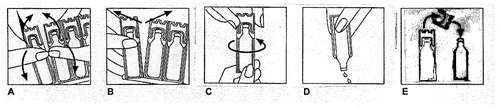
INSTRUCTIONS FOR USE OF FLUIBRON FOR NEBULISER
Before use, carefully read the following instructions, which tell you what to do and what to
pay attention to.
To use, perform the following operations:
Figure A Bend the single-dose container in both directions.
Figure B Detach the single-dose container from the strip first above and then in the centre.
Figure C Open the single-dose container by rotating the tab in the direction indicated by the arrow.
Figure D By applying moderate pressure to the walls of the single-dose container, release
the solution in the prescribed amount and introduce it into the nebuliser ampoule
(nebuliser device).
Figure E If you use half a dose, the container can be resealed by inverting and pressing the
cap.
The resealed container must be stored in the refrigerator, at a temperature between
2 C and 8 C, and the remaining quantity must be used within 12 hours of first
opening.
FLUIBRON 15 mg/2 ml solution for nebulisation
Ambroxol hydrochloride
Read this leaflet carefully before you start to take this medicine as it contains important information for you.
Always take this medicine exactly as described in this leaflet or as your doctor or pharmacist has told you.
- Keep this leaflet. You may need to read it again.
- If you want more information or advice, ask your pharmacist.
- If you get any side effects, even if not listed in this leaflet, tell your doctor or pharmacist. See section 4.
- Talk to your doctor if you do not feel better or if you feel worse after a short time.
Contents of this leaflet:
- 1. What FLUIBRON is and what it is used for
- 2. What you need to know before you take FLUIBRON
- 3. How to take FLUIBRON
- 4. Possible side effects
- 5. How to store FLUIBRON
- 6. Contents of the pack and other information
1. What is FLUIBRON and what is it used for
FLUIBRON contains ambroxol, an active ingredient belonging to the class of mucolytics, which
acts by making mucus more fluid and therefore more easily eliminated.
FLUIBRON is used in patients with acute and chronic respiratory diseases
characterized by dense and viscous mucus.
2. What you need to know before you take FLUIBRON
Do not take FLUIBRON if:
- you are allergic to ambroxol or to any of the other ingredients of this medicine (listed in section 6);
- you have severe liver and/or kidney disease;
- you are in the first three months of pregnancy.
Do not use FLUIBRON in children under 2 years of age.
Warnings and precautions
Talk to your doctor or pharmacist before taking FLUIBRON if:
- you have stomach lesions (peptic ulcer);
- you have mild or moderate kidney impairment;
- you are breastfeeding.
PAY ATTENTION:
- Cases of severe skin reactions associated with the administration of ambroxol have been reported. If you develop a skin rash (including lesions of mucous membranes such as mouth, throat, nose, eyes, genitals), stop taking FLUIBRON and consult your doctor immediately;
- if you have asthma, before taking FLUIBRON via inhalation (with an aerosol device), you should use your inhaler (bronchospasmolytic) to avoid possible breathing difficulties.
Children
Do not use FLUIBRON in children under 2 years of age, as mucolytics can create
obstruction of the airways (bronchi).
Other medicines and FLUIBRON
Tell your doctor or pharmacist if you are taking, have recently taken or might take
any other medicines.
Pregnancy and breastfeeding
If you are pregnant, suspect you are pregnant or are planning a pregnancy, or if you are breastfeeding
with breast milk, ask your doctor for advice before taking this medicine.
Do not take FLUIBRON during the first three months of pregnancy.
If you are breastfeeding, do not take FLUIBRON without first consulting your doctor.
Driving and operating machinery
FLUIBRON does not impair the ability to drive vehicles and operate machinery.
FLUIBRON contains:sodium.
This medicine contains less than 1 mmol (23 mg) of sodium per dose, i.e. it is practically ‘sodium-free’.
3. How to take FLUIBRON
Take this medicine following exactly as indicated in this leaflet, or as instructed by your doctor or pharmacist. If you have any doubts, consult your doctor or pharmacist.
Adults
1 single-dose container, 2 times a day.
Children
Children from 2 to 5 years of age: half or 1 single-dose container, 1-2 times a day.
Children over 5 years: 1 single-dose container, 2 times a day.
The doctor may also advise you to use half a container. Do not exceed the recommended doses.
Method of administration
This medicine must be nebulized (transformed into very small droplets) using an
“aerosol device” equipped with devices for oral and/or nasal administration.
Take the medicine by breathing normally through your mouth and/or nose. To take half the
dose, use the graduation on the container. The prescribed dose may be diluted
by adding the same amount of distilled water (1:1 ratio) into the nebulizer ampoule.
Breathing too deeply may cause coughing; to reduce this risk, it may be helpful
to warm the ampoule containing the medicine to body temperature before nebulizing it.
To use this medicine correctly, consult the section “Instructions for use of FLUIBRON”.
Consult your doctor if the disorder recurs or if you notice any recent change
in its characteristics.
If you take more FLUIBRON than you shouldthe risk of adverse effects increases. In case
of accidental ingestion/intake of an excessive dose of FLUIBRON, immediately inform
your doctor or go to the nearest hospital.
If you forget to take FLUIBRON
Do not take a double dose to make up for the missed dose.
4. Possible side effects
Like all medicines, this medicine can cause side effects, although not everybody gets them.
Stop taking FLUIBRON immediately and contact your doctor if any of the following
conditions occur: itching, skin lesions (urticaria, skin rash), swelling (angioedema) of the
face, eyes, lips and/or throat with difficulty breathing, due to allergy (hypersensitivity).
Tell your doctor if you notice:
Common side effects(may affect up to 1 in 10 people)
alteration or decrease in the sense of taste (dysgeusia), decrease in sensitivity (hypoesthesia)
of the mouth and pharynx (oral cavity), nausea.
Uncommon side effects(may affect up to 1 in 100 people)
vomiting, diarrhea, indigestion (dyspepsia), abdominal pain, dry mouth.
Rare side effects(may affect up to 1 in 1,000 people)
headache; hypersensitivity reactions; rash, urticaria.
Side effects with unknown frequency(frequency cannot be estimated based on available
data)
obstruction of the airways (bronchi); dry throat; anaphylactic reactions including anaphylactic
shock, angioedema (rapid swelling of the skin, subcutaneous tissues, mucosa and submucosal
tissues) and itching; severe skin adverse reactions (including erythema multiforme, Stevens-Johnson
syndrome/toxic epidermal necrolysis and acute generalized exanthematous pustulosis).
Reporting of side effects
If you get any side effects, talk to your doctor, pharmacist or nurse. You can also report side
effects directly through the national reporting system at
http://www.agenziafarmaco.gov.it/content/come-segnalare-una-sospetta-reazione-avversa .
By reporting side effects you can help provide more information on the safety of this medicine.
5. How to store FLUIBRON
Keep this medicine out of the sight and reach of children.
Store the single-dose containers inside the protective sachet, to protect the medicine from
light.
In case of using half a dose, the resealed container must be stored at a temperature
between 2 C and 8 C (in a refrigerator) and the remaining quantity must be used within 12 hours
from the first opening.
Do not use this medicine after the expiry date which is stated on the pack after the wording
EXP. The expiry date refers to the last day of that month. This date applies to the
product in intact packaging, correctly stored.
Do not dispose of any medicine in wastewater or household waste. Ask your pharmacist how to
dispose of medicines you no longer use. This will help protect the environment.
6. Contents of the pack and other information
What FLUIBRON contains
The active ingredient is: ambroxol hydrochloride.
A 2 ml single-dose container contains 15 mg of ambroxol hydrochloride.
The other components are: sodium chloride, water for injections.
Description of the appearance of FLUIBRON and contents of the pack
FLUIBRON solution for nebulisation is available in packs of 10, 15 and 20 single-dose
containers, each containing 2 ml.
Marketing Authorisation Holder
CHIESI FARMACEUTICI S.p.A. - Via Palermo, 26/A – Parma
Manufacturer
GENETIC S.p.A. -Contrada Canfora - Fisciano (SA)
By scanning the QR code on the outer packaging with a smartphone,
you can access the video on the authorised instructions for use.
The same information is also available at the following URL:
https://videoistruzioniduso.chiesi.it/F15G
INSTRUCTIONS FOR USE OF FLUIBRON FOR NEBULISER
Before use, read the following instructions carefully, which tell you what to do and what to
pay attention to.
To use, perform the following operations:
Figure A Bend the single-dose container in both directions.
Figure B Detach the single-dose container from the strip first at the top and then in the centre.
Figure C Open the single-dose container by rotating the tab in the direction indicated by the arrow.
Figure D By applying moderate pressure to the walls of the single-dose container, release
the solution in the prescribed quantity and introduce it into the nebuliser ampoule
(nebuliser device).
Figure E If you use half a dose, the container can be closed by turning it upside down and pressing the
cap.
The closed container must be stored in the refrigerator, at a temperature between
2 C and 8 C, and the remaining quantity must be used within 12 hours of first
opening.


Уже начали прием и появились вопросы?
Обсудите свое состояние и дальнейшие шаги с врачом онлайн.
- Страна регистрации
- Форма выпускаSyrup, 15 MG/5 ML
- Код АТХR05CB06
- Действующее вещество
- Отпускается по рецептуНет
- Производитель
- Информация на этой странице носит справочный характер и не является медицинской консультацией. Перед началом приема лекарства обязательно проконсультируйтесь с врачом.
- Аналоги FLUIBRONФорма выпуска: Solution for nebulization, 15 MG/2 MLДействующее вещество: АмброксолПроизводитель: EPIFARMA S.R.LОтпускается без рецептаФорма выпуска: Solution for nebulization, 15 MG/2 MLДействующее вещество: АмброксолПроизводитель: TECNIGEN S.R.L.Отпускается без рецептаФорма выпуска: Coated tablet, 30 MGДействующее вещество: АмброксолПроизводитель: ABC FARMACEUTICI S.P.A.Отпускается по рецепту
Аналоги FLUIBRON в других странах
Лекарства с тем же действующим веществом, доступные в других странах.
Аналог FLUIBRON в Испания
Аналог FLUIBRON в Польша
Аналог FLUIBRON в Украина
Врачи онлайн по FLUIBRON
Обсудите применение FLUIBRON и возможные следующие шаги — по оценке врача.









Получите рецепт на FLUIBRON онлайн
Заполните форму за 2 минуты
Расскажите о симптомах, истории болезни и нужном препарате.
Выберите врача или мы назначим
Выберите специалиста или мы подберём ближайшего доступного врача.
Врач рассматривает ваш случай
Обычно в течение 30 минут. Может задать уточняющие вопросы в чате.
Получите в любой аптеке
Электронный рецепт отправляется на вашу почту — действителен по всей Польше.
Часто задаваемые вопросы
FLUIBRON не требует рецепта в Италия. Вы можете уточнить у врача онлайн, подходит ли это лекарство для вашей ситуации.
Действующее вещество FLUIBRON — Амброксол. Эта информация помогает определить лекарства с тем же составом под другими торговыми названиями.
FLUIBRON производится компанией CHIESI FARMACEUTICI S.P.A.. Упаковка и торговое название могут отличаться в зависимости от дистрибьютора.
Врачи, включая Семейные врачи, Психиатры, Дерматологи, Кардиологи, Эндокринологи, Гастроэнтерологи, Пульмонологи, Нефрологи, Ревматологи, Гематологи, Инфекционисты, Аллергологи, Гериатры, Педиатры, Онкологи, могут оценить целесообразность применения FLUIBRON с учетом вашей ситуации и местных правил. Вы можете записаться на онлайн-консультацию, чтобы обсудить возможные варианты.
Польша имеет хорошо развитую систему здравоохранения в крупных городах, таких как Варшава, Краков, Вроцлав и Гданьск. Аптеки широко доступны и работают в соответствии с действующим законодательством, обеспечивая доступ к рецептурным препаратам.
Вы можете купить FLUIBRON в Варшаве, Кракове, Вроцлаве или Гданьске в любой аптеке при наличии действующего рецепта.
Чтобы получить рецепт, вы можете воспользоваться Oladoctor:
Другие лекарства с тем же действующим веществом (Амброксол) включают AMBROTUS, AMBROXOL TEKNIJEN, AMBROXOLO ABK. Они могут отличаться торговым названием или формой выпуска, но содержат одинаковый терапевтический компонент. Перед изменением лечения рекомендуется проконсультироваться с врачом.
