



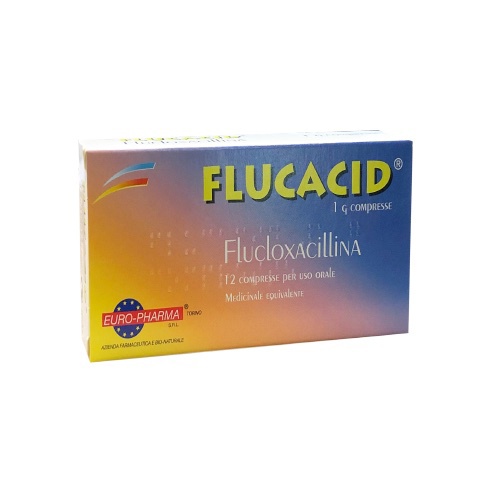
FLUCACID 1 G Coated tablet

Рассмотрение рецепта онлайн
Врач рассмотрит ваш случай и примет решение о назначении рецепта, если это медицински оправдано.

Поговорите с врачом об этом лекарстве
Обсудите симптомы и возможные дальнейшие шаги на онлайн-консультации.



Инструкция по применению FLUKAKID
Содержание инструкции
FLUCACID 1 g tablets
Flucloxacillin
Read this leaflet carefully before taking this medicine as it contains
important information for you.
- Keep this leaflet. You may need to read it again.
- If you have any questions, ask your doctor or pharmacist.
- This medicine has been prescribed for you only. Do not pass it on to others, even if their symptoms are the same as yours, as it may be harmful.
- If you get any side effects, even those not listed in this leaflet, tell your doctor or pharmacist. See section 4.
Contents of this leaflet:
- 1. What FLUCACID is and what it is used for
- 2. What you need to know before you take FLUCACID
- 3. How to take FLUCACID
- 4. Possible side effects
- 5. How to store FLUCACID
- 6. Contents of the pack and other information
1. What is FLUCACID and what is it used for
FLUCACID contains the active ingredient flucloxacillin which belongs to the group of beta-lactamase resistant antibiotics (enzymes produced by bacteria and capable of blocking penicillins).
FLUCACID is indicated for the treatment of all infections caused by bacteria sensitive to
flucloxacillin.
It works by blocking beta-lactamases and enhancing the action of other broad-spectrum semi-synthetic penicillins, such as: Amoxicillin, Ampicillin, etc.
The infections that are treated with this medicine are, therefore, those severe affecting various
organs and systems.
See your doctor if you do not feel better or if you feel worse.
2. What you need to know before taking FLUCACID
Do not take FLUCACID
- if you are allergic to flucloxacillin, to other substances chemically similar, in particular penicillins and cephalosporins, or to any of the other components of this medicine (listed in section 6).
- If you are pregnant (see section “Pregnancy and breastfeeding”).
Warnings and precautions
Talk to your doctor or pharmacist before taking FLUCACID.
In particular:
- if you experience severe hypersensitivity and anaphylactic reactions. These reactions have been reported mostly following parenteral use of penicillin, very rarely following oral administration. The onset of such reactions is however more frequent if you have a clinical history of hypersensitivity to multiple allergens of asthma, hay fever and urticaria. It is therefore necessary, before starting therapy, that you inform your doctor of the existence of any previous reactions to hypersensitivity to penicillins, cephalosporins or other substances capable of causing allergy, in particular drugs. In case of an allergic reaction, you must stop treatment and appropriate therapy must be instituted (vasopressors, antihistamines, corticosteroids) or, in the presence of anaphylaxis, immediate treatment with adrenaline or other appropriate emergency measures.
- if you suffer from kidney problems. In this case, the recommended maximum dose is 2 g in 24 hours in a single administration.
Tell your doctor if:
- you are taking antibacterial medicines at high doses and for prolonged periods as they may mask the symptoms of syphilis still in the incubation phase. In this case, your doctor will subject you to analysis to diagnose syphilis.
- you are taking penicillins or other antibiotics for a prolonged period. This can promote the development of microorganisms not sensitive to these medicines (including fungi). In this case, your doctor will indicate an adequate treatment.
- If you are taking or will take paracetamol: There is a risk of alterations in blood composition and electrolyte imbalance (metabolic acidosis with elevated anion gap) which occur when there is an increase in plasma acidity, in cases where flucloxacillin is co-administered with paracetamol, particularly in certain groups of patients at risk, such as patients with severe renal insufficiency, blood infection or malnutrition, especially if the maximum daily doses of paracetamol are used. Metabolic acidosis with elevated anion gap is a serious condition that requires urgent treatment.
- if you experience diarrhoea
- if you have been prescribed a low-salt diet
Other medicines and FLUCACID
Tell your doctor or pharmacist if you are taking, have recently taken or might take
any other medicine.
In particular:
- probenecid, (a medicine used to treat gout)
- the contraceptive pill, as the administration of FLUCACID, like other antibiotics, can reduce the effectiveness of the contraceptive pill.
- aminoglycoside antibiotics (to treat infections). Concurrent administration with these medicines may increase the effect of FLUCACID.
FLUCACID with food
The presence of food in the stomach reduces the absorption of the drug (see section “How
to take FLUCACID”). Take FLUCACID half an hour before meals, because the presence of food
in the stomach reduces the absorption of the medicine.
Pregnancy and breastfeeding
If you are pregnant, suspect you may be pregnant or are planning a pregnancy, or if you are breastfeeding
with breast milk, ask your doctor or pharmacist for advice before taking this medicine.
Pregnancy
The use of FLUCACID in pregnancy should be reserved to the doctor's judgment in cases of actual
need.
Breastfeeding
As FLUCACID passes into breast milk, your doctor will decide whether you should stop
breastfeeding and start treatment or, conversely, continue breastfeeding avoiding the
administration of the medicine.
Driving and using machines
It does not impair the ability to drive vehicles and operate machinery.
3. How to take FLUCACID
Take this medicine following exactly the instructions of your doctor or pharmacist.
If you have any doubts, consult your doctor or pharmacist.
Adults
The recommended dose is one tablet every 6-8 hours, as directed by your doctor.
Children (8-14 years)
The recommended dose is half a tablet every 8 hours, as directed by your doctor.
To achieve maximum blood concentration, it is recommended to take FLUCACID
half an hour before meals, because the presence of food in the stomach reduces the absorption of
the medicine.
In case of severe gastrointestinal disorders with vomiting and/or diarrhea, sufficient
absorption of the tablets is not guaranteed.
If you take more FLUCACID than you should
No reports of toxic effects from FLUCACID overdose are known.
Possible symptoms of an overdose are gastrointestinal disorders, electrolyte imbalances
(increased or decreased content of Sodium, Potassium and Chlorine in the blood, neuromuscular
disorders and convulsions.
In case of ingestion of excessive doses of the drug, emergency interventions should be
aimed at counteracting the symptoms that may occur.
If you have any doubts about the use of this medicine, ask your doctor or pharmacist.
4. Possible side effects
Like all medicines, this medicine can cause side effects, although not everyone will experience them.
Inform your doctor or pharmacist if you experience any side effect, even if it is not described
below.
Stop taking the medicine and contact your doctor immediately if you experience any of the
following symptoms:
- hypersensitivity or a severe allergic reaction that can manifest as itchy hives, itching, pain in the mouth or eyes, swelling of the face, lips, throat and tongue, difficulty breathing
- severe bloody diarrhea (pseudomembranous colitis).
Inform your doctor if you experience any of the following symptoms
- Glossitis (inflammation of the tongue), stomatitis (inflammation of the oral mucosa), nausea, vomiting, diarrhea, epigastric pain (in the upper part of the stomach), flatulence, anorexia.
- Abnormal liver function (increased liver enzymes which can lead to changes in some clinical tests), liver inflammation (hepatitis), yellowing of the skin (jaundice), Low levels of white blood cells and platelets in the blood which can determine an unusual appearance of bruises or a tendency to bleed (damage to red blood cells);
- Rarely, even severe decrease in kidney function, increase in azotemia and serum creatinine; isolated cases of interstitial nephritis (a form of acute kidney damage) have been reported.
- Eosinophilia (increase in eosinophils, i.e. a type of white blood cell), neutropenia (decrease in neutrophils, i.e. a type of white blood cell), agranulocytosis (significant decrease in all types of white blood cells), thrombocytopenia (decrease in platelet count) and anemia, sometimes hemolytic (resulting from the breakdown of red blood cells). Usually reversible with discontinuation of treatment;
- Exceptionally, during treatments with beta-lactam antibiotics at high dosages, in patients with renal insufficiency, metabolic encephalopathy (a form of brain damage) has been observed.
Other side effects (frequency not known): Severe skin reactions.
A red rash with crusts and swellings under the skin and blisters (pustular
exanthematous).
Very rare side effects (up to 1 in 10,000 people): Very rare cases of
alteration of blood composition and electrolyte imbalance (metabolic acidosis with elevated
anion gap) which occur when there is an increase in plasma acidity, in cases where
flucloxacillin is co-administered with paracetamol, generally in the presence of risk factors
(see section 2).
If you experience any of these symptoms, contact your doctor immediately
Reporting of side effects
If you experience any side effect, including those not listed in this leaflet, please
consult your doctor, pharmacist or nurse. You can also report side effects
directly through the national reporting system at
http://www.agenziafarmaco.gov.it/content/come-segnalare-una-sospetta-reazione-avversa.
By reporting side effects, you can help provide more information on the safety of
this medicine.
5. How to store FLUCACID
Keep this medicine out of sight and reach of children.
Do not use this medicine after the expiry date which is reported on the packaging after Exp.. The
expiry date refers to the last day of that month.
Store the medicine in a cool and dry place.
Do not dispose of any medicine in wastewater or household waste. Ask your pharmacist how to
dispose of medicines you no longer use. This will help protect the environment.
6. Contents of the pack and other information
What FLUCACID contains
- The active ingredient is flucloxacillin. Each tablet contains 1.088 g of crystalline flucloxacillin sodium monohydrate (equivalent to 1 g of Flucloxacillin acid).
- The other ingredients are: Microcrystalline cellulose, Polyvinylpyrrolidone, Magnesium stearate, Sodium carboxymethylamide.
Description of the appearance of FLUCACID and contents of the pack
Tablets for oral use. Pack of 12 tablets.
Marketing Authorisation Holder
EURO-PHARMA S.r.l. – Via Garzigliana, 8 - 10127 Torino
Manufacturer
FRANCIA FARMACEUTICI INDUSTRIA FARMACO BIOLOGICA S.R.L. - Via dei Pestagalli
- n. 7 - 20138 Milano

Не уверены, подходит ли вам это лекарство?
Обсудите симптомы и варианты лечения с врачом онлайн.

Уже начали прием и появились вопросы?
Обсудите свое состояние и дальнейшие шаги с врачом онлайн.
- Страна регистрации
- Форма выпускаCoated tablet, 1 G
- Код АТХJ01CF05
- Действующее вещество
- Отпускается по рецептуДа
- Производитель
- Информация на этой странице носит справочный характер и не является медицинской консультацией. Перед началом приема лекарства обязательно проконсультируйтесь с врачом.
- Аналоги FLUKAKIDФорма выпуска: Powder for injectable solution, 1 GДействующее вещество: flucloxacillinПроизводитель: K24 PHARMACEUTICALS S.R.L.Отпускается по рецептуФорма выпуска: Powder for injectable/infusion solution, 1000 MGДействующее вещество: oxacillinПроизводитель: AVAS PHARMACEUTICALS SRLОтпускается по рецептуФорма выпуска: Powder and solvent for injectable solution, 1 G/5 MLДействующее вещество: oxacillinПроизводитель: LABORATOIRES DELBERTОтпускается по рецепту
Аналоги FLUKAKID в других странах
Лекарства с тем же действующим веществом, доступные в других странах.
Аналог FLUKAKID в Испания
Врачи онлайн по FLUKAKID
Обсудите применение FLUKAKID и возможные следующие шаги — по оценке врача.









Получите рецепт на FLUKAKID онлайн
Заполните форму за 2 минуты
Расскажите о симптомах, истории болезни и нужном препарате.
Выберите врача или мы назначим
Выберите специалиста или мы подберём ближайшего доступного врача.
Врач рассматривает ваш случай
Обычно в течение 30 минут. Может задать уточняющие вопросы в чате.
Получите в любой аптеке
Электронный рецепт отправляется на вашу почту — действителен по всей Польше.
Часто задаваемые вопросы
FLUKAKID требует рецепта в Италия. Вы можете уточнить у врача онлайн, подходит ли это лекарство для вашей ситуации.
Действующее вещество FLUKAKID — flucloxacillin. Эта информация помогает определить лекарства с тем же составом под другими торговыми названиями.
FLUKAKID производится компанией EURO-PHARMA S.R.L.. Упаковка и торговое название могут отличаться в зависимости от дистрибьютора.
Врачи, включая Семейные врачи, Психиатры, Дерматологи, Кардиологи, Эндокринологи, Гастроэнтерологи, Пульмонологи, Нефрологи, Ревматологи, Гематологи, Инфекционисты, Аллергологи, Гериатры, Педиатры, Онкологи, могут оценить целесообразность применения FLUKAKID с учетом вашей ситуации и местных правил. Вы можете записаться на онлайн-консультацию, чтобы обсудить возможные варианты.
Польша имеет хорошо развитую систему здравоохранения в крупных городах, таких как Варшава, Краков, Вроцлав и Гданьск. Аптеки широко доступны и работают в соответствии с действующим законодательством, обеспечивая доступ к рецептурным препаратам.
Вы можете купить FLUKAKID в Варшаве, Кракове, Вроцлаве или Гданьске в любой аптеке при наличии действующего рецепта.
Чтобы получить рецепт, вы можете воспользоваться Oladoctor:
Другие лекарства с тем же действующим веществом (flucloxacillin) включают FLUKLOXAKILLINA, OXKIVA, PENSTAPO. Они могут отличаться торговым названием или формой выпуска, но содержат одинаковый терапевтический компонент. Перед изменением лечения рекомендуется проконсультироваться с врачом.
