



FINLEE 10 мг Диспергируемая таблетка

Рассмотрение рецепта онлайн
Врач рассмотрит ваш случай и примет решение о назначении рецепта, если это медицински оправдано.

Поговорите с врачом об этом лекарстве
Обсудите симптомы и возможные дальнейшие шаги на онлайн-консультации.



Инструкция по применению FINLEE
Содержание инструкции
Finlee 10 mg dispersible tablets
dabrafenib
Read this leaflet carefully before the child takes this medicine as it
contains important information.
- Keep this leaflet. You may need to read it again.
- If you have any questions, ask your doctor, pharmacist or nurse.
- This medicine has been prescribed only for the child. Do not give it to other people, even if their symptoms are the same as those of the child, as it could be dangerous.
- If the child experiences any side effects, including those not listed in this leaflet, ask your doctor, pharmacist or nurse. See section 4.
Contents of this leaflet
- 1. What Finlee is and what it is used for
- 2. What you need to know before giving Finlee
- 3. How to give Finlee
- 4. Possible side effects
- 5. How to store Finlee
- 6. Contents of the pack and other information
1. What is Finlee and what is it used for
Finlee is a medicine that contains the active substance dabrafenib.
This drug is used in association with another medicine (trametinib oral solution) in
children aged 1 year and over to treat a type of brain tumor called glioma.
Finlee can be used in patients with:
- low-grade glioma
- high-grade glioma, when the patient has received at least one treatment with radiotherapy and/or chemotherapy.
Finlee is used for the treatment of patients whose brain tumor presents a specific mutation
(alteration) in the gene called BRAF. This mutation causes the body to produce defective
proteins which in turn can cause the development of the tumor. The doctor will test for this mutation before
starting treatment.
In combination with trametinib, Finlee acts on these defective proteins and slows down or stops the
2. What you need to know before giving Finlee
Do not give Finlee
- if the child is allergicto dabrafenib or to any of the other ingredients of this medicine (listed in section 6).
Warnings and precautions
Talk to your doctor before giving Finlee. It is necessary that the doctor knows if the child:
- has eye problems,including a blockage of the vein that drains the eye (retinal vein occlusion) or swelling of the eyes that can be caused by fluid leakage (chorioretinopathy).
- has heart problems,such as heart failure or problems with the way their heart beats.
- has or has had any kidney problems.
- has or has had any liver problems.
- has or has ever had any lung or breathing problems, including difficulty breathing often accompanied by dry cough, shortness of breath and fatigue.
- has or has had gastrointestinal problemssuch as diverticulitis (inflamed pouches in the colon) or metastases in the gastrointestinal tract.
Before the child starts taking Finlee, during and after treatment, the doctor will perform
checks to prevent complications.
Skin check
Finlee can cause skin cancer. Generally these skin changes remain at a local level
and can be removed with surgery and treatment with Finlee can be
continued without interruption. The doctor may check the child's skin before and regularly
during treatment.
Check the child's skin monthly during treatment and for 6 months after stopping
taking this medicine. Tell the doctoras soon as possible if you notice any changes in the
child's skin such as a new wart, a wound or a reddish bump that bleeds and does not
heal or a change in the size or color of a mole.
Tumor lysis syndrome
If the child develops the following symptoms, tell the doctorimmediately as this may
be a life-threatening condition: nausea, shortness of breath, irregular heartbeat,
muscle cramps, seizures, clouding of the urine, decreased urine production and
fatigue. These may be caused by a group of metabolic complications that can
occur during cancer treatment and are caused by the breakdown products of dying cancer cells (tumor lysis syndrome or TLS) and can lead to changes in
renal function (see also section 4).
Children under 1 year of age
The effects of Finlee in children under 1 year of age are not known. Therefore, Finlee is not
recommended in this age group.
Patients over 18 years of age
Information on the treatment of patients over 18 years of age with glioma is limited,
therefore continuation of treatment into adulthood should be evaluated by the doctor.
Other medicines and Finlee
Before starting treatment, tell your doctor, pharmacist or nurse if the child is
taking, has recently taken or might take any other medicines, including those
available without a prescription.
Some medicines can affect the way Finlee works or may increase the
likelihood that the child will have unwanted effects. Finlee can also affect the way other medicines work. These include:
- medicines used for birth control (contraceptives) containing hormones, such as pills, injections or patches
- medicines used to thin the blood, such as warfarin and acenocoumarol
- medicines used to treat heart disorders, such as digoxin
- medicines used to treat fungal infections, such as itraconazole, voriconazole and posaconazole
- medicines used to treat Cushing's syndrome, such as ketoconazole
- some medicines known as calcium channel blockers, used to treat high blood pressure, such as diltiazem, felodipine, nicardipine, nifedipine or verapamil
- medicines used to treat cancer, such as cabazitaxel
- some medicines used to lower fats (lipids) in the blood, such as gemfibrozil
- some medicines used to treat certain psychiatric disorders, such as haloperidol
- some medicines known as antibiotics, such as clarithromycin, doxycycline and telithromycin
- some medicines used to treat tuberculosis (TB), such as rifampicin
- some medicines used to lower cholesterol levels, such as atorvastatin and simvastatin
- some medicines known as immunosuppressants, such as cyclosporine, tacrolimus and sirolimus
- some medicines known as anti-inflammatory drugs, such as dexamethasone and methylprednisolone
- some medicines used to treat HIV, such as ritonavir, amprenavir, indinavir, darunavir, delavirdine, efavirenz, fosamprenavir, lopinavir, nelfinavir, tipranavir, saquinavir and atazanavir
- some medicines used to help you sleep, such as diazepam, midazolam, zolpidem
- some medicines used to relieve pain, such as fentanyl and methadone
- medicines used to treat seizures (epilepsy), such as phenytoin, phenobarbital, primidone, valproic acid or carbamazepine
- medicines known as antidepressants, such as nefazodone and medicines containing St. John's wort (Hypericum perforatum)
Tell your doctor, pharmacist or nurseif the child is taking any of the medicines
listed above (or if you are not sure). The doctor may decide to change the dose.
Pregnancy, breastfeeding and fertility
Pregnancy
- If the girl is pregnant, or if she suspects she may be, ask your doctor or nurse for advice before giving her this medicine. Finlee can potentially cause harm to the fetus.
- If the girl becomes pregnant while taking this medicine, tell your doctor immediately.
Breastfeeding
It is not known whether Finlee passes into breast milk. If the girl is breastfeeding, or
is planning to do so, she must tell her doctor. She, the girl and the doctor will decide whether to take
Finlee or to breastfeed.
Fertility
Finlee may reduce the number of sperm and this may not return to normal levels after
stopping treatment with Finlee.
Taking Finlee with trametinib oral solution:Trametinib may impair fertility in
males and females.
Before starting treatment with Finlee, talk to your doctor about options to improve the
child's chances of having children in the future.
Contraception
- If the girl can become pregnant, she must use a reliable method of contraception (birth control) while taking Finlee in combination with trametinib oral solution and for at least 16 weeks after the last dose of Finlee in combination with trametinib.
- Birth control methods containing hormones (such as pills, injections or patches) may not work well while taking Finlee in combination with trametinib oral solution. An alternative effective method of birth control must be used to avoid the risk of pregnancy while taking this combination of medicines. Ask your doctor or nurse for advice.
Driving and operating machinery
Finlee can have side effects that can affect the child's ability to drive, ride a
bicycle/scooter, operate machinery or participate in other activities that require
attention. If the child has vision problems or feels tired or weak or their energy levels
are low, they should avoid these activities.
Descriptions of these effects can be found in section 4. Read all the information
Discuss with your doctor, pharmacist or nurse if you are not sure about anything. The child's illness, symptoms and treatment conditions may also affect their ability to
participate in these activities.
Finlee contains potassium
This medicine contains less than 1 mmol (39 mg) of potassium per maximum daily dose, i.e.
essentially ‘potassium-free’.
Finlee contains benzyl alcohol
This medicine contains <0.00078 mg of benzyl alcohol in each dispersible tablet.
Benzyl alcohol can cause allergic reactions.
Ask your doctor or pharmacist if the girl is pregnant or breastfeeding. This
is because large amounts of benzyl alcohol can accumulate in the girl's body and cause adverse effects
(such as metabolic acidosis).
Ask your doctor or pharmacist if the child has a liver or kidney condition. This
is because large amounts of benzyl alcohol can accumulate in the child's body and cause adverse effects
(such as metabolic acidosis).
3. How to administer Finlee
Administer this medicine to the child always following the doctor's, pharmacist's or nurse's instructions exactly. If you have any doubts, consult the doctor, pharmacist or nurse.
How much to administer
The doctor will decide the correct dose of Finlee based on the child's body weight.
The doctor may decide that the child needs to take a lower dose if they experience undesirable effects.
How to administer it
Read the instructions for use at the end of this leaflet for details on how to prepare and administer the solution of dispersible tablets.
- Administer Finlee twice a day. Administering Finlee at the same time each day will help you remember when to administer the medicine. Administer each dose of Finlee approximately 12 hours apart. Trametinib oral solution is administered once a day. Administer trametinib oral solution orwith the morning dose orwith the evening dose of Finlee.
- Administer Finlee on an empty stomach, at least one hour before or two hours after a meal, this means that: o after taking Finlee, the child must wait at least 1 hourbefore eating. o after eating, the child must wait at least 2 hoursbefore taking Finlee. o if necessary, breastfeeding and/or formula milk can be administered on demand.
If you administer more Finlee than you should
If you administer an excessive dose of Finlee, contact the doctor, pharmacist or nurse for advice.If possible, show them the Finlee packaging and this leaflet.
If you forget to administer Finlee
If you forget a dose and less than 6 hours have passed, administer it as soon as you remember.
If the forgotten dose is 6 hours or more late, skip that dose and administer the next dose at the usual time. Then continue to administer Finlee at regular times as usual.
Do not administer a double dose to compensate for a missed dose.
If the child vomits after taking Finlee
If the child vomits after taking Finlee, do not administer another dose until the next scheduled dose.
If you stop the treatment with Finlee
Administer Finlee for the entire time recommended by the doctor. Do not stop it unless the doctor tells you to do so.
If you have any doubts about the use of this medicine, consult the doctor, pharmacist or nurse.
4. Possible side effects
Like all medicines, this medicine can cause side effects, although not everybody gets them.
Stop taking the medicine and contact your doctor urgently if the child
shows any of the following symptoms:
- coughing up blood, blood in the urine, vomit containing blood or looking like coffee grounds, red or black stools that look like tar. These can be a sign of bleeding.
- fever (temperature of 38°C or higher).
- chest pain or shortness of breath, sometimes with fever or cough. These can be signs of pneumonia or lung inflammation (interstitial lung disease).
- blurred vision, loss of vision, or other changes in vision. These can be signs of retinal detachment.
- red eye, eye pain, increased sensitivity to light. These can be signs of uveitis.
- unexplained muscle pain, muscle cramps or muscle weakness, dark urine. These can be signs of rhabdomyolysis.
- severe abdominal pain. This can be a sign of pancreatitis.
- fever, swollen lymph nodes, bruising or rash at the same time. These can be signs of a condition where the immune system produces too many cells that fight infections, which can cause various symptoms (hemophagocytic lymphohistiocytosis).
- nausea, shortness of breath, irregular heartbeat, muscle cramps, convulsions, cloudy urine, decreased urine production, and fatigue. These can be signs of a condition resulting from the rapid breakdown of cancer cells that can be fatal in some people (tumor lysis syndrome or TLS).
- reddish patches on the trunk that are circular or target-shaped, with or without central blisters, skin peeling, ulcers of the mouth, throat, nose, genitals, and eyes. These can be signs of severe skin reactions, which can be life-threatening and may be preceded by fever and flu-like symptoms (Stevens-Johnson syndrome), widespread rash, fever, and swollen lymph nodes (DRESS).
Other possible side effects
Very common(may affect more than 1 in 10 people)
- Headache
- Dizziness
- Cough
- Diarrhea, feeling unwell (nausea), discomfort (vomiting), constipation, stomach pain
- Skin problems such as rash, acne-like rash, dry or itchy skin, redness of the skin
- Wart-like growths (cutaneous papilloma)
- Nail infection
- Pain in the arms or legs or joints
- Lack of energy or feeling weak or tired
- Weight gain
- Upper respiratory tract infections with symptoms such as sore throat and nasal congestion (nasopharyngitis)
- Increased liver enzymes in blood tests
- Decreased level of white blood cells (neutropenia, leukopenia)
- Decreased level of red blood cells (anemia)
Common(may affect up to 1 in 10 people)
- Frequent urination with pain or burning sensation (urinary tract infection)
- Skin effects including skin infection (cellulitis), inflammation of the hair follicles in the skin, scaly inflamed skin (generalized exfoliative dermatitis), thickening of the outer layer of the skin (hyperkeratosis)
- Decreased appetite
- Low blood pressure (hypotension)
- High blood pressure (hypertension)
- Shortness of breath
- Pain in the mouth or mouth ulcers, inflammation of the mucous membrane
- Inflammation of the subcutaneous fat layer (panniculitis)
- Unusual hair loss or thinning
- Red and painful hands and feet (hand-foot syndrome)
- Muscle spasms
- Chills
- Allergic reaction (hypersensitivity)
- Dehydration
- Vision problems including blurred vision
- Decreased heart rate (bradycardia)
- Fatigue, chest discomfort, dizziness, palpitations (reduced ejection fraction)
- Swelling of the tissues (edema)
- Muscle pain (myalgia)
- Fatigue, chills, sore throat, joint or muscle pain (flu-like illness)
- Abnormal results of tests related to creatine phosphokinase, an enzyme found mainly in the heart, brain, and skeletal muscle
- Increased blood sugar level
- Low levels of sodium or phosphate in the blood
- Decreased level of platelets in the blood (cells that help blood clotting)
- Increased skin sensitivity to the sun
Uncommon(may affect up to 1 in 100 people)
- Irregular heartbeat (atrioventricular block)
- Inflammation of the intestine (colitis)
- Skin cracks
- Night sweats
- Excessive sweating
- Raised, painful, red to dark red skin spots or ulcers, mainly located on the arms, legs, face, and neck, accompanied by fever (signs of acute febrile neutrophilic dermatosis)
In addition to the side effects described above, the following side effects have only been reported in adult patients, but may also occur in children:
- a condition affecting the nerves that can cause pain, loss of sensation or tingling in the hands and feet and/or muscle weakness (peripheral neuropathy)
- dry mouth
- kidney failure
- benign skin tumor (acrochordon)
- inflammatory disease mainly affecting the skin, lungs, eyes, and lymph nodes (sarcoidosis)
- inflammation of the kidneys
- a hole (perforation) in the stomach or intestine
- inflammation of the heart muscle that can cause shortness of breath, fever, palpitations, and chest pain
Reporting of side effects
If the child gets any side effect, talk to your doctor, pharmacist or nurse. This includes any side effects not listed in this leaflet. You can also report side effects directly through the national reporting system listed in Annex V. By reporting side effects you can help provide more information on the safety of this medicine.
5. How to store Finlee
Keep this medicine out of the sight and reach of children.
Do not use this medicine after the expiry date which is stated on the label of the bottle and on the
package after Scad.. The expiry date refers to the last day of that month.
Administer the solution no later than 30 minutes after the tablets have dissolved.
This medicine does not require any particular storage temperature.
Store in the original package to protect the medicine from humidity.
Do not dispose of any medicine in wastewater or household waste. Ask your pharmacist how to
dispose of medicines you no longer use. This will help protect the environment.
6. Content of the pack and other information
What Finlee contains
- The active ingredient is dabrafenib. Each dispersible tablet contains dabrafenib mesilate equivalent to 10 mg of dabrafenib.
- The other ingredients are: mannitol (E 421), microcrystalline cellulose (E 460), crospovidone (E 1202), hypromellose (E 464), potassium acesulfame (E 950) (see section 2), magnesium stearate (E 470b), artificial berry flavouring (maltodextrin, propylene glycol [E 1520], artificial flavourings, triethyl citrate [E 1505], benzyl alcohol E 1519] [see section 2]), and anhydrous colloidal silica (E 551).
Description of the appearance of Finlee and content of the pack
Finlee 10 mg dispersible tablets are round tablets from white to pale yellow, 6 mm
marked with a “D” on one side and “NVR” on the other.
The bottles are made of white plastic with threaded plastic closures.
The bottles also include a silica gel desiccant in small cylindrical containers. The desiccants
must be kept inside the bottle and must not be eaten.
Finlee 10 mg dispersible tablets are available in packs containing 1 or 2 bottles (210 or 420
dispersible tablets) and 2 dosing devices.
Marketing Authorisation Holder
Novartis Europharm Limited
Vista Building
Elm Park, Merrion Road
Dublin 4
Ireland
Manufacturer
Lek Pharmaceuticals d.d.
Verovškova ulica 57
1526, Ljubljana
Slovenia
Novartis Pharmaceutical Manufacturing LLC
Verovškova ulica 57
1000, Ljubljana
Slovenia
Novartis Pharma GmbH
Roonstrasse 25
90429 Nuremberg
Germany
Novartis Farmacéutica S.A.
Gran Via de les Corts Catalanes 764
08013 Barcelona
Spain
Novartis Pharma GmbH
Sophie-Germain-Strasse 10
90443 Norimberga
Germany
For further information on this medicine, contact the local representative of the marketing
authorisation holder:
België/Belgique/Belgien
Novartis Pharma N.V.
Tél/Tel: +32 2 246 16 11
Lietuva
SIA Novartis Baltics Lietuvos filialas
Tel: +370 5 269 16 50
България
Novartis Bulgaria EOOD
Тел: +359 2 489 98 28
Luxembourg/Luxemburg
Novartis Pharma N.V.
Tél/Tel: +32 2 246 16 11
Česká republika
Novartis s.r.o.
Tel: +420 225 775 111
Magyarország
Novartis Hungária Kft.
Tel.: +36 1 457 65 00
Danmark
Novartis Healthcare A/S
Tlf.: +45 39 16 84 00
Malta
Novartis Pharma Services Inc.
Tel: +356 2122 2872
Deutschland
Novartis Pharma GmbH
Tel: +49 911 273 0
Nederland
Novartis Pharma B.V.
Tel: +31 88 04 52 111
Eesti
SIA Novartis Baltics Eesti filiaal
Tel: +372 66 30 810
Norge
Novartis Norge AS
Tlf: +47 23 05 20 00
Ελλάδα
Novartis (Hellas) A.E.B.E.
Τηλ: +30 210 281 17 12
Österreich
Novartis Pharma GmbH
Tel: +43 1 86 6570
España
Novartis Farmacéutica, S.A.
Tel: +34 93 306 42 00
Polska
Novartis Poland Sp. z o.o.
Tel.: +48 22 375 4888
France
Novartis Pharma S.A.S.
Tél: +33 1 55 47 66 00
Portugal
Novartis Farma - Produtos Farmacêuticos, S.A.
Tel: +351 21 000 8600
Hrvatska
Novartis Hrvatska d.o.o.
Tel. +385 1 6274 220
România
Novartis Pharma Services Romania SRL
Tel: +40 21 31299 01
Ireland
Novartis Ireland Limited
Tel: +353 1 260 12 55
Slovenija
Novartis Pharma Services Inc.
Tel: +386 1 300 75 50
Ísland
Vistor hf.
Sími: +354 535 7000
Slovenská republika
Novartis Slovakia s.r.o.
Tel: +421 2 5542 5439
Italia
Novartis Farma S.p.A.
Tel: +39 02 96 54 1
Suomi/Finland
Novartis Finland Oy
Puh/Tel: +358 (0)10 6133 200
Κύπρος
Novartis Pharma Services Inc.
Τηλ: +357 22 690 690
Sverige
Novartis Sverige AB
Tel: +46 8 732 32 00
Latvija
SIA Novartis Baltics
Tel: +371 67 887 070
Other sources of information
More detailed information on this medicine is available on the website of the European
Medicines Agency, https://www.ema.europa.eu.
INSTRUCTIONS FOR USE
| SECTION A ADMINISTRATION VIA DOSING DEVICE | |
| o c Dissolve the tablets in water before administering Finlee. Follow the instructions below to dissolve the tablets in water. a If the Finlee solution comes into contact with the skin, wash the area thoroughly with soap and water. m If the Finlee solution comes into contact with the eyes, rinse the eyes thoroughly with fresh water. In case of spillage, follow the information in the “CLEANING UP SPILLAGES” section. | |
| 1 Wash and dry your hands before administering Finlee. | F a r |
| 2 Add drinking water to the dosing device: o Approximately 5 ml for 1 to 4 tablets o Approximately 10 ml for 5 to 15 tablets | d e l |
| 3 n Remove the child-resistant cap by pushing down and turning it a counterclockwise. | a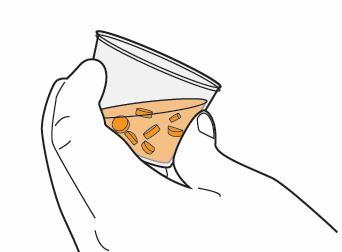 |
| i 4 l a Count the prescribed number of tablets in one hand and put them into the dosing device. t I The bottle contains 2 plastic containers with silica gel desiccant to keep the dispersible tablets dry. a Put the containers back inside the bottle if i they fall out. z Do not throw away the containers. n Close the bottle with the cap. Store the e bottle closed in the carton away from the sight and d reach of children. | |
| 5 Tilt the dosing device slightly and stir gently with the handle of a stainless steel teaspoon until the tablets are completely dissolved (may take 3 minutes or more). Once ready, the solution will be whitish cloudy. Administer the solution within and no later than 30 minutes after the tablets have dissolved. | r m a c o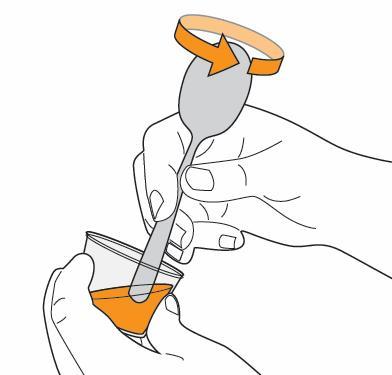 |
| 6 Make sure the child drinks all the solution from the dosing device. | l F a |
| 7 Add approximately 5 ml of drinking water to the empty dosing device and stir with the handle of a stainless steel teaspoon (there will be tablet residue inside the dosing device n that may be difficult to see). | a d e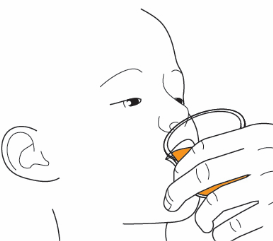 |
| a 8 i Make sure the child drinks this solution from the dosing device as well. | |
| a 9 t If the prescribed tablets are from 5 to 15: I repeat steps 7 to 8. | |
| a 10 i For cleaning instructions, see “SECTION z C”. |
| SECTION B ADMINISTRATION VIA ORAL SYRINGE OR FEEDING TUBE | |
| o c Minimum tube size: a Dose Minimum size m 1 to 3 tablets 10 French gauge 4 to 15 tablets 12 French gauge | |
| 1 Follow steps 1 to 5 in “SECTION A” to dissolve the tablets, then go to step 2 in this section. | F a r |
| 2 Draw all the solution from the dosing device into a syringe compatible with a feeding tube or oral administration. | d e l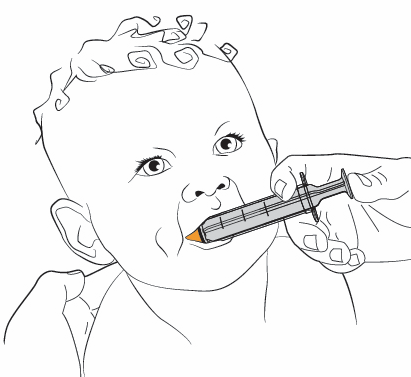 |
| 3a Administration via oral syringe: n Position the end of the oral syringe inside the mouth with the tip touching a the inside of one of the cheeks. i Slowly press the plunger all the way down l to deliver the entire dose. a WARNING: Administering Finlee t directly into the throat or pushing the plunger I too quickly may cause choking. | a |
| 3b a Administration via feeding tube: Deliver the solution into the feeding tube according to the manufacturer’s instructions. | |
| 4 n Add approximately 5 ml of drinking water e to the empty dosing device and stir with the handle of a stainless steel teaspoon to A dissolve any residue (there will be tablet residue inside the dosing device that may be difficult to see). | |
| Dose | Minimum size |
| 1 to 3 tablets | 10 French gauge |
| 4 to 15 tablets | 12 French gauge |
| 5 Draw all the solution from the dosing device into a syringe compatible with a feeding tube or oral administration. | o |
| 6 Administer the solution into the feeding tube or inside the cheek. | m a c |
| 7 Repeat steps 4 to 6 a total of 3 times to take the entire dose. | a r |
| 8 For cleaning instructions, see “SECTION C”. | l F |
SECTION CCLEANING
Dosing device
- Rinse the dosing device with water immediately after administration. Do not use hot water as the dosing device may deform.
- Remove excess water, then dry with clean paper towels.
- Always keep the dosing device away from other kitchen items to avoid contamination.
- If both dosing devices become soiled and cannot be cleaned with water alone, contact your pharmacist for a new dosing device.
Teaspoon
- Wash the teaspoon by hand with warm soapy water or wash it in the dishwasher.
Oral syringe
If used, clean the oral syringe as follows:
- 1. Fill a glass with warm soapy water.
- 2. Place the oral syringe in the glass with warm soapy water.
- 3. Draw water into the oral syringe and expel it again 4 or 5 times.
- 4. Separate the plunger from the barrel.
- 5. Rinse the glass, plunger and barrel under warm running water.
- 6. Let the plunger and barrel air dry on a dry surface before next use.
The dosing device can be used for up to 4 months after first use. After 4 months, discard the
dosing device in household waste.
CLEANING UP SPILLAGES
Follow these steps if you spill Finlee solution:
- 1. Wear plastic gloves.
- 2. Absorb the solution completely using an absorbent material, such as paper towels soaked in a mixture of water and household disinfectant.
- 3. Repeat the cleaning with new absorbent material at least 3 times until the area is clean.
- 4. Dry the area with paper towels.
- 5. Place all materials used to clean the spillage in a sealable plastic bag.
- 6. Ask your pharmacist how to dispose of the plastic bag.
- 7. Wash your hands thoroughly with soap and water.
ANNEX IV
SCIENTIFIC CONCLUSIONS AND JUSTIFICATION FOR THE VARIATION OF THE TERMS
OF THE MARKETING AUTHORISATION
Scientific conclusions
In light of the evaluation by the Pharmacovigilance and Risk Assessment Committee
(PRAC) of the Periodic Safety Update Report (PSUR) for dabrafenib, the PRAC’s scientific
conclusions are as follows:
In light of the available risk data from the literature and spontaneous reports, including in some cases a strong temporal association, a positive de-challenge and/or a re-challenge, and in
view of a plausible mechanism of action, the PRAC considers that a causal relationship between dabrafenib and
probable Vogt-Koyanagi-Harada (VKH)-like uveitis is at least a reasonable
possibility. The PRAC concluded that the product information for products containing dabrafenib
should be amended accordingly.
Having examined the PRAC recommendation, the Committee for Human Medicinal Products
(CHMP) agrees with the related overall conclusions and with the justification for the recommendation.
Justification for the variation of the terms of the marketing authorisation
Based on the scientific conclusions on dabrafenib, the CHMP considers that the benefit/risk
balance of the medicinal product(s) containing dabrafenib is unchanged subject to the proposed
changes to the product information.
The CHMP recommends the variation of the terms of the marketing authorisation.

Не уверены, подходит ли вам это лекарство?
Обсудите симптомы и варианты лечения с врачом онлайн.

Уже начали прием и появились вопросы?
Обсудите свое состояние и дальнейшие шаги с врачом онлайн.
- Страна регистрации
- Форма выпускаDispersible tablet, 10 mg
- Код АТХL01EC02
- Действующее вещество
- Отпускается по рецептуДа
- Производитель
- Информация на этой странице носит справочный характер и не является медицинской консультацией. Перед началом приема лекарства обязательно проконсультируйтесь с врачом.
- Аналоги FINLEEФорма выпуска: Hard capsule, 50 MGДействующее вещество: dabrafenibПроизводитель: NOVARTIS EUROPHARM LIMITEDОтпускается по рецептуФорма выпуска: Hard capsule, 50 MGДействующее вещество: ЭнкорафенибПроизводитель: PIERRE FABRE MEDICAMENTОтпускается без рецептаФорма выпуска: Film-coated tablet, 240 MGДействующее вещество: ВемурафенибПроизводитель: ROCHE REGISTRATION GMBHОтпускается по рецепту
Аналоги FINLEE в других странах
Лекарства с тем же действующим веществом, доступные в других странах.
Аналог FINLEE в Испания
Аналог FINLEE в Украина
Получите рецепт на FINLEE онлайн
Заполните форму за 2 минуты
Расскажите о симптомах, истории болезни и нужном препарате.
Выберите врача или мы назначим
Выберите специалиста или мы подберём ближайшего доступного врача.
Врач рассматривает ваш случай
Обычно в течение 30 минут. Может задать уточняющие вопросы в чате.
Получите в любой аптеке
Электронный рецепт отправляется на вашу почту — действителен по всей Польше.
Часто задаваемые вопросы
FINLEE требует рецепта в Италия. Вы можете уточнить у врача онлайн, подходит ли это лекарство для вашей ситуации.
Действующее вещество FINLEE — dabrafenib. Эта информация помогает определить лекарства с тем же составом под другими торговыми названиями.
FINLEE производится компанией NOVARTIS EUROPHARM LIMITED. Упаковка и торговое название могут отличаться в зависимости от дистрибьютора.
Врачи, включая Семейные врачи, Психиатры, Дерматологи, Кардиологи, Эндокринологи, Гастроэнтерологи, Пульмонологи, Нефрологи, Ревматологи, Гематологи, Инфекционисты, Аллергологи, Гериатры, Педиатры, Онкологи, могут оценить целесообразность применения FINLEE с учетом вашей ситуации и местных правил. Вы можете записаться на онлайн-консультацию, чтобы обсудить возможные варианты.
Польша имеет хорошо развитую систему здравоохранения в крупных городах, таких как Варшава, Краков, Вроцлав и Гданьск. Аптеки широко доступны и работают в соответствии с действующим законодательством, обеспечивая доступ к рецептурным препаратам.
Вы можете купить FINLEE в Варшаве, Кракове, Вроцлаве или Гданьске в любой аптеке при наличии действующего рецепта.
Чтобы получить рецепт, вы можете воспользоваться Oladoctor:
Другие лекарства с тем же действующим веществом (dabrafenib) включают TAFINLAR, BRAFTOVI, TSELBORAF. Они могут отличаться торговым названием или формой выпуска, но содержат одинаковый терапевтический компонент. Перед изменением лечения рекомендуется проконсультироваться с врачом.
