



FILENA Коированная таблетка

Рассмотрение рецепта онлайн
Врач рассмотрит ваш случай и примет решение о назначении рецепта, если это медицински оправдано.

Поговорите с врачом об этом лекарстве
Обсудите симптомы и возможные дальнейшие шаги на онлайн-консультации.



Инструкция по применению FILENA
Содержание инструкции
Filena tablets
estradiol valerate and medroxyprogesterone acetate
Read this leaflet carefully before taking this medicine as it contains
important information for you.
- Keep this leaflet. You may need to read it again.
- If you have any questions, ask your doctor or pharmacist.
- This medicine has been prescribed for you only. Do not pass it on to others, even if their symptoms are the same as yours, as it could be harmful.
- If you get any side effects, even those not listed in this leaflet, tell your doctor or pharmacist. See section 4.
Contents of this leaflet:
- 1. What Filena is and what it is used for
- 2. What you need to know before you take Filena
- 3. How to take Filena
- 4. Possible side effects
- 5. How to store Filena
- 6. Contents of the pack and other information
1. What is Filena and what is it used for
Filena belongs to a group of medicines called Hormone Replacement Therapy (HRT). Filena
contains two types of female hormones, an estrogen and a progestin. Filena is used in women
who are already postmenopausal.
Experience in women over 65 years of age is limited.
Filena is used for:
Relief of symptoms in postmenopausal women
During menopause, the amount of estrogen hormones produced by the woman decreases. This can
cause symptoms such as heat in the face, neck and chest (“hot flushes”). Filena relieves these symptoms
after menopause. Filena will be prescribed to you only if your symptoms seriously interfere with your
daily life.
2. Cosa deve sapere prima di prendere Filena
Medical history and regular check-ups
Hormone Replacement Therapy (HRT) carries some risks that must be considered if you are
deciding to start or continue therapy.
Experience in treating women with early menopause (caused by ovarian insufficiency
or surgery) is limited. If you suffer from early menopause, the risks associated with the use
of Hormone Replacement Therapy (HRT) may be different. Talk to your doctor.
Before starting (or resuming) Hormone Replacement Therapy (HRT), your doctor will ask you
about your personal and family medical history. Your doctor may decide to subject you
to a visit. This, if necessary, may include a breast exam and/or an internal examination.
Once you have started therapy with Filena, you must go to the doctor for periodic check-ups
(at least once a year). During these check-ups, discuss with your doctor the risks and benefits
associated with continuing therapy with Filena.
Undergo regular breast screenings, as recommended by your doctor.
Do not use Filena:
if you experience any of the following conditions. If you have any doubts about any of the points below, consult
your doctorbefore taking Filena.
Do not use Filena:
- if you are allergicto estradiol or medroxyprogesterone or any of the other ingredients of this medicine (listed in section 6)
- if you have or have had breast canceror suspect you have it
- if you have a cancer that is hormone-sensitive (estrogen), such as cancer of the uterine lining (endometrium), or suspect you have it
- if you have unexpected vaginal bleeding
- if you have excessive thickening of the uterine lining(endometrial hyperplasia) that is not being treated
- if you have or have ever had a blood clot (thrombus) in a vein(thrombosis) in the legs (deep vein thrombosis) or in the lungs (pulmonary embolism)
- if you suffer from a blood clotting (coagulation) disorder(such as protein C, protein S, or antithrombin deficiency)
- if you have or have recently had a disease caused by blood clots in the arteries, such as a heart attack, strokeor angina
- if you have or have ever had liver diseaseand tests to check liver function have not returned to normal
- if you have a rare blood disease called "porphyria", which is hereditary (family history)
If any of the conditions described above appear for the first time during the use of Filena,
stop taking it immediately and consult your doctor immediately.
Warnings and precautions
Talk to your doctor or pharmacist before taking Filena.
Tell your doctor if you have or have ever had any of the following problems, before starting treatment
as these may recur or worsen during treatment with Filena. If this happens, you should see your doctor more often for a check-up:
- benign tumors (fibroids) inside the uterus
- growth of the uterine lining outside the uterus (endometriosis) or a history of excessive growth of the uterine lining (endometrial hyperplasia)
- increased risk of developing blood clots (see “Blood clots in a vein [thrombosis]”)
- increased risk of having a hormone-sensitive cancer (resulting from having a mother, sister or grandmother with breast cancer)
- high blood pressure
- liver disorder, such as a benign liver tumor
- diabetes
- gallstones
- migraine or severe headaches
- a disease of the body's defense system that affects many organs of the body (systemic lupus erythematosus, SLE)
- epilepsy
- asthma
- a disease affecting the eardrum and hearing (otosclerosis)
- very high levels of fat in the blood (triglycerides)
- fluid retention (edema) due to heart or kidney problems
- rapid formation of swelling within the layers of the skin, mucous membranes and tissues under the mucous membranes of hereditary and acquired character (hereditary and acquired angioedema).
Stop taking Filena and see your doctor immediately
if you notice any of the following effects during therapy with Hormone Replacement Therapy (HRT):
- one of the conditions listed in the section "Do not use Filena"
- yellowing of the skin or whites of the eyes (jaundice). These may be signs of a liver disease
- swelling of the face, tongue and/or throat and/or difficulty swallowing or hives with difficulty breathing, which are indicative of angioedema
- a significant increase in blood pressure (symptoms may include headache, fatigue, dizziness)
- severe headache that occurs for the first time
- pregnancy
- if you notice signs of a blood clot, such as:
- painful and reddened swelling of the legs
- sudden chest pain
- difficulty breathing.
For more information, see "Blood clots in a vein (thrombosis)".
Note:Filena is not a contraceptive. If less than 12 months have passed since
your last menstrual period or you are under 50 years of age, you may still need to use
additional contraception to prevent pregnancy. Talk to
your doctor for advice.
Hormone Replacement Therapy (HRT) and cancer
Excessive thickening of the uterine lining (endometrial hyperplasia) and cancer of the uterine lining (endometrial carcinoma)
Hormone Replacement Therapy (HRT) with only estrogen hormones increases the risk of excessive
thickening of the uterine lining (endometrial hyperplasia) and cancer of the uterine lining (endometrial carcinoma).
The progestin hormone present in Filena protects you from these additional risks.
Unexpected bleeding
With the intake of Filena you will usually have bleeding once a month (withdrawal bleeding). But, if you have unexpected bleeding or spotting, in addition to your
monthly losses, which:
- continue for more than the first 6 months of therapy
- start after taking Filena for more than 6 months
- continue after you stop using Filena Consult your doctor as soon as possible.
Breast cancer
Experience shows that taking Hormone Replacement Therapy (HRT) combined with
the use of an estrogen hormone together with a progestin hormone or estrogen-only therapy increases the risk of breast cancer. This risk depends on the duration of use of
Hormone Replacement Therapy (HRT). This risk becomes evident within 3 years of use.
After stopping HRT, the additional risk will decrease over time, but this risk may
persist for 10 years or more if you use HRT for more than 5 years.
Comparison
In women aged 50-54 who do not use Hormone Replacement Therapy (HRT), an average of 13-17 cases of breast cancer will be diagnosed over a period of 5 years. In
women aged 50 who start estrogen-only therapy for a period of 5 years, 16-17 cases will occur per 1,000 users (i.e., 0-3 more cases). For women aged 50 who
start Hormone Replacement Therapy (HRT) with the use of an estrogen hormone together
with a progestin hormone for 5 years, 21 cases will be diagnosed per 1,000 (i.e. 4 to 8 more cases).
In women aged 50 to 59 who do not follow HRT, breast cancer will be
diagnosed on average in 27 women out of 1,000 over a period of 10 years.
In women aged 50 who start estrogen-only therapy for 10 years, 34 cases will occur per 1,000 users (i.e. 7 more cases).
In women aged 50 who start HRT based on estrogens and combined progestins for
10 years, 48 cases will occur per 1,000 users (i.e. 21 more cases).
- Check your breasts regularly.Make an appointment with your doctor if you notice anychanges to your breasts such as:
- small depressions on the skin
- changes in the nipple
- any visible or palpable hardening
In addition, it is recommended to participate in mammography screening programs when you are offered the
opportunity. For mammography screening, it is important that you inform the nurse/healthcare professional
performing the X-ray that you are using Hormone Replacement Therapy (HRT), in
as much as this medicine may increase breast density and this may affect the result of the
mammography. When breast density increases, mammography may not detect all
masses.
Ovarian cancer
Ovarian cancer is rare - much rarer than breast cancer. The use of estrogen-only therapy or estro-progestins has been associated with a slight increase in the risk of ovarian cancer.
The risk of ovarian cancer varies depending on age. For example, in women aged 50 to 54
who do not use HRT, approximately 2 women out of 2,000 will be diagnosed with ovarian cancer
over a period of 5 years. For women who have been taking HRT for 5 years, there will be about 3
cases per 2,000 women (i.e., about 1 more case).
Effects of Hormone Replacement Therapy (HRT) on the heart and circulation
Blood clots in a vein (thrombosis)
The risk of blood clots in the veinsis approximately 1.3 - 3 times higher for women who use
Hormone Replacement Therapy (HRT) compared to those who do not use it, especially during the
first year of treatment.
Blood clots can be serious and if one of them reaches the lungs, it can cause chest pain,
difficulty breathing (dyspnea), fainting or even death.
You are more likely to develop a blood clot in the veins with increasing
age and if one of the following conditions occurs. Tell your doctor if one of the
following situations occurs:
- you cannot walk for a long period due to major surgery (major surgery), injury or illness (see also section 3, if you need surgery)
- you are seriously overweight (BMI > 30 kg/m)
- you have or have had problems with blood clotting for which you need long-term treatment with a medicine used to thin the blood
- one of your relatives has ever had a blood clot in the leg, lung or another organ
- you have a disease of the body's defense system that affects many organs of the body (systemic lupus erythematosus - SLE)
- you have cancer.
For symptoms of a blood clot formation, see “Stop taking Filena and see
your doctor immediately”.
Comparison
Analyzing women aged 50 who do not use Hormone Replacement Therapy (HRT), are
expected, on average, 4 to 7 cases per 1,000 in which blood clots in the vein will occur over
5 years.
For women aged 50 who have taken Hormone Replacement Therapy (HRT) combined
with the use of an estrogen hormone together with a progestin hormone for more than 5 years, there will be 9-12
cases per 1,000 (i.e. 5 more cases).
Heart disease (heart attack)
There is no evidence that Hormone Replacement Therapy (HRT) can prevent a heart attack.
Women over 60 years of age who use Hormone Replacement Therapy (HRT) combined with
the use of an estrogen hormone together with a progestin hormone have a slightly
higher probability of developing heart disease compared to those who do not use any Hormone
Replacement Therapy (HRT).
Stroke
The risk of stroke is approximately 1.5 times higher for women who use Hormone Replacement
Therapy (HRT) compared to those who do not use it. The number of additional cases of stroke due to
the use of Hormone Replacement Therapy (HRT) increases with age.
Comparison
Analyzing women aged 50 who do not use Hormone Replacement Therapy (HRT), are
expected, on average, 8 cases of stroke per 1,000 over a period of 5 years. For women aged 50 who have
taken Hormone Replacement Therapy (HRT) for more than 5 years, there will be 11 cases per 1,000 (i.e. 3
more cases).
Other conditions
- Hormone Replacement Therapy (HRT) does not prevent memory loss. There is some evidence of a greater risk of memory loss in women who start Hormone Replacement Therapy (HRT) after age 65. Talk to your doctor for advice.
- Women with a tendency to skin discoloration (cloasma) should minimize exposure to sunlight and ultraviolet radiation while using Filena.
Other medicines and Filena
Tell your doctor or pharmacist if you are taking, have recently taken, or might take
any other medicine.
Some medicines can affect the effect of Filena. This can cause irregular
bleeding. This applies to the following medicines:
- medicines for epilepsy(such as phenobarbital, phenytoin and carbamazepine)
- medicines for tuberculosis(such as rifampicin, rifabutin)
- medicines for HIV infectionsuch as nevirapine, efavirenz, ritonavir and nelfinavir)
- herbal remedies containing St. John's Wort(Hypericum perforatum)
- medicines against hepatitis C virus(HCV) (such as a combination regimen with ombitasvir/paritaprevir/ritonavir with or without dasabuvir, as well as the regimen based on glecaprevir/pibrentasvir) may cause increases in blood test results concerning liver function (increased liver enzyme ALT) in women using COCs containing ethinylestradiol. Filena contains estradiol instead of ethinylestradiol. It is not known whether an increase in liver enzyme ALT may occur when using Filena with this combination regimen against HCV. Your doctor will give you the necessary instructions.
Laboratory tests
If you need to have blood tests, tell your doctor or laboratory personnel that you are
taking Filena because this medicine can affect the results of some tests.
Pregnancy and breastfeeding
Filena is used only in women who are already postmenopausal. If you become pregnant, stop taking Filena and
contact your doctor.
Driving and operating machinery
Filena does not alter the ability to drive vehicles or operate machinery.
Filena contains lactose
If your doctor has diagnosed you with intolerance to certain sugars, contact them before taking
this medicine.
3. How to take Filena
Take this medicine always exactly as your doctor or pharmacist has told you. If
you have any doubts, ask your doctor or pharmacist.
Dosage
Filena is composed of an association of an estrogen hormone together with a progestin hormone
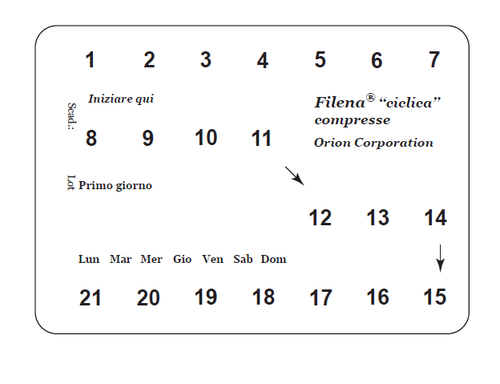
cyclic to be taken in 2 phases with 21 tablets. The dosage is, following the blister-calendar, of one
tablet a day, for 21 consecutive days, followed by a 7-day break without taking
tablets.
The tablets should be taken according to the following instructions:
- one white tablet (containing 2 mg of valerate estradiol) per day for the first 11 days of the cycle;
- one blue tablet in the next 10 days (containing 2 mg of valerate estradiol and 10 mg of medroxyprogesterone acetate).
- Followed by a 7-day interval without taking the tablets, during which, normally, a withdrawal bleeding occurs.
The blister shows the numerical sequence according to which the tablets must be taken; on the
blister are also printed, one after the other, the days of the week (MON ... SUN); it is
recommended to mark the day you take the first pill (number 1) with the
corresponding day of the week; this makes it easier to remember when the corresponding
treatment started and to check if the tablets have been taken correctly.
Tablet number 8 and number 15 will be taken on the same day of the week as number 1.
HRT should be continued only as long as the benefit obtained in relieving severe symptoms is
greater than the risk.
Treatment with Filena can be started at any time in women who are not already
undergoing Hormone Replacement Therapy (HRT).
Women coming from another Hormone Replacement Therapy (HRT) that does not lead to
the occurrence of menstruation (continuous combined HRT) can start treatment at any
time.
Women coming from another Hormone Replacement Therapy (HRT) that leads to
the occurrence of menstruation (cyclic or sequential HRT) should start treatment with Filena the day following
completion of the previous 28-day cycle.
The doctor will prescribe the minimum dose to treat your symptoms, for as short a time
as possible. Talk to your doctor if you think this dosage is too high or not high
enough.
If you are going to have surgery
If you are going to have surgery, tell the surgeon that you are using Filena. It may be
necessary to stop using Filena about 4-6 weeks before the surgery to reduce the risk of a
blood clot (see section 2, Blood clots in a vein). Ask your doctor when you can
start using Filena again.
If you take more Filena than you should
Symptoms of overdose may include: nausea, vomiting, breast tension, dizziness,
abdominal pain, drowsiness/fatigue; withdrawal bleeding may occur.
These symptoms disappear with discontinuation of treatment or with dose reduction.
If you accidentally take an excessive dose of the medicine, immediately notify your
doctor or go to the nearest hospital.
If you forget to take Filena
If you forget to take a tablet, it should be taken within 12 hours of the usual time of
taking; otherwise the tablet should be discarded and the next day the usual
tablet should be taken.
If you have completely forgotten to take a tablet, do not take two tablets
at the same time, but only take the one scheduled for that day.
Forgetting one or more tablets of Filena may increase the likelihood of withdrawal bleeding or spotting.
If you stop taking Filena
If you have any doubts about the use of this medicine, ask your doctor or pharmacist.
4. Possible side effects
Like all medicines, this medicine can cause side effects, although not everybody gets them.
The following conditions are reported more often in women using Hormone Replacement Therapy (HRT)
than in those not using Hormone Replacement Therapy (HRT):
- breast cancer
- abnormal growth or tumor of the uterine wall (endometrial hyperplasia or tumor)
- ovarian cancer
- blood clots in the veins of the legs or lungs (venous thromboembolism)
- heart disease
- stroke
- probable memory loss if Hormone Replacement Therapy (HRT) is started at more than 65 years of age.
For more information on these side effects, see section 2.
The side effects associated with the use of Filena are as follows:
Common (may affect up to 1 in 10 people):
- increase or decrease in weight, swelling (edema)
- generalized headache, dizziness
- nausea, vomiting, stomach pain, flatulence
- swollen and painful breasts (breast tension)
- irregular vaginal bleeding (breakthrough bleeding) or spotting, vaginal disorders, menstrual disorders
- depression, nervousness, lethargy
- hot flushes
- increased sweating
Uncommon (may affect up to 1 in 100 people):
- benign tumor of the breast and the inner wall of the uterus
- allergic reaction (hypersensitivity)
- increased appetite, elevated cholesterol levels in the blood (hypercholesterolemia)
- changes in sexual desire and mood, anxiety, insomnia, apathy, emotional instability, reduced concentration, euphoria, agitation
- severe headache (migraine), tingling, tremor
- visual disturbances, dry eye
- palpitations
- high blood pressure (hypertension), inflammation of a vein (phlebitis), reddish-purple blotches (purpura)
- shortness of breath (dyspnea), runny nose (rhinitis)
- constipation, digestive disorders (dyspepsia), diarrhea, rectal disorders
- acne, hair loss (alopecia), dry skin, nail disorders, skin nodule, excessive hair growth (hirsutism), painful reddish skin nodules (erythema nodosum), hives
- joint disorders, muscle cramps
- increased frequency/urgency of urination, incontinence, urinary tract infection (cystitis), discoloration of urine, blood in urine (hematuria)
- sensitive or swollen breasts, abnormal growth of the uterine wall, uterine pathology
- fatigue, altered laboratory tests, weakness, fever, flu-like syndrome, general feeling of discomfort
Rare (may affect more than 1 in 1,000 people):
- intolerance to contact lenses
- blood clots in the veins of the legs or lungs (venous thromboembolism)
- alterations in liver function and bile flow
- skin rash (rash)
- menstrual pain, premenstrual-like syndrome
Post-marketing adverse reactions with unknown frequency (cannot be estimated on the basis of available data
):
- benign tumors of the uterus (uterine fibroids)
- rapid formation of swellings within the layers of the skin, mucous membranes and tissues beneath the mucous membranes of hereditary and acquired character (hereditary and acquired angioedema)
- cerebral circulatory disorders
- pain, abdominal bloating (abdominal distension)
- liver diseases causing yellowing of the skin (cholestatic jaundice)
- contact dermatitis (eczema)
The following side effects have been reported with other Hormone Replacement Therapies (HRT):
- Myocardial infarction
- Gallbladder disease
- Various skin disorders:
- alteration of skin color especially of the face or neck known as "melasma" (cloasma)
- skin rash in the form of redness or blisters (erythema multiforme)
- Inflammation of the pancreas (pancreatitis)
- Probable dementia after 65 years of age.
You should stop treatment with Filena and contact your doctor:
- if you experience the formation of a thrombus (see section “Blood clots in a vein [thrombosis] ”);
- if you suddenly experience vision problems, severe headache or migraine (see section “Stroke”);
- if you experience sudden chest pain that spreads to the arm or neck (see section “Heart disease”);
- if the skin turns yellowish (jaundice);
- if blood pressure increases significantly;
- in case of pregnancy.
Reporting of side effects
If you get any side effects, even those not listed in this leaflet, tell your
doctor or pharmacist. You can also report side effects directly through the national
reporting system at https://www.aifa.gov.it/content/segnalazioni-reazioni-avverse.
By reporting side effects you can help provide more information on the safety of
this medicine.
5. How to store Filena
Keep this medicine out of the sight and reach of children.
Do not store at a temperature above 25°C.
Do not use this medicine after the expiry date which is stated on the label after “EXP”.
The expiry date refers to the last day of that month.
Do not dispose of any medicine in wastewater or household waste. Ask your pharmacist how
to eliminate medicines that you no longer use. This will help protect the environment.
6. Contents of the pack and other information
What Filena contains
Filena consists of 11 white tablets and 10 blue tablets:
Each white tablet contains:
The active ingredient is: estradiol valerate 2 mg.
The other ingredients are: lactose, corn starch, gelatin, purified water, talc, magnesium stearate.
Each blue tablet contains:
The active ingredients are: estradiol valerate 2 mg; medroxyprogesterone acetate 10 mg.
The other ingredients are: lactose, corn starch, gelatin, purified water, talc, magnesium stearate,
indigo carmine (E 132) and polyvinylpyrrolidone (K25).
Description of the appearance of Filena and contents of the pack
Filena is presented in tablet form.
Each blister contains 11 white tablets and 10 blue tablets.
The packs contain: 1 blister or 3 blisters.
Marketing Authorisation Holder
Orion Corporation, Orionintie 1, FI-02200 Espoo, Finland.
Distributor for sales
Orion Pharma S.r.l. - Milan
Manufacturer
Orion Corporation Orion Pharma
Orionintie 1, FI-02200 Espoo, Finland
Delpharm Lille S.A.S. - Lys Lez Lannoy
Parc d’ Activités Roubaix-Est
22 rue de Toufflers
CS 50070
Lys Lez Lannoy 59452, France

Не уверены, подходит ли вам это лекарство?
Обсудите симптомы и варианты лечения с врачом онлайн.

Уже начали прием и появились вопросы?
Обсудите свое состояние и дальнейшие шаги с врачом онлайн.
- Страна регистрации
- Форма выпускаCoated tablet
- Код АТХG03FA12
- Действующее вещество
- Отпускается по рецептуНет
- Производитель
- Информация на этой странице носит справочный характер и не является медицинской консультацией. Перед началом приема лекарства обязательно проконсультируйтесь с врачом.
- Аналоги FILENAДействующее вещество: norethisterone and estrogenПроизводитель: NOVO NORDISK S.P.A.Отпускается по рецептуФорма выпуска: Film-coated tablet, 1 MG/2MGДействующее вещество: drospirenone and estrogenПроизводитель: BAYER S.P.A.Отпускается без рецептаФорма выпуска: Soft capsule, 1 MG/100 MGДействующее вещество: progesterone and estrogenПроизводитель: THERAMEX IRELAND LIMITEDОтпускается по рецепту
Аналоги FILENA в других странах
Лекарства с тем же действующим веществом, доступные в других странах.
Аналог FILENA в Испания
Врачи онлайн по FILENA
Обсудите применение FILENA и возможные следующие шаги — по оценке врача.
Получите рецепт на FILENA онлайн
Заполните форму за 2 минуты
Расскажите о симптомах, истории болезни и нужном препарате.
Выберите врача или мы назначим
Выберите специалиста или мы подберём ближайшего доступного врача.
Врач рассматривает ваш случай
Обычно в течение 30 минут. Может задать уточняющие вопросы в чате.
Получите в любой аптеке
Электронный рецепт отправляется на вашу почту — действителен по всей Польше.
Часто задаваемые вопросы
FILENA не требует рецепта в Италия. Вы можете уточнить у врача онлайн, подходит ли это лекарство для вашей ситуации.
Действующее вещество FILENA — medroxyprogesterone and estrogen. Эта информация помогает определить лекарства с тем же составом под другими торговыми названиями.
FILENA производится компанией ORION CORPORATION. Упаковка и торговое название могут отличаться в зависимости от дистрибьютора.
Врачи, включая Семейные врачи, Психиатры, Дерматологи, Кардиологи, Эндокринологи, Гастроэнтерологи, Пульмонологи, Нефрологи, Ревматологи, Гематологи, Инфекционисты, Аллергологи, Гериатры, Педиатры, Онкологи, могут оценить целесообразность применения FILENA с учетом вашей ситуации и местных правил. Вы можете записаться на онлайн-консультацию, чтобы обсудить возможные варианты.
Польша имеет хорошо развитую систему здравоохранения в крупных городах, таких как Варшава, Краков, Вроцлав и Гданьск. Аптеки широко доступны и работают в соответствии с действующим законодательством, обеспечивая доступ к рецептурным препаратам.
Вы можете купить FILENA в Варшаве, Кракове, Вроцлаве или Гданьске в любой аптеке при наличии действующего рецепта.
Чтобы получить рецепт, вы можете воспользоваться Oladoctor:
Другие лекарства с тем же действующим веществом (medroxyprogesterone and estrogen) включают AKTIVELLE, ANJELIQ, BIJUVA. Они могут отличаться торговым названием или формой выпуска, но содержат одинаковый терапевтический компонент. Перед изменением лечения рекомендуется проконсультироваться с врачом.
