



FEDIVELLE 1.000 IU Soft capsule

Рассмотрение рецепта онлайн
Врач рассмотрит ваш случай и примет решение о назначении рецепта, если это медицински оправдано.

Поговорите с врачом об этом лекарстве
Обсудите симптомы и возможные дальнейшие шаги на онлайн-консультации.



Инструкция по применению FEDIVELLE
Содержание инструкции
Fedivelle 1.000 U.I. soft capsules
cholecalciferol
Read this leaflet carefully before you start taking this medicine as it contains important information for you.
- Keep this leaflet. You may need to read it again.
- If you have any questions, ask your doctor or pharmacist.
- This medicine has been prescribed for you only. Do not pass it on to others, even if they have the same symptoms as you, as it may be harmful.
- If you get any side effects, even those not listed in this leaflet, tell your doctor or pharmacist. See section 4.
Contents of this leaflet
- 1. What Fedivelle is and what it is used for
- 2. What you need to know before you take Fedivelle
- 3. How to take Fedivelle
- 4. Possible side effects
- 5. How to store Fedivelle
- 6. Contents of the pack and other information
1. What is Fedivelle and what is it used for
Fedivelle contains vitamin D3 which regulates calcium absorption and metabolism and
the incorporation of calcium into bone tissue.
Fedivelle is indicated in the following cases:
- Treatment of vitamin D deficiency in adults and adolescents.
- Prevention of vitamin D deficiency in adults with an identified risk.
- Some bone conditions, such as bone thinning (osteoporosis), when administered together with other medicines.
2. What you need to know before you take Fedivelle
Do not take Fedivelle:
- if you are allergic to cholecalciferol or any of the other ingredients of this medicine (listed in section 6);
- if you have high levels of calcium in your blood or urine;
- if you have kidney stones;
- if you have severe kidney problems.
Warnings and precautions
When you take Fedivelle, your doctor will check the level of calcium in your blood and/or urine to
make sure they are not too high.
Talk to your doctor or pharmacist before taking Fedivelle if:
- you have a very increased risk of developing kidney stones;
- you have any condition that may have an effect on your bones;
- you have an altered hormonal metabolism of the parathyroid gland (pseudo-hypoparathyroidism);
- you have "sarcoidosis"; a condition of the immune system that can affect the liver, lungs, skin or lymph nodes;
- you have heart problems;
- you are already taking additional doses of calcium or vitamin D.
Children and adolescents
This medicine is not indicated for use in children under 12 years of age.
Other medicines and Fedivelle
Tell your doctor if you are taking, have recently taken or might take any other
medicines.
- products containing high doses of calcium: increase the risk of high levels of calcium in the blood;
- medicines for the heart (cardiac glycosides, such as digoxin). Your doctor may monitor your heart with an electrocardiogram (ECG) and measure calcium levels in your blood;
- thiazide diuretics, as they may increase the risk of hypercalcemia
- medicines for epilepsy (such as phenytoin) or sleeping pills (barbiturates, such as phenobarbital), as these medicines may reduce the effect of vitamin D;
- antibiotics such as rifampicin and isoniazid for the treatment of bacterial infections;
- laxatives (such as paraffin oil), orlistat, a medicine used to treat obesity, or a medicine to lower cholesterol called colestyramine, as they may reduce the absorption of vitamin D;
- products containing magnesium (e.g. antacids) - these should not be used during treatment with vitamin D due to the risk of high levels of magnesium;
- products containing large amounts of phosphorus. These agents increase the risk of high blood phosphate levels;
- Actinomycin (a medicine used to treat some forms of cancer) and imidazole antimycotics (medicines such as clotrimazole and ketoconazole that are used to treat fungal diseases), because they can interfere with vitamin D metabolism;
- glucocorticoids (steroid hormones, such as hydrocortisone or prednisolone). These can reduce the effect of vitamin D.
Pregnancy and breastfeeding
Pregnancy
If you are pregnant, suspect you are pregnant, are planning to become pregnant or are breastfeeding with
breast milk, ask your doctor or pharmacist for advice before taking this medicine.
You should not take this medicine during pregnancy without a confirmed vitamin
D deficiency.
During pregnancy, high doses of vitamin D3 which are administered weekly or
monthly instead of daily are not recommended for safety reasons.
Breastfeeding
Fedivelle can be used during breastfeeding when vitamin D deficiency is confirmed.
Vitamin D passes into breast milk. This should be taken into consideration when
prescribing additional vitamin D to the breastfed baby. Such supplementation does not replace
the administration of vitamin D in newborns.
Driving and using machines
No effects on the ability to drive and operate machines are known.
Fedivelle contains tartrazine
It may cause allergic reactions.
Fedivelle contains sorbitol
This medicine contains 4.8 mg of sorbitol per capsule.
3. How to take Fedivelle
The amount of Fedivelle will depend on vitamin D levels and response to treatment.
Treatment of vitamin D deficiency (loading dose) in:
- Adults: 1,000-4,000 I.U./day (1 to 4 capsules per day)
- Adolescents: 1,000 I.U./day (1 capsule per day); higher doses may be administered according to the doctor's opinion, but must not exceed 4,000 I.U. per day (4 capsules per day). Depending on the conditions, the doctor may modify the dose. Any further treatment necessary with Fedivelle must be decided by the doctor.
Prevention of vitamin D deficiency (maintenance dose) in adults: 1,000 I.U. (1 capsule) per
day.
In addition to specific therapy in patients with osteoporosis: 1,000 I.U. (1 capsule) per day.
Swallow the capsule whole (do not chew) with water, preferably with a substantial meal.
Use in children
This medicine is not indicated for use in children under 12 years of age.
If you take more Fedivelle than you should
If you have taken too many Fedivelle capsules than you should, contact your doctor or
pharmacist immediately. Bring the medicine package with you.
An overdose may lead to an increase in calcium levels in the blood and urine identified
by laboratory tests.
Signs and symptoms of overdose may include loss of appetite, thirst, nausea, vomiting, diarrhea
followed by constipation, abdominal pain, headache, muscle and joint pain, muscle weakness,
fatigue, confusion, more frequent urination than usual with calcium in the urine,
kidney problems and, in severe cases, irregular heartbeat, coma or even death.
If you forget to take Fedivelle
Do not take a double dose to make up for a missed dose. If you forget to take the
capsules, take them as soon as possible. Then take the next dose at the correct time following the
instructions provided by the doctor. However, if it is almost time to take the next dose, do not take the
forgotten dose but take the next dose normally.
If you stop taking Fedivelle
If you have any doubts about the use of this medicine, contact your doctor or pharmacist.
4. Possible side effects
Like all medicines, this medicine can cause side effects, although not everybody gets them.
Uncommon side effects (may affect up to 1 in 100 people)
- too much calcium in the blood (hypercalcemia). You may feel or become unwell, lose your appetite, have constipation, stomach pain, feel very thirsty, muscle weakness, drowsiness and confusion
- too much calcium in the urine (hypercalciuria).
Rare side effects (may affect up to 1 in 1,000)
- skin rash
- itching
- raised itchy rash (urticaria)
Reporting of side effects
If you get any side effects, talk to your doctor or pharmacist. You can also report side effects directly through the national reporting system at https://www.aifa.gov.it/content/segnalazioni-reazioni-avverse.
By reporting side effects you can help provide more information on the safety of
this medicine.
5. How to store Fedivelle
Keep this medicine out of the sight and reach of children.
Do not use this medicine after the expiry date which is stated on the pack after Exp. The expiry date refers to the last day of that month.
Do not use this medicine if you notice any visible signs of deterioration.
Do not dispose of any medicine in waste water or household waste. Ask your pharmacist how to
dispose of medicines you no longer use. This will help protect the environment.
6. Contents of the pack and other information
What Fedivelle contains
- The active ingredient is cholecalciferol.
- The other ingredients are medium chain triglycerides, all-rac-α-tocopheryl acetate, gelatin (E441), glycerol (E422), liquid sorbitol (E420) (partially dehydrated) and tartrazine yellow (E102).
Description of the appearance of Fedivelle and contents of the pack
Fedivelle 1,000 I.U. capsules are round and transparent yellow soft gelatin capsules
containing clear transparent liquid.
Pack in blisters containing 30 capsules.
Marketing Authorisation Holder and Manufacturer
Theramex Ireland Limited
3 Floor, Kilmore House,
Park Lane, Spencer Dock,
Dublin 1
D01 YE64
Ireland
Manufacturer
NetPharma Lab Consulting Services
Carretera de Fuencarral, 22
- 28051 – Alcobendas Madrid Spain
This medicinal product is authorised in the Member States of the European Economic Area with the
following denominations:
Netherlands: Fedivelle 1,000 IU
Spain: Lundeos 1,000 UI soft capsules
Italy: Fedivelle 1,000 I.U. soft capsules
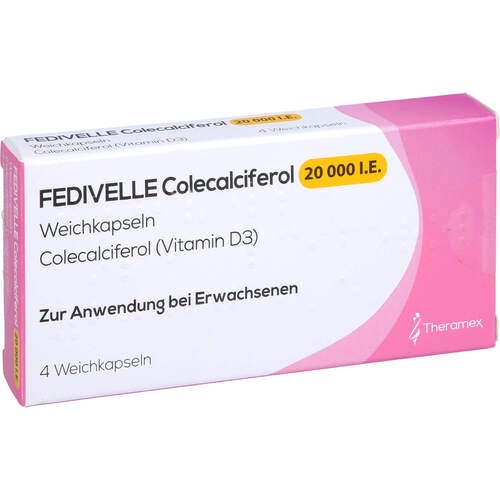
Fedivelle 20.000 U.I. soft capsules
colecalciferol
Read this leaflet carefully before taking this medicine as it contains
important information for you.
- Keep this leaflet. You may need to read it again.
- If you have any questions, ask your doctor or pharmacist.
- This medicine has been prescribed for you only. Do not pass it on to others, even if their symptoms are the same as yours, as it may be harmful.
- If you experience any side effects, including those not listed in this leaflet, tell your doctor or pharmacist. See section 4.
Contents of this leaflet
- 7. What is Fedivelle and what it is used for
- 8. What you need to know before you take Fedivelle
- 9. How to take Fedivelle
- 10. Possible side effects
- 11. How to store Fedivelle
- 12. Contents of the pack and other information
1. What is Fedivelle and what is it used for
Fedivelle contains vitamin D3 which regulates the absorption and metabolism of calcium and
the incorporation of calcium into bone tissue.
Fedivelle is indicated for the treatment of vitamin D deficiency in adults.
2. What you need to know before you take Fedivelle
Do not take Fedivelle:
- if you are allergic to cholecalciferol or any of the other ingredients of this medicine (listed in section 6);
- if you have high levels of calcium in the blood or urine;
- if you have kidney stones;
- if you have severe kidney problems.
Warnings and precautions
When you take Fedivelle, your doctor will check the level of calcium in the blood and/or urine to
ensure that they are not too high.
Talk to your doctor or pharmacist before taking Fedivelle if:
- you have a very increased risk of developing kidney stones;
- you have any condition that may have an effect on the bones;
- you have an altered hormonal metabolism of the parathyroid gland (pseudo-hypoparathyroidism);
- you have "sarcoidosis"; a condition of the immune system that can affect the liver, lungs, skin or lymph nodes;
- you have heart problems;
- you are already taking additional doses of calcium or vitamin D.
Children and adolescents
This medicine is not recommended for use in children and adolescents under 18 years of age.
Other medicines and Fedivelle
Tell your doctor if you are taking, have recently taken or might take any other
medicines.
- products containing high doses of calcium: increase the risk of high levels of calcium in the blood;
- medicines for the heart (cardiac glycosides, such as digoxin). Your doctor may monitor your heart with an electrocardiogram (ECG) and measure the levels of calcium in the blood;
- thiazide diuretics, as they can increase the risk of hypercalcemia
- medicines for epilepsy (such as phenytoin) or sleeping pills (barbiturates, such as phenobarbital), as these medicines can reduce the effect of vitamin D;
- antibiotics such as rifampicin and isoniazid for the treatment of bacterial infections;
- laxatives (such as paraffin oil), orlistat, a medicine used for the treatment of obesity or a medicine to lower cholesterol called colestyramine, as they can reduce the absorption of vitamin D;
- products containing magnesium (for example antacids) - these should not be used during treatment with vitamin D due to the risk of high levels of magnesium;
- products containing large amounts of phosphorus. These agents increase the risk of high blood phosphate levels;
- Actinomycin (a medicine used to treat some forms of cancer) and imidazole antifungals (medicines such as clotrimazole and ketoconazole that are used to treat fungal diseases), because they can interfere with the metabolism of vitamin D;
- glucocorticoids (steroid hormones, such as hydrocortisone or prednisolone). These can reduce the effect of vitamin D.
Pregnancy and breastfeeding
Pregnancy
This medicine is a high-dose formulation and is not recommended for use during
pregnancy.
Breastfeeding
Fedivelle can be used during breastfeeding. Vitamin D passes into breast milk. This
should be taken into consideration when prescribing additional vitamin D to the breastfed baby
Driving and using machines
No effects on the ability to drive and use machines are known.
Fedivelle contains sorbitol
This medicine contains 4.8 mg of sorbitol per capsule.
3. How to take Fedivelle
Take this medicine following the instructions of your doctor or pharmacist exactly. If you have any
doubts, ask your doctor or pharmacist.
The amount of Fedivelle will depend on your vitamin D levels and your response to treatment.
Treatment of vitamin D deficiency (loading dose) in adults: 20,000 IU per week (1
capsule).
After the first month of treatment and based on your condition, your doctor may consider a lower
dose. Any further treatment necessary with Fedivelle must
be decided by your doctor.
Swallow the capsule whole (do not chew) with water, preferably with a substantial meal.
Use in children
This medicine is not recommended for use in children and adolescents.
If you take more Fedivelle than you should
If you have taken too many Fedivelle capsules than you should, contact your doctor or
pharmacist immediately. Bring the medicine packaging with you.
An overdose may lead to an increase in calcium levels in the blood and urine identified
by laboratory tests.
Signs and symptoms of overdose may be loss of appetite, thirst, nausea, vomiting, diarrhea
followed by constipation, abdominal pain, headache, muscle and joint pain, muscle weakness,
fatigue, confusion, more frequent urination than usual with calcium in the urine,
kidney problems and, in severe cases, irregular heartbeat, coma or even death.
If you forget to take Fedivelle
Do not take a double dose to make up for a missed dose. If you forget to take the
capsules, take them as soon as possible. Then take the next dose at the correct time following the
instructions provided by your doctor. However, if it is almost time to take the next dose, do not take the
forgotten dose but take the next dose normally.
If you stop taking Fedivelle
If you have any doubts about the use of this medicine, ask your doctor or pharmacist.
4. Possible side effects
Like all medicines, this medicine can cause side effects, although not everybody gets them.
Uncommon side effects (may affect up to 1 in 100 people)
- too much calcium in the blood (hypercalcemia). You may feel or be sick, lose your appetite, have constipation, stomach pain, feel very thirsty, muscle weakness, drowsiness and confusion
- too much calcium in the urine (hypercalcinuria). Rare side effects (may affect up to 1 in 1,000 people)
- skin rash
- itching
- raised itchy rash (urticaria)
Reporting of side effects
If you get any side effects, even those not listed in this leaflet, tell your doctor or pharmacist. You can also report side effects directly through the national reporting system at https://www.aifa.gov.it/content/segnalazioni-reazioni-avverse.
By reporting side effects you can help provide more information on the safety of this medicine.
5. How to store Fedivelle
Keep this medicine out of the sight and reach of children.
Do not use this medicine after the expiry date which is stated on the pack after Exp. The expiry date refers to the last day of that month.
Do not use this medicine if you notice any visible signs of deterioration.
Do not dispose of any medicine in wastewater or household waste. Ask your pharmacist how to
dispose of medicines you no longer use. This will help protect the environment.
6. Contents of the pack and other information
What Fedivelle contains
- The active ingredient is cholecalciferol.
- The other ingredients are medium chain triglycerides, all-rac-α-tocopheryl acetate, gelatin (E441), glycerol (E422) and liquid sorbitol (E420) (partially dehydrated).
Description of the appearance of Fedivelle and contents of the pack
Fedivelle 20,000 I.U. capsules are round, transparent, light yellow soft gelatin capsules
containing clear, transparent liquid.
Packs in blisters containing 5, 10 and 14 capsules.
Not all pack sizes may be marketed.
Marketing Authorisation Holder and Manufacturer
Theramex Ireland Limited
3 Floor, Kilmore House,
Park Lane, Spencer Dock,
Dublin 1
D01 YE64
Ireland
Manufacturer
NetPharma Lab Consulting Services
Carretera de Fuencarral, 22
- 28051 – Alcobendas Madrid Spain
This medicinal product is authorised in the Member States of the European Economic Area under the
following denominations:
Netherlands: Fedivelle 20,000 IU
Spain: Lundeos 20,000 UI soft capsules
Italy: Fedivelle 20,000 U.I. soft capsules

Не уверены, подходит ли вам это лекарство?
Обсудите симптомы и варианты лечения с врачом онлайн.

Уже начали прием и появились вопросы?
Обсудите свое состояние и дальнейшие шаги с врачом онлайн.
- Страна регистрации
- Форма выпускаSoft capsule, 1.000 IU
- Код АТХA11CC05
- Действующее вещество
- Отпускается по рецептуДа
- Производитель
- Информация на этой странице носит справочный характер и не является медицинской консультацией. Перед началом приема лекарства обязательно проконсультируйтесь с врачом.
- Аналоги FEDIVELLEФорма выпуска: Film-coated tablet, 1000 IUДействующее вещество: colecalciferolПроизводитель: I.B.N. SAVIO S.R.LОтпускается по рецептуФорма выпуска: Film-coated tablet, 800 IUДействующее вещество: colecalciferolПроизводитель: I.B.N. SAVIO S.R.LОтпускается по рецептуФорма выпуска: Soft capsule, 10,000 IUДействующее вещество: colecalciferolПроизводитель: PHARMACARE S.R.L.Отпускается по рецепту
Аналоги FEDIVELLE в других странах
Лекарства с тем же действующим веществом, доступные в других странах.
Аналог FEDIVELLE в Испания
Аналог FEDIVELLE в Польша
Аналог FEDIVELLE в Украина
Врачи онлайн по FEDIVELLE
Обсудите применение FEDIVELLE и возможные следующие шаги — по оценке врача.









Получите рецепт на FEDIVELLE онлайн
Заполните форму за 2 минуты
Расскажите о симптомах, истории болезни и нужном препарате.
Выберите врача или мы назначим
Выберите специалиста или мы подберём ближайшего доступного врача.
Врач рассматривает ваш случай
Обычно в течение 30 минут. Может задать уточняющие вопросы в чате.
Получите в любой аптеке
Электронный рецепт отправляется на вашу почту — действителен по всей Польше.
Часто задаваемые вопросы
FEDIVELLE требует рецепта в Италия. Вы можете уточнить у врача онлайн, подходит ли это лекарство для вашей ситуации.
Действующее вещество FEDIVELLE — colecalciferol. Эта информация помогает определить лекарства с тем же составом под другими торговыми названиями.
FEDIVELLE производится компанией THERAMEX IRELAND LIMITED. Упаковка и торговое название могут отличаться в зависимости от дистрибьютора.
Врачи, включая Семейные врачи, Психиатры, Дерматологи, Кардиологи, Эндокринологи, Гастроэнтерологи, Пульмонологи, Нефрологи, Ревматологи, Гематологи, Инфекционисты, Аллергологи, Гериатры, Педиатры, Онкологи, могут оценить целесообразность применения FEDIVELLE с учетом вашей ситуации и местных правил. Вы можете записаться на онлайн-консультацию, чтобы обсудить возможные варианты.
Польша имеет хорошо развитую систему здравоохранения в крупных городах, таких как Варшава, Краков, Вроцлав и Гданьск. Аптеки широко доступны и работают в соответствии с действующим законодательством, обеспечивая доступ к рецептурным препаратам.
Вы можете купить FEDIVELLE в Варшаве, Кракове, Вроцлаве или Гданьске в любой аптеке при наличии действующего рецепта.
Чтобы получить рецепт, вы можете воспользоваться Oladoctor:
Другие лекарства с тем же действующим веществом (colecalciferol) включают ANNEXXO, ANNOVA, ANORSIA. Они могут отличаться торговым названием или формой выпуска, но содержат одинаковый терапевтический компонент. Перед изменением лечения рекомендуется проконсультироваться с врачом.
