



EPISTATUS 10 mg Оральный Мукозный Раствор

Рассмотрение рецепта онлайн
Врач рассмотрит ваш случай и примет решение о назначении рецепта, если это медицински оправдано.

Поговорите с врачом об этом лекарстве
Обсудите симптомы и возможные дальнейшие шаги на онлайн-консультации.



Инструкция по применению EPISTATUS
Содержание инструкции
Epistatus 10 mg oral mucosal solution
midazolam
Read this leaflet carefully before using this medicine as it contains important
information for you.
- Keep this leaflet. You may need to read it again.
- If you have any questions, ask your doctor or pharmacist.
- This medicine has been prescribed only for your child or adolescent. Do not give it to other people, even if their symptoms are the same as yours, as it could be dangerous.
- If any side effects occur, including those not listed in this leaflet, tell your doctor or pharmacist. See section 4.
Contents of this leaflet
- 1. What Epistatus is and what it is used for
- 2. What you need to know before using Epistatus
- 3. How to use Epistatus
- 4. Possible side effects
- 5. How to store Epistatus
- 6. Contents of the pack and other information
1. What is Epistatus and what is it used for
Epistatus 10 mg oral mucosal solution contains a medicine called midazolam, which belongs to a group of medicines known as benzodiazepines.
Epistatus is used to stop a sudden, prolonged convulsive crisis ('seizure') in children and adolescents aged between 10 and less than 18 years.
This medicine must only be used by parents/caregivers of patients who have been diagnosed with epilepsy. The patient's doctor must give parents or caregivers instructions on how to administer Epistatus and what to do if the seizure does not stop.
2. What you need to know before using Epistatus
Do not administer Epistatus if the patient has
- An allergy to midazolam, to any other benzodiazepine (such as diazepam or nitrazepam), or to any of the other ingredients of this medicine (listed in section 6).
- A disease called ‘myasthenia gravis’ (which causes muscle weakness).
- Severe breathing problems (Epistatus may worsen breathing difficulties).
- Sleep apnea syndrome (which causes frequent interruptions of breathing during sleep).
- Severe liver problems.
Warnings and precautions
Consult your doctor or pharmacist before using Epistatus if the patient
- Has a lung disorder that causes difficulty breathing as this medicine may worsen breathing.
- Has problems with the kidneys, liver or heart.
- Is taking any other medicine with a sedative effect and feels very weak, debilitated and lacking in energy because this medicine acts on the central nervous system (CNS).
- Regularly drinks large amounts of alcohol or has had problems with alcohol use in the past (see "Epistatus contains ethanol (alcohol)").
- Regularly uses recreational drugs or has had problems with drug use in the past. This medicine may affect the patient's memory of events after it has been administered (temporary memory loss). Patients should be kept under close observation after the medicine has been administered. See also section 4 (Possible side effects).
If you have any doubts as to whether the patient falls into any of the above cases, consult your doctor or pharmacist before
administering this medicine.
Children and adolescents
This medicine must only be administered to children and adolescents between the ages of
10 and less than 18 years.
Other medicines and Epistatus
Tell your doctor or pharmacist if the patient is taking, has recently taken or might
take any other medicines. If you have any doubts as to whether a medicine taken
by the patient may affect the use of Epistatus, consult your doctor or pharmacist.
This is extremely important, because using more than one medicine at the same time may strengthen
or weaken the effect of the medicines themselves.
The effects of Epistatus may be intensified by medicines such as:
- antiepileptics, (for the treatment of epilepsy) e.g. phenytoin
- antibiotics, e.g. erythromycin, clarithromycin
- antifungals, e.g. ketoconazole, voriconazole, fluconazole, itraconazole, posaconazole
- medicines for ulcers, e.g. cimetidine, ranitidine and omeprazole
- medicines used to treat blood pressure, e.g. diltiazem, verapamil
- certain medicines used to treat HIV and AIDS, e.g. saquinavir, lopinavir/ritonavir combination
- narcotic analgesics (very potent painkillers), e.g. fentanyl
- medicines used to reduce blood fats, e.g. atorvastatin
- medicines used to treat nausea, e.g. nabilone
- hypnotics (medicines that induce sleep)
- sedative antidepressants (medicines for the treatment of depression that cause drowsiness)
- sedatives (medicines that relax)
- anaesthetics (for pain relief)
- antihistamines (for the treatment of allergies).
The effects of Epistatus may be reduced by medicines such as:
- rifampicin (used to treat tuberculosis)
- xanthines (used to treat asthma)
- St John's wort (a herbal medicine). This should be avoided in patients taking Epistatus. Epistatus may increase the effect of some muscle relaxants, e.g. baclofen (causing increased drowsiness). This medicine may also prevent some other medicines from performing their action, e.g. levodopa (used to treat Parkinson's disease).
The concomitant use of Epistatus and opioids (strong painkillers, medicines for substitution therapy and
some medicines for cough) increases the risk of drowsiness, breathing difficulties (respiratory depression), coma and may be fatal. For this reason, concomitant use should only be considered when other treatment options are not possible.
However, if your doctor prescribes Epistatus together with opioids, the dose and duration of treatment
with opioids must be limited by your doctor.
Tell your doctor about all medicines containing opioids that you are taking and carefully follow the
doses recommended by your doctor. It may be helpful to inform friends or family members so that they
are aware of the signs and symptoms above. Consult your doctor when these
symptoms occur.
Epistatus contains a small amount of alcohol and therefore should not be administered in
concomitance with disulfiram.
Consult your doctor or pharmacist about the medicines that the patient should avoid during treatment
with Epistatus.
Surgery
If the patient is to be given an inhalation anaesthetic (one that the patient breathes) for
surgery or dental treatment, it is important to inform the doctor or dentist
that the patient has been given Epistatus.
Epistatus with food, drinks and alcohol
The patient should not drink alcohol during treatment with Epistatus. Alcohol may increase the
sedative effects of Epistatus and cause severe drowsiness.
The patient should not drink grapefruit juice during treatment with Epistatus. Grapefruit juice may increase the
sedative effects of Epistatus and cause severe drowsiness.
Pregnancy, breastfeeding and fertility
Pregnancy
If the patient is pregnant, suspects she is pregnant or is planning a pregnancy, ask your
doctor for advice before administering this medicine.
Midazolam may be used during pregnancy if absolutely necessary. The
administration of frequent doses of this medicine during the last 3 months of pregnancy or
during labour may cause problems for the newborn; these may include irregular heartbeat,
hypothermia (low body temperature), poor sucking, breathing difficulties and poor muscle tone
at birth.
Breastfeeding
Tell your doctor if the patient is breastfeeding. Although small amounts of Epistatus may pass
into breast milk, it may not be necessary to stop breastfeeding. The doctor will advise
the patient whether to temporarily stop breastfeeding after the administration of Epistatus.
Driving and using machines
Epistatus can significantly affect the ability to drive and use machines.
This medicine may cause the patient to feel drowsy, forgetful or affect
concentration and coordination. This may affect their ability to perform tasks that
require skill, such as driving vehicles, riding a bicycle or using machinery. After
administration of this medicine, the patient should not drive vehicles, ride a bicycle or
use machines until fully recovered. Consult your doctor if you need further advice.
Epistatus contains maltitol
If your doctor has told you that you have an intolerance to some sugars, tell your doctor before
administering this medicine.
Epistatus contains ethanol (alcohol)
This medicine contains 197 mg of alcohol (ethanol) per dose, which is equivalent to 25 vol %.
The amount per dose of this medicine is equivalent to less than 5 ml of beer or 2 ml of wine.
The small amount of alcohol in this medicine will have no noticeable effects.
Epistatus contains sodium
This medicine contains less than 1 mmol (23 mg) of sodium per dose, i.e. it is essentially ‘sodium-free’.
3. How to use Epistatus
Administer this medicine following the doctor's instructions exactly. If you have any doubts,
consult your doctor or pharmacist. The patient's doctor must give parents or caregivers
instructions on how to administer Epistatus and what to do if the convulsion does not stop.
Epistatus is exclusively for oral mucosal use, which means it must be administered only
in the mouth. Take care when administering the product to avoid the risk of
patient choking
For children and adolescents between 10 and less than 18 years of age, the recommended dose is 10 mg (1
ml). This dose is completely contained in an oral administration syringe. Do not
administer more than one dose without first consulting a doctor.
The patient must be kept under close observation after the administration of Epistatus and it is
necessary for someone to be present.
Epistatus must not be injected. Do not attach a needle to the syringe.
How to prepare to administer this medicine
If the patient has a convulsive crisis ("seizure"), allow the body to move freely
and do not try to restrain it. Move the patient only if they are in danger from the
surrounding environment, for example a road, deep water, hot cooking appliances, fire or sharp
objects.
Support the patient's head with something soft, such as a pillow or your lap
How to administer this medicine
Ask a doctor, pharmacist or nurse to show you how to take or administer
this medicine. Always consult them if you have any doubts.
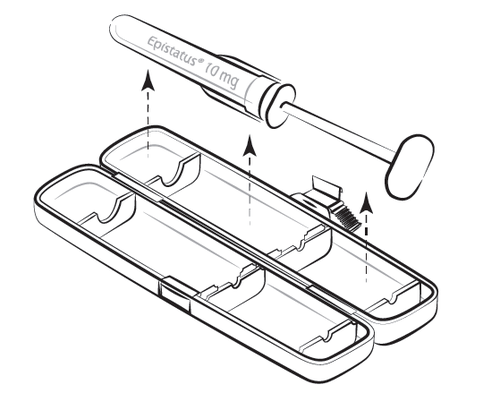
Step 1
Pull the tamper-evident tab on the side
of the polypropylene secondary packaging,
open it and remove the syringe
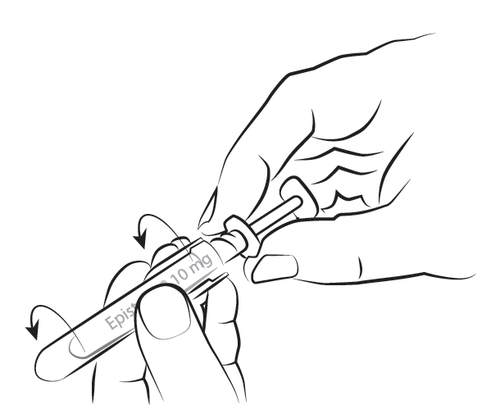
Step 2
Holding the transparent finger grips,
unscrew the amber protective cap counterclockwise and remove the
amber protective cap.
.
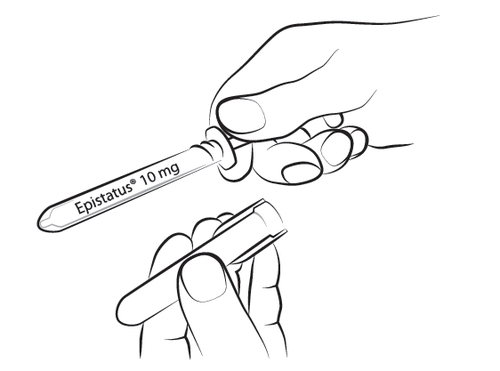
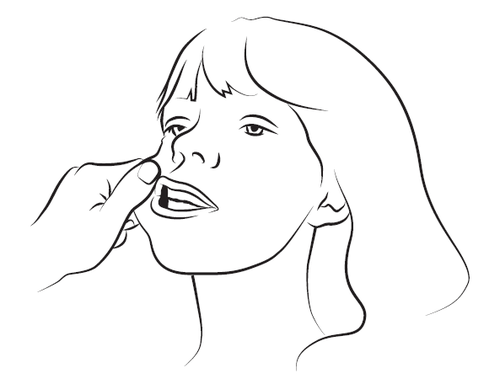
Step 3
With your index finger and thumb gently pinch
the patient's cheek and pull it back. Insert the
syringe tip into the back of the space between
the inside of the cheek and the lower gum
(buccal cavity).
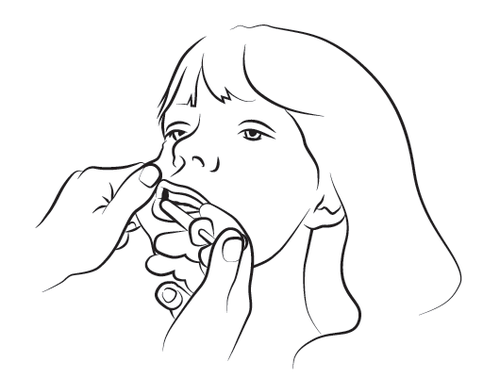
Step 4
Slowly administer about half of the
solution into the oral cavity on one side of the
mouth, then slowly administer the rest on the
other side, pressing the syringe plunger until it stops. If it is particularly
difficult to insert the syringe into an oral cavity,
administer the entire dose for a duration of 4-5
seconds into the other oral cavity. Dispose of the syringe
and cap safely.
If the patient's condition does not improve
Seek emergency medical assistance - call an ambulance immediately - if the patient's convulsions
do not stop shortly after the administration of Epistatus.
Follow the instructions you received from the patient's doctor on how to act in this situation.
A second dose of Epistatus should not be administered without the doctor's advice.
If the patient's condition improves but the convulsion ("seizure") restarts
Seek emergency medical assistance - call an ambulance immediately.
A second dose of Epistatus should not be administered without the doctor's advice.
The empty syringe must be delivered to ambulance personnel or the doctor to provide
information about the dose and product received by the patient.
If you have administered more Epistatus than you should
Seek emergency medical assistance - call an ambulance immediately.
Signs that the patient has been given more Epistatus may include:
- Sleepiness, fatigue, tiredness
- Confusion or disorientation
- Loss of coordination
- Onset of muscle weakness
- Low blood pressure - this can cause dizziness and fainting
- Difficulty breathing
The syringe must be kept and shown to ambulance personnel or the doctor.
If you have any doubts about the use of this medicine, ask your doctor or pharmacist.
4. Possible side effects
Like all medicines, this medicine can cause side effects, although not everybody gets them.
Serious side effects
Seek immediate medical attention or call an ambulance if any of the following side effects occur:
- Severe difficulty breathing, e.g. slow breathing, shallow breathing or blue lips. In very rare cases breathing may stop
- Cardiac arrest (the heart has stopped) reported in very rare cases. Symptoms include loss of consciousness associated with the absence of heartbeat.
- Swelling of the face, lips, tongue or throat that makes it difficult to swallow or breathe.
Other side effects
Common side effects (may affect up to 1 in 10 people):
- Drowsiness or loss of consciousness, muscle spasms and muscle tremors (tremors of muscles impossible to control), reduced alertness, headache, dizziness
- Feeling unwell
- Fatigue
Uncommon side effects (may affect up to 1 in 100 people):
- Agitation, hallucinations (seeing and in some cases hearing things that are not there)
- Temporary memory loss
- Skin rash, urticaria (irregular skin rash), itching
Very rare side effects (may affect up to 1 in 10,000 people):
- Aggression, difficulty with muscle coordination, physical aggression
- Seizures (convulsions), restlessness
- Low blood pressure, slowed heart rate or flushing of the face and neck (hot flushes)
- Shortness of breath
- Constipation
- Dry mouth
- Hiccups
Frequency not known (the frequency cannot be estimated from the available data):
- Anger, confusion, hostility, euphoria (an excessive feeling of happiness or excitement)
- Thrombosis (local blood clot or blood clot in part of the circulatory system), laryngospasm (stiffening of the vocal cords, causing difficult and noisy breathing),
Reporting of side effects
If the patient experiences any side effects, including those not listed in this leaflet,
tell your doctor, pharmacist or nurse. You can also report side effects directly through the national reporting system at:
https://www.aifa.gov.it/content/segnalazioni-reazioni-avverse . By reporting side effects you
can help to provide more information on the safety of this medicine.
5. How to store Epistatus
Keep this medicine out of the sight and reach of children.
Do not use this medicine after the expiry date which is stated on the label and on the orange container after “EXP:”. The expiry date refers to the last day of that month.
Do not store above 25°C.
Do not refrigerate or freeze.
Store in the original packaging to protect the medicine from light.
Do not administer this medicine if you notice that the syringe is damaged or if the solution is not
clear (i.e. is cloudy or there are white particles present)
Do not dispose of any medicine in wastewater or household waste. Ask your pharmacist how to
dispose of medicines that you no longer use. This will help protect the environment.
6. Contents of the pack and other information
What Epistatus contains
- The active ingredient is midazolam (as midazolam maleate). Each pre-filled oral syringe (1 ml) contains midazolam maleate corresponding to 10 mg of midazolam.
- The other ingredients are ethanol, sodium saccharin, glycerol, purified water, sodium hydroxide, liquid maltitol.
Description of the appearance of Epistatus and contents of the pack
Epistatus oral mucosal solution is a clear solution from colorless to pale yellow. It is
supplied in a single-dose pre-filled syringe (without needle) for oral administration. Each syringe
for oral administration is individually packaged in its own container. Each syringe
for oral administration contains a single dose of 1 ml of Epistatus.
Marketing authorisation holder and manufacturer
Marketing authorisation holder
SERB SA
Avenue Louise 480, 1050 Brussels
Belgium
Manufacturer
Torbay and South Devon NHS Foundation Trust, Torbay Pharmaceuticals, Wilkins Drive, Paignton,
Devon, TQ4 7FG, United Kingdom

Не уверены, подходит ли вам это лекарство?
Обсудите симптомы и варианты лечения с врачом онлайн.

Уже начали прием и появились вопросы?
Обсудите свое состояние и дальнейшие шаги с врачом онлайн.
- Страна регистрации
- Форма выпускаOral mucosal solution, 10 MG
- Код АТХN05CD08
- Действующее вещество
- Отпускается по рецептуДа
- Производитель
- Информация на этой странице носит справочный характер и не является медицинской консультацией. Перед началом приема лекарства обязательно проконсультируйтесь с врачом.
- Аналоги EPISTATUSФорма выпуска: Oral mucosal solution, 2.5 MGДействующее вещество: МидазоламПроизводитель: NEURAXPHARM PHARMACEUTICALS, S.LОтпускается по рецептуФорма выпуска: Injectable solution, 15 MG/3 MLДействующее вещество: МидазоламПроизводитель: CHEPLAPHARM ARZNEIMITTEL GMBHОтпускается по рецептуФорма выпуска: Injectable solution, 1 MG/MLДействующее вещество: МидазоламПроизводитель: ACCORD HEALTHCARE, S.L.U.Отпускается по рецепту
Аналоги EPISTATUS в других странах
Лекарства с тем же действующим веществом, доступные в других странах.
Аналог EPISTATUS в Испания
Аналог EPISTATUS в Польша
Аналог EPISTATUS в Украина
Врачи онлайн по EPISTATUS
Обсудите применение EPISTATUS и возможные следующие шаги — по оценке врача.







Получите рецепт на EPISTATUS онлайн
Заполните форму за 2 минуты
Расскажите о симптомах, истории болезни и нужном препарате.
Выберите врача или мы назначим
Выберите специалиста или мы подберём ближайшего доступного врача.
Врач рассматривает ваш случай
Обычно в течение 30 минут. Может задать уточняющие вопросы в чате.
Получите в любой аптеке
Электронный рецепт отправляется на вашу почту — действителен по всей Польше.
Часто задаваемые вопросы
EPISTATUS требует рецепта в Италия. Вы можете уточнить у врача онлайн, подходит ли это лекарство для вашей ситуации.
Действующее вещество EPISTATUS — Мидазолам. Эта информация помогает определить лекарства с тем же составом под другими торговыми названиями.
EPISTATUS производится компанией SERB S.A.. Упаковка и торговое название могут отличаться в зависимости от дистрибьютора.
Врачи, включая Семейные врачи, Психиатры, Дерматологи, Кардиологи, Эндокринологи, Гастроэнтерологи, Пульмонологи, Нефрологи, Ревматологи, Гематологи, Инфекционисты, Аллергологи, Гериатры, Педиатры, Онкологи, могут оценить целесообразность применения EPISTATUS с учетом вашей ситуации и местных правил. Вы можете записаться на онлайн-консультацию, чтобы обсудить возможные варианты.
Польша имеет хорошо развитую систему здравоохранения в крупных городах, таких как Варшава, Краков, Вроцлав и Гданьск. Аптеки широко доступны и работают в соответствии с действующим законодательством, обеспечивая доступ к рецептурным препаратам.
Вы можете купить EPISTATUS в Варшаве, Кракове, Вроцлаве или Гданьске в любой аптеке при наличии действующего рецепта.
Чтобы получить рецепт, вы можете воспользоваться Oladoctor:
Другие лекарства с тем же действующим веществом (Мидазолам) включают BUKKOLAM, IPNOVEL, MIDATSOLAM AKKORD EALTKARE. Они могут отличаться торговым названием или формой выпуска, но содержат одинаковый терапевтический компонент. Перед изменением лечения рекомендуется проконсультироваться с врачом.
