



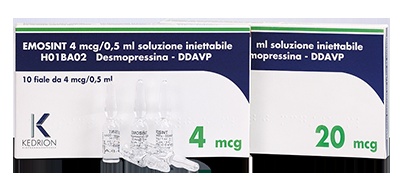
EMOSINT 4 MCG/0.5 ML Инъекционный раствор

Рассмотрение рецепта онлайн
Врач рассмотрит ваш случай и примет решение о назначении рецепта, если это медицински оправдано.

Поговорите с врачом об этом лекарстве
Обсудите симптомы и возможные дальнейшие шаги на онлайн-консультации.



Инструкция по применению EMOSINT
Содержание инструкции
EMOSINT 4 mcg/0,5 ml injectable solution, 20 mcg/1 ml injectable solution
Desmopressin acetate trihydrate
Read this leaflet carefully before you use this medicine as it contains important
information for you.
- Keep this leaflet. You may need to read it again.
- If you have any questions, ask your doctor, pharmacist or nurse.
- This medicine has been prescribed for you only. Do not pass it on to others, even if their symptoms are the same as yours, as it could be harmful.
- If you get any side effects, even those not listed in this leaflet, tell your doctor or pharmacist. See section 4.
Contents of this leaflet:
- 1. What EMOSINT is and what it is used for
- 2. What you need to know before you use EMOSINT
- 3. How to use EMOSINT
- 4. Possible side effects
- 5. How to store EMOSINT
- 6. Contents of the pack and other information
1. What is EMOSINT and what is it used for
EMOSINT contains desmopressin, a synthetic analogue of the antidiuretic hormone (ADH).
EMOSINT is used for:
- the treatment of mild and moderate haemophilia A, and von Willebrand's disease (type 1), conditions characterized by altered factor VIII activity (a protein that regulates blood coagulation);
- the preparation for surgical interventions in patients with mild and moderate haemophilia A, and von Willebrand's disease (type 1).
2. What you need to know before using EMOSINT
Do not use EMOSINT
- if you are allergic to desmopressin or any of the other ingredients of this medicine (listed in section 6);
- if you have von Willebrand disease type II B;
- if you have abnormalities of the blood vessels;
- if you have kidney problems (if you have renal insufficiency).
Warnings and precautions
Talk to your doctor or pharmacist before using EMOSINT.
During therapy, it is possible to experience fluid retention with consequent hyponatremia (decrease in the amount of sodium in the blood).
For this reason, it is necessary to limit fluid intake, especially if you have liver or kidney problems (hepatic or renal insufficiency).
Tell your doctor if:
- you have bronchial asthma,
- you have migraine and/or epilepsy,
- you have heart failure (reduced heart function), if you have coronary artery disease (an alteration of the heart arteries), if you have high blood pressure or if you are at risk of thrombotic events (blockage of a blood vessel).
During treatment, your doctor, if deemed necessary, will prescribe tests to
evaluate blood coagulation.
In the case of repeated treatments with desmopressin, monitoring of
urine production and the amount of salts in the blood will be performed, especially in children and in case of
therapies with other drugs that can reduce the amount of sodium in the blood.
For those who engage in sports: the use of the drug without therapeutic need constitutes doping and
can still result in positive doping tests.
Children and adolescents
EMOSINT can cause fluid retention and/or hyponatremia (decrease in the amount of sodium in the
blood) which can expose you to the risk of convulsions. Those at greater risk are:
- children under 2 years of age;
- children with cystic fibrosis (a genetic disease that causes alterations in mucus secretion);
- children with conditions that induce inappropriate consumption of large amounts of fluids, such as attention deficit and hyperactivity disorder (ADHD) or Prader-Willi syndrome. In these cases, the doctor will recommend restricting fluid intake and blood and urine tests for at least 24 hours after administration.
Other medicines and EMOSINT
Tell your doctor or pharmacist if you are taking, have recently taken or might take
any other medicines.
Tell your doctor if you are being treated with:
Carbamazepine (medicine for epilepsy),
cyclophosphamide (medicine used in the treatment of tumors and diseases of the immune system),
sulfonylureas, in particular chlorpropamide (medicines used for diabetes),
clofibrate (medicine that reduces the amount of triglycerides in the blood),
antidepressants,
anti-inflammatory and pain relievers,
medicines for diabetes insipidus and for urinary disorders
Pregnancy, breastfeeding and fertility
If you are pregnant, suspect you are pregnant or are planning a pregnancy, or if you are breastfeeding with
breast milk, ask your doctor for advice before taking this medicine.
Pregnancy
It is not known whether desmopressin crosses the placenta.
Desmopressin can stimulate uterine contractions and reduce blood flow.
The doctor will prescribe EMOSINT only if absolutely necessary and will monitor
your blood pressure during treatment..
Breastfeeding
Desmopressin is excreted in breast milk. The doctor will prescribe EMOSINT only if
absolutely necessary.
.
Fertility
Studies conducted on mice show harmful effects on sperm function, fertility and
embryonic development. These effects are dose-dependent and are evident at high doses.
Driving and using machines
EMOSINT does not alter or negligibly alters the ability to drive vehicles or use
machinery.
EMOSINT contains sodium
EMOSINT 4 mcg/0.5 ml injectable solution contains 4.5 mg of sodium (the main component of
table salt) per vial. This is equivalent to 0.22% of the maximum recommended daily intake
with the diet of an adult.
EMOSINT 20 mcg/1 ml injectable solution contains 9 mg of sodium (the main component of
table salt) per vial. This is equivalent to 0.44% of the maximum recommended daily intake
with the diet of an adult.
3. How to use EMOSINT
Use this medicine following the doctor's instructions exactly .If you have any doubts
consult your doctor, pharmacist or nurse.
The recommended dose is 0.3 mcg/kg of body weight intravenously or subcutaneously.
The dose may be repeated at intervals of 12-24 hours depending on the type and severity of the
bleeding. During administration, your heart rate and
blood pressure will be monitored. Dosage adjustment may reduce the possible occurrence of adverse
effects.
Use in children and adolescents
EMOSINT is not recommended for children under 2 years of age.
If you use more EMOSINT than you should
In case of administration of an excessive dose of EMOSINT, discontinue use of the medicine.
An excessive dose of medicine increases the risk of fluid retention and hyponatremia (decrease
in the amount of sodium in the blood).
If you stop taking EMOSINT
If you have any doubts about the use of this medicine, consult your doctor or pharmacist.
4. Possible side effects
Like all medicines, this medicine can cause side effects, although not everybody gets them.
The side effects associated with EMOSINT reported below have unknown frequency (the
frequency cannot be estimated from the available data):
. Side effects include:
- facial flushing,
- tachycardia (increased heart rate),
- hypotension,
- nausea,
- uterine spasms (similar to the pains that occur during menstruation) and vulvar pain,
- headache,
- abdominal pain,
- serious allergic reactions (including anaphylactic reactions).
Reporting of side effects
If you get any side effects, even if not listed in this leaflet, tell your doctor, pharmacist or
nurse. You can also report side effects directly to https://www.aifa.gov.it/content/segnalazioni-reazioni-avverse.
By reporting side effects you can help provide more information on the safety of this medicine.
5. How to store EMOSINT
Keep this medicine out of the sight and reach of children.
Store at 2°C - 8°C. Keep the vials in the outer packaging to protect the medicine from
light.
Do not use this medicine after the expiry date which is stated on the label and the outer
packaging after “Exp.”. The expiry date refers to the last day of that month.
Do not dispose of any medicine in wastewater or household waste. Ask your pharmacist how to
dispose of medicines you no longer use. This will help protect the environment.
6. Package contents and other information
What EMOSINT contains
The active ingredient is desmopressin acetate trihydrate.
A 0.5 ml vial contains 4 micrograms of desmopressin acetate trihydrate.
A 1 ml vial contains 20 micrograms of desmopressin acetate trihydrate.
The other ingredients are: sodium chloride, hydrochloric acid, water for injections.
Description of the appearance of EMOSINT and package contents
EMOSINT is a clear and colourless solution. Do not use this medicine if you notice that the solution is
cloudy or contains deposits or if it presents a change in colour.
Lithographed cardboard box containing a thermoformed PVC blister pack for 10 glass vials
neutral borosilicate type 1
EMOSINT desmopressin 10 vials 4 micrograms/0.5 ml
EMOSINT desmopressin 10 vials 20 micrograms/1 ml
Marketing Authorisation Holder and Manufacturer
Marketing Authorisation Holder
Kedrion S.p.A. – Loc. Ai Conti, 55051 Castelvecchio Pascoli, Barga (Lucca).
Manufacturer
BIOLOGICI ITALIA LABORATORIES S.r.l. – via Filippo Serpero 2, Masate (MI).
The following information is intended exclusively for doctors or healthcare professionals
Dosage
The recommended dose is 0.3 mcg/Kg intravenously by infusion or subcutaneously.
The dose may be repeated at intervals of 12-24 hours depending on the type and severity of the
bleeding.
Paediatric population
EMOSINT is not recommended in children under 2 years of age (see section 4.4).
Method of administration
Intravenous use
EMOSINT should be diluted in 50 - 100 ml of physiological saline and must be administered by
slow infusion (20-30 minutes). Pulse rate and blood pressure should be monitored during the infusion.
Subcutaneous use
EMOSINT should not be diluted.
Overdose
In case of overdose, discontinue treatment, restrict fluids and, if
necessary, start symptomatic treatment.

Не уверены, подходит ли вам это лекарство?
Обсудите симптомы и варианты лечения с врачом онлайн.

Уже начали прием и появились вопросы?
Обсудите свое состояние и дальнейшие шаги с врачом онлайн.
- Страна регистрации
- Форма выпускаInjectable solution, 4 MCG/0.5 ML
- Код АТХH01BA02
- Действующее вещество
- Отпускается по рецептуДа
- Производитель
- Информация на этой странице носит справочный характер и не является медицинской консультацией. Перед началом приема лекарства обязательно проконсультируйтесь с врачом.
- Аналоги EMOSINTФорма выпуска: Sublingual tablet, 60 MICROGRAMSДействующее вещество: ДезмопрессинПроизводитель: TEVA ITALIA S.R.L.Отпускается по рецептуФорма выпуска: Sublingual tablet, 60 MICROGRAMSДействующее вещество: ДезмопрессинПроизводитель: ZENTIVA ITALIA S.R.L.Отпускается по рецептуФорма выпуска: Injectable solution, 4 MCG/MLДействующее вещество: ДезмопрессинПроизводитель: FERRING S.P.A.Отпускается без рецепта
Аналоги EMOSINT в других странах
Лекарства с тем же действующим веществом, доступные в других странах.
Аналог EMOSINT в Испания
Аналог EMOSINT в Польша
Аналог EMOSINT в Украина
Врачи онлайн по EMOSINT
Обсудите применение EMOSINT и возможные следующие шаги — по оценке врача.









Получите рецепт на EMOSINT онлайн
Заполните форму за 2 минуты
Расскажите о симптомах, истории болезни и нужном препарате.
Выберите врача или мы назначим
Выберите специалиста или мы подберём ближайшего доступного врача.
Врач рассматривает ваш случай
Обычно в течение 30 минут. Может задать уточняющие вопросы в чате.
Получите в любой аптеке
Электронный рецепт отправляется на вашу почту — действителен по всей Польше.
Часто задаваемые вопросы
EMOSINT требует рецепта в Италия. Вы можете уточнить у врача онлайн, подходит ли это лекарство для вашей ситуации.
Действующее вещество EMOSINT — Дезмопрессин. Эта информация помогает определить лекарства с тем же составом под другими торговыми названиями.
EMOSINT производится компанией KEDRION S.P.A.. Упаковка и торговое название могут отличаться в зависимости от дистрибьютора.
Врачи, включая Семейные врачи, Психиатры, Дерматологи, Кардиологи, Эндокринологи, Гастроэнтерологи, Пульмонологи, Нефрологи, Ревматологи, Гематологи, Инфекционисты, Аллергологи, Гериатры, Педиатры, Онкологи, могут оценить целесообразность применения EMOSINT с учетом вашей ситуации и местных правил. Вы можете записаться на онлайн-консультацию, чтобы обсудить возможные варианты.
Польша имеет хорошо развитую систему здравоохранения в крупных городах, таких как Варшава, Краков, Вроцлав и Гданьск. Аптеки широко доступны и работают в соответствии с действующим законодательством, обеспечивая доступ к рецептурным препаратам.
Вы можете купить EMOSINT в Варшаве, Кракове, Вроцлаве или Гданьске в любой аптеке при наличии действующего рецепта.
Чтобы получить рецепт, вы можете воспользоваться Oladoctor:
Другие лекарства с тем же действующим веществом (Дезмопрессин) включают DESMOPRESSINA TEVA, DESMOPRESSINA TSENTIVA, MINIRIN/DDAVP. Они могут отличаться торговым названием или формой выпуска, но содержат одинаковый терапевтический компонент. Перед изменением лечения рекомендуется проконсультироваться с врачом.
