



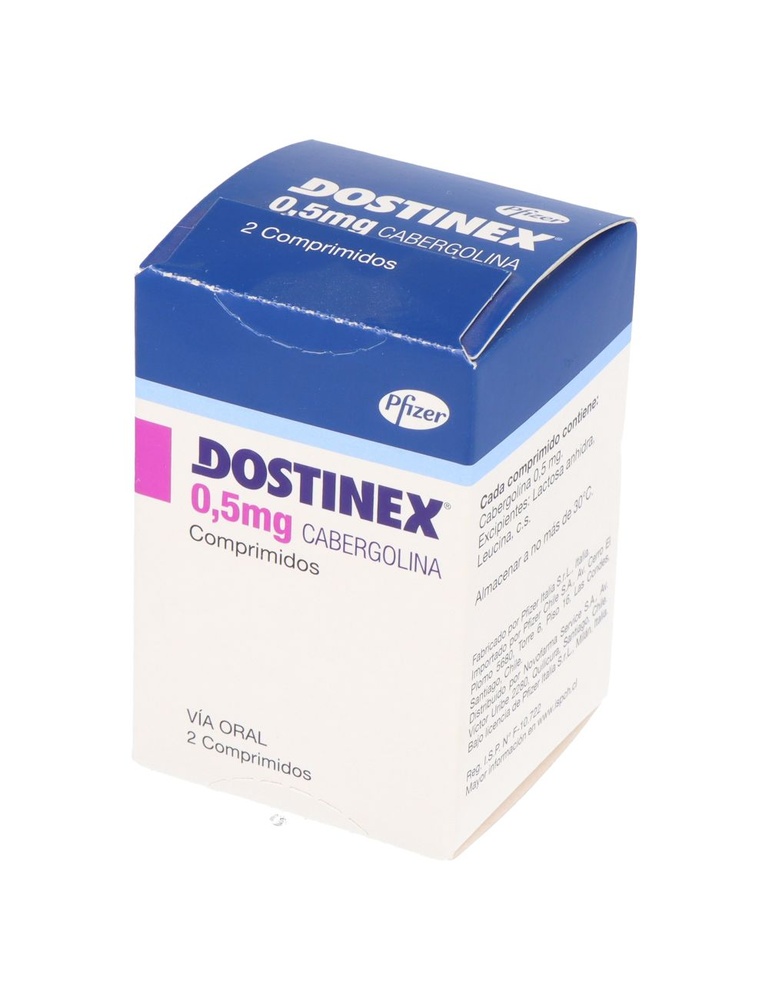
DOSTINEX 0.5 мг Таблетка

Рассмотрение рецепта онлайн
Врач рассмотрит ваш случай и примет решение о назначении рецепта, если это медицински оправдано.

Поговорите с врачом об этом лекарстве
Обсудите симптомы и возможные дальнейшие шаги на онлайн-консультации.



Инструкция по применению DOSTINEX
Содержание инструкции
DOSTINEX 0,5 mg tablets
Cabergoline
Read this leaflet carefully before you start taking this medicine as it contains important
information for you.
- Keep this leaflet. You may need to read it again.
- If you have any questions, ask your doctor or pharmacist.
- This medicine has been prescribed for you only. Do not pass it on to others, even if their symptoms are the same as yours because it may be harmful.
- If you get any side effects, even those not listed in this leaflet, tell your doctor or pharmacist. See section 4.
Contents of this leaflet:
- 1. What Dostinex is and what it is used for
- 2. What you need to know before you take Dostinex
- 3. How to take Dostinex
- 4. Possible side effects
- 5. How to store Dostinex
- 6. Contents of the pack and other information
1. What is Dostinex and what it is used for
Dostinex contains the active substance cabergoline, which belongs to a group of medicines called
prolactin inhibitors (a hormone that stimulates milk production from the breasts). Cabergoline
works by reducing the production of prolactin in the blood.
- 1. Dostinex is used immediately afterchildbirth to prevent the normal production and secretion of breast milk (lactation) from starting, or to stop lactation that has already started:
- when you do not want to continue breastfeeding your baby;
- when breastfeeding is not recommended for reasons of the mother's or newborn's health;
- after the birth of a deceased fetus in the womb;
- after a termination of pregnancy or a spontaneous abortion.
- 2. Dostinex can also be used to treat other conditions that may be caused by high levels of prolactin (hyperprolactinemia), such as:
- the absence or disappearance of menstruation (amenorrhea);
- changes in the menstrual cycle (oligomenorrhea);
- suspension or cessation of ovulation (anovulation);
- persistent milk production from the breasts after stopping breastfeeding (galactorrhea). High levels of prolactin are caused by some diseases of the pituitary gland (a gland located at the base of the skull) in both men and women.
2. What you need to know before taking Dostinex
Do not take Dostinex
- If you are allergic to cabergoline, to other similar medicines called ergot alkaloids or to any of the other ingredients of this medicine (listed in section 6).
- If you have ever suffered from fibrotic reactions (formation of scar tissue) affecting the lungs, heart or abdomen.
- For a long period of time if you have ever suffered or are suffering from a disease of the heart valves, including cases of fibrotic reactions (formation of scar tissue) affecting the heart valves.
Warnings and precautions
Tell your doctor or pharmacist if you suffer from or have ever suffered from any of the following conditions:
- Severe heart or blood vessel diseases (veins and/or arteries);
- A disease that causes cold hands and feet (Raynaud's syndrome);
- Stomach ulcer;
- Bleeding from the stomach or intestine;
- Severe mental illnesses, in particular psychotic disorders (severe disturbances of mental balance);
- If your liver is functioning very poorly (severe hepatic insufficiency) and you are already being treated for a long time with this medicine, because this situation may require a lower dose of Dostinex than expected;
- High blood pressure (arterial hypertension) and are already taking other medicines to lower it. Particular caution is required when taking Dostinex together with other medicines that lower blood pressure, because a drop in blood pressure may occur when moving from a sitting or lying position to a standing position after taking Dostinex. Dostinex can also lower blood pressure if taken for a long period of time;
- High blood pressure (arterial hypertension) that occurs suddenly during pregnancy, or immediately after childbirth, because treatment with Dostinex may not be suitable for you. The doctor will assess the risks and benefits of administering this medicine based on your condition.
If you have just given birth, you may be at greater risk of developing certain conditions. These can
include hypertension, heart attack, seizures, stroke, or psychiatric disorders. Therefore, your doctor will need to check
your blood pressure regularly during treatment. Contact your doctor immediately if you develop
hypertension, chest pain, or unusually severe or persistent headache (with or without visual disturbances).
Beforeadministering Dostinex, and at regular intervals during therapy, your doctor may
want to subject you to the following tests:
- Medical examination to assess the condition of the heart and major blood vessels (arteries and veins);
- Echocardiogram, to establish the possible presence of a disease of one of the heart valves (even if you have never had symptoms);
- Blood tests;
- A test to assess the functioning of the lungs;
- A chest X-ray or other radiological examinations;
- A test to assess the functioning of the kidneys;
- Tests to check the functioning of the pituitary gland, to rule out the presence of diseases in this gland;
- Suitable tests to rule out pregnancy. If you are being treated with Dostinex and wish to become pregnant, the intake of Dostinex must be stopped one month before the expected conception (see Pregnancy and Breastfeeding);
- Any other tests established by the doctor.
Dostinex can promote the development of fibrotic reactions (formation of scar tissue) affecting various
organs, which, initially, may not be diagnosed. Contact your doctor if during prolonged
treatmentwith Dostinex, the following symptoms appear (see section 4 Possible side effects):
- Difficulty breathing (dyspnea), shortness of breath, persistent cough, chest pain, appearance of fluid in the space between the lungs and the chest (pleurisy). These symptoms may reveal the onset of fibrotic reactions affecting the lungs or pleura (a membrane that surrounds each lung).
- Pain in the flanks/lower back, swollen ankles and/or legs (edema), abdominal pain, formation of a mass within the abdomen. These symptoms may reveal the onset of fibrotic reactions affecting various organs contained in the abdomen.
- Widespread feeling of weakness and fatigue, palpitations and other symptoms that may reveal the onset of fibrotic reactions affecting the heart and/or heart valves and/or the pericardium (a thin membrane that normally surrounds the heart). If fibrotic reactions affecting the heart occur, treatment with Dostinex must be discontinued.
Tell your doctor if duringtreatment with Dostinex you or your family, or anyone who cares for you, notice
the following symptoms (see section 4 Possible side effects):
- Drowsiness/sudden sleep attacks, especially if you have ever suffered or are suffering from Parkinson's disease, which occur even without you realizing it and without warning signs. The doctor may decide to reduce the dosage or discontinue therapy (see section Driving and operating machinery).
- Desire/need to behave differently than usual/inability to resist the urge, desire, or temptation to do things that could harm you or others. These problems are called “impulse control disorders” and can include behaviors such as pathological gambling, overeating or excessive spending, unusually strong sexual desire, or increased thoughts or desires of a sexual nature. The doctor may decide to adjust the dose or discontinue therapy.
If your doctor has prescribed Dostinex for the treatment of absent menstruation (amenorrhea) caused by
high levels of prolactin in the blood (hyperprolactinemia), the doctor may decide to perform a
pregnancy test. The pregnancy test performed regularly serves to reveal the possible onset of a
pregnancy, because Dostinex restores fertility in women before the return of menstruation.
The pregnancy test should be performed:
- during the absence of menstruation: at least once every 4 weeks;
- upon resumption of menstruation: whenever menstruation is delayed by more than 3 days. If pregnancy occurs during treatment with Dostinex, the doctor may decide to perform precautionary tests to check the functioning of the gland that produces prolactin (pituitary gland).
Other medicines and Dostinex
Tell your doctor or pharmacist if you are taking, have recently taken, or may take any
other medicine.
The effectiveness of Dostinex may be reduced by some medicines, including the following:
- medicines used to treat mental illnesses (e.g. phenothiazines, butyrophenones, thioxanthenes);
- medicines used to treat nausea and vomiting (e.g. metoclopramide).
Side effects may be increased by the use of Dostinex together with other medicines, including the
following:
- erythromycin and other antibiotics belonging to the same class (macrolide antibiotics).
If the doctor has decided to subject you to long-term treatment with Dostinex, the use of
Dostinex is not recommended together with other medicines called ergot alkaloids.
Dostinex can cause a drop in blood pressure when moving from a sitting or
lying position to a standing position. Therefore, caution is required when Dostinex must be administered
together with the following class of medicines:
- medicines that lower blood pressure (see section 2 Warnings and precautions)
Pregnancy, breastfeeding and fertility
Tell your doctor before taking Dostinex if you are pregnant, suspect you are pregnant or are planning
a pregnancy.
Pregnancy
During treatment with Dostinex, use effective contraceptive methods to avoid pregnancy.
Dostinex may only be used during pregnancy if strictly necessary and only after careful
assessment by the doctor of the possible benefits and risks of this medicine.
If conception occurs while you are taking Dostinex, therapy should be discontinued as soon as
pregnancy is confirmed.
Breastfeeding
Because Dostinex stops milk production, you should not take it if you intend to breastfeed.
If you have to take Dostinex, you should use another method to feed your baby.
Because there is no information on the passage of Dostinex into breast milk, you should not breastfeed
your baby if Dostinex has not been effective in stopping lactation.
Fertility
If you are being treated with Dostinex and are planning a pregnancy, you should stop the medicine one
month before the expected conception. Stopping Dostinex one month before conception will not
decrease your fertility because the effect of the medicine lasts for about 6 months after it is stopped.
Driving and operating machinery
Dostinex can cause drowsiness and sudden sleep attacks. If you experience these symptoms, do not drive and
do not use tools or machinery, or perform activities that require a high degree of attention or
coordination until they have completely resolved.
Dostinex contains lactose
Dostinex contains lactose, a type of sugar. If your doctor has diagnosed you with intolerance to some
sugars, contact him before taking this medicine.
3. How to take Dostinex
Take this medicine following exactly the instructions of your doctor. If you have any doubts, consult your
doctor.
The recommended dose is:
- to prevent milk production (lactation):2 Dostinex 0.5 mg tablets to be taken only on the first day after delivery.
- to stop milk production after starting breastfeeding:half a Dostinex 0.5 mg tablet every 12 hours for two days.
- to reduce prolactin levels in other conditions (hyperprolactinemia):you should initially take one 0.5 mg tablet, in a single dose or divided into two doses over a week (e.g. half a tablet on Monday and the other half tablet on Thursday). Subsequently, your doctor may decide to gradually increase the dose to find the right dose needed to control your symptoms, and up to a maximum of 4.5 mg (9 Dostinex 0.5 mg tablets) per week. You should not take more than 3 mg (6 Dostinex 0.5 mg tablets) per day.
When and how to take Dostinex
Take Dostinex tablets by mouth, preferably after a meal to reduce unwanted effects.
Swallow the tablets with a little water.
Use in children and adolescents
The use of Dostinex is not recommended in children under 16 years of age.
Elderly patients
Experience in elderly people is very limited. Currently, no particular risks are known.
If you take more Dostinex than you should
If you accidentally took too many tablets, symptoms such as nausea, vomiting, stomach disorders, low blood
pressure when moving from a sitting or lying position to a standing position, confusion, psychosis (e.g. altered
perception of reality, changes in thought, emotional states, behavioral abnormalities), hallucinations may occur. In
this case, contact your doctor immediately or go to the nearest hospital emergency room.
If you forget to take Dostinex
It is important not to miss a dose. If you forget to take the medicine at the usual time, take it as soon as you
remember, then continue taking it as usual. Do not take a double dose to make up for a missed dose.
If you stop taking Dostinex
Your doctor will tell you how long to take Dostinex. Do not stop treatment until your doctor tells you to. If you
stop treatment with Dostinex before your doctor tells you to, your condition may worsen or recur.
If you have any doubts about the use of this medicine, ask your doctor or pharmacist.
4. Possible side effects
Like all medicines, this medicine can cause side effects, although not everybody gets them.
Seek immediatemedical attention if you experience the following symptoms as they may be serious and
treatment with Dostinex must be stopped (see Warnings and precautions):
- Very common side effects(may affect more than 1 in 10 people): heart valve disorders and related problems, for example, inflammation of the pericardium (pericarditis) or fluid accumulation in the pericardium (pericardial effusion). These disorders can manifest with various symptoms including a general feeling of weakness, fatigue and palpitations.
- Other side effects(frequency cannot be estimated based on available data): chest pain (angina pectoris).
The following side effects have been reported in patients treated with Dostinex:
Very common side effects(may affect more than 1 in 10 people):
- headache*;
- dizziness/vertigo*;
- nausea*;
- stomach pain, discomfort and a feeling of fullness (dyspepsia);
- gastritis;
- abdominal pain*;
- weakness;
- fatigue.
Side effects marked with an asterisk (*) are very commonin women treated with
Dostinex to decrease excessively high prolactin levels (hyperprolactinemia). They are instead common
in women treated with Dostinex to prevent or stop breast milk production.
Weakness is very commonin women treated with Dostinex to decrease excessively high prolactin
levels (hyperprolactinemia). It is instead not commonin women treated with Dostinex to
prevent or stop breast milk production.
Common side effects(may affect up to 1 in 10 people):
- sleepiness;
- depression;
- decreased blood pressure (hypotension), especially with long-term Dostinex therapy;
- lowering of blood pressure when moving from a sitting or lying position to a
standing position (orthostatic hypotension);
- lowering of blood pressure, but without you noticing it;
- hot flushes**;
- constipation;
- vomiting**;
- breast pain.
Side effects marked with two asterisks (**) are commonin women treated with
Dostinex to decrease excessively high prolactin levels (hyperprolactinemia). They are instead not
commonin women treated with Dostinex to prevent or stop breast milk production.
Uncommon side effects(may affect up to 1 in 100 people):
- palpitations;
- difficulty breathing (dyspnea);
- fluid accumulation in the space between the lungs and the chest (pleural effusion);
- fibrotic reactions (scar tissue formation) that can also affect the lungs;
- nosebleeds;
- allergies;
- temporary loss of vision in one half of the visual field, from one or both eyes (transient hemianopsia);
- sudden loss of consciousness;
- sensations of tingling or warmth;
- increased sexual desire;
- cold hands and feet;
- fainting;
- fluid retention in various parts of the body (edema);
- swollen ankles and/or legs;
- skin rash;
- patchy hair loss (alopecia);
- leg cramps;
- decreased levels of hemoglobin (a substance contained within red blood cells). This side effect occurred in the first few months after the resumption of the menstrual cycle in women who suffered from absence of menstruation (amenorrhea).
Rare side effects(may affect up to 1 in 1,000 people):
- stomach pain.
Very rare side effects(may affect up to 1 in 10,000 people):
- fibrotic reactions (scar tissue formation) of the pleura (a membrane that surrounds the lungs). Other side effects(frequency cannot be estimated based on available data):
- breathing disorders;
- lung function abnormalities (respiratory failure);
- inflammation of the pleura (pleuritis);
- chest pain;
- sudden sleepiness;
- tremor;
- vision changes;
- aggression;
- delusions;
- pathological and obsessive need to have sexual intercourse or otherwise think about sex;
- strong urge to gamble;
- psychosis (e.g. altered perception of reality, altered thinking, emotional states, abnormal behavior);
- hallucinations;
- liver function abnormalities;
- increased levels in the blood of a substance (called creatine phosphokinase) that is predominantly found within muscles;
- changes in laboratory tests to assess liver function.
Pay particular attention to the following side effects(see section 2 Warnings and
precautions):
Impulse control disorders, a condition that can harm you or others and whose symptoms may be:
- strong urge to gamble excessively;
- increased sexual desire, pathological and obsessive need to have sexual intercourse or otherwise think about sex;
- compulsive urge to shop;
- uncontrollable urge to eat (consuming an amount of food greater than normal and greater than necessary to satisfy hunger). Tell your doctor if any of these behaviors occur, so he can decide how to intervene to manage or reduce the symptoms.
Reporting of side effects
If you get any side effects, talk to your doctor or pharmacist. This includes any possible side effects not listed in this leaflet. You can also report side effects directly through the Italian Medicines Agency, website: https://www.aifa.gov.it/content/segnalazioni-reazioni-avverse
By reporting side effects you can help provide more information on the safety of
this medicine.
5. How to store Dostinex
Keep this medicine out of the sight and reach of children.
Do not use this medicine after the expiry date which is stated on the pack after “Expiry”. The expiry date refers to the last day of that month.
No special storage precautions are required.
Do not dispose of any medicine in waste water or household waste. Ask your pharmacist how to dispose of medicines you no longer use. This will help protect the environment.
6. Contents of the pack and other information
What Dostinex contains
The active ingredient is cabergoline.
Each Dostinex 0.5 mg tablet contains 0.5 mg of cabergoline.
The other ingredients are: lactose (see section Dostinex contains lactose), leucine.
Description of the appearance of Dostinex and contents of the pack
Dostinex 0.5 mg tablets are flat, oblong, white tablets, imprinted with “PU”
separated by a score line on one side and imprinted with “700” with a slight incision above and below the
central “0” on the other side.
The tablets are contained in high-density polyethylene (HDPE) bottles with a child-resistant closure,
containing silica gel as a desiccant. This desiccant must not be removed.
It is recommended to carefully close the bottle after use. Bottle sizes of 2, 4 or 8 tablets.
Not all pack sizes may be marketed.
Marketing Authorisation Holder and Manufacturer
Marketing Authorisation Holder
Pfizer Italia S.r.l. - Via Isonzo, 71 - 04100 Latina
Manufacturer
Pfizer Italia S.r.l. - Località Marino del Tronto - 63100 Ascoli Piceno (AP)

Не уверены, подходит ли вам это лекарство?
Обсудите симптомы и варианты лечения с врачом онлайн.

Уже начали прием и появились вопросы?
Обсудите свое состояние и дальнейшие шаги с врачом онлайн.
- Страна регистрации
- Форма выпускаTablet, 0.5 MG
- Код АТХG02CB03
- Действующее вещество
- Отпускается по рецептуДа
- Производитель
- Информация на этой странице носит справочный характер и не является медицинской консультацией. Перед началом приема лекарства обязательно проконсультируйтесь с врачом.
- Аналоги DOSTINEXФорма выпуска: Tablet, 0.5 MGДействующее вещество: каберголинаПроизводитель: PFIZER ITALIA S.R.L.Отпускается по рецептуФорма выпуска: Tablet, 0.5 MGДействующее вещество: каберголинаПроизводитель: DOC GENERICI SRLОтпускается по рецептуФорма выпуска: Tablet, 0.5 MGДействующее вещество: каберголинаПроизводитель: RATIOPHARM GMBHОтпускается по рецепту
Аналоги DOSTINEX в других странах
Лекарства с тем же действующим веществом, доступные в других странах.
Аналог DOSTINEX в Польша
Аналог DOSTINEX в Украина
Аналог DOSTINEX в Испания
Врачи онлайн по DOSTINEX
Обсудите применение DOSTINEX и возможные следующие шаги — по оценке врача.
Получите рецепт на DOSTINEX онлайн
Заполните форму за 2 минуты
Расскажите о симптомах, истории болезни и нужном препарате.
Выберите врача или мы назначим
Выберите специалиста или мы подберём ближайшего доступного врача.
Врач рассматривает ваш случай
Обычно в течение 30 минут. Может задать уточняющие вопросы в чате.
Получите в любой аптеке
Электронный рецепт отправляется на вашу почту — действителен по всей Польше.
Часто задаваемые вопросы
DOSTINEX требует рецепта в Италия. Вы можете уточнить у врача онлайн, подходит ли это лекарство для вашей ситуации.
Действующее вещество DOSTINEX — каберголина. Эта информация помогает определить лекарства с тем же составом под другими торговыми названиями.
DOSTINEX производится компанией PFIZER ITALIA S.R.L.. Упаковка и торговое название могут отличаться в зависимости от дистрибьютора.
Врачи, включая Семейные врачи, Психиатры, Дерматологи, Кардиологи, Эндокринологи, Гастроэнтерологи, Пульмонологи, Нефрологи, Ревматологи, Гематологи, Инфекционисты, Аллергологи, Гериатры, Педиатры, Онкологи, могут оценить целесообразность применения DOSTINEX с учетом вашей ситуации и местных правил. Вы можете записаться на онлайн-консультацию, чтобы обсудить возможные варианты.
Польша имеет хорошо развитую систему здравоохранения в крупных городах, таких как Варшава, Краков, Вроцлав и Гданьск. Аптеки широко доступны и работают в соответствии с действующим законодательством, обеспечивая доступ к рецептурным препаратам.
Вы можете купить DOSTINEX в Варшаве, Кракове, Вроцлаве или Гданьске в любой аптеке при наличии действующего рецепта.
Чтобы получить рецепт, вы можете воспользоваться Oladoctor:
Другие лекарства с тем же действующим веществом (каберголина) включают AKTUALENE, KABERGOLINA DOK, KABERGOLINA RATIOPARM. Они могут отличаться торговым названием или формой выпуска, но содержат одинаковый терапевтический компонент. Перед изменением лечения рекомендуется проконсультироваться с врачом.
