



DINCREL 600 мг/1000 МЕ Ородиспергируемая таблетка

Рассмотрение рецепта онлайн
Врач рассмотрит ваш случай и примет решение о назначении рецепта, если это медицински оправдано.

Поговорите с врачом об этом лекарстве
Обсудите симптомы и возможные дальнейшие шаги на онлайн-консультации.



Инструкция по применению DINKREL
Содержание инструкции
DINCREL 600 mg/1000 U.I. orodispersible tablets
calcium / cholecalciferol
Read this leaflet carefully before taking this medicine as it contains important
information for you
- Keep this leaflet. You may need to read it again.
- If you have any questions, ask your doctor or pharmacist.
- This medicine has been prescribed for you only. Do not pass it on to others, even if they have the same symptoms as you, as it may be harmful.
- If you get any side effects, even those not listed in this leaflet, tell your doctor or pharmacist. See section 4
Contents of this leaflet:
- 1. What DINCREL is and what it is used for
- 2. What you need to know before you take DINCREL
- 3. How to take DINCREL
- 4. Possible side effects
- 5. How to store DINCREL
- 6. Contents of the pack and other information
1. What is DINCREL and what is it used for
DINCREL is used for the prevention and treatment of calcium and vitamin D deficiency in the elderly and
as an additional treatment in the care of osteoporosis in patients at risk of calcium and vitamin
D deficiency, when a dietary supplement with doses of calcium equal to 600 mg/day and of vitamin
D equal to 1000 I.U./day is deemed appropriate.
DINCREL contains calcium and vitamin D, both of which are important components for bone formation. Vitamin D regulates the absorption and metabolism of calcium as well as the deposition of calcium
in bone tissue.
Consult your doctor or pharmacist if you have further questions and always follow their instructions.
Consult your doctor if you do not feel better or if you feel worse after a few days.
2. What you need to know before taking DINCREL
Do not take DINCREL
- if you are allergic to calcium, vitamin D or any of the other ingredients of this medicine (listed in section 6);
- if you have hypercalcemia (high levels of calcium in the blood) or hypercalciuria (high levels of calcium in the urine);
- if you have hypervitaminosis D (high levels of vitamin D in the blood);
- if you have kidney stones;
- if you suffer from kidney failure;
- if you are allergic to peanuts or soy;
Warnings and precautions
Talk to your doctor or pharmacist before taking DINCREL
- if you suffer from sarcoidosis (a particular disease of the connective tissue that affects the lungs, skin and joints);
- if you are taking other medicines containing vitamin D or calcium;
- if you have reduced kidney function or a high tendency to form kidney stones;
- if you are bedridden due to osteoporosis;
Other medicines and DINCREL
Tell your doctor or pharmacist if you are taking, have recently taken or might take any other medicine.
The effect of this treatment may be affected if this medicine is taken at the same time as some medicines used for:
- hypertension (thiazide diuretics);
- heart disorders (cardiac glycosides such as digoxin);
- hypercholesterolemia (cholestyramine);
- constipation (laxatives such as paraffin oil);
- epilepsy (phenytoin or barbiturates);
- inflammatory conditions/immunosuppression (corticosteroids);
- obesity (orlistat);
Make sure your doctor is informed if you are taking any of the medicines listed above. It may be necessary to adjust the dose.
If you are taking a medicine for:
- osteoporosis (bisphosphonates) you must take this medicine at least one hour before taking DINCREL
If you are taking a medicine for:
- infections (quinolones) you must take these medicines two hours before or six hours after taking DINCREL
If you are taking a medicine for:
- infections (tetracyclines) you must take these medicines two hours before or four to six hours after taking DINCREL
If you are taking a medicine for:
- tooth decay (sodium fluoride)
- anemia (iron) you must take these medicines at least three hours before taking DINCREL
If you are taking medicines for:
- hypothyroidism (levothyroxine) you must take these medicines at least four hours after taking DINCREL
DINCREL with food, drinks and alcohol
The absorption of calcium may be inhibited by foods containing oxalic acid (found in spinach and rhubarb) and phytic acid (found in whole grains).
You should wait at least two hours before taking DINCREL if you have eaten foods with a high content of oxalic acid or phytic acid.
Pregnancy and breastfeeding and fertility
During pregnancy, the daily intake of calcium and vitamin D should not exceed 1500 mg of calcium and 600 IU of vitamin D, respectively.
Therefore, DINCREL is not recommended during pregnancy.
DINCREL can be used during breastfeeding. Calcium and vitamin D3 pass into breast milk.
This aspect should be considered if additional vitamin D is administered to the child.
If you are pregnant, suspect you are pregnant, are planning to become pregnant, or are breastfeeding, ask your doctor or pharmacist for advice before taking this medicine.
Driving and using machines
No effects on the ability to drive or operate machinery are known.
DINCREL contains aspartame.
Aspartame is a source of phenylalanine. Phenylalanine may be harmful to patients with phenylketonuria.
DINCREL contains lactose and sucrose.
If your doctor has told you that you have an intolerance to some sugars, contact your doctor before taking this medicine
DINCREL contains soybean oil.
If you are allergic to peanuts or soy, do not take this medicine.
3. How to take DINCREL
Always take this medicine exactly as your doctor or pharmacist has told you. If
you have any doubts, ask your doctor or pharmacist.
The dosage is established individually for you by your doctor.
The recommended dose is one tablet a day.
The tablets can be sucked and should not be swallowed whole.
The tablets should be taken preferably after meals.
The amount of calcium in DINCREL is lower than the recommended daily dose.
DINCREL, therefore, should be used mainly by patients who need a supply of
vitamin D, but who take with their diet an amount of calcium between 500 mg and 1000 mg per day.
The amount of calcium taken with the diet must be evaluated by the doctor.
Use in children and adolescents
DINCREL is not indicated in children and adolescents.
If you take more DINCREL than you should
If you take more DINCREL than you should, contact your doctor or pharmacist immediately.
Some symptoms of DINCREL overdose are: loss of appetite, thirst, increased abnormal excretion
of urine, nausea, vomiting and constipation.
If you forget to take DINCREL
Take the tablet as soon as possible. Afterwards, take the next dose at the usual time. However, if it is
almost time for the next dose, do not take the forgotten dose and continue as usual.
Never take two doses together.
If you have further questions on the use of this medicine, ask your doctor or pharmacist.
4. Possible side effects
Like all medicines, this medicine can cause side effects, although not everybody gets them.
You must stop taking DINCREL and see a doctor immediately if you experience
symptoms of a severe allergic reaction, such as:
- swelling of the face, lips, tongue or throat
- difficulty swallowing
- hives and difficulty breathing
Uncommon (may affect up to 1 in 100 people): hypercalcemia (high levels of calcium in the blood) and/or
hypercalciuria (high levels of calcium in the urine).
Rare (may affect up to 1 in 1000):constipation, flatulence, nausea, abdominal pain,
itching, rash, hives.
Not known (frequency cannot be estimated from available data):severe allergic reactions.
Special populations
Patients with renal impairment: there is a potential risk of hyperphosphataemia, nephrolithiasis and
nephrocalcinosis.
Reporting of side effects
If you get any side effects, even those not listed in this leaflet, tell your doctor
or pharmacist.
You can also report side effects directly through the national reporting system
at http://www.agenziafarmaco.gov.it/content/come-segnalare-una-sospetta-reazione-avversa .
By reporting side effects you can help provide more information on the safety of this
medicine.
5. How to store DINCREL
- Keep this medicine out of the sight and reach of children.
- Keep the packaging closed. Do not use this medicine after the expiry date which is stated on the label. The expiry date refers to the last day of that month.
- Store in the original package to protect it from light.
- Keep the container tightly closed to protect the product from moisture.
- The validity of the product after the first opening of the vial is 60 days.
- Do not use this medicine if you notice any visible signs of deterioration.
- Do not dispose of any medicine in wastewater or household waste. Ask your pharmacist how to dispose of medicines you no longer use. This will help protect the environment.
6. Contents of the pack and other information
What DINCREL contains
- The active ingredients are: calcium carbonate 1500 mg equivalent to 600 mg of calcium and cholecalciferol (vitamin D3) 1000 I.U. equivalent to 0.025 mg.
- The other excipients are: maltodextrins, aspartame (E 951), hydroxypropylcellulose with a low degree of substitution (E 463), lactose monohydrate, anhydrous citric acid (E 330), orange flavour, stearic acid, DL- -tocopherol (E 307), partially hydrogenated soybean oil, gelatin, sucrose, corn starch.
Description of the appearance of DINCREL and contents of the DINCREL pack
Round orodispersible tablets of white or almost white colour with bevelled edges.
Tablet container containing 30 or 60 tablets.
The multiple pack contains 60 orodispersible tablets (2 packs of 30).
Not all pack sizes may be marketed.
Marketing Authorisation Holder
ITALFARMACO S.p.A. – Viale F. Testi, 330 – 20126 Milan.
Tel. + 39 02 64431
Fax. + 39 02644346
e-mail:[email protected]
Manufacturer responsible for batch release
ITALFARMACO S.p.A. – Viale F. Testi, 330 – 20126 Milan.
This medicinal product is authorised in the Member States of the European Economic Area with the following
denominations:
Italy: Dincrel 600mg/1,000IU orodispersible tablets
Spain: Demilos 600 mg/1,000 IU bucodispersable tablets
France:Demilos 600 mg/1,000 IU orodispersible tablets
Portugal: Demilos 600 mg+ 1000 UI orodispersível tablets
Ireland: Cadelius 600 mg/1,000 IU orodispersible tablets
This leaflet was last approved in:
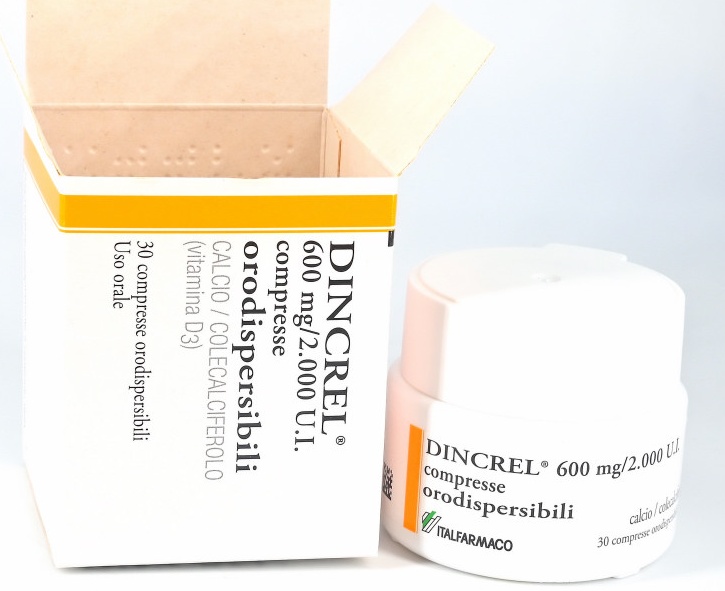
DINCREL 600 mg / 2.000 IU orodispersible tablets
calcium / cholecalciferol
Read this leaflet carefully before using this medicine as it contains
important information for you.
- Keep this leaflet. You may need to read it again.
- If you have any questions, ask your doctor, pharmacist or nurse.
- This medicine has been prescribed for you only. Do not pass it on to others, even if their symptoms are the same as yours, as it could be harmful.
- If you experience any side effects, including those not listed in this leaflet, tell your doctor, pharmacist or nurse. See section 4.
Contents of this leaflet:
- 1. What DINCREL is and what it is used for
- 2. What you need to know before you take DINCREL
- 3. How to take DINCREL
- 4. Possible side effects
- 5. How to store DINCREL
- 6. Contents of the pack and other information
1. What is DINCREL and what it is used for
DINCREL is used to treat calcium and vitamin D deficiency in adults.
DINCREL contains calcium and vitamin D3 which are both important components for bone formation.
Vitamin D3 regulates the absorption and metabolism of calcium and the incorporation of calcium into
bone tissue.
If you have any further questions, please contact your doctor or pharmacist and always follow their instructions.
Contact your doctor if you do not feel better or if you feel worse after a few days.
2. What you need to know before taking DINCREL
Do not take DINCREL
- if you are allergic to calcium, vitamin D or any of the other ingredients of this medicine (listed in section 6)
- if you have hypercalcemia (high levels of calcium in the blood) or hypercalciuria (high levels in the urine).
- if you have hypervitaminosis D (increased levels of vitamin D in the blood).
- if you have kidney stones
- if you suffer from kidney failure
- if you are pregnant
- if you are allergic to soy or peanuts.
Warnings and precautions
Talk to your doctor or pharmacist before taking DINCREL
- if you suffer from sarcoidosis (a particular disease of the connective tissue that affects the lungs, skin and joints).
- if you are taking other medicines containing vitamin D or calcium.
- if you have reduced kidney function or a high tendency to form kidney stones.
- if you are immobilized with osteoporosis.
Children and adolescents
DINCREL orodispersible tablets are not intended for use in children and adolescents.
Other medicines and DINCREL
Tell your doctor or pharmacist if you are taking, have recently taken or might take
any other medicine.
The effect of the treatment may be affected if this medicine is taken at the same time as
some other medicines used for:
- high blood pressure (thiazide diuretics)
- heart problems (cardiac glycosides such as digoxin)
- high cholesterol (cholestyramine)
- constipation (laxatives such as paraffin oil)
- epilepsy (phenytoin or barbiturates)
- inflammatory conditions/suppression of the immune system (corticosteroids)
- obesity (orlistat)
Make sure your doctor is informed if you are taking any of the medicines listed above. It may
be necessary to adjust the dose.
If you are taking at the same time a medicine for:
- osteoporosis (bisphosphonates) you must take it at least three hours before taking DINCREL
If you are taking at the same time certain medicines for;
- infection (quinolones) you must take these medicines two hours before or six hours after taking DINCREL
If you are taking at the same time certain medicines for:
- infection (tetracyclines) you must take these medicines two hours before or four to six hours after taking DINCREL
If you are taking at the same time certain medicines for:
- dental caries (sodium fluoride)
- anemia (iron) you must take these medicines at least three hours before taking DINCREL
If you are taking at the same time medicines for:
- hypothyroidism (levothyroxine) you must take these medicines at least four hours apart from taking DINCREL DINCREL with food, drinks and alcoholThe absorption of calcium may be inhibited by foods containing oxalic acid (found in spinach and rhubarb) and phytic acid (found in whole grains). You should wait at least two hours before taking DINCREL if you have eaten foods with a high content of oxalic acid or phytic acid.
Pregnancy and breastfeeding and fertility
DINCREL should not be used during pregnancy.
DINCREL can be used during breastfeeding. Calcium and vitamin D3 pass into breast milk.
This aspect should be taken into consideration when giving additional vitamin D to
the child. Such supplementation does not replace the administration of vitamin D in newborns.
If you are pregnant, suspect you are pregnant, or are planning a pregnancy, or if you are breastfeeding,
ask your doctor or pharmacist for advice before taking this medicine.
Driving and using machines
DINCREL has no known effects on the ability to drive vehicles or operate machinery.
DINCREL contains aspartame.
This medicine contains 8.67 mg of aspartame in each orodispersible tablet.
Aspartame is a source of phenylalanine. Phenylalanine may be harmful to people with
phenylketonuria, a rare genetic disorder in which phenylalanine builds up because the body cannot
remove it properly.
DINCREL contains lactose and sucrose.
If your doctor has diagnosed you with an intolerance to certain sugars, contact him before taking this
medicine.
DINCREL contains soybean oil.
If you are allergic to peanuts or soy, do not take this medicine.
3. How to take DINCREL
Always take this medicine exactly as your doctor or pharmacist has told you. If
you have any doubts, ask your doctor or pharmacist.
The dosage is established individually for you by your doctor.
The recommended dose is one tablet daily.
The tablets can be sucked and should not be swallowed whole.
The tablets should be taken preferably after meals.
The amount of calcium in DINCREL is lower than the recommended daily dose.
DINCREL, therefore, should be used mainly by patients who need a supply of
vitamin D, but who take with their diet an amount of calcium between 500 mg and 1000 mg per day.
The amount of calcium taken with the diet must be evaluated by the doctor.
Use in children and adolescents
DINCREL is not indicated in children and adolescents.
If you take more DINCREL than you should
If you take more DINCREL than you should, contact your doctor or pharmacist immediately.
Some symptoms of DINCREL overdose are: loss of appetite, thirst, abnormally increased urine
output, nausea, vomiting and constipation.
If you forget to take DINCREL
Take the tablet as soon as possible. Afterwards, take the next dose at the usual time. However, if it is
almost time for the next dose, do not take the forgotten dose and continue as usual.
Never take two doses together.
If you have further questions on the use of this medicine, ask your doctor or pharmacist.
4. Possible side effects
Like all medicines, this medicine can cause side effects, although not everybody gets them.
You must stop taking DINCREL and contact your doctor immediately if you
experience symptoms of a severe allergic reaction, such as:
- swelling of the face, lips, tongue or throat
- difficulty swallowing
- hives and difficulty breathing
Uncommon (may affect up to 1 in 100 people):hypercalcemia (high levels of serum calcium) and / or
hypercalciuria (high levels of calcium in the urine).
Rare (may affect up to 1 in 1,000): constipation, flatulence, nausea, abdominal pain, diarrhea,
abdominal distension, itching, rash and hives.
Not known (frequency cannot be estimated from available data):severe allergic reactions:
Other special populations
Patients with renal impairment may have a potential risk of hyperphosphataemia, nephrolithiasis
and nephrocalcinosis.
Reporting of side effects
If you get any side effects, even those not listed in this leaflet, tell your
doctor or pharmacist. You can also report side effects directly through the national
reporting system at https://www.aifa.gov.it/content/segnalazioni-reazioni-avverse .
By reporting side effects you can help provide more information on the safety of this
medicine.
5. How to store DINCREL
- Keep this medicine out of the sight and reach of children.
- Keep the packaging closed. Do not use this medicine after the expiry date which is stated on the label. The expiry date refers to the last day of that month.
- Store in the original packaging to protect it from light.
- Keep the container tightly closed to protect the product from moisture.
- The validity of the product after the first opening of the vial is 30 days.
- Do not use this medicine if you notice any visible signs of deterioration.
- Do not dispose of any medicine in wastewater or household waste. Ask your pharmacist how to dispose of medicines you no longer use. This will help protect the environment.
6. Package contents and other information
What DINCREL contains
- The active ingredients are: calcium carbonate 1500 mg equivalent to 600 mg of calcium and cholecalciferol (vitamin
D3) 2,000 IU equivalent to 0.050 mg.
- The other ingredients are: maltodextrins, aspartame (E 951), hydroxypropylcellulose with a low degree of substitution (E 463), lactose monohydrate, anhydrous citric acid (E 330), orange aroma (containing flavouring preparations, natural flavouring substances, maltodextrin and dextrin), stearic acid, DL-α-tocopherol (E 307), partially hydrogenated soybean oil, gelatin, sucrose, corn starch.
Description of the appearance of DINCREL and package contents
DINCREL is an orodispersible tablet, from white to almost white, with a rounded shape, bevelled
edge, 30 tablets in the bottle.
Multipacks contain 60 (2 packs of 30) orodispersible tablets.
Not all pack sizes may be marketed.
Marketing Authorisation Holder
ITALFARMACO S.p.A. – Viale F. Testi, 330 – 20126 Milan.
Tel. + 39 02 64431
Fax. + 39 02644346
e-mail: [email protected]
Manufacturer
ITALFARMACO S.p.A. – Viale F. Testi, 330 – 20126 Milan.
This medicinal product is authorised in the Member States of the European Economic Area with the following
denominations:
Italy: Dincrel 600mg/2,000IU orodispersible tablets
Spain: Demilos 600 mg/2,000 IU bucodispersable tablets
France: Demilos 600 mg/2,000 IU orodispersible tablets
Portugal: Demilos 600 mg+ 2000 IU orodispersíveis tablets
Ireland: Cadelius 600 mg/2,000 IU orodispersible tablets
This leaflet was last approved in:

Не уверены, подходит ли вам это лекарство?
Обсудите симптомы и варианты лечения с врачом онлайн.

Уже начали прием и появились вопросы?
Обсудите свое состояние и дальнейшие шаги с врачом онлайн.
- Страна регистрации
- Форма выпускаOrodispersible tablet, 600 MG + 1000 IU
- Отпускается по рецептуДа
- Производитель
- Информация на этой странице носит справочный характер и не является медицинской консультацией. Перед началом приема лекарства обязательно проконсультируйтесь с врачом.
- Аналоги DINKRELФорма выпуска: Coated tablet, 1000 MGДействующее вещество: Карбонат кальцияПроизводитель: THERAMEX IRELAND LIMITEDОтпускается по рецептуФорма выпуска: Injectable solution, 10 %Действующее вещество: глюконат кальцияПроизводитель: B. BRAUN MELSUNGEN AGОтпускается по рецептуФорма выпуска: Injectable solution, 500 MG/5 MLДействующее вещество: глюконат кальцияПроизводитель: BIOINDUSTRIA LABORATORIO ITALIANO MEDICINALI S.P.A.Отпускается по рецепту
Аналоги DINKREL в других странах
Лекарства с тем же действующим веществом, доступные в других странах.
Аналог DINKREL в Польша
Аналог DINKREL в Украина
Аналог DINKREL в Испания
Врачи онлайн по DINKREL
Обсудите применение DINKREL и возможные следующие шаги — по оценке врача.









Получите рецепт на DINKREL онлайн
Заполните форму за 2 минуты
Расскажите о симптомах, истории болезни и нужном препарате.
Выберите врача или мы назначим
Выберите специалиста или мы подберём ближайшего доступного врача.
Врач рассматривает ваш случай
Обычно в течение 30 минут. Может задать уточняющие вопросы в чате.
Получите в любой аптеке
Электронный рецепт отправляется на вашу почту — действителен по всей Польше.
Часто задаваемые вопросы
DINKREL требует рецепта в Италия. Вы можете уточнить у врача онлайн, подходит ли это лекарство для вашей ситуации.
DINKREL производится компанией ITALFARMACO S.P.A.. Упаковка и торговое название могут отличаться в зависимости от дистрибьютора.
Врачи, включая Семейные врачи, Психиатры, Дерматологи, Кардиологи, Эндокринологи, Гастроэнтерологи, Пульмонологи, Нефрологи, Ревматологи, Гематологи, Инфекционисты, Аллергологи, Гериатры, Педиатры, Онкологи, могут оценить целесообразность применения DINKREL с учетом вашей ситуации и местных правил. Вы можете записаться на онлайн-консультацию, чтобы обсудить возможные варианты.
Польша имеет хорошо развитую систему здравоохранения в крупных городах, таких как Варшава, Краков, Вроцлав и Гданьск. Аптеки широко доступны и работают в соответствии с действующим законодательством, обеспечивая доступ к рецептурным препаратам.
Вы можете купить DINKREL в Варшаве, Кракове, Вроцлаве или Гданьске в любой аптеке при наличии действующего рецепта.
Чтобы получить рецепт, вы можете воспользоваться Oladoctor:
Другие лекарства с тем же действующим веществом () включают KAKIT, KALKIO LUKONATO B. BRAUN, KALKIO LUKONATO BIOINDUSTRIA L.I.M.. Они могут отличаться торговым названием или формой выпуска, но содержат одинаковый терапевтический компонент. Перед изменением лечения рекомендуется проконсультироваться с врачом.
