



DAIVONEX 0.005% Крем

Рассмотрение рецепта онлайн
Врач рассмотрит ваш случай и примет решение о назначении рецепта, если это медицински оправдано.

Поговорите с врачом об этом лекарстве
Обсудите симптомы и возможные дальнейшие шаги на онлайн-консультации.



Инструкция по применению DAIVONEX
Содержание инструкции
Daivonex 0.005% cream
Calcipotriol
Read this leaflet carefully before you start using this medicine as it contains important
information for you.
- Keep this leaflet. You may need to read it again.
- If you have any questions, ask your doctor or pharmacist.
- This medicine has been prescribed for you only. Do not pass it on to others, even if they have the same symptoms as you, as it may be harmful.
- If you get any side effects, even those not listed in this leaflet, tell your doctor or pharmacist. See section 4.
Contents of this leaflet:
- 1. What Daivonex is and what it is used for
- 2. What you need to know before you use Daivonex
- 3. How to use Daivonex
- 4. Possible side effects
- 5. How to store Daivonex
- 6. Contents of the pack and other information
1. What Daivonex is and what it is used for
Daivonex belongs to a group of medicines called anti-psoriasics. It contains the active ingredient
calcipotriol, a synthetic derivative of vitamin D. Vitamin D controls the growth of skin cells.
If your skin cells grow too quickly, psoriasis may develop. Psoriasis is a
disease in which the skin develops thick, red patches and silvery-scaled plaques. These scaly plaques are made up of dead cells that normally shed from the skin without people even
noticing it.
Daivonex works by reducing the amount of cells produced by the skin. This means that the skin symptoms also decrease.
Daivonex is used to treat plaque psoriasis, the most common type of psoriasis.
See your doctor if you do not feel better or if you feel worse during treatment.
2. What you need to know before using Daivonex
Do not use Daivonex
- If you are allergic to calcipotriol or any of the other ingredients of this medicine (listed in section 6)
- if you have been told by your doctor that you have high or low levels of a substance called calcium in your body (calcium metabolism disorders)
- if you suffer from other forms of psoriasis (guttate, erythrodermic, exfoliative and pustular psoriasis), because it may increase the risk that the levels of calcium in the blood become high
- if you have severe kidney problems
- if you have severe liver problems.
Warnings and precautions
Talk to your doctor or pharmacist before using Daivonex.
In particular, talk to your doctor if you think that any of the following conditions apply to you:
- you have high levels of vitamin D in your blood
- you have high levels of calcium in your blood (hypercalcemia)
- you have high levels of calcium in your urine (hypercalciuria)
- you have suffered from kidney stones because the use of calcipotriol may increase the possibility that kidney stones form. Exposure to ultraviolet (UV) rays Talk to your doctor if you are undergoing UV radiation, because you will need to discuss with your doctor the possibility of undergoing UV radiation in conjunction with the use of Daivonex. Your doctor will tell you to limit your exposure to sunlight or artificial light while using this medicine.
Children and adolescents
Avoid using Daivonex in children and adolescents (0-18 years of age), as the efficacy and
safety of this medicine are not known in this age group.
Other medicines and Daivonex
Tell your doctor or pharmacist if you are taking, have recently taken or might take any other
medicines.
Pregnancy, breastfeeding and fertility
If you are pregnant, suspect you are pregnant or are planning a pregnancy, or if you are breastfeeding,
ask your doctor or pharmacist for advice before using this medicine.
Pregnancy
Avoidusing Daivonex if you are pregnant, unless your doctor has assessed the actual need for
this medicine.
Breastfeeding
Do not applyDaivonex to the breast if you are breastfeeding.
Fertility
Daivonex has no effect on fertility.
Driving and using machines
Daivonex does not affect, or has a negligible effect on, the ability to drive vehicles or use
machinery.
Daivonex cream contains cetostearyl alcohol, diazolidinyl urea and 2,4-dichlorobenzyl alcohol
Daivonex contains cetostearyl alcohol: it may cause local skin reactions (e.g. contact dermatitis).
Daivonex cream contains diazolidinyl urea, an excipient that releases formaldehyde: it may cause skin
reactions on the localized skin (e.g. contact dermatitis).
Daivonex cream contains 1 mg/g of 2,4-dichlorobenzyl alcohol: it may cause allergic reactions and mild
local irritation
3. How to use Daivonex
Use this medicine following exactly as described in this leaflet or as instructed by your doctor or pharmacist. If you have any doubts, consult your doctor or pharmacist.
The recommended dose is 1 application 2 times a day.
The maximum recommended dose is 100 grams of this medicine per week (one 100 gram tube).
Do not exceed the recommended dose, as this may cause an increase in blood calcium (see section 4 “Possible side effects”), which however disappears with discontinuation of treatment.
Inform your doctor or pharmacist if you are using another medicine containing calcipotriol (the same substance contained in Daivonex) together with Daivonex.
How to use Daivonex
Wash and thoroughly dry the area to be treated.
Apply the cream to the lesions.
Do not useDaivonex on the faceas this may cause itching and skin irritation.
If you accidentally applyDaivonex to your eyes, you may experience swelling of the conjunctiva
(inner membrane of the eye).
Therefore, wash your hands thoroughly after each application.
Avoidapplying Daivonex in the skin foldsas there is a higher risk of experiencing side effects (see section 4 “Possible side effects”).
Duration of treatment
Continue treatment until the lesions have disappeared. However, the duration of treatment should normally not exceed 22 weeks.
If you use more Daivonex than you should
Do not exceed the recommended dose as this may cause an increase in blood calcium (hypercalcemia);
the symptoms you may experience are:
- excessive production and elimination of urine
- constipation
- muscle weakness
- confusion
- coma These symptoms however disappear with discontinuation of treatment. Furthermore, if you use more Daivonex than you should, you may also experience an increase in calcium in your urine. In case of accidental ingestion/intake of an excessive dose of Daivonex, immediately inform your doctor or go to the nearest hospital.
If you forget to use Daivonex
If you forget to use Daivonex, do not apply a double dose of the medicine to the lesions, but consult your doctor or pharmacist.
If you stop using Daivonex
If you have any doubts about using this medicine, consult your doctor or pharmacist.
4. Possible side effects
Like all medicines, this medicine can cause side effects, although not everybody gets them.
The following side effects have been observed during use of this medicine:
Very common (may affect more than 1 in 10 people)
- skin irritation Common (may affect up to 1 in 10 people)
- worsening of psoriasis
- skin inflammations (dermatitis)
- skin redness (erythema)
- skin rash (rash: several types of rash have been reported such as erythematous rash, maculopapular rash, measles-like rash, papular rash and pustular rash)
- skin peeling
- skin burning sensation
- itching
- pain at the application site Uncommon (may affect up to 1 in 100 people)
- allergy
- increased sensitivity to light
- skin swelling
- skin inflammation manifesting with redness and scaling, especially on the scalp, face and chest (seborrheic dermatitis)
- dry skin
- increased calcium in the blood (hypercalcemia)
- increased calcium in the urine (hypercalciuria) Rare (may affect up to 1 in 1000 people)
- skin redness accompanied by itching
- change in skin color at the application site Reporting of side effectsIf you get any side effects, even those not listed in this leaflet, tell your doctor. You can also report side effects directly through the national reporting system at www.agenziafarmaco.gov.it/it/responsabili . By reporting side effects you can help to provide more information on the safety of this medicine.
5. How to store Daivonex
Keep this medicine out of the sight and reach of children.
Do not use this medicine after the expiry date which is stated on the pack after Exp.
The expiry date refers to the last day of that month.
Do not store at a temperature above 25°C. Do not freeze.
Shelf life after first opening: 6 months. Write the date of first opening of the tube in the designated space on the
pack.
Do not dispose of any medicine in wastewater or household waste. Ask your pharmacist how to dispose of medicines you
no longer use. This will help protect the environment.
6. Contents of the pack and other information
What Daivonex contains
100 grams of cream contain:
- The active ingredient is calcipotriol 5 milligrams
- The other components are macrogol cetostearyl ether, sodium edetate, disodium phosphate dihydrate, liquid paraffin, cetostearyl alcohol, glycerol 85%, diazolidinyl urea (contains formaldehyde), 2,4-dichlorobenzyl alcohol, sodium hydroxide white soft paraffin, purified water, all-rac- α-tocopherol.
Description of the appearance of Daivonex and contents of the pack
Daivonex is presented in the form of a cream in a tube of 30 grams or 100 grams.
Not all pack sizes may be marketed.
The following packs are also available:
Daivonex 0.005% ointment and Daivonex 0.005% cutaneous solution.
Marketing Authorisation Holder
Leo Pharma A/S, Industriparken 55, 2750 – Ballerup (DK)
Marketing Authorisation Holder in Italy: LEO Pharma S.p.A. Via Elio Vittorini, 129 – 00144 Roma
Manufacturer
LEO Laboratories Limited, 285 Cashel Road, Dublin 12, Ireland.
Daivonex 0.005% ointment
Calcipotriol
Read this leaflet carefully before you start to use this medicine as it contains important
information for you.
- Keep this leaflet. You may need to read it again.
- If you have any questions, ask your doctor or pharmacist.
- This medicine has been prescribed for you only. Do not pass it on to others, even if they have the same symptoms as you, as it may be harmful.
- If you get any side effects, even those not listed in this leaflet, tell your doctor or pharmacist. See section 4.
Contents of this leaflet:
- 1. What Daivonex is and what it is used for
- 2. What you need to know before you use Daivonex
- 3. How to use Daivonex
- 4. Possible side effects
- 5. How to store Daivonex
- 6. Contents of the pack and other information
1. What Daivonex is and what it is used for
Daivonex belongs to a group of medicines called anti-psoriatics. It contains the active ingredient
calcipotriol, a synthetic derivative of vitamin D. Vitamin D controls the growth of skin cells.
If your skin cells grow too quickly, psoriasis can develop. Psoriasis is a
condition in which the skin develops thick, red patches and silvery-scaled plaques. These scaly plaques are made up of dead cells that normally shed from the skin without people even
noticing.
Daivonex works by reducing the amount of cells produced by the skin. This means that the skin symptoms also reduce.
Daivonex is used to treat plaque psoriasis, the most common type of psoriasis.
See your doctor if you do not feel better or if you feel worse during treatment.
2. What you need to know before using Daivonex
Do not use Daivonex
- If you are allergic to calcipotriol or any of the other ingredients of this medicine (listed in section 6)
- if you have been told by your doctor that you have high or low levels of a substance called calcium in your body (calcium metabolism disorders)
- if you suffer from other forms of psoriasis (guttate, erythrodermic, exfoliative and pustular psoriasis), because it may increase the risk that calcium levels in the blood become high
- if you have severe kidney problems
- if you have severe liver problems.
- Warnings and precautions
Talk to your doctor or pharmacist before using Daivonex.
In particular, talk to your doctor if you think that any of the following conditions apply to you:
- you have high levels of vitamin D in your blood
- you have high levels of calcium in your blood (hypercalcemia)
- you have high levels of calcium in your urine (hypercalciuria)
- you have suffered from kidney stones
because the use of calcipotriol may increase the possibility of kidney stones forming.
Exposure to ultraviolet (UV) rays
Talk to your doctor if you are undergoing UV radiation, because you will need to discuss with your doctor the
possibility of undergoing UV radiation while using Daivonex.
Your doctor will tell you to limit exposure to sunlight or artificial light while using this
medicine.
Children and adolescents
Avoid using Daivonex in children and adolescents (0-18 years of age), as the efficacy and
safety of this medicine are not known in this age group.
Other medicines and Daivonex
Tell your doctor or pharmacist if you are taking, have recently taken or might take any
other medicines.
Pregnancy, breastfeeding and fertility
If you are pregnant, suspect you are pregnant, are planning a pregnancy or are breastfeeding with
breast milk, ask your doctor or pharmacist for advice before using this medicine.
Pregnancy
Avoidusing Daivonex if you are pregnant, unless your doctor has assessed the actual need for
this medicine.
Breastfeeding
Do not applyDaivonex to the breast if you are breastfeeding.
Fertility
Daivonex has no influence on fertility.
Driving and operating machinery
Daivonex does not affect, or has a negligible effect on, the ability to drive vehicles or operate
machinery.
Daivonex contains propylene glycol
Daivonex contains propylene glycol: it may cause skin irritation.
3. How to use Daivonex
Use this medicine following exactly as stated in this leaflet or as instructed by your doctor or pharmacist. If you have any doubts, consult your doctor or pharmacist.
The recommended dose is 1 application 2 times a day.
The maximum recommended dose is 100 grams of this medicine per week (slightly more than three 30 gram tubes).
Do not exceed the recommended dose, as this may cause an increase in blood calcium (see
section 4 “Possible side effects”), which however disappears with discontinuation of treatment.
Inform your doctor or pharmacist if you are using another medicine containing
calcipotriol (the same substance contained in Daivonex) together with Daivonex,
How to use Daivonex
Wash and thoroughly dry the area to be treated.
Apply the ointment to the lesions.
Do not useDaivonex on the faceas this may cause itching and skin irritation.
If you accidentally applyDaivonex to your eyes, you may experience swelling of the conjunctiva
(inner membrane of the eye).
Therefore, wash your hands thoroughly after each application.
Avoidapplying Daivonex in the skin foldsas there is a higher risk of experiencing side
effects (see section 4 “Possible side effects”).
Duration of treatment
Continue treatment until the lesions disappear. However, the duration of
treatment should normally not exceed 22 weeks.
If you use more Daivonex than you should
Do not exceed the recommended dose as this may cause an increase in blood calcium (hypercalcemia);
the symptoms you may experience are:
- excessive production and elimination of urine
- constipation
- muscle weakness
- confusion
- coma These symptoms however disappear with discontinuation of treatment. Furthermore, if you use more Daivonex than you should, you may experience an increase in calcium in your urine as well. In case of accidental ingestion/intake of an excessive dose of Daivonex, immediately inform your doctor or go to the nearest hospital.
If you forget to use Daivonex
If you forget to use Daivonex, do not apply a double dose of the medicine to the lesions, but consult
your doctor or pharmacist.
If you stop using Daivonex
If you have any doubts about using this medicine, consult your doctor or pharmacist.
4. Possible side effects
Like all medicines, this medicine can cause side effects, although not everybody gets them.
The following side effects have been observed during the use of this medicine:
Common (may affect up to 1 in 10 people)
- worsening of psoriasis
- skin inflammations (dermatitis)
- skin redness (erythema)
- skin irritation
- skin exfoliation
- skin burning sensation
- itching Uncommon (may affect up to 1 in 100 people)
- superficial infections of the folliclepilifer, the structure that surrounds the hair root (folliculitis)
- skin rash (rash: several types of rash have been reported, such as erythematous rash, measles-like rash, papular rash, itchy rash and pustular rash)
- change in skin color at the application site
- dry skin Rare (may affect up to 1 in 1000 people)
- allergy
- increased calcium in the blood (hypercalcemia)
- increased calcium in the urine (hypercalciuria)
- increased sensitivity to light
- skin swelling
- skin inflammation manifested by redness and scaling, especially on the scalp, face and chest (seborrheic dermatitis)
- skin redness accompanied by itching Reporting of side effects
If you get any side effects, even those not listed in this leaflet, please tell your
doctor. You can also report side effects directly through the national reporting system at www.agenziafarmaco.gov.it/it/responsabili .
By reporting side effects you can help provide more information on the safety of
this medicine.
5. How to store Daivonex
Keep this medicine out of the sight and reach of children.
Do not use this medicine after the expiry date which is stated on the pack after Exp.
The expiry date refers to the last day of that month.
Do not store at a temperature above 25°C.
Do not dispose of any medicine in waste water or household waste. Ask your pharmacist how to dispose of medicines you no longer use. This will help protect the environment.
6. Contents of the pack and other information
What Daivonex contains
100 grams of ointment contain:
- The active ingredient is calcipotriol 5 milligrams (equivalent to 0.005%).
- The other components are sodium edetate, disodium phosphate dihydrate, alpha-tocopherol, liquid paraffin, stearyl alcohol (2) POE, propylene glycol, white petrolatum, purified water.
Description of the appearance of Daivonex and contents of the pack
Daivonex is presented as an ointment in a 30 g tube.
The following packs are also available:
Daivonex 0.005% cream and Daivonex 0.005% cutaneous solution.
Marketing Authorisation Holder
Leo Pharma A/S, Industriparken 55, 2750 – Ballerup (DK)
Marketing Authorisation Holder in Italy: LEO Pharma S.p.A. Via Amsterdam 125 – 00144 Roma
Manufacturer
LEO Laboratories Limited, 285 Cashel Road, Dublin 12, Ireland.

Не уверены, подходит ли вам это лекарство?
Обсудите симптомы и варианты лечения с врачом онлайн.

Уже начали прием и появились вопросы?
Обсудите свое состояние и дальнейшие шаги с врачом онлайн.
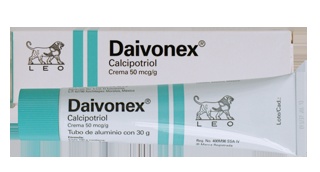
- Страна регистрации
- Форма выпускаCream, 0.005%
- Код АТХD05AX02
- Действующее вещество
- Отпускается по рецептуДа
- Производитель
- Информация на этой странице носит справочный характер и не является медицинской консультацией. Перед началом приема лекарства обязательно проконсультируйтесь с врачом.
- Аналоги DAIVONEXФорма выпуска: Ointment, 0.05 MG/GДействующее вещество: calcipotriolПроизводитель: SANDOZ S.P.A.Отпускается по рецептуФорма выпуска: Ointment, 50 MICROGRAMMI/G + 0,5 MG/GДействующее вещество: calcipotriol, combinationsПроизводитель: MIBE PHARMA ITALIA S.R.L.Отпускается по рецептуФорма выпуска: Ointment, 3 GДействующее вещество: calcipotriol, combinationsПроизводитель: LEO PHARMA A/SОтпускается по рецепту
Аналоги DAIVONEX в других странах
Лекарства с тем же действующим веществом, доступные в других странах.
Аналог DAIVONEX в Испания
Врачи онлайн по DAIVONEX
Обсудите применение DAIVONEX и возможные следующие шаги — по оценке врача.



Получите рецепт на DAIVONEX онлайн
Заполните форму за 2 минуты
Расскажите о симптомах, истории болезни и нужном препарате.
Выберите врача или мы назначим
Выберите специалиста или мы подберём ближайшего доступного врача.
Врач рассматривает ваш случай
Обычно в течение 30 минут. Может задать уточняющие вопросы в чате.
Получите в любой аптеке
Электронный рецепт отправляется на вашу почту — действителен по всей Польше.
Часто задаваемые вопросы
DAIVONEX требует рецепта в Италия. Вы можете уточнить у врача онлайн, подходит ли это лекарство для вашей ситуации.
Действующее вещество DAIVONEX — calcipotriol. Эта информация помогает определить лекарства с тем же составом под другими торговыми названиями.
DAIVONEX производится компанией LEO PHARMA A/S. Упаковка и торговое название могут отличаться в зависимости от дистрибьютора.
Врачи, включая Семейные врачи, Психиатры, Дерматологи, Кардиологи, Эндокринологи, Гастроэнтерологи, Пульмонологи, Нефрологи, Ревматологи, Гематологи, Инфекционисты, Аллергологи, Гериатры, Педиатры, Онкологи, могут оценить целесообразность применения DAIVONEX с учетом вашей ситуации и местных правил. Вы можете записаться на онлайн-консультацию, чтобы обсудить возможные варианты.
Польша имеет хорошо развитую систему здравоохранения в крупных городах, таких как Варшава, Краков, Вроцлав и Гданьск. Аптеки широко доступны и работают в соответствии с действующим законодательством, обеспечивая доступ к рецептурным препаратам.
Вы можете купить DAIVONEX в Варшаве, Кракове, Вроцлаве или Гданьске в любой аптеке при наличии действующего рецепта.
Чтобы получить рецепт, вы можете воспользоваться Oladoctor:
Другие лекарства с тем же действующим веществом (calcipotriol) включают KALKIPOTRIOLO SANDOTS, KALBETA, DOVOBET. Они могут отличаться торговым названием или формой выпуска, но содержат одинаковый терапевтический компонент. Перед изменением лечения рекомендуется проконсультироваться с врачом.
