



CLISMA 133 ML Ректальный раствор

Рассмотрение рецепта онлайн
Врач рассмотрит ваш случай и примет решение о назначении рецепта, если это медицински оправдано.

Поговорите с врачом об этом лекарстве
Обсудите симптомы и возможные дальнейшие шаги на онлайн-консультации.



Инструкция по применению KLISMA LAX
Содержание инструкции
- Clisma lax, rectal solution
- Clisma lax contains methyl parahydroxybenzoate which may cause allergic reactions (also
Clisma lax, rectal solution
Sodium phosphate monobasic anhydrous, sodium phosphate dibasic
Read this leaflet carefully before using this medicine as it contains
important information for you.
Always use this medicine exactly as described in this leaflet or as your doctor
or pharmacist has told you.
- Keep this leaflet. You may need to read it again.
- If you want more information or advice, ask your pharmacist.
- If you experience any side effects, including those not listed in this leaflet, tell your doctor or pharmacist. See section 4.
- See a doctor if your symptoms do not improve or worsen after 7 days of treatment.
Contents of this leaflet:
- 1. What Clisma lax is and what it is used for
- 2. What you need to know before using Clisma lax
- 3. How to use Clisma lax
- 4. Possible side effects
- 5. How to store Clisma lax
- 6. Contents of the pack and other information
1. What is Clisma lax and what is it used for
Clisma lax contains the active ingredients anhydrous monobasic sodium phosphate and sodium phosphate
dibasic, which belong to a group of medicines called osmotic laxatives.
Clisma lax is a highly concentrated rectal solution that works by drawing water to the site
of administration and thus increasing the volume of intestinal contents. This
stimulates peristaltic movements in the intestine and thus promotes the elimination of feces.
Clisma lax is used for short-term treatment of occasional constipation.
Consult your doctor if you do not notice any improvement or if your symptoms worsen after
7 days.
2. What you need to know before using Clisma lax
Do not use Clisma lax:
- if you are allergic to sodium phosphate or any of the other ingredients of this medicine (listed in section 6)
- if you have acute abdominal pain or any pain of unknown origin
- if you have nausea or vomiting
- if you have an obstruction or narrowing (stenosis) of the intestine or the anorectal area
- if you have an intestinal blockage due to a real obstacle (mechanical ileus) or only partial (subocclusive intestinal obstruction)
- if you have an intestinal blockage or impaired normal intestinal emptying (paralytic ileus)
- if you suffer from inflammatory bowel disorders and other conditions that may increase the absorption of the medicine
- if you have a perforation of the anal wall
- if you suffer from specific problems with the intestine (colon anomalies such as Hirschsprung's disease or congenital or acquired megacolon)
- if you suffer from rectal bleeding of unknown cause
- if you have an acute hemorrhoidal crisis with pain and bleeding
- if you are in a severe state of dehydration
- if you suffer from heart disorders or problems
- if you have severe kidney problems (severe renal insufficiency) or have high levels of phosphate in the blood (hyperphosphatemia)
- in children under 12 years of age
- if you are taking other medicines containing sodium phosphate (such as oral solutions or tablets)
Warnings and precautions
Talk to your doctor or pharmacist before using Clisma lax:
- if the need for a laxative is due to a sudden change in previous bowel habits (frequency and characteristics of bowel movements) that lasts for more than two weeks, or when the use of the laxative fails to produce effects
- if you are elderly or in poor health
- if you suffer from high blood pressure, heart problems, an increase in abdominal fluid volume (ascites) or ulcers and fissures of the rectal mucosa
- if you frequently have problems with bowel movements or suffer from chronic constipation.
What you need to know about laxatives:
- the prolonged use of a laxative for the treatment of constipation is not recommended
- to treat constipation, medicines should only be an aid to hygienic-dietary treatment (e.g., increased intake of vegetable fibers and fluids in the diet, regular physical activity)
- you should drink at least 6-8 glasses of water, or other liquids during treatment with laxatives in order to promote softening of the stool
- it is advisable to correct eating habits by integrating more fiber and water into your diet during episodes of constipation.
Abuse of laxatives (frequent or prolonged use or with excessive doses) can cause:
- persistent diarrhea with consequent loss of water, mineral salts and other essential substances
- in the most severe cases, dehydration or severe decrease in blood potassium levels may occur, which can determine heart or nerve and muscle dysfunction, especially if you are simultaneously taking medicines for the heart (digitalis), medicines to increase urine production (diuretics) or corticosteroids (anti-inflammatory drugs)
- a state of dehydration, especially if you are simultaneously taking medicines that modify renal filtration such as diuretics, ACE inhibitors and sartans (drugs to reduce hypertension that act on angiotensin) or NSAIDs (anti-inflammatory drugs)
- an alteration of the levels of some mineral salts in the blood that can manifest with severe kidney problems (renal insufficiency) and muscle stiffness (tetany)
- the need to gradually increase the dosage (dependence)
- chronic constipation
- loss of normal intestinal function (decreased intestinal tone).
Health education notes
First of all, it must be kept in mind that in most cases, a balanced diet rich in water and fiber (bran, vegetables and fruit) can durably solve the problem of constipation.
Many people think they suffer from constipation if they cannot evacuate every day.
This is a mistaken belief, as this situation is perfectly normal for a large number of individuals.
Instead, consider that constipation occurs when bowel movements are reduced compared to one's personal habits and are associated with the passage of hard stools.
Consult your doctor if episodes of constipation occur repeatedly.
Children
Do not use Clisma lax in children under 12 years of age.
Other medicines and Clisma lax
Tell your doctor or pharmacist if you are taking, have recently taken or may take any other medicines.
In particular, tell your doctor before using Clisma lax if you are taking:
- medicines that promote urine elimination (diuretics), medicines based on cortisone (corticosteroids), some medicines that lower blood pressure (calcium antagonists) or medicines based on lithium
- medicines that alter the heart rhythm (prolongation of the QT interval)
- calcium supplements and antacids containing calcium
- other medicines containing sodium phosphate (such as oral solutions or tablets)
Pregnancy and breastfeeding
If you are pregnant, suspect you are pregnant or are planning a pregnancy, or if you are breastfeeding, ask your doctor or pharmacist for advice before using this medicine.
If you are pregnant or breastfeeding, use Clisma lax only if necessary and under direct medical supervision, who will assess whether the benefits to you outweigh the potential risks to the fetus or infant.
Driving and operating machinery
Clisma lax does not impair the ability to drive vehicles and operate machinery.
However, side effects may occur during treatment, so it is advisable to know the reaction to the medicine before driving vehicles or using machinery.
Clisma laxcontains 133 mg per dose of sodium benzoatewhich may cause local irritation.
Clisma lax contains methyl parahydroxybenzoate which may cause allergic reactions (also
delayed).
3. How to use Clisma lax
Use this medicine following exactly as stated in this leaflet or as instructed by your doctor or pharmacist. If you have any doubts, consult your doctor or pharmacist. Do not exceed the recommended doses. Use laxatives occasionally, as infrequently as possible and for no more than 7 days. In case of use for longer periods, contact your doctor who will evaluate whether to continue or not the treatment.
Use in adults and adolescents
The recommended dose is the entire contents of the bottle, preferably in the evening.
Keep in mind that:
- you must not use more than one bottle per day
- each bottle must be used for a single administration: discard any remaining medicine.
- stop administration if you encounter resistance during the introduction of the cannula to avoid causing injury
Instructions for use of Clisma lax
You can administer Clisma lax rectal solution at room temperature, if you prefer a lukewarm solution, place the bottle in contact with warm water by immersing it or
placing it under the tap.
To administer Clisma lax in the best way:
- 1. Lie on your left side (Figure 1), after administering Clisma lax, assume the knee-chest position for a few minutes (Figure 2).
- 2. Remove the cap protecting the rectal cannula (Figure 3).
- 3. Hold the bottle and gently insert the cannula into the rectum (Figure 4) and then press the bottle firmly; some solution will still remain in the bottle. When administering to a child, insert the cannula up to half its length.
- 4. Once administration is complete, remove the cannula and discard the empty bottle in its box (Figure 5).
- 5. Remain lying down until you feel the urge to evacuate, which usually occurs within 5 minutes. In any case, it is not necessary to retain the enema for more than 10-15 minutes.
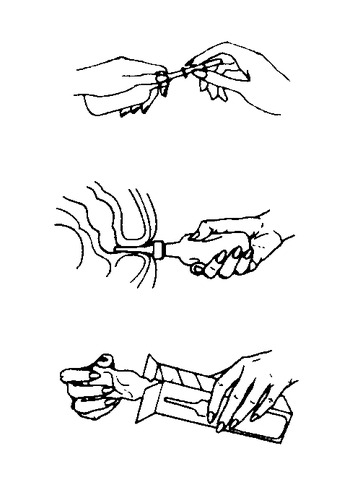

Figure 1 Figure 3
Figure 4

Figure 2
Figure 5
If you use more Clisma lax than you should
In case of ingestion/accidental intake of an excessive dose of Clisma lax, immediately inform your doctor or go to the nearest hospital emergency room.
The side effects that may occur following ingestion or rectal administration:
- abdominal pain
- nausea
- vomiting
- persistent diarrhea with consequent loss of water, mineral salts (especially potassium) and other essential nutrients. These losses must be replenished by drinking water or other liquids. Excessive absorption of phosphate contained in the enema may cause:
- high levels of phosphate in the blood (hyperphosphatemia)
- low levels of calcium in the blood (hypocalcemia)
- low levels of magnesium in the blood (hypomagnesemia)
If you take an excessive dose of Clisma lax, you may experience abdominal pain and diarrhea
and you will need to replenish the loss of fluids and mineral salts (see also paragraph 2
“Warnings and precautions”).
If you forget to use Clisma lax
Do not use a double dose to make up for a missed dose. If you have any doubts
about the use of this medicine, consult your doctor or pharmacist.
4. Possible side effects
Like all medicines, this medicine can cause side effects, although not everybody gets them.
The side effects that may occur with the use of Clisma lax are:
- cramping abdominal pains (isolated)
- non-continuous abdominal pain (abdominal colic)
- diarrhea with loss of fluids and salts, more frequent in cases of severe constipation (difficulty having a bowel movement)
- redness with burning or pain (irritation) at the rectal level
- nausea and vomiting
- hypersensitivity reactions (e.g. urticaria)
- blisters, itching and burning at the skin level
The following side effects occur rarely:
- elevated levels of phosphate in the blood (hyperphosphatemia)
- elevated levels of sodium in the blood (hypernatremia)
- low calcium values in the blood (hypocalcemia)
- low potassium values in the blood (hypopotassemia)
- calcium accumulation (calcification) of tissues
Reporting of side effects
If you experience any side effect, including those not listed in this leaflet,
please inform your doctor or pharmacist. You can also report side effects
directly through the national reporting system at
https://www.aifa.gov.it/content/segnalazioni-reazioni-avverse
By reporting side effects you can help provide more information on the
safety of this medicine.
5. How to store Clisma lax
Keep this medicine out of the sight and reach of children.
Do not use this medicine after the expiry date stated on the packaging after “Expiry”.
The expiry date refers to the last day of that month.
This medicine does not require any particular storage conditions.
Do not dispose of any medicine in wastewater or household waste. Ask your pharmacist
how to dispose of medicines you no longer use. This will help protect the environment.
6. Contents of the pack and other information
What Clisma lax contains
- The active ingredients are anhydrous monobasic sodium phosphate and dibasic sodium phosphate. 100 ml of Clisma lax contains: 13.91 g of anhydrous monobasic sodium phosphate (NaH PO ); 3.18 g of dibasic sodium phosphate (Na HPO ).
- The other ingredients are: sodium hydroxide, sodium benzoate, methylparahydroxybenzoate, purified water.
Description of the appearance of Clisma lax and contents of the pack
Clisma lax is a hyperosmotic rectal solution, clear and colourless, contained in a soft PE bottle of 133 ml or 260 ml.
Clisma lax in a 133 ml bottle is available in packs containing 1, 4 or 20 bottles.
Clisma lax in a 260 ml bottle is available in packs containing 4 bottles.
Not all pack sizes may be marketed.
Marketing Authorisation Holder and Manufacturer
Marketing Authorisation Holder:
Alfasigma S.p.A. - Via Ragazzi del ’99, n. 5 - 40133 Bologna (BO)
Manufacturer:
SOFAR S.p.A. - Via Firenze, n. 40 - 20060 Trezzano Rosa (MI)

Не уверены, подходит ли вам это лекарство?
Обсудите симптомы и варианты лечения с врачом онлайн.

Уже начали прием и появились вопросы?
Обсудите свое состояние и дальнейшие шаги с врачом онлайн.

- Страна регистрации
- Форма выпускаRectal solution, 133 ML
- Код АТХA06AG01
- Действующее вещество
- Отпускается по рецептуНет
- Производитель
- Информация на этой странице носит справочный характер и не является медицинской консультацией. Перед началом приема лекарства обязательно проконсультируйтесь с врачом.
- Аналоги KLISMA LAXФорма выпуска: Rectal solution, 133 MLДействующее вещество: СДинатрийфосфатПроизводитель: CASEN RECORDATI SLОтпускается без рецептаФорма выпуска: Rectal solution, 16,1 G/100 ML + 6 G/100 MLДействующее вещество: СДинатрийфосфатПроизводитель: EUROSPITAL S.P.A.Отпускается без рецептаФорма выпуска: Rectal solution, 16%/6%Действующее вещество: СДинатрийфосфатПроизводитель: AEFFE FARMACEUTICI SRLОтпускается без рецепта
Аналоги KLISMA LAX в других странах
Лекарства с тем же действующим веществом, доступные в других странах.
Аналог KLISMA LAX в Польша
Аналог KLISMA LAX в Испания
Врачи онлайн по KLISMA LAX
Обсудите применение KLISMA LAX и возможные следующие шаги — по оценке врача.









Получите рецепт на KLISMA LAX онлайн
Заполните форму за 2 минуты
Расскажите о симптомах, истории болезни и нужном препарате.
Выберите врача или мы назначим
Выберите специалиста или мы подберём ближайшего доступного врача.
Врач рассматривает ваш случай
Обычно в течение 30 минут. Может задать уточняющие вопросы в чате.
Получите в любой аптеке
Электронный рецепт отправляется на вашу почту — действителен по всей Польше.
Часто задаваемые вопросы
KLISMA LAX не требует рецепта в Италия. Вы можете уточнить у врача онлайн, подходит ли это лекарство для вашей ситуации.
Действующее вещество KLISMA LAX — СДинатрийфосфат. Эта информация помогает определить лекарства с тем же составом под другими торговыми названиями.
KLISMA LAX производится компанией ALFASIGMA S.P.A.. Упаковка и торговое название могут отличаться в зависимости от дистрибьютора.
Врачи, включая Семейные врачи, Психиатры, Дерматологи, Кардиологи, Эндокринологи, Гастроэнтерологи, Пульмонологи, Нефрологи, Ревматологи, Гематологи, Инфекционисты, Аллергологи, Гериатры, Педиатры, Онкологи, могут оценить целесообразность применения KLISMA LAX с учетом вашей ситуации и местных правил. Вы можете записаться на онлайн-консультацию, чтобы обсудить возможные варианты.
Польша имеет хорошо развитую систему здравоохранения в крупных городах, таких как Варшава, Краков, Вроцлав и Гданьск. Аптеки широко доступны и работают в соответствии с действующим законодательством, обеспечивая доступ к рецептурным препаратам.
Вы можете купить KLISMA LAX в Варшаве, Кракове, Вроцлаве или Гданьске в любой аптеке при наличии действующего рецепта.
Чтобы получить рецепт, вы можете воспользоваться Oladoctor:
Другие лекарства с тем же действующим веществом (СДинатрийфосфат) включают KLISMA FLEET, ENEMAK, SODIO FOSFATO AFOM. Они могут отличаться торговым названием или формой выпуска, но содержат одинаковый терапевтический компонент. Перед изменением лечения рекомендуется проконсультироваться с врачом.
