



CLENIL 50 MCG Прессurized ингаляционная суспензия

Рассмотрение рецепта онлайн
Врач рассмотрит ваш случай и примет решение о назначении рецепта, если это медицински оправдано.

Поговорите с врачом об этом лекарстве
Обсудите симптомы и возможные дальнейшие шаги на онлайн-консультации.



Инструкция по применению KLENIL
Содержание инструкции
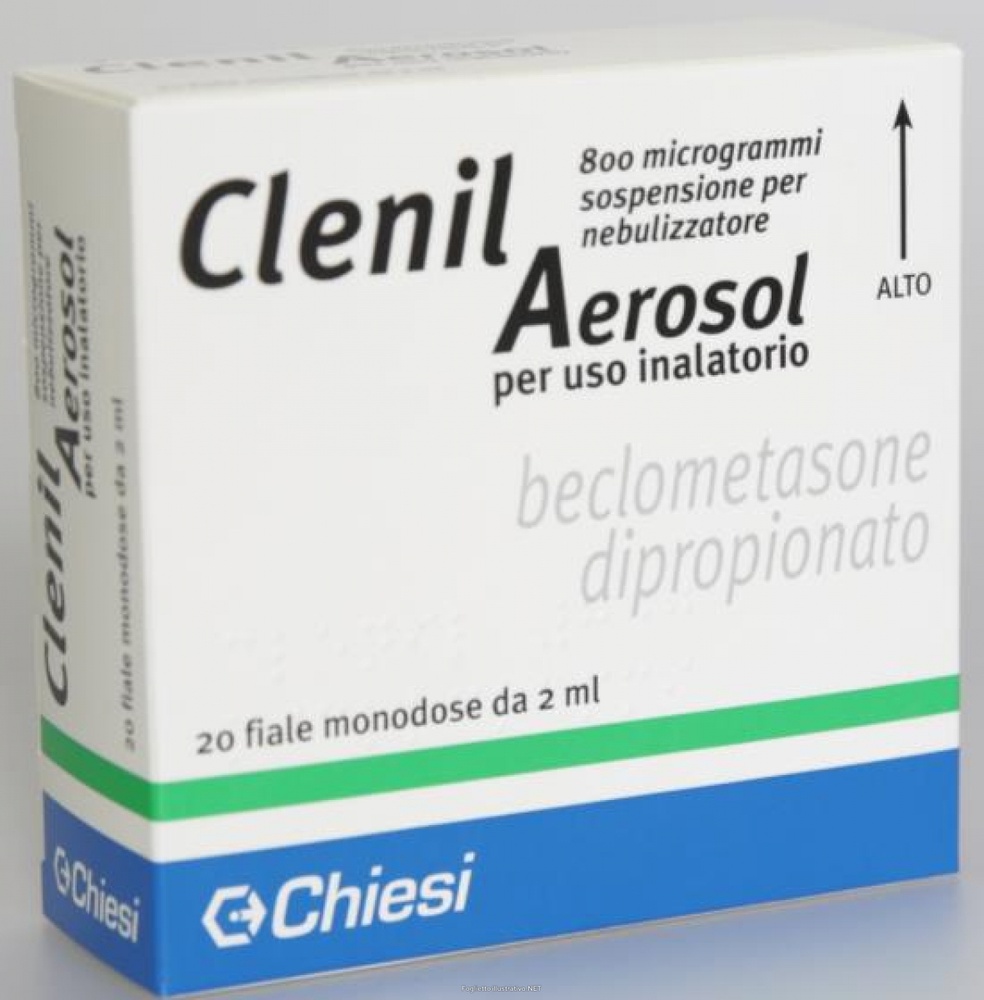
CLENIL 800 micrograms suspension for nebulizer
Beclometasone dipropionate
Read this leaflet carefully before you start to use this medicine as it contains important
information for you.
- Keep this leaflet. You may need to read it again.
- If you have any questions, ask your doctor or pharmacist.
- This medicine has been prescribed for you only. Do not pass it on to others, even if their symptoms are the same as yours, as it could be harmful.
- If you get any side effects, even those not listed in this leaflet, tell your doctor or pharmacist. See section 4.
Contents of this leaflet:
- 1. What CLENIL is and what it is used for
- 2. What you need to know before you use CLENIL
- 3. How to use CLENIL
- 4. Possible side effects
- 5. How to store CLENIL
- 6. Contents of the pack and other information
1. WHAT IS CLENIL AND WHAT IT IS USED FOR
CLENIL contains the active ingredient beclometasone dipropionate. It belongs to a group of
medicines called corticosteroids which have an anti-inflammatory action capable of reducing swelling and
irritation in the walls of the airways (e.g. nose, lungs), thus alleviating respiratory problems.
CLENIL is indicated in the treatment of asthma in adults and children up to 18 years of age when the use of
predosed inhalers or dry powder inhalers is unsatisfactory or inadequate.
CLENIL is also indicated in the treatment of recurrent wheezing (whistling) in children up to 5
years of age.
2. WHAT YOU NEED TO KNOW BEFORE USING CLENIL
Do not use CLENIL:
- if you are allergic to the active substance or to any of the other ingredients of this medicine listed in section 6.
Warnings and precautions
Talk to your doctor or pharmacist before using CLENIL if any of the following conditions
apply to you:
- You have, or have had, treatment for tuberculosis.
- Your condition seems to be getting worse. Your wheezing or shortness of breath seems to be worsening or the inhaler seems less effective.
- The doctor may need to increase the dose of CLENIL, or prescribe a course of corticosteroids in tablet form or change the entire treatment.
- You have a chest infection. The doctor may prescribe a course of antibiotics.
- If you have an infection of the nasal and paranasal cavities, you should be treated with appropriate therapies, although this does not represent a specific contraindication to the use of CLENIL.
- If you experience blurred vision or other visual disturbances.
If you develop an immediate increase in wheezing, shortness of breath and cough after using
CLENIL, stop CLENIL immediately and contact your doctor.
Immediately after inhalation, rinse your mouth with water to reduce the frequency of fungal infections of the
oral cavity.
Switching from corticosteroids in tablet form to CLENIL
Switching from corticosteroids in tablet form to treatment with inhaled corticosteroids
may cause you to feel unwell or you may develop a rash, eczema or runny
nose and sneezing (rhinitis).
If you experience these symptoms, contact your doctor as soon as possible. Do not stop treatment with
CLENIL unless your doctor tells you to.
If you have taken corticosteroids in tablet form at high doses or for a prolonged period of time, the dose
may be gradually reduced, about a week after you have started treatment with CLENIL.
During this period, the doctor will regularly check the steroid levels in your body.
If you have been treated for a prolonged period of time with high doses of inhaled corticosteroids,
you may require additional treatment with corticosteroids during times of stress. For
example:
- during hospitalisation after a serious accident,
- before an operation,
- or if you have a chest infection or other serious illnesses. The doctor will decide if you need a course of corticosteroids in tablet form or, possibly, an injection of corticosteroids and will also advise you on how long you need to take the course of corticosteroids in tablet form and how you should reduce them when you feel better.
Children and adolescents
If the child is under 5 years of age and is using CLENIL for a long time for the treatment of
recurrent wheezing (whistling), the doctor will regularly monitor the child's height to
assess any slowing of growth and interruption of treatment.
Other medicines and CLENIL
Tell your doctor if you are taking or have recently taken any other medicines, including medicines
obtained without a prescription.
Some medicines can increase the effects of CLENIL and the doctor may want to keep you under
close observation if you are taking these medicines (including some medicines for the treatment
of HIV: ritonavir, cobicistat).
Tell your doctor if you are taking, have recently taken or may take any other
medicine containing corticosteroids, as these medicines can interact with CLENIL, worsening
any side effects.
Pregnancy, breastfeeding and fertility
If you are pregnant, suspect or are planning a pregnancy or if you are breastfeeding with breast
milk, ask your doctor or pharmacist for advice before taking this medicine.
Since, during pregnancy, it is not possible to rule out delays in growth or damage to the foetus following
prolonged treatment with corticosteroids (such as beclometasone dipropionate contained in
CLENIL), in these cases the decision to use CLENIL is up to the doctor.
Corticosteroids pass into breast milk in small amounts. To date, no harm has been reported to
babies breastfed with breast milk. However, as a precaution, if high amounts of beclometasone dipropionate are inhaled, it is advisable to avoid breastfeeding for the 4 hours
following administration of the drug.
Driving and operating machinery
It is unlikely that CLENIL can alter the ability to drive and operate machinery. However, if you
experience side effects such as dizziness and/or tremor, your ability to drive or operate
machinery may be affected.
Attention for those who play sports: the product contains substances prohibited for doping. Use
other than as directed, dosage regimen and route of
administration are prohibited.
3. HOW TO USE CLENIL
Use this medicine following the doctor's instructions exactly. If you have any doubts, consult your
doctor or pharmacist.
The initial dose must be prescribed by the doctor according to the frequency and severity of the disease.
The dose may then be adjusted by the doctor until effective control of the
symptoms is achieved.
The recommended starting doses are:
Adults and adolescents (from 12 years of age):
- 800-1600 micrograms twice a day, corresponding to a total daily dose of 1600 or 3200 micrograms.
Children (up to 11 years of age):
400-800 micrograms twice a day, corresponding to a total daily dose of 800 or
1600 micrograms.
Normally, the daily dose of 1600 micrograms in children up to 11 years of age and 3200 micrograms in adults and adolescents should not be exceeded.
In case of asthma, CLENIL should be used regularly on a daily basis. The doctor will decide the
duration of treatment.
If the child suffers from recurrent wheezing (wheezing), the duration of treatment should not exceed
3 months, unless otherwise prescribed by the pediatrician.
The CLENIL 800 microgram vial can be used to obtain 400 micrograms (half of the
contents) using the half-dose line as described below.
Method of administration
CLENIL must be used exclusively by inhalation. Do not inject intravenously or use for
oral use.
CLENIL must be administered by inhalation with a suitable device (pneumatic nebulizer) according to the doctor's instructions.
The use of CLENIL with ultrasonic nebulizers is not recommended.
Instructions for use:
The vial must be used according to the following instructions:
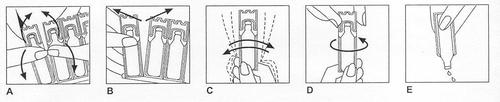
- 1. Bend the vial back and forth to loosen it from the strip (Figure A).
- 2. Carefully separate the vial from the strip, starting from the top, then in the center (Figure B), leaving the other vials in the pouch.
- 3. Shake vigorously and turn the vial upside down to mix the suspension. Repeat this operation until the entire contents are completely dissolved and mixed (Figure C).
- 4. Open the vial by rotating the opening tabs, as indicated by the arrow (Figure D).
- 5. Gently press the vial and pour the contents into the nebulizer ampoule (Figure E).
The vial must be opened immediately before administration.
If only half a dose of CLENIL 800 micrograms is needed, turn the vial upside down, make sure that the
half-dose line is clearly visible and apply slight pressure. While holding the vial pressed, pour out the contents until the suspension level reaches the half-dose line (do not
go beyond). Once half of the contents have been poured, close it with the cap by pressing it
on the vial. The vial closed in this way must be stored at 2◦C-8◦C (in the refrigerator) and the
remaining quantity must be used within 12 hours of the first opening.
Dilution:
The doctor may decide that the dose needs to be diluted.
In this case, empty the contents of the vial into the nebulizer ampoule, then add the
amount of sterile sodium chloride solution 9 mg/ml (0.9%, physiological solution) that the doctor has
prescribed.
Close the ampoule, shake gently to mix the contents.
Dilution of the dose may be necessary to obtain a final volume suitable for the particular
nebulizer used, to help in the administration of small volumes or if a prolonged administration time is preferred.
During nebulization
Position the mask or mouthpiece
Turn on the nebulizer.
Breathe normally. Nebulization should not last more than 10-15 minutes.
After nebulization
Do not forget to rinse your mouth, lips and the area of the face covered by the
mask with water.
After inhalation, any unused suspension remaining in the nebulizer ampoule should be discarded.
Cleaning:
Follow the manufacturer's instructions for cleaning the nebulizer. It is important that the nebulizer
is kept clean.
If you use more CLENIL than you should:
It is important to use the dose as recommended by the doctor. Do not increase or decrease the dose without
consulting the doctor.
If you have used more CLENIL than you should, inform the doctor as soon as possible. The doctor may
decide to check the levels of corticosteroids in the blood and, therefore, a blood sample may be needed.
If you forget to use CLENIL:
If you forget to use a dose, use it as soon as you remember. If it is almost time for the next dose,
do notuse the missed dose, just use the next dose as scheduled. Do not use a double doseto make up for the missed dose.
If you have any doubts about using this medicine, ask your doctor or pharmacist.
4. POSSIBLE SIDE EFFECTS
Like all medicines, this medicine can cause side effects, although not everybody gets them.
The following side effects have been reported. Tell your doctor as soon as possible if you notice any of
these side effects, but do not stop treatment unless you are told to do so. The doctor will try to avoid
these effects by prescribing CLENIL at the lowest effective dose possible.
Very common side effects(may affect more than 1 in 10 people):
- sore throat (pharyngitis, laryngitis). Gargling with water immediately after inhalation may help to prevent this effect.
Common side effects(may affect up to 1 in 10 people):
- cough
- nausea and stomach pain
- thrush in the mouth, tongue and throat. Rinsing your mouth or gargling with water immediately after inhalation may help to prevent these effects.
Uncommon side effects(may affect up to 1 in 100 people):
- headache
- throat irritation, hoarseness
- worsening of shortness of breath, cough and wheezing (known as paradoxical bronchospasm). In this case, do not take another dose of CLENIL. Then contact your doctor immediately. It is likely that the doctor will decide to evaluate asthma or recurrent wheezing and, if necessary, start another course of treatment. You may be told that you should not use CLENIL again
Rare side effects(may affect up to 1 in 1,000 people):
- cold sores (herpes simplex) painful blisters on the lips and in the mouth
- tremor (involuntary shaking)
- fatigue
- allergic reaction (swelling of the eyes, face, lips and throat with resulting severe breathing difficulties, rash, hives, itching or redness).
Side effects with unknown frequency (frequency cannot be estimated from the available
data)
- blurred vision.
The following effects may also occur more likely in children
- Problems with sleeplessness, depression or worry, restlessness, nervousness, overexcitement or irritability.
At high doses for a long period of time, CLENIL may alter the normal production of
corticosteroids in the body. In children and adolescents this can lead to delayed growth,
so it is important that their height is checked regularly by the doctor. Thinning of the bones and
problems with the eyes, such as clouding of the lens of the eye (cataract),
increased pressure in the eye (glaucoma) have been reported.
Reporting of side effects
If you get any side effects, even those not listed in this leaflet, tell your
doctor or pharmacist. You can also report side effects directly through the
national reporting system located at:
http://www.agenziafarmaco.gov.it/content/come-segnalare-una-sospetta-reazione-avversa . By reporting
side effects you can help provide more information on the safety of this
medicine.
5. HOW TO STORE CLENIL
Keep this medicine out of the sight and reach of children.
Do not use CLENIL after the expiry date, which is stated on the package, the sachet and the vial.
Store the vials in an upright position in the original packaging (cardboard box) in order to
protect the medicine from light.
After the first opening of the sachet, write the date in the designated space on the sachet. Do not use the vials
after 3 months from the date of the first opening of the sachet.
After the first opening of the vial, store in a refrigerator (2 C-8 C). The remaining quantity must be
used within 12 hours of the first opening.
Do not use CLENIL if you notice that the packaging is damaged.
Do not dispose of any medicine in wastewater or household waste. Ask your pharmacist how to
dispose of medicines you no longer use. This will help protect the environment.
6. PACKAGE CONTENTS AND OTHER INFORMATION
What CLENIL contains
The active ingredient is beclometasone dipropionate.
Each 2 ml vial contains 800 micrograms of beclometasone dipropionate.
The vial has a half-dose line on one side (corresponding to 400 micrograms).
The other excipients are polysorbate 20, sorbitan laurate, sodium chloride, water for
injections.
Description of the appearance of CLENIL and contents of the pack
CLENIL is a white or almost white suspension for nebuliser.
The CLENIL suspension is supplied in polyethylene vials containing 2 ml (CLENIL 800
micrograms). Strips of 5 vials are packaged in a sealed sachet, in packs of 10 vials (2
sachets), 20 vials (4 sachets) or 40 vials (8 sachets).
Not all pack sizes may be marketed.
Marketing Authorisation Holder
CHIESI FARMACEUTICI S.p.A., Via Palermo 26/A Parma
Manufacturer:
CHIESI FARMACEUTICI S.p.A., Parma Manufacturing Plant, Via S. Leonardo 96
This medicinal product is authorised in the Member States of the European Community with the following
names:
IrelandBeclospin/Becloneb
GermanySanasthmax
GreeceBeclospin/Becloneb
FranceBeclospin
| Italy | Clenil |
By scanning the QR code on the outer packaging with a smartphone, you can
access the video on the authorised instructions for use.
The same information is also available at the following URL:
https://videoistruzioniduso.chiesi.it/C800
CLENIL 400 micrograms suspension for nebulizer
Beclometasone dipropionate
Read this leaflet carefully before using this medicine as it contains important
information for you.
- Keep this leaflet. You may need to read it again.
- If you have any questions, ask your doctor or pharmacist.
- This medicine has been prescribed for you only. Do not pass it on to others, even if they have the same symptoms as you, as it may be harmful.
- If you get any side effects, even those not listed in this leaflet, tell your doctor or pharmacist. See section 4.
Contents of this leaflet:
- 1. What CLENIL is and what it is used for
- 2. What you need to know before you use CLENIL
- 3. How to use CLENIL
- 4. Possible side effects
- 5. How to store CLENIL
- 6. Contents of the pack and other information
1. WHAT IS CLENIL AND WHAT IS IT USED FOR
CLENIL contains the active ingredient beclometasone dipropionate. It belongs to a group of
medicines called corticosteroids which have an anti-inflammatory action capable of reducing swelling and
irritation in the walls of the airways (e.g. nose, lungs), thus alleviating breathing problems.
CLENIL is indicated in the treatment of asthma in adults and children up to 18 years of age when the use of
predosed inhalers or dry powder inhalers is unsatisfactory or inadequate.
CLENIL is also indicated in the treatment of recurrent wheezing in children up to 5 years of age.
2. WHAT YOU NEED TO KNOW BEFORE USING CLENIL
Do not use CLENIL:
- if you are allergic to the active substance or to any of the other ingredients of this medicine listed in section 6.
Warnings and precautions
Talk to your doctor or pharmacist before using CLENIL if any of the following conditions
apply to you:
- You are, or have been, undergoing treatment for tuberculosis.
- Your condition seems to be getting worse. Your wheezing or shortness of breath seems to be worsening or the inhaler seems less effective.
- The doctor may need to increase the dose of CLENIL, or prescribe a course of corticosteroid tablets or change the entire treatment.
- You have a chest infection. The doctor may prescribe a course of antibiotics.
- If you have an infection of the nasal and paranasal cavities, it must be treated with appropriate therapies, although this does not represent a specific contraindication to the use of CLENIL.
- If you experience blurred vision or other visual disturbances.
If you develop an immediate increase in wheezing, shortness of breath and cough after using
CLENIL, stop CLENIL immediately and contact your doctor.
Immediately after inhalation, rinse your mouth with water to reduce the frequency of fungal infections in the
oral cavity.
Switching from corticosteroid tablets to CLENIL
Switching from corticosteroid tablets to treatment with inhaled corticosteroids
may cause you to feel unwell or you may develop a rash, eczema or runny
nose and sneezing (rhinitis).
If you experience these symptoms, contact your doctor as soon as possible. Do not stop treatment with
CLENIL unless your doctor tells you to.
If you have taken corticosteroid tablets at high doses or for a prolonged period, the dose
may be gradually reduced, about a week after you have started treatment with CLENIL.
During this period, the doctor will regularly check the steroid levels in your body.
If you have been treated for a prolonged period with high doses of inhaled corticosteroids,
you may require additional treatment with corticosteroids during times of stress. For
example:
- during hospitalisation after a serious accident,
- before an operation,
- or if you have a chest infection or other serious illnesses. The doctor will decide if you need a course of corticosteroid tablets or, possibly, an injection of corticosteroids and will also advise you how long you need to take the course of corticosteroid tablets and how you should reduce them when you feel better.
Children and adolescents
If the child is under 5 years of age and has been using CLENIL for a long time for the treatment of
recurrent wheezing (whistling), the doctor will regularly monitor the child's height to
assess any slowing of growth and interruption of treatment.
Other medicines and CLENIL
Tell your doctor if you are taking or have recently taken any other medicines, including medicines
obtained without a prescription.
Some medicines can increase the effects of CLENIL and the doctor may want to keep you under
close observation if you are taking these medicines (including some medicines for the treatment
of HIV: ritonavir, cobicistat).
Tell your doctor if you are taking, have recently taken or may take any other
medicine containing corticosteroids, as these drugs can interact with CLENIL, worsening
any side effects.
Pregnancy, breastfeeding and fertility
If you are pregnant, suspect you are pregnant or are planning a pregnancy, or if you are breastfeeding,
ask your doctor or pharmacist for advice before taking this medicine.
Since, during pregnancy, it is not possible to exclude delays in fetal growth or damage to the fetus following
prolonged treatment with corticosteroids (such as beclometasone dipropionate contained in
CLENIL), in these cases the decision to use CLENIL rests with the doctor.
Corticosteroids pass into breast milk in small amounts. To date, no harm has been reported to
babies breastfed by mothers taking beclometasone dipropionate. However, as a precaution, if high amounts of beclometasone dipropionate are inhaled, it is advisable to avoid breastfeeding for the 4
hours following administration of the drug.
Driving and operating machinery
It is unlikely that CLENIL will impair your ability to drive or operate machinery. However, if you
experience side effects such as dizziness and/or tremor, your ability to drive or operate
machinery may be affected.
Caution for those who engage in sports activities: the product contains substances prohibited for doping. Use other than as indicated therapeutically, according to the dosage scheme and route of
administration, is prohibited.
3. HOW TO USE CLENIL
Use this medicine following exactly the instructions of your doctor. If you have any doubts, consult your
doctor or pharmacist.
The initial dose must be prescribed by the doctor according to the frequency and severity of the disease.
The dose may then be adjusted by the doctor until effective control of the
symptoms is achieved.
The recommended initial doses are:
Adults and adolescents (from 12 years of age):
- 800 micrograms twice a day, corresponding to a total daily dose of 1600 micrograms.
Children (up to 11 years of age):
400 micrograms twice a day, corresponding to a total daily dose of 800 micrograms.
Normally, the daily dose of 1600 micrograms in children up to
11 years of age and 3200 micrograms in adults and adolescents should not be exceeded.
In case of asthma, CLENIL must be used regularly on a daily basis. The doctor will decide the
duration of treatment.
If the child suffers from recurrent wheezing, the duration of treatment should not exceed 3 months,
unless otherwise prescribed by the pediatrician.
Method of administration
CLENIL must be used exclusively by inhalation. Do not inject intravenously or use for
oral use.
CLENIL must be administered by inhalation with a suitable device (pneumatic nebulizer) according to the doctor's instructions.
The use of CLENIL with ultrasonic nebulizers is not recommended.
Instructions for use:
The vial must be used according to the following instructions:
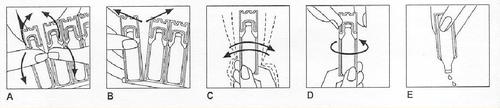
- 1. Bend the vial back and forth to detach it from the strip (Figure A).
- 2. Carefully separate the vial from the strip, starting from the top, then in the center (Figure B), leaving the other vials in the pouch.
- 3. Shake vigorously and turn the vial upside down, so as to mix the suspension. Repeat this operation until the entire content is completely dissolved and mixed (Figure C).
- 4. Open the vial by rotating the opening tabs, as indicated by the arrow (Figure D).
- 5. Gently press the vial and pour the contents into the nebulizer ampoule (Figure E).
The vial must be opened immediately before administration.
The 400 microgram vial is for single use.
Dilution:
The doctor may decide that the dose needs to be diluted.
In this case, empty the contents of the vial into the nebulizer ampoule, then add the
amount of sterile sodium chloride solution 9 mg/ml (0.9%, saline solution) that your doctor has prescribed.
Close the ampoule, shake gently to mix the contents.
Dilution of the dose may be necessary to obtain a final volume suitable for the particular
nebulizer used, to help in the administration of small volumes or if a prolonged administration time is preferred.
During nebulization
Position the mask or mouthpiece
Turn on the nebulizer.
Breathe normally. The nebulization should not last more than 10-15 minutes.
After nebulization
Do not forget to rinse your mouth, lips and the area of the face covered by the
mask with water.
After inhalation, any unused suspension remaining in the nebulizer ampoule
must be discarded.
Cleaning:
To clean the nebulizer, follow the manufacturer's instructions. It is important that the nebulizer
is kept clean.
If you use more CLENIL than you should:
It is important to use the dose as recommended by your doctor. Do not increase or decrease the dose without
consulting your doctor.
If you have used more CLENIL than you should, inform your doctor as soon as possible. The doctor may
decide to check the levels of corticosteroids in the blood and, therefore, a blood sample may be necessary.
If you forget to use CLENIL:
If you forget to use a dose, use it as soon as you remember. If it is almost time for the next dose,
do notuse the missed dose, just use the next dose when scheduled. Do not use a double
doseto make up for the missed dose.
If you have any doubts about the use of this medicine, ask your doctor or pharmacist.
4. POSSIBLE SIDE EFFECTS
Like all medicines, this medicine can cause side effects, although not everybody gets them.
The following side effects have been reported. Tell your doctor as soon as possible if you notice any of
these side effects, but do not stop treatment unless your doctor tells you to.
The doctor will try to avoid these effects by prescribing CLENIL at the lowest effective dose
possible.
Very common side effects(may affect more than 1 in 10 people):
- sore throat (pharyngitis, laryngitis). Gargling with water immediately after inhalation can help to prevent this effect.
Common side effects(may affect up to 1 in 10 people):
- cough
- nausea and stomach discomfort
- thrush in the mouth, tongue and throat. Rinsing your mouth or gargling with water immediately after inhalation can help to prevent these effects.
Uncommon side effects(may affect up to 1 in 100 people):
- headache
- throat irritation, hoarseness
- worsening of shortness of breath, cough and wheezing (known as paradoxical bronchospasm). In this case, do not take another dose of CLENIL. Then contact your doctor immediately. It is likely that the doctor will decide to evaluate asthma or recurrent wheezing and, if necessary, start another course of treatment. You may be told that you should not use CLENIL again.
- blurred vision.
Rare side effects(may affect up to 1 in 1,000 people):
- cold sores (herpes simplex) painful blisters on the lips and in the mouth
- tremor (shaking)
- fatigue
- allergic reaction (swelling of the eyes, face, lips and throat with resulting severe breathing difficulties, rash, hives, itching or redness).
The following effects may also occur more likely in children
- Problems with sleep, depression or worry, restlessness, nervousness, overexcitement or irritability.
At high doses for a long period of time, CLENIL can alter the normal production of
corticosteroids in the body. This in children and adolescents can lead to delayed growth,
so it is important that their height is checked regularly by the doctor. Thinning of the bones and problems with the eyes, such as clouding of the lens of the eye (cataract),
increased pressure in the eye (glaucoma) have been reported.
Reporting of side effects
If you get any side effects, even those not listed in this leaflet, tell your
doctor or pharmacist. You can also report side effects directly through
the national reporting system at:
http://www.agenziafarmaco.gov.it/content/come-segnalare-una-sospetta-reazione-avversa . By reporting
side effects you can help provide more information on the safety of this
medicine.
5. HOW TO STORE CLENIL
Keep this medicine out of the sight and reach of children.
Do not use CLENIL after the expiry date, which is stated on the package, the sachet and the vial.
Store the vials in an upright position in the original packaging (cardboard box) in order to
protect the medicine from light.
After the first opening of the sachet, write the date in the appropriate space on the sachet. Do not use the vials
after 3 months from the date of the first opening of the sachet.
Do not use CLENIL if you notice that the packaging is damaged.
Do not dispose of any medicine in wastewater or household waste. Ask your pharmacist how to
dispose of medicines you no longer use. This will help protect the environment.
6. CONTENTS OF THE PACK AND OTHER INFORMATION
What CLENIL contains
The active ingredient is beclometasone dipropionate.
Each 1 ml vial contains 400 micrograms of beclometasone dipropionate.
The other excipients are polysorbate 20, sorbitan laurate, sodium chloride, water for
injections.
Description of the appearance of CLENIL and contents of the pack
CLENIL is a white to almost white suspension for nebulizer.
The CLENIL suspension is supplied in polyethylene vials containing 1 ml (CLENIL 400
micrograms). Strips of 5 vials are packaged in a sealed sachet, in packs of 10 vials (2
sachets), 20 vials (4 sachets) or 40 vials (8 sachets).
Not all pack sizes may be marketed.
Marketing Authorisation Holder
CHIESI FARMACEUTICI S.p.A., Via Palermo 26/A Parma
Manufacturer:
CHIESI FARMACEUTICI S.p.A., Parma Manufacturing Plant, Via S. Leonardo 96
This medicinal product is authorised in the Member States of the European Community under the following
names:
IrelandBeclospin/Becloneb
GermanySanasthmax
GreeceBeclospin/Becloneb
FranceBeclospin
ItalyClenil
.

Не уверены, подходит ли вам это лекарство?
Обсудите симптомы и варианты лечения с врачом онлайн.

Уже начали прием и появились вопросы?
Обсудите свое состояние и дальнейшие шаги с врачом онлайн.
- Страна регистрации
- Форма выпускаPressurized inhalation suspension, 50 MCG
- Код АТХR03BA01
- Действующее вещество
- Отпускается по рецептуНет
- Производитель
- Информация на этой странице носит справочный характер и не является медицинской консультацией. Перед началом приема лекарства обязательно проконсультируйтесь с врачом.
- Аналоги KLENILФорма выпуска: Pressurized solution for inhalation, 50 MICROGRAMSДействующее вещество: beclometasoneПроизводитель: DOC GENERICI SRLОтпускается по рецептуФорма выпуска: Nebulizable suspension, 800 MICROGRAMMIДействующее вещество: beclometasoneПроизводитель: MASTER PHARMA S.R.L.Отпускается без рецептаФорма выпуска: Pressurized suspension for inhalation, 50 MICROGRAMSДействующее вещество: beclometasoneПроизводитель: MENARINI INTERNATIONAL OPERATIONS LUXEMBOURG S.A.Отпускается без рецепта
Аналоги KLENIL в других странах
Лекарства с тем же действующим веществом, доступные в других странах.
Аналог KLENIL в Польша
Аналог KLENIL в Украина
Аналог KLENIL в Испания
Врачи онлайн по KLENIL
Обсудите применение KLENIL и возможные следующие шаги — по оценке врача.









Получите рецепт на KLENIL онлайн
Заполните форму за 2 минуты
Расскажите о симптомах, истории болезни и нужном препарате.
Выберите врача или мы назначим
Выберите специалиста или мы подберём ближайшего доступного врача.
Врач рассматривает ваш случай
Обычно в течение 30 минут. Может задать уточняющие вопросы в чате.
Получите в любой аптеке
Электронный рецепт отправляется на вашу почту — действителен по всей Польше.
Часто задаваемые вопросы
KLENIL не требует рецепта в Италия. Вы можете уточнить у врача онлайн, подходит ли это лекарство для вашей ситуации.
Действующее вещество KLENIL — beclometasone. Эта информация помогает определить лекарства с тем же составом под другими торговыми названиями.
KLENIL производится компанией CHIESI FARMACEUTICI S.P.A.. Упаковка и торговое название могут отличаться в зависимости от дистрибьютора.
Врачи, включая Семейные врачи, Психиатры, Дерматологи, Кардиологи, Эндокринологи, Гастроэнтерологи, Пульмонологи, Нефрологи, Ревматологи, Гематологи, Инфекционисты, Аллергологи, Гериатры, Педиатры, Онкологи, могут оценить целесообразность применения KLENIL с учетом вашей ситуации и местных правил. Вы можете записаться на онлайн-консультацию, чтобы обсудить возможные варианты.
Польша имеет хорошо развитую систему здравоохранения в крупных городах, таких как Варшава, Краков, Вроцлав и Гданьск. Аптеки широко доступны и работают в соответствии с действующим законодательством, обеспечивая доступ к рецептурным препаратам.
Вы можете купить KLENIL в Варшаве, Кракове, Вроцлаве или Гданьске в любой аптеке при наличии действующего рецепта.
Чтобы получить рецепт, вы можете воспользоваться Oladoctor:
Другие лекарства с тем же действующим веществом (beclometasone) включают BEKLOMETASONE DOK JENERIKI, BEKLONEB, BEKOTIDE. Они могут отличаться торговым названием или формой выпуска, но содержат одинаковый терапевтический компонент. Перед изменением лечения рекомендуется проконсультироваться с врачом.
